The Late Period
~664 – ~332 BCEDynasties 26–31
5 chapters · 20 min read · 43 sources
~664 BCE
Introduction
1 min readThe Late Period of Egypt refers to the last flowering of native Egyptian rulers after the Third Intermediate Period in the 26th Saite Dynasty founded by Psamtik I, but includes the time of Achaemenid rule over Egypt…The Late Period of Egypt refers to the last flowering of native Egyptian rulers after the Third Intermediate Period in the 26th Saite Dynasty founded by Psamtik I, but includes the time of Achaemenid rule over Egypt after the conquest by Cambyses II in 525 BC. The Late Period existed from 664 BC until 332 BC, following a period of foreign rule by the Nubian 25th Dynasty and beginning with a short period of Neo-Assyrian suzerainty, with Psamtik I initially ruling as their vassal. The period ended with the conquests of the Achaemenid Empire by Alexander the Great and the establishment of the Ptolemaic dynasty by his general Ptolemy I Soter, one of the Hellenistic diadochi from Macedon in northern Greece. With the Macedonian Greek conquest in the latter half of the 4th century BC, the age of Hellenistic Egypt began.
History
5 min readThe Twenty-Sixth Dynasty, also known as the Saite Dynasty, after its seat of power the city of Sais, reigned from 672 to 525 BC, and consisted of six pharaohs. It started with the unification of Egypt under Psamtik I in…26th Dynasty
The Twenty-Sixth Dynasty, also known as the Saite Dynasty, after its seat of power the city of Sais, reigned from 672 to 525 BC, and consisted of six pharaohs. It started with the unification of Egypt under Psamtik I in 656/655 BC, itself a direct consequence of the Sack of Thebes by the Assyrians in 663 BC. Canal construction from the Nile to the Red Sea began.
Egypt seems to have expanded into the Near East early in this period. They conquered the city of Ashdod around 655 BC, and a wide range of archaeological finds from throughout the Levant shows an Egyptian occupation and control in the late decades of the 7th century BC. These include various Egyptian objects from several sites, ostraca and documents showing a tribute/tax system, and evidence from the fortress of Mezad Hashavyahu. Egyptian influence reached to the Euphrates area in places such as Kimuhu and Quramati. Later they were pushed back by the defeat at Carcemish, although Egyptian intervention in the Near East seems to have continued for a while after this battle.
In 570 BC, Apries (Hophra) was deposed by Amasis II, who replaced him as Pharaoh of Egypt. In Amasis' fourth year, around 568–567 BC, Egypt was invaded by the Babylonians, under the leadership of Nebuchadnezzar II. This assault was recorded by a fragmentary Babylonian inscription, as well as a fragmentary stele of Amasis from the 4th year of his reign in 567 BC, which may describe a combined naval and land attack by the Babylonians. Recent evidence suggests that the Babylonians were initially successful during the invasion and gained a foothold in Egypt, but they were repelled by Amasis' forces. It is believed that this forced Nebuchadnezzar II to retire plans to conquer Egypt.
Amasis II followed a new policy and directed his interests toward the Greek world. He annexed Cyprus during his reign. To the south, Psamtik II led a great military expedition that reached deep into upper Nubia and inflicted a heavy defeat on them. A demotic papyrus from the reign of Ahmose II describes a small expedition into Nubia, the character of which is unclear. There is archaeological evidence of an Egyptian garrison at Dorginarti in lower Nubia during the Saite period.
One major contribution from the Late Period of ancient Egypt was the Brooklyn Medical Papyrus. This was a medical papyrus with a collection of medical and magical remedies for victims of snakebites based on snake type or symptoms.
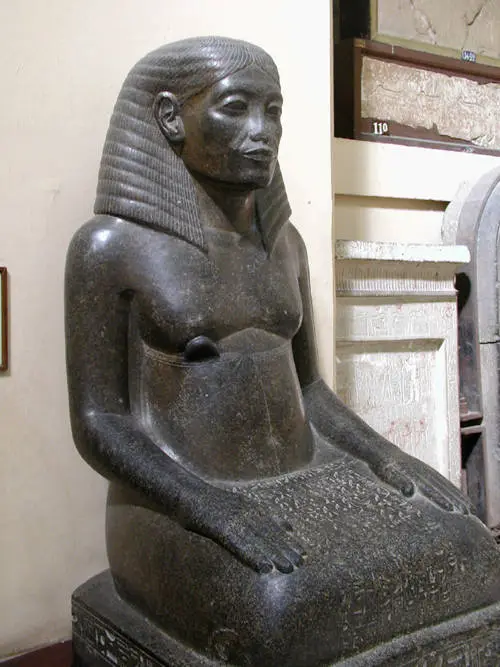
Artwork during this time was representative of animal cults and animal mummies.
27th Dynasty
The First Achaemenid Period (525–404 BC) began with the Battle of Pelusium, which saw Egypt ( Mudrāya) conquered by the expansive Achaemenid Empire under Cambyses, and Egypt become a satrapy. The Persians came to dominate Egypt, but Egypt remained independent until it was made a Persian province in 485 B.C., after a revolt. The Twenty-seventh Dynasty of Egypt consists of the Persian emperors - including Cambyses, Xerxes I, and Darius the Great - who ruled Egypt as Pharaohs and governed through their satraps, as well as the Egyptian Petubastis III (522–520 BC) (and possibly the disputed Psammetichus IV), who rebelled in defiance of the Persian authorities. The unsuccessful revolt of Inaros II (460–454), aided by the Athenians as part of the Wars of the Delian League, aspired to the same object. The Persian satraps were Aryandes (525–522 BC; 518–c.496 BC) - whose rule was interrupted by the rebel Pharaoh Petubastis III, Pherendates (c.496–c.486 BC), Achaemenes (c.486–459 BC) - a brother of the emperor Xerxes I, and Arsames (c.454–c.406 BC).
28th–30th Dynasties
The Twenty-Eighth Dynasty consisted of a single king, Amyrtaeus, prince of Sais, who successfully rebelled against the Persians, inaugurating Egypt's last significant phase of independence under native sovereigns. He left no monuments with his name. This dynasty reigned for six years, from 404 BC–398 BC.
The Twenty-Ninth Dynasty ruled from Mendes, for the period from 398 to 380 BC. King Hakor of this dynasty was able to defeat a Persian invasion during his reign.
The Thirtieth Dynasty took their art style from the Twenty-Sixth Dynasty. A series of three Pharaohs ruled from 380 to 343 BC. The first king of the dynasty, Nectanebo I, defeated a Persian invasion in 373 BC. His successor, Teos, subsequently led an expedition against the Achaemenid Empire in the Near East. The expedition was beginning to meet with some success, and made its way to Phoenicia without any particular problems. Unfortunately for Teos, his brother, Tjahapimu, was plotting against him. Tjahapimu convinced his son, Nectanebo II, to rebel against Teos and to make himself Pharaoh. The plan was successful and the betrayed Teos had no alternative but to flee, and the expedition disintegrated. The final ruler of this dynasty, and the final native ruler of Egypt, was Nectanebo II who was defeated in battle, leading to the re-annexation of Egypt by the Achaemenid Empire.
31st Dynasty
The Second Achaemenid Period saw the re-inclusion of Egypt as a satrapy of the Persian Empire under the rule of the Thirty-First Dynasty, (343–332 BC) which consisted of three Persian emperors who ruled as Pharaoh—Artaxerxes III (343–338 BC), Artaxerxes IV (338–336 BC), and Darius III (336–332 BC)—interrupted by the revolt of the non-Achaemenid Khababash (338–335 BC).
32nd Dynasty
Persian rule in Egypt ended with the defeat of the Achaemenid Empire by Alexander the Great, who accepted the surrender of the Persian satrap of Egypt Mazaces in 332 BC. This marked the beginning of Hellenistic rule in Egypt, with Alexander appointing Cleomenes of Naucratis as its overseer (possibly with the title satrap). Cleomenes's oversight lasted until Alexander's death, which was followed after a short interval by the 33rd dynasty, generally known as the Ptolemaic Kingdom.
~612 BCE
Twenty-sixth Dynasty of Egypt
5 min readThe Twenty-sixth Dynasty of Egypt (notated Dynasty XXVI, alternatively 26th Dynasty or Dynasty 26) was the last native dynasty of ancient Egypt before the Persian conquest in 525 BC (although other brief periods of rule…The Twenty-sixth Dynasty of Egypt (notated Dynasty XXVI, alternatively 26th Dynasty or Dynasty 26) was the last native dynasty of ancient Egypt before the Persian conquest in 525 BC (although other brief periods of rule by Egyptians followed). The dynasty's reign (664–525 BC) is also called the Saite Period after the city of Sais, where its pharaohs had their capital, and marks the beginning of the Late Period of ancient Egypt.
History
This dynasty traced its origins to the Twenty-fourth Dynasty. Psamtik I was probably a descendant of Bakenranef. However, other sources describe him as of Libyan descent.
Following the Neo-Assyrian conquest of Egypt during the reigns of Taharqa and Tantamani, and the subsequent collapse of the Napata-based Twenty-fifth Dynasty of Egypt, Psamtik I was recognized as sole king over all of Egypt. Psamtik formed alliances with King Gyges of Lydia, who sent him mercenaries from Caria and ancient Greece that Psamtik used to unify all of Egypt under his rule.
With the sack of Nineveh in 612 BC and the Fall of the Neo-Assyrian Empire, both Psamtik and his successors attempted to reassert Egyptian power in the Near East but were driven back by the Neo-Babylonian Empire under Nebuchadnezzar II. With the help of Greek mercenaries, Pharaoh Apries was able to hold back Babylonian attempts to conquer Egypt, although Apries was later deposed by Amasis II in 570 BC, who became the next Pharaoh of Egypt.
In Amasis' fourth year, around 568–567 BC, Egypt was invaded by the Babylonians, under the leadership of Nebuchadnezzar II. This assault was recorded by a fragmentary Babylonian inscription, with the modern designation BM 33041; the inscription from that year records the word "Egypt" as well as possible traces of the name "Amasis". A stele of Amasis from the 4th year of his reign in 567 BC, also fragmentary, may also describe a combined naval and land attack by the Babylonians. Recent evidence suggests that the Babylonians were initially successful during the invasion and gained a foothold in Egypt, but they were repelled by Amasis' forces. It is believed that this forced Nebuchadnezzar II to retire plans to conquer Egypt. (However, some have suggested that Nebuchadnezzar came to defeat Apries, with the combined forces of Amasis and Nebuchadnezzar managing to kill him, securing Amasis' throne, though as vassal king.)
The Persians would eventually invade Egypt in 525 BCE when Emperor Cambyses II captured and later executed Psamtik III in the First Achaemenid conquest of Egypt, marking the end of the last native dynasty of Egypt. Cambyses founded the First Egyptian Satrapy, a territory of the Achaemenid Empire, and was crowned the first Pharaoh of the Dynasty XXVII.
Archaeology
In May 2020, an Egyptian-Spanish archaeological mission headed by Esther Ponce revealed a unique cemetery, which consists of one room built with glazed limestone dating back to the 26th Dynasty (also known as the El-Sawi era) at the site of ancient Oxyrhynchus. Archaeologists also uncovered bronze coins, clay seals, Roman tombstones and small crosses. On October 3, 2020, Egypt unveiled 59 coffins of priests and clerks from the 26th dynasty, dating to nearly 2,500 years ago.
Art
Pharaohs of the 26th Dynasty
The 26th Dynasty may be related to the 24th Dynasty. Manetho begins the dynasty with:
When the Nubian King Shabaka defeated Bakenranef, son of Tefnakht, he likely installed a Nubian commander as governor at Sais. This may be the man named Ammeris. Stephinates may be a descendant of Bakenrenef. He is sometimes referred to as Tefnakht II in the literature. Nechepsos has been identified with a local king named Nekauba (678–672 BC). Manetho's Necho is King Necho I (672–664 BC); Manetho gives his reign as 8 years. Necho was killed during a conflict with the Nubian king Tantamani. Psamtik I fled to Nineveh – capital of the Neo-Assyrian Empire – and returned to Egypt when Ashurbanipal defeated Tantamani and drove him back south. Scholars now start the 26th Dynasty with the reign of Psamtik I.
Sextus Julius Africanus states in his often accurate version of Manetho's Epitome that the dynasty numbered nine pharaohs, beginning with a "Stephinates" (Tefnakht II) and ending with Psamtik III. Africanus also notes that Psamtik I and Necho I ruled for 54 and 8 years respectively.
Timeline of the 26th Dynasty
ImageSize = width:800 height:auto barincrement:12 PlotArea = top:100 bottom:100 right:100 left:100 AlignBars = early
DateFormat = yyyy Period = from:-664 till:-500 TimeAxis = orientation:horizontal ScaleMajor = unit:year increment:10 start:-664
Colors = id:canvas value:rgb(0.97,0.97,0.97) id:PA value:green id:GP value:red
Backgroundcolors = canvas:canvas
BarData = barset:Rulers
PlotData= width:5 align:left fontsize:S shift:(5,-4) anchor:till barset:Rulers
from: -664 till: -610 color:PA text:"Psamtik I (664–610 BC)" from: -610 till: -595 color:PA text:"Necho II (610–595 BC)" from: -595 till: -589 color:PA text:"Psamtik II (595–589 BC)" from: -589 till: -570 color:PA text:"Wahibre Haaibre (589–570 BC)" from: -570 till: -526 color:PA text:"Amasis II (570–526 BC)" from: -526 till: -525 color:PA text:"Psamtik III (526–525 BC)" barset:skip
~525 BCE
Twenty-seventh Dynasty of Egypt
6 min readThe Twenty-seventh Dynasty of Egypt (notated Dynasty XXVII, alternatively 27th Dynasty or Dynasty 27), also known as the First Egyptian Satrapy, was a satrapy of the Achaemenid Empire between 525 and 404 BC. It was…The Twenty-seventh Dynasty of Egypt (notated Dynasty XXVII, alternatively 27th Dynasty or Dynasty 27), also known as the First Egyptian Satrapy, was a satrapy of the Achaemenid Empire between 525 and 404 BC. It was founded by Cambyses II, the King of Persia, after the Battle of Pelusium (525 BC) and the Achaemenid conquest of Egypt, and his subsequent crowning as Pharaoh of Egypt. It was disestablished upon the rebellion and crowning of Amyrtaeus as Pharaoh. A second period of Achaemenid rule in Egypt occurred under the Thirty-first Dynasty of Egypt (343–332 BC).
History
The last pharaoh of the Twenty-sixth Dynasty of Egypt, Psamtik III, was defeated by Cambyses II at the Battle of Pelusium in the eastern Nile Delta in May of 525. Cambyses was crowned pharaoh in the summer of that year at the latest, beginning the first period of Persian rule over Egypt, known as the 27th Dynasty. Egypt was then joined with Cyprus and Phoenicia to form the sixth satrapy of the Achaemenid Empire, with Aryandes as the local satrap (provincial governor).
As Pharaoh of Egypt, Cambyses' reign saw the fiscal resources of traditional Egyptian temples diminished considerably. One decree, written on papyrus in demotic script, ordered a limitation on resources to all Egyptian temples, excluding Memphis, Heliopolis and Wenkhem (near Abusir). Cambyses left Egypt sometime in early 522 BC, dying en route to Persia, and was nominally succeeded briefly by his younger brother Bardiya, although contemporary historians suggest Bardiya was actually Gaumata, an impostor, and that the real Bardiya had been murdered some years before by Cambyses, ostensibly out of jealousy. Darius I, suspecting this impersonation, led a coup against "Bardiya" in September of that year, overthrowing him and being crowned as King and Pharaoh the next morning.
As the new Persian King, Darius spent much of his time quelling rebellions throughout his empire. Sometime in late 522 BC or early 521 BC, a local Egyptian prince led a rebellion and declared himself Pharaoh Petubastis III. The main cause of this rebellion is uncertain, but the Ancient Greek military historian Polyaenus states that it was oppressive taxation imposed by the satrap Aryandes. Polyaenus further writes that Darius himself marched to Egypt, arriving during a period of mourning for the death of the sacred Herald of Ptah bull. Darius made a proclamation that he would award a sum of one hundred talents to the man who could produce the next Herald, impressing the Egyptians with his piety such that they flocked en masse to his side, ending the rebellion.
Darius took a greater interest in Egyptian internal affairs than Cambyses. He reportedly codified the laws of Egypt, and notably completed the excavation of a canal system at Suez, allowing passage from the Bitter Lakes to the Red Sea, much preferable to the arduous desert land route. This feat allowed Darius to import skilled Egyptian laborers and artisans to construct his palaces in Persia. The result of this was a minor brain drain in Egypt, due to the loss of these skilled individuals, creating a demonstrable lowering of quality in Egyptian architecture and art from this period. Nevertheless, Darius was more devoted to supporting Egyptian temples than Cambyses, earning himself a reputation for religious tolerance in the region. In 497 BC, during a visit by Darius to Egypt, Aryandes was executed for treason, most likely for attempting to issue his own coinage, a visible attempt to distance Egypt from the rest of the Persian Empire. Darius died in 486 BC, and was succeeded by Xerxes I.
Upon the accession of Xerxes, Egypt again rebelled, this time possibly under Psamtik IV, although different sources dispute that detail. Xerxes quickly quelled the rebellion, installing his brother Achaemenes as satrap. Xerxes ended the privileged status of Egypt held under Darius, and increased supply requirements from the country, probably to fund his invasion of Greece. Furthermore, Xerxes promoted the Zoroastrian god Ahura Mazda at the expense of traditional Egyptian deities, and permanently stopped the funding of Egyptian monuments. Xerxes was murdered in 465 BC by Artabanus, beginning a dynastic struggle that ended with Artaxerxes I being crowned the next King and Pharaoh.
In 460 BC another major Egyptian rebellion took place, led by a Libyan chief named Inaros II, substantially assisted by the Athenians of Greece. Inaros defeated an army led by Achaemenes, killing the satrap in the process, and took Memphis, eventually exerting control over large parts of Egypt. Inaros and his Athenian allies were finally defeated by a Persian army led by general Megabyzus in 454 BC and consequently sent into retreat. Megabyzus promised Inaros no harm would come of him or his followers if he surrendered and submitted to Persian authority, terms Inaros agreed to. Nevertheless, Artaxerxes eventually had Inaros executed, although exactly how and when is a matter of dispute. Artaxerxes died in 424 BC.
Artaxerxes successor, Xerxes II only ruled for forty-five days, being murdered by his brother Sogdianus. Sogdianus was consequently murdered by his brother Ochus, who became Darius II. Darius II ruled from 423 BC to 404 BC, and nearing the end of his reign a rebellion led by Amyrtaeus took place, potentially beginning as early as 411 BC. In 405 BC Amyrtaeus, with the help of Cretan mercenaries expelled the Persians from Memphis, declaring himself Pharaoh the next year and ending the 27th Dynasty. Darius II's successor, Artaxerxes II made attempts to begin an expedition to retake Egypt, but due to political difficulty with his brother Cyrus the Younger, abandoned the effort. Artaxerxes II was still recognized as the rightful Pharaoh in some parts of Egypt as late as 401 BC, although his sluggish response to the situation allowed Egypt to consolidate its independence.
During the period of independent rule, three indigenous dynasties reigned: the 28th, 29th, and 30th Dynasty. Artaxerxes III (358 BC) reconquered Egypt for a brief second period (343 BC), which is called the 31st Dynasty of Egypt.
H. P. Colburn (2019) analyses suggest Achaemenid legacy there was significant and the Egyptians had a wide variety of experiences in this period.
Timeline of the 27th Dynasty (Achaemenid Pharaohs only)
ImageSize = width:800 height:auto barincrement:12 PlotArea = top:100 bottom:100 right:100 left:100 AlignBars = early
DateFormat = yyyy Period = from:-525 till:-375 TimeAxis = orientation:horizontal ScaleMajor = unit:year increment:10 start:-525
Colors = id:canvas value:rgb(0.97,0.97,0.97) id:PA value:green id:GP value:red
Backgroundcolors = canvas:canvas
BarData = barset:Rulers
PlotData= width:5 align:left fontsize:S shift:(5,-4) anchor:till barset:Rulers
from: -525 till: -522 color:PA text:"Cambyses II (525 BC – 522 BC)" from: -522 till: -522 color:PA text:"Bardiya (522 BC – 522 BC)" from: -522 till: -486 color:PA text:"Darius I (522 BC – 486 BC)" from: -486 till: -465 color:PA text:"Xerxes I (486 BC – 465 BC)" from: -465 till: -424 color:PA text:"Artaxerxes I (465 BC – 424 BC)" from: -425 till: -424 color:PA text:"Xerxes II (425 BC – 424 BC)" from: -424 till: -423 color:PA text:"Sogdianus (424 BC – 423 BC)" from: -423 till: -404 color:PA text:"Darius II (423 BC – 404 BC)" barset:skip
~380 BCE
Thirtieth Dynasty of Egypt
3 min readThe Thirtieth Dynasty of Egypt (notated Dynasty XXX, alternatively 30th Dynasty or Dynasty 30) is usually classified as the fifth Dynasty of the Late Period of ancient Egypt. It was founded after the overthrow of…The Thirtieth Dynasty of Egypt (notated Dynasty XXX, alternatively 30th Dynasty or Dynasty 30) is usually classified as the fifth Dynasty of the Late Period of ancient Egypt. It was founded after the overthrow of Nepherites II in 380 BC by Nectanebo I, and was disestablished upon the invasion of Egypt by the Achaemenid king Artaxerxes III in 343 BC. This is the final native dynasty of ancient Egypt.
History
Nectanebo I had gained control of all of Egypt by November of 380 BC, but spent much of his reign defending his kingdom from Persian reconquest with the occasional help of Sparta or Athens. In 365 BC, Nectanebo made his son, Teos, co-king and heir, and until his death in 363 BC, father and son reigned together. After his father's death, Teos invaded the Persian territories of modern Syria and Israel and was beginning to meet with some successes when he lost his throne due to the machinations of his own brother Tjahapimu. Tjahepimu took advantage of Teos' unpopularity within Egypt by declaring his son—and Teos' nephew, Nectanebo II—king. The Egyptian army rallied around Nectanebo II which forced Teos to flee to the court of the king of Persia.
Nectanebo II's reign was dominated by the efforts of the Persian rulers to reconquer Egypt, which they considered a satrapy in revolt. For the first ten years, Nectanebo avoided the Persian reconquest because Artaxerxes III was forced to consolidate his control of the realm. Artaxerxes then attempted an unsuccessful invasion of Egypt in the winter of 351/350 BC; the repercussions of his defeat prompted revolts in Cyprus, Phoenicia, and Cilicia. Although Nectanebo gave support to these revolts, Artaxerxes eventually suppressed them and was once again able to invade Egypt in 343 BC. This second invasion proved successful, and Nectanebo was forced to withdraw from his defenses in the Nile Delta to Memphis, where he saw that his cause was lost. He thereupon fled south to Nubia, where he is assumed to have found refuge at the court of King Nastasen of Napata. Nectanebo, however, may have managed to maintain some form of independent rule in the south of Egypt for 2 more years since a document from Edfu is dated to his eighteenth year.
Although a shadowy figure named Khababash proclaimed himself king and led a rebellion against the Persians from about 338 to 335 BC, Nectanebo has been considered the last native pharaoh of Egypt. His flight marked the end of Egypt as an independent entity.
Timeline of the 30th Dynasty
ImageSize = width:800 height:auto barincrement:12 PlotArea = top:100 bottom:100 right:100 left:100 AlignBars = early
DateFormat = yyyy Period = from:-380 till:-330 TimeAxis = orientation:horizontal ScaleMajor = unit:year increment:10 start:-380
Colors = id:canvas value:rgb(0.97,0.97,0.97) id:PA value:green id:GP value:red
Backgroundcolors = canvas:canvas
BarData = barset:Rulers
PlotData= width:5 align:left fontsize:S shift:(5,-4) anchor:till barset:Rulers
from: -380 till: -362 color:PA text:"Nectanebo I (380 BC – 362 BC)" from: -362 till: -360 color:PA text:"Teos (362 BC – 360 BC)" from: -360 till: -343 color:PA text:"Nectanebo II (360 BC – 343 BC)" barset:skip
From this period
Places, objects and deities these chapters name — each one on the site, with its picture.
Sources for this chapter (43)Academic7Institution5Specialist book20Reputable web11
Academic(7)
- Federico · Some Preliminary Remarks on the Neo-Assyrian City Wall in the Outer Town at Karkemish · Pearls of the Past. Studies on Near Eastern Art and Archaeology in Honour of Frances Pinnock · 2019
- Ephʿal · Nebuchadnezzar the Warrior: Remarks on his Military Achievements · Israel Exploration Journal · 2003
- Kahn · Nebuchadnezzar and Egypt: An Update on the Egyptian Monuments · Hebrew Bible and Ancient Israel · 2018
- Egyptian Hieroglyphs on Achaemenid Period Cylinder Seals · Iran, vol. 44 · 2006
- Klotz · UCLA Encyclopedia of Egyptology - Persian Period · UCLA Encyclopedia of Egyptology · 2015
- A Stone Jar with Inscriptions of Darius I in Four Languages · ARTA · 2002
- "And in the fourth year Egypt rebelled ..." The Chronology of and Sources for Egypt's Second Revolt (ca. 487–484 BC) · Journal of Ancient History · 2019
Institution(5)
Specialist book(20)
- Egypt, Canaan and Israel: History, Imperialism, Ideology and Literature (Culture and History of the Ancient Near East) · BRILL · 2011
- Shaw · The Oxford History of Ancient Egypt · OUP Oxford · 2003
- Elayi · The History of Phoenicia · Lockwood Press · 2018
- Lloyd · The Oxford History of Ancient Egypt · Oxford Univ. Press · 2004
- Hill · A History of Cyprus, Vol. 1 · Cambridge University Press · 2010
- Ruzicka · Trouble in the West · Oxford University Press · 2012
- The Encyclopedia of Ancient Egypt · Amber Books · 2013
- Hölbl · A History of the Ptolemaic Empire · Psychology Press · 2001
- Henry Bernard · Ancient Greece · 1913
- Robert G. Morkot · The A to Z of Ancient Egyptian Warfare · Scarecrow Press · 2010
- Atlas of World History · Oxford University Press · 2002
- Atlas of Empires: The World's Great Powers from Ancient Times to Today · i5 Publishing LLC · 2018
- The Times Atlas of World History · Times Books · 1989
- The Archaeology of Power and Politics in Eurasia: Regimes and Revolutions · Cambridge University Press · 2012
- The king and kingship in Achaemenid art: essays on the creation of an iconography of empire · Diffusion, E.J. Brill · 1979
- From Cyrus to Alexander: A History of the Persian Empire · Eisenbrauns · 2002
- Ars orientalis; the arts of Islam and the East · Freer Gallery of Art · 1954
- Thucydides · History of the Peloponnesian War
- Archaeology of Empire in Achaemenid Egypt · Edinburgh University Press · 2020
- Emmanuel K. Akyeampong and Henry Louis Gates, Jr · Dictionary of African Biographies - Google Books · Oxford University Press · 2012
Reputable web(11)
- Artaxerxes III Ochus ( 358 BC to 338 BC )
- Mahmoud · Egypt makes major archaeological discovery amid coronavirus crisis · 2020
- Unique cemetery dating back to el-Sawi era discovered in Egypt amid coronavirus crisis · 2020
- StackPath · 2020
- Egypt unveils 59 ancient coffins in major archaeological discovery · 2020
- electricpulp.com · ACHAEMENID SATRAPIES – Encyclopaedia Iranica
- Smith · Polyaenus: Stratagems - Book 7
- electricpulp.com · DARIUS iii. Darius I the Great – Encyclopaedia Iranica
- Photius · Photius' excerpt of Ctesias' Persica (2)
- Alabastres royaux d'époque achéménide · 2020
- Mark · Late Period of Ancient Egypt - World History Encyclopedia · 2016
Every ancient date is an estimate. Scholarly chronologies differ by decades, and by more the further back you go, which is why each figure carries a tilde. When a period is published we name the chronology its dates come from.