The Arab Conquest and the Governors
~641 – ~868 CE
9 chapters · 73 min read · 87 sources
641 CE
Introduction
1 min readForces of the Rashidun Caliphate led by Amr ibn al-As conquered Byzantine Egypt between 639 and 642 AD. The conquest ended the Roman period in Egypt, which had begun in 30 BC and lasted for approximately seven…Forces of the Rashidun Caliphate led by Amr ibn al-As conquered Byzantine Egypt between 639 and 642 AD. The conquest ended the Roman period in Egypt, which had begun in 30 BC and lasted for approximately seven centuries, and more broadly concluded the Greco-Roman period of Egyptian history, which had endured for nearly a millennium.
Prior to the conquest, Byzantine rule in Egypt had undergone significant political and military disruption. The province had been conquered and occupied by the Sasanian Empire for roughly a decade between 618 and 629, before being reconquered by the Byzantines under Emperor Heraclius. These events occurred within the wider context of prolonged conflict between the Byzantine and Sasanian empires that reshaped imperial authority across the eastern Mediterranean in the early seventh century.
By the mid-630s, the Byzantine Empire had also lost control of the Levant and its Ghassanid federate allies in Arabia following a series of defeats by the Rashidun Caliphate. The subsequent loss of Egypt—one of the empire’s most economically and strategically important provinces—and the defeat of Byzantine forces further reduced imperial military and fiscal capacity, contributing to additional territorial contraction in the eastern Mediterranean in the centuries that followed.
Background
2 min readIn 640, Heraclius was the Byzantine emperor, Cyrus of Alexandria was both the government-appointed Chalcedonian Patriarch of Alexandria and de facto governor of Egypt, and Theodore was the commander-in-chief of the…In 640, Heraclius was the Byzantine emperor, Cyrus of Alexandria was both the government-appointed Chalcedonian Patriarch of Alexandria and de facto governor of Egypt, and Theodore was the commander-in-chief of the Byzantine army in the province. The majority of the Egyptians were non-Chalcedonian Oriental Christians, and instead recognised Pope Benjamin I as their rightful Pope and Patriarch of Alexandria.
Since the time of the Byzantine Emperor Justinian I, Egypt was administratively divided into four provinces under the control of the general ruler of the East in Constantinople. These provinces were Aigyptiaca (Alexandria and the western Delta), Augustamnica (the eastern Delta until Arish in northern Sinai), Arcadia (Middle Egypt to Oxyrhynchus) and Thebaid (Upper Egypt starting at Hermopolis). Each of these provinces was headed by a Pagarch (prefect). This division resulted in divided accountability for Egypt, which contributed to its defeat to both the Sasanian invasion (618–621 AD) and the Arab invasion (641 AD).
Following the death of Muhammad in 632 AD, the Arab armies of the Rashidun Caliphate began expanding toward both Sasanian Persia and the Byzantine Empire. Neither of the two former powers was prepared for the aggressive expansion of the Arabs, as both largely underestimated them. This is best depicted by the ambivalent views held by the Byzantines and the painstakingly slow reaction of the Sasanians.
After defeating the Byzantines at Yarmuk (636 AD) and the Persians at Qadisiyah (637 AD), the gaze of the Arab generals turned towards the riches of Byzantine Africa. After the Siege of Jerusalem, it was Amr ibn al-As who suggested an invasion of Egypt to the Caliph Umar, being familiar with the country's prosperity both from visiting it as a merchant and from leading the expedition to Gaza in 637. Appealing to the Caliph, he said "the conquest of Egypt will give great power to the Muslims and will be a great aid to them, for it is the wealthiest land and the weakest in fighting and war power."
After being convinced by Amr to proceed with the invasion, Umar is said to have had "an eleventh-hour change of heart", but too late to stop it. This element of the story, which conveys the caliph's wariness at allowing a general to seize such an asset, may have been a later embellishment in light of Amr's subsequent reputation as a stubbornly independent governor.
For three years after the Muslim conquest of the Levant, Cyrus had been paying them tribute not to invade Egypt.
Rashidun invasion of Egypt
20 min readIn December 639, Amr ibn al-As left for Egypt with a force of 4,000 troops. The invading army included units from various Arab tribes, especially from Yemen. Most of the soldiers belonged to the Arab tribe of 'Ak, but…Crossing the Egyptian border
In December 639, Amr ibn al-As left for Egypt with a force of 4,000 troops. The invading army included units from various Arab tribes, especially from Yemen. Most of the soldiers belonged to the Arab tribe of 'Ak, but Al-Kindi mentioned that one third of the soldiers belonged to the Arab tribe of Ghafik. The Arab army also contained many apostates whom the Caliph Abu Bakr forced back into Islam during the Ridda Wars. These were encouraged by Abu Bakr's successor, Umar ibn al-Khattab, to join the conquests as a way to tempt them to gain bounty and to keep them away from seditious activities. On the way to Egypt through northern Sinai and along the Mediterranean coast, the Arab soldiers were also joined by numerous bedouins from Sinai and the Eastern Desert, Nabataeans, some Roman and Persian converts to Islam, as well as bandits and vagabonds. Amr ibn al-As enticed these various groups by promising them war booty, spoils and captives in return for their help in battles leading to the invasion. In total, the invaders numbered between twelve and fifteen thousand men.
However, Umar, the Muslim caliph, reconsidered his orders to Amr and considered it unwise to expect to conquer such a large country as Egypt with a mere 4,000 soldiers. Accordingly, he wrote a letter to Amr ordering him to "return with all haste to the court of the Caliph, so that his soldiers might join additional campaigns being planned elsewhere". However, there was a provision in the letter stating that Amr's first duty was the protection of his troops, and if he found himself on Egyptian soil by the time he received the letter, the Caliph would leave overall strategic command of movement to him, so as to not unduly burden troops already in the field.
The messenger, Uqba ibn Amir, caught up with Amr at Rafah, a little short of the Egyptian frontier. Guessing what might be in the letter, Amr ordered the army to quicken its pace. Turning to Uqbah, Amr said that he would receive the caliph's letter from him when the army had halted after the day's journey. Uqbah, unaware of the contents of the letter, agreed and marched along with the army. The army halted for the night at Shajratein, a little valley near the city of El Arish, which Amr knew to be beyond the Egyptian border. Amr then received and read Umar's letter and went on to consult his companions as to the course of action to be adopted. The unanimous view was that as they had received the letter on Egyptian soil, they had permission to proceed.
When Umar received the reply, he decided to watch further developments and to start concentrating fresh forces at Madinah that could be dispatched to Egypt as reinforcements. On Eid al-Adha, the Muslim army marched from Shajratein to El Arish, a small town lacking a garrison. The town put up no resistance, and the citizens offered allegiance on the usual terms.
Conquest of Pelusium and Belbeis
According to a legend related by al-Waqidi, Cyrus of Alexandria had a beautiful daughter named Armenousa, whom he sought to marry to Heraclius Constantine. Constantine accepted the marriage proposal, so in late 639 Armenousa left Babylon in a grand marriage procession which included two thousand horsemen, along with slaves and a long caravan laden with treasures that served both as dowry and tribute. On her way to Constantine, who was in Caesarea, she heard of the Arab army approaching Egypt and dispatched a regiment of her guards to defend Pelusium, a garrison city considered to be the eastern gateway to Egypt at the time, while she herself remained in Belbeis with more of her guards and sent warnings to her father Cyrus. However, Alfred J. Butler dismisses Armenousa's story as a myth.
In December of 639 or early January 640, the Muslim army reached Pelusium. The siege of the town dragged on for two months. In February 640, an assault group, led by the prominent Huzaifah ibn Wala, successfully captured the fort and city.
The losses incurred by the Muslim army were ameliorated by the number of Sinai Bedouins, who had joined them in conquering Egypt, out of a desire for plunder. The Bedouins belonged to the tribes of Rashidah and Lakhm.
The ease with which Pelusium fell to the Muslims and the lack of Roman reinforcements during the month-long siege is often attributed to the treachery of Cyrus, who was also the Greek Patriarch of Alexandria (not the one recognised by most of the population, who was Pope Benjamin I).
After the fall of Pelusium, the Muslims marched to Belbeis, 65 km (40 mi) from Memphis via desert roads, and besieged it. Belbeis was the first place in Egypt that the Byzantines showed some measure of resistance towards the Arabs. Two Christian monks, accompanied by Cyrus of Alexandria and the famous Roman general Aretion, came out to negotiate with 'Amr ibn al-'As. Aretion had been the Byzantine governor of Jerusalem, but had gone to Egypt shortly after losing the Battle of Ajnadayn. 'Amr gave them three options: convert to Islam, pay the jizya, or fight. They requested three days to reflect and then, according to Al-Tabari, requested two extra days.
At the end of the five days, the two monks and the general decided to reject Islam and the jizya and fight the Muslims, thus disobeying Cyrus, who wanted to surrender and pay jizya. Cyrus left for the Babylon Fortress. The battle resulted in a Muslim victory during which Aretion was killed and Armenousa was captured, but sent back to Cyrus. 'Amr ibn al-'As subsequently attempted to convince the native Egyptians to aid the Arabs and surrender the city, based on the kinship between Egyptians and Arabs via Hajar. When the Egyptians refused, the siege resumed until the city fell around the end of March 640.
Siege of Babylon Fortress
Amr had assumed that Egypt would be a pushover but was quickly proven wrong. Even at the outposts of Pelusium and Belbeis, the Muslims had met stiff resistance, with sieges of two and one months, respectively. As Babylon, near what is now Cairo, was a larger and more important city, resistance on a larger scale was expected. The Muslims arrived at Babylon some time in May 640.
Babylon was a fortified city, and Theodore had indeed prepared it for a siege. Outside the city, a ditch had been dug, and a large force was positioned in the area between the ditch and the city walls. The Muslims besieged the fort, a massive structure high with walls more than thick and studded with numerous towers and bastions and a force of some 4,000 men. Early Muslim sources place the strength of the Byzantine force in Babylon at about six times the strength of the Muslim force. For the next two months, fighting remained inconclusive, with the Byzantines repulsing every Muslim assault.
Realising that Babylon was too strong to take, 'Amr sent a detachment to raid the city of Faiyum. The Byzantines had anticipated that and so had strongly guarded the roads that led to the city and had fortified their garrison in the nearby town of Lahun. At this time, the governor of Faiyum was Domentianus, while Theodosius was the prefect of its province, Arcadia Aegypti, and Anastasius was the prefect of Alexandria. The defence of Arcadia Aegypti was entrusted to a certain John, whom Hermann Zotenberg identifies with the John, Duke of Barca or Barcaina mentioned by Nicephorus. He had brought the Ecthesis and a portion of the True Cross from Patriarch Sergius to Cyrus, and was likely on a direct commission from Emperor Heraclius.
When the Muslims realised that Faiyum was also too strong for them to take, they headed towards the Western Desert, where they looted as many cattle and animals as they could. They subsequently headed to a town in the Faiyum district named Bahnasa (not to be confused with Oxyrhynchus 50 miles further south), which was defeated and the city was captured. According to John of Nikiû, "they compelled the city to open its gates, and they put to the sword all that surrendered, and they spared none, whether old men, babe, or woman." The Arabs then noticed that John, with a small group of 50 men, had been following them. John and his men retreated to their base at Abûît, but their hiding place was betrayed by a Bedouin chief and they were all killed.
When news of John's death reached Theodore, who was commanding the garrison at Babylon, 'his lamentations were more grievous than the lamentations of David over Saul when he said: "How are the mighty fallen, and the weapons of war perished!"' as John of Nikiu puts it. Theodore hurried his troops up the Nile while Anastasius and Theodosius rushed from Nikiû to Babylon to strengthen it, while a further force was sent from Babylon to Abûît to strengthen it under Leontius, who was "obese in person, quite without energy and unacquainted with warlike affairs". When he arrived, he found Theodore and his troops there already making sorties every day against the Arab base at Bahnasa. Judging that Amr would soon be defeated, Leontius left only half of his men there, going back to Babylon with the other half.
The Arabs eventually gave up on attempting to take Faiyum and returned northwards. Theodore gave orders for the body of John, which had been thrown in the Nile, to be found. It was retrieved with a net, embalmed with honour and sent back to Heraclius. As Theodore was commander-in-chief, Heraclius blamed him for John's death. Feeling that he was blamed due to negative reports from Theodosius and Anastasius, Theodore formed an enmity with them.
Reinforcements from Madinah
In July, 'Amr wrote to 'Umar requesting reinforcements, but before the letter reached him, the caliph had already dispatched 4,000 men, mostly veterans of the Syrian campaigns, to bolster Amr's strength. Even with the reinforcements, 'Amr was unsuccessful and so, by August, 'Umar had assembled another 4,000-strong force, consisting of four columns, each of 1,000 elite men. Zubayr ibn al-Awwam, a renowned warrior and commander, veteran of the Battle of Yarmouk and once a part of Khalid ibn al-Walid's elite mobile guard, was appointed the supreme commander of the army.
'Umar had also offered Zubayr the chief command and governorship of Egypt, but Zubayr had declined. The column commanders included Miqdad ibn Aswad, Ubadah ibn al-Samit and Kharija ibn Hudhafa. The reinforcements arrived at Babylon sometime in September 640, bringing the total strength of the Muslim force to 12,000 (and likely far less, given losses incurred), still quite modest.
It is said that a Coptic soldier, seeing the size of the Muslim force, expressed amazement that such a small force could stand against the Emperor's army, whereto another soldier replied that Arabs could not yield, and had to either emerge victorious or die to the last man. In another anecdote, some Roman soldiers refused to fight, saying 'We have small chance against the men who have conquered Chosroes and Caesar in Syria.
Battle of Heliopolis
When Zubayr arrived, he pointed out to 'Amr that the Roman-garrisoned city of Heliopolis was a short distance away, and that troops from there could relieve the Siege of Babylon. To remove this threat, 'Amr went with about half of his men there.
The Muslim army reached Heliopolis, 15 km (10 mi) from Babylon, in July 640. The city boasted the Sun Temple of the Pharaohs and grandiose monuments and learning institutions. There was the danger that forces from Heliopolis could attack the Muslims from the flank while they were engaged with the Roman army at Babylon.
There was a cavalry clash near the current neighbourhood of Abbaseya. The engagement was not decisive, but it resulted in the occupation of the fortress located between the current neighborhoods of Abdyn and Azbakeya. The defeated Byzantine soldiers retreated to either the Babylon Fortress or the fortress of Nikiû. Zubayr and some of his handpicked soldiers scaled the Heliopolis city wall at an unguarded point and, after overpowering the guards, opened the gates for the army to enter the city. After the capture of Heliopolis, 'Amr returned to Babylon.
Conquering of Fayoum and Babylon
When news of the Muslims' victory at Heliopolis reached Fayoum, its governor, Domentianus, and his troops fled without informing the people of Fayoum and Abuit that they were abandoning their cities to the enemy. When news reached 'Amr, he sent troops across the Nile to invade Fayoum and Abuit, capturing the entire province of Fayoum with practically no resistance. Fayoum's population was enslaved, and the city was looted (the traditional fate of cities that had resisted).
Emissaries were exchanged between Theodore and 'Amr, leading to 'Amr meeting Theodore in person. Then, with negotiations stalled, during the night of 20 December, a company of handpicked warriors, led by Zubayr, managed to scale the wall, kill the guards, and open the gates for the Muslim army to enter. The city was captured by the Muslims the following morning with tactics similar to those that had been used by Khalid ibn Walid at Damascus. However, Theodore and his army managed to slip away to the island of Rauda during the night, whence they continued to fight the Muslims.
During this time, Theodore assembled an army in the Nile Delta and put two generals in charge of defending Samannud. Hearing of this, 'Amr went north to destroy this army. The two generals in Samannud refused to fight the Muslims, but Theodore fought 'Amr there and defeated him, inflicting many casualties on the Muslims. Unable to damage any cities in the Nile Delta, they retreated back to Babylon. However, Theodore was unable to follow up this victory by recapturing Babylon.
The final assault of the Muslims was on Good Friday, April 6 641, and by Easter Monday the Roman troops had evacuated and began marching to Nikiû. The Romans were given a few days to evacuate so they might celebrate Easter. Many Copts who were imprisoned in Babylon, either for refusing to accept Chalcedon or on suspicion of treachery, were released from prison by the Romans, but Eudocianus, the brother of Domentianus, had them scourged and their hands cut off. The Siege of Babylon had lasted seven months.
Surrender of Thebaid (Southeastern Egypt)
On 22 December, Cyrus of Alexandria entered a treaty with the Muslims, recognizing Muslim sovereignty over the whole of Egypt and effectively over Thebaid, and agreeing to pay Jizya at the rate of 2 dinars per male adult. According to Nikephoros, Cyrus even suggested giving one of Heraclius' daughters in marriage to Amr. The treaty was subject to the approval of the emperor Heraclius, but Cyrus stipulated that even if the emperor repudiated the treaty, he and the Egyptians, would honour its terms. Cyrus asked Heraclius to ratify the treaty and offered an argument in support. 'Amr submitted a detailed report to Umar recommending ratification.
Upon hearing about this, Heraclius was furious and had Cyrus recalled to Constantinople. Cyrus tried to defend his actions, but Heraclius angrily threatened to kill him, calling him an abject coward and a heathen, and asking whether 100,000 Romans were a match for 12,000 barbarians. He then handed him to the city Prefect to humiliate him, and sent him to exile.
March to Alexandria
The Byzantine commanders, knowing full well that the Muslims' next target was Alexandria, set out to repel the Muslims through continued sallies from the fort or, at least, to exhaust them and erode their morale in a campaign of attrition. In February 641, 'Amr set off for Alexandria from Babylon with his army, encountering defending regiments all along the route. On the third day of their march the Muslims' advance guard encountered a Byzantine detachment at Tarnut on the west bank of the Nile. The Byzantines failed to inflict heavy losses but were able to delay the advance by a full day. The Muslim commanders decided to halt the main army at Tarnut and send an advance guard of cavalry forward to clear the path.
The Muslims came to Kebrias of Abadja, where Domentianus and his soldiers were. He cravenly fled the city in a small boat, leaving his soldiers to their fate. They attempted to follow him, but in the panic the boatmen fled to their home provinces, leaving many of the soldiers stranded. When the Arabs arrived, the soldiers threw their weapons into the water before their enemies, hoping to be spared, but instead they were all massacred. According to John of Nikiu, the only man who lived to tell the tale was a "gallant warrior" named Zacharias. The Muslims then passed by Sais and, finding the family of Theodorus there, killed all of them.
Now from Tarnut, the Byzantine detachment that had withdrawn from Tarnut the day before joined another that was already at Shareek, and both attacked and routed the Muslim cavalry. The next day, before the Byzantines could annihilate the Muslim advance guard completely, the main Muslim army arrived, prompting the Byzantines to withdraw. The following day, the whole army marched forward without an advance guard. The Muslims reached Sulteis, where they encountered another Byzantine detachment. Hard fighting followed, but the Byzantine resistance soon broke down and they withdrew to Alexandria.
The Muslims halted at Sulteis for a day, still two days' march from Alexandria. After another day's march, the Muslim forces arrived at Kirayun, from Alexandria. There, the Muslim advance to Alexandria was blocked by a Byzantine force about 20,000 strong. The resulting action remained indecisive for ten days. However, on the tenth day, the Muslims launched a vigorous assault, forcing the defeated Byzantines to retreat to Alexandria. With the way to Alexandria clear, the Muslims reached the capital's outskirts in March.
Theodore and Cyrus in Constantinople
Heraclius died in February 641, two months before the fall of the Babylon Fortress, and was succeeded by his two sons Constantine III and Heraclonas as co-emperors. Heraclonas' mother, Martina, ruled through Heraclonas because of his young age and consistently opposed Constantine. Constantine, following his father's wishes, summoned Cyrus from exile and Theodore from Egypt to Constantinople to discuss the invasion. Cyrus was in favour of surrendering to the Muslims, whereas Theodore wanted to continue fighting them and hoped the Emperor would send reinforcements to Egypt. Constantine had been preparing a fleet to send to Egypt, but died on May 25 after a reign of just 100 days. With Heraclonas as sole emperor, Martina gained complete control over the government. She had Heraclonas give Cyrus express permission to make peace at any price with the Arabs, but also gave him reinforcements and a new general named Constantine to replace John. After Theodore and Cyrus' left for Egypt with reinforcements, Martina was deposed by Valentine, who sent envoys to Rhodes with a message to Cyrus' troops, telling them to return to Constantinople and not to side with Cyrus. He also sent a letter to Alexandria telling the defenders not to obey Martina, and to keep fighting. Theodore was pleased to hear this, and without telling Cyrus or anyone but the captain, he secretly attempted to sail from Rhodes to Pentapolis. However, the captain of the ship claimed the wind was contrary to him, and Theodore was stuck with Cyrus. They returned to Alexandria on September 14, 641, the Feast of the Cross.
Conquest of Alexandria
When Theodore returned to Alexandria, he dismissed Domentianus as the military commander of the garrison and exiled him from the city, replacing him with Menas, who was a non-Chalcedonian Copt and popular with the army. Menas held a grudge against Domentianus' brother Eudocianus for Eudocianus' torture of the Coptic prisoners in Babylon. Theodore was angry with Domentianus for his cowardly flight from Nikiu and took Menas' side in their quarrel. Despite being brothers-in-law, Domentianus also disrespected Cyrus and showed him unreasonable hatred. He enlisted the Blues in Alexandria to his side, to which Menas responded by enlisting the Greens. There also came to Alexandria Philiades, prefect of the province of Faiyum and brother of Patriarch George I of Alexandria. Philiades was Menas' friend, but unlike Menas he was corrupt and unpopular, so much so that he was nearly lynched.
Since Theodore and Cyrus' arrival in Egypt was on September 14, 641, the Feast of the Cross, a great procession was organised from their landing place to Alexandria. Their entire path was covered in carpets, hymns were sung, and a piece of the True Cross which was earlier brought to Egypt by John, Duke of Barca, and stored in a church of the Theodosians, was carried with Cyrus and Theodore. The procession passed between Cleopatra's Needles and entered the Caesareum Church, where a liturgy was prayed. The Psalm reading of the day was, but the deacon said another psalm hoping to praise Cyrus and congratulate him on his return. This was said to be a bad omen. Cyrus then gave a sermon about the discovery of the True Cross, perhaps encouraging them to resist the siege in the name of the Cross, despite having already decided in himself to forsake the Cross and surrender to the Muslims.
Cyrus then went to Babylon to negotiate with 'Amr, and agreed the following treaty: He then returned to Alexandria and reported the terms of this humiliating treaty to Theodore and Constantine, convincing them that it was necessary and telling them to report it to the Emperor Heraclonas, who ratified it in what may had been his last act as Emperor, as he was deposed in November. The local populace was not informed of it until an Arab army approached Alexandria to receive the tribute, and the Byzantine generals told the people not to resist. Realising what had happened, a furious mob attempted to stone Cyrus, but he said to them "I have made this treaty in order to save you and your children" and wept before them, which calmed the riot down. The first installment of tribute was paid on 10 December 641, sealing the surrender of Alexandria.
After the siege was over, Cyrus negotiated with 'Amr to allow the Egyptians who had taken refuge in Alexandria during the war to return to their lands, but he apparently did not allow them to do so. Towns along the northern coast of the Nile Delta remained outside Muslim control for some more years; 'Amr evidently did not consider them a priority. He began building his new capital, Fustat, just outside Babylon. Of Egypt's five Byzantine prefects, three (Menas, Prefect of Lower Egypt, Sinôdâ or Sanutius, Prefect of the Rîf, and Philoxenus, Prefect of Arcadia Aegypti) converted to Islam to retain their positions, and the other two were replaced by Muslims. 'Amr and these Muslim governors forced the Christians to work for them, and made them dig a canal from the Nile to the Red Sea.
Cyrus fell into depression and died on Holy Thursday, March 21, 642. Theodore arranged the withdrawal of Byzantine forces from Alexandria. On September 17, 642, he left Egypt and set sail for Cyprus with the last Roman troops. Then on September 29, the 11 months of armistice ended, and 'Amr marched at the head of his Arab army into Alexandria, thus marking the end of Roman Egypt after 671 years.
Invasion of Nubia
1 min readIn the summer of 642, 'Amr ibn al-'As sent an expedition to the Christian kingdom of Nubia, which bordered Egypt to the south, under the command of his cousin Uqba ibn Nafi as a pre-emptive raid to announce the arrival…In the summer of 642, 'Amr ibn al-'As sent an expedition to the Christian kingdom of Nubia, which bordered Egypt to the south, under the command of his cousin Uqba ibn Nafi as a pre-emptive raid to announce the arrival of new rulers in Egypt. Uqba ibn Nafi, who later made a great name for himself as the conqueror of Africa and led his horse to the Atlantic, had an unhappy experience in Nubia in the First battle of Dongola. No pitched battle was fought, but there were only skirmishes and haphazard engagements, the type of warfare in which the Nubians excelled.
The Nubian cavalry displayed remarkable speed, even more so than the Muslim cavalry. The Nubians would strike hard and then vanish before the Muslims could recover and counterattack. The hit-and-run raids took their toll on the Muslim expedition. Uqba reported that to 'Amr, who ordered 'Uqba to withdraw from Nubia, terminating the expedition. A treaty was finally concluded with the Nubians in 651–2, securing the southern frontier of Muslim rule in Egypt.
Byzantine counterattack
2 min readThe caliph Umar was assassinated on 6 November 644, with one of his last acts being to reduce Amr's governorship to only Upper Egypt and give Lower Egypt to Abdallah ibn Sa'd. Umar's successor Uthman completed Amr's…The caliph Umar was assassinated on 6 November 644, with one of his last acts being to reduce Amr's governorship to only Upper Egypt and give Lower Egypt to Abdallah ibn Sa'd. Umar's successor Uthman completed Amr's demotion by removing him altogether, making Abdallah the governor of all Egypt. Abdallah was deeply unpopular, with al-Tabari saying "Of all the wakils of Uthman, the worst was Abdallah, governor of Egypt". His first action was to raise taxes on Alexandrians. Some sent letters of complaint to the newly installed Byzantine emperor Constans II, mentioning that the Alexandria was only guarded by about 1000 Arab soldiers and could easily be taken. After receiving these letters, Constans sent a large fleet of 300 ships to retake Egypt towards the end of 645. These troops, commanded by an Armenian eunuch named Manuel, landed without resistance and easily overpowered small Arab garrison at Alexandria - thus temporarily winning the city back.
At the time, Amr was in Mecca, where Uthman had recalled him. When Uthman heard of the Byzantine landing and Abdallah's failure to oppose it, he sent Amr to take command of the Arab forces in Egypt. On returning to Egypt, he engaged the Byzantines at the Battle of Nikiou ( Pashati), about two-thirds of the way from Alexandria to Fustat, with the Arab forces numbering around 15,000, against a smaller Byzantine force. The Arabs prevailed, and the Byzantine forces retreated in disarray, back to Alexandria.
The Byzantines closed the city gates behind them, but the Arabs managed to batter the walls down and storm the city. Manuel himself died in the subsequent fighting, along with many of his soldiers. The Arabs then engaged in widespread burning, looting and slaughter. They also captured many Alexandrian women and children as slaves. The church of Saint Mark in Baucalis, where his relics had been kept, was burned, as were all the convents around it. Amr himself intervened to stop the massacre; the Rahma Mosque (Mosque of Mercy) later being built over the spot where he did so.
The defeat of Manuel's forces marked the last attempt by the Byzantine Empire to recapture Egypt for some 500 years, before Emperor Manuel I Komnenos sent a failed expedition there in the 12th century.
Egypt under Arab rule
4 min readIn The Great Arab Conquests, Hugh Kennedy writes that Cyrus, the Roman governor, had exiled the Coptic patriarch, Benjamin. When 'Amr occupied Alexandria, a Coptic nobleman (duqs) called Sanutius persuaded him to send…In The Great Arab Conquests, Hugh Kennedy writes that Cyrus, the Roman governor, had exiled the Coptic patriarch, Benjamin. When 'Amr occupied Alexandria, a Coptic nobleman (duqs) called Sanutius persuaded him to send out a proclamation of safe conduct for Benjamin and an invitation to return to Alexandria. When Benjamin arrived, he was then instructed by the governor to resume control over the Coptic Church. He arranged for the restoration of the monasteries in the Wadi Natrun, which had been ruined by the Chalcedonean Christians; four of them still survive as functioning monasteries.
On Benjamin's return, the Egyptian population also worked with him. Kennedy wrote, "The pious biographer of Coptic patriarch Benjamin presents us with the striking image of the patriarch prayed for the success of the Muslim commander Amr against the Christians of the Cyrenaica. Benjamin survived for almost twenty years after the fall of Egypt to the Muslims, dying of full years and honour in 661. His body was laid to rest in the monastery of St Macarius, where he is still venerated as a saint. There can be no doubt that he played a major role in the survival of the Coptic Church". Benjamin also prayed for 'Amr when he attempted to take Libya.
Kennedy also wrote, "Even more striking is the verdict of John of Nikiu. John was no admirer of Muslim government and was fierce in his denunciation, but he says of Amr: 'He extracted the taxes which had been determined upon but he took none of the property of the churches, and he committed no act of spoliation or plunder, and he preserved them throughout all his days.... Of all the early Muslim conquests, that of Egypt was the swiftest and most complete. Within a space of two years the country had come entirely under Arab rule. Even more remarkably, it has remained under Muslim rule ever since. Seldom in history can so massive a political change have happened so swiftly and been so long lasting."
The Coptic Chronicler Severus ibn al-Muqaffa claims that "The Arabs in the land of Egypt had ruined the country.… They burnt the fortresses and pillaged the provinces, and killed a multitude of the saintly monks who were in them and they violated a multitude of the virgin nuns and killed some of them with the sword.""Egypt had become enslaved to Satan" concludes John of Nikiu.
Uqba ibn Nafi then used Egypt as a launch pad to move across North Africa, all the way to the Atlantic Ocean. Kennedy wrote that when Uqba reached the Atlantic, he is said to have ridden his horse into the sea until the water was below his chest, and then shouted, 'O Lord, if the sea did not stop me, I would go through lands like Alexander the Great, defending your faith'. Kennedy writes further that the image of a warrior whose conquest in the name of God was stopped only by the ocean remains important in the history of the conquests.
Fustat, the new capital
During the Egyptian campaign, Alexandria was the capital of Egypt. When Alexandria was captured by the Muslims, the houses vacated by the Byzantines were occupied by the Muslims, who were impressed and attracted by Alexandria, "the queen of cities". 'Amr wanted Alexandria to remain the capital of Muslim Egypt. He wrote to 'Umar to propose that but 'Umar refused on the basis that Alexandria was a maritime city, and there would always be a danger that the Byzantine Navy would attack. He suggested instead for the capital would be established at a central location further inland, where no mass of water separated it from Arabia.
As 'Amr's tent was to be the focal point of the city, the city was called Fustat, meaning in Arabic "the tent". The first structure to be built was the mosque that later became famous as Mosque of 'Amr ibn al-'As. In the course of time, Fustat extended to include the old town of Babylon to the west, becoming the bustling commercial centre of Egypt.
Umar's reforms
To consolidate his rule in Egypt, Umar imposed the jizya on Egyptians. During later Umayyad rule, higher taxes would be levied. With Umar's permission, Amr decided to build a canal to join the Nile with the Red Sea to open new markets for Egyptian merchants and an easy route to Arabia and Iraq. The project was presented to Umar, who approved it. A canal was dug and, within a few months, was opened for merchants. It was named "Nahar Amir ul-Mu'mineen" (the canal of the Commander of the Faithful), after Umar's title.
Fustat
10 min readFusṭāṭ was the first capital of Egypt under Muslim rule, nowadays part of Cairo. It was built adjacent to what is now known as Old Cairo by the Rashidun Muslim general ʿAmr ibn ul-ʿĀṣ immediately after the Muslim…Fusṭāṭ was the first capital of Egypt under Muslim rule, nowadays part of Cairo. It was built adjacent to what is now known as Old Cairo by the Rashidun Muslim general ʿAmr ibn ul-ʿĀṣ immediately after the Muslim conquest of Egypt in AD 641, and featured the Mosque of ʿAmr, the first mosque built in Egypt.
The city reached its peak in the 12th century, with a population of approximately 200,000. It was the centre of administrative power in Egypt, until it was ordered burnt in 1168 by its own vizier, Shawar, to keep its wealth out of the hands of the invading Crusaders. The remains of the city were eventually absorbed by nearby Cairo, which had been built to the north of Fustat in 969 when the Fatimids conquered the region and created a new city as a royal enclosure for the Caliph. The area fell into disrepair for hundreds of years and was used as a rubbish dump.
Today, Fustat is a suburb that lies within the modern district of Old Cairo, with few buildings remaining from its days as a capital. Many archaeological digs have revealed the wealth of buried material in the area. Many ancient items recovered from the site are on display in Cairo's Museum of Islamic Art.
Egyptian capital
Fustat was the capital of Egypt for approximately 500 years. After the city's founding in 641, its authority was uninterrupted until 750, when the Abbasid dynasty staged a revolt against the Umayyads. This conflict was focused not in Egypt, but elsewhere in the Arab world. When the Abbasids gained power, they moved various capitals to more controllable areas. They had established the centre of their caliphate in Baghdad, moving the capital from its previous Umayyad location at Damascus. Similar moves were made throughout the new dynasty. In Egypt, they moved the capital from Fustat slightly north to the Abbasid city of al-Askar, which remained the capital until 868. When the Tulunid dynasty took control in 868, the Egyptian capital moved briefly to another nearby northern city, al-Qatta'i. This lasted only until 905, when al-Qatta'i was destroyed and the capital was returned to Fustat. The city again lost its status as capital city and the capital of Egypt was moved to Cairo in 973, and its own vizier, Shawar, ordered its burning in 1168, fearing it might fall into the hands of Amalric, king of the Crusader Kingdom of Jerusalem.
Origin of name
According to legend, the location of Fustat was chosen by a bird: A dove laid an egg in the tent of 'Amr ibn al-'As (585–664), the Muslim conqueror of Egypt, just before he was to march against Alexandria in 641. His camp at that time was just north of the Roman fortress of Babylon. Amr declared the dove's nest as a sign from God, and the tent was left untouched as he and his troops went off to battle. When they returned victorious, Amr told his soldiers to pitch their tents around his, giving his new capital city its name, Miṣr al-Fusṭāṭ, or Fusṭāṭ Miṣr, popularly translated as, though this is not an exact translation.
The word Miṣr was an ancient Semitic root designating Egypt, but in Arabic also has the meaning of a (or, as a verb, ), so the name Miṣr al-Fusṭāṭ could mean. Fusṭāṭ Miṣr would mean. (Since it lacks the article on the word Miṣr it would not be.) Egyptians to this day call Cairo Miṣr, or, in Egyptian Arabic, Maṣr, even though this is properly the name of the whole country of Egypt. The country's first mosque, the Mosque of Amr, was later built in 642 on the same site of the commander's tent.
Early history
For thousands of years, the capital of Egypt was moved with different cultures through multiple locations up and down the Nile, such as Thebes and Memphis, depending on which dynasty was in power. After Alexander the Great conquered Egypt around 331 BC, the capital became the city named for him, Alexandria, on the Mediterranean coast. This situation remained stable for nearly a thousand years. After the army of the Arabian Caliph Umar captured the region in the 7th century, shortly after the death of Muhammad, he wanted to establish a new capital. When Alexandria fell in September 641, Amr ibn al-As, the commander of the conquering army, founded a new capital on the eastern bank of the river.
The early population of the city was composed almost entirely of soldiers and their families, and the layout of the city was similar to that of a garrison. Amr intended for Fustat to serve as a base from which to conquer North Africa, as well as to launch further campaigns against Byzantium. It remained the primary base for Arab expansion in Africa until Qayrawan was founded in Tunisia in 670.
Fustat developed as a series of tribal areas, khittas, around the central mosque and administrative buildings. The majority of the settlers came from Yemen, with the next largest grouping from western Arabia, along with some Jews and Roman mercenaries. Arabic was generally the primary spoken dialect in Egypt, and was the language of written communication. Coptic was still spoken in Fustat in the 8th century.
Fustat was the centre of power in Egypt under the Umayyad dynasty, which had started with the rule of Muawiyah I, and headed the Islamic caliphate from 660 to 750. However, Egypt was considered only a province of larger powers, and was ruled by governors who were appointed from other Muslim centres such as Damascus, Medina, and Baghdad. Fustat was a major city, and in the 9th century, it had a population of approximately 120,000. But when General Gawhar of the Tunisian-based Fatimids captured the region, this launched a new era when Egypt was the centre of its own power. Gawhar founded a new city just north of Fustat on August 8, 969, naming it Al Qahira (Cairo), and in 971, the Fatimid Caliph al-Mu'izz moved his court from al-Mansuriya in Tunisia to Al Qahira. But Cairo was not intended as a center of government at the time—it was used primarily as the royal enclosure for the Caliph and his court and army, while Fustat remained the capital in terms of economic and administrative power. The city thrived and grew, and in 987, the geographer Ibn Hawkal wrote that al-Fustat was approximately one third the size of Baghdad. By 1168, it had a population of 200,000.
The city was known for its prosperity, with shaded streets, gardens, and markets. It contained high-rise residential buildings, some seven storeys tall, which could reportedly accommodate hundreds of people. Al-Muqaddasi in the 10th century described them as minarets, while Nasir Khusraw in the early 11th century described some of them rising up to 14 stories, with roof gardens on the top storey complete with ox-drawn water wheels for irrigation.
The Persian traveller Nasir-i-Khusron wrote of the exotic and beautiful wares in the Fustat markets: iridescent pottery, crystal, and many fruits and flowers, even during the winter months. From 975 to 1075, Fustat was a major production centre for Islamic art and ceramics, and one of the wealthiest cities in the world. One report stated that it paid taxes that were equivalent to US$150,000 per day, to the administration of Caliph al-Mu'izz. Modern archaeological digs have turned up trade artefacts from as far away as Spain, China, and Vietnam. Excavations have also revealed intricate house and street plans; a basic unit consisted of rooms built around a central courtyard, with an arcade of arches on one side of the courtyard being the principal means of access.
Destruction and decline
In the mid-12th century, the caliph of Egypt was the teenager Athid, but his position was primarily ceremonial. The true power in Egypt was that of the vizier, Shawar. He had been involved in extensive political intrigue for years, working to repel the advances of both the Christian Crusaders, and the forces of the Nur al-Din from Syria. Shawar managed this by constantly shifting alliances between the two, playing them against each other, and in effect keeping them in a stalemate where neither army could successfully attack Egypt without being blocked by the other.
However, in 1168, the Christian King Amalric I of Jerusalem, who had been trying for years to launch a successful attack on Egypt in order to expand the Crusader territories, had finally achieved a certain amount of success. He and his army entered Egypt, sacked the city of Bilbeis, slaughtered nearly all of its inhabitants, and then continued on towards Fustat. Amalric and his troops camped just south of the city, and then sent a message to the young Egyptian caliph Athid, only 18 years old, to surrender the city or suffer the same fate as Bilbeis.
Seeing that Amalric's attack was imminent, Shawar ordered Fustat city burned, to keep it out of Amalric's hands. According to the Egyptian historian al-Maqrizi (1346–1442):
After the destruction of Fustat, the Syrian forces arrived and successfully repelled Amalric's forces. Then with the Christians gone, the Syrians were able to conquer Egypt themselves. The untrustworthy Shawar was put to death, and the reign of the Fatimids was effectively over. The Syrian general Shirkuh was placed in power, but died due to ill health just a few months later, after which his nephew Saladin became vizier of Egypt on March 2, 1169, launching the Ayyubid dynasty.
With Fustat no more than a dying suburb, the center of government moved permanently to nearby Cairo. Saladin later attempted to unite Cairo and Fustat into one city by enclosing them in massive walls, although this proved to be largely unsuccessful.
In 1166 Maimonides went to Egypt and settled in Fustat, where he gained much renown as a physician, practising in the family of Saladin and in that of his vizier Ḳaḍi al-Faḍil al-Baisami, and Saladin's successors. The title Ra'is al-Umma or al-Millah (Head of the Nation or of the Faith), was bestowed upon him. In Fustat, he wrote his Mishneh Torah (1180) and The Guide for the Perplexed. Some of his writings were later discovered among the manuscript fragments in the geniza (storeroom) of the Ben Ezra Synagogue, located in Fustat.
While the Mamluks were in power from the 13th century to the 16th century, the area of Fustat was used as a rubbish dump, though it still maintained a population of thousands, with the primary crafts being those of pottery and trash-collecting. The layers of garbage accumulated over hundreds of years, and gradually the population decreased, leaving what had once been a thriving city a wasteland.
Modern Fustat
Today, little remains of the grandeur of the old city. The three capitals, Fustat, al-Askar and al-Qatta'i were absorbed into the growing city of Cairo. Some of the old buildings remain visible in the region known as "Old Cairo", but much of the rest has fallen into disrepair, overgrown with weeds or used as garbage dumps.
The oldest-remaining building from the area is probably the Mosque of Ibn Tulun, from the 9th century, which was built while the capital was in al-Qatta'i. The first mosque ever built in Egypt (and by extension, one of the first mosques built in Africa), the Mosque of Amr, is still in use, but has been extensively rebuilt over the centuries, and nothing remains of the original structure. In February 2017 the National Museum of Egyptian Civilisation was inaugurated on a site adjacent to the mosque.
It is believed that further archaeological digs could yield substantial rewards, considering that the remains of the original city are still preserved under hundreds of years of rubbish. Some archaeological excavations have taken place, the paths of streets are still visible, and some buildings have been partially reconstructed to waist-height. Some artifacts that have been recovered can be seen in Cairo's Museum of Islamic Art.
664 CE
Amr ibn al-As
28 min readAmr ibn al-As ibn Wa'il al-Sahmi (664) was an Arab commander and companion of Muhammad who led the Muslim conquest of Egypt and served as its governor in 640–646 and 658–664. The son of a wealthy Qurayshite, Amr…Amr ibn al-As ibn Wa'il al-Sahmi (664) was an Arab commander and companion of Muhammad who led the Muslim conquest of Egypt and served as its governor in 640–646 and 658–664. The son of a wealthy Qurayshite, Amr embraced Islam in and was assigned important roles in the nascent Muslim community by the Islamic prophet Muhammad. The first caliph Abu Bakr appointed Amr as a commander of what became the conquest of Syria. He conquered most of Palestine, to which he was appointed governor, and helped lead the Arabs to decisive victories over the Byzantines at the battles of Ajnadayn and the Yarmuk in 634 and 636.
Amr launched the expedition that conquered Egypt on his own initiative in late 639, defeating the Byzantines in a string of victories ending with the surrender of Alexandria in 641 or 642. It was the swiftest of the early Muslim conquests. This was followed by westward advances by Amr as far as Tripoli in present-day Libya. In a treaty signed with the Byzantine governor Cyrus, Amr guaranteed the security of Egypt's population and imposed a poll tax on non-Muslim adult men. He maintained the Coptic-dominated bureaucracy and cordial ties with the Coptic patriarch Benjamin. He founded Fustat as the provincial capital with the mosque later called after him at its center. Amr ruled relatively independently, acquired significant wealth, and upheld the interests of the Arab conquerors who formed Fustat's garrison in relation to the central authorities in Medina. After gradually diluting Amr's authority, Caliph Uthman dismissed him in 646 after accusations of incompetence from his successor Abd Allah ibn Sa'd.
After mutineers from Egypt assassinated Uthman, Amr distanced himself from their cause, despite previously instigating opposition against Uthman. In the ensuing First Fitna, Amr joined Mu'awiya ibn Abi Sufyan against Caliph Ali due to promises of the governorship of Egypt and its tax revenues. Amr served as Mu'awiya's representative in the abortive arbitration talks to end the war. Afterward, he wrested control of Egypt from Ali's loyalists, killing its governor Muhammad ibn Abi Bakr, and assumed the governorship instead. Mu'awiya kept him in his post after establishing the Umayyad Caliphate in 661 and Amr ruled the province until his death.
Early life and military career
Amr ibn al-As was born in. His father, al-As ibn Wa'il, was a wealthy landowner from the Banu Sahm clan of the Quraysh tribe of Mecca. Following the death of al-As in, Amr inherited from him the lucrative estate and vineyards near Ta'if. Amr's mother was al-Nabigha bint Harmala from the Banu Jallan clan of the Anaza tribe. She had been taken captive and sold, in succession, to several members of the Quraysh, one of whom was Amr's father. As such, Amr had two maternal half-brothers, Amr ibn Atatha of the Banu Adi and Uqba ibn Nafi of the Banu Fihr, and a half-sister from the Banu Abd Shams. Amr is physically described in the traditional sources as being short with broad shoulders, having a large head with a wide forehead and wide mouth, long arms and a long beard.
There are conflicting reports about when Amr embraced Islam, with the most credible version placing it in 629/630, not long before the conquest of Mecca by Muhammad. According to this account, he converted alongside the Qurayshites Khalid ibn al-Walid and Uthman ibn Talha. According to Amr's own testimony, transmitted by his fourth-generation descendant Amr ibn Shu'ayb, he converted in Axum in the presence of King Armah (Najashi) and met Muhammad in Medina upon the latter's return from the Battle of Khaybar in 628. Amr conditioned his conversion on the forgiveness of his past sins and an "active part in affairs", according to a report cited by the historian Ibn Asakir (d. 1176).
Indeed, in October 629, Amr was tasked by Muhammad with leading the raid on Dhat al-Salasil, likely located in the northern Hejaz (western Arabia), a lucrative opportunity for Amr in view of the potential war spoils. The purpose of the raid is unclear, though the modern historian Fred Donner speculates that it was to "break up a gathering of hostile tribal groups" possibly backed by the Byzantine Empire. The historian Ibn Hisham (d. 833) holds that Amr rallied the nomadic Arabs in the region "to make war on [[Diocese of the East|[Byzantine] Syria]]". The tribal groups targeted in the raid included the Quda'a in general and the Bali specifically. Amr's paternal grandmother hailed from the Bali, and this may have motivated his appointment to the command by Muhammad as Amr was instructed to recruit tribesmen from the Bali and the other Quda'a tribes of Balqayn and Banu Udhra. Following the raid, a delegation of the Bali embraced Islam. Amr further consecrated ties with the tribe by marrying a Bali woman, with whom he had his son Muhammad.
Muhammad appointed Amr as the governor of Oman and he remained there until being informed of Muhammad's death in 632. Amr was personally chosen by Muhammad to deliver a letter calling the kings of Oman, the Julanda brothers Abd and Jayfa, to convert to Islam while being accompanied by Sa'id ibn Aws al-Ansari. Historian Al-Baladhuri reports that on their departure to Sohar, Muhammad said to them:
The death of Muhammad prompted several Arab tribes to defect from the nascent Medina-based Muslim polity in the Ridda wars. Muhammad's successor Caliph Abu Bakr appointed Amr to rein in the apostate Quda'a tribes, and among those targeted were the Hejazi branches of the Bali. Amr's campaigns, which were supported by the commander Shurahbil ibn Hasana, succeeded in restoring Medina's authority as far as the northern frontier with Syria.
Governor of Palestine and role in the Syrian conquest
Amr was one of four commanders dispatched by Abu Bakr to conquer Syria in 633. The focus of Amr's campaign was Palestine, to which he had been appointed governor by Abu Bakr before his departure. As a Qurayshite merchant Amr was likely already well-acquainted with the routes to Gaza, a principle terminal for Meccan caravans. He took the coastal route of the Hejaz, reaching Ayla, a Muslim possession since 630, before breaking west into the Negev desert or possibly the Sinai. He arrived near the villages of Dathin and Badan in Gaza's environs where he entered into talks with Gaza's Byzantine commander. After the negotiations broke down, Amr's men bested the Byzantines at the Battle of Dathin on 4 February 634 and set up headquarters at Ghamr al-Arabat in the middle of the Wadi Araba. Most accounts hold that Amr's army was 3,000-strong; the Muhajirun (emigrants from Mecca to Medina) and the Ansar (natives of Medina), who together formed the core of the earliest Muslim converts, dominated his forces according to al-Waqidi (d. 823), while the 9th-century historian Ibn A'tham holds that Amr's army consisted of 3,300 Qurayshite and allied horsemen, 1,700 horsemen from the Banu Sulaym and 200 from the Yemenite tribe of Madh'hij. The historian Philip Mayerson considers the troop figures to be "unquestionably exaggerated" but still representing the largest Arab fighting force to have ever been assembled in southern Palestine and the Sinai until then.
Amr conquered the area around Gaza by February or March 634 and proceeded to besiege Caesarea, the capital of Byzantine Palestine, in July. He soon after abandoned the siege upon the approach of a large Byzantine army. After being reinforced by the remainder of the Muslim armies in Syria, including the new arrivals commanded by Khalid ibn al-Walid, Amr, with overall command of the 20,000-strong Muslim forces, routed the Byzantine army at the Battle of Ajnadayn, the first major confrontation between the Muslims and Byzantium, in July–August 634. Amr occupied numerous towns in Palestine, including Bayt Jibrin, Yibna, Amwas, Lydda, Jaffa, Nablus and Sebastia. Most of these localities surrendered after little resistance due to the flight of Byzantine troops; consequently, there is scant information about them in the traditional accounts of the conquest. Abu Bakr's successor Umar appointed or confirmed Amr as the commander and governor of the military district of Palestine.
The Muslims pursued the Byzantine army northward and besieged them at Pella for four months. Amr may have retained overall command of the Muslim armies until this point, though other accounts assign command to Khalid or Abu Ubayda ibn al-Jarrah. In any case, the Muslims landed a heavy blow against the Byzantines in the ensuing Battle of Fahl in December 634 or January 635. Afterward, Amr and Shurahbil may have been sent to besiege Beisan, which capitulated after minor resistance. The Muslims proceeded to besiege Damascus, where the remnants of the Byzantine army from the battles of Ajnadayn and Fahl had gathered. Amr was positioned at the Bab Tuma gate, the Muslim commanders having each been assigned to block one of the city's entrances. By August–September 635, Damascus surrendered to the Muslims. Amr acquired several residences there.
In response to the series of defeats, the Byzantine emperor Heraclius led a large army in person to confront the Muslims; its rout at the Battle of Yarmouk, in which Amr played a key role by confining the Byzantines between the banks of the Yarmouk River and the Yarmouk's ravine, in August–September 636, paved the way for the rest of Syria's conquest by the Muslims. Following Yarmouk, the Muslims attempted to capture Jerusalem, where Amr had previously sent an advance force. Abu Ubayda led the siege of Jerusalem, in which Amr participated, but the city only surrendered after Caliph Umar arrived in person to conclude a treaty with its defenders. Amr was one of the witnesses of the Treaty of Umar. From Jerusalem, Amr then proceeded to besiege and capture the city of Gaza.
First governorship of Egypt
Conquest of Egypt
From his base in southern Palestine, Amr launched the conquest of Byzantine Egypt. He had established trading interests there before his conversion to Islam, making him aware of its importance in international trade. The traditional Muslim sources generally hold that Amr undertook the campaign with Caliph Umar's reluctant approval, though a number of accounts hold that he entered the region without Umar's authorization. At the head of 4,000 cavalries and with no siege engines, Amr arrived at the frontier town of al-Arish along the northern Sinai coastline on 12 December 639. He captured the strategic Mediterranean port city of Pelusium (al-Farama) following a month-long siege and moved against Bilbeis, which also fell after a month-long siege.
Amr halted his campaign before the fortified Byzantine stronghold of Babylon, at the head of the Nile Delta, and requested reinforcements from Umar. The latter dispatched Zubayr ibn al-Awwam, a leading Qurayshite companion of Muhammad, with a 4,000-strong force, which joined Amr's camp in June 640. Amr retained the supreme command of Arab forces in Egypt. In the following month, his army decisively defeated the Byzantines at the Battle of Heliopolis. He captured Memphis soon after and besieged Babylon. During the siege, Amr entered truce negotiations with the Alexandria-based Byzantine governor Cyrus; Emperor Heraclius opposed the talks and recalled Cyrus to Constantinople. Though strong resistance was put up by Babylon's defenders, their morale was sapped after news of Heraclius' death in February 641. Amr made an agreement with the Byzantine garrison, allowing their peaceful withdrawal toward the provincial capital Alexandria on 9 April 641. Amr then sent his lieutenants to conquer different parts of the country. One of them, Kharija ibn Hudhafa, captured the Fayyum oasis, Oxyrhynchus (Bahnasa), Hermopolis (el-Ashmunein) and Akhmim, all in Middle Egypt, and an unspecified number of villages in Upper Egypt.
In late 641, Amr besieged Alexandria. It fell virtually without resistance after Cyrus, who had since been restored to office, and Amr finalized a treaty in Babylon guaranteeing the security of Egypt's inhabitants and imposing a poll tax on adult males. The date of the city's surrender was likely November 642. Taking advantage of the uncertain political situation in the wake of Umar's death in 644 and the meager Arab military presence in Alexandria, Emperor Constans II dispatched a naval expedition led by a certain Manuel which occupied the city and killed most of its Arab garrison in 645. Alexandria's elite and most of the inhabitants assisted the Byzantines; medieval Byzantine, Coptic and, to a lesser extent, Muslim sources indicate the city was not firmly in Arab hands during the preceding three years. Byzantine forces pushed deeper into the Nile Delta, but Amr forced them back at the Battle of Nikiou. He besieged and captured Alexandria in the summer of 646; most of the Byzantines, including Manuel, were slain, many of its inhabitants were killed and the city was burned until Amr ordered an end to the onslaught. Afterward, Muslim rule in Alexandria was gradually solidified.
In contrast to the disarray of the Byzantine defense, the Muslim forces under Amr's command were unified and organized; Amr frequently coordinated with Caliph Umar and his own troops for all major military decisions. According to the historian Vassilios Christides, Amr "cautiously counterbalanced the superiority in numbers and equipment of the Byzantine army by applying skillful military tactics" and despite the lack of "definite, prepared, long-term plans, the Arab army moved with great flexibility as the occasion arose". In the absence of siege engines, Amr oversaw long sieges of heavily fortified Byzantine positions, most prominently Babylon, cut supply lines and engaged in long wars of attrition. He made advantageous use out of the nomads in his ranks, who were seasoned in hit-and-run tactics, and his settled troops, who were generally more acquainted with siege warfare. His cavalry-dominated army moved through Egypt's deserts and oases with relative ease. Moreover, political circumstances became more favorable to Amr with the death of the hawkish Heraclius and his short-term replacement with the more pacifist Heraklonas and Martina.. si
Expeditions in Cyrenaica and Tripolitania
After the surrender of Alexandria in 642, Amr marched his army westward, bypassing the fortified Byzantine coastal strongholds of Paraetonium (Marsa Matruh), Appolonia Sozusa (Marsa Soussa) and Ptolemais (Tolmeita), capturing Barca and reaching Torca in Cyrenaica. Toward the end of the year, Amr launched a second cavalry assault targeting Tripoli. The city was heavily fortified by the Byzantines and contained several naval vessels in its harbor. Due to his lack of siege engines, he employed the lengthy siege tactic used in the Egyptian conquest. After about a month, his troops entered Tripoli through a vulnerable point in its walls and sacked the city. Its fall, which entailed the evacuation by sea of the Byzantine garrison and most of the population, is dated to 642 or 643/44. Though the Arab hold over Cyrenaica and Zawila to the far south remained firm for decades except for a short-lived Byzantine occupation in 690, Tripoli was recaptured by the Byzantines a few years after Amr's entry. The region was definitively conquered by the Arabs during the reign of Caliph Abd al-Malik.
Administration
Amr "regulated the government of the country [Egypt], administration of justice and the imposition of taxes", according to the historian A. J. Wensinck. During his siege of Babylon, Amr had erected an encampment near the fortress. He originally intended for Alexandria to serve as the Arabs' capital in Egypt, but Umar rejected this on the basis that no body of water, i.e. the Nile, should separate the caliph from his army. Instead, following Alexandria's surrender, in 641 or 642, Amr made his encampment near Babylon the permanent garrison town of Fustat, the first town founded by the Arabs in Egypt. Its location along the eastern bank of the Nile River and at the head of the Nile Delta and edge of the Eastern Desert strategically positioned it to dominate the Upper and Lower halves of Egypt. Fustat's proximity to Babylon, where Amr also established an Arab garrison, afforded the Arab settlers a convenient means to employ and oversee the Coptic bureaucratic officials who inhabited Babylon and proved critical to running the day-to-day affairs of the Arab government.
Amr had the original tents of Fustat replaced with mud brick and baked brick dwellings. Documents found in Hermopolis (al-Ashmunayn) dating from the 640s confirm official orders to forward building materials to Babylon to construct the new city. The city was organized into allotments over an area stretching along the Nile and inland to the east. The allotments were distributed among the components of Amr's army, with priority given to the Quraysh, the Ansar and Amr's personal guard, the 'Ahl al-Rāya' (People of the Banner), which included several Bali tribesmen as a result of their kinship and marital ties to Amr. An opposing theory holds that Amr did not assign the plots; rather, the tribes staked their own claims and Amr established a commission to resolve the ensuing land disputes. At the center of the new capital Amr built a congregational mosque, later known as the Amr ibn al-As Mosque; the original structure was frequently redesigned and expanded between its foundation and its final form in 827. Amr had his own dwelling built immediately east of the mosque and it most likely served as his government headquarters.
In the northwestern part of Alexandria, Amr built a hilltop congregational mosque, later called after him, before the Byzantine occupation of 645/46, after which he built a second called the Mosque of Mercy; neither mosque has been presently identified. Adjacent to the congregational mosque, Amr took personal ownership of a fort, which he later donated for government use. This part of the city became the administrative and social core of Arab settlement in Alexandria. Accounts vary as to the number of troops Amr garrisoned in the city, ranging from 1,000 soldiers from the Azd and Banu Fahm tribes to a quarter of the army which was replaced on a rotational basis every six months.
As per the 641 treaty with Cyrus, Amr imposed a poll tax of two gold dinars on non-Muslim adult males. He imposed other measures, sanctioned by Umar, that entailed the inhabitants' regular provision of wheat, honey, oil and vinegar as a subsistence allowance for the Arab troops. He had these goods stored in a distribution warehouse called. After taking a census of the Muslims, he further ordered that each Muslim be annually supplied by the inhabitants a highly embroidered wool robe (Egyptian robes were prized by the Arabs), a burnous, a turban, a sirwal (trousers) and shoes. In a Greek papyrus dated to 8 January 643 and containing Amr's seal (a fighting bull), Amr (transliterated as "Ambros") requests fodder for his army's animals and bread for his soldiers from an Egyptian village. According to the historian Martin Hinds, there is "no evidence" that Amr "did anything to streamline the cumbersome fiscal system taken over from the Byzantines; rather, the upheavals of conquest can only have made the system more open to abuse than ever".
After entering Alexandria, Amr invited the Coptic patriarch Benjamin to return to the city after his years of exile under Cyrus. The patriarch maintained close ties with Amr and restored the monasteries of Wadi al-Natrun, including the Saint Macarius Monastery, which functions until the present-day. According to the historian Hugh N. Kennedy, "Benjamin played a major role in the survival of the Coptic Church through the transition to Arab rule".
Dismissal and aftermath
Amr acted relatively independent as governor and retained much of the surplus tax revenue of the province for the benefit of its troops despite pressure from Umar to forward proceeds to Medina. He also amassed significant personal wealth in Egypt, part of which was confiscated by Muhammad ibn Maslama on Umar's orders. At a certain point, the Caliph separated Upper Egypt from Amr's administration and appointed Abd Allah ibn Sa'd over the region.
Umar's successor Caliph Uthman initially kept Amr in his governorship and forged marital links with him by wedding to him his maternal half-sister Umm Kulthum bint Uqba ibn Abi Mu'ayt. Uthman diluted Amr's power in 645/46 by transferring fiscal responsibilities to Ibn Abi Sarh, his own relative, leaving Amr in charge of military affairs. Amr and Ibn Sa'd lodged complaints to Uthman each alleging the other of incompetence, prompting Uthman to dismiss Amr entirely and replace him in his duties with Ibn Sa'd. Uthman's appointee established an effective fiscal system that largely preserved its Byzantine predecessor. Ibn Sa'd reduced the fiscal privileges of Egypt's original Arab military settlers, who had been shown favor by Amr, and secured the remittance of the surplus to Medina. This led to the consternation of the Arab garrisons and the native officials and elite, all of whom were "deprived of the opportunities for self-enrichment which they had hitherto enjoyed", according to Hinds. Open opposition to Ibn Sa'd and Uthman began under the leadership of the Qurayshite Muhammad ibn Abi Hudhayfa in 654/55.
Conflict with Uthman
Upon his return to Medina, Amr openly criticized Uthman. The caliph and Amr engaged in a number of heated public exchanges and, according to a report in the Islamic traditional sources, Amr incited Muhammad's senior companions Ali, Zubayr and Talha ibn Ubayd Allah, as well as the Hajj pilgrims in Mecca, against Uthman. He lobbied Muhammad's wife A'isha for support and the latter pressed Uthman to reappoint Amr to Egypt citing its garrisons' satisfaction with his rule. In a sermon at the mosque in Medina in June 656 and a letter penned to the Muslim leaders in Syria, Uthman mentioned that he had intended to reappoint Amr but did not follow through as a result of the latter's excessive insult. According to the historian Wilferd Madelung, the insult Uthman cited was likely Amr's public reaction to the caliph's statement that the mutinous Egyptian troops who had arrived in Medina to protest the Caliph's policies had withdrawn because they were misinformed: "Fear God, Uthman, for you have ridden over abysses and we have ridden over them with you. So repent to God, that we may repent".
After his last exchange with Uthman, Amr retired to his estate in southern Palestine. The estate was called "Ajlan" after one of his mawālī (non-Arab, Muslim freedmen) and was located in the vicinity of "al-Sab'", which had conventionally been identified with modern Beersheba, but more likely corresponds with Bayt Jibrin, according to the historian Michael Lecker; the medieval historians al-Baladhuri (d. 892) and Yaqut al-Hamawi (d. 1226) also suggest that Ajlan was located in the area of Bayt Jibrin. Amr had likely become owner of the estate through a caliphal grant, though he possibly could have taken possession of it in the course of his conquest of Palestine and his ownership had been confirmed by the caliphs. He lived on the estate, where he derived agricultural revenue, with his sons Muhammad and Abd Allah.
At his estate Amr received news of the siege of Uthman's house and the caliph's subsequent assassination by Amr's Egyptian partisans. The roughly 400–600 Egyptian mutineers had protested Uthman's fiscal centralization policies in Medina and accused him of favoring his relatives over the early Muslim converts. The caliph had initially persuaded them to withdraw, but when they intercepted a letter on their departure ordering Ibn Abi Sarh to punish them, they turned back and assaulted Uthman in his home. In an anecdote cited by al-Baladhuri, Amr is quoted as taking partial credit for Uthman's assassination. Ali succeeded Uthman, but did not reappoint Amr to his post in Egypt. Amr was one of a number of figures held culpable for Uthman's death by the slain caliph's clan, the Banu Umayya (Umayyads), most prominently by Uthman's uterine brother and Amr's former brother-in-law al-Walid ibn Uqba. Nonetheless the governor of Syria, which included Palestine, the Umayyad Mu'awiya ibn Abi Sufyan, had left Amr on his estate undisturbed. As pressure from the Umayyads increased against him, Amr distanced himself from any role in Uthman's death and wrote Mu'awiya to execute or banish the participating Egyptian troops who had been apprehended as they passed through Mu'awiya's jurisdiction on their way back to Egypt.
Alliance with Mu'awiya
After Ali's victory against Zubayr, Talha and Aisha at the Battle of the Camel in Iraq, Mu'awiya, who maintained his opposition to Ali, became the focus of the Caliph's attention. Mu'awiya summoned Amr to discuss an alliance against Ali. In the ensuing negotiations, Amr pressed Mu'awiya for lifetime possession of Egypt, to which Mu'awiya ultimately acceded after being persuaded by his brother Utba ibn Abi Sufyan. The public agreement, composed by Amr's mawlā Wardan and made in Jerusalem, secured Amr's allegiance to Mu'awiya in return for the latter's assistance in gaining control of Egypt from Ali's governor. According to Madelung, the "alliance between Mu'awiya and Amr b. al-As constituted a formidable political force"; in forging the alliance, Mu'awiya sought to benefit from Amr's political acumen, "practical battle experience and sure judgement of military strategy and tactics", as well as his "expertise" and support base in Egypt. Amr became Mu'awiya's chief adviser. To secure the defense of his Syrian realm from Ali's loyalists in Egypt, Amr counseled Mu'awiya to secure the support of the Judhamite chief in Palestine, Natil ibn Qays, by ignoring his seizure of the district treasury; Natil subsequently joined Mu'awiya's cause. Amr then advised Mu'awiya to lead the Syrian army in person against Ali, who began his march toward Syria in late May 657.
When Ali's Iraqi forces set up camp around Siffin, south of the Euphrates town of Raqqa, in early June, Mu'awiya's advance guard led by Abu al-A'war refused them access to the watering places under their control. After Ali protested, Amr advised Mu'awiya to accept their request as preventing access to water might rally the hitherto demotivated Iraqis to a determined fight against the Syrians. Mu'awiya refused and the Iraqis subsequently defeated the Syrians led by Amr and Abu al-A'war in a skirmish known as the "Day of the Euphrates". As the leader of the Syrian cavalry, Amr held the overall field command for Mu'awiya's forces in the ensuing weeks-long Battle of Siffin and on occasion personally participated in direct combat, though without particular distinction. At one point in the battle, he raised a black fabric given to him by Muhammad at the tip of his spear, symbolizing the command role given to him by Muhammad.
As the Iraqis gained the battlefield advantage, Amr proposed to Mu'awiya that their men tie leaves from the Qur'an at the tips of their lances in an appeal to Ali's men to settle the conflict peacefully. It served as a successful ruse which ended the fighting as the battle turned in Ali's favor and sowed uncertainty in Ali's ranks. The Caliph heeded the majority will in his army to settle the matter diplomatically; an arbitration was agreed with Amr representing Mu'awiya and Abu Musa al-Ash'ari representing Ali. Amr met with Ali once and the two exchanged insults, but Ali ultimately agreed to Amr's condition that he omit his caliphal title, (commander of the faithful), from the preliminary arbitration document drafted on 2 August. The omission effectively placed Ali and Mu'awiya on an equal political footing and thereby weakened Ali's leadership position over the Muslim polity.
Amr and Abu Musa likely met twice, at Dumat al-Jandal and then Adhruh, to forge an agreement. At Dumat al-Jandal, Amr succeeded in gaining Abu Musa's recognition that Uthman was wrongfully killed, a verdict opposed by Ali and which strengthened Syrian support for Mu'awiya, who had taken up the cause of revenge for the death of his kinsman Uthman. At the last meeting in Adhruh, the office of the caliphate was discussed, but the meeting ended in violence and without agreement; during the brawl, Amr was physically assaulted by a Kufan partisan of Ali, but the latter was fended off by one of Amr's sons. Abu Musa retired to Mecca, while Amr and the Syrians returned to Mu'awiya and recognized him as before formally pledging allegiance to him in April/May 658. As a result, Amr was among those invoked in a ritual curse issued by Ali during the morning prayers and became the subject of derision among the Kufan core of Ali's supporters.
Reestablishment in Egypt
As early as 656/57, Amr and Mu'awiya persuaded Ibn Abi Hudhayfa, who had seized control of Egypt after Uthman's assassination, to meet them in al-Arish, where they took him captive in a ruse. Amr and Mu'awiya did not advance further than this point and Ibn Abi Hudhayfa was executed. Ali's second governor in Egypt, Qays ibn Sa'd, was dismissed in late 657 due to concerns that he would defect to Mu'awiya and his next appointee, Malik al-Ashtar, died in Qulzum (Suez) on his way to the province. Malik's replacement was Muhammad ibn Abi Bakr, son of the first caliph and a foster son of Ali. Ibn Abi Bakr burned the homes and arrested the families of pro-Uthman mutineers from the Fustat garrison led by Mu'awiya ibn Hudayj and Maslama ibn Mukhallad. The latter two requested intervention by Mu'awiya, who dispatched Amr to Egypt with a 4,000–6,000-strong army. Despite his thirteen-year absence from Egypt, Amr nonetheless mustered the support of Egypt's original Arab military settlers and their sons. In July/August 658, his forces defeated Ali's troops at the Battle of al-Musannah between Heliopolis (Ain Shams) and Fustat. He subsequently captured Fustat. Ibn Hudayj pursued and captured Ibn Abi Bakr and had him executed over the objections of Amr, who had been lobbied by Ibn Abi Bakr's brother Abd al-Rahman to spare his life.
As per his agreement with Mu'awiya, Amr was installed as governor of Egypt for life and ruled as a virtual partner rather than a subordinate of Mu'awiya, who had become caliph after Ali's assassination and his son Hasan's abdication in 661. On 22 January of that year, Amr escaped an assassination attempt by the Kharijite Zadawayh or Amr ibn Bakr, who killed Amr's stand-in for the Friday prayers, Kharija ibn Hudhafa, mistaking the latter for Amr. When the Kharijite was apprehended and brought before him, Amr proclaimed "You wanted me, but God wanted Kharija!" and he personally executed him.
Amr was permitted by the Caliph to retain personally the surplus revenues of the province after the payment of the troops' stipends and other government expenses. He increased the original garrison at Fustat, numbering some 15,000 soldiers, with the Syrian troops he brought with him. According to the historian Clive Foss "Amr ruled the country successfully, and with considerable independence and privilege, until his death".
Death and legacy
Amr died of natural causes over the age of 79. Accounts vary regarding the date of his death, though the most credible versions place it in 43 AH (663–664 CE). He was buried at the foot of the Muqattam hills to the east of Fustat. Due to the early Muslims' reticence to mark the graves of their dead, Amr's burial place has not been identified. In a testament to the personal wealth that he accrued, at the time of his death he left seventy sacks of gold dinars. His sons Abd Allah and Muhammad refused inheritance of the sums, which were then confiscated by Mu'awiya. Abd Allah succeeded his father as governor for a few weeks until Mu'awiya replaced him with his own brother Utba.
The traditional Egypt-based Arabic and Coptic sources regard Amr positively. The major source of information about the Muslim conquest of Egypt and the province's early Arab military generations, Ibn Abd al-Hakam (d. 871), commends Amr for his leadership of the Egyptian conquest and as the upholder of the interests of Egypt's troops and their families against the central authorities in Medina and later Damascus. The Egyptian Arab tradition holds that Amr was personally praised by Muhammad and was a man of wisdom and piety on his deathbed. The nearly contemporary Coptic historian John of Nikiu, who was generally critical of Arab rule, said of Amr that he "had no mercy on the Egyptians, and did not observe the covenant they had made with him", but also says of him that: "He exacted the taxes which had been determined upon but he took none of the property of the churches, and he committed no act of spoliation or plunder, and he preserved them throughout all his days." In the words of Kennedy, "Of his [Amr's] competence as a military commander and politician there can be no doubt- the results speak for themselves, but he also has a reputation for straight dealing and justice." Amr's roughly two-year conquest of Egypt was the quickest in the history of the early Muslim conquests. Though demographically Egypt remained largely non-Arab and non-Muslim for centuries after the conquest, the country has been continuously ruled by Muslims until the present day.
Descendants
Amr's estates in Palestine remained in the possession of his descendants as late as the 10th or 11th centuries. His granddaughter Umm Abd Allah bint Abd Allah married the Umayyad viceroy of Egypt Abd al-Aziz ibn Marwan (d. 705) and gave birth to his sons Suhayl and Sahl and daughters Sahla and Umm al-Hakam. The estates in Medina that Amr's descendants inherited from him were confiscated by the Abbasids after they took over the Caliphate from the Umayyads in 750. The estates were restored to Amr's family after the intercession of his great-granddaughter Abida al-Hasna bint Shu'ayb ibn Abd Allah, who married the Abbasid prince al-Husayn ibn Abd Allah ibn Ubayd Allah ibn Abbas (d. 758).
672 CE
Mosque of Amr ibn al-As
5 min readThe Amr ibn al-As Mosque is a mosque, located in the Fustat neighbourhood of Old Cairo, Egypt. Named in honour of the Arab Muslim commander Amr ibn al-As, the mosque was built in CE as the centre of the newly founded…The Amr ibn al-As Mosque is a mosque, located in the Fustat neighbourhood of Old Cairo, Egypt. Named in honour of the Arab Muslim commander Amr ibn al-As, the mosque was built in CE as the centre of the newly founded capital of Egypt, Fustat. The original structure was the first mosque built in Egypt and one of the first in Africa. For 600 years, the mosque was also an important centre of Islamic learning until it was replaced by al-Muizz's Al-Azhar Mosque in Islamic Cairo. Through the twentieth century, it was the fourth largest mosque in the Islamic world.
The mosque's location was the site of the former tent of Amr ibn al-As. One corner of the mosque contained a room related in some significant way to his son, Abd Allah ibn Amr ibn al-As. Due to extensive reconstruction over the centuries nothing of the original building remained, but the rebuilt mosque is a prominent landmark and can be seen in what today is known as Old Cairo. It is an active mosque with a devout congregation, and when prayers are not taking place, it is also open to visitors and tourists.
History
According to tradition, the original location was chosen by a bird. Amr ibn al-As, by order of Caliph Umar, was the Arab general that conquered Egypt from the Romans. In 641 CE, before he and his army attacked their capital city of Alexandria (at the northwestern part of the Nile Delta), the commander had set up his tent on the eastern side of the Nile, at the southern part of the delta. As the story is told, shortly before he set off to battle, a dove laid an egg in the commander's tent. When he returned victorious, he needed to choose a site for a new capital city, since Umar had decreed that it could not be in far-away Alexandria. Therefore, the commander was inspired to declare the site of the dove's egg as the centre of a new capital city, Fustat, or Misr al-Fustat, "City of the Tents". The commander built a grand mosque at the site of his tent in the encampment.
Renovations and expansions
The complex was completely rebuilt in 673 CE by the governor Maslama ibn Mukhallad al-Ansari, who added four minarets, one at each of the mosque's corners, and doubled its area in size. The addition of these minarets allowed the call to prayer to be heard from every corner, and taken up by other nearby mosques. Governor Abd al-Aziz ibn Marwan added an extension to the mosque in 698 CE and once again doubled the mosque's area. In 711 a concave prayer niche was added to replace the flat one. In 827 CE, it had seven new aisles built, parallel to the wall of the qibla, the direction Muslims face during prayer. Each aisle had an arcade of columns, with the last column in each row attached to the wall by means of a wooden architrave carved with a frieze.
In 827 CE, governor Abd Allah ibn Tahir made more additions to the mosque. It was enlarged to its present size, and the southern wall of the present day mosque was built.
In the 9th century, the mosque was extended by the Abbasid Caliph al-Mamun, who added a new area on the southwest side, increasing the mosque's dimensions to. In 1169, the city of Fustat and the mosque were destroyed by a fire that was ordered by Egypt's own vizier Shawar, who had ordered its destruction to prevent the city from being captured by the Crusaders. After the Crusaders were expelled, and the area had been conquered by Nur al-Din's army, Saladin took power, and had the mosque rebuilt in 1179. During this time Saladin had a belvedere built below a minaret.
In the 14th century CE, Burhan al-Din Ibrahim al-Mahalli paid the costs of restoring the mosque. In 1303, Emir Salar restored the mosque after an earthquake. He also added a stucco prayer niche for the outer wall of the mosque, which is now gone.
In the 18th century CE, Mourad Bey, one of the Egyptian Mamluk leaders, destroyed the mosque because of dilapidation. In 1796, he then ordered the mosque to be rebuilt, before the arrival of Napoleon's French Expedition to Egypt. During Mourad's reconstruction, the builders decreased the number of rows of columns from seven to six, and changed the orientation of the aisles to make them perpendicular to the qibla wall. It was also probably at this time that the current remaining minarets were added. During the French occupation much of the interior wood decoration was taken for firewood by the French Army.
In 1875, the mosque was rebuilt again; and in the 20th century, during the reign of Abbas Helmi II, the mosque was again restored. Parts of the entrance were reconstructed in the 1980s.
Architecture
The original layout was a simple rectangle, long by wide. It was a low shed with columns made from split palm tree trunks, stones and mud bricks, covered by a roof of wood and palm leaves. The floor was of gravel. Inside the building, the orientation toward Mecca was not noted by a concave niche like it would be in all later mosques. Instead, four columns were used to point out the direction of Mecca and were inserted on the qibla wall. It was large enough to provide prayer space for the commander's army but had no other adornments and no minarets.
At a point during the Fatimid era, the mosque had five minarets. There were four, with one at each corner, and one at the entrance. However, all five are now gone. The current minarets were built by Mourad Bey in 1800. Also, the Fatimid Caliph al-Mustansir added a silver belt to the prayer niche which was eventually removed by Saladin when the mosque was restored after the fire in Fustat.
The only part of the mosque's older structure that can still be seen are some of the architraves, which can be viewed along the southern wall of the mosque. These were probably added during reconstruction in 827 CE.
From this period
Places, objects and deities these chapters name — each one on the site, with its picture.
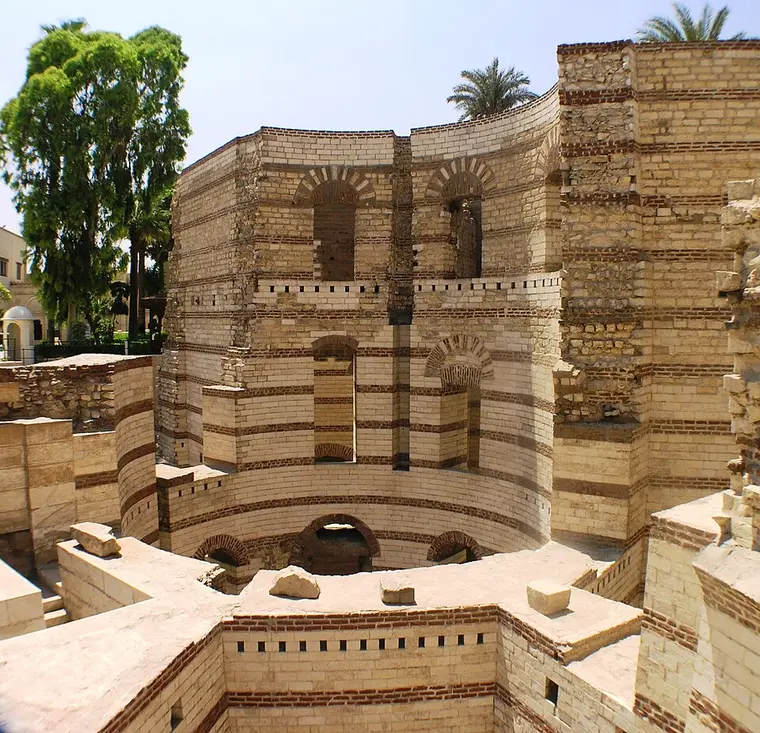
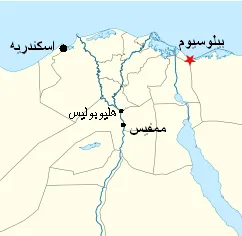
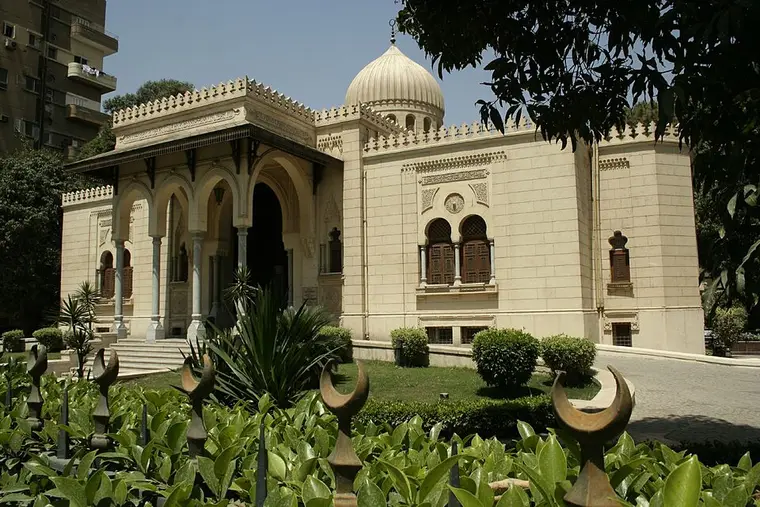
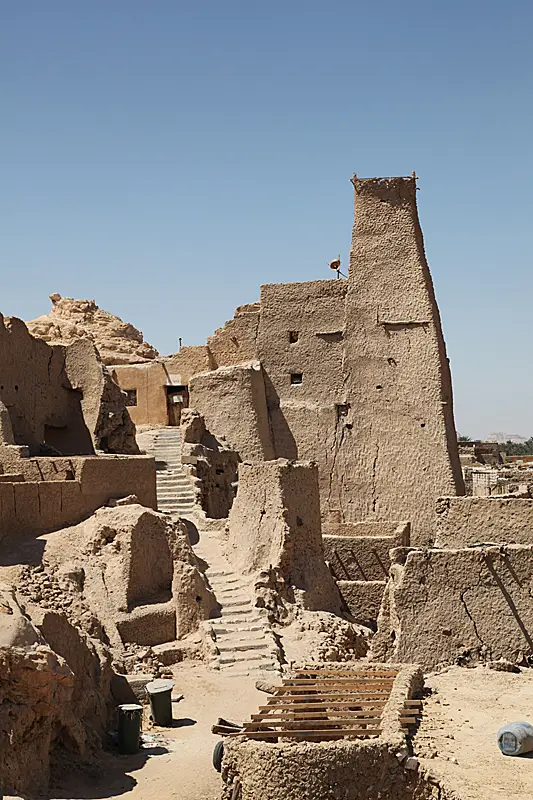
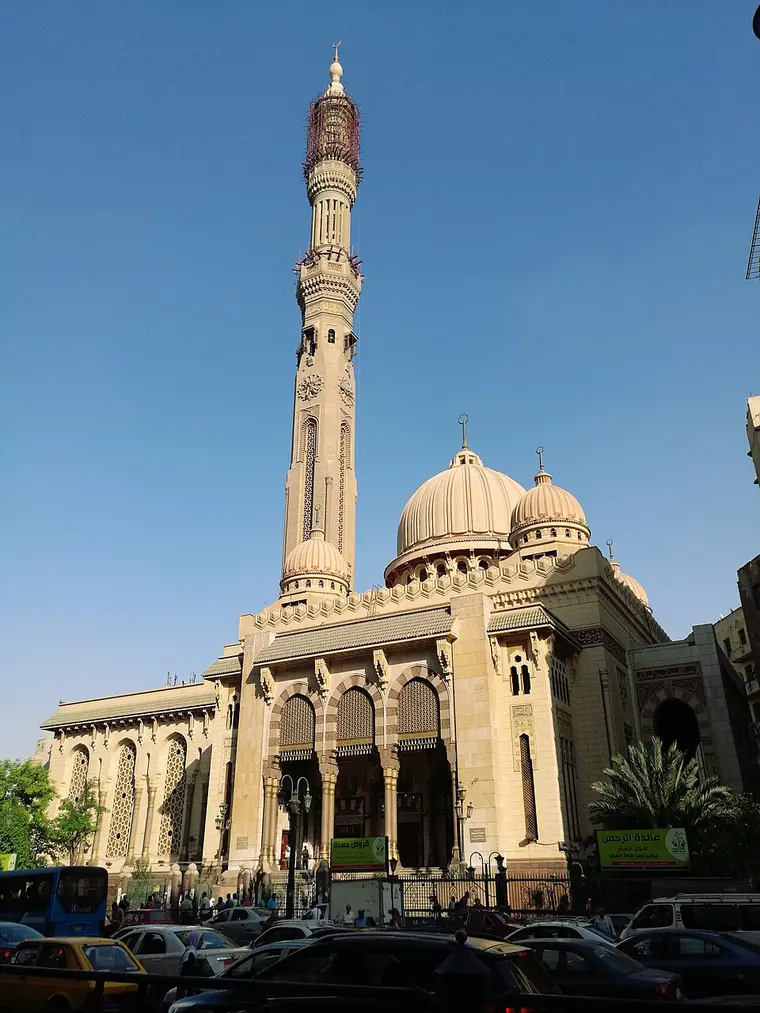
Sources for this chapter (87)Academic16Institution2Specialist book56Reputable web13
Academic(16)
- Booth · The Last Years of Cyrus, Patriarch of Alexandria · Travaux et mémoires · 2016
- Ajlan: Locating the Estate of Amr b. al-As · Near Eastern Archaeology · 2010
- Egypt under Muʿāwiya Part I: Flavius Papas and Upper Egypt · Bulletin of the School of Oriental and African Studies · 2009
- Egypt under Muʿāwiya Part II: Middle Egypt, Fusṭāṭ and Alexandria · Bulletin of the School of Oriental and African Studies · 2009
- The Murder of the Caliph 'Uthman · International Journal of Middle East Studies · 1972
- A Note on Early Marriage Links between Qurashīs and Jewish Women · Jerusalem Studies in Arabic and Islam · 1987
- The Estates of 'Amr b. al-'Āṣ in Palestine: Notes on a New Negev Arabic Inscription · Bulletin of the School of Oriental and African Studies, University of London · 1989
- The First Muslim Attacks on Southern Palestine (A.D. 633–634) · Transactions and Proceedings of the American Philological Association · 1964
- Amr ibn al-As and His Conquest of Egypt · Islamic Culture · 1981
- Fustat and the Islamic Art of Egypt · Archaeology · 1968
- An Early Umayyad Papyrus Invitation for the Ḥajj · Journal of Near Eastern Studies · 2014
- Fiscal documents from the Muslim conquest of Egypt: military supplies and administrative dislocation, ca 639–644 · Revue des Études Byzantines · 2013
- Mason · New Looks at Old Pots: Results of Recent Multidisciplinary Studies of Glazed Ceramics from the Islamic World · Brill Academic Publishers · 1995
- Scanlon, George T. · The Pits of Fustat: Problems of Chronology · The Journal of Egyptian Archaeology, Vol. 60 · 1974
- Stewart, W. A. · The Pottery of Fostat, Old Cairo · The Burlington Magazine for Connoisseurs · 1921
- Gascoigne · Sherds and the City: Pottery Production, Society, and the Changing Urban Fabric of Fustat, Egypt · Journal of Field Archaeology · 2024
Institution(2)
Specialist book(56)
- A Sword over the Nile · Austin Macauley · 2020
- Mango · Nikephoros' Short History [for the years 602-769 A.D.] · Dumbarton Oaks, Research Library and Collection · 2018
- Kaegi · Byzantium and the early Islamic conquests · Cambridge University Press · 1995
- Butcher · The Story of the Church of Egypt: An Outline Of The History Of The Egyptians Under Their Successive Masters From The Roman Conquest Until Now · Smith, Elder, & Company · 1897
- The Prosopography of the Later Roman Empire · Cambridge University Press · 1992
- al-Tabari · The History of al-Tabari, Volume XII: The Conquest of Iraq, Southwestern Persia, and Egypt · State University of New York Press · 1992
- Butler · The Arab Conquest of Egypt and the Last Thirty Years under Roman Dominion · Oxford University Press · 1903
- Bagnall · Roman Egypt: A History · Cambridge University Press · 2021
- Nikephoros' Short History [for the years 602-769 A.D.]
- Rosenwein · A Short Medieval Reader · University of Toronto Press · 2023
- Conflicts that Changed the World · Canary Press eBooks · 2023
- The Rough Guide History of Egypt · Rough Guides · 2003
- Handbook to Life in the Medieval World, 3-Volume Set, Volumes 1-3 · Infobase Publishing · 2009
- The War of the Three Gods: Romans, Persians and the Rise of Islam · Pen and Sword · 2013
- Sword and Scimitar: Fourteen Centuries of War between Islam and the West · Hachette Books · 2018
- Butler · The Arab Conquest of Egypt and the Last Thirty Years of the Roman Dominion · Oxford University Press · 1902
- The Arab Conquest of Egypt and the Last Thirty Years of the Roman Dominion · Clarendon Press · 1978
- Haykal · Al Farooq, Umar · 1944
- Kennedy · The Great Arab Conquests: How the Spread of Islam Changed the World We Live in · Da Capo Press · 2007
- Sijpesteijn · Egypt in the Byzantine world, 300-700 · 2007
- Betts · Christians in the Arab East: A Political Study · Lycabettus Press · 1978
- Charles · The Chronicle of John, Bishop of Nikiu: Translated from Zotenberg's Ethiopic Text · Evolution Publishing · 2007
- Meyendorff · Imperial unity and Christian divisions: The Church 450-680 A.D. · St. Vladimir's Seminary Press · 1989
- Ostrogorsky · History of the Byzantine State · Basil Blackwell · 1956
- Sijpesteijn · Shaping a Muslim State: The World of a Mid-Eighth-Century Egyptian Official · 2013
- Muqarnas: An Annual on Islamic Art and Architecture, Volume 6 · Brill · 1989
- The Men of Madina by Muhammad Ibn Sa'd, Volume 2 · Ta-Ha Publishers · 2000
- The Rise of a Capital: Al-Fusṭāṭ and Its Hinterland, 18–132/639–750 · Brill · 2018
- The Chronicle of John, Bishop of Nikiu: Translated from Zotenberg's Ethiopic Text · 1913
- The Early Islamic Conquests · Princeton University Press · 1981
- The Rebellion of Muḥammad al-Nafs al-Zakiyya in 145/762: Ṭālibīs and Early ʿAbbāsīs in Conflict · Brill · 2016
- The Life of Muhammad: Al-Waqidi's Kitab Al-Maghazi · Routledge · 2011
- Kennedy · Cambridge History of Egypt, Volume One: Islamic Egypt, 640–1517 · Cambridge University Press · 1998
- The Great Arab Conquests: How the Spread of Islam Changed the World We Live In · Da Capo Press · 2007
- The Succession to Muhammad: A Study of the Early Caliphate · Cambridge University Press · 1997
- ibn Sa'd · Biographien Muhammeds: seiner Gefährten und der späteren Träger des Islams bis zum Jahre 230 der Flucht · Brill · 1905
- AlSayyad, Nezar · Cairo · Harvard University Press · 2011
- Doris Behrens-Abouseif · Islamic Architecture in Cairo · Brill Publishers · 1992
- Barghusen, Joan D. · Daily Life in Ancient and Modern Cairo · Twenty-First Century Books · 2001
- Tyerman, Christopher · God's War: a new history of the Crusades · Belknap · 2006
- Hoffman, Edward · The Wisdom of Maimonides · Shambhala Productions · 2008
- Kessler, Adam T. · Song Blue and White Porcelain on the Silk Road · Koninklijke Brill · 2012
- David · The Experience of Ancient Egypt · Routledge · 2000
- Eyewitness Travel: Egypt · Dorlin Kindersley Limited, London · 2007
- Petersen · Dictionary of Islamic Architecture · Routledge · 1999
- Yeomans, Richard · The Art and Architecture of Islamic Cairo · Garnet & Ithaca Press · 2006
- Williams, Caroline · Islamic Monuments in Cairo: The Practical Guide · American University in Cairo Press · 2002
- Bacharach, Jere L. · Fustat Finds: Beads, Coins, Medical Instruments, Textiles, and Other Artifacts from the Awad Collection · American University in Cairo Press · 2004
- Barekeet, Elinoar · Fustat on the Nile: The Jewish Elite in Medieval Egypt · Brill · 1999
- Kubiak · Al-Fusṭāṭ, its foundation and early urban development · American University in Cairo Press · 1987
- Scanlon, George T. · Fustat Glass of the Early Islamic Period: Finds Excavated by the American Research Center in Egypt, 1964–1980 · Altajir World of Islam Trust · 2001
- Islamic Architecture in Cairo: An Introduction · The American University in Cairo Press · 1993
- Izzeddin · The Druzes: A New Study of Their History, Faith, and Society · Brill · 1993
- The History and Religious Heritage of Old Cairo: Its Fortress, Churches, Synagogue, and Mosque · American University in Cairo Press · 2013
- Behrens-Abouseif, Doris · Islamic Architecture in Cairo · E. J. Brill · 1989
- Creswell, K. A. C. · Early Muslim Architecture · Oxford University Press · 1979
Reputable web(13)
- CATHOLIC ENCYCLOPEDIA: Cyrus of Alexandria
- John, Bishop of Nikiu: Chronicle. London (1916). English Translation
- أسماء بعض البلاد المصرية بالقبطية
- Manuel I Comnenus
- Muḥammad · 1993
- Kjeilin, Tore · Fustat · Encyclopaedia of the Orient
- Beeson, Irene · Cairo, a Millennial · 1969
- Zayn Bilkadi · The Oil Weapons · 1995
- Alison Gascoigne · Islamic Cairo · egyptvoyager.com
- Antoniou, Jim · Historic Cairo – rehabilitation of Cairo's historic monuments · 1998
- Amr Ibn Al-As Mosque · sis.gov.eg · 2009
- 'Amr, Mosque of · Dictionary of Islamic Architecture
- Jami' 'Amr ibn al-'As · ArchNet
Every ancient date is an estimate. Scholarly chronologies differ by decades, and by more the further back you go, which is why each figure carries a tilde. When a period is published we name the chronology its dates come from.