The Fatimid Caliphate
~969 – ~1171 CE
13 chapters · 176 min read · 312 sources
969 CE
Introduction
3 min readThe Fatimid Caliphate (; ), also known as the Fatimid Empire, was a caliphate that existed from the tenth to the twelfth centuries CE under the rule of the Fatimids, an Isma'ili Shi'a dynasty. Spanning a large area of…The Fatimid Caliphate (; ), also known as the Fatimid Empire, was a caliphate that existed from the tenth to the twelfth centuries CE under the rule of the Fatimids, an Isma'ili Shi'a dynasty. Spanning a large area of North Africa and West Asia, it ranged from the western Mediterranean in the west to the Red Sea in the east. The Fatimids traced their ancestry to the Islamic prophet Muhammad's daughter Fatima and her husband Ali, considered the first Imam of Shi'a Islam. The Fatimids were acknowledged as the rightful imams by different Isma'ili communities as well as by denominations in many other Muslim lands and adjacent regions. Starting in Ifriqiya under the Aghlabids, who were themselves nominally under the Abbasid Caliphate, the Fatimids eventually overthrew both, and extended their rule across the Mediterranean coast, ultimately making Egypt the centre of their caliphate. At its height, the caliphate included—in addition to Egypt—varying areas of the Maghreb, Sicily, the Levant, and the Hejaz.
Between 902 and 909, the foundation of the Fatimid state was realised under the leadership of da'i (missionary) Abu Abdallah, who led Kutama tribal forces in establishing an Isma'ili state and then conquering Aghlabid Ifriqiya, thus paving the way for the establishment of the Caliphate. After the conquest, Abdallah al-Mahdi Billah was retrieved from his temporary residence in Sijilmasa, a remote Moroccan city at the edge of the Sahara, and then accepted as the Imam of the movement, becoming the first Caliph and the founder of the dynasty in 909. In 921, the city of al-Mahdiyya was established on the coast of modern-day Tunisia as the capital. In 948, the capital was shifted their to al-Mansuriyya, near Kairouan, also in modern-day Tunisia. In 969, during the reign of al-Mu'izz, the Fatimids conquered Egypt, and in 973, the center of the caliphate was moved to the newly founded Fatimid capital of Cairo. Egypt became the political, cultural, and religious centre of the empire and it developed a new and "indigenous Arabic culture". After its initial conquests, the caliphate often allowed a degree of religious tolerance towards non-Shi'a sects of Islam, as well as to Jews and Christians. However, its leaders made little headway in persuading the Egyptian population to adopt its religious beliefs.
After the reigns of al-'Aziz and al-Hakim, the long reign of al-Mustansir entrenched a regime in which the caliph remained aloof from state affairs and viziers took on greater importance. Political and ethnic factionalism within the army led to a civil war in the 1060s, which threatened the empire's survival. After a period of revival during the tenure of the vizier Badr al-Jamali, the Fatimid caliphate declined rapidly during the late eleventh and twelfth centuries. In addition to internal difficulties, the caliphate was weakened by the encroachment of the Seljuk Turks into Syria in the 1070s and the arrival of the Crusaders in the Levant in 1097. In 1171, Saladin abolished the dynasty's rule and founded the Ayyubid dynasty, which incorporated the Levant and Egypt back into the nominal sphere of authority of the Abbasid Caliphate.
Name
1 min readThe Fatimid dynasty claimed descent from Fatimah, the daughter of Muhammad. The dynasty legitimised its claim through descent from Muhammad by way of his daughter and her husband Ali, the first Shi'a imam, hence the…The Fatimid dynasty claimed descent from Fatimah, the daughter of Muhammad. The dynasty legitimised its claim through descent from Muhammad by way of his daughter and her husband Ali, the first Shi'a imam, hence the dynasty's name, faṭimiyy, the Arabic relative adjective for Fāṭima.
Emphasising its Alid descent, the dynasty named itself simply the 'Alid dynasty', but many hostile Sunni sources only refer to them as the Ubaydids, after the diminutive form Ubayd Allah for the name of the first Fatimid caliph.
History
41 min readThe Fatimid dynasty came to power as the leaders of Isma'ilism, a revolutionary Shi'a movement "which was at the same time political and religious, philosophical and social," and which originally proclaimed nothing less…Origins
The Fatimid dynasty came to power as the leaders of Isma'ilism, a revolutionary Shi'a movement "which was at the same time political and religious, philosophical and social," and which originally proclaimed nothing less than the arrival of an Islamic messiah. The origins of that movement, and of the dynasty itself, are obscure prior to the late ninth century.
The Fatimid rulers were Arab in origin, starting with its founder, the Isma'ili Shi'a caliph Abdallah al-Mahdi Billah. The caliphate's establishment was accomplished by Kutama Berbers from Little Kabylia, who converted to the Fatimid cause early and made up its original military forces.
Early Shi'ism and the roots of Isma'ilism
The Shi'a opposed the Umayyad and Abbasid caliphates, whom they considered usurpers. Instead, they believed in the exclusive right of the descendants of Ali through Muhammad's daughter Fatima, to lead the Muslim community. This manifested itself in a line of imams, descendants of Ali via al-Husayn, whom their followers considered as the true representatives of God on earth. At the same time, there was a widespread messianic tradition in Islam concerning the appearance of a mahdi ("the Rightly Guided One") or qa'im ("He Who Arises"), who would restore true Islamic government and justice and usher in the end times. This figure was widely expectednot just among the Shi'ato be a descendant of Ali. Among Shi'a, however, this belief became a core tenet of their faith, and was applied to several Shi'a leaders who were killed or died; their followers believed that they had gone into "occultation" and would return (or be resurrected) at the appointed time.
These traditions manifested themselves in the succession of the sixth imam, Ja'far al-Sadiq. Al-Sadiq had appointed his son Isma'il ibn Ja'far as his successor, but Isma'il died before his father, and when al-Sadiq himself died in 765, the succession was left open. Most of his followers followed al-Sadiq's son Musa al-Kazim down to a twelfth and final imam who supposedly went into occultation in 874 and would one day return as the. This branch is hence known as the "Twelvers". Others followed other sons, or even refused to believe that al-Sadiq had died, and expected his return as the. Another branch believed that al-Sadiq was followed by a seventh imam, who had gone into occultation and would one day return; hence this party is known as the "Seveners". The exact identity of that seventh imam was disputed, but by the late ninth century had commonly been identified with Muhammad, son of Isma'il and grandson of al-Sadiq. From Muhammad's father, Isma'il, the sect, which gave rise to the Fatimids, receives its name of "Isma'ili". Due to the harsh Abbasid persecution of the Alids, the Ismaili Imams went into hiding and neither Isma'il's nor Muhammad's lives are well known, and after Muhammad's death during the reign of Harun al-Rashid, the history of the early Isma'ili movement becomes obscure.
The secret network
While the awaited mahdi Muhammad ibn Isma'il remained hidden, however, he would need to be represented by agents, who would gather the faithful, spread the word (da'wa, "invitation, calling"), and prepare his return. The head of this secret network was the living proof of the imam's existence, or "seal" (hujja). It is in this role that the ancestors of the Fatimids are first documented. The first known hujja was a certain Abdallah al-Akbar ("Abdallah the Elder"), a wealthy merchant from Khuzestan, who established himself at the small town of Salamiya on the western edge of the Syrian Desert. Salamiya became the centre of the Isma'ili da'wa, with Abdallah al-Akbar being succeeded by his son and grandson as the secret "grand masters" of the movement.
In the last third of the ninth century, the Isma'ili da'wa spread widely, profiting from the collapse of Abbasid power in the Anarchy at Samarra and the subsequent Zanj Revolt, as well as from dissatisfaction among Twelver adherents with the political quietism of their leadership and the recent disappearance of the twelfth imam. Missionaries (da'is) such as Hamdan Qarmat and Ibn Hawshab spread the network of agents to the area round Kufa in the late 870s, and from there to Yemen (882) and thence India (884), Bahrayn (899), Persia, and the Maghreb (893).
The Qarmatian schism and its aftermath
In 899, Abdallah al-Akbar's great-grandson, Abdallah, became the new head of the movement, and introduced a radical change in the doctrine: no longer was he and his forebears merely the stewards for Muhammad ibn Isma'il, but they were declared to be the rightful imams, and Abdallah himself was the awaited mahdi. Various genealogies were later put forth by the Fatimids to justify this claim by proving their descent from Isma'il ibn Ja'far, but even in pro-Isma'ili sources, the succession and names of imams differ, while Sunni and Twelver sources of course reject any Fatimid descent from the Alids altogether and consider them impostors. Abdallah's claim caused a rift in the Isma'ili movement, as Hamdan Qarmat and other leaders denounced this change and held onto the original doctrine, becoming known as the "Qarmatians", while other communities remained loyal to Salamiya. Shortly after, in 902–903, pro-Fatimid loyalists began a great uprising in Syria. The large-scale Abbasid reaction it precipitated and the attention it brought on him, forced Abdallah to abandon Salamiya for Palestine, Egypt, and finally for the Maghreb, where the da'i Abu Abdallah al-Shi'i had made great headway in converting the Kutama Berbers to the Isma'ili cause. Unable to join his da'i directly, Abdallah instead settled at Sijilmasa sometime between 904 and 905.
Rise to power
Establishment of the Isma'ili State
Prior to the Fatimid rise to power, Ifriqiya was under the control of the Aghlabids, an Arab dynasty who ruled nominally on behalf of the Abbasids but were de facto independent. In 893 the Abu Abdallah al-Shi'i first settled among the Banu Saktan tribe (part of the larger Kutama tribe) in Ikjan, near the city of Mila (in northeastern Algeria today). However, due to hostility from the local Aghlabid authorities and other Kutuma tribes, he was forced to leave Ikjan and sought the protection of another Kutama tribe, the Banu Ghashman, in Tazrut (two miles southwest of Mila). From there, he began to build support for a new movement. Shortly after, the hostile Kutama tribes and the Arab lords of the nearby cities (Mila, Setif, and Bilizma) allied together to march against him, but he was able to move quickly and muster enough support from friendly Kutama to defeat them one by one before they were able to unite. This first victory brought Abu Abdallah and his Kutama troops valuable loot and attracted more support to the 's cause. Over the next two years Abu Abdallah was able to win over most of the Kutama tribes in the region through either persuasion or coercion. This left much of the countryside under his control, while the major cities remained under Aghlabid control. He established an Isma'ili theocratic state based in Tazrut, operating in a way similar to previous Isma'ili missionary networks in Mesopotamia but adapted to local Kutama tribal structures. He adopted the role of a traditional Islamic ruler at the head of this organisation while remaining in frequent contact with Abdallah. He continued to preach to his followers, known as the Awliya' Allah ('Friends of God'), and to initiate them into Isma'ili doctrine.
Conquest of Aghlabid Ifriqiya
In 902, while the Aghlabid emir Ibrahim II was away on campaign in Sicily, Abu Abdallah struck the first significant blow against Aghlabid authority in Ifriqiya by attacking and capturing the city of Mila for the first time. This news triggered a serious response from the Aghlabids, who sent a punitive expedition of 12,000 men from Tunis in October of the same year. Abu Abdallah's forces were unable to resist this counterattack and after two defeats they evacuated Tazrut (which was largely unfortified) and fled to Ikjan, leaving Mila to be retaken. Ikjan became the new centre of the Fatimid movement and the reestablished his network of missionaries and spies.
Ibrahim II died in October 902 while in southern Italy and was succeeded by Abdallah II. In early 903 Abdallah II set out on another expedition to destroy Ikjan and the Kutama rebels, but he ended the expedition prematurely due to troubles at home arising from disputes over his succession. On 27 July 903, he was assassinated and his son Ziyadat Allah III took power in Tunis. These internal Aghlabid troubles gave Abu Abdallah the opportunity to recapture Mila and then go on to capture Setif, another fortified city, by October or November 904. In 905 the Aghlabids sent a third expedition to try and subdue the Kutama. They based themselves in Constantine and in the fall of 905, after receiving further reinforcements, set out to march against Abu Abdallah. However, they were surprised by Kutama forces on the first day of their march, which caused a panic and scattered their army. The Aghlabid general fled and the Kutama captured a large booty. Another Aghlabid military expedition organised the next year (906) failed when the soldiers mutinied. Around the same time or soon after, Abu Abdallah's forces besieged and captured the fortified cities of Tubna and Bilizma. The capture of Tubna was significant as it was the first major commercial centre to come under Abu Abdallah's control.
Meanwhile, Ziyadat Allah III moved his court from Tunis to Raqqada, the palace-city near Kairouan, in response to the growing threat. He fortified Raqqada in 907. In early 907 another Aghlabid army marched westwards again against Abu Abdallah, accompanied by Berber reinforcements from the Aurès Mountains. They were again scattered by Kutama cavalry and retreated to Baghaya, the most fortified town on the old southern Roman road between Ifriqiya and the central Maghreb. The fortress, however, fell to the Kutama without a siege when local notables arranged to have the gates opened to them in May or June 907. This opened a hole in the wider defensive system of Ifriqiya and created panic in Raqqada. Ziyadat Allah III stepped up anti-Fatimid propaganda, recruited volunteers, and took measures to defend the weakly fortified city of Kairouan. He spent the winter of 907–908 with his army in al-Aribus (Roman-era Laribus, between present-day El Kef and Maktar), expecting an attack from the north. However, Abu Abdallah's forces had been unable to capture the northerly city of Constantine and therefore they instead attacked along the southern road from Baghaya in early 908 and captured Maydara (present-day Haïdra). An indecisive battle subsequently occurred between the Aghalabid and Kutama armies near Dar Madyan (probably a site between Sbeitla and Kasserine), with neither side gaining the upper hand. During the winter of 908–909 Abu Abdallah campaigned in the region around Chott el-Jerid, capturing the towns of Tuzur (Tozeur), Nafta, and Qafsa (Gafsa) and taking control of the region. The Aghlabids responded by besieging Baghaya soon afterward in the same winter, but they were quickly repelled.
On 25 February 909, Abu Abdallah set out from Ikjan with an army of 200,000 men for a final invasion of Kairouan. The remaining Aghlabid army, led by an Aghlabid prince named Ibrahim Ibn Abi al-Aghlab, met them near al-Aribus on 18 March. The battle lasted until the afternoon, when a contingent of Kutama horsemen managed to outflank the Aghlabid army and finally caused a rout. When news of the defeat reached Raqqada, Ziyadat Allah III packed his valuable treasures and fled towards Egypt. The population of Kairouan looted the abandoned palaces of Raqqada and resisted Ibn Abi al-Aghlab's calls to organise a last-ditch resistance. Upon hearing of the looting, Abu Abdallah sent an advance force of Kutama horsemen who secured Raqqada on 24 March. On 25 March 909 (Saturday, 1 Rajab 296), Abu Abdallah himself entered Raqqada and took up residence here.
Establishment of the Caliphate
Upon assuming power in Raqqada, Abu Abdallah inherited much of the Aghlabid state's apparatus and allowed its former officials to continue working for the new regime. He established a new, Isma'ili Shi'a regime on behalf of his absent, and for the moment unnamed, master. He then led his army west to Sijilmasa, whence he led Abdallah in triumph to Raqqada, which he entered on 15 January 910. There Abdallah publicly proclaimed himself as caliph with the regnal name of, and presented his son and heir, with the regnal name of al-Qa'im. Al-Mahdi quickly fell out with Abu Abdallah: not only was the over-powerful, but he demanded proof that the new caliph was the true. The elimination of Abu Abdallah al-Shi'i and his brother led to an uprising among the Kutama, led by a child-, which was suppressed. At the same time, al-Mahdi repudiated the millenarian hopes of his followers and curtailed their antinomian tendencies.
The new regime regarded its presence in Ifriqiya as only temporary: the real target was Baghdad, the capital of the Fatimids' Abbasid rivals. The ambition to carry the revolution eastward had to be postponed after the failure of two successive invasions of Egypt, led by al-Qa'im, in 914–915 and 919–921. In addition, the Fatimid regime was as yet unstable. The local population were mostly adherents of Maliki Sunnism and various Kharijite sects such as Ibadism, so that the real power base of Fatimids in Ifriqiya was quite narrow, resting on the Kutama soldiery, later extended by the Sanhaja Berber tribes as well. The historian Heinz Halm describes the early Fatimid state as being, in essence, "a hegemony of the Kutama and Sanhaja Berbers over the eastern and central Maghrib".
In 912, al-Mahdi began looking for the site of a new capital along the Mediterranean shore. Construction of the new fortified palace city, al-Mahdiyya, began in 916. The new city was officially inaugurated on 20 February 921, though construction continued after this. The new capital was removed from the Sunni stronghold of Kairouan, allowing for the establishment of a secure base for the Caliph and his Kutama forces without raising further tensions with the local population.
The Fatimids also inherited the Aghlabid province of Sicily, which the Aghlabids had gradually conquered from the Byzantine Empire starting in 827. The conquest was generally completed when the last Christian stronghold, Taormina, was conquered by Ibrahim II in 902. However, some Christian or Byzantine resistance continued in some spots in the northeast of Sicily until 967, and the Byzantines still held territories in southern Italy, where the Aghlabids had also campaigned. This ongoing confrontation with the traditional foe of the Islamic world provided the Fatimids with a prime opportunity for propaganda, in a setting where geography gave them the advantage. Sicily itself proved troublesome, and only after a rebellion under Ibn Qurhub was subdued, was Fatimid authority on the island consolidated.
Consolidation and western rivalry
For a large part of the tenth century the Fatimids also engaged in a rivalry with the Umayyads of Cordoba, who ruled Al-Andalus and were hostile to the Fatimids' pretensions in an effort to establish domination over the western Maghreb. In 911, Tahert, which had been briefly captured by Abu Abdallah al-Shi'i in 909, had to be retaken by the Fatimid general Masala ibn Habus of the Miknasa tribe. The first Fatimid expeditions to what is now northern Morocco occurred in 917 and 921 and were primarily aimed at the Principality of Nakur, which they subjugated on both occasions. Fez and Sijilmasa were also captured in 921. These two expeditions were led by Masala ibn Habus, who had been made governor of Tahert. Thereafter, the weakened Idrisids and various local Zenata and Sanhaja leaders acted as proxies whose formal allegiances oscillated between the Umayyads or the Fatimids depending on the circumstances. As a result of the political instability in the western Maghreb, effective Fatimid control did not extend much beyond the former territory of the Aghlabids. Masala's successor, Musa ibn Abi'l-Afiya, captured Fez from the Idrisids again, but in 932 defected to the Umayyads, taking the western Maghreb with him. The Umayyads gained the upper hand again in northern Morocco during the 950s, until the Fatimid general Jawhar, on behalf of Caliph Al-Mu'izz li-Din Allah, led another major expedition to Morocco in 958 and spent two years subjugating most of northern Morocco. He was accompanied by Ziri ibn Manad, the leader of the Zirids. Jawhar took Sijilmasa in September or October 958 and then, with the help of Ziri, his forces took Fez in November 959. He was unable, however, to dislodge the Umayyad garrisons in Sala, Sebta (present-day Ceuta) and Tangier, and this marked the only time that the Fatimid army was present at the Strait of Gibraltar. Jawhar and Ziri returned to al-Mansuriyya in 960. The subjugated parts of Morocco, including Fez and Sijilmasa, were left under the control of local vassals while most of the central Maghreb (Algeria), including Tahert, was given to Ziri ibn Manad to govern on the caliph's behalf.
All this warfare in the Maghreb and Sicily necessitated the maintenance of a strong army, and a capable fleet as well. Nevertheless, by the time of al-Mahdi's death in 934, the Fatimid Caliphate "had become a great power in the Mediterranean". The reign of the second Fatimid imam-caliph, al-Qa'im, was dominated by the Kharijite rebellion of Abu Yazid. Starting in 943/4 among the Zenata Berbers, the uprising spread through Ifriqiya, taking Kairouan and blockading al-Qa'im at al-Mahdiyya, which was besieged in January–September 945. Al-Qa'im died during the siege, but this was kept secret by his son and successor, Isma'il, until he had defeated Abu Yazid; he then announced his father's death and proclaimed himself imam and caliph as al-Mansur. While al-Mansur was campaigning to suppress the last remnants of the revolt, a new palace city was being constructed for him south of Kairouan. Construction began around 946 and it was only fully completed under al-Mansur's son and successor, al-Mu'izz. It was named al-Mansuriyya (also known as Sabra al-Mansuriyya) and became the new seat of the caliphate.
Apogee
Conquest of Egypt and transfer of the Caliphate to Cairo
In 969, Jawhar launched a carefully prepared and successful invasion of Egypt, which had been under the control of the Ikhshidids, another regional dynasty whose formal allegiance was to the Abbasids. Al-Mu'izz had given Jawhar specific instructions to carry out after the conquest, and one of his first actions was to found a new capital named al-Qahira (Cairo) in 969. The name al-Qahira, meaning "the Vanquisher" or "the Conqueror", referenced the planet Mars, "The Subduer", rising in the sky at the time when the construction of the city started. The city was located several miles northeast of Fustat, the older regional capital founded by the Arab conquerors in the seventh century.
Control of Egypt was secured with relative ease and soon afterward, in 970, Jawhar sent a force to invade Syria and remove the remaining Ikhshidids who had fled there from Egypt. This Fatimid force was led by a Kutama general named Ja'far ibn Falah. This invasion was successful at first and many cities, including Damascus, were occupied that same year. Ja'far's next step was to attack the Byzantines, who had captured Antioch and subjugated Aleppo in 969 (around the same time as Jawhar was arriving in Egypt), but he was forced to call off the advance in order to face a new threat from the east. The Qarmatis of Bahrayn, responding to the appeal of the recently defeated leaders of Damascus, had organised a large coalition of Arab tribesmen to attack him. Ja'far chose to confront them in the desert in August 971, but his army was surrounded and defeated and Ja'far himself was killed. A month later the Qarmati imam Hasan al-A'ṣam led the army, with new reinforcements from Transjordan, into Egypt, seemingly without opposition. The Qarmatis spent time occupying the Nile Delta region, which gave Jawhar time to organise a defence of Fustat and Cairo. The Qarmati advance was halted just north of the city and eventually routed. A Kalbid relief force arriving by sea secured the expulsion of the Qarmatis from Egypt. Ramla, the capital of Palestine, was retaken by the Fatimids in May 972, but otherwise the progress in Syria had been lost.
Once Egypt was sufficiently pacified and the new capital was ready, Jawhar sent for al-Mu'izz in Ifriqiya. The caliph, his court, and his treasury, departed from al-Mansuriyya in fall 972, travelling by land but shadowed by the Fatimid navy sailing along the coast. After making triumphant stops in major cities along the way, the caliph arrived in Cairo on 10 June 973. Like other royal capitals before it, Cairo was constructed as an administrative and palatine city, housing the palaces of the caliph and the official state mosque, Al-Azhar Mosque. In 988, the mosque also became an academic institution that was central in the dissemination of Isma'ili teachings. Until the last years of the Fatimid Caliphate, the economic centre of Egypt remained Fustat, where most of the general population lived and traded.
Under the Fatimids, Egypt became the centre of an empire that included at its peak parts of North Africa, Sicily, the Levant (including Transjordan), the Red Sea coast of Africa, Tihamah, Hejaz, Yemen, with its most remote territorial reach being Multan (in modern-day Pakistan). Egypt flourished, and the Fatimids developed an extensive trade network both in the Mediterranean and in the Indian Ocean. Their trade and diplomatic ties, extending all the way to China under the Song Dynasty, eventually determined the economic course of Egypt during the High Middle Ages. The Fatimid focus on agriculture further increased their riches and allowed the dynasty and the Egyptians to flourish. The use of cash crops and the propagation of the flax trade allowed Fatimids to import other items from various parts of the world. The Fatimids built upon some of the bureaucratic foundations laid by the Ikhshidids and the old Abbasid imperial order. The office of the wazir (vizier), which existed under the Ikhshidids, was soon revived under the Fatimids. The first to be appointed to this position was the Jewish convert Ya'qub ibn Killis, who was elevated to this office in 979 by al-Mu'izz's successor al-Aziz. The office of the vizier became progressively more important over the years, as the vizier became the intermediary between the caliph and the large bureaucratic state that he ruled.
Campaigns in Syria
In 975, the Byzantine emperor John Tzimisces retook most of Palestine and Syria, leaving only Tripoli in Fatimid control. He aimed to capture Jerusalem, but he died in 976 on his way back to Constantinople, thus staving off the Byzantine threat to the Fatimids. Meanwhile, the Turkish ghulam (plural: ghilman, meaning soldiers recruited as slaves) Aftakin, a Buyid refugee who had fled an unsuccessful rebellion in Baghdad with his own contingent of Turkish soldiers, became the protector of Damascus. He allied with the Qarmatis and with Arab Bedouin tribes in Syria and invaded Palestine in the spring of 977. Jawhar, once again called into action, repelled their invasion and besieged Damascus. However, he suffered a rout during the winter and was forced to hold out in Ascalon against Aftakin. When his Kutama soldiers mutinied in April 978, Caliph al-Aziz himself led an army to relieve him. Instead of returning to Damascus, Aftakin and his Turkish ghilman joined the Fatimid army and became a useful instrument in the Syrian effort.
After Ibn Killis became vizier in 979, the Fatimids changed tactics. Ibn Killis was able to subjugate most of Palestine and southern Syria (the former Ikhshidid territories) by paying off the Qarmatis with an annual tribute and making alliances with local tribes and dynasties, such as the Jarrahids and the Banu Kilab. Following another failed attempt by a Kutama general, Salman, to take Damascus, the Turkish ghulam Bultakin finally succeeded in occupying the city for the Fatimids in 983, demonstrating the value of this new force. Another ghulam, Bajkur, was appointed governor of Damascus at this time. That same year he tried and failed to take Aleppo, but he was soon able to conquer Raqqa and Rahba in the Euphrates valley (present-day northeast Syria). Cairo eventually judged him to be a little too popular as governor of Damascus and he was forced to move to Raqqa while Munir, a eunuch in the caliph's household (like Jawhar before him), took direct control in Damascus on behalf of the caliph. Further north, Aleppo remained out of reach and under Hamdanid control.
The incorporation of the Turkish troops into the Fatimid army had long-term consequences. On the one hand, they were a necessary addition to the military in order for the Fatimids to compete militarily with other powers in the region. The Fatimids began to recruit ghilman much as the Abbasids had done before them. They were soon joined by recruited Daylamis (footmen from the Buyid homeland in Iran). Black Africans from the Sudan (upper Nile valley) were also recruited afterward. In the short term the Kutama warriors remained the most important troops of the Caliph, but resentment and rivalry eventually grew between the different ethnic components of the army.
Bajkur, based in Raqqa, made another unsuccessful attempt against Aleppo in 991 which resulted in his capture and execution. That same year, Ibn Killis died and Munir was accused of conducting treasonous correspondence with Baghdad. These difficulties triggered a strong response in Cairo. A major military campaign was prepared to impose Fatimid control over all of Syria. Along the way, Munir was arrested in Damascus and sent back to Cairo. Circumstances were favourable to the Fatimids as the Byzantine emperor Basil II was campaigning far away in the Balkans and the Hamdanid ruler Sa'd al-Dawla died in late 991. Manjutakin, the Turkish Fatimid commander, advanced methodically north along the Orontes valley. He took Homs and Hama in 992 and defeated a combined force from Hamdanid Aleppo and Byzantine-held Antioch. In 993 he took Shayzar and in 994 he began the siege of Aleppo. In May 995, however, Basil II unexpectedly arrived in the region after a forced march with his army through Anatolia, forcing Manjutakin to lift the siege and return to Damascus. Before another Fatimid expedition could be sent, Basil II negotiated a one-year truce with the caliph, which the Fatimids used to recruit and build new ships for their fleet. In 996 many of the ships were destroyed by a fire at al-Maqs, the port on the Nile near Fustat, further delaying the expedition. Finally, in August 996 al-Aziz died and the objective of Aleppo became secondary to other concerns.
The Zirids in the Maghreb
Before leaving for Egypt, al-Mu'izz had installed Buluggin ibn Ziri, the son of Ziri bn Manad (who died in 971), as his viceroy in the Maghreb. This established a dynasty of viceroys, with the title of "amir", who ruled the region on behalf of the Fatimids. Their authority remained disputed in the western Maghreb, where the rivalry with the Umayyads and with local Zenata leaders continued. After Jawhar's successful western expedition, the Umayyads returned to northern Morocco in 973 to reassert their authority. Buluggin launched one last expedition in 979–980 that reestablished his authority in the region temporarily, until a final decisive Umayyad intervention in 984–985 put an end to further efforts. In 978 the caliph also gave Tripolitania to Buluggin to govern, though Zirid authority there was later replaced by the local Banu Khazrun dynasty in 1001.
In 988, Buluggin's son and successor al-Mansur moved the Zirid dynasty's base from Ashir (central Algeria) to the former Fatimid capital al-Mansuriyya, cementing the status of the Zirids as more or less de facto independent rulers of Ifriqiya, while still officially maintaining their allegiance to the Fatimid caliphs. Caliph al-Aziz accepted this situation for pragmatic reasons to maintain his own formal status as universal ruler. Both dynasties exchanged gifts and the succession of new Zirid rulers to the throne was officially sanctioned by the caliph in Cairo.
The reign of al-Hakim
After al-Aziz's unexpected death, his young son al-Mansur, 11 years old, was installed on the throne as al-Hakim. Hasan ibn Ammar, the leader of the Kalbid clan in Egypt, a military veteran, and one of the last remaining members of al-Mu'izz's old guard, initially became regent, but he was soon forced to flee by Barjawan, the eunuch and tutor of the young al-Hakim, who took power in his stead. Barjawan stabilised the internal affairs of the empire but refrained from pursuing al-Aziz's policy of expansion towards Aleppo. In the year 1000, Barjawan was assassinated by al-Hakim, who now took direct and autocratic control of the state. His reign, which lasted until his mysterious disappearance in 1021, is the most controversial in Fatimid history. Traditional narratives have described him as either eccentric or outright insane, but more recent studies have tried to provide more measured explanations based on the political and social circumstances of the time.
Among other things, al-Hakim was known for executing his officials when unsatisfied with them, seemingly without warning, rather than dismissing them from their posts as had been traditional practice. Many of the executions were members of the financial administration, which may mean that this was al-Hakim's way of trying to impose discipline in an institution rife with corruption. He also opened the Dar al-'Ilm ("House of Knowledge"), a library for the study of the sciences, which was in line with al-Aziz's previous policy of cultivating this knowledge. For the general population, he was noted for being more accessible and willing to receive petitions in person, as well as for riding out in person among the people in the streets of Fustat. On the other hand, he was also known for his capricious decrees aimed at curbing what he saw as public improprieties. He also unsettled the plurality of Egyptian society by imposing new restrictions on Christians and Jews, particularly on the way they dressed or behaved in public. He ordered or sanctioned the destruction of a number of churches and monasteries (mostly Coptic or Melkite), which was unprecedented, and in 1009, for reasons that remain unclear, he ordered the demolition of the Church of the Holy Sephulchre in Jerusalem.
Al-Hakim greatly expanded the recruitment of Black Africans into the army, who subsequently became another powerful faction to balance against the Kutama, Turks, and Daylamis. In 1005, during his early reign, a dangerous uprising led by Abu Rakwa was successfully put down but had come within striking distance of Cairo. In 1012 the leaders of the Arab Tayyi tribe occupied Ramla and proclaimed the sharif of Mecca, al-Hasan ibn Ja'far, as the Sunni anti-caliph, but the latter's death in 1013 led to their surrender. Despite his policies against Christians and his demolition of the church in Jerusalem, al-Hakim maintained a ten-year truce with the Byzantines that began in 1001. For most of his reign, Aleppo remained a buffer state that paid tribute to Constantinople. This lasted until 1017, when the Fatimid Armenian general Fatāk finally occupied Aleppo at the invitation of a local commander who had expelled the Hamdanid ghulam ruler Mansur ibn Lu'lu'. After a year or two, however, Fatak made himself effectively independent in Aleppo.
Al-Hakim also alarmed his Isma'ili followers in several ways. In 1013 he announced the designation of two great-great-grandsons of al-Mahdi as two separate heirs: one, Abd al-Rahim ibn Ilyas, would inherit the title of caliphate as the role of political ruler, and the other, Abbas ibn Shu'ayb, would inherit the imamate or religious leadership. This was a serious departure from a central purpose of the Fatimid Imam-Caliphs, which was to combine these two functions in one person. In 1015 he also suddenly halted the Isma'ili doctrinal lectures of the majalis al-hikma ("sessions of wisdom") which had taken place regularly inside the palace. In 1021, while wandering the desert outside Cairo on one of his nightly excursions, he disappeared. He was purportedly murdered, but his body was never found.
Decline
Losses, successes, and civil war
After al-Hakim's death his two designated heirs were killed, putting an end to his succession scheme, and his sister Sitt al-Mulk arranged to have his 15-year-old son Ali installed on the throne as al-Zahir. She served as his regent until her death in 1023, at which point an alliance of courtiers and officials ruled, with al-Jarjara'i, a former finance official, at their head. Fatimid control in Syria was threatened during the 1020s. In Aleppo, Fatak, who had declared his independence, was killed and replaced in 1022, but this opened the way for a coalition of Bedouin chiefs from the Banu Kilab, Jarrahids, and Banu Kalb led by Salih ibn Mirdas to take the city in 1024 or 1025 and to begin imposing their control on the rest of Syria. Al-Jarjara'i sent Anushtakin al-Dizbari, a Turkish commander, with a force that defeated them in 1029 at the Battle of Uqhuwana near Lake Tiberias. In 1030 the new Byzantine emperor Romanos III broke a truce to invade northern Syria and forced Aleppo to recognise his suzerainty. His death in 1034 changed the situation again and in 1036 peace was restored. In 1038 Aleppo was directly annexed by the Fatimids state for the first time.
Al-Zahir died in 1036 and was succeeded by his son, al-Mustansir, who had the longest reign in Fatimid history, serving as caliph from 1036 to 1094. However, he remained largely uninvolved in politics and left the government in the hands of others. He was seven years old at his accession and thus al-Jarjara'i continued to serve as vizier and his guardian. When al-Jarjara'i died in 1045 a series of court figures ran the government until al-Yazuri, a jurist of Palestinian origin, took and kept the office of vizier from 1050 to 1058.
In the 1040s (possibly in 1041 or 1044), the Zirids declared their independence from the Fatimids and recognised the Sunni Abbasid caliphs of Baghdad, which led the Fatimids to launch the devastating Banu Hilal invasions of North Africa. Fatimid suzerainty over Sicily also faded as the Muslim polity there fragmented and external attacks increased. By 1060, when the Italo-Norman Roger I began his conquest of the island (completed in 1091), the Kalbid dynasty, along with any Fatimid authority, were already gone.
There was more success in the east, however. In 1047, the Fatimid da'i Ali Muhammad al-Sulayhi in Yemen built a fortress and recruited tribes with which he was able to capture San'a in 1048. In 1060, he began a campaign to conquer all of Yemen, capturing Aden and Zabid. In 1062 he marched on Mecca, where Shukr ibn Abi al-Futuh's death in 1061 provided an excuse. Along the way he forced the Zaydi Imam in Sa'da into submission. Upon arriving in Mecca, he installed Abu Hashim Muhammad ibn Ja'far as the new sharif and custodian of the holy sites under the suzerainty of the Fatimids. He returned to San'a where he established his family as rulers on behalf of the Fatimid caliphs. His brother founded the city of Ta'izz, while the city of Aden became an important hub of trade between Egypt and India, which brought Egypt further wealth. His rise to power established the Sulayhid dynasty which continued to rule Yemen as nominal vassals of the Fatimids after this.
Events degenerated in Egypt and Syria, however. Starting in 1060, various local leaders began to break away or challenge Fatimid dominion in Syria. While the ethnic-based army was generally successful on the battlefield, it had begun to have negative effects on Fatimid internal politics. Traditionally, the Kutama element of the army had the strongest sway over political affairs, but as the Turkish element grew more powerful it began to challenge this. In 1062, the tentative balance between the different ethnic groups within the Fatimid army collapsed and they quarrelled constantly or fought each other in the streets. At the same time, Egypt suffered a seven-year period of drought and famine known as the Mustansirite Hardship. Viziers came and went in a flurry, the bureaucracy broke down, and the caliph was unable or unwilling to assume responsibilities in their absence. Declining resources accelerated the problems among the different ethnic factions and outright civil war began, primarily between the Turks under Nasir al-Dawla ibn Hamdan, a scion of the Hamdanids of Aleppo, and Black African troops, while the Berbers shifted alliance between the two sides. The Turkish faction under Nasir al-Dawla seized partial control of Cairo but their leader was not given any official title. In 1067–1068, they plundered the state treasury and then looted any treasures they could find in the palaces. The Turks turned against Nasir al-Dawla in 1069 but he managed to rally Bedouin tribes to his side, took over most of the Nile Delta region, and blocked supplies and food from reaching the capital from this region. Things degenerated further for the general population, especially in the capital, which relied on the countryside for food. Historical sources of this period report extreme hunger and hardship in the city, even to the point of cannibalism. The depredations in the Nile Delta may have also been a turning point that accelerated the long-term decline of the Coptic community in Egypt.
Badr al-Jamali and the Fatimid revival
By 1072, in a desperate attempt to save Egypt, al-Mustansir recalled general Badr al-Jamali, who was at the time the governor of Acre. Badr led his troops into Egypt, entered Cairo in January 1074, and successfully suppressed the different groups of the rebelling armies. As a result, Badr was made vizier, becoming one of the first military viziers (amir al-juyush 'commander of the armies') who would dominate late Fatimid politics. In 1078 al-Mustansir formally abdicated responsibility for all state affairs to him. His de facto rule initiated a temporary and limited revival of the Fatimid state, although it was now faced with serious challenges. Badr reestablished Fatimid authority in the Hejaz (Mecca and Medina) and the Sulayhids were able to hold on in Yemen. Syria, however, saw the advance of the Sunni-aligned Seljuk Turks, who had conquered much of the Middle East and had become the guardians of the Abbasid Caliphs, as well as independent Turkmen groups. Atsiz ibn Uwaq, a Turkmen of the Nawaki tribe, conquered Jerusalem in 1073 and Damascus in 1076 before attempting to invade even Egypt itself. After defeating him at a battle close to Cairo, Badr was able to start a counter-offensive to secure coastal cities, such as Gaza and Ascalon, and later Tyre, Sidon, and Byblos further north in 1089.
Badr made major reforms to the state, updating and simplifying the administration of Egypt. As he was of Armenian background, his term also saw a large influx of Armenian immigrants, both Christian and Muslim, into Egypt. The Armenian church, patronised by Badr, established itself in the country along with a clerical hierarchy. He commanded a large contingent of Armenian troops, many (if not all) of whom were also Christian. Badr also used his relations and influence with the Coptic Church for political advantage. In particular, he enlisted Cyril II (Coptic Pope from 1078 to 1092) to secure the allegiance of the Christian kingdoms of Nubia (specifically Makuria) and Ethiopia (specifically the Zagwe dynasty) as vassals to the Fatimid state.
The Juyushi Mosque ('the Mosque of the Armies'), was commissioned by Badr and completed in 1085 under the patronage of the caliph. The mosque, identified as a mashhad, was also a victory monument commemorating vizier Badr's restoration of order for al-Mustansir. Between 1087 and 1092, the vizier also replaced the mudbrick walls of Cairo with new stone walls and slightly expanded the city. Three of its monumental gates still survive today: Bab Zuweila, Bab al-Futuh, and Bab al-Nasr.
Final decline
As the military viziers effectively became heads of state, the Caliph himself was reduced to the role of a figurehead. The reliance on the iqta system also ate into Fatimid central authority, as more and more the military officers at the further ends of the empire became semi-independent.
Badr al-Jamali died in 1094, along with Caliph al-Mustansir that same year, and his son Al-Afdal Shahanshah succeeded him in power as vizier. After al-Mustansir, the Caliphate passed on to al-Musta'li; after his death in 1101, it passed to the 5-year-old al-Amir. Another of al-Mustansir's sons, Nizar, attempted to take the throne after his father's death and organised a rebellion in 1095, but he was defeated and executed that same year. This resulted in a schism with Isma'ili missionaries in Iran, led by the da'i Hasan-i Sabbah, who founded the Nizari sect and went on to form the Order of Assassins. Al-Afdal arranged for his sister to marry al-Musta'li and later for his daughter to marry al-Amir, hoping in this way to merge his family with that of the caliphs. He also attempted to secure the succession of his son to the vizierate as well, but this ultimately failed.
During al-Afdal's tenure (1094–1121), the Fatimids faced a new external threat: the First Crusade. Although initially both sides intended to reach an agreement and an alliance against the Seljuk Turks, these negotiations would eventually break down. First contact seems to have been established by the crusaders who sent in May or June 1097, on suggestion of Byzantine Emperor Alexios Komnenos, an embassy to al-Afdal. In return the Fatimids dispatched an embassy to the crusading forces which arrived in February 1098 during their siege of Antioch, witnessing and congratulating the crusaders on their victory against the Seljuk emirs Ridwan of Aleppo and Sökmen of Jerusalem as well as stressing their friendly attitude towards Christians. The Fatimid embassy stayed for a month with the crusading forces before returning via the harbour of Latakia with gifts as well as Frankish ambassadors. It is uncertain whether an agreement was reached but it seems that the parties expected to reach a conclusion in Cairo. Al-Afdal took then advantage of the crusader victory at Antioch to reconquer Jerusalem in August 1098, possibly to be in a better position in the negotiations with the crusaders. The next time both parties met was at Arqah in April 1099 where an impasse was reached in regard to the question of ownership over Jerusalem. Following this, the crusaders crossed into Fatimid territory and captured Jerusalem in July 1099 while al-Afdal was leading a relief army trying to reach the city. The two forces finally clashed in the Battle of Ascalon in which al-Afdal was defeated. Nevertheless, the initial negotiations were held against the Fatimids and Ibn al-Athir wrote that it was said that the Fatimids had invited the crusaders to invade Syria.
This defeat established the Kingdom of Jerusalem as a new regional rival and although many crusaders returned to Europe, having fulfilled their vows, the remaining forces, often aided by the Italian maritime republics, overran much of the coastal Levant, with Tripoli, Beirut, and Sidon falling to them between 1109 and 1110. The Fatimids retained Tyre, Ascalon, and Gaza with the help of their fleet. After 1107, a new rising star rose through the ranks of the regime in the form of Muhammad Ali bin Fatik, better known as al-Ma'mun al-Bata'ihi. He managed to carry out various administrative reforms and infrastructural projects in the later years of al-Afdal's term, including the construction of an astronomical observatory in 1119. Al-Afdal was assassinated in 1121, an act blamed on the Nizaris or Assassins, though the truth of this is unconfirmed.
Al-Bata'ihi took al-Afdal's place as vizier, but unlike his predecessors he had less support in the army and was ultimately reliant on the caliph for power. In 1124, he lost Tyre to the Crusaders. He was also responsible for constructing a small but notable mosque in Cairo, the Al-Aqmar Mosque, which was completed in 1125 and has largely survived to the present day. That same year, however, Caliph al-Amir had him arrested, probably due to his failure to resist the Crusaders or due to the caliph's resentment of his wealth and power. Three years later he was executed. Al-Amir then ruled the Caliphate personally, briefly interrupting the long period of de facto rule by the caliph's viziers. Al-Amir himself was assassinated in 1130, probably by the Nizari Assassins.
Al-Amir did not leave an adult heir but apparently had a son born shortly before his death, known as al-Ṭayyib. One of Al-Amir's cousins (a grandson of al-Mustansir), Abd al-Majid, had himself appointed regent. Under pressure from the army, one of al-Afdal's sons, Abu Ali Ahmad (known as Kutayfat), was appointed vizier with titles similar to al-Afdal and Badr al-Jamali. Kutayfat attempted to depose the Fatimid dynasty by imprisoning Abd al-Majid and by declaring himself to be the representative of Muhammad al-Muntazar, the "hidden" Imam awaited by Twelver Shi'as. The coup did not last long, as Kutayfat was assassinated in 1131 by al-Amir's followers in the Fatimid establishment. Abd al-Majid was released and resumed his role as regent. In 1132, however, he declared himself to be the new Imam-Caliph, taking the title of al-Hafiz, sidelining the infant al-Ṭayyib and breaking with the tradition of the succession passing directly from father to son. Most of the Fatimid lands acknowledged his succession, but the Sulayhids in Yemen did not and broke away from the Caliphate in Cairo, recognising al-Ṭayyib as the true Imam. This caused another schism between the Hafizi and Tayyibi branches of the Musta'li Isma'ilis.
In 1135, al-Hafiz was pressured by the Fatimid Armenian troops into appointing Bahram, a Christian Armenian, to the office of vizier. Opposition from Muslim troops forced him to leave in 1137, when Ridwan, a Sunni Muslim, was appointed vizier. When Ridwan began to plot the deposition of al-Hafiz, he was expelled from Cairo and later defeated in battle. He accepted a pardon from the caliph and remained at the palace. Al-Hafiz chose not to appoint another vizier, and instead took direct control of the state until his death in 1149. During this time, the fervour of the Isma'ili religious cause in Egypt had significantly faded, and political challenges to the caliph became more common. Sunni Muslims were also increasingly appointed to high posts. The Fatimid dynasty largely continued to survive due to the established common interests that many factions and elites had in maintaining the current system of government.
Al-Hafiz was the last Fatimid caliph to rule directly and the last one to ascend to the throne as an adult. The last three caliphs, al-Zafir (r. 1149–1154), al-Fa'iz (r. 1154–1160), and al-Adid (r. 1160–1171), were all children when they came to the throne. Under al-Zafir, an elderly Berber named Ibn Masal was initially vizier, per the instructions left by Al-Hafiz. The army, however, supported a Sunni named Ibn Sallar instead, whose supporters managed to defeat and kill Ibn Masal in battle. After negotiating with the women of the palace, Ibn Sallar was installed as vizier in 1150. In January 1153, the Crusader king Baldwin III of Jerusalem besieged Ascalon, the last remaining Fatimid foothold in the Levant. In April, Ibn Sallar was murdered in a plot organised by Abbas, his stepson, and Abbas's son, Nasr. As no relieving force arrived, Ascalon surrendered in August, on the condition that the inhabitants could leave safely for Egypt. It was on this occasion that the head of Husayn was allegedly brought from Ascalon to Cairo, where it was housed in what is now the al-Hussein Mosque. The next year (1154), Nasr murdered al-Zafir, and Abbas, now vizier, declared his 5-year-old son Isa (al-Fa'iz) the new caliph. The women of the palace intervened, calling on Tala'i ibn Ruzzik, a Muslim Armenian governor in Upper Egypt, to help. Tala'i drove out Abbas and Nasr from Cairo and became vizier that same year. Afterwards he also conducted renewed operations against the Crusaders, but he could do little more than harass them by sea. Al-Fa'iz died in 1160 and Tala'i was assassinated in 1161 by Sitt al-Qusur, a sister of al-Zafir. Tala'i's son, Ruzzik ibn Tala'i, held the office of vizier until 1163, when he was overthrown and killed by Shawar, the governor of Qus.
As vizier, Shawar came into conflict with his rival, the Arab general Dirgham. The internal disorder of the Caliphate attracted the attention and meddling of the Sunni Zengid ruler Nur ad-Din, who was now in control of Damascus and a large part of Syria, and of the King of Jerusalem, Amalric I. The Crusaders had already forced Tala'i ibn Ruzzik to pay them a tribute in 1161 and had made an attempt to invade Egypt in 1162. When Shawar was driven out of Cairo by Dirgham in 1163, he sought refuge and help with Nur al-Din. Nur al-Din sent his general, Asad al-Din Shirkuh, to seize Egypt and reinstall Shawar as vizier. He accomplished this task in the summer of 1164, when Dirgham was defeated and killed.
Shawar's remaining years continued in chaos as he made shifting alliances with either the King of Jerusalem or with Nur al-Din, depending on circumstances. In 1167, the Crusaders pursued Shirkuh's forces into Upper Egypt. In 1168, Shawar, worried about the possible Crusader capture of Cairo, infamously set fire to Fustat in an attempt to deny the Crusaders a base from which to besiege the capital. After forcing the Crusaders to leave Egypt again, Shirkuh finally had Shawar murdered in 1169, with the agreement of Caliph al-Adid. Shirkuh himself was appointed as al-Adid's vizier, but he died unexpectedly two months later. The position passed to his nephew, Salah ad-Din Yusuf ibn Ayyub (known in the West as Saladin). Salah ad-Din was openly pro-Sunni and suppressed the Shi'a call to prayer, ended the Isma'ili doctrinal lectures (the majalis al-hikma), and installed Sunni judges. He finally and officially deposed al-Adid, the last Fatimid caliph, in September 1171. This ended the Fatimid dynasty and began the Ayyubid Sultanate of Egypt and Syria.
Dynasty
1 min readWhite was the dynastic colour of the Fatimids, in opposition to Abbasid black, while red and yellow banners were associated with the Fatimid caliph's person. Green is also cited as their dynastic colour, based on a…White was the dynastic colour of the Fatimids, in opposition to Abbasid black, while red and yellow banners were associated with the Fatimid caliph's person. Green is also cited as their dynastic colour, based on a tradition that Muhammad wore a green cloak.
Caliphs
Consorts
Burial place
The Fatimid caliphs were buried in a mausoleum known as Turbat az-Za'faraan ("the Saffron Tomb"), located at the southern end of the eastern Fatimid palace in Cairo on the site now occupied by the Khan el-Khalili market. The remains of the early Fatimid caliphs in Ifriqiya were also transferred here when al-Mu'izz moved his capital to Cairo. However, the mausoleum was completely demolished by the Mamluk amir Jaharkas al-Khalili in 1385 to make way for the construction of a new merchant building (which gave its name to the present-day market). During the demolition, Jaharkas reportedly desecrated the bones of the Fatimid royal family by having them dumped into the rubbish hills east of the city.
Society
8 min readFatimid society was highly pluralistic. Isma'ili Shi'ism was the religion of the state and the caliph's court, but most of the population followed different religions or denominations. Most of the Muslim population…Religious communities
Fatimid society was highly pluralistic. Isma'ili Shi'ism was the religion of the state and the caliph's court, but most of the population followed different religions or denominations. Most of the Muslim population remained Sunni, and a large part of the population remained Christian. Jews were a smaller minority. As in other Islamic societies of the time, non-Muslims were classified as dhimmis, a term which implied both certain restrictions and certain liberties, though the practical circumstances of this status varied from context to context. As elsewhere in the historic Muslim world, they were required to pay the jizya tax. Scholars generally agree that, on the whole, Fatimid rule was highly tolerant and inclusive towards different religious communities.
Unlike western European governments of the era, advancement in Fatimid state offices was more meritocratic than hereditary. Members of other branches of Islam, like the Sunnis, were just as likely to be appointed to government posts as Shiites. Tolerance was extended to non-Muslims, such as Christians and Jews, who occupied high levels in government based on ability, and this policy of tolerance ensured the flow of money from non-Muslims in order to finance the Caliphs' large army of Mamluks brought in from Circassia by Genoese merchants.
There were exceptions to this general attitude of tolerance, however, most notably by al-Hakim, though this has been highly debated, with Al-Hakim's reputation among medieval Muslim historians conflated with his role in the Druze faith. Christians in general and Copts in particular were persecuted by Al-Hakim; the persecution of the Christians included closing and demolishing churches and forced conversion to Islam. With the succession of Caliph al-Zahir, the Druze faced a mass persecution, which included large massacres against the Druze in Antioch, Aleppo, and other cities.
Isma'ilis
It's unclear what number or percentage of the population inside the caliphate were actually Isma'ilis, but they always remained a minority. Historical chronicles report large numbers of enthusiastic converts in Egypt during the reign of al-'Aziz, but this trend dropped significantly around the middle of al-Hakim's reign. The Fatimid state promoted Isma'ili doctrine (the da'wa) through a hierarchical organisation. The Imam-Caliph, as successor to Muhammad, was both the political and religious leader. Below the Imam-Caliph, the top of this hierarchy was headed by the da'i l-du'at or "supreme missionary". Newcomers to the doctrine were initiated by attending the majalis al-hikma ("Sessions of Wisdom"), lectures and lessons that were delivered in a special hall inside the palaces of Cairo. The doctrine was kept secret from those who were not initiated. Additionally, Isma'ili doctrines were disseminated through the lectures hosted at Al-Azhar Mosque in Cairo, which became an intellectual centre hosting teachers and students. Beyond the borders of the Fatimid Caliphate, recruitment to the da'wa continued to be performed in secret as it had been before the caliphate's establishment, though the many missionaries maintained contact with the leadership in Ifriqiya or Egypt. Some of the da'is (missionaries) abroad sometimes came to Cairo and became important figures in the state, as with the example of al-Kirmani during al-Hakim's reign.
Isma'ili unity was weakened over time by several schisms after the establishment of the caliphate (in addition to the Qarmatian schism before its establishment). The Druze, who believed in the divinity of Caliph al-Hakim, were suppressed in Egypt and elsewhere, but eventually found a home in the region of Mount Lebanon. After the death of Caliph al-Mustansir, a succession crisis resulted in the breakaway of the Nizaris, who supported the claim of his oldest son Nizar, as opposed to the Musta'lis who supported the successful enthronement of al-Musta'li. The Nizaris were also suppressed inside the Caliphate's borders, but continued to be active outside it, mostly in Iran, Iraq, and parts of Syria. After the death of Caliph al-Amir, al-Hafiz, his cousin, successfully claimed the title of Imam-Caliph at the expense of al-Amir's infant son, al-Tayyib. Those who recognised al-Hafiz in Cairo were known as the al-Hafizi branch, but those who opposed this unusual succession and supported the succession of al-Tayyib were known as the al-Tayyibi branch. This particular schism resulted in the loss of Fatimid support in Yemen.
Other Muslims
In Ifriqiya, the Sunni Muslims of the cities largely followed the Maliki school or madhhab. The Maliki school had become predominant here during the eighth century at the expense of the Hanafi school, which had generally been favoured by the Aghlabids. In Egypt, the majority of Muslims were Sunni and remained so throughout the Fatimid period. Cognisant of this, the Fatimid authorities introduced Shi'a changes to religious rituals only gradually after Jawhar's conquest. It was also in this era that the followers of the Hanafi, Shafi'i, Hanbali, and Maliki schools were beginning to think of themselves collectively, to one extent or another, as Sunni, which undermined the universalism that the Shi'a Isma'ilis promoted. Some Shi'as, including some Hasanid and Husaynid families, were also present in Egypt and welcomed the Fatimids as fellow Shi'as or as blood relatives, but without necessarily converting to Isma'ilism. Many non-Isma'ili Muslims also accepted the Fatimid caliphs as having legitimate rights to lead the Muslim community but did not accept the more absolute Shi'a beliefs in the concept of the Imamate.
Christians
Christians may have still constituted a majority of the population in Egypt during the Fatimid period, although scholarly estimates on this issue are tentative and vary between authors. The proportion of Christians would have likely been greater in the rural population than in the main cities. Among Christians, the largest community were Copts, followed by Melkite Christians. A large number of Armenian immigrants also arrived in Egypt during the late 11th and early 12th centuries when Armenian viziers like Badr al-Jamali dominated the state, which led to the Armenian church establishing a foothold in the country as well. In addition to churches in towns and cities, Christian monasteries also dotted the countryside. Some regions, like Wadi al-Natrun, were ancient centres of Coptic monasticism. Italian traders, led by Amalfitans, were also present in Fustat and Alexandria, moving goods between Egypt and the rest of the Mediterranean world.
Within the Christian communities, and especially among Copts, there emerged a relatively affluent class of notables who served as scribes or administrators in the Fatimid regime. These laymen used their wealth to patronise, and in turn influence, their churches. The state also had influence on the church, as demonstrated by the transfer of the Coptic Patriarchate from Alexandria to Fustat (specifically what is now Old Cairo) during the patriarchate of Cyril II (1078–1092), due to the demands of Badr al-Jamali, who wished for the Coptic pope to stay close to the capital. The Church of the Virgin, now known as the Hanging Church, became the new seat of the Patriarchate, along with an alternative church compound built on the upper floor of the St. Mercurius Church. Until the 14th century (when the seat was moved to the Church of the Virgin Mary in Harat Zuwayla), both churches were residences of the Coptic pope and served as venues for the consecrations of new popes and other important religious events.
Jews
Jewish communities existed across the territories under Fatimid control and also enjoyed a degree of self-governance. Although a smaller minority compared to Christians and Muslims, their history is relatively well documented thanks to the Genizah documents. The community was divided between Rabbanites and Karaites. Traditionally, up until the late 11th century, the most powerful head of the Jewish community was the ga'on or leader of the yeshiva of Jerusalem, who appointed judges and other Jewish community officials across the region. The Fatimids formally charged the ga'on of Jerusalem with responsibilities as representative of the community. By 1100, however, a new position had been established by Jews in Fustat, known to them as Nagid in Hebrew, and later officially recognized by the Muslim authorities as Rais al-Yahud (meaning "Head of the Jews") in Arabic. This shift was likely due to the Jerusalem ga'ons own loss of influence, hastened by the Fatimid time of troubles and by the Seljuk invasion of Palestine, and to the Jewish community's engagement with the centralizing politics that Badr al-Jamali pursued around this time (which had already resulted in the transfer of the Coptic Patriarchate to Fustat). While the Nagid was always from the Rabbinite community, he also represented Karaite Jews and Samaritans.
Language
Religious diversity notwithstanding, the spread of Arabic as the main language of the population had already progressed rapidly before the Fatimid period. In parts of Egypt, Copts and possibly also some Muslim communities were still speaking Coptic when the Fatimids arrived on the scene. It is during the Fatimid period, however, that Coptic religious culture began to be translated into Arabic. By the end of the Fatimid period (12th century), many Coptic Christians could no longer understand the Coptic language, and eventually its usage was reduced to a liturgical language.
In the Maghreb, Berber languages had remained dominant among the rural and nomadic populations of the countryside since the early Arab conquests, while Arabic was dominant primarily in and around urban centres such as Kairouan. In the 11th century, the Fatimid caliphs in Egypt incited the Arab Bedouin tribes of the Banu Hilal and Banu Sulaym to migrate westwards from Egypt towards Ifriqiya in retaliation for the Zirids' declaration of independence. This mass migration initiated a new wave of Arabization throughout most of the Maghrebi countryside and precipitated the decline of Berber languages there over time, except in some mountainous or desert areas.
Military system
2 min readThe Fatimid military was based largely on the Kutama Berber tribesmen brought along on the march to Egypt, and they remained an important part of the military even after Ifriqiya began to break away.The Fatimid military was based largely on the Kutama Berber tribesmen brought along on the march to Egypt, and they remained an important part of the military even after Ifriqiya began to break away.
A fundamental change occurred when the Fatimid Caliphate attempted to push into Syria in the latter half of the tenth century. The Fatimids were faced with the now Turkish-dominated forces of the Abbasid Caliphate and began to realise the limits of their current military. Thus during the reign of al-Aziz Billah and al-Hakim bi-Amr Allah, the Caliph began incorporating armies of Turks and, later, black Africans (even later, other groups such as Armenians were also used). The army units were generally separated along ethnic lines: the Berbers were usually the light cavalry and foot skirmishers, while the Turks were the horse archers or heavy cavalry (known as Mamluks). The black Africans, Syrians, and Arabs generally acted as the heavy infantry and foot archers. This ethnic-based army system, along with the partial slave status of many of the imported ethnic fighters, would remain fundamentally unchanged in Egypt for many centuries after the fall of the Fatimid Caliphate.
The Fatimids focused their military on the defence of the empire as threats presented, which they were able to repel. In the mid-10th century, the Byzantine Empire was ruled by Nikephoros II Phokas, who had destroyed the Muslim Emirate of Crete in 961 and conquered Tartus, al-Masaisah, Ain Zarbah, among other areas, gaining complete control of Iraq and the Syrian borders, and earning the sobriquet "The Pale Death of the Saracens". With the Fatimids, however, he proved less successful. After renouncing his payments of tribute to the Fatimid caliphs, he sent an expedition to Sicily, but was forced by defeats on land and sea to evacuate the island completely. In 967, he made peace with the Fatimids and turned to defend himself against their common enemy, Otto I, who had proclaimed himself Roman Emperor and had attacked Byzantine possessions in Italy.
Capital cities
3 min readAl-Mahdiyya, the first capital of the Fatimid dynasty, was established by its first caliph, Abdullah al-Mahdi (297–322 AH/909–934 CE) in 300 AH/912–913 CE. The caliph had been residing in nearby Raqqada but chose this…Al-Mahdiyya
Al-Mahdiyya, the first capital of the Fatimid dynasty, was established by its first caliph, Abdullah al-Mahdi (297–322 AH/909–934 CE) in 300 AH/912–913 CE. The caliph had been residing in nearby Raqqada but chose this new and more strategic location in which to establish his dynasty. The city of al-Mahdiyya is located on a narrow peninsula along the coast of the Mediterranean Sea, east of Kairouan and just south of the Gulf of Hammamet, in modern-day Tunisia. The primary concern in the city's construction and locale was defence. With its peninsular topography and the construction of a wall 8.3 m thick, the city became impenetrable by land. This strategic location, together with a navy that the Fatimids had inherited from the conquered Aghlabids, made the city of al-Mahdiyya a strong military base where Abdullah al-Mahdi consolidated power and planted the seeds of the Fatimid caliphate for two generations. The city included two royal palaces—one for the caliph and one for his son and successor al-Qa'im—as well as a mosque, many administrative buildings, and an arsenal.
Al-Mansuriyya
Al-Mansuriyya (also known as Ṣabra al-Mansuriyya) was established between 334 and 336 AH (945 and 948 CE) by the third Fatimid caliph al-Mansur (334–41 AH/946–53 CE) in a settlement known as Ṣabra, located on the outskirts of Kairouan in modern-day Tunisia. The new capital was established in commemoration of the victory of al-Mansur over the Kharijite rebel Aba Yazid at Ṣabra. Construction of the city was not quite finished when al-Mansur died in 953, but his son and successor, al-Mu'izz, finished it and completed the city's mosque that same year. Like Baghdad, the plan of the city of Al-Mansuriyya is round, with the caliphal palace at its centre. Due to a plentiful water source, the city grew and expanded a great deal under al-Mansur. Archaeological evidence suggests that there were more than 300 hammams built during this period in the city as well as numerous palaces. When al-Mansur's successor, al-Mu'izz, moved the caliphate to Cairo he left his deputy, Buluggin ibn Ziri, as regent of Ifriqiya, marking the beginning of the city's Zirid period. In 1014–15 the Zirid ruler Badis ibn al-Mansur ordered merchants and artisans of Kairouan to be transferred to al-Mansuriyya, which may have helped provoke a revolt in 1016 which damaged the city. In 1057, under pressure from the Banu Hilal invasions, the Zirids abandoned al-Mansuriyya for Mahdiyya and the city was devastated. Unlike Kairouan, it remained in ruins afterwards and was never revived. The site was pillaged over time. Modern archaeological excavations here began in 1921.
Cairo
Cairo was established by the fourth Fatimid caliph, al-Mu'izz, in 359 AH/970 CE and remained the capital of the Fatimid caliphate for the duration of the dynasty. The city was officially named al-Qahirah al-Mu'izziyya, which can be translated as the "Victorious City of al-Mu'izz", known afterward simply as al-Qahira and giving us the modern English name "Cairo". Cairo can thus be considered the capital of Fatimid cultural production. Though the original Fatimid palace complex, including administrative buildings and royal residents, no longer exists, modern scholars can glean a good idea of the original structure based on the Mamluk-era account of al-Maqrizi. Perhaps the most important of Fatimid monuments outside the palace complex is the mosque of al-Azhar (359–61 AH/970–72 CE) which still stands today, though the building was significantly expanded and modified in later periods. Likewise, the important Fatimid mosque of al-Hakim, built from 380 to 403 AH/990–1012 CE under two Fatimid caliphs, was significantly rebuilt and renovated in the 1980s. Cairo remained the capital for, including al-Mu'izz, eleven generations of caliphs, after which the Fatimid Caliphate finally fell to Ayyubid forces in 567 AH/1171 CE.
Art and architecture
1 min readThe Fatimids were known for their exquisite arts. The Fatimid period is important in the history of Islamic art and architecture as it is one of the earliest Islamic dynasties for which enough materials survive for a…The Fatimids were known for their exquisite arts. The Fatimid period is important in the history of Islamic art and architecture as it is one of the earliest Islamic dynasties for which enough materials survive for a detailed study of their evolution. The stylistic diversity of Fatimid art was also a reflection of the wider cultural environment of the Mediterranean world at this time. The most notable characteristics of their decorative arts are the use of lively figurative motifs and the use of an angular, floriated Kufic script for Arabic inscriptions. Among the best-known art forms that flourished are a type of ceramic lustreware and the crafting of objects carved in solid rock crystal. The dynasty also sponsored the production of linen textiles and a tiraz workshop. A vast collection of different luxury objects once existed within the caliph's palaces, but few examples of them have survived to the present day.
Many traces of Fatimid architecture exist in both Egypt and Tunisia, particularly in the former capitals of Mahdia (al-Mahdiyya) and Cairo (al-Qahira). At Mahdia, the most important surviving monument is Great Mosque. In Cairo, prominent examples include the Al-Azhar Mosque and the Al-Hakim Mosque, as well as the smaller monuments of al-Aqmar Mosque, the Mashhad of Sayyida Ruqayya, and the Mosque of al-Salih Tala'i. Al-Azhar Mosque, which was also a centre of learning and teaching known today as al-Azhar University, was named in honour of Fatimah (the daughter of Muhammad from whom the Fatimids claimed descent), who was called Az-Zahra (the brilliant). There were two main Fatimid palaces in Cairo, covering a huge area around Bayn al-Qasrayn, near Khan el-Khalili. Parts of the city walls constructed by Badr al-Jamali—most notably three of its gates—also survive.
Legacy
1 min readAfter Al-Mustansir Billah, his sons Nizar and Al-Musta'li both claimed the right to rule, leading to a split into the Nizari and Musta'li factions respectively. Nizar's successors eventually came to be known as the Aga…After Al-Mustansir Billah, his sons Nizar and Al-Musta'li both claimed the right to rule, leading to a split into the Nizari and Musta'li factions respectively. Nizar's successors eventually came to be known as the Aga Khan, while Musta'li's followers eventually came to be called the Dawoodi bohra.
The Fatimid dynasty continued and flourished under Al-Musta'li until Al-Amir bi-Ahkami'l-Lah's death in 1130. Leadership was then contested between At-Tayyib Abu'l-Qasim, Al-Amir's two-year-old son, and Al-Hafiz, Al-Amir's cousin whose supporters (Hafizi) claimed Al-Amir died without an heir. The supporters of At-Tayyib became the Tayyibi Isma'ilis. At-Tayyib's claim to the imamate was endorsed by Arwa al-Sulayhi, Queen of Yemen. In 1084, Al-Mustansir had Arwa designated a hujjah (a holy, pious lady), the highest rank in the Yemeni Da'wah. Under Arwa, the Da'i al-Balagh (the imam's local representative) Lamak ibn Malik and then Yahya ibn Lamak worked for the cause of the Fatimids. After At-Tayyib's disappearance, Arwa named Dhu'ayb bin Musa the first Da'i al-Mutlaq with full authority over Tayyibi religious matters. Tayyibi Isma'ili missionaries (in about 1067 AD (460 AH)) spread their religion to India, leading to the development of various Isma'ili communities, most notably the Alavi, Dawoodi, and Sulaymani Bohras. Syedi Nuruddin went to Dongaon to look after southern India and Syedi Fakhruddin went to East Rajasthan.
Al-Muizz li-Din Allah
5 min readAbu Tamim Ma'ad al-Mu'izz li-Din Allah (; 26 September 932 – 19 December 975) was the fourth Fatimid caliph and the 14th Ismaili imam, reigning from 953 to 975. It was during his caliphate that the center of power of…Abu Tamim Ma'ad al-Mu'izz li-Din Allah (; 26 September 932 – 19 December 975) was the fourth Fatimid caliph and the 14th Ismaili imam, reigning from 953 to 975. It was during his caliphate that the center of power of the Fatimid dynasty was moved from Ifriqiya (modern Tunisia) to Egypt. The Fatimids founded the city of Cairo (, "the Victorious") in 969 as the new capital of the Fatimid Caliphate in Egypt during his reign. The Al-Mu'izz Street in Cairo is named after him, it is considered to be the most important historical street in Cairo and it includes monumental buildings from the Fatimid era as well as the later Ayyubid, Memluk and Ottoman eras.
Political career
After the Fatimids, under the third caliph, al-Mansur bi-Nasr Allah, had defeated the rebellion of Abu Yazid, they began, under his son al-Mu'izz, to turn their attentions back to their ambition of establishing their caliphate throughout the Islamic world and overthrowing the Abbasids. Although the Fatimids were primarily concerned with Egypt and the Near East, there were nevertheless campaigns fought in the Maghreb and against the Umayyads of Spain. At the same time, Fatimid raids on Italy enabled naval superiority in the Western Mediterranean to be affirmed, at the expense of Byzantium, even capturing Sicily for a period of time.
The way to Egypt was then clear for the Fatimids, the more so given the state of crisis that the incumbent Ikhshidid dynasty found itself in and the inability of the Abbasids to counterattack. The territory fell to the Fatimids in 969 without any great resistance. After he had secured his position, al-Mu'izz transferred the royal residence from Al-Mansuriya to the newly founded city of "al-Mu'izz's Victory", i.e., Cairo, thereby shifting the centre of gravity of the Fatimid realm eastwards. In Egypt, several attacks by the Carmathians had to be fought off (972–974) before the restructuring of state finances under Yaqub ibn Killis could be embarked upon. Al-Mu'izz was succeeded by his son Al-Aziz (975–996).
Cultural achievements
Al-Mu'izz was renowned for his tolerance of other religions, and was popular among his Jewish and Christian subjects. He is also credited for having commissioned the invention of the first fountain pen, when in 953, he demanded a pen which would not stain his hands or clothes, and was provided with a pen which held ink in a reservoir. As recorded by Qadi al-Nu'man al-Tamimi (d. 974) in his, al-Mu'izz commissioned the construction of the pen instructing:
Fatimid literature rose to a degree of prominence in the period of al-Mu'izz with the emergence of skilled poets like Ibn Hani, who was often compared to al-Mutanabbi, and hailed as the Mutanabbi of the West. Da'a'im al-Islam, the canon law of the Fatimid Caliphate, was completed under al-Mu'izz.
Relationship with Coptic Christians
Coptic Christians were allowed a large degree of freedom under al-Mu'izz. Copts were among those appointed to the highest offices of the empire and were allowed to freely practice their religion. Under Al-Mu'izz, the viceroy of Syria was Quzman Ibn Nima, a Copt who remained a Christian. The Nayrouz festival, the celebration of the Coptic New Year, was permitted, though prohibitions on some of the activities, such as fire illumination and water splashing, were instituted.
The relationship between al-Mu'izz and the Copts of Egypt has been the subject of a number of legends written later by Coptic Christians. One such legend involves al-Mu'izz challenging Pope Abraham of Alexandria to move the Mokattam mountain in Cairo, recalling a verse in the Gospel of Matthew which says:If ye have faith as a grain of mustard seed, ye shall say unto this mountain, Remove hence to yonder place; and it shall remove; and nothing shall be impossible unto you. According to Coptic sources, Pope Abraham of Alexandria ordered the Coptic community to keep vigil and to pray for three days and nights. On the third night, Pope Abraham had a dream in which Mary directed him to search for Simon the Tanner. The legend continues that with the prayers of the Coptic community, led by the Pope and Simon, the Mokattam mountain moved. This story is recounted in the book History of the Patriarchs of Alexandria, written by Severus Ibn al-Muqaffa.
Later Coptic sources would further claim that this miracle led al-Mu'izz to convert to Christianity, and that he was baptized at the church of Saint Mercurius in Cairo in a baptismal font that continues to exist to this day, known today as the "Sultan's Baptistry". According to this legend al-Mu'izz abdicated the throne in favor of his son, and spent the rest of his life in a monastery. This story is rejected by Muslim historians such as Ahmad Zaki Pasha and Muhammad Abdullah Enan.
Family
Sources differ on al-Mu'izz's consorts. According to one version, he married a cousin of his, who gave him two sons, including his successor al-Aziz. Other sources report that his main consort (al-Sayyida al-Mu'iziyya), and mother of al-Aziz, was a slave-girl (jarya) from Mahdia named Durzan, who due to her beautiful singing voice (although this may simply reflect a common stereotype about jaryas) was nicknamed ("twittering"). Al-Mu'izz had several other sons, but two are known by name: Tamim and Abdallah, who was the designated heir-apparent but died before his father. He also had seven daughters, of whom three are known with some detail: Sitt al-Malik, Rashida, and Abda. The last two died in their nineties in 1050, leaving behind enormous fortunes.
Cairo
51 min readCairo is the capital and largest city of Egypt and the Cairo Governorate. It is home to more than 9.8 million people. It is also part of the largest urban agglomeration in Africa, the Arab world, and the Middle East.…Cairo is the capital and largest city of Egypt and the Cairo Governorate. It is home to more than 9.8 million people. It is also part of the largest urban agglomeration in Africa, the Arab world, and the Middle East. The Greater Cairo metropolitan area is one of the largest in the world by population with over 22 million people. Areas of what would become Cairo were inhabited from pre-dynastic and early-dynastic ancient Egypt c. 6000 years ago, as the Giza pyramid complex and the ancient cities of Memphis and Heliopolis are today within the city.
Located near the Nile Delta, the predecessor city was Fustat. Thereafter, Cairo was founded in 969. It later superseded Fustat as the main urban centre during the Ayyubid and Mamluk periods (12th–16th centuries). Cairo has since become a longstanding centre of political and cultural life, and is titled "the city of a thousand minarets" for its preponderance of Islamic architecture. Cairo's historic center was awarded World Heritage Site status in 1979. The city is considered a regional center of finance and commerce, academics and the arts, and is home to the Cairo Symphony Orchestra and the Cairo Opera House, while the Academy of Arts provides visual arts education.
Cairo is home to Egypt's oldest university, Al-Azhar University, one of the oldest universities in the world, as well as the oldest and largest film and music industry in Africa and the Arab world. Many international media, businesses, and organizations have regional headquarters in Cairo, such as the headquarters of the Arab League, and the regional offices of the World Health Organization, the Food and Agriculture Organization, the International Civil Aviation Organization, and the United Nations Development Programme.
Cairo is a key global city and, like many other megacities, suffers from high levels of pollution and traffic. The Cairo Metro, opened in 1987, is the oldest metro system in Africa, and ranks amongst the fifteen busiest in the world, with over 1 billion annual passenger rides. The economy of Cairo was ranked first in the Middle East in 2005 by Foreign Policy Global Cities Index, and first in Africa in 2025 according to the International Monetary Fund, and continues to be a major destination for foreign direct investment (FDI) due to its massive consumer market and strategic location.
Etymology
The name of Cairo is derived from the Arabic, meaning 'the Vanquisher' or 'the Conqueror', given by the Fatimid Caliph al-Mu'izz following the establishment of the city as the capital of the Fatimid dynasty. Its full, formal name was, meaning 'the Vanquisher of al-Mu'izz'. It is also supposedly due to the fact that the planet Mars, known in Arabic by names such as (, 'the Conquering Star'), was rising at the time of the city's founding.
Egyptians often refer to Cairo as (; ), the Egyptian Arabic name for Egypt itself, emphasising the city's importance for the country.
There are a number of Coptic names for the city. Tikešrōmi ( Late Coptic: ) is attested in the 1211 text The Martyrdom of John of Phanijoit and is either a calque meaning 'man breaker' (, 'the',, 'to break', and, 'man'), akin to Arabic, or a derivation from Arabic (qaṣr ar-rūm, "the Roman castle"), another name of Babylon Fortress in Old Cairo. The Arabic name is also calqued as, "the victor city" in the Coptic antiphonary.
The form Khairon is attested in the modern Coptic text Ⲡⲓⲫⲓⲣⲓ ⲛ̀ⲧⲉ ϯⲁⲅⲓⲁ ⲙ̀ⲙⲏⲓ Ⲃⲉⲣⲏⲛⲁ (The Tale of Saint Verina). ( Late Coptic: ) or ( Late Coptic: ) is another name which is descended from the Greek name of Heliopolis. Some argue that ( Late Coptic: ) or ( Late Coptic: ) is another Coptic name for Cairo, although others think that it is rather a name for the Abbasid province capital al-Askar. is a popular modern rendering of an Arabic name (others being [Kairon] and [Kahira]), which is modern folk etymology meaning 'land of sun'. Some argue that it was the name of an Egyptian settlement upon which Cairo was built, but it is rather doubtful as this name is not attested in any Hieroglyphic or Demotic source, although some researchers, like Paul Casanova, view it as a legitimate theory. Cairo is also referred to as (Late Coptic: ) or (Late Coptic: ), which means Egypt in Coptic, the same way it is referred to in Egyptian Arabic.
People from Alexandria sometimes informally refer to the city as (; ).
History
Ancient settlements
The area around present-day Cairo had long been a focal point of Ancient Egypt due to its strategic location at the junction of the Nile Valley and the Nile Delta regions (roughly Upper Egypt and Lower Egypt), which also placed it at the crossing of major routes between North Africa and the Levant. Memphis, the capital of Egypt during the Old Kingdom and a major city up until the Ptolemaic period, was located a short distance south west of present-day Cairo. Heliopolis, another important city and major religious centre, was located in what are now the modern districts of Matariya and Ain Shams in northeastern Cairo. It was largely destroyed by the Persian invasions in 525 BC and 343 BC and partly abandoned by the late first century BC.
However, the origins of modern Cairo are generally traced back to a series of settlements in the first millennium AD. Around the turn of the fourth century, as Memphis was continuing to decline in importance, the Romans established a large fortress along the east bank of the Nile. The trading post of Babylon, first mentioned in 50 BC, became a fortress, built by the Roman emperor Diocletian (r. 285–305) at the entrance of a canal connecting the Nile to the Red Sea that was created earlier by Emperor Trajan (r. 98–117). Further north of the fortress, near the present-day district of al-Azbakiya, was a port and fortified outpost known as Tendunyas or Umm Dunayn. While no structures older than the 7th century have been preserved in the area aside from the Roman fortifications, historical evidence suggests that a sizeable city existed. The city was important enough that its bishop, Cyrus, participated in the Second Council of Ephesus in 449.
The Byzantine-Sassanian War between 602 and 628 caused great hardship and likely led much of the urban population to leave for the countryside, leaving the settlement partly deserted. The site today remains at the nucleus of the Coptic Orthodox community, which separated from the Roman and Byzantine churches in the late 4th century. Cairo's oldest extant churches, such as the Church of Saint Barbara and the Church of Saints Sergius and Bacchus (from the late 7th or early 8th century), are located inside the fortress walls in what is now known as Old Cairo or Coptic Cairo.
Fustat and other early Islamic settlements
The Muslim conquest of Byzantine Egypt was led by Amr ibn al-As from 639 to 642. Babylon Fortress was besieged in September 640 and fell in April 641. In 641 or early 642, after the surrender of Alexandria, the Egyptian capital at the time, he founded a new settlement next to Babylon Fortress. The city, known as Fustat, served as a garrison town and as the new administrative capital of Egypt. Historians such as Janet Abu-Lughod and André Raymond trace the genesis of present-day Cairo to the foundation of Fustat.
The choice of founding a new settlement at this inland location, instead of using the existing capital of Alexandria on the Mediterranean coast, may have been due to the new conquerors' strategic priorities. One of the first projects of the new Muslim administration was to clear and re-open Trajan's ancient canal in order to ship grain more directly from Egypt to Medina, the capital of the caliphate in Arabia. Ibn al-As also founded a mosque for the city at the same time, now known as the Mosque of Amr Ibn al-As, the oldest mosque in Egypt and Africa (although the current structure dates from later expansions).
In 750, following the overthrow of the Umayyad Caliphate by the Abbasids, the new rulers created their own settlement to the northeast of Fustat which became the new provincial capital. This was known as al-Askar as it was laid out like a military camp. A governor's residence and a new mosque were also added, with the latter completed in 786. The Red Sea canal re-excavated in the 7th century was closed by the Abbasid Caliph al-Mansur, but a part of the canal, known as the Khalij, continued to be a major feature of Cairo's geography and of its water supply until the 19th century. In 861, on the orders of the Abbasid Caliph al-Mutawakkil, a Nilometer was built on Roda Island near Fustat. Although it was repaired and given a new roof in later centuries, its basic structure is still preserved today, making it the oldest preserved Islamic-era structure in Cairo today.
In 868, a commander of Turkic origin named Bakbak was sent to Egypt by the Abbasid Caliph al-Mu'taz to restore order after a rebellion in the country. He was accompanied by his stepson, Ahmad ibn Tulun, who became effective governor of Egypt. Over time, Ibn Tulun gained an army and accumulated influence and wealth, allowing him to become the de facto independent ruler of both Egypt and Syria by 878. In 870, he used his growing wealth to found a new administrative capital, al-Qata'i, to the northeast of Fustat and of al-Askar.
The new city included a palace known as the Dar al-Imara, a parade ground known as al-Maydan, a bimaristan (hospital), and an aqueduct to supply water. Between 876 and 879 Ibn Tulun built a great mosque, now known as the Mosque of Ibn Tulun, at the centre of the city, next to the palace. After his death in 884, Ibn Tulun was succeeded by his son and his descendants who continued a short-lived dynasty, the Tulunids. In 905, the Abbasids sent general Muhammad Sulayman al-Katib to re-assert direct control over the country. Tulunid rule was ended and al-Qatta'i was razed to the ground, except for the mosque which remains standing today.
Foundation and expansion of Cairo under the Fatimids
In 969, the Fatimid Caliphate conquered Egypt after ruling from Ifriqiya. The Fatimid Caliph al-Mu'izz li-Din Allah instructed his courtier and general Jawhar al-Saqili to establish a new fortified city northeast of Fustat and of former al-Qata'i. It took four years to build the city, initially known as al-Manṣūriyyah, which was to serve as the new capital of the caliphate. During that time, the construction of the al-Azhar Mosque was commissioned by order of the caliph, which developed into the third-oldest university in the world. Cairo would eventually become a centre of learning, with the library of Cairo containing hundreds of thousands of books. When Caliph al-Mu'izz arrived from the old Fatimid capital of Mahdia in Tunisia in 973, he gave the city its present name, Qāhirat al-Mu'izz ("The Vanquisher of al-Mu'izz"), from which the name "Cairo" (al-Qāhira) originates. The caliphs lived in a vast and lavish palace complex that occupied the heart of the city. Cairo remained a relatively exclusive royal city for most of this era, but during the tenure of Badr al-Gamali as vizier (1073–1094) the restrictions were loosened for the first time and richer families from Fustat were allowed to move into the city. Between 1087 and 1092 Badr al-Gamali also rebuilt the city walls in stone and constructed the city gates of Bab al-Futuh, Bab al-Nasr, and Bab Zuweila that still stand today.
During the Fatimid period Fustat reached its apogee in size and prosperity, acting as a centre of craftsmanship and international trade and as the area's main port on the Nile. Historical sources report that multi-story communal residences existed in the city, particularly in its centre, which were typically inhabited by middle and lower-class residents. Some of these were as high as seven stories and could house some 200 to 350 people. They may have been similar to Roman insulae and may have been the prototypes for the rental apartment complexes which became common in the later Mamluk and Ottoman periods. However, in 1168 the Fatimid vizier Shawar set fire to the unfortified Fustat to prevent its potential capture by Amalric, the Crusader king of Jerusalem. While the fire did not destroy the city and it continued to exist afterward, it did mark the beginning of its decline. Over the following centuries it was Cairo, the former palace-city, that became the new economic centre and attracted migration from Fustat.
While the Crusaders did not capture the city in 1168, a continuing power struggle between Shawar, King Amalric, and the Zengid general Shirkuh led to the downfall of the Fatimid establishment. In 1169, Shirkuh's nephew Saladin was appointed as the new vizier of Egypt by the Fatimids, and two years later, he seized power from the family of the last Fatimid caliph, al-'Āḍid. As the first Sultan of Egypt, Saladin established the Ayyubid dynasty, based in Cairo, and aligned Egypt with the Sunni Abbasids, who were based in Baghdad. In 1176, Saladin began construction on the Cairo Citadel, which was to serve as the seat of the Egyptian government until the mid-19th century. The construction of the Citadel definitively ended Fatimid-built Cairo's status as an exclusive palace-city and opened it up to common Egyptians and to foreign merchants, spurring its commercial development. Along with the Citadel, Saladin also began the construction of a new 20-kilometre-long wall that would protect both Cairo and Fustat on their eastern side and connect them with the new Citadel. These construction projects continued beyond Saladin's lifetime and were completed under his Ayyubid successors.
Further expansion and decline under the Ayyubids and Mamluks
In 1250, during the Seventh Crusade, the Ayyubid dynasty had a crisis with the death of al-Salih and power transitioned instead to the Mamluks, partly with the help of al-Salih's wife, Shajar ad-Durr, who ruled for a brief period around this time. Mamluks were soldiers who were purchased as young slaves and raised to serve in the sultan's army. Between 1250 and 1517 the throne of the Mamluk Sultanate passed from one mamluk to another in a system of succession that was generally non-hereditary, but also frequently violent and chaotic. The Mamluk Empire nonetheless became a major power in the region and was responsible for repelling the advance of the Mongols (most famously at the Battle of Ain Jalut in 1260) and for eliminating the last Crusader states in the Levant.
Despite their military character, the Mamluks were also prolific builders and left a rich architectural legacy throughout Cairo. Continuing a practice started by the Ayyubids, much of the land occupied by former Fatimid palaces was sold and replaced by newer buildings, becoming a prestigious site for the construction of Mamluk religious and funerary complexes. Construction projects initiated by the Mamluks pushed the city outward while also bringing new infrastructure to the centre of the city. Meanwhile, Cairo flourished as a centre of Islamic scholarship and a crossroads on the spice trade route among the civilisations in Afro-Eurasia. Under the reign of the Mamluk sultan al-Nasir Muhammad (1293–1341, with interregnums), Cairo reached its apogee in terms of population and wealth. By 1340, Cairo had a population of close to half a million, making it the largest city west of China.
Multi-story buildings occupied by rental apartments, known as a rab (plural ribā or urbu), became common in the Mamluk period and continued to be a feature of the city's housing during the later Ottoman period. These apartments were often laid out as multi-story duplexes or triplexes. They were sometimes attached to caravanserais, where the two lower floors were for commercial and storage purposes and the multiple stories above them were rented out to tenants. The oldest partially-preserved example of this type of structure is the Wikala of Amir Qawsun, built before 1341. Residential buildings were in turn organised into close-knit neighbourhoods called a harat, which in many cases had gates that could be closed off at night or during disturbances.
When the traveller Ibn Battuta first came to Cairo in 1326, he described it as the principal district of Egypt. When he passed through the area again on his return journey in 1348, the Black Death was ravaging most major cities. He cited reports of thousands of deaths per day in Cairo. Although Cairo avoided Europe's stagnation during the Late Middle Ages, it could not escape the Black Death, which struck the city more than fifty times between 1348 and 1517.
During its initial and most deadly waves, approximately 200,000 people were killed by the plague, and by the 15th century, Cairo's population had been reduced to between 150,000 and 300,000. The population decline was accompanied by a period of political instability between 1348 and 1412. It was nonetheless in this period that the largest Mamluk-era religious monument, the Madrasa-Mosque of Sultan Hasan, was built. In the late 14th century, the Burji Mamluks replaced the Bahri Mamluks as rulers of the Mamluk state, but the Mamluk system continued to decline.
Though the plagues returned frequently throughout the 15th century, Cairo remained a major metropolis and its population recovered in part through rural migration. More conscious efforts were conducted by rulers and city officials to redress the city's infrastructure and cleanliness. Its economy and politics also became more deeply connected with the wider Mediterranean. Some Mamluk sultans in this period, such as Barbsay (r. 1422–1438) and Qaytbay (r. 1468–1496), had relatively long and successful reigns. After al-Nasir Muhammad, Qaytbay was one of the most prolific patrons of art and architecture of the Mamluk era. He built or restored numerous monuments in Cairo, in addition to commissioning projects beyond Egypt. The crisis of Mamluk power and of Cairo's economic role deepened after Qaytbay. The city's status was diminished after Vasco da Gama discovered a sea route around the Cape of Good Hope between 1497 and 1499, thereby allowing spice traders to avoid Cairo.
Ottoman rule
Cairo's political influence diminished significantly after the Ottomans defeated Sultan al-Ghuri in the Battle of Marj Dabiq in 1516 and conquered Egypt in 1517. Ruling from Constantinople, Sultan Selim I relegated Egypt to a province, with Cairo as its capital. For this reason, the history of Cairo during the Ottoman era is often described as inconsequential, especially in comparison to other time periods.
During the 16th and 17th centuries, Cairo still remained an important economic and cultural centre. Although no longer on the spice route, the city facilitated the transportation of Yemeni coffee and Indian textiles, primarily to Anatolia, North Africa, and the Balkans. Cairene merchants were instrumental in bringing goods to the barren Hejaz, especially during the annual hajj to Mecca. It was during this same period that al-Azhar University attained a predominance among Islamic schools that it continues to hold today; pilgrims on their way to hajj often attested to the superiority of the institution, which had become associated with Egypt's body of Islamic scholars. The first printing press of the Middle East, printing in Hebrew, was established in Cairo by a scion of the Soncino family of printers, Italian Jews of Ashkenazi origin who operated a press in Constantinople. The existence of the press is known solely from two fragments discovered in the Cairo Geniza.
Under the Ottomans, Cairo expanded south and west from its nucleus around the Citadel. The city was the second-largest in the empire, behind Constantinople, and, although migration was not the primary source of Cairo's growth, twenty percent of its population at the end of the 18th century consisted of religious minorities and foreigners from around the Mediterranean. Still, when Napoleon arrived in Cairo in 1798, the city's population was less than 300,000, forty percent lower than it was at the height of Mamluk—and Cairene—influence in the mid-14th century.
The French occupation was short-lived as British and Ottoman forces, including a sizeable Albanian contingent, recaptured the country in 1801. Cairo itself was besieged by a British and Ottoman force culminating with the French surrender on 22 June 1801. The British vacated Egypt two years later, leaving the Ottomans, the Albanians, and the long-weakened Mamluks jostling for control of the country. Continued civil war allowed an Albanian named Muhammad Ali Pasha to ascend to the role of commander and eventually, with the approval of the religious establishment, viceroy of Egypt in 1805.
Modern era
Until his death in 1848, Muhammad Ali Pasha instituted a number of social and economic reforms that earned him the title of founder of modern Egypt. However, while Muhammad Ali initiated the construction of public buildings in the city, those reforms had minimal effect on Cairo's landscape. Bigger changes came to Cairo under Isma'il Pasha (r. 1863–1879), who continued the modernisation processes started by his grandfather. Drawing inspiration from Paris, Isma'il envisioned a city of maidans and wide avenues; due to financial constraints, only some of them, in the area now composing Downtown Cairo, came to fruition. Isma'il also sought to modernise the city, which was merging with neighbouring settlements, by establishing a public works ministry, bringing gas and lighting to the city, and opening a theatre and opera house.
The immense debt resulting from Isma'il's projects provided a pretext for increasing European control, which culminated with the British invasion in 1882. The city's economic centre quickly moved west toward the Nile, away from the historic Islamic Cairo section and toward the contemporary, European-style areas built by Isma'il. Europeans accounted for five percent of Cairo's population at the end of the 19th century, by which point they held most top governmental positions.
In 1906, the Heliopolis Oasis Company headed by the Belgian industrialist Édouard Empain and his Egyptian counterpart Boghos Nubar, built a suburb called Heliopolis (city of the sun in Greek) ten kilometres from the centre of Cairo. In 1905–1907 the northern part of the Gezira island was developed by the Baehler Company into Zamalek, which would later become Cairo's upscale "chic" neighbourhood. In 1906 construction began on Garden City, a neighbourhood of urban villas with gardens and curved streets.
The British occupation was intended to be temporary, but it lasted well into the 20th century. Nationalists staged large-scale demonstrations in Cairo in 1919, five years after Egypt had been declared a British protectorate. Nevertheless, this led to Egypt's independence in 1922.
The King Fuad I Edition of the Qur'an was first published on 10 July 1924 in Cairo under the patronage of King Fuad. The goal of the government of the newly formed Kingdom of Egypt was not to delegitimise the other variant Quranic texts ("qira'at"), but to eliminate errors found in Qur'anic texts used in state schools. A committee of teachers chose to preserve a single one of the canonical qira'at "readings", namely that of the "Ḥafṣ" version, an 8th-century Kufic recitation. This edition has become the standard for modern printings of the Quran for much of the Islamic world. The publication has been called a "terrific success", and the edition has been described as one "now widely seen as the official text of the Qur'an", so popular among both Sunni and Shi'a that the common belief among less well-informed Muslims is "that the Qur'an has a single, unambiguous reading". Minor amendments were made later in 1924 and in 1936 - the "Faruq edition" in honour of then ruler, King Faruq.
British occupation until 1956
British troops remained in the country until 1956. During this time, urban Cairo, spurred by new bridges and transport links, continued to expand to include the upscale neighbourhoods of Garden City, Zamalek, and Heliopolis. Between 1882 and 1937, the population of Cairo more than tripled—from 347,000 to 1.3 million —and its area increased from.
The city was devastated during the 1952 riots known as the Cairo Fire or Black Saturday, which saw the destruction of nearly 700 shops, movie theatres, casinos and hotels in downtown Cairo. The British departed Cairo following the Egyptian Revolution of 1952, but the city's rapid growth showed no signs of abating. Seeking to accommodate the increasing population, President Gamal Abdel Nasser redeveloped Tahrir Square and the Nile Corniche, and improved the city's network of bridges and highways. Meanwhile, additional controls of the Nile fostered development within Gezira Island and along the city's waterfront. The metropolis began to encroach on the fertile Nile Delta, prompting the government to build desert satellite towns and devise incentives for city-dwellers to move to them.
After 1956
In the second half of the 20th century, Cairo continued to grow enormously in both population and area. Between 1947 and 2006, the population of Greater Cairo went from 2,986,280 to 16,292,269. The population explosion also drove the rise of "informal" housing (ashwa'iyyat), meaning housing that was built without any official planning or control. The exact form of this type of housing varies considerably but usually has a much higher population density than formal housing. By 2009, over 63% of the population of Greater Cairo lived in informal neighbourhoods, even though these occupied only 17% of the total area of Greater Cairo. According to economist David Sims, informal housing has the benefits of providing affordable accommodation and vibrant communities to huge numbers of Cairo's working classes, but it also suffers from government neglect, a relative lack of services, and overcrowding.
The "formal" city was also expanded. The most notable example was the creation of Madinat Nasr, a huge government-sponsored expansion of the city to the east which officially began in 1959 but was primarily developed in the mid-1970s. In 1979, the government established the New Urban Communities Authority (NUCA) to initiate and direct the development of new towns on the outskirts of Cairo, generally established on desert land. These new satellite cities were intended to provide housing, investment, and employment opportunities for the region's growing population as well as to pre-empt the further growth of informal neighbourhoods. As of 2014, about 10% of the population of Greater Cairo lived in the new cities.
Concurrently, Cairo established itself as a political and economic hub for North Africa and the Arab world, with many multinational businesses and organisations, including the Arab League, operating out of the city. In 1979 the historic districts of Cairo were listed as a UNESCO World Heritage Site.
In 1992, Cairo was hit by an earthquake which caused 545 deaths, injured 6,512 and left around 50,000 people homeless.
2011 Egyptian revolution
Cairo's Tahrir Square was the focal point of the 2011 Egyptian revolution against former president Hosni Mubarak. More than 50,000 protesters first occupied the square on 25 January, during which the area's wireless services were reported to be impaired. In the following days, Tahrir Square continued to be the primary destination for protests in Cairo. The uprising was mainly a campaign of non-violent civil resistance, which featured a series of demonstrations, marches, acts of civil disobedience, and labour strikes. Millions of protesters from a variety of socio-economic and religious backgrounds demanded the overthrow of the regime of Egyptian President Hosni Mubarak.
Despite being predominantly peaceful in nature, the revolution was not without violent clashes between security forces and protesters, with at least 846 people killed and 6,000 injured. The uprising took place in Cairo, Alexandria, and in other cities in Egypt, following the Tunisian revolution that resulted in the overthrow of the long-time Tunisian president Zine El Abidine Ben Ali. On 11 February, following weeks of determined popular protest and pressure, Hosni Mubarak resigned from office.
Post-revolutionary Cairo
Under the rule of President el-Sisi, in March 2015, plans were announced for another yet-unnamed planned city to be built further east of the existing satellite city of New Cairo, intended to serve as the new capital of Egypt.
Geography
Cairo is located in northern Egypt, known as Lower Egypt, south of the Mediterranean Sea and west of the Gulf of Suez and Suez Canal. The city lies along the Nile River, immediately south of the point where the river leaves its desert-bound valley and branches into the low-lying Nile Delta region. Although the Cairo metropolis extends away from the Nile in all directions, the city of Cairo resides only on the east bank of the river and two islands within it on a total area of. Geologically, Cairo lies on alluvium and sand dunes which date from the quaternary period.
Until the mid-19th century, when the river was tamed by dams, levees, and other controls, the Nile in the vicinity of Cairo was highly susceptible to changes in course and surface level. Over the years, the Nile gradually shifted westward, providing the site between the eastern edge of the river and the Mokattam highlands on which the city now stands. The land on which Cairo was established in 969 (present-day Islamic Cairo) was located underwater just over three hundred years earlier, when Fustat was first built.
Low periods of the Nile during the 11th century continued to add to the landscape of Cairo; a new island, known as Geziret al-Fil, first appeared in 1174, but eventually became connected to the mainland. Today, the site of Geziret al-Fil is occupied by the Shubra district. The low periods created another island at the turn of the 14th century that now composes Zamalek and Gezira. Land reclamation efforts by the Mamluks and Ottomans further contributed to expansion on the east bank of the river.
Because of the Nile's movement, the newer parts of the city—Garden City, Downtown Cairo, and Zamalek—are located closest to the riverbank. The areas, which are home to most of Cairo's embassies, are surrounded on the north, east, and south by the older parts of the city. Old Cairo, located south of the centre, holds the remnants of Fustat and the heart of Egypt's Coptic Christian community, Coptic Cairo. The Boulaq district, which lies in the northern part of the city, was born out of a major 16th-century port and is now a major industrial centre.
The Citadel is located east of the city centre around Islamic Cairo, which dates back to the Fatimid era and the foundation of Cairo. While western Cairo is dominated by wide boulevards, open spaces, and modern architecture of European influence, the eastern half, having grown haphazardly over the centuries, is dominated by small lanes, crowded tenements, and Islamic architecture.
Northern and extreme eastern parts of Cairo, which include satellite towns, are among the most recent additions to the city, as they developed in the late 20th and early 21st centuries to accommodate the city's rapid growth. The western bank of the Nile is commonly included within the urban area of Cairo, but it composes the city of Giza and the Giza Governorate. Giza city has also undergone significant expansion over recent years, and today has a population of 2.7 million. The Cairo Governorate was just north of the Helwan Governorate from 2008 when some Cairo's southern districts, including Maadi and New Cairo, were split off and annexed into the new governorate, to 2011 when the Helwan Governorate was reincorporated into the Cairo Governorate.
According to the World Health Organization, the level of air pollution in Cairo is nearly 12 times higher than the recommended safety level.
Climate
In Cairo, and along the Nile River Valley, the climate is a hot desert climate (BWh according to the Köppen climate classification system).
Wind storms can be frequent, bringing Saharan dust into the city from March to May, and the air often becomes uncomfortably dry. Winters are mild, while summers are long and hot. High temperatures in winter range from, while night-time lows drop to below, often to. In summer, the highs often exceed but rarely surpass, and lows drop to about. Rainfall is sparse and only happens in the colder months, but sudden showers can cause severe flooding. The summer months have high humidity due to Cairo's proximity to the Mediterranean coast. Snowfall is extremely rare; a small amount of graupel, widely believed to be snow, fell on Cairo's easternmost suburbs on 13 December 2013, the first time Cairo's area had received this kind of precipitation in many decades. Dew points in the hottest months range from in June to in August.
Metropolitan area and districts
The city of Cairo forms part of Greater Cairo, the largest metropolitan area in Africa. While it has no administrative body, the Ministry of Planning considers it as an economic region consisting of Cairo Governorate, Giza Governorate, and Qalyubia Governorate. As a contiguous metropolitan area, various studies have considered Greater Cairo be composed of the administrative cities that are Cairo, Giza and Shubra al-Kheima, in addition to the satellite cities/new towns surrounding them.
Cairo is a city-state where the governor is also the head of the city. Cairo City itself differs from other Egyptian cities in that it has an extra administrative division between the city and district levels, and that is areas, which are headed by deputy governors. Cairo consists of four areas (manatiq, singl. mantiqa) divided into 38 districts (ahya', singl. hayy) and 46 qisms (police wards, 1-2 per district):
The Northern Area is divided into eight districts:
The Eastern Area is divided into nine districts and three new cities:
The Western Area is divided into nine districts:
The Southern Area is divided into 12 districts:
Satellite cities
Since 1977 a number of new towns have been planned and built by the New Urban Communities Authority (NUCA) in the Eastern Desert around Cairo, ostensibly to accommodate additional population growth and development of the city and stem the development of self-built informal areas, especially over agricultural land. As of 2022, four new towns have been built and have residential populations: 15th of May City, Badr City, Shorouk City, and New Cairo. In addition, two more are under construction: the New Administrative Capital and Capital Gardens, where land was allocated in 2021, which will house most of the civil servants employed in the new capital.
Planned new capital
In March 2015, plans were announced for a new city to be built east of Cairo in an undeveloped area of the Cairo Governorate, which would serve as the New Administrative Capital of Egypt. Cairo also introduced more modern metro lines to reduce traffic in central areas.
Demographics
According to the 2017 census, Cairo had a population of 9,539,673 people, distributed across 46 qisms (police wards):
Religion
The majority of Egypt and Cairo's population is Sunni Muslim. A significant Christian minority exists, among whom Coptic Orthodox are the majority. Precise numbers for each religious community in Egypt are not available and estimates vary. Other churches that have, or had, a presence in modern Cairo include the Catholic Church (including Armenian Catholic, Coptic Catholic, Chaldean Catholic, Syrian Catholic, and Maronite), the Greek Orthodox Church, the Evangelical Church of Egypt (Synod of the Nile), and some Protestant churches. Cairo has been the seat of the Coptic Orthodox Church since the 12th century, and the seat of the Coptic Orthodox Pope is located in Saint Mark's Coptic Orthodox Cathedral.
Benjamin of Tudela reported that Cairo had 7,000 Jews in 1170. Until the 20th century, Cairo had a sizeable Jewish community, but as of 2022 only three Jews were reported to be living in the city. A total of 12 synagogues in Cairo still exist.
Economy
Cairo's economy has traditionally been based on governmental institutions and services, with the modern productive sector expanding in the 20th century to include developments in textiles and food processing – specifically the production of sugar cane. As of 2005, Egypt has the largest non-oil based GDP in the Arab world.
Cairo accounts for 11% of Egypt's population and 22% of its economy (PPP). The majority of the nation's commerce is generated there, or passes through the city. The great majority of publishing houses and media outlets and nearly all film studios are there, as are half of the nation's hospital beds and universities. This has fuelled rapid construction in the city, with one building in five being less than 15 years old.
According to the WIPO Innovation Cluster Rating 2025, the Cairo area is one of the top 100 leading science and technology clusters in the world, ranking 83rd overall.
This growth until recently surged well ahead of city services. Homes, roads, electricity, telephone and sewer services were all in short supply. Analysts trying to grasp the magnitude of the change coined terms like "hyper-urbanization".
Automobile manufacturers from Cairo
Infrastructure
Health
Cairo, as well as neighbouring Giza, has been established as Egypt's main centre for medical treatment, and despite some exceptions, has the most advanced level of medical care in the country. Cairo's hospitals include the JCI-accredited As-Salaam International Hospital, Ain Shams University Hospital, Dar Al Fouad, Nile Badrawi Hospital, 57357 Hospital, and the International Medical Center.
Education
Greater Cairo has long been the hub of education and educational services for Egypt and the region.
Today, Greater Cairo is the centre for many government offices governing the Egyptian educational system, has the largest number of schools and higher education institutes among other cities and governorates of Egypt.
Some of the international schools in Cairo
Universities in Greater Cairo
Transport
Air
The largest airport in Egypt, Cairo International Airport, is located near in the Heliopolis district and is accessible by car, taxi and bus. The third line of the Cairo Metro, opened in 2012, was originally planned to reach the Airport, but those plans were cancelled in mid-2020 in place of a future shuttle bus system that runs directly from Adly Mansour Station to the Airport.
Public transportation
Metro
The Cairo Transportation Authority (CTA) manages Cairo's public transit and runs the Cairo Metro. The metro network covers Helwan and other suburbs. It can get very crowded during rush hour. Two train cars (the fourth and fifth ones) are reserved for women only, although women may ride in any car they want. Trams in Greater Cairo and Cairo trolleybus were used as modes of transportation, but were closed in the 1970s everywhere except Heliopolis and Helwan. These were shut down in 2014, after the Egyptian Revolution.
In 2022, the Cairo Light Rail Transit system opened. Despite the name, the CLRT is more like a commuter rail system than a Light Rail system. As of 2025, the system consists of a single bifurcating line of 12 stations over 70 km, with a top speed of 120 km/h. In 2017, plans to construct two monorail systems were announced, one linking 6th of October to suburban Giza, a distance of, and the other linking Nasr City to New Cairo, a distance of.
Monorail
In 2015, plans to construct two monorail systems were announced, one of which linking 6 October City to suburban Giza, a distance of 42 km, and the other linking Nasr City to New Cairo, a distance of 54 km. They will be Egypt's first monorail systems. In May 2019, the contract to build 70 four-car trains was awarded to Bombardier Transportation with assembly to take place at its Derby Litchurch Lane Works in England. Delivery of the trains is expected between 2021 and 2024. The network is to be built by Orascom Construction and Arab Contractors.
Bus system
There are two types of buses in Cairo, those run by the Cairo Transport Authority, and those run by private companies, with the latter using smaller minibuses. Bus lines are spread all over the Greater Cairo area, and are considered the main mean of transport in the city for many Cairenes.
Train
Cairo, specifically Ramses Station located on Midan Ramses, is the centre of almost the entire Egyptian transportation network. Cairo is extensively connected to other Egyptian cities and villages by rail operated by the Egyptian National Railways.
Road System
Two trans-African automobile routes originate in Cairo: the Cairo-Cape Town Highway and the Cairo-Dakar Highway. An extensive road network connects Cairo with other Egyptian cities and villages. There is a new Ring Road that surrounds the outskirts of the city, with exits that reach outer Cairo districts. There are flyovers and bridges, such as the 6th October Bridge that, when the traffic is not heavy, allow fast means of transportation from one side of the city to the other.
Cairo traffic is known to be overwhelming and overcrowded. Traffic moves at a relatively fluid pace. Drivers tend to be aggressive, but are more courteous at junctions, taking turns alternating, with police aiding in traffic control of some congested areas.
Taxis
Cairo is served by its "white taxis" which were introduced in the early 2010s and aren't run by a company, but rather by individuals. These taxis have plummeted in popularity due to factors such as drivers not turning on their meters and instead demanding a fare which is usually considerably inflated, and other problems such as the lack of air-conditioning.
Other forms of transport
Culture
Theatre
Cairo Opera House
President Mubarak inaugurated the new Cairo Opera House of the Egyptian National Cultural Centres on 10 October 1988, 17 years after the Royal Opera House had been destroyed by fire. The National Cultural Centre was built with the help of JICA, the Japan International Co-operation Agency and stands as a prominent feature for the Japanese-Egyptian co-operation and the friendship between the two nations.
Egyptian Royal Opera House
The Egyptian Royal Opera House, or Royal Opera House, was the original opera house in Cairo. It was dedicated on 1 November 1869, and burned down on 28 October 1971. After the original opera house was destroyed, Cairo was without an opera house for nearly two decades until the opening of the Cairo Opera House in 1988.
Cairo International Film Festival
Cairo held its first international film festival 16 August 1976, when the first Cairo International Film Festival was launched by the Egyptian Association of Film Writers and Critics, headed by Kamal El-Mallakh. The association ran the festival for seven years until 1983.
This achievement led to the president of the festival again contacting the FIAPF with the request that a competition should be included at the 1991 festival. The request was granted.
In 1998, the festival took place under the presidency of one of Egypt's leading actors, Hussein Fahmy, who was appointed by the Minister of Culture, Farouk Hosni, after the death of Saad El-Din Wahba. Four years later, the journalist and writer Cherif El-Shoubashy became president.
Cairo Geniza
The Cairo Geniza is an accumulation of almost 200,000 Jewish manuscripts that were found in the genizah of the Ben Ezra Synagogue (built 882) of Fustat, Egypt (now Old Cairo), the Basatin cemetery east of Old Cairo, and a number of old documents that were bought in Cairo in the later 19th century. These documents were written from about 870 to 1880 AD and have been archived in various American and European libraries. The Taylor-Schechter collection in the University of Cambridge runs to 140,000 manuscripts; a further 40,000 manuscripts are housed at the Jewish Theological Seminary of America.
Sports
Football is the most popular sport in Egypt, and Cairo has sporting teams that compete in national and regional leagues, most notably Al Ahly and Zamalek SC, who were the CAF first and second African clubs of the 20th century. The annual match between Al Ahly and El Zamalek is one of the most watched sports events in Egypt. The teams form the major rivalry of Egyptian football. They play their home games at Cairo International Stadium, which is the second largest stadium in Egypt, as well as the largest in Cairo.
The Cairo International Stadium was built in 1960. Its multi-purpose sports complex houses the main football stadium, an indoor stadium, satellite fields that hold regional and continental games, including the African Games, U17 Football World Championship and the 2006 Africa Cup of Nations. Egypt later won the competition and the next edition in Ghana (2008) making the Egyptian and Ghanaian national teams the only to win the African Nations Cup back to back. Egypt won the title for a record six times in the history of African Continental Competition. This was followed by a third consecutive win in Angola in 2010, making Egypt the only country with a record 3-consecutive and 7-total Continental Football Competition winner. As of 2021, Egypt's national team is ranked #46 in the world by FIFA.
Cairo failed at the applicant stage when bidding for the 2008 Summer Olympics, which was hosted in Beijing. However, Cairo did host the 2007 Pan Arab Games.
There are other sports teams in the city that participate in several sports including Gezira Sporting Club, el Shams Club, Shooting Club, Heliopolis Sporting Club, and several smaller clubs. There are new sports clubs in the area of New Cairo (one hour far from Cairo's downtown), these are Al Zohour sporting club, Wadi Degla sporting club and Platinum Club.
Most of the sports federations of the country are located in the city suburbs, including the Egyptian Football Association. The headquarters of the Confederation of African Football (CAF) was previously located in Cairo, before relocating to its new headquarters in 6 October City, a small city away from Cairo's crowded districts. In 2008, the Egyptian Rugby Federation was officially formed and granted membership into the International Rugby Board.
Egypt is internationally known for the excellence of its squash players who excel in professional and junior divisions. Egypt has seven players in the top ten of the PSA men's world rankings, and three in the women's top ten. Mohamed El Shorbagy held the world number one position for more than a year. Nour El Sherbini has won the Women's World Championship twice and has been the women's world number one. On 30 April 2016, she became the youngest woman to win the Women's World Championship. In 2017 she retained her title.
Cairo is the official endpoint of Cross Egypt Challenge where its route ends yearly in the most sacred place in Egypt, under the Great Pyramids of Giza with a huge trophy-giving ceremony.
Cityscape and landmarks
Downtown
Downtown Cairo is the heart of the city and was established during the reign of Isma'il Pasha of Egypt, coinciding with the occasion of the opening of the Suez Canal. Its core layout, with public squares and grand boulevards, was inspired by the ideas of Baron Haussmann, the French administrator who remodelled Paris in the same era. The area includes major landmarks such as Tahrir Square, the adjacent Egyptian Museum, and Talaat Harb Street and its public square, where a statue of economist and entrepreneur Talaat Harb stands. The area also encompasses Abdeen Palace, the former royal residence now used as the official presidential palace, which houses several museums. Its districts feature buildings blending a variety of architectural styles, including Egyptian Islamic architecture, contemporary Beaux-Arts architecture, and other styles of international or European architecture that were fashionable during the late 19th and early 20th centuries. The Qasr El Nil Bridge is also located in the heart of downtown Cairo. The current bridge was completed in 1933 in an Art Deco style, replacing an earlier 19th-century bridge whose four colossal bronze lion statues were preserved and reinstalled on the current bridge. Groppi Ice Cream Shop, located in Talaat Harb Square, was founded in 1909, one of Cairo's oldest ice cream parlours. Café Riche, opened in 1908, has been a meeting place for intellectuals and revolutionaries, witnessing significant events throughout the 20th century.
Tahrir Square
Tahrir Square was founded during the mid-19th century with the establishment of modern downtown Cairo. It was first named Ismailia Square, after the 19th-century ruler Khedive Ismail, who commissioned the new downtown district's 'Paris on the Nile' design. After the Egyptian Revolution of 1919 the square became widely known as Tahrir (Liberation) Square, though it was not officially renamed as such until after the 1952 Revolution which eliminated the monarchy. Several notable buildings surround the square including, the American University in Cairo's downtown campus, the Mogamma governmental administrative Building, the headquarters of the Arab League, the Nile Ritz Carlton Hotel, and the Egyptian Museum. Being at the heart of Cairo, the square has witnessed several major protests over the years. In 2020, the government completed the erection of a new monument in the centre of the square featuring an ancient obelisk from the reign of Ramses II, originally unearthed at Tanis (San al-Hagar) in 2019, and four ram-headed sphinx statues moved from Karnak.
Egyptian Museum
The Museum of Egyptian Antiquities, known commonly as the Egyptian Museum, is home to the most extensive collection of ancient Egyptian antiquities in the world. It has 136,000 items on display, with many more hundreds of thousands in its basement storerooms. Among the collections on display are the finds from the tomb of Tutankhamun.
National Museum of Egyptian Civilization
The National Museum of Egyptian Civilization is a museum located in Fustat, covering an area of 33.5 acres. It houses 50,000 artifacts that tell the story of the development of Egyptian civilization, showcasing the achievements of the Egyptian people in various fields of life from the dawn of history to the present day. The museum also contains models, photographs, manuscripts, oil paintings, works of art, and artifacts from the Stone Age, Ancient Egyptian, Coptic, and modern periods. The museum site overlooks the Ain El Sira natural lake.
Cairo Tower
The Cairo Tower is a free-standing tower with a revolving restaurant at the top. It is one of Cairo's landmarks and provides a bird's eye view of the city to restaurant patrons. It stands in the Zamalek district on Gezira Island on the Nile River, in the city centre. At, it is higher than the Great Pyramid of Giza, which stands some to the southwest.
Old Cairo
This area of Cairo is so-named as it contains the remains of the ancient Roman fortress of Babylon and also overlaps the original site of Fustat, the first Arab settlement in Egypt (7th century AD) and the predecessor of later Cairo. The area includes Coptic Cairo, which holds a high concentration of old Christian churches such as the Hanging Church, the Greek Orthodox Church of St. George, and other Christian or Coptic buildings, most of which are located in an enclave on the site of the ancient Roman fortress. It is also the location of the Coptic Museum, which showcases the history of Coptic art from Greco-Roman to Islamic times, and of the Ben Ezra Synagogue, the oldest and best-known synagogue in Cairo, where the important collection of Geniza documents were discovered in the 19th century.
To the north of this Coptic enclave is the Amr ibn al-'As Mosque, the first mosque in Egypt and the most important religious centre of what was formerly Fustat, founded in 642 AD right after the Arab conquest but rebuilt many times since. A part of the former city of Fustat has also been excavated to the east of the mosque and of the Coptic enclave, although the archeological site is threatened by encroaching construction and modern development. To the northwest of Babylon Fortress and the mosque is the Monastery of Saint Mercurius (or Dayr Abu Sayfayn), an important and historic Coptic religious complex consisting of the Church of Saint Mercurius, the Church of Saint Shenute, and the Church of the Virgin (also known as al-Damshiriya). Several other historic churches are also situated to the south of Babylon Fortress.
Islamic Cairo
Cairo holds one of the greatest concentrations of historical monuments of Islamic architecture in the world. The areas around the old walled city and around the Citadel are characterised by hundreds of mosques, tombs, madrasas, mansions, caravanserais, and fortifications dating from the Islamic era and are often referred to as "Islamic Cairo", especially in English travel literature. It is also the location of several important religious shrines such as the al-Hussein Mosque (whose shrine is believed to hold the head of Husayn ibn Ali), the Mausoleum of Imam al-Shafi'i (founder of the Shafi'i madhhab, one of the primary schools of thought in Sunni Islamic jurisprudence), the Tomb of Sayyida Ruqayya, the Mosque of Sayyida Nafisa, and others.
The first mosque in Egypt was the Mosque of Amr ibn al-As in what was formerly Fustat, the first Arab-Muslim settlement in the area. However, the Mosque of Ibn Tulun is the oldest mosque that still retains its original form and is a rare example of Abbasid architecture from the classical period of Islamic civilisation. It was built in 876–879 AD in a style inspired by the Abbasid capital of Samarra in Iraq. It is one of the largest mosques in Cairo and is often cited as one of the most beautiful. Another Abbasid construction, the Nilometer on Roda Island, is the oldest original structure in Cairo, built in 862 AD. It was designed to measure the level of the Nile, which was important for agricultural and administrative purposes.
The settlement that was formally named Cairo (Arabic: al-Qahira) was founded to the northeast of Fustat in 959 AD by the victorious Fatimid army. The Fatimids built it as a separate palatial city which contained their palaces and institutions of government. It was enclosed by a circuit of walls, which were rebuilt in stone in the late 11th century AD by the vizier Badr al-Gamali, parts of which survive today at Bab Zuwayla in the south and Bab al-Futuh and Bab al-Nasr in the north. Among the extant monuments from the Fatimid era are the large Mosque of al-Hakim, the Aqmar Mosque, Juyushi Mosque, Lulua Mosque, and the Mosque of Al-Salih Tala'i.
One of the most important and lasting institutions founded in the Fatimid period was the Mosque of al-Azhar, founded in 970 AD, which competes with the al-Qarawiyyin in Fes for the title of oldest university in the world. Today, al-Azhar University is the foremost Center of Islamic learning in the world and one of Egypt's largest universities with campuses across the country. The mosque itself retains significant Fatimid elements but has been added to and expanded in subsequent centuries, notably by the Mamluk sultans Qaytbay and al-Ghuri and by Abd al-Rahman Katkhuda in the 18th century.
The most prominent architectural heritage of medieval Cairo, however, dates from the Mamluk period, from 1250 to 1517 AD. The Mamluk sultans and elites were eager patrons of religious and scholarly life, commonly building religious or funerary complexes whose functions could include a mosque, madrasa, khanqah (for Sufis), a sabil (water dispensary), and a mausoleum for themselves and their families. Among the best-known examples of Mamluk monuments in Cairo are the huge Mosque-Madrasa of Sultan Hasan, the Mosque of Amir al-Maridani, the Mosque of Sultan al-Mu'ayyad (whose twin minarets were built above the gate of Bab Zuwayla), the Sultan Al-Ghuri complex, the funerary complex of Sultan Qaytbay in the Northern Cemetery, and the trio of monuments in the Bayn al-Qasrayn area comprising the complex of Sultan al-Mansur Qalawun, the Madrasa of al-Nasir Muhammad, and the Madrasa of Sultan Barquq. Some mosques include spolia (often columns or capitals) from earlier buildings built by the Romans, Byzantines, or Copts.
The Mamluks, and the later Ottomans, also built wikalas or caravanserais to house merchants and goods due to the important role of trade and commerce in Cairo's economy. Still intact today is the Wikala al-Ghuri, which today hosts regular performances by the Al-Tannoura Egyptian Heritage Dance Troupe. The Khan al-Khalili is a commercial hub which also integrated caravanserais (also known as khans).
Citadel of Cairo
The Citadel is a fortified enclosure begun by Salah al-Din in 1176 AD on an outcrop of the Muqattam Hills as part of a large defensive system to protect both Cairo to the north and Fustat to the southwest. It was the centre of Egyptian government and residence of its rulers until 1874, when Khedive Isma'il moved to 'Abdin Palace. It is still occupied by the military today, but is now open as a tourist attraction comprising, notably, the National Military Museum, the 14th century Mosque of al-Nasir Muhammad, and the 19th century Mosque of Muhammad Ali which commands a dominant position on Cairo's skyline.
Khan el-Khalili
Khan el-Khalili is an ancient bazaar, or marketplace adjacent to the Al-Hussein Mosque. It dates back to 1385, when Amir Jarkas el-Khalili built a large caravanserai, or khan. (A caravanserai is a hotel for traders, and usually the focal point for any surrounding area.) This original caravanserai building was demolished by Sultan al-Ghuri, who rebuilt it as a new commercial complex in the early 16th century, forming the basis for the network of souqs existing today. Many medieval elements remain today, including the ornate Mamluk-style gateways. Today, Khan el-Khalili is a major tourist attraction and popular stop for tour groups.
Society
In the present day, Cairo is a heavily urbanised city. Because of the influx of people into the city, lone standing houses are rare, and apartment buildings accommodate for the limited space and abundance of people. Single detached houses are usually owned by the wealthy. Formal education is also seen as important, with twelve years of standard formal education. Cairenes can take a standardised test similar to the SAT to be accepted to an institution of higher learning, but most children do not finish school and opt to pick up a trade to enter the workforce. Egypt still struggles with poverty, with almost half the population living on $2 or less a day.
Women's rights
The civil rights movement for women in Cairo – and by extent, Egypt – has been a struggle for years. Women are reported to face constant discrimination, sexual harassment, and abuse throughout Cairo. A 2013 UN study found that over 99% of Egyptian women reported experiencing sexual harassment at some point in their lives. The problem has persisted in spite of new national laws since 2014 defining and criminalising sexual harassment. The situation is so severe that in 2017, Cairo was named by one poll as the most dangerous megacity for women in the world. In 2020, the social media account "Assault Police" began to name and shame perpetrators of violence against women, in an effort to dissuade potential offenders. The account was founded by student Nadeen Ashraf, who is credited for instigating an iteration of the #MeToo movement in Egypt.
Challenges
Traffic
Traffic in Cairo is known for being congested. As of 2026, the city remains a global outlier for high-density vehicle traffic on limited road space. Most of Cairo operates in a near-permanent rush-hour state. Major corridors often see average speeds drop to 15–40 km/h, which is roughly half of their design speed. While traffic is heavy throughout the day, the primary peak hours are between 8:00 AM – 9:00 AM and 6:00 PM – 7:00 PM. One of the most critical arterial routes, frequently prone to severe bottlenecks.
A major road running along the river that serves as one of the city's busiest and most vital thoroughfares. Areas around Tahrir Square, Ramsses, and Ataba are congested due to dense pedestrian activity. The Cairo Metro is a faster alternative to bypass street-level traffic, though it is often extremely crowded. The persistent congestion is estimated to cost Egypt approximately 4% of its annual GDP due to wasted time, excessive fuel consumption, and vehicle wear-and-tear.
Pollution
The air pollution in Cairo is a matter of serious concern. Greater Cairo's volatile aromatic hydrocarbon levels are higher than many other similar cities. Air quality measurements in Cairo have also been recording dangerous levels of lead, carbon dioxide, sulphur dioxide, and suspended particulate matter concentrations due to decades of unregulated vehicle emissions, urban industrial operations, and chaff and trash burning. There are over 4,500,000 cars on the streets of Cairo, 60% of which are over 10 years old, and therefore lack modern emission cutting features. Cairo has a very poor dispersion factor because of its lack of rain and its layout of tall buildings and narrow streets, which create a bowl effect.
In recent years, a black cloud (as Egyptians refer to it) of smog has appeared over Cairo every autumn due to temperature inversion. Smog causes serious respiratory diseases and eye irritations for the city's citizens. Tourists who are not familiar with such high levels of pollution must take extra care.
Cairo also has many unregistered lead and copper smelters which heavily pollute the city. The results of this has been a permanent haze over the city with particulate matter in the air reaching over three times normal levels. It is estimated that 10,000 to 25,000 people a year in Cairo die due to air pollution-related diseases. Lead has been shown to cause harm to the central nervous system and neurotoxicity particularly in children. In 1995, the first environmental acts were introduced and the situation has seen some improvement with 36 air monitoring stations and emissions tests on cars. Twenty thousand buses have also been commissioned to the city to improve congestion levels, which are very high.
The city also suffers from a high level of land pollution. Cairo produces 10,000 tons of waste material each day, 4,000 tons of which are not collected or managed. This is a huge health hazard, and the Egyptian Government is looking for ways to combat this. The Cairo Cleaning and Beautification Agency was founded to collect and recycle the waste; they work with the Zabbaleen community that has been collecting and recycling Cairo's waste since the turn of the 20th century and live in an area known locally as Manshiyat Naser. Both are working together to pick up as much waste as possible within the city limits, though it remains a pressing problem.
Al-Azhar Mosque
40 min readAl-Azhar Mosque, known in Egypt simply as al-Azhar, is a mosque in the historic Islamic core of the city of Cairo, Egypt. Commissioned as the new capital of the Fatimid Caliphate in 970 CE, it was the first mosque…Al-Azhar Mosque, known in Egypt simply as al-Azhar, is a mosque in the historic Islamic core of the city of Cairo, Egypt. Commissioned as the new capital of the Fatimid Caliphate in 970 CE, it was the first mosque established in a city that eventually earned the nickname "the City of a Thousand Minarets". Its name is usually thought to derive from az-Zahrāʾ, a title given to Fatima, the daughter of Muhammad.
After its dedication in 972, and with the hiring by mosque authorities of 35 scholars in 989, the mosque slowly developed into what it is today.
The affiliated Al-Azhar University is the second oldest continuously run one in the world after Al-Qarawiyyin in Idrisid Fes. It has long been regarded as the foremost institution in the Islamic world for the study of Sunni theology and sharia, or Islamic law. In 1961, the university, integrated within the mosque as part of a mosque school since its inception, was nationalized and officially designated an independent university, Al-Azhar Al-Sharif, following the Egyptian Revolution of 1952.
Over the course of its over a millennium-long history, the mosque has been alternately neglected and highly regarded. Because it was founded as a Shiite Ismaili institution, Saladin and the Sunni Ayyubid dynasty that he founded shunned al-Azhar, removing its status as a congregational mosque and denying stipends to students and teachers at its school. These moves were reversed under the Mamluk Sultanate, under whose rule numerous expansions and renovations took place. Later rulers of Egypt showed differing degrees of deference to the mosque and provided widely varying levels of financial assistance, both to the school and to the upkeep of the mosque. Today, al-Azhar remains a deeply influential institution in Egyptian society that is highly revered in the Sunni Muslim world and a symbol of Islamic Egypt.
Name
The city of Cairo was established by the Fatimid general Jawhar al-Siqilli, on behalf of the Fatimid caliph al-Mu'izz, following the Fatimid conquest of Egypt in 969. It was originally named after the prior seat of the Fatimid caliphate, al-Mansuriyya in modern Tunisia. The mosque, first used in 972, may have initially been named (, "the mosque of Mansuriyya"), as was common practice at the time. It was al-Mu'izz who renamed the city (, "the Victorious"). The name of the mosque thus became (, "the mosque of Cairo"), the first transcribed in Arabic sources.
The mosque acquired its current name,, sometime between the caliphate of al-Mu'izz and the end of the reign of the second Fatimid caliph in Egypt, al-Aziz Billah. is the masculine form for, meaning "splendid" or "most resplendent". is an epithet applied to Muhammad's daughter Fatimah, wife of caliph Ali. She was claimed as the ancestress of al-Mu'izz and the imams of the Fatimid dynasty; one theory is that her epithet is the source for the name. The theory, however, is not confirmed in any Arabic source and its plausibility has been both supported and denied by later Western sources.
An alternative theory is that the mosque's name is derived from the names given by the Fatimid caliphs to their palaces. Those near the mosque were collectively named (, "the Brilliant Palaces") by al-Aziz Billah, and the royal gardens were named after another derivative of the word. The palaces had been completed and named prior to the mosque changing its name from to.
The word is derived from the Arabic root word (g-m-ʿ), meaning "to gather". The word is used for large congregational mosques. While in classical Arabic the name for al-Azhar remains, the pronunciation of the word changes to in Egyptian Arabic.
History
Fatimid Caliphate
After the conquest of Egypt, Jawhar al-Siqilli oversaw the construction of the royal enclosure for the caliph's court and the Fatimid army, and had al-Azhar built as a base to spread Isma'ili Shi'a Islam. Located near the densely populated Sunni city of Fustat, Cairo became the center of the Isma'ili sect of Shi'a Islam, and seat of the Fatimid empire.
Jawhar ordered the construction of a congregational mosque for the new city and work commenced on April 4, 970. The mosque was built out of limestone from the Mokattam Formation. The mosque was completed in 972 and the first Friday prayers were held there on June 22, 972 during Ramadan.
Al-Azhar soon became a center of learning in the Islamic world, and official pronouncements and court sessions were issued from and convened there. Under Fatimid rule, the previously secretive teachings of the Isma'ili (school of law) were made available to the general public. Al-Nu'man ibn Muhammad was appointed (judge) under al-Mu'izz and placed in charge of the teaching of the Isma'ili doctrine. Classes were taught at the palace of the caliph, as well as at al-Azhar, with separate sessions available to women. During Eid al-Fitr in 973, the mosque was rededicated by the caliph as the official congregational mosque in Cairo. Al-Mu'izz, and his son—when he in turn became caliph—would preach at least one Friday (sermon) during Ramadan at al-Azhar.
Yaqub ibn Killis, a polymath, jurist and the first official vizier of the Fatimids, made al-Azhar a key center for instruction in Islamic law in 988. The following year, 45 scholars were hired to give lessons, laying the foundation for what would become the leading university in the Muslim world.
The mosque was expanded during the rule of the caliph al-Aziz Billah. According to al-Mufaddal, he ordered the restoration of portions of the mosque and had the ceiling raised by one cubit. The next Fatimid caliph, al-Hakim bi-Amr Allah, would continue to renovate the mosque, providing a new wooden door in 1010. However, al-Hakim's reign saw the completion of the al-Hakim Mosque, and al-Azhar lost its status as Cairo's primary congregational mosque. In May 1009 the al-Hakim Mosque became the sole location for the caliph's sermons; prior to this, al-Hakim would rotate where the Friday sermon was held. Following al-Hakim's reign, al-Azhar was restored by Caliph al-Mustansir Billah. Additions and renovations were carried during the reign of the remaining Fatimid caliphs. Caliph al-Hafiz undertook a major refurbishment in 1138, which established the keel-shaped arches and carved stucco decoration seen in the courtyard today, as well as the dome at the central entrance of the prayer hall.
Initially lacking a library, al-Azhar was endowed by the Fatimid caliph in 1005 with thousands of manuscripts that formed the basis of its collection. Fatimid efforts to establish Isma'ili practice among the population were, however largely unsuccessful. Much of its manuscript collection was dispersed in the chaos that ensued with the fall of the Fatimid Caliphate, and Al-Azhar became a Sunni institution shortly thereafter.
Ayyubid dynasty
Saladin, who overthrew the Fatimids in 1171, was hostile to the Shi’ite principles of learning propounded at al-Azhar during the Fatimid Caliphate, and under his Ayyubid dynasty the mosque suffered from neglect. Congregational prayers were banned by Sadr al-Din ibn Dirbass, appointed qadi by Saladin. The reason for this edict may have been Shāfi‘ī teachings that proscribe congregational prayers in a community to only one mosque, or mistrust of the former Shi'a institution by the new Sunni ruler. By this time, the much larger al-Hakim Mosque was completed; congregational prayers in Cairo were held there.
In addition to stripping al-Azhar of its status as congregational mosque, Saladin also ordered the removal from the mihrab of the mosque a silver band on which the names of the Fatimid caliphs had been inscribed. This and similar silver bands removed from other mosques totaled 5,000 dirhems. Saladin did not completely disregard the upkeep of the mosque and according to al-Mufaddal one of the mosque's minarets was raised during Saladin's rule.
The teaching center at the mosque also suffered. The once well stocked library at al-Azhar was neglected, and manuscripts of Fatimid teachings that were held at al-Azhar were destroyed. The Ayyubid dynasty promoted the teaching of Sunni theology in subsidized madrasas (schools) built throughout Cairo. Student funding was withdrawn, organized classes were no longer held at the mosque, and the professors that had prospered under the Fatimids were forced to find other means to earn their living.
Al-Azhar nevertheless remained the seat of Arabic philology and a place of learning throughout this period. While official classes were discontinued, private lessons were still offered in the mosque. There are reports that a scholar, possibly al-Baghdadi, taught a number of subjects, such as law and medicine, at al-Azhar. Saladin reportedly paid him a salary of 30 dinars, which was increased to 100 dinars by Saladin's heirs. While the mosque was neglected by Saladin and his heirs, the policies of the Sunni Ayyubid dynasty would have a lasting impact on al-Azhar. Educational institutions were established by Sunni rulers as a way of combating what they regarded as the heretical teachings of Shi'a Islam. These colleges, ranging in size, focused on teaching Sunni doctrine, had an established and uniform curriculum that included courses outside of purely religious topics, such as rhetorics, math, and science. No such colleges had been established in Egypt by the time of Saladin's conquest. Saladin and the later rulers of the Ayyubid dynasty would build twenty-six colleges in Egypt, among them the Salihiyya Madrasa.
Al-Azhar eventually adopted Saladin's educational reforms modeled on the college system he instituted, and its fortunes improved under the Mamluks, who restored student stipends and salaries for the shuyūkh (teaching staff).
Mamluk Sultanate
Congregational prayers were reestablished at al-Azhar during the Mamluk Sultanate by Sultan Baibars in 1266. While Shāfi‘ī teachings, which Saladin and the Ayyubids followed, stipulated that only one mosque should be used as a congregational mosque in a community, the Hanafi madh'hab, to which the Mamluks adhered, placed no such restriction. Al-Azhar had by now lost its association with the Fatimids and Ismāʿīli doctrines, and with Cairo's rapid expansion, the need for mosque space allowed Baibars to disregard al-Azhar's history and restore the mosque to its former prominence. Under Baibars and the Mamluk Sultanate, al-Azhar saw the return of stipends for students and teachers, as well as the onset of work to repair the mosque, which had been neglected for nearly 100 years. According to al-Mufaddal, the emir 'Izz al-Din Aydamur al-Hilli built his house next to the mosque and while doing so repaired the mosque. Al-Maqrizi reports that the emir repaired the walls and roof as well as repaving and providing new floor mats. The first khutbah since the reign of the Fatimid caliph al-Hakim took place on 16 January 1266 with the sermon delivered on a new pulpit completed five days earlier.
An earthquake in 1302 caused damage to al-Azhar and a number of other mosques throughout Mamluk territory. The responsibility for reconstruction was split among the amirs (princes) of the Sultanate and the head of the army, Sayf al-Din Salar, who was tasked with repairing the damage. These repairs were the first done since the reign of Baibars. Seven years later, a dedicated school, the Madrasa al-Aqbughawiyya, was built along the northwest wall of the mosque. Portions of the wall of the mosque were removed to accommodate the new building. Construction of another school, the Madrasa al-Taybarsiyya began in 1332–1333. This building, which was completed in 1339–1340, would also impact the structure of the mosque as it was built over the site of the mida'a, the fountain for ablution. Both of the madrasas were built as complementary buildings to al-Azhar, with separate entrances and prayer halls.
Though the mosque had regained its standing in Cairo, repairs and additional work were carried out by those in positions lower than sultan. This changed under the rule of al-Zahir Barquq, the first sultan of the Burji dynasty. Both Sultan Barquq and then Sultan al-Mu'ayyad tried, in 1397 and 1424 respectively, to replace the minaret of al-Azhar with a new one in stone, but on both occasions the construction was found to be defective and had to be pulled down. The resumption of direct patronage by those in the highest positions of government continued through to the end of Mamluk rule. Improvements and additions were made by the sultans Qaytbay and Qansuh al-Ghuri, each of whom oversaw numerous repairs and erected minarets that still stand today. It was common practice among the Mamluk sultans to build minarets, perceived as symbols of power and the most effective way of cementing one's position in the Cairo cityscape. The sultans wished to have a noticeable association with the prestigious al-Azhar. Al-Ghuri may also have rebuilt the dome in front of the original mihrab.
Although the mosque-school was the leading university in the Islamic world and had regained royal patronage, it did not overtake the madrasas as the favored place of education among Cairo's elite. Al-Azhar maintained its reputation as an independent place of learning, whereas the madrasas that had first been constructed during Saladin's rule were fully integrated into the state educational system. Al-Azhar did continue to attract students from other areas in Egypt and the Middle East, far surpassing the numbers attending the madrasas. Al-Azhar's student body was organized in riwaqs (fraternities) along national lines, and the branches of Islamic law were studied. The average degree required six years of study.
By the 14th century, al-Azhar had achieved a preeminent place as the center for studies in law, theology, and Arabic, becoming a cynosure for students all around the Islamic world. However, only one third of the ulema (Islamic scholars) of Egypt were reported to have either attended or taught at al-Azhar. One account, by Muhammad ibn Iyas, reports that the Salihiyya Madrasa, and not al-Azhar, was viewed as the "citadel of the ulema" at the end of the Mamluk Sultanate.
Province of the Ottoman Empire
With the Ottoman annexation of 1517, despite the mayhem their fight to control the city engendered, the Turks showed great deference to the mosque and its college, though direct royal patronage ceased. Sultan Selim I, the first Ottoman ruler of Egypt, attended al-Azhar for the congregational Friday prayer during his last week in Egypt, but did not donate anything to the upkeep of the mosque. Later Ottoman amirs likewise regularly attended Friday prayers at al-Azhar, but rarely provided subsidies for the maintenance of the mosque, though they did on occasion provide stipends for students and teachers. In contrast to the expansions and additions undertaken during the Mamluk Sultanate, only two Ottoman walīs (governors) restored al-Azhar in the early Ottoman period.
Despite their defeat by Selim I and the Ottomans in 1517, the Mamluks remained influential in Egyptian society, becoming beys ("chieftains"), nominally under the control of the Ottoman governors, instead of amirs at the head of an empire. The first governor of Egypt under Selim I was Khai'r Bey, a Mamluk amir who had defected to the Ottomans during the Battle of Marj Dabiq. Though the Mamluks launched multiple revolts to reinstate their Sultanate, including two in 1523, the Ottomans refrained from completely destroying the Mamluk hold over the power structure of Egypt. The Mamluks did suffer losses—both economic and military—in the immediate aftermath of the Ottoman victory, and this was reflected in the lack of financial assistance provided to al-Azhar in the first hundred years of Ottoman rule. By the 18th century the Mamluk elite had regained much of its influence and began to sponsor numerous renovations throughout Cairo and at al-Azhar specifically.
Al-Qazdughli, a powerful Mamluk bey, sponsored several additions and renovations in the early 18th century. Under his direction, a riwaq for blind students was added in 1735. He also sponsored the rebuilding of the Turkish and Syrian riwaqs, both of which had originally been built by Qaytbay.
This marked the beginning of the largest set of renovations to be undertaken since the expansions conducted under the Mamluk Sultanate. Abd al-Rahman Katkhuda was appointed katkhuda (head of the Janissaries) in 1749 and embarked on several projects throughout Cairo and at al-Azhar. Under his direction, three new gates were built: the Bab al-Muzayinīn (the Gate of the Barbers), so named because students would have their heads shaved outside of the gate, which eventually became the main entrance to the mosque; the Bab al-Sa'ayida (the Gate of the Sa'idis), named for the Sa'idi people of Upper Egypt; and, several years later, the Bab al-Shurba (the Soup Gate), from which food, often rice soup, would be served to the students. A prayer hall was added to the south of the original one, doubling the size of the available prayer space. Katkhuda also refurbished or rebuilt several of the riwaqs that surrounded the mosque. Katkhuda was buried in a mausoleum he himself had built in Al-Azhar; in 1776, he became the first person (and the last) to be interred within the mosque since Nafissa al-Bakriyya, a female mystic who had died around 1588.
During the Ottoman period, al-Azhar regained its status as a favored institution of learning in Egypt, overtaking the madrasas that had been originally instituted by Saladin and greatly expanded by the Mamluks. By the end of the 18th century, al-Azhar had become inextricably linked to the ulema of Egypt. The ulema also were able to influence the government in an official capacity, with several sheikhs appointed to advisory councils that reported to the pasha (honorary governor), who in turn was appointed for only one year. This period also saw the introduction of more secular courses taught at al-Azhar, with science and logic joining philosophy in the curriculum. During this period, al-Azhar saw its first non-Maliki rector; Abdullah al-Shubrawi, a follower of the Shafii madhab, was appointed rector. No follower of the Maliki madhab would serve as rector until 1899 when Salim al-Bishri was appointed to the post.
Al-Azhar also served as a focal point for protests against the Ottoman occupation of Egypt, both from within the ulema and from among the general public. Student protests at al-Azhar were common, and shops in the vicinity of the mosque would often close out of solidarity with the students. The ulema was also on occasion able to defy the government. In one instance, in 1730–31, Ottoman aghas harassed the residents living near al-Azhar while pursuing three fugitives. The gates at al-Azhar were closed in protest and the Ottoman governor, fearing a larger uprising, ordered the aghas to refrain from going near al-Azhar. Another disturbance occurred in 1791 in which the wāli harassed the people near the al-Hussein Mosque, who then went to al-Azhar to demonstrate. The wāli was subsequently dismissed from his post.
French occupation
Napoleon invaded Egypt in July 1798, arriving in Alexandria on July 2 and moving on to Cairo on July 22. In a bid to placate both the Egyptian population and the Ottoman Empire, Napoleon gave a speech in Alexandria in which he proclaimed his respect for Islam and the Sultan:
On July 25 Napoleon set up a diwan made up of nine al-Azhar sheikhs tasked with governing Cairo, the first body of Egyptians to hold official powers since the beginning of the Ottoman occupation. This practice of forming councils among the ulema of a city, first instituted in Alexandria, was put in place throughout French-occupied Egypt. Napoleon also unsuccessfully sought a fatwa from the al-Azhar imams that would deem it permissible under Islamic law to declare allegiance to Napoleon.
Napoleon's efforts to win over both the Egyptians and the Ottomans proved unsuccessful; the Ottoman Empire declared war on 9 September 1798, and a revolt against French troops was launched from al-Azhar on 21 October 1798. Egyptians armed with stones, spears, and knives rioted and looted. The following morning the diwan met with Napoleon in an attempt to bring about a peaceful conclusion to the hostilities. Napoleon, initially incensed, agreed to attempt a peaceful resolution and asked the sheikhs of the diwan to organize talks with the rebels. The rebels, believing the move indicated weakness among the French, refused. Napoleon then ordered that the city be fired upon from the Cairo Citadel, aiming directly at al-Azhar. During the revolt two to three hundred French soldiers were killed, with 6,000 Egyptian casualties. Six of the ulema of al-Azhar were killed following summary judgments laid against them, with several more condemned. Any Egyptian caught by French troops was imprisoned or, if caught bearing weapons, beheaded. The French troops intentionally desecrated the mosque, walking in with their shoes on and guns displayed. The troops tied their horses to the mihrab and ransacked the student quarters and libraries, throwing copies of the Quran on the floor. The leaders of the revolt then attempted to negotiate a settlement with Napoleon, but were rebuffed.
Napoleon, who had been well respected in Egypt and had earned himself the nickname Sultan el-Kebir (the Great Sultan) among the people of Cairo, lost their admiration and was no longer so addressed. In March 1800, French General Jean Baptiste Kléber was assassinated by Suleiman al-Halabi, a student at al-Azhar. Following the assassination, Napoleon ordered the closing of the mosque; the doors remained bolted until Ottoman and British assistance arrived in August 1801.
The conservative tradition of the mosque, with its lack of attention to science, was shaken by Napoleon's invasion. A seminal innovation occurred with the introduction of printing presses to Egypt, finally enabling the curriculum to shift from oral lectures and memorization to instruction by text, though the mosque itself only acquired its own printing press in 1930. Upon the withdrawal of the French, Muhammad Ali Pasha encouraged the establishment of secular learning, and history, math, and modern science were adopted into the curriculum. By 1872, under the direction of Jamāl al-Dīn al-Afghānī, European philosophy was also added to the study program.
Muhammad Ali Dynasty and British occupation
Following the French withdrawal, Ali, the wāli (governor) and self-declared khedive (viceroy) of Egypt, sought to consolidate his newfound control of the country. To achieve this goal he took a number of steps to limit, and eventually eliminate, the ability of the al-Azhar ulema to influence the government. He imposed taxes on rizqa lands (tax-free property owned by mosques) and madrasas, from which al-Azhar drew a major portion of its income. In June 1809, he ordered that the deeds to all rizqa lands be forfeited to the state in a move that provoked outrage among the ulema. As a result, Umar Makram, the naqib al-ashraf, a prestigious Islamic post, led a revolt in July 1809. The revolt failed and Makram, an influential ally of the ulema, was exiled to Damietta.
Ali also sought to limit the influence of the al-Azhar sheikhs by allocating positions within the government to those educated outside of al-Azhar. He sent select students to France to be educated under a Western system and created an educational system based on that model that was parallel to, and thus bypassed, the system of al-Azhar.
Under the rule of Isma'il Pasha, the grandson of Muhammad Ali, major public works projects were initiated with the aim of transforming Cairo into a European styled city. These projects, at first funded by a boom in the cotton industry, eventually racked up a massive debt which was held by the British, providing an excuse for the British to occupy Egypt in 1882 after having pushed out Isma'il Pasha in 1879.
The reign of Isma'il Pasha also saw the return of royal patronage to al-Azhar. As khedive, Isma'il restored the Bab al-Sa'ayida (first built by Katkhuda) and the Madrasa al-Aqbughawiyya. Tewfik Pasha, Isma'il's son, who became khedive when his father was deposed as a result of British pressure, continued to restore the mosque. Tewfik renovated the prayer hall that was added by Katkhuda, aligned the southeastern facade of the hall with the street behind it, and remodeled the facade of the Madrasa al-Aqbughawiya along with several other areas of the mosque. Abbas Hilmi II succeeded his father Tewfik as khedive of Egypt and Sudan in 1892, and continued the renovations started by his grandfather Isma'il. He restructured the main facade of the mosque and built a new three-story riwaq in neo-Mamluk style along the mosque's southwestern corner (known as the Riwaq al-'Abbasi) which was completed in 1901. Under his rule, the Committee for the Conservation of Monuments of Arab Art (also known as the "Comité"), also restored the original Fatimid sahn. These renovations were both needed and helped modernize al-Azhar and harmonize it with what was becoming a metropolis.
The major set of reforms that began under the rule of Isma'il Pasha continued under the British occupation. Muhammad Mahdi al-'Abbasi, sheikh al-Azhar, had instituted a set of reforms in 1872 intended to provide structure to the hiring practices of the university as well as to standardize the examinations taken by students. Further efforts to modernize the educational system were made under Hilmi's rule during the British occupation. The mosque's manuscripts were gathered into a centralized library, sanitation for students improved, and a regular system of exams instituted. From 1885, other colleges in Egypt were placed directly under the administration of the al-Azhar Mosque.
During Sa'ad Zaghloul's term as minister of education, before he went on to lead the Egyptian Revolution of 1919, further efforts were made to modify the educational policy of al-Azhar. While a bastion of conservatism in many regards, the mosque was opposed to Islamic fundamentalism, especially as espoused by the Muslim Brotherhood, founded in 1928. The school attracted students from throughout the world, including students from Southeast Asia and particularly Indonesia, providing a counterbalance to the influence of the Wahhabis in Saudi Arabia.
Under the reign of King Fuad I, two laws were passed that reorganized the educational structure at al-Azhar. The first of these, in 1930, split the school into three departments: Arabic language, sharia, and theology, with each department located in buildings outside of the mosque throughout Cairo. Additionally, formal examinations were required to earn a degree in one of these three fields of study. Six years later, a second law was passed that moved the main office for the school to a newly constructed building across the street from the mosque. Additional structures were later added to supplement the three departmental buildings.
The ideas advocated by several influential reformers in the early 1900s, such as Muhammad Abduh and Muhammad al-Ahmadi al-Zawahiri, began to take hold at al-Azhar in 1928, with the appointment of Mustafa al-Maraghi as rector. A follower of Abduh, the majority of the ulema opposed his appointment. Al-Maraghi and his successors began a series of modernizing reforms of the mosque and its school, expanding programs outside of the traditional subjects. Fuad disliked al-Maraghi, and had him replaced after one year by al-Zawahiri, but al-Maraghi would return to the post of rector in 1935, serving until his death in 1945. Under his leadership, al-Azhar's curriculum was expanded to include non-Arabic languages and modern sciences. Al-Zawahiri, who had also been opposed by the ulema of the early 1900s, continued the efforts to modernize and reform al-Azhar. Following al-Maraghi's second term as rector, another student of Abduh was appointed rector.
Post 1952 revolution
Following the Egyptian Revolution of 1952, led by the Free Officers Movement of Mohamed Naguib and Gamal Abdel Nasser, in which the Egyptian monarchy was overthrown, the university began to be separated from the mosque. A number of properties that surrounded the mosque were acquired and demolished to provide space for a modern campus by 1955. The mosque itself would no longer serve as a school, and the college was officially designated a university in 1961. The 1961 law separated the dual roles of the educational institution and the religious institution which made judgments heeded throughout the Muslim world. The law also created secular departments within al-Azhar, such as colleges of medicine, engineering, and economics, furthering the efforts at modernization first seen following the French occupation. The reforms of the curriculum have led to a massive growth in the number of Egyptian students attending al-Azhar run schools, specifically youths attending primary and secondary schools within the al-Azhar system. The number of students reported to attend al-Azhar primary and secondary schools increased from under 90,000 in 1970 to 300,000 in the early 1980s, up to nearly one million in the early 1990s, and exceeding 1.3 million students in 2001.
During his tenure as Prime Minister, and later President, Nasser continued the efforts to limit the power of the ulema of al-Azhar and to use its influence to his advantage. In 1952, the waqfs were nationalized and placed under the authority of the newly created Ministry of Religious Endowments, cutting off the ability of the mosque to control its financial affairs. He abolished the sharia courts, merging religious courts with the state judicial system in 1955, severely limiting the independence of the ulema. The 1961 reform law, which invalidated an earlier law passed in 1936 that had guaranteed the independence of al-Azhar, gave the President of Egypt the authority to appoint the sheikh al-Azhar, a position first created during Ottoman rule and chosen from and by the ulema since its inception. Al-Azhar, which remained a symbol of the Islamic character of both the nation and the state, continued to influence the population while being unable to exert its will over the state. Al-Azhar became increasingly co-opted into the state bureaucracy after the revolution—independence of its curriculum and its function as a mosque ceased. The authority of the ulema were further weakened by the creation of government agencies responsible for providing interpretations of religious laws. While these reforms dramatically curtailed the independence of the ulema, they also had the effect of reestablishing their influence by integrating them further into the state apparatus. The 1961 reform law also provided the ulema with the resources of the state, though the purse strings were outside of their control. While Nasser sought to subjugate the ulema beneath the state, he did not allow more extreme proposals to limit the influence of al-Azhar. One such proposal was made by Taha Hussein in 1955. Hussein sought to dismantle the Azharite primary and secondary educational system and transform the university into a faculty of theology which would be included within the modern, secular, collegiate educational system. The ulema opposed this plan, though Nasser's choice of maintaining al-Azhar's status was due more to personal political considerations, such as the use of al-Azhar to grant legitimacy to the regime, than on the opposition of the ulema.
Al-Azhar, now fully integrated as an arm of the government, was then used to justify actions of the government. Although the ulema had in the past issued rulings that socialism is irreconcilable with Islam, following the Revolution's land reforms new rulings were supplied giving Nasser a religious justification for what he termed an "Islamic" socialism. The ulema would also serve as a counterweight to the Muslim Brotherhood, and to Saudi Arabia's Wahhabi influence. An assassination attempt on Nasser was blamed on the Brotherhood, and the organization was outlawed. Nasser, needing support from the ulema as he initiated mass arrests of Brotherhood members, relaxed some of the restrictions placed on al-Azhar. The ulema of al-Azhar in turn consistently supported him in his attempts to dismantle the Brotherhood, and continued to do so in subsequent regimes. Despite the efforts of Nasser and al-Azhar to discredit the Brotherhood, the organization continued to function. Al-Azhar also provided legitimacy for war with Israel in 1967, declaring the conflict against Israel a "holy struggle".
Following Nasser's death in 1970, Anwar Sadat became President of Egypt. Sadat wished to restore al-Azhar as a symbol of Egyptian leadership throughout the Arab world, saying that "the Arab world cannot function without Egypt and its Azhar". Recognizing the growing influence of the Muslim Brotherhood, Sadat relaxed several restrictions on the Brotherhood and the ulema as a whole. However, in an abrupt about-face, in September 1971 a crackdown was launched on journalists and organizations that Sadat felt were undermining or attacking his positions. As part of this effort to silence criticism of his policies, Sadat instituted sanctions against any of the ulema who criticized or contradicted official state policies. The ulema of al-Azhar continued to be used as a tool of the government, sparking criticism among several groups, including Islamist and other more moderate groups. Shukri Mustafa, an influential Islamist figure, accused the ulema of providing religious judgments for the sole purpose of government convenience. When Sadat needed support for making peace with Israel, which the vast majority of the Egyptian population regarded as an enemy, al-Azhar provided a decree stating that the time had come to make peace.
Hosni Mubarak succeeded Sadat as President of Egypt following Sadat's assassination in 1981. While al-Azhar would continue to oblige the government in granting a religious legitimacy to its dictates, the mosque and its clergy were given more autonomy under Mubarak's regime. Under Jad al-Haq, the sheikh of al-Azhar from 1982 until his death in 1994, al-Azhar asserted its independence from the state, at times criticizing policies of the state for instigating extremist Islamist sects. Al-Haq argued that if the government wished al-Azhar to effectively combat groups such as al-Gama'a al-Islamiyya then al-Azhar must be permitted greater independence from the state and for it to be allowed to make religious declarations without interference. Under Mubarak, a number of powers of the state were ceded to al-Azhar. During the 1990s, modifications to existing censorship laws gave al-Azhar the ability to censor both print and electronic media. Though the law stipulates that al-Azhar may only become involved following a complaint, in practice its role has been much more pervasive; for example, television scripts were routinely sent to al-Azhar for approval prior to airing.
Al-Azhar continues to hold a status above other Sunni religious authorities throughout the world, and as Sunnis form a large majority of the total Muslim population al-Azhar exerts considerable influence on the Islamic world as a whole. In addition to being the default authority within Egypt, al-Azhar has been looked to outside of Egypt for religious judgments. Prior to the Gulf War, Saudi Arabia's King Fahd asked for a fatwa authorizing the stationing of foreign troops within the kingdom, and despite Islam's two holiest sites being located within Saudi Arabia, he asked the head sheikh of al-Azhar instead of the Grand Mufti of Saudi Arabia. In 2003, Nicolas Sarkozy, at the time French Minister of the Interior, requested a judgment from al-Azhar allowing Muslim girls to not wear the hijab in French public schools, despite the existence of the French Council of Islam. The sheikh of al-Azhar provided the ruling, saying that while wearing the hijab is an "Islamic duty" the Muslim women of France are obligated to respect and follow French laws. The ruling drew much criticism within Egypt as compromising Islamic principles to convenience the French government, and in turn the Egyptian government.
Post 2011 revolution
Al-Azhar was not unaffected by the 2011 Egyptian revolution that saw the removal of Hosni Mubarak as president of Egypt. Student government elections in the months following the revolution resulted in an overwhelming victory for the once banned Muslim Brotherhood. Protests demanding that the military junta ruling Egypt restore the mosque's independence from the state broke out, and the mosque itself commissioned the writing of a draft law that would grant al-Azhar greater independence from the government. Within al-Azhar, debate on its future and rightful role within the state has replaced what had been a mollified single-voice in support of the policies of the Mubarak regime. The various views on al-Azhar's future role in Egypt come from several parties, including leading Islamist organizations such as the Muslim Brotherhood, liberal voices that wish to see al-Azhar stand as a bulwark against ultra-conservative Islamists (known as Salafists), and those that hope to see al-Azhar become wholly independent from the state and in complete control of its finances, leadership, and further that it be placed in charge of the religious ministries of the state.
In 2018 a major restoration of the mosque was completed, financed by both King Abdullah and King Salman of Saudi Arabia. Among the goals of the restoration was the reinforcement of the building's foundations, the restoration of its architectural elements, and upgrades to its infrastructure. The Bab al-Muzayinīn (Gate of the Barbers), formerly one of the main public entrances to the mosque, has been made less accessible as a result of the restoration project.
In 2020, representatives from the mosque spoke out against sexual violence in Egypt, prompted by the social media campaign instigated by student Nadeen Ashraf.
Architecture
Foundation and structural evolution under Fatimids
The original structure of the mosque was in length and wide, and was made up of three arcades situated around a courtyard. To the southeast of the courtyard was the original prayer hall, built as a hypostyle hall, five aisles deep, though with its qibla wall slightly off the correct angle. The marble columns supporting the four arcades that made up the prayer hall were reused from sites extant at different times in Egyptian history, from Pharaonic times through Roman rule to Coptic dominance. The different heights of the columns were made level by using bases of varying thickness. The stucco exterior shows influences from Abbasid, Coptic and Byzantine architecture.
Ultimately a total of three domes were built, a common trait among early north African mosques, although none of them have survived Al-Azhar's many renovations. The historian al-Maqrizi recorded that in the original dome al-Siqilli inscribed the following: Gawhar included the honorific Amir al-Mu'minin, Commander of the Faithful, as the Caliphs title and also included his nickname "the Secretary" which he had earned serving as a secretary prior to becoming a general.
K. A. C. Creswell wrote that the original structure certainly had one dome, and likely a second for symmetry. The original mihrab, uncovered in 1933, has a semi-dome above it with a marble column on either side. Intricate stucco decorations were a prominent feature of the mosque, with the mihrab and the walls ornately decorated. The mihrab had two sets of verses from the Quran inscribed in the conch, which is still intact. The first set of verses are the three that open al-Mu’minoon:The next inscription is made up of verses 162 and 163 of al-An'am:These inscriptions are the only surviving piece of decoration that has been definitively traced to the Fatimids.
The marble paved central courtyard was added between 1009 and 1010. The arcades that surround the courtyard have keel shaped arches with stucco inscriptions. The arches were built during the reign of al-Hafiz li-Din Allah. The stucco ornaments also date to his rule and were redone in 1891. Two types of ornaments are used. The first appears above the center of the arch and consists of a sunken roundel and twenty-four lobes. A circular band of vegetal motifs was added in 1893. The second ornament used, which alternates with the first appearing in between each arch, consists of shallow niches below a fluted hood. The hood rests on engaged columns which are surrounded by band of Qu'ranic writing in Kufic script. The Qu'ranic script was added after the rule of al-Hafiz but during the Fatimid period. The walls are topped by a star shaped band with tiered triangular crenellations. The southeastern arcade of the courtyard contains the main entrance to the prayer hall. A Persian framing gate, in which the central arch of the arcade is further in with a higher rectangular pattern above it, opens into the prayer hall.
A new wooden door was installed during the reign of al-Hakim in 1009. In 1125, al-Amir installed a new wooden mihrab. An additional dome was constructed during the reign of al-Hafiz li-Din Allah. He additionally ordered the creation of a fourth arcade around the courtyard and had a porch built on the western end of the sahn.
Mamluk additions
The Fatimid dynasty was succeeded by the rule of Saladin and his Ayyubid dynasty. Initially appointed vizier by the last Fatimid Caliph Al-'Āḍid (who incorrectly thought he could be easily manipulated), Saladin consolidated power in Egypt, allying that country with the Sunni Abbasid Caliphate in Baghdad. Distrusting al-Azhar for its Shi'a history, the mosque lost prestige during his rule. However, the succeeding Mamluk dynasty made restorations and additions to the mosque, overseeing a rapid expansion of its educational programs. Among the restorations was a modification of the mihrab, with the installation of a polychrome marble facing.
Madrasa al-Taybarsiyya
The Madrasa al-Taybarsiyya, which contains the tomb of Amir Taybars, was built in 1309. Originally intended to function as a complementary mosque to al-Azhar it has since been integrated with the rest of the mosque. The Maliki and Shāfi‘ī madh'hab were studied in this madrasa, though it now is used to hold manuscripts from the library. The only surviving piece from the original is the qibla wall and its polychrome mihrab. Al-Maqrizi reported that the madrasa was used only for studying the Shāfi‘ī while the historian Ibn Duqmaq reported that one of the liwans in the madrasa was reserved for Shāfi‘ī teachings while the other was for Maliki teachings.
The madrasa was completely rebuilt by Abd al-Rahman Katkhuda, leaving only the southeastern wall and its mihrab untouched. The mihrab was described by K. A. C. Creswell as being "one of the finest in Cairo". The niche of the mihrab is wide and deep. On each side of the niche stands a high porphyry column. Above the columns are impost blocks decorated with colored geometrical designs. The semi-dome at the top of the mihrab is set within an outer arch. Surrounding this arch is a molding that forms a rectangular outer frame. This is the first mihrab in Egypt to have this type of frame. Inside the frame are glass mosaics depicting pomegranate trees.
Madrasa and mausoleum of Aqbugha
A dome and minaret cover the Madrasa al-Aqbughawiyya, which contains the tomb of Amir Aqbugha, which was built in 1339. Intended by its founder, another Mamluk amir called Sayf al-Din Aqbugha 'Abd al-Wahid, to be a stand-alone mosque and school, the madrasa has since become integrated with the rest of the mosque. It includes both a small tomb chamber and a larger hall, both with mihrabs. The entrance, qibla wall, and the mihrabs with glass mosaics are all original, while the pointed dome was rebuilt in the Ottoman period. Parts of the facade were remodeled by Khedive Tewfik in 1888. The top of the minaret was remodelled by Abd al-Rahman Katkhuda so as to have a pointed top like the other Ottoman-style minarets he built around the entrances of the mosque, but at some point after 1932 the top was once again refashioned to end with a Mamluk-style finial which we see today.
Madrasa Gawhariyya
Built in 1440, the Madrasa Gawhariyya contains the tomb of Gawhar al-Qanaqba'i, a Sudanese eunuch who became treasurer to the sultan. The floor of the madrasa is marble, the walls lined with cupboards, decoratively inlaid with ebony, ivory, and nacre. The tomb chamber is covered by small stone dome whose exterior is carved with an arabesque pattern, making it one for the earliest domes in Cairo with this type of decoration (later refined in the dome of Qaytay's mausoleum in the Northern Cemetery). The structure was restored between 1980 and 1982.
Minaret of Qaytbay
Built in 1483 or in 1495, it has a square base, a transitional segment leading into an octagonal shaft, then a 10-sided polygon shaft, followed by a cylindrical shaft that consists of 8 brick pillars, each two adjoined by bricks in between. The Minaret of Qaytbay also has three balconies, supported by muqarnas, a form of stalactite vaulting which provide a smooth transition from a flat surface to a curved one (first recorded to have been used in Egypt in 1085), that adorn the minaret. The first shaft is octagonal is decorated with keel-arched panels on each side, with a cluster of three columns separating each panel. Above this shaft is the second octagonal shaft which is separated from the first by a balcony and decorated with plaiting. A second balcony separates this shaft with the final cylindrical shaft, decorated with four arches. Above this is the third balcony, crowned by the finial top of the minaret.
The minaret is believed to have been built in the area of an earlier, Fatimid-era brick minaret that had itself been rebuilt several times. Contemporary accounts suggest that the Fatimid minaret had defects in its construction and needed to be rebuilt several times, including once under the direction of Sadr al-Din al-Adhra'i al-Dimashqi al-Hanafi, the qadi al-qudat (Chief Justice of the Highest Court) during the rule of Sultan Baibars. Recorded to have been rebuilt again under Barquq in 1397, the minaret began to lean at a dangerous angle and was rebuilt in 1414 by Taj al-Din al-Shawbaki, the walī and muhtasib of Cairo, and again in 1432. The Qaytbay minaret was built in its place as part of a reconstruction of the entrance to the mosque.
Gate of Qaytbay
Directly across the courtyard from the entrance from the Bab al-Muzayinīn is the Gate of Qaytbay. It is a refined example of the late Mamuk architectural and decorative style. Built in 1495, this gate leads to the court of the prayer hall.
Minaret of al-Ghuri
The double finial minaret was built in 1509 by Qansuh al-Ghuri. Sitting on a square base, the first shaft is octagonal, and four sides have a decorative keel arch, separated from the adjacent sides with two columns. The second shaft, a 12-sided polygon separated from the first by fretted balconies supported by muqarnas, is decorated with blue faience. A balcony separates the third level from the second shaft. The third level is made up of two rectangular shafts with horseshoe arches on each side of both shafts. Atop each of these two shafts rests a finial atop two identical onion shaped bulbs, with a balcony separating the finials from the shafts.
Ottoman renovations and additions
Several additions and restorations were made during Ottoman reign in Egypt, many of which were completed under the direction of Abd al-Rahman Katkhuda who nearly doubled the size of the mosque. Three gates were added by Katkhuda, the Bab al-Muzayinīn (see below), which became the main entrance to the mosque, the Bab al-Shurba (the Soup Gate), and the Bab al-Sa'ayida (the Gate of the Sa'idis). To each gate he added a pointed Ottoman-style minaret, of which one was later demolished during the creation of al-Azhar Street. For the Bab al-Muzayinīn, which was adjacent to the Madrasa al-Aqbughiyya, he remodelled the top of Aqbugha's minaret to make it resemble the other Ottoman minarets (though the top was later rebuilt again in a Mamluk style during the 20th century). Several riwaqs were added, including one for the blind students of al-Azhar, as well as refurbished during the Ottoman period. Katkhuda also added an additional prayer hall south of the original Fatimid hall, with an additional mihrab, doubling the total prayer area. His overall work reintegrated the mosque's disparate elements in a relatively unified whole.
Bab al-Muzayinīn
The Bab al-Muzayinīn ("Gate of the Barbers", Arabic: ) was built in 1753. Credited to Katkhuda the gate has two doors, each surrounded by recessed arches. Two molded semi-circular arches with tympanums decorated with trefoils stand above the doors. Above the arches is a frieze with panels of cypress trees, a common trait of Ottoman work.
A free-standing minaret, built by Katkhuda, originally stood outside the gate. The minaret was demolished prior to the opening of al-Azhar street by Tewfik Pasha during modernization efforts which took place throughout Cairo.
Current layout and structure
The present main entrance to the mosque is the Bab al-Muzayinīn, which opens into the white marble-paved courtyard at the opposite end of the main prayer hall. To the northeast of the Bab al-Muzayinīn, the courtyard is flanked by the façade of the Madrasa al-Aqbughawiyya; the southwestern end of the courtyard leads to the Madrasa al-Taybarsiyya. Directly across the courtyard from the entrance to the Bab al-Muzayinīn is the Bab al-Gindi (Gate of Qaytbay), built in 1495, above which stands the minaret of Qaytbay. Through this gate lies the courtyard of the prayer hall.
The mihrab has recently been changed to a plain marble facing with gold patterns, replacing some of the Mamluk marble facing, but the stucco carvings in the semi-dome are likely from the Fatimid era.
985 CE
Al-Hakim bi-Amr Allah
19 min readAbu Ali al-Mansur (; 13 August 985 – 13 February 1021), better known by his regnal name al-Hakim bi-Amr Allah, was the sixth Fatimid caliph and 16th Ismaili imam (996–1021). Al-Hakim is an important figure in a number…Abu Ali al-Mansur (; 13 August 985 – 13 February 1021), better known by his regnal name al-Hakim bi-Amr Allah, was the sixth Fatimid caliph and 16th Ismaili imam (996–1021). Al-Hakim is an important figure in a number of Shia Ismaili sects, such as the world's 15 million Nizaris and 1–2 million Musta'lis, in addition to 2 million Druze.
Histories of al-Hakim can prove controversial, as diverse views of his life and legacy exist. Historian Paul Walker writes "Ultimately, both views of him, the mad and despotic tyrant (like Germanic and Roman despots) irrationally given to killing those around him on a whim, and the ideal supreme ruler, divinely ordained and chosen, whose every action was just and righteous, were to persist, the one among his enemies and those who rebelled against him, and the other in the hearts of true believers, who, while perhaps perplexed by events, nonetheless remained avidly loyal to him to the end." Appraisals of the more controversial accounts of al-Hakim's life and rule have earned him such monikers as "the Nero of Egypt", and "the Mad Caliph".
Biography
Born in 985 CE in Cairo, Abu 'Ali al-Mansur was the first Fatimid ruler to have been born in Egypt. Abu 'Ali al-Mansur had been proclaimed as heir-apparent (wali al-'ahd) in 993 CE and succeeded his father Al-Aziz Billah (975–996) at the age of eleven, on 14 October 996, with the caliphal title of al-Hakim Bi-Amr Allah. Al-Ḥākim is reported to have had blue eyes flecked with reddish gold.
Lineage
Al-Ḥākim was born on Thursday, 3 Rabi' al-awwal in AD 985 (AH 375). His father, caliph al-'Azīz bil-Lāh, had two consorts. One was an umm al-walad who is only known by the title as-Sayyidah al-'Azīziyyah or al-'Azīzah (d. 385/995). She was a Melkite Christian whose two brothers were appointed patriarchs of the Melkite Church by Caliph al-'Azīz. Different sources say either one of her brothers or her father was sent by al-'Azīz as an ambassador to Sicily.
Al-'Azīzah is considered to be the mother of Sitt al-Mulk, one of the most famous women in Islamic history, who had a stormy relationship with her half-brother al-Ḥākim and may have had him assassinated. Some, such as the Crusader chronicler William of Tyre, claimed that al-'Azīzah was also the mother of Caliph al-Ḥākim, though most historians dismiss this. William of Tyre went so far as to claim that al-Ḥākim's destruction of the Church of the Holy Sepulchre in 1009 was due to his eagerness to disprove taunts that he was a Christian born of a Christian woman. By contrast, the chronicler al-Musabbihi recounts that in 981, al-Ḥākim's Muslim mother sought the aid of an imprisoned Islamic sage named ibn al-Washa and asked him to pray for her son who had fallen ill. The sage wrote the entire Qur'an in the inner surface of a bowl and bade her wash her son out of it. When al-Ḥākim recovered, she demanded the release of the sage in gratitude. Her request was granted and the sage and his associates were freed from prison.
Druze sources claim that al-Ḥākim's mother was the daughter of 'Abdu l-Lāh, one of al-Mu'izz li-Din Allah's sons and therefore al-'Azīz's niece. Historians such as Delia Cortese are critical of this claim:
Caliphate
In 996, al-Ḥākim's father Caliph al-'Azīz began a trip to visit Syria (which was held by the Fatimids only by force of arms and was under pressure from the Byzantines). The Caliph fell ill at the beginning of the trip at Bilbeis and lay in sickbed for several days. He suffered from "stone with pains in the bowels." When he felt that his end was nearing he charged Qadi Muhammad ibn an-Nu'man and General Abū Muhammad al-Hasan ibn 'Ammar to take care of al-Ḥākim, who was then only eleven. He then spoke to his son. Al-Ḥākim later recalled the event:
On the following day, he and his new court proceeded from Bilbays to Cairo, behind the camel bearing his father's body, and with the dead Caliph's feet protruding from the litter. They arrived shortly before evening prayer and his father was buried the next evening next to the tomb of his predecessor al-Mu'īzz. Al-Ḥākim was sworn in by Barjawan, a "white eunuch whom al-'Azīz had appointed as Ustad 'tutor'."
Because it had been unclear whether he would inherit his father's position, this successful transfer of power was a demonstration of the stability of the Fatimid dynasty. Al-Hakim's father had intended the eunuch Barjawan to act as regent until al-Hakim was old enough to rule by himself. Ibn 'Ammar and Qadi Muhammad ibn Nu'man were to assist in the guardianship of the new caliph.
Nevertheless, the Kutama Berbers seized the chance to recover their dominant position in the state, which had eroded under al-Aziz due to the influx of Turkish and Daylamite mercenaries from the Islamic East (the Mashāriqa, "Easterners"). They compelled the underage al-Hakim to dismiss the Christian vizier 'Īsa ibn Nestorius (who was executed shortly after) and appoint their leader Ibn Ammar to head the government, with the title of wāsiṭa ("intermediary") rather than full vizier. At the time the office of sifāra "secretary of state" was also combined within that office. Ibn 'Ammar then took the title of Amīn ad-Dawla "the one trusted in the empire". This was the first time that the term "empire" was associated with the Fatimid state. Ibn Ammar's rule quickly descended into a Berber tyranny: he immediately began staffing the government with Berbers, who engaged in a virtual pillaging of the state coffers. The Berbers' attempts to exclude the other interest groups from power—not only the Turks and the other ethnic contingents of the army, but also the civilian bureaucracy, whose salary was cut—alienated not only the Mashāriqa, but alarmed Barjawan as well. Barjawan contacted the Fatimid governor of Damascus, the Turk Manjutakin, and invited him to march onto Egypt and depose Ibn Ammar. Manjutakin accepted, but was defeated by Ibn Ammar's troops under Sulayman ibn Ja'far ibn Falah at Ascalon and taken prisoner. Barjawan however soon found a new ally, in the person of the Kutama leader Jaysh ibn Samsam, governor of Tripoli, whom Ibn Falah dismissed and replaced with his own brother. Jaysh and Barjawan gathered a following of other dissatisfied Berber leaders, and launched an uprising in Cairo in October 997. Ibn Ammar was forced to flee, and Barjawan replaced him as wāsiṭa.
During his predominance, Barjawan managed to balance the two factions, fulfilling the demands of the Mashāriqa while taking care of the Kutama as well. In this vein, he pardoned Ibn Ammar and restored him his monthly salary of 500 gold dinars. After Bajarwan's murder on 26 March 1000, however, Caliph al-Hakim assumed the reins of government and launched a purge of the Fatimid elites, during which Ibn Ammar and many of the other Kutama leaders were executed. To ensure his own power, Hakim limited the authority and terms of office of his wasitas and viziers, of whom there were more than 15 during the remaining 20 years of his caliphate.
Internal unrest and groups
Al-Hakim's reign was characterized by a general unrest. The Fatimid army was troubled by a rivalry between two opposing factions, the Turks and the Berbers. Tension grew between the Caliph and his viziers (called wasītas), and near the end of his reign, the Druze movement, a religious sect that deified al-Hakim as God manifest, began to form. Members of that sect were reported to address prayers to al-Hakim, whom they regarded as "a manifestation of God in His unity."
The Baghdad Manifesto
Alarmed by the expansion of the Fatimid dominion, the 'Abbasid caliph al-Qadir of Baghdad adopted retaliatory measures to halt the spread of Ismailism within the very seat of his realm. In particular, in 1011 he assembled a number of Sunni and Twelver Shiite scholars at his court and commanded them to declare in a written document that Hakim and his predecessors lacked genuine descent from Ali and Fatima. This so-called Baghdad Manifesto was read out in Friday mosques throughout the 'Abbasid domains accusing the Fatimids of Jewish ancestry. In addition, because of al-Hakim's alleged Christian mother, he was accused of being over-sympathetic to non-Muslims, giving them more privileges than they should have been given under Islamic rule. Such accusations were manifested through poetry criticizing the Fatimids. Qadir also commissioned several refutations of Ismaili doctrines, including those written by the Mu'tazili 'Ali b. Sa'id al-Istakri (1013).
Foreign affairs
Hakim confronted numerous difficulties and uprisings during his relatively long reign. While he did not lose any important territories in North Africa, the Ismaili communities there were attacked by Sunni fighters led by their influential Maliki jurists. Relations between the Fatimids and the Qarmatians also remained hostile. On the other hand, Hakim's Syrian policy was successful as he managed to extend Fatimid hegemony to the emirate of Aleppo.
Al-Hakim upheld diplomatic relations between the Fatimid Empire and many different countries. Skillful diplomacy was needed in establishing friendly, or at least neutral relations with the Byzantine Empire, which had irredentist goals in the early 11th century.
The geographically farthest-reaching diplomatic mission of al-Hakim was to Song dynasty China. The Fatimid Egyptian sea captain known as Domiyat traveled to a Buddhist pilgrimage site in Shandong in AD 1008. It was on this mission that he sought to present to the Chinese emperor Zhenzong of Song gifts from his ruling Caliph, al-Hakim. This reestablished diplomatic relations between Egypt and China that had been lost during the collapse of the Tang dynasty in 907.
Disappearance and succession
In the final years of his reign, al-Hakim displayed a growing inclination toward asceticism and withdrew for meditation regularly. On the night of 12/13 February 1021 at the age of 35, al-Hakim left for one of his regular nocturnal meditation journeys to the Mokattam hills on the outskirts of Cairo but failed to return. A search found only his horse and bloodstained garments. His disappearance has remained a mystery.
Modern historians have assessed whether al-Hakim's sister Sitt al-Mulk may have had a hand in his disappearance, but no historic evidence has emerged that would implicate her. Al-Mulk would lead moves to declare her nephew al-Zahir li-I'zaz Din Allah as his father's successor as imam-caliph. The heir al-Hakim had designated was removed from court and al-Mulk was appointed regent for her 16-year-old nephew. After al-Zahir came of age, al-Mulk assumed positions within his administration until her death in 1023.
Sobriquet in Western literature
In Western literature he has been referred to as the "Mad Caliph". This title is largely due to his erratic and oppressive behavior concerning religious minorities under his command, as historian Hunt Janin relates: al-Hakim "was known as the 'Mad Caliph' because of his many cruelties and eccentricities"; his persecution of Christians is seen as a contributing factor to the Crusades, as he not only forbade pilgrimage to the Holy Land but also ordered the demolition of the Church of the Holy Sepulchre in Jerusalem in 1009. The church was reconstructed by his son and successor al-Zahir, with historian Michael Bonner pointing out that the term is also used due to the dramatic difference between al-Hakim and his predecessors and successors and also points out that such persecution is an extreme rarity in Islam during this era. "In his capital of Cairo, this unbalanced (and, in the view of most, mad) caliph raged against the Christians in particular.... On the whole such episodes remained exceptional, like the episodes of forced conversion to Islam." Historian Michael Foss also notes this contrast: "For more than three hundred and fifty years, from the time when the Caliph Omar made a treaty with the Patriarch Sophronius until 1009, when mad al-Hakim began attacks on Christians and Jews, the city of Jerusalem and the Holy Land were open to the West, with an easy welcome and the way there was no more dangerous than a journey from Paris to Rome.... Soon [after al-Hakim] the panic was over. In 1037 al-Mustansir came to an amicable agreement with Emperor Michael IV."
As one prominent journal has noted, al-Hakim has attracted the interest of modern historians more than any other member of the Fatimid dynasty because:
The claim that al-Hakim was mad and the version of events around him is disputed as mere propaganda by some scholars, such as Willi Frischaue, who states: "His enemies called him the 'Mad Caliph' but he enhanced Cairo's reputation as a centre of civilization." The writing of historian Heinz Halm attempts to dispel "those distorted and hostile accounts, stating that the anti-Fatimid tradition tried to make a real monster of this caliph", while P.J. Vatikiotis writes that, "[al-Hakim's] persecution of Christians and Jews and the legislation enacted for that purpose between 1004 and 1020 seem to have been a policy with a justifiable purpose."
al-Hakim and Ismailism
Al-Hakim maintained a keen interest in the organization and operation of the Fatimid Ismaili da'wa (preaching) centred in Cairo. Under his reign it was systematically intensified outside the Fatimid dominions, especially in Iraq and Persia. In Iraq, the da'is now concentrated their efforts on a number of local amirs and influential tribal chiefs with whose support they aimed to uproot the Abbasids. Foremost among the Fatimid da'is of this period operating in the eastern provinces was Hamid al-Din Kirmani, the most accomplished Ismaili theologian-philosopher of the entire Fatimid period. The activities of Kirmani and other da'is soon led to concrete results in Iraq: in 1010 the ruler of Mosul, Kufa and other towns acknowledged the suzerainty of Hakim. The 16th Fatimid imam, caliph al-Hakim bi-Amr Allah (996–1021) ordered his da'i, Harun ibn Muhammad in Yemen, to give decisions in light of Da'a'im al-Islam only.
In 1013 he completed the construction of al-Jāmiʻ al-Anwar begun by his father. Commonly known as "Hākim's Mosque", over time it fell into ruin. In the 1970s, the Dawoodi Bohras, an Ismaili Shia sect, under the leadership of Mohammed Burhanuddin, restored the then-dilapidated mosque, using new building methods and materials while maintaining as many of the architectural and artistic features as possible. Their attempts received strong criticism from some academics, conservators, and art historians who saw the effort as constructing "a new building" rather than restoration.
House of Knowledge
In the area of education and learning, one of Hakim's most important contributions was the founding in 1005 of the Dār al-ʿIlm (House of Knowledge) in Cairo. A wide range of subjects ranging from the Qur'an and hadith to philosophy and astronomy were taught at the Dār al-ʿIlm, which was equipped with a vast library. During his rule, al-Hakim provided paper, ink, pens and inkstands free of charge to all those who studied there. Access to education was made available to the public and many Fatimid da'is received at least part of their training in this major institution of learning which served the Ismaili da'wa (mission) until the downfall of the Fatimid dynasty. For more than 100 years, Dār al-ʿIlm distinguished itself as a center of learning where astronomers, mathematicians, grammarians, logicians, physicians, philologists, jurists and others conducted research, gave lectures and collaborated. All were welcomed, and it remained unfettered by political pressures or partisan influences.
Sessions of Wisdom
Hakim made the education of the Ismailis and the Fatimid da'is a priority; in his time various study sessions (majalis) were established in Cairo. Hakim provided financial support and endowments for these educational activities. The private 'wisdom sessions' (majalis al-hikma) devoted to esoteric Ismaili doctrines and reserved exclusively for initiates, now became organized so as to be accessible to different categories of participants. Al-Hakim himself often attended these sessions which were held at the Fatimid palace. The name majalis al-hikma is still used by the Druze, Nizari and Taiyabi Ismailis as the name of the building in which their religious assembly and worship is carried, often abbreviated as Majlis (session).
He would allow women to attend the house of knowledge to study so they could teach other women and their children, learning a wide range of subjects from Islam to philosophy.
Druze
Al-Hakim is a central figure in the history of the Druze religion, whose eponymous founder ad-Darazi proclaimed him as the incarnation of God in 1018. Hamza ibn Ali ibn Ahmad is considered the founder of the Druze and the primary author of the Druze manuscripts, he proclaimed that God had become human and taken the form of man, al-Hakim bi-Amr Allah.
Interreligious relationships
According to the religious scholar Nissim Dana, al-Hakim's relationship with other monotheistic religions can be divided into three separate stages.
First period
From 996 to 1006 when most of the executive functions of the Khalif were performed by his advisors, the Shiite al-Hakim "behaved like the Shiite khalifs, who he succeeded, exhibiting a hostile attitude with respect to Sunni Muslims, whereas the attitude toward 'People of the Book' – Jews and Christians – was one of relative tolerance, in exchange for the jizya tax."
In 1005, al-Hakim ordered a public posting of curses against the first three Caliphs (Abu Bakr, Umar and Uthman) and against Aisha, wife of Muhammad, for denying the caliphate to Muhammad's cousin and son-in-law ʿAlī, who according to Shia beliefs, was the rightful prophetic successor.
According to historian Nissîm Dānā, al-Hakim ordered that "curses were registered against the warrior Muawiyah I, founder of the Umayyad Caliphate, and against others in the inner circle of Muhammad from the Sahabah - the compatriots of Muhammad in the way of Islam." This was in accordance with Shia practice, as laid out by Muslim scholar Ayatollah Haydari: "the followers of Ahl al-Bayt [Shias] say 'O Allah curse all of the Banu Umayya'." The Shia maintain that out of hatred for ʿAlī, Muʿawiyah ordered the Talbiyah not be said (as it was promoted by ʿAlī) and ordered people to curse him (Saʿd ibn Abi Waqqas refused to do so). The Shia hold that Muʿawiyah and all of the Umayyad caliphs (with the possible exception of Umar II) were Nasibi who "are the hypocrites for whom hatred of ʿAlī is their religion...They don't just hate ʿAlī, but they worship Allah and seek closeness to Him by hating ʿAlī."
After only two years of posting the curses, al-Hakim ended the practice. During this era, al-Hakim ordered that the inclusion of the phrase as-salāh khayr min an-nawm "prayer is preferable to sleep", which followed fajr prayer, be stopped – he saw it as a Sunni addition. In its place he ordered that ḥayyi ʿalā khayr al-ʿamal "come to the best of deeds" should be said after the summons was made. He further forbade the use of two prayers – Salāt at-Tarāwih and Salāt ad-Duha as they were believed to have been formulated by Sunni sages.
Religious minorities
In 1004 al-Hakim decreed that the Christians could no longer celebrate Epiphany or Easter. He also outlawed the use of wine (nabidh) and even other intoxicating drinks not made from grapes (fuqa) to both Muslims and non-Muslims alike. This produced a hardship for both Christians (who used wine in their religious rites) and Jews (who used it in their religious festivals).
In 1005, al-Hakim ordered that Jews and Christians follow ghiyār "the law of differentiation" – in this case, the mintaq or zunnar "belt" (Greek ζωνάριον) and imāmah "turban", both in black. In addition, Jews must wear a wooden calf necklace and Christians a heavy iron cross. In the public baths, Jews must replace the calf with a bell. In addition, women of the People of the Book had to wear two different coloured shoes, one red and one black. These remained in place until 1014 and were thematised and protested by the Arab Christian poet Sulayman al-Ghazzi in his diwan.
Following contemporary Shiite thinking, during this period al-Hakim also issued many other restrictive ordinances (sijillat). These sijillat included outlawing entrance to a public bath with uncovered loins, forbidding women from appearing in public with their faces uncovered, and closing many clubs and places of entertainment.
Second period
From 1007 to 1012 "there was a notably tolerant attitude toward the Sunnis and less zeal for Shiite Islam, while the attitude with regard to the 'People of the Book' was hostile." On 18 October 1009, al-Hakim ordered the destruction of the Holy Sepulchre and its associated buildings, apparently outraged by what he regarded as the fraud practiced by the monks in the "miraculous" Descent of the Holy Fire, celebrated annually at the church during the Easter Vigil. The chronicler Yahia noted that "only those things that were too difficult to demolish were spared." Processions were prohibited, and a few years later all of the convents and churches in Palestine were said to have been destroyed or confiscated. It was only in 1042 that the Byzantine Emperor Constantine IX undertook to reconstruct the Holy Sepulchre with the permission of al-Hakim's successor.
Third period
Al-Hakim ultimately allowed the unwilling Christian and Jewish converts to Islam to return to their faith and rebuild their ruined houses of worship. Indeed, from 1012 to 1021 al-Hakim
While it is clear that Hamza ibn Ali was the Caliph's chief dāʿī, there are claims that al-Hakim believed in his own divinity. Other scholars disagree with this assertion of direct divinity, particularly the Druze themselves, noting that its proponent was ad-Darazi, who (according to some resources) al-Hakim executed for shirk. Letters show that ad-Darazi was trying to gain control of the Muwahhidun movement and this claim was an attempt to gain support from the Caliph, who instead found it heretical.
Consort and issue
The mother of al-Hakim's heir 'Alī al-Zāhir was the umm al-walad Amīna Ruqayya, daughter to the late prince Abd Allah, son of al-Mu'izz. Some see her as the same as the woman in the prediction reported by al-Hamidi which held "that in 390/1000 al-Hakim would choose an orphan girl of good stock brought up [by?] his father al-Aziz and that she would become the mother of his successor." While the chronicler al-Maqrizi claims that al-Hakim's stepsister Sitt al-Mulk was hostile to Amīna, other sources say she gave her and her child refuge when they were fleeing al-Hakim's persecution. Some sources say al-Hakim married the jariya (young female servant) known by the title as-Sayyidah but historians are unsure if this is just another name for Amīna.
Besides al-Zahir, al-Hakim had a daughter named Sitt Misr (d. 455/1063) who was said to be a princess of generous patronage and a noble character.
In literature
The story of al-Hakim's life inspired (presumably through Antoine Isaac Silvestre de Sacy) the French author Gérard de Nerval (1808–1855) who recounted his version of it ("Histoire du Calife Hakem": History of the Caliph Hakem) as an appendix to his Voyage to the Orient (1851).
He is a major character in The Prisoner of Al-Hakim by American novelist Bradley Steffens, which recounts the ten-year imprisonment of Ibn al-Haytham under al-Hakim's rule.
A fictional version of al-Hakim is presented in Robert E. Howard's posthumously published short story "Hawks over Egypt".
The novel "The Sleeper in the Sands" by the English author and popular historian Tom Holland contains another fictional adaptation of the figure of al-Hakim.
From this period
Places, objects and deities these chapters name — each one on the site, with its picture.
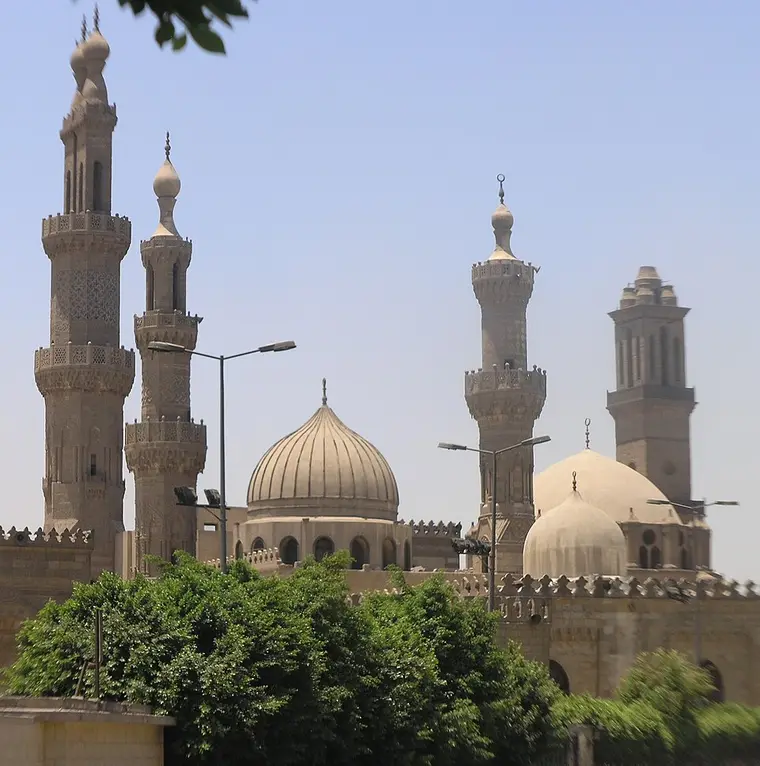
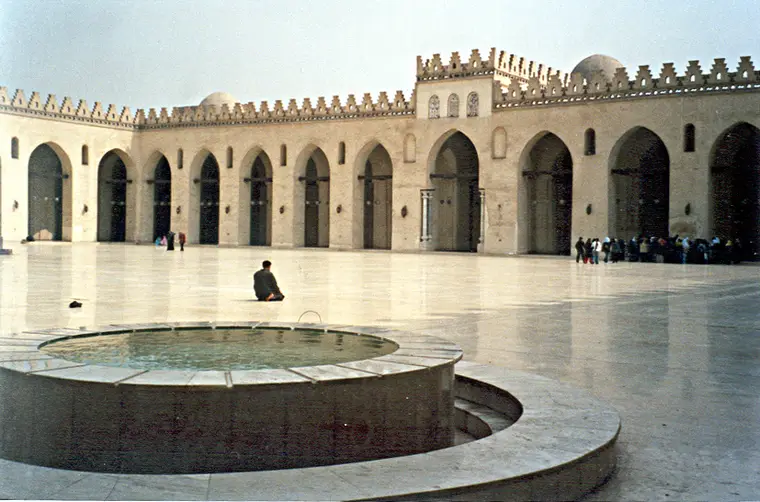
Sources for this chapter (312)Academic31Institution17Specialist book159Reputable web105
Academic(31)
- East-West Orientation of Historical Empires · Journal of World-Systems Research · 2006
- Rein Taagepera · Expansion and Contraction Patterns of Large Polities: Context for Russia · International Studies Quarterly · 1997
- Sabra Al-Mansuriyya And Her Neighbors During The First Half Of The Eleventh Century: Investigations Into Stucco Decoration · Muqarnas · 2009
- Beeson · Cairo, a Millennial · Saudi Aramco World · 1969
- Cortese · The Nile: Its Role in the Fortunes and Misfortunes of the Fatimid Dynasty During its Rule of Egypt (969–1171) · History Compass · 2015
- Talking Hats: What Documents and Textiles Can Tell Us about Each Other · Journal of Material Cultures in the Muslim World · 2023
- Painting in the Fatimid Period: A Reconsideration · Journal of the Royal Asiatic Society · 2022
- Tillier · Droit et messianisme chez les Fatimides de l'an 1000 · L'Eurasie autour de l'an 1000. Cultures, religions et sociétés d'un monde en développement · 2022
- The Turkoman Defeat at Cairo · The American Journal of Semitic Languages and Literatures · 1906
- Podeh · The symbolism of the Arab flag in modern Arab states: between commonality and uniqueness*: The Symbolism of the Arab Flag · Nations and Nationalism · 2011
- Fierro · Dhimmīs in Fatimid Egypt: A View from the Islamic West · Medieval Encounters: Jewish, Christian, and Muslim Culture in Confluence and Dialogue · 2015
- Yarbrough · Medieval Sunni historians on Fatimid policy and non-Muslim influence · Journal of Medieval History · 2019
- Rustow · Jews and the Fāṭimid Caliphate · Al-Masāq · 2021
- Sufism in Fatimid Egypt and The Problem of Historiographical Inertia · Journal of Islamic Studies · 2017
- Lev · Army, Regime, and Society in Fatimid Egypt, 358–487/968–1094 · International Journal of Middle East Studies · 1987
- Lev · The Fatimids and Byzantium, tenth–12th Centuries · Graeco-Arabica · 1995
- Bosworth · A Mediaeval Islamic Prototype of the Fountain Pen? · Journal of Semitic Studies · 1981
- Casanova · Les noms coptes du Caire et localités voisines · Bulletin de l'Institut français d'archéologie orientale · 1901
- Gascoigne · Sherds and the City: Pottery Production, Society, and the Changing Urban Fabric of Fustat, Egypt · Journal of Field Archaeology · 2024
- ROWLAND-SMITH · The Beginnings of Hebrew Printing in Egypt · The British Library Journal · 1989
- Supplement II - Qurʾān Concordance · Brill Online
- Melchert · Ibn Mujahid and the Establishment of Seven Qur'anic Readings · Studia Islamica · 2000
- Volait · The reclaiming of “Belle Époque” Architecture in Egypt (1989-2010): On the Power of Rhetorics in Heritage-Making · ABE Journal. Architecture beyond Europe · 2013
- Khoder · Ambient levels of volatile organic compounds in the atmosphere of Greater Cairo · Atmospheric Environment · 2007
- Black cloud reappears over Cairo · Middle East Online · 2007
- Lead neurotoxicity in children: basic mechanisms and clinical correlates · Brain · 2003
- Abu-Lughod · Tale of Two Cities: The Origins of Modern Cairo · Comparative Studies in Society and History · 1965
- Rescuing Cairo's Lost Heritage · Islamica Magazine · 2006
- Aly · The impact of salt crystallization on the building stones of Al-Azhar Mosque - Historic Cairo – Egypt · International Journal of Conservation Science · 2020
- Ismail K. Poonawala · Review – The Fatimids and Their Traditions of Learning · Journal of the American Oriental Society
- Susanna Myllylä · Islamic Cairo imagined: from a historical city slum to a time machine for tourism? · Building Peace by Intercultural Dialogue
Institution(17)
- Governance and Pluralism under the Fatimids (909–996 CE) · The Institute of Ismaili Studies
- Social Fabrics: Inscribed Textiles from Medieval Egyptian Tombs · 2021
- Daftary · The World of the Fatimids · Aga Khan Museum; The Institute of Ismaili Studies; Hirmer · 2018
- Torky · Khan al-Khalili
- Behrens-Abouseif · The World of the Fatimids · Aga Khan Museum; The Institute of Ismaili Studies; Hirmer · 2018
- The World of the Fatimids · Aga Khan Museum; The Institute of Ismaili Studies; Hirmer · 2018
- Sanders · The World of the Fatimids · Aga Khan Museum; The Institute of Ismaili Studies; Hirmer · 2018
- The World According to GaWC 2016 · Loughborough University · 2017
- Bartel · Return Home: 1346 - 1349 · UC Berkeley, Office of Resources for International and Area Studies
- Ottoman Cairo · The University of Texas Centre for Middle Eastern Studies · 1995
- The Chosen Few: How Education Shaped Jewish History, 70-1492 · Princeton University Press · 2012
- Ain Shams university
- National Museum of Egyptian Civilization opens temporary exhibit, free admission - Museums - Antiquities
- National Museum of Egyptian Civilization(NMEC)
- Life in Modern Cairo
- Dr Farhad Daftary · al-Hakim bi-Amr Allah · Institute of Ismaili Studies · 2011
- Virani · The Ismailis in the Middle Ages · Oxford University Press · 2007
Specialist book(159)
- Lascoste · Ibn Khaldun: The Birth of History and the Past of the Third World · Verso · 1984
- Nanjira · African Foreign Policy and Diplomacy from Antiquity to the 21st Century · ABC-CLIO · 2010
- Fage · An Atlas of African History · E. Arnold · 1958
- Worldmark Encyclopedia of Cultures and Daily Life: Africa · Gale · 2009
- American University Foreign Area Studies · Algeria, a Country Study · Department of Defense, Department of the Army · 1979
- Abbasid Belles Lettres · Cambridge University Press · 1990
- Wintle · History of Islam · Rough Guides · 2003
- Robert · Worlds Together, Worlds Apart · W. W. Norton & Co., Inc. · 2011
- Baer · Metalwork in Medieval Islamic Art · SUNY Press · 1983
- Hitti, Philip K. · History of The Arabs · Palgrave Macmillan · 1970
- The Aghlabids and their Neighbors: Art and Material Culture in Ninth-Century North Africa · Brill · 2017
- Davis-Secord · Where Three Worlds Met: Sicily in the Early Medieval Mediterranean · Cornell University Press · 2017
- Eustache · Encyclopaedia of Islam · Brill · 2012
- Goldschmidt · A concise history of the Middle East · Westview Press · 2002
- Hillenbrand · Islamic art and architecture · Thames and Hudson · 1999
- Kenneth M. Setton · A History of the Crusades: The First Hundred Years · Univ of Wisconsin Press · 1969
- Allan Trawinski · The Clash of Civilizations · Page Publishing Inc · 2017
- Islamic art and architecture · London : Thames and Hudson · 1999
- Bosworth · The New Islamic Dynasties: A Chronological and Genealogical Manual · Edinburgh University Press · 1996
- Gil · A History of Palestine, 634–1099 · Cambridge University Press · 1997
- Angold · The Cambridge History of Christianity: Volume 5, Eastern Christianity · Cambridge University Press · 2006
- al Juyushi: A Vision of the Fatemiyeen · Graphico Printing Ltd · 2002
- Hathaway · A Tale of Two Factions: Myth, Memory, and Identity in Ottoman Egypt and Yemen · SUNY Press · 2012
- Wilson B. Bishai · Islamic History of the Middle East: Backgrounds, Development, and Fall of the Arab Empire · Allyn and Bacon · 1968
- Le Khan al-Khalili et ses environs: Un centre commercial et artisanal au Caire du XIIIe au XXe siècle · Institut français d'archéologie orientale · 1999
- Williams · Islamic Monuments in Cairo: The Practical Guide · The American University in Cairo Press · 2018
- John Joseph Saunders · A History of Medieval Islam · Routledge · 2002
- Marina Rustow · Heresy and the Politics of Community: The Jews of the Fatimid Caliphate · Cornell University Press · 2014
- Lyster · The Cave Church of Paul the Hermit at the Monastery of St. Pau · Yale University Press · 2013
- N. Swanson · The Coptic Papacy in Islamic Egypt (641–1517) · American Univ in Cairo Press · 2010
- Parsons · The Druze between Palestine and Israel 1947–49 · Springer · 2000
- The History and Religious Heritage of Old Cairo: Its Fortress, Churches, Synagogue, and Mosque · American University in Cairo Press · 2013
- Brett · Egypt and Syria in the Fatimid, Ayyubid and Mamluk Eras IV: Proceedings of the 9th and 10th International Colloquium Organized at the Katholieke Universiteit Leuven in May 2000 and May 2001 · Peeters Publishers · 2005
- Cohen · Jewish Self-Government in Medieval Egypt: The Origins of the Office of the Head of the Jews, ca. 1065–1126 · Princeton University Press · 2014
- R. Cohen · Jewish Self-Government in Medieval Egypt : The Origins of the Office of the Head of the Jews, Ca. 1065-1126 · Princeton University Press · 1980
- Mann · The Jews in Egypt and in Palestine Under the Fatimid Caliphs Vol. I · Oxford University Press · 1920
- Versteegh · The Arabic Language · Edinburgh University Press · 2014
- Naylor · North Africa, Revised Edition: A History from Antiquity to the Present · University of Texas Press · 2015
- Egger · A History of the Muslim World to 1750: The Making of a Civilization · Routledge · 2017
- Bennison · Almoravid and Almohad Empires · Edinburgh University Press · 2017
- Jiwa · The Fatimids: 1 – The Rise of a Muslim Empire · I.B. Tauris (in association with the Institute of Ismaili Studies) · 2017
- Bloom · Encyclopaedia of Islam, Three · Brill
- Bloom · Architecture of the Islamic West: North Africa and the Iberian Peninsula, 700–1800 · Yale University Press · 2020
- Behrens-Absouseif · Islamic Architecture in Cairo: An Introduction · Brill · 1989
- Enthoven · The Tribes and Castes of Bombay · Asian Educational Services · 1922
- Blank · Mullahs on the Mainframe · University of Chicago Press · 2001
- Daftary · The Isma'ilis: Their History and Doctrines · Cambridge University Press · 1992
- Abun-Nasr · A history of the Maghrib in the Islamic period · Cambridge University Press · 1987
- Brett · The Rise of the Fatimids: The World of the Mediterranean and the Middle East in the Fourth Century of the Hijra, Tenth Century CE · BRILL · 2001
- Brett · The Fatimid Empire · Edinburgh University Press · 2017
- Halm · Das Reich des Mahdi: Der Aufstieg der Fatimiden · C.H. Beck · 1991
- Halm · The Empire of the Mahdi: The Rise of the Fatimids · BRILL · 1996
- Alliances and Treaties between Frankish and Muslim Rulers in the Middle East · Brill · 2013
- O'Kane · The Mosques of Egypt · American University of Cairo Press · 2016
- Raymond · Le Caire · Fayard · 1993
- Cairo · Harvard University Press · 2000
- The Chronicle of Ibn al-Athir for the Crusading Period from al-Kamil fi'l-Ta'rikh. Part 1: The Years 491–541/1097–1146: The Coming of the Franks and the Muslim Response · Routledge · 2017
- Sanders · Ritual, Politics, and the City in Fatimid Cairo · State University of New York Press · 1994
- Walker · Exploring an Islamic Empire: Fatimid History and its Sources · I.B. Tauris · 2002
- Langer · An Encyclopedia of World History: Ancient, Medieval, and Modern, Chronologically Arranged · Houghton Mifflin · 1968
- M. Th. Houtsma, T.W. Arnold · Biographical Encyclopaedia of Islam, Volume 3 · Cosmo Publications · 2006
- The Bible in Africa: transactions, trajectories, and trends · Brill · 2000
- Gibb · The Encyclopaedia of Islam · Brill · 1979
- A History of Eastern Christianity, by Aziz Suryal Atiya · Taylor & Francis · 1968
- The Mamluks in Egyptian politics and society · Cambridge University Press · 1999
- Women and the Fatimids in the World of Islam · Edinburgh University Press · 2006
- Towards a Shi'i Mediterranean Empire: Fatimid Egypt and the Founding of Cairo. The Reign of Imam-Caliph al-Muʿizz, from al-Maqrīzī's Ittiʿāẓ al-ḥunafāʾ · I.B. Tauris · 2009
- The Founder of Cairo: The Fatimid Imam-Caliph al-Mu'izz and his Era · I.B. Tauris · 2013
- UNESCO · The African Film Industry: Trends, challenges and opportunities for growth · UNESCO Publishing · 2021
- Jiwa · The Fatimids: 1 - The Rise of a Muslim Empire · I.B. Tauris (in association with the Institute of Ismaili Studies) · 2017
- Towards a Shi'i Mediterranean Empire: Fatimid Egypt and the Founding of Cairo · I.B. Tauris · 2009
- Crum · Catalogue of the Coptic manuscripts in the collection of the John Rylands library, Manchester · 1909
- Amelineau · La Géographie de l'Egypte À l'Époque Copte · 1980
- The Grove Encyclopedia of Islamic Art and Architecture · Oxford University Press · 2009
- Snape · The Complete Cities of Ancient Egypt · Thames & Hudson · 2014
- Stanley · Cities of the Middle East and North Africa: A Historical Encyclopedia · ABC-CLIO · 2007
- Meinardus · Two Thousand Years of Coptic Christianity · American University in Cairo Press · 1999
- Campanini · The Oxford Dictionary of Islam · Oxford University Press · 2003
- Cairo: Histories of a City · Harvard University Press · 2013
- Ruggles · Tree of pearls: The extraordinary architectural patronage of the 13th-century Egyptian slave-queen Shajar al-Durr · Oxford University Press · 2020
- Rippin, Andrew · The Blackwell companion to the Qur'an · Blackwell · 2006
- Gender and Muslim Constructions of Exegetical Authority · BRILL · 2015
- Ali · The Routledge Handbook of Planning Megacities in the Global South · Routledge · 2020
- United Nations Economic Commission for Africa · Economic Report on Africa 2017: Urbanization and Industrialization for Africa's Transformation · United Nations · 2017
- Sims · Egypt's Desert Dreams: Development or Disaster? · American University in Cairo Press · 2018
- Sims · Understanding Cairo: The Logic of a City Out of Control · American University in Cairo Press · 2011
- Recensement général de l'Égypte, 15 Gamad Akher 1299 / 3 mai 1882 · Imprimerie Nationale de Boulaq · 1884
- The census of Egypt taken in 1907 · National Printing Department · 1909
- Meinardus · Christian Egypt, Ancient and Modern · American University in Cairo Press · 1977
- The Cambridge History of Christianity: Volume 5: Eastern Christianity · Cambridge University Press · 2006
- Travel Cairo · MobileReference · 2007
- Images of Enchantment: Visual and Performing Arts of the Middle East · American Univ in Cairo Press · 1998
- A Companion to Islamic Art and Architecture · Wiley Blackwell · 2017
- The Middle East: From the End of Empire to the End of the Cold War · Routledge · 1997
- Abu-Lughod · Cairo: 1001 Years of the City Victorious · Princeton University Press · 1971
- Egypt in the Reign of Muhammad Ali · Cambridge University Press · 1984
- AlSayyad · Cairo: Histories of a City · The Belknap Press of Harvard University Press · 2011
- Battuta · The Travels of Ibn Battuta · Cosimo Classics
- Behrens-Abouseif · Islamic Architecture in Cairo: An Introduction · E.J. Brill · 1989
- Behrens-Abouseif · Cairo of the Mamluks: A History of Architecture and its Culture · The American University in Cairo Press · 2007
- The Qur'an in its Historical Context · Routledge · 2008
- Byrne · The Black Death · Greenwood Publishing Group · 2004
- Clot · L'Égypte des Mamelouks: L'empire des esclaves, 1250–1517 · Perrin · 1996
- Collins · The Nile · Yale University Press · 2002
- The Cambridge History of Egypt: Islamic Egypt, 640–1517 · Cambridge University Press · 1998
- Elshahed · Cairo Since 1900: An Architectural Guide · American University in Cairo Press · 2020
- Elyachar · Markets of Dispossession: NGOs, Economic Development, and the State in Cairo · Duke University Press · 2005
- The New Encyclopedia of Islam · Tien Wah Press · 2003
- Golia · Cairo: city of sand · Reaktion Books · 2004
- Egyptology at the Dawn of the Twenty-First Century: Archaeology · American University in Cairo · 2003
- The Modern Middle East: A Reader · I.B. Tauris · 2004
- An Economic and Social History of the Ottoman Empire · Cambridge University Press · 1997
- Kennedy · The Great Arab Conquests: How the Spread of Islam Changed the World We Live in · Da Capo Press · 2007
- McGregor · A Military History of Modern Egypt: From the Ottoman Conquest to the Ramadan War · Greenwood Publishing Group · 2006
- Medieval Islamic Civilization: An Encyclopedia · Taylor & Francis · 2006
- Lonely Planet Egypt · Lonely Planet · 2012
- Le Caire · Fayard · 1993
- Raymond · Cairo · Harvard University Press · 2000
- Shillington · Encyclopedia of African History · Taylor & Francis · 2005
- Shoshan · Popular Culture in Medieval Cairo · Cambridge University Press · 2002
- Sicker · The Islamic World in Decline: From the Treaty of Karlowitz to the Disintegration of the Ottoman Empire · Greenwood Publishing Group · 2001
- Swelim · Ibn Tulun: His Lost City and Great Mosque · The American University in Cairo Press · 2015
- Cairo - a City in Transition · UN-Habitat · 2011
- Islamic Monuments in Cairo: The Practical Guide · The American University in Cairo Press · 2008
- Winter · Egyptian Society Under Ottoman Rule, 1517–1798 · Routledge · 1992
- Beattie · Cairo: A Cultural History · Oxford University Press · 2005
- Butler · The Arab Conquest of Egypt – And the Last Thirty Years of the Roman Dominion · Butler Press · 2008
- Food and Foodways of Medieval Cairenes · 2011
- Sanders · Creating Medieval Cairo: Empire, Religion, and Architectural Preservation in Nineteenth-century Egypt · American University in Cairo Press · 2008
- Routledge Handbook of Sustainable Heritage · Taylor & Francis · 2022
- Willi Frischauer · The Aga Khans · Bodley Head · 1970
- Walker, Paul · Caliph of Cairo: Al-Hakim bi-Amr Allah, 996–??? · The American University in Cairo Press · 2010
- Jerome Murphy-O'Connor · Keys to Jerusalem: Collected Essays · OUP Oxford · 2012
- Ahmed (Sheikh.) · Muslim Architecture: From the Advent of Islam in Arabia to the Rise of the Great Ummayad Khilafat in Spain · Pakistan Institute of Arts and Design of Book-Production · 1974
- Phyllis G. Jestice · Holy People of the World: A Cross-cultural Encyclopedia · ABC-CLIO · 2004
- Delia Cortese and Simonetta Calderini · Women and the Fatimids in the World of Islam · Edinburgh University Press · 2006
- O'Leary · A Short History of the Fatimid Khalifate · Routledge · 1923
- Shen, Fuwei · Cultural flow between China and the outside world · Beijing: Foreign Languages Press · 1996
- Corduan · Neighboring Faiths: A Christian Introduction to World Religions · InterVarsity Press · 2013
- Makarim · The Druze faith · Caravan Books · 1974
- The Unforgettable Queens of Islam: Succession, Authority, Gender · Cambridge University Press · 2020
- Hunt Janin · The Pursuit of Learning in the Islamic World, 610–2003 · McFarland & Company Inc · 2005
- Michael Bonner · Jihad in Islamic History: Doctrines and Practice · Princeton University Press · 2006
- Michael Foss · People of the First Crusade: The Truth About the Christian-Muslim War Revealed · Arcade Publishing · 1997
- Wilferd Madelung · Journal of Near Eastern Studies · 2013
- Saifiyah · al-Jāmiʻ al-Anwar: The Luminous Masjid · Aljamea-tus-Saifiyah · 2016
- The World's Greatest Religious Leaders: How Religious Figures Helped Shape World History [2 volumes] · ABC-CLIO · 2018
- Nissim Dana · The Druze in the Middle East: Their Faith, Leadership, Identity and Status · Sussex Academic Press · 2003
- Stillman · Arab Dress: A Short History - From the Dawn of Islam to Modern Times · Brill Publishers · 2000
- Palestine Across Millennia: A History of Literacy, Learning and Educational Revolutions · Bloomsbury Publishing · 2022
- Christian-Muslim Relations. A Bibliographical History. Volume 2 (900–1050) · Brill · 2010
- Sir Thomas Walker Arnold · The preaching of Islam: a history of the propagation of the Muslim faith · A. Constable and co. · 1896
- Mordechai Nisan · Minorities in the Middle East: A History of Struggle and Self-expression · McFarland · 2002
- Cherine Badawi · Egypt · Footprint · 2004
- Zeidan Atashi · Druze and Jews in Israel: A Shared Destiny? · Sussex Academic Press · 1997
- Swayd · Historical dictionary of the Druzes · Scarecrow Press · 2006
- Swayd · The Druzes: an annotated bibliography · ISES Publications · 1998
- Damas et la Syrie sous la domination fatimide (359–468/969–1076): essai d'interprétation de chroniques arabes médiévales. Tome premier · Institut français de Damas · 1986
- Vatikiotis · The Fatimid Theory of State · Orientalia Publishers · 1957
Reputable web(105)
- Rock Crystal Ewer from the Keir Collection | DMA Content Management System
- Stewart · Encyclopaedia of Islam · Brill · 2007
- Al-Aqmar Mosque
- Fatimid Al-Aqmar mosque in Cairo
- Rebecca Erickson · The Druze
- At least 8 killed in building collapse in Cairo · 2024
- Gite · Beyond pyramids: Cairo is more than the land of Pharaohs · Network18 · 2025
- Egypt: Governorates, Major Cities & Towns - Population Statistics, Maps, Charts, Weather and Web Information
- Major Agglomerations of the World - Population Statistics and Maps
- TelluBase—Egypt Fact Sheet (Tellusant Public Service Series) · Tellusant
- Santa Maria Tours · Cairo – "Al-Qahira" – is Egypt's capital and the largest city in the Middle East and Africa. · PRLog · 2009
- World's Densest Cities - Forbes.com
- Historic Cairo
- Yonga · About Egyptian Exchange - african markets · 2020
- Richard · JDP Global Expands to Cairo, Egypt – JDP Global
- Academy · What Are the 15 Oldest Universities in the World? · 2023
- Herve · APM Economic Forum in Cairo: A Lever for African Growth · 2025
- A City of Millionaires: How Cairo Became North Africa's Richest Metropolis · 2025
- الشرق الأوسط
- Strategic Development of Greater Cairo - English Version | UN-Habitat
- Brandon Joseph
- Transport and Communications-SIS
- Cairo's third metro line beats challenges
- Cairo Metro Statistics
- The 2010 Global Cities Index
- City Mayors reviews the richest cities in the world in 2005
- Egypt ranks as second-largest economy in Africa by GDP in 2025 | IMF · 2025
- Egypt Retains Rank as Africa's Second-Largest Economy in 2025
- Zondi · EGYPT’S CAIRO CROWNED AFRICA’S MOST ATTRACTIVE CITY FOR 2025 · 2025
- Cairo Ranked as 'Top Business City in Africa' by Germany's Statista
- Cairo tops business cities in Africa in 2022: Cabinet - Economy - Business
- Ⲡⲓⲫⲓⲣⲓ ⲛ̀ⲧⲉ ϯⲁⲅⲓⲁ ⲙ̀ⲙⲏⲓ Ⲃⲉⲣⲏⲛⲁ · coptic.org
- Al-Ahram Weekly | Features | City of the sun · Weekly.ahram.org.eg · 2005
- Memphis (Egypt) · Microsoft · 2009
- National Geophysical Data Center / World Data Service (NGDC/WDS): NCEI/WDS Global Significant Earthquake Database. NOAA National Centers for Environmental Information · Significant Earthquake Information · NOAA National Centers for Environmental Information · 1972
- Egyptians report poor communication services on Day of Anger · Almasry Alyoum · 2011
- cairo to suez - Wolfram|Alpha
- Cairo Maps · Cairo Governorate
- Brinkhoff · Egypt: Governorates & Cities · City Population
- Ten Facts about Cairo, Egypt · About.com · 2011
- Egypte. Pollution: Forbes fâche les autorités du Caire · 2018
- World Map of Köppen-Geiger Climate Classification · Köppen-Geiger
- Sarajevo Climate Normals 1961–1990 · National Oceanic and Atmospheric Administration
- The strategic urban development master plan study for a sustainable development of the Greater Cairo region in the Arab Republic of Egypt : final report; Vol. 2. -Main report : strategic urban development master plan
- Regions
- Northern Area
- Eastern Area
- Areas
- Southern Area
- Capital Gardens
- Cairo population
- Central Agency for Public Mobilisation and Statistics (CAPMAS) · 2017 Census for Population and Housing Conditions · 2017
- People of Cairo
- 2022 Report on International Religious Freedom: Egypt · 2022
- Hackett · How many Christians are there in Egypt? · 2011
- 50 years on St Mark's, Pope consecrates renovated Cathedral · 2018
- Shawkat · How Egypt's last Jews will mark Hanukkah, and make sure their culture doesn't "disappear" with them · 2022
- Arab American Vehicles Co · Aav.com.eg
- Ghabbourauto.com · Ghabbourauto.com
- Welcome to MCV Web Site · Mcv-eg.com
- TradeHolding.com B2B Network · Panda, Buy from Mod Car. Egypt – Ash Sharqiyah – Middle East Business B2B Directory – Saudi Arabia, UAE, Bahrain Companies, Middle East Businesses, Products & Trade Leads, Arab Business · Gulfbusiness.tradeholding.com
- Seoudi Group 1001 opportunities for investment in Egypt and Arab World · Seoudi.com
- اسبرانزا ايجيبت · Speranza Egypt
- Welcome to Daewoo Motor Website · Aboulfotouh.com
- As-Salam International Hospital | Cairo
- Dar al Fouad Hospital | Leading hospital in Egypt and Middle East
- Children's Cancer Hospital Egypt 57357(CCHE) website
- "القومية للأنفاق" تقرر إلغاء وصلة مترو مطار القاهرة وتستبدله بـ"شاتل باص" · 2020
- On Cairo's dying trams
- Tawfeek · Egypt to build country's first ever monorail in Cairo · 2017
- Egypt becomes first country to debut new intercity Uber bus service · 2020
- SWVL: An Egyptian Startup out to Reinvent Urban Mass Transit | Egyptian Streets · 2017
- Reem Leila · Reaching an impasse · Weekly.ahram.org.eg · 2006
- Cairo taxi drivers press demands to shut down Uber, Careem - Politics - Egypt
- Bolt launches its ride-hailing operations in Cairo — Trade with Estonia · 2024
- Chinese ride sharing app Didi Chuxing to operate in Egypt mid-September · 2021
- Cairo International Film Festival - Short Film Competition
- Sport in Egypt
- FIFA
- Report of the IOC Evaluation Commission for the Games of the XXIX Olympiad in 2008 · International Olympic Committee · 2000
- The 11th Arab Games
- CAF - Confedération Africaine du Football · CAFOnline.com
- Welcome to the website of the Egyptian Rugby Football Union (ERFU)!
- LoRé · Why Egyptians Are so Dominant at Squash · 2018
- Cross Egypt Challenge
- Tahrir Square soon to boast ancient obelisk and stone rams · 2020
- Egypt Defies Archaeologists' Protests by Relocating Four Ancient Sphinxes
- Under Constraction
- Main Gallery - NMEC Objects shows Egyptian civilization
- Ask-Aladdin · Cairo Tower | Cairo Tower, Egypt Cairo Tower | Cairo Tower information | Cairo Tower Facts - AskAladdin
- Toler · In Fragments from Fustat, Glimpses of a Cosmopolitan Old Cairo · 2016
- Islamic Egypt's first capital under threat · 2014
- Egypt's #MeToo Activists See Progress, but 'the Road Ahead Is Long' · 2020
- Holidays to Cairo | Egyptian Holidays | Africa Odyssey
- Cairo traffic is much more than a nuisance
- Battling Cairo's traffic congestion · 2016
- Whittaker-Wood · The Most Polluted Cities in the World · The Eco Experts · 2018
- A black cloud over Cairo | Earthdata
- Brotherhood & Friendship Agreements · Cairo
- Al-Azhar Mosque shines after years-long restoration - Politics - Egypt
- Al-Mashareq · Al-Sisi, Saudi Crown Prince inaugurate Al-Azhar Mosque renovation
- Daftary · ḤĀKEM BE-AMR-ALLĀH
- Gamal Nkrumah · The crazed caliph · Al-Ahram Weekly Online · 2009
- Sara Elkamel · Caliph of Cairo: The rule and mysterious disappearance of al-Hakim bi-Amr Allah · Egypt Independent · 2010
- Cairo's House of Knowledge
Every ancient date is an estimate. Scholarly chronologies differ by decades, and by more the further back you go, which is why each figure carries a tilde. When a period is published we name the chronology its dates come from.
In this period
In this period
176 minutes in total- 01Introduction3 min read
- 02Name1 min read
- 03History41 min read
- 04Dynasty1 min read
- 05Society8 min read
- 06Military system2 min read
- 07Capital cities3 min read
- 08Art and architecture1 min read
- 09Legacy1 min read
- 10Al-Muizz li-Din Allah5 min read
- 11Cairo51 min read
- 12Al-Azhar Mosque40 min read
- 13Al-Hakim bi-Amr Allah19 min read