The New Kingdom
~1550 – ~1069 BCEDynasties 18–20
15 chapters · 287 min read · 657 sources
~1550 BCE
Introduction
1 min readThe New Kingdom, also called the Egyptian Empire, refers to ancient Egypt between the 16th century BC and the 11th century BC. This period of ancient Egyptian history covers the Eighteenth, Nineteenth, and Twentieth…The New Kingdom, also called the Egyptian Empire, refers to ancient Egypt between the 16th century BC and the 11th century BC. This period of ancient Egyptian history covers the Eighteenth, Nineteenth, and Twentieth dynasties. Through radiocarbon dating, the establishment of the New Kingdom has been placed between 1570 and 1544 BC. The New Kingdom followed the Second Intermediate Period and was succeeded by the Third Intermediate Period. It was the most prosperous time for ancient Egypt and marked the peak of its power.
In 1845, the concept of a "New Kingdom" as one of three "golden ages" was coined by German scholar Christian Charles Josias von Bunsen; the original definition would evolve significantly throughout the 19th and 20th centuries. The later part of this period, under the Nineteenth Dynasty (1295–1189 BC) and the Twentieth Dynasty (1189–1069 BC), is also known as the Ramesside period. It is named after the eleven pharaohs who took the name Ramesses, after Ramesses I, who founded the Nineteenth Dynasty, and his grandson Ramesses II, who was its longest-reigning monarch.
Possibly as a result of the foreign rule of the Hyksos during the Second Intermediate Period, the New Kingdom saw a historic expansion into the Levant, thus marking Egypt's greatest territorial extent. Similarly, in response to attacks by the Kushites, who led raids into Egypt during the Second Intermediate Period, the rulers of the New Kingdom felt compelled to expand far into Nubia and to hold wider territories in the Near East, particularly on the Levantine frontier.
History
11 min readThe Eighteenth Dynasty included some of Egypt's most famous kings, including Ahmose I, Hatshepsut, Thutmose III, Amenhotep III, Akhenaten, and Tutankhamun.Rise
The Eighteenth Dynasty included some of Egypt's most famous kings, including Ahmose I, Hatshepsut, Thutmose III, Amenhotep III, Akhenaten, and Tutankhamun.
Ahmose I is viewed to be the founder of the eighteenth dynasty. He continued the campaigns of his father Seqenenre Tao and of Kamose against the Hyksos until he reunified the country once more. Ahmose would then continue to campaign in the Levant, the home of the Hyksos, to prevent any future invasions on Egypt.
Ahmose was followed by Amenhotep I, who campaigned in Nubia and was followed by Thutmose I. Thutmose I campaigned in the Levant and reached as far as the Euphrates, thus becoming the first pharaoh to cross the river. During this campaign, the Syrian princes declared allegiance to Thutmose. However, after he returned, they discontinued tribute and began fortifying against future incursions.
Hatshepsut was one of the most powerful pharaohs of this dynasty. She was the daughter of Thutmose I and the royal wife of Thutmose II. Upon the death of her husband, she ruled jointly with his son by a minor wife, Thutmose III, who had ascended to the throne as a child of about two years of age, but eventually she ruled in her own right. Hatshepsut built extensively in the Karnak temple in Luxor and throughout all of Egypt and she re-established the trade networks that had been disrupted during the Hyksos rule of Lower Egypt during the Second Intermediate Period, thereby building the wealth of the Eighteenth Dynasty. She oversaw the preparations and funding for a mission to the Land of Punt. After her death, having gained valuable experience heading up the military for Hatshepsut, Thutmose III assumed rule.
Thutmose III expanded Egypt's army and wielded it with great success to consolidate the empire created by his predecessors. This resulted in a peak in Egypt's power and wealth during the reign of Amenhotep III. The term pharaoh, originally the name of the king's palace, became a form of address for the person who was king during his reign (–1425 BC).
Widely considered a military genius by historians, Thutmose III conducted at least 16 campaigns in 20 years. He was an active expansionist ruler. He is recorded to have captured 350 cities during his rule and conquered much of the Near East from the Euphrates to Nubia during seventeen known military campaigns. He was the first pharaoh after Thutmose I to cross the Euphrates, doing so during his campaign against Mitanni. He continued north through the territory belonging to the still unconquered cities of Aleppo and Carchemish and quickly crossed the Euphrates in his boats, taking the Mitannian king entirely by surprise.
The wealthiest of all the kings of this dynasty is Amenhotep III, who built the Luxor Temple, the Precinct of Monthu at Karnak and his massive Mortuary Temple. Amenhotep III also built the Malkata palace, the largest built in Egypt.
One of the best-known eighteenth dynasty pharaohs is Amenhotep IV, who changed his name to Akhenaten in honour of the Aten, a representation of the Egyptian god, Ra. His worship of the Aten as his personal deity is often interpreted as history's first instance of monotheism. Akhenaten's wife, Nefertiti, contributed a great deal to his new direction in the Egyptian religion. Nefertiti was bold enough to perform rituals to Aten. Akhenaten's religious fervour is cited as the reason why he and his wife were subsequently written out of Egyptian history. Under his reign, in the fourteenth century BC, Egyptian art flourished in a distinctive new style (see Amarna Period).
By the end of the Eighteenth Dynasty, Egypt's status had changed radically. Aided by Akhenaten's apparent lack of interest in international affairs, the Hittites had gradually extended their influence into the Levant to become a major power in international politics—a power that both Seti I and his son Ramesses II would confront during the nineteenth Dynasty.
The last two members of the Eighteenth Dynasty—Ay and Horemheb—became rulers from the ranks of officials in the royal court, although Ay might also have been the maternal uncle of Akhenaten and a fellow descendant of Yuya and Tjuyu.
Ay may have married the widowed Great Royal Wife and young half-sister of Tutankhamun, Ankhesenamun, in order to obtain power; she did not live long afterward. Ay then married Tey, who originally had been wet-nurse to Nefertiti.
Ay's reign was short. His successor was Horemheb, a general during the reign of Tutankhamun, whom the pharaoh may have intended as his successor in the event that he had no surviving children, which came to pass. Horemheb may have taken the throne away from Ay in a coup d'état. Although Ay's son or stepson Nakhtmin was named as his father or stepfather's Crown Prince, Nakhtmin seems to have died during the reign of Ay, leaving the opportunity for Horemheb to claim the throne next.
Horemheb also died without surviving children, having appointed his vizier, Pa-ra-mes-su, as his heir. This vizier ascended the throne in 1292 BC as Ramesses I, and was the first pharaoh of the Nineteenth Dynasty.
Height of power
The Nineteenth Dynasty was founded by the Vizier Ramesses I, whom the last ruler of the eighteenth dynasty, Pharaoh Horemheb, had chosen as his successor. His brief reign marked a transition period between the reign of Horemheb and the powerful pharaohs of this dynasty, in particular, his son Seti I and grandson Ramesses II, who would bring Egypt to new heights of imperial power.
Seti I fought a series of wars in western Asia, Libya, and Nubia in the first decade of his reign. The main source for knowledge of Seti's military activities are his battle scenes on the north exterior wall of the Karnak Hypostyle Hall, along with several royal stelas with inscriptions mentioning battles in Canaan and Nubia. The greatest achievement of Seti I's foreign policy was the capture of the Syrian town of Kadesh and neighboring territory of Amurru from the Hittite Empire. Egypt had not held Kadesh since the time of Akhenaten. Seti I was successful in defeating a Hittite army that tried to defend the town and erected a victory stela at the site which has been found by archaeologists. Kadesh, however, soon reverted to Hittite control because the Egyptians did not or could not maintain a permanent military occupation of Kadesh and Amurru which were close to the Hittite homelands.
Ramesses II sought to recover territories in the Levant that had been held by the 18th Dynasty. In his second year, before confronting the Hittites, Ramesses II had to deal with a raid by the Sherden sea people whom he defeated and incorporated into his army. His campaigns against the Hittites culminated in the Battle of Kadesh, where he led Egyptian armies against those of the Hittite king Muwatalli II. Ramesses was caught in history's first recorded military ambush, although he was able to rally his troops and turn the tide of battle against the Hittites thanks to the arrival of the Ne'arin (possibly mercenaries in the employ of Egypt). The outcome of the battle was undecided, with both sides claiming victory at their home front, and ultimately resulting in a peace treaty between the two governments. He campaigned later in the Levant capturing Edom and Moab. New kingdom Egyptian stelae from this period have been found in Jordan. Later, Egyptians conquered Qatna and Tunip where a statue of Ramses II was erected. Thus he recaptured Qadesh and northern Amurru. Nevertheless, like Seti I, he found that he could not permanently hold territory so far from base and after years of conflict, a peace treaty was concluded between the two states. Egypt was able to obtain wealth and stability under the rule of Ramesses, for more than half a century. His immediate successors continued the military campaigns, although an increasingly troubled court—which at one point put a usurper (Amenmesse) on the throne—made it increasingly difficult for a pharaoh to effectively retain control of the territories.
Ramesses II built extensively throughout Egypt and Nubia, and his cartouches are prominently displayed, even in buildings that he did not construct. There are accounts of his honor hewn on stone, statues, and the remains of palaces and temples—most notably the Ramesseum in western Thebes and the rock temples of Abu Simbel. He covered the land from the Delta to Nubia with buildings in a way no king before him had. He also founded a new capital city in the Delta during his reign, called Pi-Ramesses. It previously had served as a summer palace during the reign of Seti I.
Ramesses II constructed many large monuments, including the archaeological complex of Abu Simbel, and the Mortuary temple known as the Ramesseum. He built on a monumental scale to ensure that his legacy would survive the ravages of time. Ramesses used art as a means of propaganda for his victories over foreigners, which are depicted on numerous temple reliefs. Ramesses II erected more colossal statues of himself than any other pharaoh, and also usurped many existing statues by inscribing his own cartouche on them.
Ramesses II was also famed for the huge number of children he sired by his various wives and concubines; the tomb he built for his sons (many of whom he outlived) in the Valley of the Kings has proven to be the largest funerary complex in Egypt.
Civil war
The immediate successors of Ramesses II continued the military campaigns although an increasingly troubled court complicated matters. He was succeeded by his son Merneptah and then by Merneptah's son Seti II. Seti II's right to the throne seems to have been disputed by his half-brother Amenmesse, who may have temporarily ruled from Thebes.
Upon his death, Seti II's son Siptah, who may have been afflicted with poliomyelitis during his life, was appointed to the throne by Bay, a chancellor and a West Asian commoner who served as vizier behind the scenes. Siptah died early and throne was assumed by Twosret, who was the royal wife of his father and, possibly, his uncle Amenmesse's sister.
A period of anarchy at the end of Twosret's short reign saw the enthronement of Setnakhte, establishing the Twentieth Dynasty.
Final years
The last "great" pharaoh from the New Kingdom is widely considered to be Ramesses III, a Twentieth Dynasty pharaoh who reigned several decades after Ramesses II.
In the eighth year of his reign, the Sea Peoples invaded Egypt by land and sea. Ramesses III defeated them in two great land and sea battles (the Battle of Djahy and the Battle of the Delta). He incorporated them as subject peoples and is thought to have settled them in Southern Canaan, although there is evidence that they forced their way into Canaan. Their presence in Canaan may have contributed to the formation of new states, such as the Philistian pentapolis, in this region after the collapse of the Egyptian Empire (In the reign of Ramses III himself, Egyptian presence in the Levant is still attested as far as Byblos). He later was compelled to fight invading Libyan tribesmen in two major campaigns in Egypt's Western Delta in his sixth year and eleventh year respectively.
The heavy cost of this warfare slowly drained Egypt's treasury and contributed to the gradual decline of the Egyptian Empire in Asia. The severity of the difficulties is indicated by the fact that the first known labour strike in recorded history occurred during the twenty-ninth year of Ramesses III's reign. At that time, the food rations for Egypt's favoured and elite royal tomb-builders and artisans in the village of Deir el Medina could not be provisioned. Air pollution limited the amount of sunlight penetrating the atmosphere, affecting agricultural production and arresting global tree growth for almost two full decades, until 1140 BC. One proposed cause is the Hekla 3 eruption of the Hekla volcano in Iceland, but the dating of this remains disputed.
Near the end of Ramesses III's reign, one of his secondary wives plotted to assassinate the king in her quest to place her son on the throne. Palace personnel, the harem, government officials, and army officers participated in the plot. A special court of 12 judges was formed to try the defendants who were sentenced to death. Written sources show that the coup failed and that the conspirators were successfully tried. However, it is not clear from the documents whether Ramses survived the assassination attempt. The king's mummy showed no visible wounds, and questions about his fate were left open to speculation for many years. In 2012, researchers announced that a CT scan had revealed a deep knife wound in the mummy's throat, indicating that Ramesses was indeed killed by the conspirators. He died in Thebes in the 32nd year of his reign and was succeeded by Crown Prince Ramesses IV.
A number of raids by the Libyans and the Sea Peoples, more dangerous than those during the reign of Ramses III, drew the kingdom to more weakness. This increased the influence of the priests of Amon, which finally led to control of the throne by the great priests.
Decline into the Third Intermediate Period
Ramesses III's death was followed by years of bickering among his heirs. Three of his sons ascended the throne successively as Ramesses IV, Rameses VI, and Rameses VIII. Egypt was increasingly beset by droughts, below-normal flooding of the Nile, famine, civil unrest, and corruption of officials. The power of the last pharaoh of the dynasty, Ramesses XI, grew so weak that in the south the High Priests of Amun at Thebes became the de facto rulers of Upper Egypt, and Smendes controlled Lower Egypt in the north, even before Rameses XI's death. Smendes eventually founded the twenty-first dynasty at Tanis.
Eighteenth Dynasty of Egypt
18 min readThe Eighteenth Dynasty of Egypt (notated Dynasty XVIII, alternatively 18th Dynasty or Dynasty 18) is classified as the first dynasty of the New Kingdom of Egypt, the era in which ancient Egypt achieved the peak of its…The Eighteenth Dynasty of Egypt (notated Dynasty XVIII, alternatively 18th Dynasty or Dynasty 18) is classified as the first dynasty of the New Kingdom of Egypt, the era in which ancient Egypt achieved the peak of its power. The Eighteenth Dynasty spanned the period from 1550/1549 to 1292 BC. This dynasty is also known as the Thutmoside Dynasty for the four pharaohs named Thutmose.
Several of Egypt's most famous pharaohs were from the Eighteenth Dynasty, including Tutankhamun. Other famous pharaohs of the dynasty include Hatshepsut (c. 1479 BC–1458 BC), the longest-reigning woman pharaoh of an indigenous dynasty, and Akhenaten (c. 1353–1336 BC), the "heretic pharaoh", with his Great Royal Wife, Nefertiti.
The Eighteenth Dynasty is unique among indigenous Egyptian dynasties in that it had two queens regnant women who ruled as pharaohs: Hatshepsut and Neferneferuaten, usually identified as Nefertiti.
History
Early Dynasty XVIII
Dynasty XVIII was founded by Ahmose I, the brother or son of Kamose, the last ruler of the 17th Dynasty. Ahmose finished the campaign to expel the Hyksos rulers. His reign is seen as the end of the Second Intermediate Period and the start of the New Kingdom. Ahmose's consort, Queen Ahmose-Nefertari was "arguably the most venerated woman in Egyptian history, and the grandmother of the 18th Dynasty." She was deified after she died. Ahmose was succeeded by his son, Amenhotep I, whose reign was relatively uneventful.
Amenhotep I probably left no male heir and the next pharaoh, Thutmose I, seems to have been related to the royal family through marriage. During his reign, the borders of Egypt's empire reached their greatest expanse, extending in the north to Carchemish on the Euphrates and in the south up to Kanisah Kurgus beyond the fourth cataract of the Nile. Thutmose I was succeeded by Thutmose II and his queen, Hatshepsut, who was the daughter of Thutmose I. After her husband's death and a period of regency for her minor stepson (who would later become pharaoh as Thutmose III) Hatshepsut became pharaoh in her own right and ruled for over twenty years.
Thutmose III, who became known as the greatest military pharaoh ever, also had a lengthy reign after becoming pharaoh. He had a second co-regency in his old age with his son Amenhotep II. Amenhotep II was succeeded by Thutmose IV, who in his turn was followed by his son Amenhotep III, whose reign is seen as a high point in this dynasty.
Amenhotep III's reign was a period of unprecedented prosperity, artistic splendor, and international power, as attested by over 250 statues (more than any other pharaoh) and 200 large stone scarabs discovered from Syria to Nubia. Amenhotep III undertook large scale building programmes, the extent of which can only be compared with those of the much longer reign of Ramesses II during Dynasty XIX. Amenhotep III's consort was the Great Royal Wife Tiye, for whom he built an artificial lake, as described on eleven scarabs.
Akhenaten, the Amarna Period, and Tutankhamun
Amenhotep III may have shared the throne for up to twelve years with his son Amenhotep IV. There is much debate about this proposed co-regency, with different experts considering that there was a lengthy co-regency, a short one, or none at all.
In the fifth year of his reign, Amenhotep IV changed his name to Akhenaten (, "Effective for the Aten") and moved his capital to Amarna, which he named Akhetaten. During the reign of Akhenaten, the Aten (jtn, the sun disk) became, first, the most prominent deity, and eventually came to be considered the only god. Whether this amounted to true monotheism continues to be the subject of debate within the academic community. Some state that Akhenaten created a monotheism, while others point out that he merely suppressed a dominant solar cult by the assertion of another, while he never completely abandoned several other traditional deities.
Later Egyptians considered this "Amarna Period" an unfortunate aberration. After his death, Akhenaten was succeeded by two short-lived pharaohs, Smenkhkare and Neferneferuaten, of which little is known. In 1334 BC, Akhenaten's probable son, Tutankhaten, ascended to the throne: shortly after, he restored Egyptian polytheist cult and subsequently changed his name to Tutankhamun, in honor to the Egyptian god Amun. His infant daughters represent the final genetically related generation of the Eighteenth Dynasty.
Ay and Horemheb
The last two members of the Eighteenth Dynasty—Ay and Horemheb—became rulers from the ranks of officials in the royal court, although Ay might also have been the maternal uncle of Akhenaten as a fellow descendant of Yuya and Tjuyu.
Ay may have married the widowed Great Royal Wife and presumed half-sister of Tutankhamun, Ankhesenamun, in order to obtain power; she did not live long afterward, with Ay instead ascending to the throne with his long-time wife Tey, who was originally Nefertiti's wet-nurse.
Ay's reign was short. His successor was Horemheb, a general who appeared to have been Tutankhamun's heir presumptive, and whose wife Mutnedjmet might have been sister of the former queen Nefertiti. It is possible that Horemheb took throne away from Ay in a coup d'état. Although Ay's son or stepson Nakhtmin was named as his father/stepfather's Crown Prince, Nakhtmin seems to have died during the reign of Ay, leaving the opportunity for Horemheb to claim the throne next.
Horemheb also died without surviving children, having appointed his vizier, Pa-ra-mes-su, as his heir. This vizier ascended the throne in 1292 BC as Ramesses I, and was the first pharaoh of the Nineteenth Dynasty.
This example to the right depicts a man named Ay who achieved the exalted religious positions of Second Prophet of Amun and High Priest of Mut at Thebes. His career flourished during the reign of Tutankhamun, when the statue was made. The cartouches of King Ay, Tutankhamun's successor appearing on the statue, were an attempt by an artisan to "update" the sculpture.
Relations with Nubia
The Eighteenth Dynasty empire conquered all of Lower Nubia under Thutmose I. By the reign of Thutmose III, the Egyptians directly controlled Nubia to the Nile river, 4th cataract, with Egyptian influence / tributaries extending beyond this point. The Egyptians referred to the area as Kush and it was administered by the Viceroy of Kush. The 18th dynasty obtained Nubian gold, animal skins, ivory, ebony, cattle, and horses, which were of exceptional quality. The Egyptians built temples throughout Nubia. One of the largest and most important temples was dedicated to Amun at Jebel Barkal in the city of Napata. This Temple of Amun was enlarged by later Egyptian and Nubian Pharaohs, such as Taharqa.
Relations with the Near-East
After the end of the Hyksos period of foreign rule, the Eighteenth Dynasty engaged in a vigorous phase of expansionism, conquering vast areas of the Near-East, with especially Pharaoh Thutmose III submitting the "Shasu" Bedouins of northern Canaan, and the land of Retjenu, as far as Syria and Mittani in numerous military campaigns circa 1450 BC.
Anthropological and genetic data
A 1973 X-ray examination of southern king, Seqenenre Tao, by American Egyptologists, Kent Weeks and James E. Harris identified cranial similarities between his cranio-facial complex along with other Nubian and Old Kingdom Giza Skulls. In their view, this was supportive of scholarly interpretations that Sequenre Tao and his family may have held Nubian ancestry.
Robins and Shute (1983) performed X-ray measurements on the physical proportions of Upper Egyptian rulers such as Thutmose III, Amenhotep III, Tutankhamun. The authors reported that the limbs of the pharaohs, like those of other Ancient Egyptians, had "negroid characteristics", in that the distal segments were relatively long in comparison with the proximal segments. An exception was Ramesses II, who appears to have had short legs below the knees.
James Harris and Fawzia Hussien (1991) conducted an X-ray survey on southern based 18th dynasty royal mummies and examined the mummified remains of Thutmose II. The results of the study determined that the mummy of Thutmose II had a craniofacial trait measurement that was common among Nubian populations.
A genetic study, published in 2020, revealed Tutankhamun had the haplogroups YDNA R1b, which originated in western Asia and which today makes up 50–60% of the genetic pool of modern Europeans, and mtDNA K, which originated in the Near East. He shares this Y-haplogroup with his father, the KV55 mummy (Akhenaten), and grandfather, Amenhotep III (and his entire male ancestral line), and his mtDNA haplogroup with his mother, The Younger Lady, his grandmother, Tiye, and his great-grandmother, Thuya (and his entire female ancestral line). The profiles for Tutankhamun and Amenhotep III were incomplete, and the analysis produced differing probability figures despite having concordant allele results. Because the relationships of these two mummies with the KV55 mummy had previously been confirmed in an earlier study, the haplogroup prediction of both mummies could be derived from the full profile of the KV55 data.
In 2022, S.O.Y. Keita analysed 8 Short Tandem loci (STR) data originally published by Hawass et al. in studies from 2010 and 2012. The first of these studies had investigated familial relationships among 11 royal mummies of the New Kingdom, which included Tutankhamun and Amenhotep III, as well as potential inherited disorders and infectious diseases. The second of these studies had investigated the Y-haplogroups and genetic kinship of Ramesses III and an unknown man buried along with him in the royal cache at Deir el Bahari. Keita analysed the STR data from these studies using an algorithm that only has three choices: Eurasians, sub-Saharan Africans, and East Asians. Using these three options, Keita concluded that the majority of the samples had a population "affinity with 'sub-Saharan' Africans in one affinity analysis". However, Keita cautioned that this does not mean that the royal mummies "lacked other affiliations", which he argued had been obscured in typological thinking. Keita further added that different "data and algorithms might give different results", reflecting the complexity of biological heritage and the associated interpretation.
According to historian William Stiebling and archaeologist Susan N. Helft, (2023) conflicting DNA analysis on recent genetic samples such as the Amarna royal mummies has led to a lack of consensus on the genetic makeup of the ancient Egyptians and their geographic origins.
In 2025, biochemist Jean-Philippe Gourdine reviewed genetic data on the Ancient Egyptian populations in the international scholarly publication, General History of Africa Volume IX. Expanding on a previous STR analysis co-performed with Keita, on the Amarna royal mummies which included Tutankhamun, Gourdine stated the analysis had found "that they had strong affinities with current sub-Saharan populations: 41 per cent to 93.9 per cent for sub-Saharan Africa, compared to 4.6 per cent to 41 per cent for Eurasia and 0.3 per cent to 16 per cent for Asia (Gourdine, 2018)." He also referenced comparable analysis conducted by DNA Tribes company, which specialized in genetic genealogy and had large datasets, with the latter having identified strong affinities between the Amarna royal mummies and Sub-Saharan African populations.
In 2025, Christopher Ehret, David Schoenbrun, Steven A Brandt and Shomarka Keita issued a multidisciplinary review, noting the R1b M89 haplogroup subtype identified among the three Amarna pharaohs (Tutankhamun, Amenhotep III and Akhenaten) was not further specified. The authors also stated that the R1b haplogroup usually interpreted as indicating a back migration to Africa from or via the Near East could have been attributed to Asian back migration or trans-Saharan connections as the genetic marker is found at relative high frequencies among Chadic populations. Referencing a Short Tandem Report (STR) autosomal background analysis on the Amarna royal mummies, performed by Keita in an earlier publication, the authors considered this analysis could suggest closer trans-Saharan connections. Ehret et al also disclosed through personal communication with the Gad team that "other eighteenth dynasty lineages in the Amarna period were found to be E1b1a (Gad et al 2020)". The authors further postulated that association of the palaeolithic Asian lineage (R1B) and an affiliation that is tropical African (E1b1a) is an example of admixture found in some Nile Valley populations, and that a mixture of lineages could illustrate Egypt being near a crossroads.
Pharaohs of the 18th Dynasty
The pharaohs of the 18th Dynasty ruled for approximately 250 years (c. 1550–1298 BC). The dates and names in the table are taken from Dodson and Hilton. Many of the pharaohs were buried in the Valley of the Kings in Thebes (designated KV). More information can be found on the Theban Mapping Project website. Several diplomatic marriages are known for the New Kingdom. These daughters of foreign kings are often only mentioned in cuneiform texts and are not known from other sources. The marriages were likely to have been a way to confirm good relations between these states. Royal brother-sister marriages were observed, as a means to strengthen the royalty by echoing the practices in their creation myths.
Comparison of regnal lists
The Eighteenth Dynasty is well-recorded across Egyptian king lists, mostly due to being written extensively by their Nineteenth Dynasty successors. The Abydos, Saqqara and Ramesseum king lists, all from the New Kingdom of Egypt, provide a list of kings of this dynasty and are in broad agreement on the order of most kings in this dynasty, though they omit Hatshepsut and the Amarna pharaohs as a form of damnatio memoriae; the repudiation of Hatshepsut and the Amarna Period had been state policy since the reign of Horemheb. A Theban tomb, TT19, also provides a king list. It's possible the Turin King List originally listed the Eighteenth Dynasty, but it's now in a fragmentary state and some information is lost, including a section that contained Dynasties 18–19/20. Manetho's now-lost work Aegyptiaca also provided individual reign lengths, however the lengths seem to be inaccurate since his sources were likely already corrupted due to the damnatio memoriae imposed over the Amarna rulers, and co-regency may have caused additional confusion. Later Epitomes of the work were then misunderstood by various writers who conflated multiple kings into a single figure, failed to understand the number of kings in this dynasty.
Timeline of the 18th Dynasty
ImageSize = width:801 height:auto barincrement:12 PlotArea = top:10 bottom:30 right:130 left:20 AlignBars = justify
DateFormat = yyyy Period = from:-1550 till:-1285 TimeAxis = orientation:horizontal ScaleMajor = unit:year increment:100 start:-1550 ScaleMinor = unit:year increment:10 start:-1550
Colors = id:canvas value:rgb(0.97,0.97,0.97) id:PA value:green id:GP value:red id:eon value:rgb(1,0.7,1) # light purple
Backgroundcolors = canvas:canvas
BarData = barset:Rulers
PlotData= width:5 align:left fontsize:S shift:(5,-4) anchor:till barset:Rulers
from: -1550 till: -1525 color:PA text:"Ahmose I (1550–1525 BC)" from: -1525 till: -1504 color:PA text:"Amenhotep I (1525–1504 BC)" from: -1504 till: -1492 color:PA text:"Thutmose I (1504–1492 BC)" from: -1492 till: -1479 color:PA text:"Thutmose II (1492–1479 BC)" from: -1479 till: -1425 color:PA text:"Thutmose III (1479–1425 BC)" from: -1473 till: -1457 color:PA text:"Hatshepsut (1478/1472–1457 BC)" from: -1427 till: -1401 color:PA text:"Amenhotep II" (1427–1401 BC) from: -1401 till: -1391 color:PA text:"Thutmose IV" (1401–1391 BC) from: -1391 till: -1353 color:PA text:"Amenhotep III" (1391–1353 BC) from: -1353 till: -1335 color:PA text:"Akhenaten" (1353–1335 BC) from: -1336 till: -1335 color:PA text:"Smenkhkare ?" (1336–1335 BC?) from: -1335 till: -1333 color:PA text:"Neferneferuaten?" (1335–1333 BC?) from: -1333 till: -1323 color:PA text:"Tutankhamun (1333–1323 BC)" from: -1323 till: -1319 color:PA text:"Ay (1323–1319 BC)" from: -1319 till: -1292 color:PA text:"Horemheb (1319–1292 BC)"
barset:skip
Gallery of images
~1505 BCE
Hatshepsut
19 min readHatshepsut ( ; BC) was the sixth pharaoh of the Eighteenth Dynasty of Egypt, ruling first as regent, then as queen regnant from until (Low Chronology) and the Great Royal Wife of Pharaoh Thutmose II. She was Egypt's…Hatshepsut ( ; BC) was the sixth pharaoh of the Eighteenth Dynasty of Egypt, ruling first as regent, then as queen regnant from until (Low Chronology) and the Great Royal Wife of Pharaoh Thutmose II. She was Egypt's second confirmed woman who ruled in her own right, the first being Sobekneferu/Neferusobek in the Twelfth Dynasty.
Hatshepsut was the daughter of Thutmose I and Great Royal Wife, Ahmose. Upon the death of her husband and half-brother Thutmose II, she had initially ruled as regent to her stepson, Thutmose III, who inherited the throne at the age of two. Several years into her regency, Hatshepsut assumed the position of pharaoh and adopted the full royal titulary, making her a co-ruler alongside Thutmose III. In order to establish herself in the Egyptian patriarchy, she took on traditionally male roles and was depicted as a male pharaoh, with physically masculine traits and traditionally male garb. She emphasized both the qualities of men and women to convey the idea that she was both a mother and father to the realm. Hatshepsut's reign was a period of great prosperity and general peace. One of the most prolific builders in Ancient Egypt, she oversaw large-scale construction projects such as the Karnak Temple Complex, the Red Chapel, the Speos Artemidos and most famously, the Mortuary Temple of Hatshepsut at Deir el-Bahari.
Hatshepsut presumably died in Year 22 of the reign of Thutmose III. Towards the end of the reign of Thutmose III and into the reign of his son Amenhotep II, an attempt was made to remove her from official accounts of Egyptian historiography: her statues were destroyed, her monuments were defaced, and many of her achievements were ascribed to other pharaohs.
Early life
Hatshepsut was born between 1505 and 1495 BC as eldest daughter of Thutmose I and his great royal wife, Ahmose. After her father's death, Hatshepsut was then married to Thutmose II, her half-brother and father's heir, when she was fourteen or fifteen years old. Thutmose II was of a similar age. The couple had together at least one daughter, Princess Neferure, who bore later the title of "King's Eldest Daughter", which implies that her parents might have had eventually a second daughter, who probably died in childhood.
Reign
Upon the death of Thutmose II, the underage Thutmose III became the pharaoh of Egypt. Hatshepsut was thought of by early modern scholars to have only served as regent alongside him. However, modern scholars agree that, while she initially served as regent for young Thutmose III from his accession in, Hatshepsut eventually assumed the position of pharaoh alongside him by Year 7 of his reign, ; becoming queen regnant, Hatshepsut shared Thutmose III's existing regnal count, effectively back-dating her accession as pharaoh to Year 1, when she had been merely regent. As a result, Thutmose III was relegated to junior coregent (Horus), while Hatshepsut became senior coregent (Osiris). Although queen Sobekneferu and (possibly) Nitocris, have previously assumed the role of pharaoh, Hatshepsut was the only female ruler to do so in a time of prosperity, and she arguably had more powers than her female predecessors.
Retrospectively, Hatshepsut was described by ancient authors as having reigned for about 21–22 years, which included both her regency and her reign as queen regnant. Josephus and Julius Africanus follow the earlier testimony of Manetho (3rd century BC), mentioning a queen regnant called Amessis (Aμεσσης) or Amensis, specified by Josephus as having been the sister of her predecessor. This woman was later identified by historians as Hatshepsut. In Josephus's text, her reign is described as lasting for 21 years and 9 months, while Africanus states it as 22 years, apparently rounding up. The latest attestation of Hatshepsut in contemporary records comes from Year 20 of the regnal count of Thutmose III; she is no longer mentioned in Year 22, when he undertook his first major foreign campaign. This is compatible with the 21 years 9 months recorded by Manetho and Josephus, which would place the end of Hatshepsut's reign in Year 22 of Thutmose III.
Dating the beginning of her reign is more difficult. Her father, Thutmose I, began his reign in either 1526 BC or 1506 BC according to the high and low estimates of her reign, although the length of the reigns of Thutmose I and Thutmose II cannot be determined with certainty. With short reigns, Hatshepsut would have ascended the throne 14 years after her father's coronation; longer reigns would put her accession 25 years after his coronation.
The earliest attestation of Hatshepsut as pharaoh occurs in the tomb of Ramose and Hatnofer, where a collection of grave goods contained a single pottery jar or amphora from the tomb's chamber, stamped with the date "Year 7". Another jar from the same tomb, discovered in situ by a 1935–36 Metropolitan Museum of Art expedition on a hillside near Thebes, was stamped with the seal of the "God's Wife Hatshepsut", and two jars bore the seal of "The Good Goddess Maatkare". The dating of the amphorae, "sealed into the [tomb's] burial chamber by the debris from Senenmut's own tomb", is undisputed, meaning that Hatshepsut was acknowledged as pharaoh of Egypt—and no longer merely regent—by Year 7 of her reign. She was certainly pharaoh by Year 9, the date of the Punt expedition, ; her last dated attestation as pharaoh is Year 20,, and she no longer appears in Year 22,.
Major accomplishments
Trade routes
Hatshepsut re-established a number of trade networks that had been disrupted during the Hyksos occupation of Egypt during the Second Intermediate Period. She oversaw the preparations and funding for a mission to the Land of Punt.
Hatshepsut's delegation returned from Punt bearing 31 live myrrh trees and other luxuries such as frankincense. Hatshepsut would grind the charred frankincense into kohl eyeliner. This is the first recorded use of the resin.
Hatshepsut had the expedition commemorated in relief at Deir el-Bahari, which is also famous for its realistic depiction of Queen Ati of the Land of Punt. Hatshepsut also sent raiding expeditions to Byblos and the Sinai Peninsula shortly after the Punt expedition. Very little is known about these expeditions. Although many Egyptologists have claimed that her foreign policy was mainly peaceful, it is possible that she led military campaigns against Nubia and Canaan.
Building projects
Hatshepsut was one of the most prolific builders in Ancient Egypt, commissioning hundreds of construction projects throughout both Upper Egypt and Lower Egypt. Many of these building projects were temples to build her religious base and legitimacy beyond her position as God's Wife of Amun. At these temples, she performed religious rituals that had hitherto been reserved for kings, corroborating the evidence that Hatshepsut assumed traditionally male roles as pharaoh. She employed the great architect Ineni, who also had worked for her father, her husband, and for the royal steward Senenmut. The extant artifacts of the statuary provide archaeological evidence of Hatshepsut's portrayals of herself as a male pharaoh, with physically masculine traits and traditionally male Ancient Egyptian garb, such as a false beard and ram's horns. These images are seen as symbolic, and not evidence of cross-dressing or androgyny.
Following the tradition of most pharaohs, Hatshepsut had monuments constructed at the Temple of Karnak. She also restored the original Precinct of Mut, the great ancient goddess of Egypt, at Karnak that had been ravaged by the foreign rulers during the Hyksos occupation. It later was ravaged by other pharaohs, who took one part after another to use in their own projects. The precinct awaits restoration. She had twin obelisks erected at the entrance to the temple which at the time of building were the tallest in the world. Only one remains upright, which is the second-tallest ancient obelisk still standing, the other having toppled and broken in two. The official in charge of those obelisks was the high steward Amenhotep. Another project, Karnak's Red Chapel, or Chapelle Rouge, was built as a barque shrine.
Later, she ordered the construction of two more obelisks to celebrate her 16th year as pharaoh; one of the obelisks broke during construction, and a third was therefore constructed to replace it. The broken obelisk was left at its quarrying site in Aswan, where it remains. Known as the Unfinished Obelisk, it provides evidence of how obelisks were quarried.
Hatshepsut built the Temple of Pakhet at Beni Hasan in the Minya Governorate south of Al Minya. The name, Pakhet, was a synthesis that occurred by combining Bast and Sekhmet, who were similar lioness war goddesses, in an area that bordered the north and south division of their cults. The cavernous underground temple, cut into the rock cliffs on the eastern side of the Nile, was admired and called the Speos Artemidos by the Greeks during their occupation of Egypt, known as the Ptolemaic Dynasty. They saw the goddess as akin to their hunter goddess, Artemis. The temple is thought to have been built alongside much more ancient ones that have not survived. This temple has an architrave with a long dedicatory text bearing Hatshepsut's famous denunciation of the Hyksos that James P. Allen has translated. This temple was altered later, and some of its insides were altered by Seti I of the Nineteenth Dynasty in an attempt to have his name replace that of Hatshepsut.
Following the tradition of many pharaohs, the masterpiece of Hatshepsut's building projects was a mortuary temple. She built hers in a complex at Deir el-Bahari. The identity of the architect behind the project remains unclear. It is possible that Senenmut, the Overseer of Works, or Hapuseneb, the High Priest, was responsible. It is also likely that Hatshepsut provided input to the project. Located opposite the city of Luxor, it is considered to be a masterpiece of ancient architecture. The complex's focal point was the Djeser-Djeseru or "the Holy of Holies".
Official lauding
Hyperbole is common to virtually all royal inscriptions of Egyptian history. While all ancient leaders used it to laud their achievements, Hatshepsut has been called the most accomplished pharaoh at promoting her accomplishments.
Hatshepsut assumed all the regalia and symbols of the Pharaonic office in official representations: the Khat head cloth, topped with the uraeus, the traditional false beard, and shendyt kilt. Hatshepsut was ambiguous and androgynous in many of her statues and monuments. She would create a masculine version of herself to establish herself in the Egyptian patriarchy.
Osirian statues of Hatshepsut—as with other pharaohs—depict the dead pharaoh as Osiris, with the body and regalia of that deity.
To further lay her claim to the throne, priests told a story of divine birth. In this myth, Amun goes to Ahmose in the form of Thutmose I. Hatshepsut is conceived by Ahmose. Khnum, the god who forms the bodies of human children, is then instructed to create a body and ka, or corporal presence/life force, for Hatshepsut. Heket, the goddess of life and fertility, and Khnum then lead Ahmose along to a place where she gives birth to Hatshepsut. Reliefs depicting each step in these events are at Karnak and in her mortuary temple.
The Oracle of Amun proclaimed that it was the will of Amun that Hatshepsut be pharaoh, further strengthening her position. She reiterated Amun's support by having these proclamations by the god Amun carved on her monuments:
Once she became pharaoh herself, Hatshepsut supported her assertion that she was her father's designated successor with inscriptions on the walls of her mortuary temple:
Irregular Heb Sed
Like the future 18th dynasty king Akhenaten who celebrated a heb sed jubilee after only 4 years on the throne, Hatshepsut announced her first heb sed jubilee in the 15th year of her rule as pharaoh unlike the traditional 30th year for other Egyptian kings. In theory, an Egyptian ruler:
Some Egyptologists, such as Jürgen von Beckerath in his book Chronology of the Egyptian Pharaohs, speculate that Hatshepsut may have celebrated her first Sed jubilee rather to mark the passing of 30 years from the death of her father, Thutmose I, from whom she derived all of her legitimacy to rule Egypt. If true, this would imply that her late husband, Thutmose II, had a reign of 13-14 years. On other hand, Kara Cooney suggests Hatshepsut was commemorating 30 years of her father's dynasty (11 years for Thutmose I, 3 years for Thutmose II and 16 for Thutmose III) which would suggest short reign for her husband. Alternatively, Cooney proposed that Hatshepsut might have celebrated 30 years of her own life.
Death, burial, and mummification
Hatshepsut's last dated attestation as pharaoh is Year 20, III Peret, Day 2,, but the reign length of 21 years and 9 months for her by Manetho in Josephus's book Contra Apionem indicates that she ceased to reign in Year 22,. The precise date of the beginning of Thutmose III's reign as sole ruler of Egypt—and presumably of Hatshepsut's death—is considered to be Year 22, II Peret (Month IX), Day 10, recorded on a single stela erected at Armant, possibly corresponding to 16 January 1458 BC or 16 January 1457 BC. This information validates the basic reliability of Manetho's king list records since Hatshepsut's known accession date was I Shemu (Month VI), Day 4.
Hatshepsut began constructing a tomb when she was the Great Royal Wife of Thutmose II. Still, the scale of this was not suitable for a pharaoh, so when she ascended the throne, preparation for another burial started. For this, KV20, originally quarried for her father, Thutmose I, and probably the first royal tomb in the Valley of the Kings, was extended with a new burial chamber. Hatshepsut also refurbished her father's burial and prepared for a double interment of both Thutmose I and her within KV20. Therefore, it is likely that when she died (no later than the 22nd year of her reign), she was interred in this tomb along with her father.
However, during Thutmose III's reign, a new tomb (KV38), was constructed along with fresh burial equipment for Thutmose I. Thus, Thutmose I was relocated from his original tomb and reburied elsewhere. There is a possibility that at the same time, Hatshepsut's mummy was moved into the tomb of her nurse, Sitre In, in KV60. These actions could have been motivated by Amenhotep II, Thutmose III's son from a secondary wife, in an effort to secure his own uncertain claim to the throne.
Besides what was recovered from KV20 during Egyptologist Howard Carter's clearance of the tomb in 1903, other funerary furniture belonging to Hatshepsut has been found elsewhere, including a lioness throne or bedstead, a senet game board with carved lioness-headed, red-jasper game pieces bearing her pharaonic title, a signet ring, and a partial shabti figurine bearing her name. In the Royal Mummy Cache at DB320, a wooden canopic box featuring an ivory knob was found, bearing the name of Hatshepsut and containing a mummified liver or spleen, along with a molar tooth. There was also a royal lady with the same name from the 21st dynasty, leading to initial speculation that the artifacts may have belonged to her instead.
Proposed mummy
In 1903, Howard Carter had discovered tomb KV60 in the Valley of the Kings. It contained two female mummies: one identified as Hatshepsut's wet nurse and the other unidentified. In spring 2007, the unidentified body, called KV60A, was finally removed from the tomb by Dr. Zahi Hawass and taken to Cairo's Egyptian Museum for testing. This mummy was missing a tooth, and the space in the jaw perfectly matched Hatshepsut's existing molar, found in the DB320 "canopic box". Based on this, Hawass concluded that the KV60A mummy is very likely Hatshepsut.
While the mummy and the tooth could be DNA tested to see if it belonged to the same person and confirm the mummy's identity, Hawass, the Cairo Museum and some Egyptologists have refused to do it as it would require destroying the tooth to retrieve the DNA. Her death has since been attributed to a benzopyrene carcinogenic skin lotion found in possession of the Pharaoh, which led to her having bone cancer. Other members of the queen's family are thought to have suffered from inflammatory skin diseases that tend to be genetic. Assuming that the mummy is that of Hatshepsut, it is likely that she inadvertently poisoned herself while trying to soothe her itchy, irritated skin. It also would suggest that she had arthritis and bad teeth, which may be why the tooth was removed.
However, in 2011, the tooth was identified as the molar from a lower jaw, whereas the mummy from KV60 was missing a molar from its upper jaw, thus casting doubt on the supposed identification.
Legacy
Exclusion from the historical record
Toward the end of the reign of Thutmose III and into the reign of his son, an attempt was made to remove Hatshepsut from certain historical and pharaonic records. Her cartouches and images were chiselled off stone walls. Erasure methods ranged from full destruction of any instance of her name or image to replacement, inserting Thutmose I or II where Hatshepsut once stood. There were also instances of smoothing, patchwork jobs that covered Hatshepsut's cartouche; examples of this can be seen on the walls of the Deir el-Bahari temple. Simpler methods also included covering, where new stone was added to fully cover reliefs or sacred stone work.
At the Deir el-Bahari temple, Hatshepsut's many statues were torn down and in many cases, smashed or disfigured before being buried in a pit. At Karnak, an attempt was made to wall up her monuments. While it is clear that much of this rewriting of Hatshepsut's history occurred only during the close of Thutmose III's reign, it is not clear why it happened, other than as a manifestation of the typical pattern of self-promotion that existed among the pharaohs and their administrators, or perhaps to save money by not building new monuments for the burial of Thutmose III, and instead using the grand structures built by Hatshepsut.
Amenhotep II, the son of Thutmose III, who became a co-regent toward the end of his father's reign, is suspected by some as being the defacer during the end of the reign of a very old pharaoh. He would have had a motive because his position in the royal lineage was not so strong as to assure his elevation to pharaoh. He is documented, further, as having usurped many of Hatshepsut's accomplishments during his own reign. His reign is marked with attempts to break the royal lineage as well, not recording the names of his queens and eliminating the powerful titles and official roles of royal women, such as God's Wife of Amun. Some of these titles would be restored in the reign of his son Thutmose IV.
For many years, presuming that it was Thutmose III acting out of resentment once he became pharaoh, early modern Egyptologists presumed that the erasures were similar to the Roman damnatio memoriae. Egyptologist Donald Redford says that this was not borne out of hatred but was a political necessity to assert his own beliefs. Redford added:
It has long been assumed statuary of Hatshepsut was abased by Thutmose III in an act of iconoclasm but later research has suggested that it was a simple case of routine ritual deactivation of the statuary.
Modern assessment
Hatshepsut is, according to Egyptologist James Henry Breasted, "the first great woman in history of whom we are informed." In some ways, Hatshepsut's reign was seen as going against the patriarchal system of her time. She managed to rule as regent for a son who was not her own, going against the system which had previously only allowed mothers to rule on behalf of their biological sons. She used this regency to create her female kingship, constructing extensive temples to celebrate her reign, which meant that the public became used to seeing a woman in such a powerful role. This ensured that when the oracle declared her king, the Egyptian public readily accepted her status.
However, as with other female heads of state in ancient Egypt, this was only done through the use of male symbols of kingship; hence the description of Hatshepsut and others as female kings rather than queens.
Egyptologist Kara Cooney states that Hatshepsut was essentially given power by the elite class, who nominally served her, to further their own interests. She was raised to power due to her previous, successful record as a High Priestess (and during the succession crisis leading up to her regency), and during her rule, the elites gained significant power and wealth.
Historian Joyce Tyldesley stated that Thutmose III may have ordered public monuments to Hatshepsut and her achievements to be altered or destroyed in order to place her in a lower position of co-regent, meaning he could claim that royal succession ran directly from Thutmose II to Thutmose III without any interference from his aunt. This was supported by Thutmose III's officials, and as Hatshepsut's officials either died or were no longer in the public eye, there was little opposition to this. Tyldesley, along with historians Peter Dorman and Gay Robins, say that the erasure and defacement of Hatshepsut's monuments may have been an attempt to extinguish the memory of female kingship (including its successes, as opposed to the female pharaoh Sobekneferu, who failed to rejuvenate Egypt's fortunes and was therefore more acceptable to the conservative establishment as a tragic figure) and re-legitimise his right to rule.
The "Hatshepsut Problem" is a direct link to gender normatives in regards to ancient Egyptian social structures. Although she did hold Queen status, her reign, especially after, was disregarded and even erased. Her reign could be considered more successful than some pharaohs' reigns, for example with expanding borders, which can be seen as a threat to traditional gender roles. This raises questions about the conflict between power and traditional gender roles, and to what extent modernism and conservatism overlap.
Early depictions of Hatshepsut were traditionally female: yellow paint, full-body gown, stationary, a queen referred to with female pronouns. After she started ruling, these became mixed: gown, atef crown, beard; then orange paint, topless like a male Pharaoh but with female breasts. Later depictions were masculine: red paint, topless with muscles and broad shoulders, moving and engaged in physical activity, referred to with male and female pronouns as a female king. She was elevated to god status without marrying.
The erasure of Hatshepsut's name—by the men who succeeded her for whatever reason—almost caused her to disappear from Egypt's archaeological and written records. When 19th-century Egyptologists started to interpret the texts on the Deir el-Bahari temple walls (which were illustrated with two seemingly male kings) their translations made no sense. Jean-François Champollion, the French decoder of hieroglyphs, said:
This problem was a major issue in late 19th-century and early 20th-century Egyptology, centering on confusion and disagreement on the order of succession of early 18th Dynasty pharaohs. The dilemma takes its name from confusion over the chronology of the rule of Queen Hatshepsut and Thutmose I, II, and III.
~1479 BCE
Thutmose III
24 min readThutmose III (variously also spelled Tuthmosis or Thothmes, ), sometimes called Thutmose the Great, was a pharaoh of the 18th Dynasty of Egypt. He is regarded as one of the greatest warriors, military commanders, and…Thutmose III (variously also spelled Tuthmosis or Thothmes, ), sometimes called Thutmose the Great, was a pharaoh of the 18th Dynasty of Egypt. He is regarded as one of the greatest warriors, military commanders, and military strategists of his time; as Egypt's preeminent warrior pharaoh and conqueror; and as a dominant figure in the New Kingdom period.
Officially, Thutmose III ruled Egypt from 28 April 1479 BC until his death on 11 March 1425 BC. But for the first 22 years of his reign, he was coregent with his stepmother and aunt, Hatshepsut, who was named pharaoh. He became sole ruler after Hatshepsut's death in 1458.
Thutmose III conducted between 17 and 20 military campaigns, all victorious, which brought ancient Egypt's empire to its zenith. They are detailed in the inscriptions known as the Annals of Thutmose III. He also created the ancient Egyptian navy, the first navy in the ancient world. Historian Richard A. Gabriel called him the "Napoleon of Egypt".
Two years before his own death, and after the death of his firstborn son and heir Amenemhat, Thutmose III appointed a later son, Amenhotep II, as junior co-regent and successor-in-waiting.
Names
Thutmose's two main names transliterate as mn-ḫpr-rꜥ ḏḥwtj-ms. The first name is usually transcribed as Menkheperre and means "the Established One of the Manifestation of Ra". The second name is transliterated as Thutmose or Tuthmosis and means "Born of Thoth" or "Thoth is born". Manetho in his (History of Egypt) written in Greek and paraphrased by Eusebius called him Miphrês and Misphragmuthôsis.
Family
Thutmose III was the son of Thutmose II by his secondary wife, Iset (or Aset). His father's Great Royal Wife was Hatshepsut. Her daughter, Neferure, was Thutmose's half-sister.
When his father died, Thutmose III was too young to rule; estimates of his age vary between two and thirteen years. Hatshepsut became his regent and ultimately declared herself pharaoh, while never denying kingship to Thutmose III. As a result, Thutmose III was relegated to junior coregent (Horus), while Hatshepsut became senior coregent (Osiris). During his childhood, Hatshepsut ruled Egypt in practice and name, achieving prosperity and success. While Thutmose is depicted as the first on surviving monuments, both were assigned the usual royal names and insignia.
When Thutmose III reached a suitable age and demonstrated his capacity, Hatshepsut appointed him to head her armies, and upon her death in 1458, he was ready to rule.
Some Egyptologists speculate that Thutmose married his half-sister, Neferure, but there is no conclusive evidence. Neferure may have been the mother of Thutmose's firstborn son, Amenemhat, or alternatively his mother might have been the Great Royal Wife Satiah. Amenemhat predeceased his father.
Surviving records attest to several other wives of Thutmose. He is known to have at least three foreign wives, Menhet, Menwi and Merti, who were buried together. At least one other wife, Nebtu, is known from a pillar in Thutmose's tomb. Following the death of Satiah, a woman named Merytre-Hatshepsut became the Great Royal Wife. She was the mother of several of his children, including the future king Amenhotep II and another son, Menkheperre, and at least four daughters: Nebetiunet, Meritamen C and D and Iset.
Dates and length of reign
Thutmose III reigned from 1479 BC to 1425 BC according to the Low Chronology of Ancient Egypt. This has been the conventional Egyptian chronology in academic circles since the 1960s, though in some circles the older dates 1504 BC to 1450 BC are preferred from the High Chronology of Egypt. These dates, just as all the dates of the Eighteenth Dynasty, are open to dispute because of uncertainty about the circumstances surrounding the recording of a Heliacal Rise of Sothis in the reign of Amenhotep I.
Year 54
The length of Thutmose III's reign is known to the day thanks to findings in the tomb of the military commander Amenemheb-Mahu, who records Thutmose III's death to his master's 54th regnal year, on the 3rd month of Peret (i.e. 7th month), day 30. The day of Thutmose III's accession is known to be Year 1, 1st month of Shemu (9th month), day 4, and astronomical observations can be used to establish the exact dates of the beginning and end of the king's reign (assuming the low chronology). Jürgen von Beckerath dates his coronation to 28 April 1479 BC, claiming that it is a "chronological certainty", and then calculates 11 March 1425 BC as the date of his death.
Military campaigns
Thutmose III conducted at least 16 campaigns in 20 years. American Egyptologist James Breasted referred to him as "the Napoleon of Egypt" for his conquests and expansionism. He is recorded to have captured 350 cities during his rule and conquered much of the Near East from the Euphrates to Nubia. He was the first pharaoh after Thutmose I to cross the Euphrates, doing so during his campaign against Mitanni. His campaign records were inscribed onto the walls of the temple of Amun at Karnak (transcribed in Urkunden IV). He transformed Egypt into a hegemonic power, an empire stretching from the Asian regions of Syria in the North, to Upper Nubia in the south.
Much is known about Thutmose III as a warrior and ruler, through the writings of his royal scribe and army commander Thanuny. The pharaoh was able to conquer so many lands because of revolutionary developments in military technology. The Hyksos may have brought advanced weaponry, such as horse-drawn chariots, around 1650 BC, which the Egyptians adopted in the process of driving them out. Thutmose III encountered little resistance from neighbouring kingdoms, allowing him to expand his realm easily. His army also portaged boats over dry land.
Campaign 1: Battle of Megiddo
When Hatshepsut died on the 10th day of the sixth month of Thutmose III's 21st year, according to a stela from Armant, the king of Kadesh advanced his army to Megiddo. Thutmose III mustered his own army and marched from Egypt, passing through the border fortress of Tjaru (Sile) on the 25th day of the eighth month. The army moved through the coastal plain as far as Jamnia, then turned inland, reaching Yehem, a small city near Megiddo, in the middle of the ninth month of the same year.
The ensuing Battle of Megiddo was likely the largest battle of Thutmose's 17 campaigns. A ridge of mountains jutting inland from Mount Carmel stood between Thutmose and Megiddo and he had three attack routes to choose from. The northern and southern routes around the mountain were judged by his generals to be safest, but Thutmose (as he boasted in an inscription) called them cowards and took the dangerous route through the Aruna mountain pass, which he said was only wide enough for single-file "horse after horse and man after man." Such a pass does exist, although it is not as narrow as Thutmose claims. The army emerged on the plain of Esdraelon, brilliantly cutting between the rear of the Canaanite forces and Megiddo city. According to Thutmose III's Hall of Annals in the Temple of Amun at Karnak, the battle occurred on "Year 23, I Shemu [day] 21, the exact day of the feast of the new moon", a lunar date. This date corresponds to 9 May 1457 BC, based on Thutmose III's accession in 1479 BC. In the battle, Thutmose routed the Canaanite forces, but allowed many to escape into Megiddo while his troops stopped to plunder. Thutmose was forced to besiege the city, and finally took it after a siege of seven or eight months.
The size of the two forces is difficult to determine. Most scholars believe that the Egyptian army was more numerous. Redford uses the time to march the army through the pass estimate the Egyptian numbers, and the number of sheep and goats captured in the battle to estimate the Canaanite force, concluding both armies were around 10,000 men.
This campaign drastically changed the political situation in the ancient Near East. By taking Megiddo, Thutmose gained control of all of northern Canaan, forcing the Syrian princes to send tribute and noble hostages to Egypt. Beyond the Euphrates, the Assyrian, Babylonian and Hittite kings honored Thutmose with gifts, which he claimed as "tribute" on the walls of Karnak. The only notable absence was Mitanni, which would bear the brunt of subsequent Egyptian campaigns into Western Asia.
Campaigns 2–4: Tours of Canaan and Syria
Thutmose's second, third, and fourth campaigns appear to have been nothing more than tours of Syria and Canaan to collect tribute. Traditionally, the material directly after the text of the first campaign has been considered to be the second campaign. This text records tribute from the area which the Egyptians called Retjenu (roughly equivalent to Canaan) and it was also at this time that Assyria paid a second "tribute" to Thutmose III. It is probable that these texts come from Thutmose's 40th year or later and thus have nothing to do with the second campaign at all. If so, no records of this campaign have been found. Thutmose's third campaign was not considered significant enough to appear in his otherwise extensive Annals at Karnak. A survey was made of the animals and plants he found in Canaan, which was illustrated on the walls of a special room at Karnak. This survey is dated to Thutmose's 25th year. No record remains of Thutmose's fourth campaign, but at some point a fort was built in lower Lebanon and timber was cut for construction of a processional barque, and this probably fits best during this time frame.
Campaigns 5–7: Conquest of Syria
The fifth, sixth and seventh campaigns of Thutmose III were directed against the Phoenician cities in Syria and against Kadesh on the Orontes. In Thutmose's 29th year, he began his fifth campaign, where he first took an unknown city (the name falls in a lacuna) which had been garrisoned by Tunip. He then moved inland and took the city and territory around Ardata; the town was pillaged and its wheatfields burned. Unlike previous plundering raids, Thutmose III garrisoned Djahy, a name which probably refers to southern Syria. This would have permitted him to ship supplies and troops between Syria and Egypt, and some have supposed that Thutmose's sixth campaign, in his thirtieth year, commenced with naval transport of troops directly to Byblos, bypassing Canaan. After the troops arrived in Syria, they proceeded into the Jordan River valley and moved north, pillaging Kadesh's lands. Turning west again, Thutmose took Simyra and quelled a rebellion in Ardata, which apparently had rebelled again. To stop such rebellions, Thutmose began taking hostages from the cities in Syria. The policy of these cities was driven by their nobles, aligned to Mitanni and typically consisting of a king and a small number of foreign Maryannu. Thutmose III found that taking hostages from these noble families largely ensured their loyalty. Syria rebelled again in Thutmose's 31st year and he returned for his seventh campaign, taking the port city of Ullaza and the smaller Phoenician ports, and imposing more measures to prevent rebellion. By taking away the grain stores of Syria to his recently conquered harbors for support of his occupying troops and administrators, he left the famished cities of Syria without the means to fund further rebellions.
Campaign 8: Attack on Mitanni
In Year 33, after Thutmose III had taken control of the Syrian cities, the obvious target for his eighth campaign was the state of Mitanni, a Hurrian country with an Indo-Aryan ruling class. However, to reach Mitanni, he had to cross the Euphrates River. He sailed directly to Byblos and made boats which he took with him over land on what appeared to otherwise be just another tour of Syria, and he proceeded with the usual raiding and pillaging as he moved north through the lands he had already taken. He continued north through the territory belonging to the still unconquered cities of Aleppo and Carchemish and quickly crossed the Euphrates in his boats, taking the Mitannian king entirely by surprise. It appears that Mitanni was not expecting an invasion, so they had no army of any kind ready to defend against Thutmose, although their ships on the Euphrates did try to defend against the Egyptian crossing. Thutmose III then went freely from city to city and pillaged them while the nobles hid in caves, or at least this is the typically propagandistic way Egyptian records chose to record it. During this period of no opposition, Thutmose put up a second stele commemorating his crossing of the Euphrates next to the stele his grandfather, Thutmose I, had put up several decades earlier. A militia was raised to fight the invaders, but it fared very poorly. Thutmose III then returned to Syria by way of Niy, where he records that he engaged in an elephant hunt. He collected tribute from foreign powers and returned to Egypt in victory.
Campaigns 9–16: Tours of Syria
Thutmose III returned to Syria for his ninth campaign in his 34th year, but this appears to have been just a raid of the area called Nukhashshe, a region populated by semi-nomadic people. The plunder recorded is minimal, so it was probably just a minor raid. Records from his 10th campaign indicate much more fighting. By Thutmose's 35th year, the king of Mitanni had raised a large army and engaged the Egyptians around Aleppo. As usual for any Egyptian king, Thutmose boasted a total crushing victory, but this statement raises suspicion due to the very small amount of plunder taken. Thutmose's annals at Karnak indicate he only took a total of 10 prisoners of war. He may have fought the Mitannians to a stalemate, yet he did receive tribute from the Hittites after that campaign, which seems to indicate the outcome of the battle was in Thutmose's favor.
The details about his next two campaigns are unknown. His 11th is presumed to have happened in his 36th regnal year and his 12th is presumed to have happened in his 37th year since his 13th is mentioned at Karnak as happening in his 38th regnal year. Part of the tribute list for his 12th campaign remains immediately before his 13th begins, and the contents recorded, specifically wild game and certain minerals of uncertain identification, might indicate that it took place on the steppe around Nukhashshe, but this remains mere speculation.
In Year 38, Thutmose III conducted his 13th military campaign returning to Nuhašše for a very minor campaign.
His 14th campaign, waged during his 39th year, was against the Shasu. The location of this campaign is impossible to determine since the Shasu were nomads who could have lived anywhere from Lebanon to the Transjordan to Edom. After this campaign, the numbers given by Thutmose's scribes to his campaigns all fall in lacunae, so they can only be counted by date.
In his 40th year, tribute was collected from foreign powers, but it is unknown if this was considered a campaign (i.e. if the king went with it or if it was led by an official).
Only the tribute list remains from Thutmose's next campaign, and nothing may be deduced about it except that it was probably another raid to the frontiers around Niy.
His final Asian campaign is better documented. Sometime before Thutmose's 42nd year, Mitanni apparently began spreading revolt among all the major cities in Syria. Thutmose moved his troops by land up the coastal road and put down rebellions in the Arka plain ("Arkantu" in Thutmose's chronicle) and moved on Tunip. After taking Tunip, his attention turned to Kadesh again. He engaged and destroyed three surrounding Mitannian garrisons and returned to Egypt in victory. His victory in this final campaign was neither complete nor permanent since he did not take Kadesh, and Tunip could not have remained aligned to him for very long, certainly not beyond his own death. This victory however, must have had quite an impact, for the next tribute lists include Adana, a Cilician city.
Campaign 17: Nubian campaign
In Year 50, Thutmose III waged his last military campaign. He attacked Nubia, but only went so far as the fourth cataract of the Nile. Although no king of Egypt had ever penetrated so far with an army, previous kings' campaigns had spread Egyptian culture that far already, and the earliest Egyptian document found at Gebel Barkal dates from three years before Thutmose's campaign.
Monuments
Thutmose III, a great builder, constructed more than 50 temples. Some are now lost, recorded only in written records. He also commissioned the building of many tombs for nobles, which were made with greater craftsmanship than ever before. His reign saw stylistic changes in the sculpture, paintings and reliefs associated with construction, much of it beginning during the reign of Hatshepsut.
Artistic developments
Thutmose's architects and artisans followed traditional relief styles for most of his reign. But after his 42nd year he is depicted wearing the red crown of Lower Egypt and a šndyt-kilt, an unprecedented style. Architecturally, his use of pillars was unprecedented. He built Egypt's only known set of heraldic pillars, two large columns standing alone instead of being part of a set supporting the roof. His jubilee hall was arguably the earliest known building created in the basilica style. Thutmose's artisans achieved new heights of skill in painting, and tombs from his reign were the earliest to be entirely painted instead of painted reliefs. It appears that Thutmose's artisans learned glass-making skills, developed in the early 18th Dynasty, to create drinking vessels by the core-formed method.
Karnak
Thutmose dedicated far more attention to Karnak than any other site. In the Iput-isut, the temple proper in the center, he rebuilt the hypostyle hall of his grandfather Thutmose I, dismantled the red chapel of Hatshepsut, built Pylon VI, a shrine for the bark of Amun in its place, and built an antechamber in front of it, the ceiling of which was supported by his heraldic pillars. He built a temenos wall around the central chapel containing smaller chapels, along with workshops and storerooms. East of the main sanctuary, he built a jubilee hall in which to celebrate his Sed festival. The main hall was built in basilica style with rows of pillars supporting the ceiling on each side of the aisle. The central two rows were higher than the others to create windows where the ceiling was split. Two of the smaller rooms in this temple contained the reliefs of the survey of the plants and animals of Canaan which he took in his third campaign.
East of the Iput-Isut, he erected another temple to Aten, where he was depicted as being supported by Amun. It was inside this temple that Thutmose planned on erecting his tekhen waty, or "unique obelisk." The tekhen waty was designed to stand alone instead as part of a pair and is the tallest obelisk ever successfully cut. It was not, however, erected until Thutmose IV raised it 35 years later. It was later moved to Rome by Emperor Constantius II and is now known as the Lateran Obelisk.
In 390 AD, Christian Roman Emperor Theodosius I re-erected another obelisk from the Temple of Karnak in the Hippodrome of Constantinople, now known as the Obelisk of Theodosius.
Thutmose also undertook building projects to the south of the main temple between the sanctuary of Amun and the temple of Mut. Immediately to the south of the main temple, he built the seventh pylon on the north–south road which entered the temple between the fourth and fifth pylons. It was built for use during his jubilee and was covered with scenes of defeated enemies. He set royal colossi on both sides of the pylon and put two more obelisks on the south face in front of the gateway. The eastern obelisk's base remains in place, but the western obelisk was transported to the Hippodrome in Constantinople. Farther south along the road, he put up Pylon VIII, which Hatshepsut had begun. East of the road, he dug a sacred lake of 250 by 400 feet and placed another alabaster bark shrine near it.
Additionally, he commissioned royal artists to depict his extensive collections of fauna and flora in a botanical garden.
Other Attestations
At Heliopolis, a stela dated to year 47 of Tuthmosis III.
Defacing of Hatshepsut's monuments
For many years, egyptologists theorized that following the death of Thutmose II, his queen Hatshepsut usurped the throne from her stepson Thutmose III. Although Thutmose III was co-regent during this time, early historians have speculated that he never forgave his stepmother for overshadowing him. Some time after her death, many of Hatshepsut's monuments and depictions were defaced or destroyed, including those in her famous mortuary temple complex at Deir el-Bahri. These were interpreted by early modern scholars as damnatio memoriae (erasure from recorded existence) by Thutmose III in a fit of vengeful rage shortly after his accession.
However, recent research casts serious doubt upon the popular theory of Thutmose III's vengeance. Scholars such as Charles Nims and Peter Dorman have re-examined the erasures and found that those which could be dated only began during year 46 or 47, toward the end of Thutmose's reign. Also the monuments of Hatshepsut's chief steward, Senenmut, closely associated with her rule, were similarly defaced where they were found. Furthermore, it is known that Hatshepsut trusted Thutmose III to command her armies. No strong evidence has been found that Thutmose III sought to claim the throne, and after her death he kept her religious and administrative leaders. He even built his mortuary temple directly next to Hatshepsut's, showing no grudge against her.
By the time the monuments of Hatshepsut were damaged, at least 25 years after her death, the elderly Thutmose III was in a coregency with his son Amenhotep II. Currently, the purposeful destruction of the memory of Hatshepsut is seen as an attempt to ensure a smooth succession for Amenhotep II, as opposed to any of the surviving relatives of Hatshepsut with an equal or better claim to the throne. Amenhotep II would have had a motive because his position in the royal lineage was not so strong as to assure his elevation to pharaoh. Later, Amenhotep II even claimed that he had built the structures he defaced. It may also be that the attack on Hatshepsut's memory could not be taken until the death of powerful religious and administrative officials who had served under both Hatshepsut and Thutmose III.
Death and burial
According to Peter Der Manuelian, a statement in the tomb biography of the official Amenemheb establishes that Thutmose III died in Year 54, III Peret day 30 of his reign after ruling Egypt for "53 years, 10 months and 26 days" (Urk. 180.15). Thutmose III died one month and four days before the start of his 54th regnal year. When the co-regencies with Hatshepsut and Amenhotep II are deducted, he ruled as sole pharaoh for just over 30 years.
Thutmose's tomb (KV34) was discovered by Victor Loret in 1898 in the Valley of the Kings. Its plan is typical of 18th Dynasty tombs, with a sharp turn at the vestibule preceding the burial chamber. Two stairways and two corridors provide access to the vestibule, which is preceded by a quadrangular shaft or "well".
A complete version of Amduat, an important New Kingdom funerary text, is in the vestibule, making it the first tomb where the complete text was found. The burial chamber, supported by two pillars, is oval-shaped and its ceiling decorated with stars, symbolizing the cave of the deity Sokar. In the middle lies a large red quartzite sarcophagus in the shape of a cartouche. On the two pillars in the middle of the chamber are passages from the Litanies of Re celebrating the later sun deity, who was identified with the pharaoh at this time. On the other pillar is a unique image depicting Thutmosis III being suckled by the goddess Isis in the guise of the tree.
The wall decorations are executed in a simple "diagrammatic" way, imitating the manner of the cursive script of a funerary papyrus rather than the more lavish wall decorations typical of most other royal tombs. The colouring is similarly muted, executed in simple black figures accompanied by text on a cream background with highlights in red and pink. The decorations depict the pharaoh aiding the deities in defeating Apep, the serpent of chaos, thereby helping to ensure the daily rebirth of the sun as well as the pharaoh's own resurrection.
Mummy
Thutmose III's mummy was discovered in the Deir el-Bahri Cache above the Mortuary Temple of Hatshepsut in 1881. He was interred along with those of other 18th and 19th Dynasty leaders Ahmose I, Amenhotep I, Thutmose I, Thutmose II, Ramesses I, Seti I, Ramesses II and Ramesses IX, as well as the 21st Dynasty pharaohs Pinedjem I, Pinedjem II and Siamun.
While it is popularly thought that his mummy originally was unwrapped by Gaston Maspero in 1886, it was in fact first unwrapped by Émile Brugsch, the Egyptologist who supervised the evacuation of the mummies from the Deir el-Bahri Cache in 1881. It was unwrapped soon after its arrival in the Boulak Museum while Maspero was away in France, and the Director General of the Egyptian Antiquities Service ordered the mummy re-wrapped, but not before Brugsch recovered a copy of the Litany of Re from it's shroud. So when it was "officially" unwrapped by Maspero in 1886, he almost certainly knew it was in relatively poor condition.
The mummy had been damaged extensively in antiquity by tomb robbers and its wrappings subsequently cut into and torn by the Rassul family, who had rediscovered the tomb and its contents only a few years before. Maspero's description of the body provides an idea as to the severity of the damage: His mummy was not securely hidden away, for towards the close of the 20th dynasty it was torn out of the coffin by robbers, who stripped it and rifled it of the jewels with which it was covered, injuring it in their haste to carry away the spoil. It was subsequently re-interred, and has remained undisturbed until the present day; but before re-burial some renovation of the wrappings was necessary, and as portions of the body had become loose, the restorers, in order to give the mummy the necessary firmness, compressed it between four oar-shaped slips of wood, painted white, and placed, three inside the wrappings and one outside, under the bands which confined the winding-sheet.
Of the face, which was undamaged, Maspero says the following: Happily the face, which had been plastered over with pitch at the time of embalming, did not suffer at all from this rough treatment, and appeared intact when the protecting mask was removed. Its appearance does not answer to our ideal of the conqueror. His statues, though not representing him as a type of manly beauty, yet give him refined, intelligent features, but a comparison with the mummy shows that the artists have idealised their model. The forehead is abnormally low, the eyes deeply sunk, the jaw heavy, the lips thick, and the cheek-bones extremely prominent; the whole recalling the physiognomy of Thûtmosis II, though with a greater show of energy.
Maspero was so disheartened at the state of the mummy and the prospect that all of the other mummies were similarly damaged (as it turned out, few were in so poor a state) that he would not unwrap another for several years.
Unlike many other examples from the Deir el-Bahri Cache, the wooden mummiform coffin that contained the body was original to the pharaoh, though any gilding or decoration it might have had had been hacked off in antiquity.
In his examination of the mummy, the anatomist Grafton Elliot Smith stated the height of Thutmose III's mummy to be, but the mummy was missing its feet, so Thutmose III was undoubtedly taller than the figure given by Smith. It resided in the Royal Mummies Hall of the Museum of Egyptian Antiquities, catalog number CG 61068, until April 2021 when the mummy was moved to National Museum of Egyptian Civilization along with those of 17 other kings and four queens in the Pharaohs' Golden Parade.
~1353 BCE
Amarna Period
11 min readThe Amarna Period was an era of Egyptian history during the later half of the Eighteenth Dynasty when the royal residence of the pharaoh and his queen shifted from the old capital of Thebes (Waset) to Akhetaten…The Amarna Period was an era of Egyptian history during the later half of the Eighteenth Dynasty when the royal residence of the pharaoh and his queen shifted from the old capital of Thebes (Waset) to Akhetaten (literally "Horizon of the Aten") in what is now modern Amarna. This move occurred during the reign of Amenhotep IV, who changed his name to Akhenaten (1353–1336 BC) in order to reflect the dramatic change of Egypt's polytheistic religion into one where the sun disc Aten was worshipped over all other gods. Toward the end of Akhenaten's reign, he had a mysterious co-regent, Smenkhkare, about which very little is known; similarly, Neferneferuaten, a female ruler (perhaps the wife of Smenkhkare, or even Nefertiti herself?) also exercised influence.
Akhenaten, Smenkhkare, and Neferneferuaten were succeeded by Akhenaten's son Tutankhamun, only around nine years old. The Egyptian pantheon was swiftly restored under his reign. Due to his youth, his viziers and advisors appear to have done most of the job of governance. Much of the government moved to Memphis, Egypt during Tutankhamun's reign, reducing Akhetaten's importance. Both of Tutankhamun's daughters predeceased him, and he died without an heir; he was succeeded as Pharaoh by Ay. Ay's short reign of three years was followed by Horemheb, who ordered the city of Akhetaten torn down. Horemheb excised as much of the Amarna Period as he could from official histories and monuments, considering it an aberration. According to Horemheb's revised monuments, he directly succeeded Amenhotep III, essentially erasing 30 years of history.
Religious developments
Akhenaten instigated the earliest verified expression of a form of monotheism, although the origins of a pure monotheism are the subject of continuing debate within the academic community. Some state that Akhenaten restored monotheism while others point out that he merely suppressed a dominant solar cult by the assertion of another, while never completely abandoning several other traditional deities. Scholars believe that Akhenaten's devotion to his deity, Aten, offended many in power below him, which contributed to the end of this dynasty; he later suffered damnatio memoriae and was referred to as "the enemy of Akhetaten". Although modern students of Egyptology consider the monotheism of Akhenaten the most important event of this period, the later Egyptians considered the so-called Amarna period an unfortunate aberration, to the point that they referred to the period as "the time of the enemy of Akhetaten".
The period saw many innovations in the name and service of religion. Egyptians of the time viewed religion and science as one and the same. Previously, the presence of many gods explained the natural phenomena, but during the Amarna period there was a rise in monotheism. With people beginning to think of the origins of the universe, Amun-Re was seen as the sole creator and Sun-god. The view of this god is seen through the poem entitled Great Hymn to the Aten: When your movements disappear and you go to rest in the Akhet, the land is in darkness, in the manner of death... darkness a blanket, the land in stillness, with the one who makes them at rest in his Akhet. The land grows bright once you have appeared in the Akhet, shining in the sun disk by day. When you dispel darkness and give your rays, the Two Lands are in a festival of light.
From the poem, one can see that the nature of the god's daily activity revolves around recreating the earth on a daily basis. It also focuses on the present life rather than on eternity.
After the Amarna reign, these religious beliefs fell out of favor. It has been argued that this was in part because only the king and his family were allowed to worship Amun-Re directly, while others were permitted only to worship the king and his family.
Royal women
The royal women of Amarna have more surviving text about them than any other women from ancient Egypt. It is clear that they played a large role in royal and religious functions. These women were frequently portrayed as powerful in their own right.
Queen Nefertiti was said to be the force behind the new monotheist religion. Nefertiti, whose name means "the beautiful one is here", bore six of Akhenaten's daughters.
Many of Akhenaten's daughters were as influential as, or more so than, his wives. There is a debate whether the relationship between Akhenaten and his daughters was sexual. Although there is much controversy over this topic, there is no evidence that any of them bore his children; Akhenaten did give many of his daughters titles of queen.
Art
During Akhenaten's reign, royal portraiture underwent dramatic change. Sculptures of Akhenaten deviate from conventional portrayal of royalty. Akhenaten is depicted in an androgynous and highly stylized manner, with large thighs, a slim torso, drooping belly, full lips, and a long neck and nose. Some believe that the break with convention was due to "the presence at Amarna of new people or groups of artists whose background and training were different from those of the Karnak sculptors." Colossi and wall-reliefs from the Karnak Aten Temple are highly exaggerated and almost grotesque when compared to the Egyptian royal and elite art during the millennium preceding Akhenaten's birth. Art before Akhenaten was characterized by its formality and restraint, and shifted toward becoming stylized.
While Akhenaten is famous for the changes he made in the religious practices and art, there were also changes in temple architecture, building methods, and public inscriptions. He shifted to smaller blocks of stone set in a strong mortar in order to create his stone structure. Official inscriptions changed from the old-fashioned language used in traditional earlier periods to monumental texts to reflect the spoken language of the time.
Tutankhamun and the Amarna succession
Tutankhamun, among the last of his dynasty and the Amarna kings, died before he was twenty years old, and the dynasty's final years clearly were unstable. The royal line of the dynasty died out with Tutankhamun. Two babies found buried in his tomb were his infant daughters, who would have continued the royal lineage.
An unidentified Egyptian queen Dakhamunzu, widow of "King Nibhururiya", is known from Hittite annals. She is often identified as Ankhesenamun, royal wife of Tutankhamun, although Nefertiti and Meritaten have also been suggested as possible candidates. This queen wrote to Suppiluliuma I, king of the Hittites, asking him to send one of his sons to become her husband and king of Egypt. In her letters she expressed fear and a reluctance to take as husband one of her servants. Suppiluliumas sent an ambassador to investigate, and after further negotiations agreed to send one of his sons to Egypt. This prince, named Zannanza, was, however, murdered, probably en route to Egypt. Suppiluliumas reacted with rage at the news of his son's death and accused the Egyptians. Then, he retaliated by going to war against Egypt's vassal states in Syria and Northern Canaan and captured the city of Amki. Unfortunately, Egyptian prisoners of war from Amki carried a plague which eventually would ravage the Hittite Empire and kill both Suppiluliumas I and his direct successor.
The last two members of the eighteenth dynasty – Ay and Horemheb – became rulers from the ranks of officials in the royal court, although Ay may have married the widow of Tutankhamun in order to obtain power and she did not live long afterward. Ay's reign was short. His successor was Horemheb, a general in the Egyptian army, who had been a diplomat in the administration of Tutankhamun and may have been intended as his successor by Tutankhamun, who had no surviving children. Horemheb may have taken the throne away from Ay in a coup. He also died without surviving children and appointed his successor, Paramessu, who under the name Ramesses I ascended the throne in 1292 BC and was the first pharaoh of the Nineteenth Dynasty.
Foreign relations
The Amarna Letters feature correspondence among the rulers of several empires, dubbed by modern historians The Club of Great Powers: Babylon, Assyria, Mitanni and Hatti, viz. the major powers in Mesopotamia, the Levant and Anatolia during the Late Bronze Age.
The Great Powers
Babylon EA 1–11
The Babylonians were conquered by an outside group of people and were referred to in the letters as Karaduniyas. Babylon was ruled by the Kassite dynasty which would later on assimilate to the Babylonian culture. The letters of correspondence between the two deal with various trivial things but it also contained one of the few messages from Egypt to another power. It was the pharaoh responding to the demands of King Kasashman-Enlil, who initially inquired about the whereabouts of his sister, who was sent for a diplomatic marriage. The king was hesitant to send his daughter for another diplomatic marriage until he knew the status of his sister. The pharaoh responds by politely telling the king to send someone who would recognize his sister. Then later correspondence dealt with the importance of exchanging of gifts namely the gold which is used in the construction of a temple in Babylonia. There was also a correspondence where the Babylonian king was offended by not having a proper escort for a princess. He wrote that he was distraught by how few chariots there were to transport her and that he would be shamed by the responses of the great kings of the region.
Assyria EA 15–16
By the time of the Amarna letters, the Assyrians, who were originally a vassal state, had become an independent power. The two letters were from king Assur-uballit I. The first dealt with him introducing himself and sending a messenger to investigate Egypt: "He should see what you are like and what your country is like, and then leave for here." (EA 15) The second letter dealt with him inquiring as to why Egypt was not sending enough gold to him and arguing about profit for the king: "Then let him (a messenger) stay out and let him die right there in the sun, but for (but) for the king himself there must be a profit."
Mittani EA 17–30
Once enemies, by the time of the Amarna letters, the Mittanni had become an ally of Egypt's. These letters were written by the King Tuiseratta and dealt with various topics, such as preserving and renewing marriage alliances, and sending in various gifts. For example, EA 22 and EA 25 in the Amarna letters are an inventory of the gifts from the Mittani king Tusratta to the pharaoh. Other correspondences of note dealt with a gold statue that was addressed in EA 26 and EA 27. Akhenaten married a Mittani princess in order to create stronger ties between the two nations.
Hatti EA 41–44
Hatti was a kingdom in central Anatolia that would later make Mitanni their vassal state. The correspondence from the Hatti comes from a king called Suppiluliuma. The subjects of the letters varied, from discussing past alliances to gift-giving and dealing with honor. In EA 42, the tablet stated how the Hittite king was offended by the name of the pharaoh written over his name. Although the ending of the text was very fragmented, it was discerned as saying that he will blot out the name of the pharaoh.
Amarna Letters
The opening statement
William Moran discussed how the first line in these documents followed a consistent formula of "Say to PN. Thus PN." There are variations of this but was found common among all the tablets. The other is a salutation which is one a report of the monarch's well-being and then the second which is a series of good wishes toward the monarch. Indeed, this seems to be part of the style of Akkadian style of writing which helped facilitate foreign correspondence for the long term. As scholars argued, this aided in filtering out the chauvinistic domestic ideology at home to the other monarch. This allowed diplomacy to flourish which aided to the relative peace of the time.
Brotherhood
Despite the great distances between the rulers, the concept of a global village reigned.
The importance of this in EA 7 is that it demonstrates the mindset of the rulers in the Near East world at the time. The "enlarged village" which scholars like to term permeated their thoughts where they took the idea of brotherhood. They were related through the political marriages but is an idea of a village of clans which gives reason to the good wishes and update on the health of the monarchs themselves. The monarchs seem to have very little concept of the time of travel between each other and at most likely saw that the village worldview they lived in was applicable for the long distant correspondence of the Amarna letters. Indeed, there is a constant demonstration of love as seen in these letters. Scholars pointed out that to demonstrate good friendship it had to be on the practical level of constant stream of gift giving. This request for gifts is constant with the various correspondence with the Great Kings.
~1336 BCE
Akhenaten
50 min readAkhenaten (pronounced ), also spelled Akhenaton, Echnaton, and Khuenaten ( ʾŪḫə-nə-yātəy,, meaning 'Effective for the Aten'), was an ancient Egyptian pharaoh reigning or 1351–1334 BC, the tenth ruler of the Eighteenth…Akhenaten (pronounced ), also spelled Akhenaton, Echnaton, and Khuenaten ( ʾŪḫə-nə-yātəy,, meaning 'Effective for the Aten'), was an ancient Egyptian pharaoh reigning or 1351–1334 BC, the tenth ruler of the Eighteenth Dynasty. Originally named Amenhotep IV (, meaning "Amun is satisfied", Hellenized as Amenophis IV), in the fifth year of his reign he adopted the name "Akhenaten".
As a pharaoh, Akhenaten is noted for abandoning the traditional, polytheistic ancient Egyptian religion, and introducing Atenism, or worship centered around Aten. The views of Egyptologists differ as to whether the religious policy was absolutely monotheistic, or whether it was monolatristic, syncretistic, or henotheistic. This culture shift away from traditional religion was reversed after his death. Akhenaten's monuments were dismantled and hidden, his statues were destroyed, and his name excluded from lists of rulers compiled by later pharaohs. Traditional religious practice was gradually restored, notably under his close successor Tutankhamun, who changed his name from Tutankhaten early in his reign. When, some dozen years later, rulers without clear rights of succession from the Eighteenth Dynasty founded a new dynasty, they discredited Akhenaten and his immediate successors and referred to Akhenaten as "the enemy of Akhetaten", "the enemy" or "that criminal" in archival records.
Akhenaten was all but lost to history until the late 19th-century discovery of Amarna, or Akhetaten, the new capital city he built for the worship of Aten. Furthermore, in 1907 a mummy that could be Akhenaten's was unearthed from the tomb KV55 in the Valley of the Kings by Edward R. Ayrton. Genetic testing has determined that the man buried in KV55 was Tutankhamun's father, but its identification as Akhenaten has since been questioned.
Akhenaten's rediscovery and Flinders Petrie's early excavations at Amarna sparked great public interest in the pharaoh and his queen Nefertiti. He has been described as "enigmatic", "mysterious", "revolutionary", "the greatest idealist of the world", and "the first individual in history", but also as a "heretic", "fanatic", "possibly insane", and "mad". Public and scholarly fascination with Akhenaten comes from his connection with Tutankhamun, the unique style and high quality of the pictorial arts he patronized, and the religion he attempted to establish, foreshadowing monotheism.
Family
The future Akhenaten was born Amenhotep, a younger son of pharaoh Amenhotep III and his principal wife, Tiye. Akhenaten had an elder brother, crown prince Thutmose, who was recognized as Amenhotep III's heir. Akhenaten also had four or five sisters: Sitamun, Henuttaneb, Iset, Nebetah, and possibly Beketaten. Thutmose's early death, perhaps around Amenhotep III's thirtieth regnal year, meant that Akhenaten was next in line for Egypt's throne.
Akhenaten was married to Nefertiti, his Great Royal Wife. The exact timing of their marriage is unknown, but inscriptions from the pharaoh's building projects suggest that they married either shortly before or after Akhenaten took the throne. For example, Egyptologist suggests that the marriage took place in Akhenaten's fourth regnal year. A secondary wife of Akhenaten named Kiya is also known from inscriptions. Some Egyptologists theorize that she gained her importance as the mother of Tutankhamun. William Murnane proposes that Kiya is the colloquial name of the Mitanni princess Tadukhipa, daughter of the Mitanni king Tushratta, who had married Amenhotep III before becoming the wife of Akhenaten. Akhenaten's other attested consorts are the daughter of the Enišasi ruler Šatiya and another daughter of the Babylonian king Burna-Buriash II.
Akhenaten had seven attested daughters. Six of them were born by Nefertiti:
Another daughter, whose name is lost, was born by Kiya, before Year 13.
Pharaoh Tutankhamun, born Tutankhaten, was Akheaten's son-in-law and is considered likely to be also his biological son, either with Nefertiti or another wife. Genetic testing, performed in years 2007-2009 by Zahi Hawass's team, suggests that Tutankhamun's parents were a male individual buried in KV55, and a woman whose mummy is nicknamed "The Younger Lady". They were identified most likely to be son of Amenhotep III and Tiye (which would fit for Akhenaten) and his full sister.
However, the absence of evidence of Akhenaten ever marrying any of his sisters, caused doubt regarding veracity of genetic testing due to possible contamination of ancient DNA or incorrect reading of genetic kinship between potentially inbred members of the royal family. Several alternative interpretations of the data have been proposed: Kara Cooney suggests that Akhenaten fathered Tutankhamun by one of his daughters, Meritaten or Meketaten, "making him [Tutankhamun] a product of father-daughter incest and thus fitting the [inbreeding] DNA evidence of his body", while Juan Belmonte argues that KV55 mummy should instead be identified as another son of Amenhotep III, possibly Smenkhkare (Akhenaten's coregent or successor), which would make Tutankhamun a nephew of Akhenaten instead of his son. Joyce Tyldesley ignores the result altogether, considering them unreliable, and proposes Akhenaten fathered Tutankhamun by Kiya, while KV55 male should be identified as Smenkhkare, but not as son of Amenhotep III and Tiye, but their grandson, and Tutankhamun's half-brother (a son of Akhenaten by Nefertiti in this reconstruction).
Smenkhkare, who was married to Meritaten, might have been Akhenaten's brother or son by unknown wife, though it is suggested by some researchers that this individual could be identical with female pharaoh Neferneferuaten, believed to be Nefertiti.
Some historians, such as Edward Wente and James Allen, have proposed that Akhenaten took some of his daughters as wives or sexual consorts to father a male heir. While this is debated, some historical parallels exist: Akhenaten's father Amenhotep III married his daughter Sitamun, while Ramesses II married two or more of his daughters, even though their marriages might simply have been ceremonial. In Akhenaten's case, his oldest daughter Meritaten is recorded as Great Royal Wife to Smenkhkare but is also listed on a box from Tutankhamun's tomb alongside pharaohs Akhenaten and Neferneferuaten as Great Royal Wife. Additionally, letters written to Akhenaten from foreign rulers make reference to Meritaten as "mistress of the house". Egyptologists in the early 20th century also believed that Akhenaten could have fathered a child with his second oldest daughter Meketaten. Meketaten's death, at perhaps age ten to twelve, is recorded in the royal tombs at Akhetaten from around regnal years thirteen or fourteen. Early Egyptologists attribute her death to childbirth, because of the depiction of an infant in her tomb. Because no husband is known for Meketaten, the assumption had been that Akhenaten was the father. Aidan Dodson believes this to be unlikely, as no Egyptian tomb has been found that mentions or alludes to the cause of death of the tomb owner. Further, Jacobus van Dijk proposes that the child is a portrayal of Meketaten's soul. Finally, various monuments, originally for Kiya, were reinscribed for Akhenaten's daughters Meritaten and Ankhesenpaaten. The revised inscriptions list a Meritaten-tasherit ("junior") and an Ankhesenpaaten-tasherit. According to some, this indicates that Akhenaten fathered his own grandchildren. Others hold that, since these grandchildren are not attested to elsewhere, they are fictions invented to fill the space originally portraying Kiya's child.
Early life
Egyptologists know very little about Akhenaten's life as prince Amenhotep. Donald B. Redford dates his birth before his father Amenhotep III's 25th regnal year,, based on the birth of Akhenaten's first daughter, who was likely born fairly early in his own reign. The only mention of his name, as "the King's Son Amenhotep", was found on a wine docket at Amenhotep III's Malkata palace, where some historians suggested Akhenaten was born. Others contend that he was born at Memphis, where growing up he was influenced by the worship of the sun god Ra practiced at nearby Heliopolis. Redford and James K. Hoffmeier state, however, that Ra's cult was so widespread and established throughout Egypt that Akhenaten could have been influenced by solar worship even if he did not grow up around Heliopolis.
Some historians have tried to determine who was Akhenaten's tutor during his youth, and have proposed scribes Heqareshu or Meryre II, the royal tutor Amenemotep, or the vizier Aperel. The only person who we know for certain served the prince was Parennefer, whose tomb mentions this fact.
Egyptologist Cyril Aldred suggests that prince Amenhotep might have been a High Priest of Ptah in Memphis, although no evidence supporting this had been found. It is known that Amenhotep's brother, crown prince Thutmose, served in this role before he died. If Amenhotep inherited all his brother's roles in preparation for his accession to the throne, he might have become a high priest in Thutmose's stead. Aldred proposes that Akhenaten's unusual artistic inclinations might have been formed during his time serving Ptah, the patron god of craftsmen, whose high priests were sometimes referred to as "The Greatest of the Directors of Craftsmanship".
Reign
Coregency with Amenhotep III
There is much controversy around whether Amenhotep IV ascended to Egypt's throne on the death of his father Amenhotep III or whether there was a coregency, lasting perhaps as long as 12 years. Eric Cline, Nicholas Reeves, Peter Dorman, and other scholars argue strongly against the establishment of a long coregency between the two rulers and in favor of either no coregency or one lasting at most two years. Donald B. Redford, William J. Murnane, Alan Gardiner, and Lawrence Berman contest the view of any coregency whatsoever between Akhenaten and his father.
In 2014, archaeologists found both pharaohs' names inscribed on the wall of the Luxor tomb of vizier Amenhotep-Huy. The Egyptian Ministry of Antiquities called this "conclusive evidence" that Akhenaten shared power with his father for at least eight years, based on the dating of the tomb. However, this conclusion has since been called into question by other Egyptologists, according to whom the inscription only means that construction on Amenhotep-Huy's tomb started during Amenhotep III's reign and ended under Akhenaten's, and Amenhotep-Huy thus simply wanted to pay his respects to both rulers.
Early reign as Amenhotep lV
Akhenaten took Egypt's throne as Amenhotep IV, most likely in 1353 or 1351 BC. It is unknown how old Amenhotep IV was when he did this; estimates range from 10 to 23. He was most likely crowned in Thebes, or less likely at Memphis or Armant.
The beginning of Amenhotep IV's reign followed established pharaonic traditions. He did not immediately start redirecting worship toward the Aten and distancing himself from other gods. Egyptologist Donald B. Redford believes this implied that Amenhotep IV's eventual religious policies were not conceived of before his reign, and he did not follow a pre-established plan or program. Redford points to three pieces of evidence to support this. First, surviving inscriptions show Amenhotep IV worshipping several different gods, including Atum, Osiris, Anubis, Nekhbet, Hathor, and the Eye of Ra, and texts from this era refer to "the gods" and "every god and every goddess". The High Priest of Amun was also still active in the fourth year of Amenhotep IV's reign. Second, even though he later moved his capital from Thebes to Akhetaten, his initial royal titulary honored Thebes—his nomen was "Amenhotep, god-ruler of Thebes"—and recognizing its importance, he called the city "Southern Heliopolis, the first great (seat) of Re (or) the Disc". Third, Amenhotep IV did not yet destroy temples to the other gods and he even continued his father's construction projects at Karnak's Precinct of Amun-Re. He decorated the walls of the precinct's Third Pylon with images of himself worshipping Ra-Horakhty, portrayed in the god's traditional form of a falcon-headed man.
Artistic depictions continued unchanged early in Amenhotep IV's reign. Tombs built or completed in the first few years after he took the throne, such as those of Kheruef, Ramose, and Parennefer, show the pharaoh in the traditional artistic style. In Ramose's tomb, Amenhotep IV appears on the west wall, seated on a throne, with Ramose appearing before the pharaoh. On the other side of the doorway, Amenhotep IV and Nefertiti are shown in the window of appearances, with the Aten depicted as the sun disc. In Parennefer's tomb, Amenhotep IV and Nefertiti are seated on a throne with the sun disc depicted over the pharaoh and his queen.
While continuing the worship of other gods, Amenhotep IV's initial building program sought to build new places of worship to the Aten. He ordered the construction of temples or shrines to the Aten in several cities across the country, such as Bubastis, Tell el-Borg, Heliopolis, Memphis, Nekhen, Kawa, and Kerma. He also ordered the construction of a large temple complex dedicated to the Aten at Karnak in Thebes, northeast of the parts of the Karnak complex dedicated to Amun. The Aten temple complex, collectively known as the Per Aten ("House of the Aten"), consisted of several temples whose names survive: the Gempaaten ("The Aten is found in the estate of the Aten"), the Hwt Benben ("House or Temple of the Benben"), the Rud-Menu ("Enduring of monuments for Aten forever"), the Teni-Menu ("Exalted are the monuments of the Aten forever"), and the Sekhen Aten ("booth of Aten").
Around regnal year two or three, Amenhotep IV organized a Sed festival. Sed festivals were ritual rejuvenations of an aging pharaoh, which usually took place for the first time around the thirtieth year of a pharaoh's reign and every three or so years thereafter. Egyptologists only speculate as to why Amenhotep IV organized a Sed festival when he was likely still in his early twenties. Some historians see it as evidence for Amenhotep III and Amenhotep IV's coregency, and believed that Amenhotep IV's Sed festival coincided with one of his father's celebrations. Others speculate that Amenhotep IV chose to hold his festival three years after his father's death, aiming to proclaim his rule a continuation of his father's reign. Yet others believe that the festival was held to honor the Aten on whose behalf the pharaoh ruled Egypt, or, as Amenhotep III was considered to have become one with the Aten following his death, the Sed festival honored both the pharaoh and the god at the same time. It is also possible that the purpose of the ceremony was to figuratively fill Amenhotep IV with strength before his great enterprise: the introduction of the Aten cult and the founding of the new capital Akhetaten. Regardless of the celebration's aim, Egyptologists believe that during the festivities Amenhotep IV only made offerings to the Aten rather than the many gods and goddesses, as was customary.
Name change
Among the last documents that refer to Akhenaten as Amenhotep IV are two copies of a letter to the pharaoh from Ipy, the high steward of Memphis. These letters, found at Gurob, informing the pharaoh that the royal estates in Memphis are "in good order" and the temple of Ptah is "prosperous and flourishing", are dated to regnal year five, day nineteen of the growing season's third month. About a month later, day thirteen of the growing season's fourth month, one of the boundary stela at Akhetaten already had the name Akhenaten carved on it, implying that the pharaoh changed his name between the two inscriptions.
Amenhotep IV changed his royal titulary to show his devotion to the Aten. No longer would he be known as Amenhotep IV and be associated with the god Amun, but rather he would completely shift his focus to the Aten. Egyptologists debate the exact meaning of Akhenaten, his new personal name. The word "akh" could have different translations, such as "satisfied", "effective spirit", or "serviceable to", and thus Akhenaten's name could be translated to mean "Aten is satisfied", "Effective spirit of the Aten", or "Serviceable to the Aten". Gertie Englund and Florence Friedman arrive at the translation "Effective for the Aten" by analyzing contemporary texts and inscriptions, in which Akhenaten often described himself as being "effective for" the sun disc. Englund and Friedman conclude that the frequency with which Akhenaten used this term likely means that his own name meant "Effective for the Aten".
Some historians, such as William F. Albright, Edel Elmar, and Gerhard Fecht, propose that Akhenaten's name is misspelled and mispronounced. These historians believe "Aten" should rather be "Jāti", thus rendering the pharaoh's name Akhenjāti or Aḫanjāti (pronounced ) in Ancient Egypt.
Founding Amarna
Around the same time he changed his royal titulary, on the thirteenth day of the growing season's fourth month, Akhenaten decreed that a new capital city be built: Akhetaten (, meaning "Horizon of the Aten"), better known today as Amarna. The events Egyptologists know the most about during Akhenaten's life are connected with founding Akhetaten, as several so-called boundary stelae were found around the city to mark its boundary. The pharaoh chose a site about halfway between Thebes, the capital at the time, and Memphis, on the east bank of the Nile, where a wadi and a natural dip in the surrounding cliffs form a silhouette similar to the "horizon" hieroglyph. Additionally, the site had previously been uninhabited. According to inscriptions on one boundary stela, the site was appropriate for Aten's city for "not being the property of a god, nor being the property of a goddess, nor being the property of a ruler, nor being the property of a female ruler, nor being the property of any people able to lay claim to it."
Historians do not know for certain why Akhenaten established a new capital and left Thebes, the old capital. The boundary stelae detailing Akhetaten's founding is damaged where it likely explained the pharaoh's motives for the move. Surviving parts claim what happened to Akhenaten was "worse than those that I heard" previously in his reign and worse than those "heard by any kings who assumed the White Crown", and alludes to "offensive" speech against the Aten. Egyptologists believe that Akhenaten could be referring to conflict with the priesthood and followers of Amun, the patron god of Thebes. The great temples of Amun, such as Karnak, were all located in Thebes and the priests there achieved significant power earlier in the Eighteenth Dynasty, especially under Hatshepsut and Thutmose III, thanks to pharaohs offering large amounts of Egypt's growing wealth to the cult of Amun; historians, such as Donald B. Redford, therefore posited that by moving to a new capital, Akhenaten may have been trying to break with Amun's priests and the god.
Akhetaten was a planned city with the Great Temple of the Aten, Small Aten Temple, royal residences, records office, and government buildings in the city center. Some of these buildings, such as the Aten temples, were ordered to be built by Akhenaten on the boundary stela decreeing the city's founding.
The city was built quickly, thanks to a new construction method that used substantially smaller building blocks than under previous pharaohs. These blocks, called talatats, measured by by 1 ancient Egyptian cubits, and because of the smaller weight and standardized size, using them during constructions was more efficient than using heavy building blocks of varying sizes. By regnal year eight, Akhetaten reached a state where it could be occupied by the royal family. Only his most loyal subjects followed Akhenaten and his family to the new city. While the city continued to be built, in years five through eight, construction work began to stop in Thebes. The Theban Aten temples that had begun were abandoned, and a village of those working on Valley of the Kings tombs was relocated to the workers' village at Akhetaten. However, construction work continued in the rest of the country, as larger cult centers, such as Heliopolis and Memphis, also had temples built for Aten.
International relations
The Amarna letters have provided important evidence about Akhenaten's reign and foreign policy. The letters are a cache of 382 diplomatic texts and literary and educational materials discovered between 1887 and 1979, and named after Amarna, the modern name for Akhenaten's capital Akhetaten. The diplomatic correspondence comprises clay tablet messages between Amenhotep III, Akhenaten, and Tutankhamun, various subjects through Egyptian military outposts, rulers of vassal states, and the foreign rulers of Babylonia, Assyria, Syria, Canaan, Alashiya, Arzawa, Mitanni, and the Hittites.
The Amarna letters portray the international situation in the Eastern Mediterranean that Akhenaten inherited from his predecessors. In the 200 years preceding Akhenaten's reign, following the expulsion of the Hyksos from Lower Egypt at the end of the Second Intermediate Period, the kingdom's influence and military might increased greatly. Egypt's power reached new heights under Thutmose III, who ruled approximately 100 years before Akhenaten and led several successful military campaigns into Nubia and Syria. Egypt's expansion led to confrontation with the Mitanni, but this rivalry ended with the two nations becoming allies. Slowly, however, Egypt's power started to wane. Amenhotep III aimed to maintain the balance of power through marriages—such as his marriage to Tadukhipa, daughter of the Mitanni king Tushratta—and vassal states. Under Amenhotep III and Akhenaten, Egypt was unable or unwilling to oppose the rise of the Hittites around Syria. The pharaohs seemed to eschew military confrontation at a time when the balance of power between Egypt's neighbors and rivals was shifting, and the Hittites, a confrontational state, overtook the Mitanni in influence.
Early in his reign, Akhenaten was evidently concerned about the expanding power of the Hittite Empire under Šuppiluliuma I. A successful Hittite attack on Mitanni and its ruler Tushratta would have disrupted the entire international balance of power in the Ancient Middle East at a time when Egypt had made peace with Mitanni; this would cause some of Egypt's vassals to switch their allegiances to the Hittites, as time would prove. A group of Egypt's allies who attempted to rebel against the Hittites were captured, and wrote letters begging Akhenaten for troops, but he did not respond to most of their pleas. Evidence suggests that the troubles on the northern frontier led to difficulties in Canaan, particularly in a struggle for power between Labaya of Shechem and Abdi-Heba of Jerusalem, which required the pharaoh to intervene in the area by dispatching Medjay troops northwards. Akhenaten pointedly refused to save his vassal Rib-Hadda of Byblos—whose kingdom was being besieged by the expanding state of Amurru under Abdi-Ashirta and later Aziru, son of Abdi-Ashirta—despite Rib-Hadda's numerous pleas for help from the pharaoh. Rib-Hadda wrote a total of 60 letters to Akhenaten pleading for aid from the pharaoh. Akhenaten wearied of Rib-Hadda's constant correspondences and once told Rib-Hadda: "You are the one that writes to me more than all the (other) mayors" or Egyptian vassals in EA 124. What Rib-Hadda did not comprehend was that the Egyptian king would not organize and dispatch an entire army north just to preserve the political status quo of several minor city states on the fringes of Egypt's Asiatic Empire. Rib-Hadda would pay the ultimate price; his exile from Byblos due to a coup led by his brother Ilirabih is mentioned in one letter. When Rib-Hadda appealed in vain for aid from Akhenaten and then turned to Aziru, his sworn enemy, to place him back on the throne of his city, Aziru promptly had him dispatched to the king of Sidon, where Rib-Hadda was almost certainly executed.
In a view discounted by the 21st century, several Egyptologists in the late 19th and 20th centuries interpreted the Amarna letters to mean that Akhenaten was a pacifist who neglected foreign policy and Egypt's foreign territories in favor of his internal reforms. For example, Henry Hall believed Akhenaten "succeeded by his obstinate doctrinaire love of peace in causing far more misery in his world than half a dozen elderly militarists could have done," while James Henry Breasted said Akhenaten "was not fit to cope with a situation demanding an aggressive man of affairs and a skilled military leader." Others noted that the Amarna letters counter the conventional view that Akhenaten neglected Egypt's foreign territories in favour of his internal reforms. For instance, Norman de Garis Davies praised Akhenaten's emphasis on diplomacy over war, while James Baikie said that the fact "that there is no evidence of revolt within the borders of Egypt itself during the whole reign is surely ample proof that there was no such abandonment of his royal duties on the part of Akhenaten as has been assumed." Indeed, several letters from Egyptian vassals notified the pharaoh that they have followed his instructions, implying that the pharaoh sent such instructions. The Amarna letters also show that vassal states were told repeatedly to expect the arrival of the Egyptian military on their lands, and provide evidence that these troops were dispatched and arrived at their destination. Dozens of letters detail that Akhenaten—and Amenhotep III—sent Egyptian and Nubian troops, armies, archers, chariots, horses, and ships.
Only one military campaign is known for certain under Akhenaten's reign. In his second or twelfth year, Akhenaten ordered his Viceroy of Kush Tuthmose to lead a military expedition to quell a rebellion and raids on settlements on the Nile by Nubian nomadic tribes. The victory was commemorated on two stelae, one discovered at Amada and another at Buhen. Egyptologists differ on the size of the campaign: Wolfgang Helck considered it a small-scale police operation, while Alan Schulman considered it a "war of major proportions".
Other Egyptologists suggested that Akhenaten could have waged war in Syria or the Levant, possibly against the Hittites. Cyril Aldred, based on Amarna letters describing Egyptian troop movements, proposed that Akhenaten launched an unsuccessful war around the city of Gezer, while Marc Gabolde argued for an unsuccessful campaign around Kadesh. Either of these could be the campaign referred to on Tutankhamun's Restoration Stela: "if an army was sent to Djahy [southern Canaan and Syria] to broaden the boundaries of Egypt, no success of their cause came to pass." John Coleman Darnell and Colleen Manassa also argued that Akhenaten fought with the Hittites for control of Kadesh, but was unsuccessful; the city was not recaptured until 60–70 years later, under Seti I.
Overall, archeological evidence suggests that Akhenaten paid close attention to the affairs of Egyptian vassals in Canaan and Syria, though primarily not through letters such as those found at Amarna but through reports from government officials and agents. Akhenaten managed to preserve Egypt's control over the core of its Near Eastern Empire (which consisted of present-day Israel as well as the Phoenician coast) while avoiding conflict with the increasingly powerful and aggressive Hittite Empire of Šuppiluliuma I, which overtook the Mitanni as the dominant power in the northern part of the region. Only the Egyptian border province of Amurru in Syria around the Orontes River was lost to the Hittites when its ruler Aziru defected to the Hittites; ordered by Akhenaten to come to Egypt, Aziru was released after promising to stay loyal to the pharaoh, nonetheless turning to the Hittites soon after his release.
Later years
Egyptologists know little about the last five years of Akhenaten's reign, beginning in These years are poorly attested and only a few pieces of contemporary evidence survive; the lack of clarity makes reconstructing the latter part of the pharaoh's reign "a daunting task" and a controversial and contested topic of discussion among Egyptologists.
Among the newest pieces of evidence is an inscription discovered in 2012 at a limestone quarry in Deir el-Bersha, just north of Akhetaten, from the pharaoh's sixteenth regnal year. The text refers to a building project in Amarna and establishes that Akhenaten and Nefertiti were still a royal couple just a year before Akhenaten's death. The inscription is dated to Year 16, month 3 of Akhet, day 15 of the reign of Akhenaten.
Before the 2012 discovery of the Deir el-Bersha inscription, the last known fixed-date event in Akhenaten's reign was a royal reception in regnal year twelve, in which the pharaoh and the royal family received tributes and offerings from allied countries and vassal states at Akhetaten. Inscriptions show tributes from Nubia, the Land of Punt, Syria, the Kingdom of Hattusa, the islands in the Mediterranean Sea, and Libya. Egyptologists, such as Aidan Dodson, consider this year twelve celebration to be the zenith of Akhenaten's reign. Thanks to reliefs in the tomb of courtier Meryre II, historians know that the royal family, Akhenaten, Nefertiti, and their six daughters, were present at the royal reception in full. However, historians are uncertain about the reasons for the reception. Possibilities include the celebration of the marriage of future pharaoh Ay to Tey, celebration of Akhenaten's twelve years on the throne, the summons of king Aziru of Amurru to Egypt, a military victory at Sumur in the Levant, a successful military campaign in Nubia, Nefertiti's ascendancy to the throne as coregent, or the completion of the new capital city Akhetaten.
Following year twelve, Donald B. Redford and other Egyptologists proposed that Egypt was struck by an epidemic, most likely a plague. Contemporary evidence suggests that a plague ravaged through the Middle East around this time, and ambassadors and delegations arriving to Akhenaten's year twelve reception might have brought the disease to Egypt. Alternatively, letters from the Hattians might suggest that the epidemic originated in Egypt and was carried throughout the Middle East by Egyptian prisoners of war. Regardless of its origin, the epidemic might account for several deaths in the royal family that occurred in the last five years of Akhenaten's reign, including those of his daughters Meketaten, Neferneferure, and Setepenre.
Coregency with Smenkhkare or Nefertiti
Akhenaten could have ruled together with Smenkhkare and Nefertiti for several years before his death. Based on depictions and artifacts from the tombs of Meryre II and Tutankhamun, Smenkhkare could have been Akhenaten's coregent by regnal year thirteen or fourteen, but died a year or two later. Nefertiti might not have assumed the role of coregent until after year sixteen, when a stela still mentions her as Akhenaten's Great Royal Wife. While Nefertiti's familial relationship with Akhenaten is known, whether Akhenaten and Smenkhkare were related by blood is unclear. Smenkhkare could have been Akhenaten's son or brother, as the son of Amenhotep III with Tiye or Sitamun. Archaeological evidence makes it clear, however, that Smenkhkare was married to Meritaten, Akhenaten's eldest daughter. For another, the so-called Coregency Stela, found in a tomb at Akhetaten, might show queen Nefertiti as Akhenaten's coregent, but this is uncertain as the stela was recarved to show the names of Ankhesenpaaten and Neferneferuaten. Egyptologist Aidan Dodson proposed that both Smenkhkare and Neferiti were Akhenaten's coregents to ensure the Amarna family's continued rule when Egypt was confronted with an epidemic. Dodson suggested that the two were chosen to rule as Tutankhaten's coregent in case Akhenaten died and Tutankhaten took the throne at a young age, or rule in Tutankhaten's stead if the prince also died in the epidemic.
Death and burial
Akhenaten died in his 17th year year from wine docket evidence found at Amarna. and was initially buried in a tomb in the Royal Wadi east of Akhetaten. The order to construct the tomb and to bury the pharaoh there was commemorated on one of the boundary stela delineating the capital's borders: "Let a tomb be made for me in the eastern mountain [of Akhetaten]. Let my burial be made in it, in the millions of jubilees which the Aten, my father, decreed for me." Akhenaten's burial chamber can easily be detected in his Royal Tomb of Akhenaten since it is the only tomb which was fully finished; the rest of the tomb consists of unfinished rock cut tomb chambers and rooms which were likely meant to inter other members of the royal family such as his queen Nefertiti. However, work on the tomb stopped when the Egyptian royal family later moved to Thebes and abandoned Amarna under Akhenaten's son Tutankhamun about 3 years after Akhenaten's death.
In the years following the burial, Akhenaten's sarcophagus was destroyed and left in the Akhetaten necropolis; reconstructed in the 20th century, it is in the Egyptian Museum in Cairo as of 2019. Despite leaving the sarcophagus behind, Akhenaten's mummy was removed from the royal tombs after Tutankhamun abandoned Akhetaten and returned to Thebes. It was most likely moved to tomb KV55 in Valley of the Kings near Thebes. This tomb was later desecrated, likely during the Ramesside period.
Whether Smenkhkare also enjoyed a brief independent reign after Akhenaten is unclear. If Smenkhkare outlived Akhenaten, and became sole pharaoh, he likely ruled Egypt for less than a year. The next successor is thought by some to be Nefertiti or Meritaten ruling as Neferneferuaten, reigning in Egypt for about two years. She was, in turn, probably succeeded by Tutankhaten, with the country being administered by the vizier and future pharaoh Ay.
While Akhenaten—perhaps along with Smenkhkare—was most likely reburied in tomb KV55, the identification of the mummy found in that tomb as Akhenaten remains controversial to this day. The mummy has repeatedly been examined since its discovery in 1907. Most recently, Egyptologist Zahi Hawass led a team of researchers to examine the mummy using medical and DNA analysis, with the results published in 2010. In releasing their test results, Hawass's team identified the mummy as the father of Tutankhamun and thus "most probably" Akhenaten. However, the study's validity has since been called into question. For instance, the discussion of the study results does not discuss that Tutankhamun's father and the father's siblings would share some genetic markers; if Tutankhamun's father was Akhenaten, the DNA results could indicate that the mummy is a brother of Akhenaten, possibly Smenkhkare.
Moreover, according to the genetic research KV55 cannot be maternal grandfather of the two daughters of Tutankhamun, who are believed to be children of Akhenaten's daughter, Ankhesenamun. Juan Belmonte notes three possible resolutions of this problem: either (1) Tutankhamun fathered the two princesses by different consort(s), (2) KV55 is not Akhenaten but Smenkhkare (option considered by Belmonte to be the most probable) or (3) KV55 is indeed Akhenaten but he was not biological father of Ankhesenamun because of Nefertiti's extramarital affair (which Belmonte describes as "historical speculation, possible but improbable").
Legacy
With Akhenaten's death, the Aten cult he had founded fell out of favor: at first gradually, and then with decisive finality. Tutankhaten changed his name to Tutankhamun in Year 2 of his reign and abandoned the city of Akhetaten. Their successors then attempted to erase Akhenaten and his family from the historical record. His name was erased from monuments, with later pharaohs often calling him "the enemy of Akhetaten". During the reign of Horemheb, the last pharaoh of the Eighteenth Dynasty and the first pharaoh after Akhenaten who was not related to Akhenaten's family, Egyptians started to destroy temples to the Aten and reuse the building blocks in new construction projects, including in temples for the newly restored god Amun. Horemheb's successor continued in this effort. Seti I restored monuments to Amun and had the god's name re-carved on inscriptions where it was removed by Akhenaten. Seti I also ordered that Akhenaten, Smenkhkare, Neferneferuaten, Tutankhamun, and Ay be excised from official lists of pharaohs to make it appear that Amenhotep III was immediately succeeded by Horemheb. Under the Ramessides, who succeeded Seti I, Akhetaten was gradually destroyed and the building material reused across the country, such as in constructions at Hermopolis. The negative attitudes toward Akhenaten were illustrated by, for example, inscriptions in the tomb of scribe Mose (or Mes), where Akhenaten's reign is referred to as "the time of the enemy of Akhetaten".
Some Egyptologists, such as Jacobus Van Dijk and Jan Assmann, believe that Akhenaten's reign and the Amarna period started a gradual decline in the Egyptian government's power and the pharaoh's standing in Egyptian's society and religious life. Akhenaten's religious reforms subverted the relationship ordinary Egyptians had with their gods and their pharaoh, as well as the role the pharaoh played in the relationship between the people and the gods. Before the Amarna period, the pharaoh was the representative of the gods on Earth, the son of the god Ra, and the living incarnation of the god Horus, and maintained the divine order through rituals and offerings and by sustaining the temples of the gods. Additionally, even though the pharaoh oversaw all religious activity, Egyptians could access their gods through regular public holidays, festivals, and processions. This led to a seemingly close connection between people and the gods, especially the patron deity of their respective towns and cities.
Akhenaten, however, banned the worship of gods beside the Aten, including through festivals. He also declared himself to be the only one who could worship the Aten, and required that all religious devotion previously exhibited toward the gods be directed toward himself. After the Amarna period, during the Nineteenth and Twentieth Dynasties— following Akhenaten's death—the relationship between the people, the pharaoh, and the gods did not simply revert to pre-Amarna practices and beliefs. The worship of all gods returned, but the relationship between the gods and the worshipers became more direct and personal, circumventing the pharaoh. Rather than acting through the pharaoh, Egyptians started to believe that the gods intervened directly in their lives, protecting the pious and punishing criminals. The gods replaced the pharaoh as their own representatives on Earth. The god Amun once again became king among all gods. According to van Dijk, "the king was no longer a god, but god himself had become king. Once Amun had been recognized as the true king, the political power of the earthly rulers could be reduced to a minimum." Consequently, the influence and power of the Amun priesthood continued to grow until the Twenty-first Dynasty,, by which time the High Priests of Amun effectively became rulers over parts of Egypt.
Akhenaten's reforms also had a longer-term impact on Ancient Egyptian language and hastened the spread of the spoken Late Egyptian language in official writings and speeches. Spoken and written Egyptian diverged early on in Egyptian history and stayed different over time. During the Amarna period, however, royal and religious texts and inscriptions, including the boundary stelae at Akhetaten or the Amarna letters, started to regularly include more vernacular linguistic elements, such as the definite article or a new possessive form. Even though they continued to diverge, these changes brought the spoken and written language closer to one another more systematically than under previous pharaohs of the New Kingdom. While Akhenaten's successors attempted to erase his religious, artistic, and even linguistic changes from history, the new linguistic elements remained a more common part of official texts following the Amarna years, starting with the Nineteenth Dynasty.
Akhenaten is also recognized as a Prophet in the Druze faith.
Atenism
Egyptians worshipped a sun god under several names, and solar worship had been growing in popularity even before Akhenaten, especially during the Eighteenth Dynasty and the reign of Amenhotep III, Akhenaten's father. During the New Kingdom, the pharaoh started to be associated with the sun disc; for example, one inscription called the pharaoh Hatshepsut the "female Re shining like the Disc", while Amenhotep III was described as "he who rises over every foreign land, Nebmare, the dazzling disc". During the Eighteenth Dynasty, a religious hymn to the sun also appeared and became popular among Egyptians. However, Egyptologists question whether there is a causal relationship between the cult of the sun disc before Akhenaten and Akhenaten's religious policies. Amenhotep III himself adopted the royal epithet "Aten-Tjehen", which means "the Dazzling Sun Disk", in his 30th Regnal Year, showing his increased interest in the Aten god and elevated it from a minor god to the solar disc by giving it royal patronage. He also named his youngest daughter by his great royal wife Tiye with the name Beketaten meaning 'Handmaid of Aten'. However, Amenhotep III did not promote the Aten as an exclusive god in his own reign and his main religious devotion was still towards Amun-Ra, a combination of Thebes' deity Amun and the northern Egyptian sun god Ra in his reign.
Implementation and development
The implementation of Atenism can be traced through gradual changes in the Aten's iconography, and Egyptologist Donald B. Redford divided its development into three stages—earliest, intermediate, and final—in his studies of Akhenaten and Atenism. The earliest stage was associated with a growing number of depictions of the sun disc, though the disc is still seen resting on the head of the falcon-headed sun god Ra-Horakhty, as the god was traditionally represented. The god was only "unique but not exclusive". The intermediate stage was marked by the elevation of the Aten above other gods and the appearance of cartouches around his inscribed name—cartouches traditionally indicating that the enclosed text is a royal name. The final stage had the Aten represented as a sun disc with sunrays like long arms terminating in human hands and the introduction of a new epithet for the god: "the great living Disc which is in jubilee, lord of heaven and earth".
In the early years of his reign, Amenhotep IV lived at Thebes, the old capital city, and permitted worship of Egypt's traditional deities to continue. However, some signs already pointed to the growing importance of the Aten. For example, inscriptions in the Theban tomb of Parennefer from the early rule of Amenhotep IV state that "one measures the payments to every (other) god with a level measure, but for the Aten one measures so that it overflows," indicating a more favorable attitude to the cult of Aten than the other gods. Additionally, near the Temple of Karnak, Amun-Ra's great cult center, Amenhotep IV erected several massive buildings including temples to the Aten. The new Aten temples had no roof and the god was thus worshipped in the sunlight, under the open sky, rather than in dark temple enclosures as had been the previous custom. The Theban buildings were later dismantled by his successors and used as infill for new constructions in the Temple of Karnak; when they were later dismantled by archaeologists, some 36,000 decorated blocks from the original Aten building here were revealed that preserve many elements of the original relief scenes and inscriptions.
One of the most important turning points in the early reign of Amenhotep IV is a speech given by the pharaoh at the beginning of his second regnal year. A copy of the speech survives on one of the pylons at the Karnak Temple Complex near Thebes. Speaking to the royal court, scribes or the people, Amenhotep IV said that the gods were ineffective and had ceased their movements, and that their temples had collapsed. The pharaoh contrasted this with the only remaining god, the sun disc Aten, who continued to move and exist forever. Some Egyptologists, such as Donald B. Redford, compared this speech to a proclamation or manifesto, which foreshadowed and explained the pharaoh's later religious reforms centered around the Aten. In his speech, Akhenaten said:
In Year Five of his reign, Amenhotep IV took decisive steps to establish the Aten as the sole god of Egypt. The pharaoh "disbanded the priesthoods of all the other gods... and diverted the income from these [other] cults to support the Aten." To emphasize his complete allegiance to the Aten, the king officially changed his name from Amenhotep IV to Akhenaten (, meaning "Effective for the Aten"). Meanwhile, the Aten was becoming a king itself. Artists started to depict him with the trappings of pharaohs, placing his name in cartouches—a rare, but not unique occurrence, as the names of Ra-Horakhty and Amun-Ra had also been found enclosed in cartouches—and wearing a uraeus, a symbol of kingship. The Aten may also have been the subject of Akhenaten's royal Sed festival early in the pharaoh's reign. With Aten becoming a sole deity, Akhenaten started to proclaim himself as the only intermediary between Aten and his people, and the subject of their personal worship and attention—a feature not unheard of in Egyptian history, with Fifth Dynasty pharaohs such as Nyuserre Ini proclaiming to be sole intermediaries between the people and the gods Osiris and Ra.
By Year Nine of his reign, Akhenaten declared that Aten was not merely the supreme god, but the only worshipable god. He ordered the defacing of Amun's temples throughout Egypt and, in a number of instances, inscriptions of the plural 'gods' were also removed. This emphasized the changes encouraged by the new regime, which included a ban on images, with the exception of a rayed solar disc, in which the rays appear to represent the unseen spirit of Aten, who by then was evidently considered not merely a sun god, but rather a universal deity. All life on Earth depended on the Aten and the visible sunlight. Representations of the Aten were always accompanied with a sort of hieroglyphic footnote, stating that the representation of the sun as all-encompassing creator was to be taken as just that: a representation of something that, by its very nature as something transcending creation, cannot be fully or adequately represented by any one part of that creation. Aten's name was also written differently starting as early as Year Eight or as late as Year Fourteen, according to some historians. From "Living Re-Horakhty, who rejoices in the horizon in his name Shu-Re who is in Aten", the god's name changed to "Living Re, ruler of the horizon, who rejoices in his name of Re the father who has returned as Aten", removing the Aten's connection to Re-Horakhty and Shu, two other solar deities. The Aten thus became an amalgamation that incorporated the attributes and beliefs around Re-Horakhty, universal sun god, and Shu, god of the sky and manifestation of the sunlight.
Akhenaten's Atenist beliefs are best distilled in the Great Hymn to the Aten. The hymn was discovered in the tomb of Ay, one of Akhenaten's successors, though Egyptologists believe that it could have been composed by Akhenaten himself. The hymn celebrates the sun and daylight and recounts the dangers that abound when the sun sets. It tells of the Aten as a sole god and the creator of all life, who recreates life every day at sunrise, and on whom everything on Earth depends, including the natural world, people's lives, and even trade and commerce. In one passage, the hymn declares: "O Sole God beside whom there is none! You made the earth as you wished, you alone." The hymn also states that Akhenaten is the only intermediary between the god and Egyptians, and the only one who can understand the Aten: "You are in my heart, and there is none who knows you except your son."
Atenism and other gods
Some debate has focused on the extent to which Akhenaten forced his religious reforms on his people. Certainly, as time drew on, he revised the names of the Aten, and other religious language, to increasingly exclude references to other gods; at some point, also, he embarked on the wide-scale erasure of traditional gods' names, especially those of Amun. Some of his court changed their names to remove them from the patronage of other gods and place them under that of Aten (or Ra, with whom Akhenaten equated the Aten). Yet, even at Amarna itself, some courtiers kept such names as Ahmose ("child of the moon god", the owner of tomb 3), and the sculptor's workshop where the famous Nefertiti Bust and other works of royal portraiture were found is associated with an artist known to have been called Thutmose ("child of Thoth"). An overwhelmingly large number of faience amulets at Amarna also show that talismans of the household-and-childbirth gods Bes and Taweret, the eye of Horus, and amulets of other traditional deities, were openly worn by its citizens. Indeed, a cache of royal jewelry found buried near the Amarna royal tombs (now in the National Museum of Scotland) includes a finger ring referring to Mut, the wife of Amun. Such evidence suggests that though Akhenaten shifted funding away from traditional temples, his policies were fairly tolerant until some point, perhaps a particular event as yet unknown, toward the end of the reign.
Archaeological discoveries at Akhetaten show that many ordinary residents of this city chose to gouge or chisel out all references to the god Amun on even minor personal items that they owned, such as commemorative scarabs or make-up pots, perhaps for fear of being accused of having Amunist sympathies. References to Amenhotep III, Akhenaten's father, were partly erased since they contained the traditional Amun form of his name: Nebmaatre Amunhotep.
After Akhenaten
Following Akhenaten's death, Egypt gradually returned to its traditional polytheistic religion, partly because of how closely associated the Aten became with Akhenaten. Atenism likely stayed dominant through the reigns of Akhenaten's immediate successors, Smenkhkare and Neferneferuaten, as well as early in the reign of Tutankhaten. For some years the worship of Aten and a resurgent worship of Amun coexisted. A key reason the cult of Aten failed under Akhenaten was "due to its lack of afterlife beliefs. The traditional Osirian cult offered an opportunity for Egyptians to access an idealised vision of one’s life on Earth after they had died in the Field of Reeds or A’Aru. This was replaced with a continued existence in the present."
Over time, however, Akhenaten's successors, starting with Tutankhaten, took steps to distance themselves from Atenism. Tutankhaten and his wife Ankhesenpaaten dropped the Aten from their names and changed them to Tutankhamun and Ankhesenamun, respectively. Amun was restored as the supreme deity. Tutankhamun reestablished the temples of the other gods, as the pharaoh propagated on his Restoration Stela: "He reorganized this land, restoring its customs to those of the time of Re.... He renewed the gods' mansions and fashioned all their images.... He raised up their temples and created their statues.... When he had sought out the gods' precincts which were in ruins in this land, he refounded them just as they had been since the time of the first primeval age." Additionally, Tutankhamun's building projects at Thebes and Karnak used talatat's from Akhenaten's buildings, which implies that Tutankhamun might have started to demolish temples dedicated to the Aten. Aten temples continued to be torn down under Ay and Horemheb, Tutankhamun's successors and the last pharaohs of the Eighteenth Dynasty. Horemheb might also have ordered the demolition of Akhetaten, Akhenaten's capital city. Further underlining the break with Aten worship, Horemheb claimed to have been chosen to rule by the god Horus. Finally, Seti I, the second pharaoh of the Nineteenth Dynasty, ordered the name of Amun to be restored on inscriptions where it had been removed or replaced by Aten.
Artistic depictions
Styles of art that flourished during the reigns of Akhenaten and his immediate successors, known as Amarna art, are markedly different from the traditional art of ancient Egypt. Representations are more realistic, expressionistic, and naturalistic, especially in depictions of animals, plants and people, and convey more action and movement for both non-royal and royal individuals than the traditionally static representations. In traditional art, a pharaoh's divine nature was expressed by repose, even immobility.
The portrayals of Akhenaten himself greatly differ from the depictions of other pharaohs. Traditionally, the portrayal of pharaohs—and the Egyptian ruling class—was idealized, and they were shown in "stereotypically 'beautiful' fashion" as youthful and athletic. However, Akhenaten's portrayals are unconventional and "unflattering" with a sagging stomach; broad hips; thin legs; thick thighs; large, "almost feminine breasts"; a thin, "exaggeratedly long face"; and thick lips.
Based on Akhenaten's and his family's unusual artistic representations, including potential depictions of gynecomastia and androgyny, some have argued that the pharaoh and his family have either had aromatase excess syndrome and sagittal craniosynostosis syndrome, or Antley–Bixler syndrome. In 2010, results published from genetic studies on Akhenaten's purported mummy did not find signs of gynecomastia or Antley-Bixler syndrome, although these results have since been questioned.
Arguing instead for a symbolic interpretation, Dominic Montserrat in Akhenaten: History, Fantasy and Ancient Egypt states that "there is now a broad consensus among Egyptologists that the exaggerated forms of Akhenaten's physical portrayal... are not to be read literally". Because the god Aten was referred to as "the mother and father of all humankind", Montserrat and others suggest that Akhenaten was made to look androgynous in artwork as a symbol of the androgyny of the Aten. This required "a symbolic gathering of all the attributes of the creator god into the physical body of the king himself", which will "display on earth the Aten's multiple life-giving functions". Akhenaten claimed the title "The Unique One of Re", and he may have directed his artists to contrast him with the common people through a radical departure from the idealized traditional pharaoh image.
Depictions of other members of the court, especially members of the royal family, are also exaggerated, stylized, and overall different from traditional art. Significantly, and for the only time in the history of Egyptian royal art, the pharaoh's family life is depicted: the royal family is shown mid-action in relaxed, casual, and intimate situations, taking part in decidedly naturalistic activities, showing affection for each other, such as holding hands and kissing.
Nefertiti also appears, both beside the king and alone, or with her daughters, in actions usually reserved for a pharaoh, such as "smiting the enemy", a traditional depiction of male pharaohs. This suggests that she enjoyed unusual status for a queen. Early artistic representations of her tend to be indistinguishable from her husband's except by her regalia, but soon after the move to the new capital, Nefertiti begins to be depicted with features specific to her. Questions remain whether the beauty of Nefertiti is portraiture or idealism.
Speculative theories
Akhenaten's status as a religious revolutionary has led to much speculation, ranging from scholarly hypotheses to non-academic fringe theories. Although some believe the religion he introduced was mostly monotheistic, many others see Akhenaten as a practitioner of an Aten monolatry, as he did not actively deny the existence of other gods; he simply refrained from worshiping any but the Aten.
Akhenaten and monotheism in Abrahamic religions
The idea that Akhenaten was the pioneer of a monotheistic religion that later became Judaism has been considered by various scholars. One of the first to mention this was Sigmund Freud, the founder of psychoanalysis, in his book Moses and Monotheism. Basing his arguments on his belief that the Exodus story was historical, Freud argued that Moses had been an Atenist priest who was forced to leave Egypt with his followers after Akhenaten's death. Freud argued that Akhenaten was striving to promote monotheism, something that the biblical Moses was able to achieve. Following the publication of his book, the concept entered popular consciousness and serious research.
There are strong similarities between Akhenaten's Great Hymn to the Aten and the Biblical Psalm 104, but there is debate as to relationship implied by this similarity.
Others have likened some aspects of Akhenaten's relationship with the Aten to the relationship, in Christian tradition, between Jesus Christ and God, particularly interpretations that emphasize a more monotheistic interpretation of Atenism than a henotheistic one. Donald B. Redford has noted that some have viewed Akhenaten as a harbinger of Jesus. "After all, Akhenaten did call himself the son of the sole god: 'Thine only son that came forth from thy body'." James Henry Breasted likened him to Jesus, Arthur Weigall saw him as a failed precursor of Christ and Thomas Mann saw him "as right on the way and yet not the right one for the way".
Although scholars like Brian Fagan (2015) and Robert Alter (2018) have re-opened the debate, in 1997, Redford concluded:
Possible illness
The unconventional portrayals of Akhenaten—different from the traditional athletic norm in the portrayal of pharaohs—have led Egyptologists in the 19th and 20th centuries to suppose that Akhenaten had some kind of genetic abnormality. Various illnesses have been put forward, with Fröhlich's syndrome or Marfan syndrome being mentioned most commonly.
Cyril Aldred, following up earlier arguments of Grafton Elliot Smith and James Strachey, suggested that Akhenaten may have had Fröhlich's syndrome on the basis of his long jaw and his feminine appearance. However, this is unlikely, because this disorder results in sterility and Akhenaten is known to have fathered numerous children. His children are repeatedly portrayed through years of archaeological and iconographic evidence.
Burridge suggested that Akhenaten may have had Marfan syndrome, which, unlike Fröhlich's, does not result in mental impairment or sterility. People with Marfan syndrome tend towards tallness, with a long, thin face, elongated skull, overgrown ribs, a funnel or pigeon chest, a high curved or slightly cleft palate, and larger pelvis, with enlarged thighs and spindly calves, symptoms that appear in some depictions of Akhenaten. Marfan syndrome is a dominant characteristic, which means those affected have a 50% chance of passing it on to their children. However, DNA tests on Tutankhamun in 2010 proved negative for Marfan syndrome.
By the early 21st century, most Egyptologists argued that Akhenaten's portrayals are not the results of a genetic or medical condition, but rather should be interpreted as stylized portrayals influenced by Atenism. Akhenaten was made to look androgynous in artwork as a symbol of the androgyny of the Aten.
Cultural depictions
Akhenaten's life, accomplishments, and legacy have been preserved and depicted in many ways, and he has figured in works of both high and popular culture since his rediscovery in the 19th century AD. Akhenaten—alongside Cleopatra and Alexander the Great—is among the most often popularized and fictionalized ancient historical figures.
On page, Amarna novels most often take one of two forms. They are either a Bildungsroman, focusing on Akhenaten's psychological and moral growth as it relates to establishing Atenism and Akhetaten, as well as his struggles against the Theban Amun cult. Alternatively, his literary depictions focus on the aftermath of his reign and religion. A dividing line also exists between depictions of Akhenaten from before the 1920s and since, when more and more archeological discoveries started to provide artists with material evidence about his life and times. Thus, before the 1920s, Akhenaten had appeared as "a ghost, a spectral figure" in art, while since he has become realistic, "material and tangible". Examples of the former include the romance novels In the Tombs of the Kings (1910) by Lilian Bagnall—the first appearance by Akhenaten and his wife Nefertiti in fiction—and A Wife Out of Egypt (1913) and There Was a King in Egypt (1918) by Norma Lorimer. Examples of the latter include Akhnaton King of Egypt (1924) by Dmitry Merezhkovsky, Joseph and His Brothers (1933–1943) by Thomas Mann, Akhnaton (1973) by Agatha Christie, and Akhenaten, Dweller in Truth (1985) by Naguib Mahfouz. Akhenaten also appears in The Egyptian (1945) by Mika Waltari, which was adapted into the movie The Egyptian (1954). In this movie, Akhenaten, portrayed by Michael Wilding, appears to represent Jesus Christ and his followers proto-Christians.
A sexualized image of Akhenaten, building on early Western interest in the pharaoh's androgynous depictions, perceived potential homosexuality, and identification with Oedipal storytelling, also influenced modern works of art. The two most notable portrayals are Akenaten (1975), an unfilmed screenplay by Derek Jarman, and Akhnaten (1984), an opera by Philip Glass. Both were influenced by the unproven and scientifically unsupported theories of Immanuel Velikovsky, who equated Oedipus with Akhenaten, although Glass specifically denies his personal belief in Velikovsky's Oedipus theory, or caring about its historical validity, instead being drawn to its potential theatricality.
In the 21st century, Akhenaten appeared as an antagonist in comic books and video games. For example, he is the major antagonist in limited comic-book series Marvel: The End (2003). Additionally, Akhenaten appears as the enemy in the Assassin's Creed Origins The Curse of the Pharaohs downloadable content (2017).
American death metal band Nile depicted Akhenaten's judgement, punishment, and erasure from history at the hands of the pantheon that he replaced with Aten, in the song "Cast Down the Heretic", from their 2005 album Annihilation of the Wicked. He was also featured on the cover artwork of their 2009 album, Those Whom the Gods Detest.
~1334 BCE
Tutankhamun
50 min readTutankhamun or Tutankhamen (; ), was the third to last pharaoh of the Eighteenth Dynasty of ancient Egypt, who ruled, dying at about the age of 18. Born Tutankhaten, his administration restored the traditional…Tutankhamun or Tutankhamen (; ), was the third to last pharaoh of the Eighteenth Dynasty of ancient Egypt, who ruled, dying at about the age of 18. Born Tutankhaten, his administration restored the traditional polytheistic form of ancient Egyptian religion, undoing a previous shift to the religion known as Atenism. Tutankhamun's tomb door proclaims his devotion to the ancient Egyptian gods.
His endowments and restorations of cults were recorded on the Restoration Stela. The cult of the god Amun at Thebes was restored to prominence, and the royal couple changed their names to "Tutankhamun" and "Ankhesenamun", replacing the -aten suffix. He also moved the royal court from Akhenaten's capital, Amarna, back to Memphis almost immediately on his accession to the kingship. He reestablished diplomatic relations with the Mitanni and carried out military campaigns in Nubia and the Near East. Tutankhamun was one of only a few kings known to be worshipped as a deity during their lifetime. He likely began construction of a royal tomb in the Valley of the Kings and an accompanying mortuary temple, but both were unfinished at the time of his death.
In 2012, it was suggested he died from a combination of malaria and a leg fracture. Since his royal tomb was incomplete, he was instead buried in a small non-royal tomb adapted for the purpose. He was succeeded by his vizier Ay, who was probably an old man when he became king, and had a short reign. Ay was succeeded by Horemheb, who had been the commander-in-chief of Tutankhamun's armed forces. Under Horemheb, the restoration of the traditional ancient Egyptian religion was completed; Ay and Tutankhamun's constructions were usurped, and earlier Amarna Period rulers were erased.
Tutankhamun's tomb was discovered in 1922 by excavators led by Howard Carter and his patron, George Herbert, 5th Earl of Carnarvon. Although it had clearly been raided and robbed in ancient times, it retained much of its original contents, including the king's undisturbed mummy. The discovery received worldwide press coverage; with over 5,000 artifacts, it gave rise to renewed public interest in ancient Egypt, for which Tutankhamun's mask, preserved at the Egyptian Museum, remains a popular symbol. Before it was relocated to the Grand Egyptian Museum in 2025, some of his treasures have traveled worldwide, with unprecedented response; the Egyptian government allowed tours of the tomb beginning in 1961. The deaths of some individuals who were involved in the excavation have been popularly attributed to the "curse of the pharaohs" due to the similarity of their circumstances. Since the discovery of his tomb, he has been referred to colloquially as "King Tut".
Family
Parentage
Tutankhamun was born in the reign of Akhenaten, during the Amarna Period of the late Eighteenth Dynasty of Egypt. His original name was Tutankhaten or Tutankhuaten, meaning "living image of Aten", reflecting the shift in ancient Egyptian religion known as Atenism which characterized Akhenaten's reign.
His parentage is debated as it is not attested in surviving inscriptions. He was certainly a prince, as a fragmentary inscription from Hermopolis refers to "Tutankhuaten" as a "king's son". He is generally thought to have been the son of Akhenaten or his co-ruler/successor Smenkhkare. Inscriptions from Tutankhamun's reign treat him as a son of Akhenaten's father, Amenhotep III, but that is only possible if Akhenaten's 17-year reign included a long co-regency with his father, a possibility that many Egyptologists once supported but is now being abandoned. His mother has been variously suggested to be Akhenaten's chief wife Nefertiti, Amenhotep III's daughter Beketaten, or Akhenaten's daughters Meritaten or Meketaten. Tutankhamun was wet nursed by a woman named Maia, known from her tomb at Saqqara.
DNA testing identified his father as the mummified man from tomb KV55, thought to be either Akhenaten or Smenkhkare. "The Younger Lady", an anonymous mummy cached in tomb KV35, was identified as Tutankhamun's mother. According to genetic research, his parents appear to be full siblings, both being children of Amenhotep III and his chief wife, Tiye.
The exact identity of The Younger Lady is unknown. Nefertiti is not known to be a sister of Akhenaten, which seemingly excludes her. However, researchers such as Marc Gabolde and Aidan Dodson claim that it remains a possibility, with the alternative reading of genetic results that proposes Tutankhamun was a result not of a brother/sister pairing but instead of three generations of first-cousin marriage; the theory works under assumption that Nefertiti and Akhenaten were related to each other.
Kara Cooney considers unlikely both Nefertiti being Tutankhamun's mother and the Younger Lady being Akhenaten's sister; she instead proposes that Akhenaten fathered his son by one of his daughters, Meritaten or Meketaten, "making him [Tutankhamun] a product of father-daughter incest and thus fitting the [inbreeding] DNA evidence of his body". Juan Belmonte acknowledges the genetic possibility of Akhenaten's daughter being the Younger Lady, although he notes it would be very improbable. Assuming the accuracy of the results, the Younger Lady is most likely one of Amenhotep III and Tiye's younger daughters, perhaps Nebetah or Beketaten.
The validity and reliability of the genetic data from mummified remains have been questioned due to possible degradation due to decay, as well as ambiguous readings of the results due to potential inbreeding in the family. Joyce Tyldesley ignores the genetic results altogether and considers KV55 male and the Younger Lady more likely to be Smenkhkare and Meritaten as Tutankhamun's half-siblings, with Tutankhamun being a son of Akhenaten by Kiya in her reconstruction.
Juan Belmonte argues that female succession after Akhenaten seems to suggest that Tutankhamun was not viewed heir apparent to the throne. Based on that, Belmonte speculates Tutankhamun was neither Akhenaten's son nor grandson, but instead Akhenaten's nephew as child of Smenkhkare by his sister-consort, who never became the Great Royal Wife herself.
Consorts and children
When Tutankhaten became king, he married Ankhesenpaaten, one of Akhenaten's daughters, who later changed her name to Ankhesenamun. He fathered two daughters who died at or soon after birth and were buried with him in his tomb. Computed tomography studies published in 2011 revealed that one daughter was born prematurely at 5–6 months of pregnancy and the other at full-term, 9 months. DNA testing has suggested the anonymous mummy KV21A is their mother, but the data is not statistically significant enough to allow her to be securely identified as his only known wife, Ankhesenamun.
Regardless of KV21a's maternity, genetic research suggests that male mummy KV55, who is suggested to be Ankhesenamun's father, Akhenaten, cannot be the two girls' maternal grandfather. Assuming the accuracy of the obtained data, this could mean that the mother of the two princesses was not Ankhesenamun but some unknown wife of Tutankhamun, although there also remains the possibility that Akhenaten was not Ankhesenamun's biological father, or that the KV55 male is not Akhenaten but Smenkhkare.
Two other children, a boy and a girl, are depicted alongside Tutankhamun and Ankhesenamun on ivory box. They have been proposed to be either a symbolic representation of the royal couple or the pair's otherwise unknown offspring.
Tutankhamun's death marked the end of the royal bloodline of the Eighteenth Dynasty.
Reign
Tutankhamun became pharaoh between 8 and 9 years of age following the short reigns of Akhenaten's successors, Smenkhkare and Neferneferuaten. It is uncertain whether Smenkhkare's reign outlasted Akhenaten's; the female ruler Neferneferuaten is now thought to have either been co-regent shortly before Akhenaten's death or to have had a sole reign of two or three years before the accession of Tutankhamun, which means that she was Tutankhamun's predecessor according to Athena van der Perre and Nozumu Kawai. On acceding to the throne, Tutankhamun took the throne name Nebkheperure. He reigned for about nine years.
During Tutankhamun's reign, the position of Vizier was split between Upper and Lower Egypt. The principal vizier for Upper Egypt was Usermontu. Another figure named Pentju was also vizier, but it is unclear which lands. It is not entirely known if Ay, Tutankhamun's successor, actually held this position. A gold foil fragment from KV58 seems to indicate, but not certainly, that Ay was referred to as a Priest of Maat along with an epithet of "vizier, doer of maat." The epithet does not fit the usual description used by the regular vizier but might indicate an informal title. It might be that Ay used the title of vizier in an unprecedented manner.
An Egyptian priest named Manetho wrote a comprehensive history of ancient Egypt where he refers to a king named Orus, who ruled for 36 years and had a daughter named Acencheres, who reigned for twelve years, and her brother Rathotis, who ruled for only nine years. The Amarna rulers are central in the list, but which name corresponds with which historic figure is not agreed upon by researchers. Orus and Acencheres have been identified with Horemheb and Akhenaten, and Rathotis with Tutankhamun. The names are also associated with Smenkhkare, Amenhotep III, Ay, and the others in differing order.
For the pharaoh, who held divine office, to be linked to the people and the gods, special epithets were created for them at their accession to the throne. The ancient Egyptian titulary also served to demonstrate one's qualities and link them to the terrestrial realm. The five names were developed over the centuries, beginning with the Horus name. Tutankhamun's original nomen, Tutankhaten, did not have a Nebty name or a Gold Falcon name associated with it as nothing has been found with the full five-name protocol.
Religiopolitical countermand
At the beginning of Tutankhaten's reign, the royal court was still located at Amarna, and evidence from his tomb shows that the Aten was still acknowledged. But several pieces of evidence suggest that his court was trying to reconcile Atenism with the traditional religion, and activity at Amarna decreased during the first four years of his reign. These years saw dramatic reversals of Akhenaten's policies, which, given the king's young age, must have been instigated by his advisors.
In his third regnal year, Tutankhamun reversed several changes made during his father's reign. He ended the worship of the god Aten and restored the god Amun to supremacy. The ban on the cult of Amun was lifted and traditional privileges were restored to its priesthood. The king changed his name to "Tutankhamun", and that of his queen to "Ankhesenamun". Tutankhamun enriched and endowed the priestly orders of important cults, and initiated a restoration process for old monuments that were damaged during the Amarna Period, and recorded these actions on the Restoration Stela erected in his regnal year 4; the stele was later usurped by Horemheb. He reburied his father's remains in the Valley of the Kings. It has been argued that it was in fact Tutankhamun himself, and not his successors, who began reversing Akhenaten's religious changes on a large scale.
Around this time, the royal court abandoned Amarna. Memphis became the main seat of royal administration, continuing a trend that dated back to Akhenaten's predecessors, toward administering the country from that central location rather than the more outlying site of Thebes. The capital was moved back to Thebes and the city of Akhetaten was abandoned. With Amun restored as Egypt's preeminent deity, Thebes once again became its greatest center of religious activity.
Tutankhamun's treasurer, Maya, titled overseer of the treasuries, was instrumental in executing Tutankhamun's regal orders of the restoration program. In his autobiography, he described himself as "one who carried out the plans of the king of my time and one who did not neglect what he had commanded to make splendid the temples, in fashioning the images of the gods".
This countermand rendered Tutankhamun's reign one of the greatest restoration periods in ancient Egyptian history. The action established his legacy as such. Concurrently, Tutankhamun's tomb door describes him as he "who spent his life fashioning images of the gods".
Architectural projects
As part of the restoration of the traditional cults, the king initiated building projects, in particular at Karnak in Thebes, where he laid out the sphinx avenue leading to the temple of Mut. The sphinxes were originally made for Akhenaten and Nefertiti; they were given new ram heads and small statues of the king. At Luxor temple he completed the decoration of the entrance colonnade of Amenhotep III. Tutankhamun made several endowments that enriched and added to the priestly numbers of the cults of Amun and Ptah. He commissioned new statues of the deities from the best metals and stone and had new processional barques made of the finest cedar from Lebanon and had them embellished with gold and silver.
A building called the Temple-of-Nebkheperure-Beloved-of-Amun-Who-Puts-Thebes-in-Order, which may be identical to a building called Temple-of-Nebkheperre-in-Thebes, a possible mortuary temple, used recycled talatat from Akhenaten's east Karnak Aten temples, indicating that the dismantling of these temples was already underway. Many of Tutankhamun's construction projects were uncompleted at the time of his death and were completed by or usurped by his successors, especially Horemheb. The Sphinx Avenue was completed by his successor, Ay, and the whole was usurped by Horemheb. Pieces of the Temple of Nebkheperure in Thebes were recycled into Horemheb's own building projects.
Military campaigns
The country was economically weak and in turmoil following the reign of Akhenaten. Diplomatic relations with other kingdoms had been neglected, and Tutankhamun sought to restore them, in particular with the Mitanni. Evidence of his success is suggested by the gifts from various countries found in his tomb. Despite his efforts for improved relations, battles with Nubians and Asiatics were recorded in his mortuary temple at Thebes, both victories for Egypt. Also, as far as is known, Tutankhamun's military reign was undefeated, and is one of several other undefeated reigns in ancient Egypt's history.
Battle participation
The extent to which Tutankhamun participated in battles is an open question and has yet to reach consensus among researchers. On one hand, his tomb contained extensive military armament, such as bows, khopesh swords, daggers, wristguards, maces, shields, and a club, indicating he had extensive weaponry training. Many such items were inscribed with his name, and clearly in used condition. High quality archery weaponry and archery equipment was in abundance in his tomb. For example, there were over 400 arrows and over 40 bows.
Various imagery, in ancient Egypt's classic battle narrative art genre, does depict Tutankhamun as directly participatory in warfare, such as the graphic battle depictions on the painted treasure chest in his tomb, and a gold leaf picture of him during chariot archery against enemies. Additional figurative military art depicts him dominating enemies, such as imagery of him as a sphinx trampling foes. Other personalized artifacts, such as the Nine Bows footstool, walking sticks, and sandals depicting enemies, suggest that he was personally involved in Egypt's international conflict. One of the composite bows in Tutankhamun's tomb have tips carved and painted to resemble bounded enemies position so that the bowstring is tied around the neck. Thus, whenever the bow was drawn, the enemy depiction was strangled. This also indicates personalized investment in military conflict. Egyptologist Bob Brier has argued leaning towards Tutankhamun being an actively participating warrior in his later years.
On the other hand, given Tutankhamun's youth and hypothesized physical disabilities, like a speculated cane handicap, some historians are skeptical that he participated in these battles. However, there are strong objections to both concerns. For example some experts, such as Biomedical Egyptologist Sofia Aziz and other researchers, have taken the position that the speculations of Tutankhamun's physical frailty are overestimated, arguing that mummy damage has led to misdiagnosis. For example, Tutankhamun's mummy endured being sawed in half at the torso, decapitation, torso dismemberment, skull impalement, and dismemberment of all four limbs including at elbows, wrists, knees and ankles. Instead, the researchers argue that the more rigorous, scientific view is that he was physically active and perhaps militarily participatory. Egyptologist Salima Ikram has also argued against the physical disability view, arguing for Tutankhamun's active battle participation, noting that mummy damage could be the source of the suspected physical disabilities, particularly the suspected podiatric illness especially because it does not match walking cane wear. Furthermore, the leather armor suit and other weaponry discovered in Tutankhamun's tomb also indicate active battle participation.
Tutankhamun's youth is also consistent with him being militarily participatory given that boy soldiering was standard in Ancient Egypt. Imagery from the reign of Horemheb depict him accompanied by young naked boys serving as errand-boys in the military. Other scribal texts such as the Miscellanies detail how young boys were enlisted in the military at very early ages. The text Teaching for King Merykara describes similar recruitment protocol. Another text, Papyrus Sallier I, states that
"The child will be at the service of the soldier whereas the teenager will be an infantryman."
Egyptologist Amandine Marshall stated of boy soldiers that "once they reached the end of their childhood, as teenagers they would have been fully integrated into the Egyptian army, becoming soldiers trained to kill to defend their king and country". Hence, overall, given that boy soldiers were widespread and normalized in this time period, Tutankhamun's youth is unproblematic for the plausibility of his active battle participation.
During-life deification
In ancient Egypt, pharaohs were venerated after their deaths through mortuary cults and associated temples as deities. This form of apotheosis was typically reserved for deceased pharaohs, but Tutankhamun was one of the few pharaohs who was worshiped in this manner during his lifetime. This is known from several different points of evidence, such as temples in Nubia and distinct Karnak stela that all indicated worship of Tutankhamun as a deity during his lifetime.
Nubian temples
At least two temples of his cult were built in Nubia. One temple was built in Kawa, Nubia that was dedicated to the god Amun, and the god Amun in its local form incarnation, which was literally identical Tutankhamun.
Another smaller temple was built in Faras, Nubia in a town referred to as 'He who appeases the gods'. The temple was called, “Pacifying the gods”, which is the same as Tutankhamun's Golden Horus name. This temple was dedicated to the gods of the traditional indigenous ancient Egyptian religion, as opposed to the Aten. Namely, the gods associated were Amun, Amun-Ra, Re-Horakhty and the deified form of Tutankhamun himself as a local incarnation of Amun. In addition to temple the theological purposes, it also functioned as a headquarters of Egypt's Nubain administration.
Egyptologist Lanny Bell described the meaning of a criosphinx imagery at Kawa as a representation of the deified form of Tutankhamun as Amun-Re:
In the context of the extensive evidence available on the assimilation of the king to Amun-Re, especially in Nubia, Tutankhamun's adoration of himself as a form of this god at Kawa is hardly as outlandish as might at first have seemed. In this he was following the precedent of Amenhotep III; Ramesses II merely displayed the symbolism of his predecessors on an unparalleled scale.
Tutankhamun patterned his cult parallel to Amenhotep III, except emphasizing Amun instead of Aten. Then, Ramesses II would amplify this cult structure in the design of his own cult.
Stela of Huy
The Stela of Huy discovered at Karnak Temple is also evidence of the lifetime deification of pharaoh Tutankhamun, indicating that Tutankhamun's cult was flourishing in the Theban region, as well. It contains a hymn directed to the deified form of Tutankhamun as the local Amun. Below is an excerpt of an English translation:
Give praises the ka of Amun, lord of Karnak homage to Amun, by whom swear the Two Lands and... to the royal ka of Tutankhamun
The hymn clearly regards Tutankhamun with equivalent divinity as the god Amun. Lanny Bell also described artwork accompanying the Stela of Huy, stating that Huy is shown standing adoring three deities: Amun-Re the lord of the Thrones of the Two Lands, a ram-headed Amun, and the royal ka of Tutankhamun. Hence, the artwork of the stela also clearly juxtaposes Tutankhamun with deities.
Cult structure
Tutankhamun's cult of his deified form had its own hierarchical structure that resembled the structure of a typical pharaoh mortuary cult. Information obtained from tomb TT40, the tomb of Huy provides information about these positions. An official named Khay carried the title First Prophet of Nebkheperura, a position responsible for overseeing the posthumous cult of Tutankhamun, whose throne name was Nebkheperura. Another official, named Mermose, was the Second Prophet of Nebkheperura. Merymose is the brother of Huy. Three positions in the cult and their respective appointees are known, summarized in the table below:
Khay was appointed by Tutankhamun as the officiator of the cult. Mermose, the second in the hierarchal structure, was the brother of Viceroy Huy. The harem that Taemwadjsy managed was located at Kawa, Nubia, and was specifically dedicated to Tutankhamun's deified form. It was a distinct harem from his other mortal cult, the Harem of Amun-Re.
This clergy structure of the cult of the deified form of Tutankhamun followed a similar clergy structure to the ordinary cult of Amun. In the ordinary Amun priesthood, the High Priest of Amun, also known as the First Prophet of Amun, was the leading authority, while the Second Prophet of Amun was a subordinate position. This is analogous to the how Khay was the First Prophet of Tutankhamun, and Mermose was the Second Prophet of Tutankhamun. Similarly, Taemwadjsy's position of Chief of the Harem of the Deified Tutankhamun is akin to the position of the Chief of the Harem of Amun-Re.
Personal life
Health
Details about Tutankhamun's health and early death are heavily debated, and there has been extensive investigation into various hypothesized medical diagnoses, especially about his death. The majority of the diagnoses stem from research conducted on Tutankhamun's mummy, via CT scans and genetic testing, such as the 2005 CT scans of his mummy. Out of the many hypothesized medical conditions of Tutankhamun, two of them have been confirmed to have afflicted him during his lifetime, namely, a malarial infection and a leg fracture. Various podiatric diagnoses have also been suggested. In particular, a left clubfoot diagnosis has been a subject of much debate in conjunction with debate about the purpose of the numerous walking sticks discovered in Tutankhamun's tomb. Furthermore, upon the results of later research, some of the medical diagnoses suggested have been dismissed as confirmed misdiagnoses.
In addition to investigations of his medical health, there has also been an investigation of his dental health. CT investigations of Tutankhamun's skull revealed an excellent condition of his dentition in comparison to other ancient Egyptian mummies. He had large front incisors and an overbite characteristic of the Thutmosid royal line to which he belonged.
Malaria
Malaria was endemic in ancient Egypt, as the Nile Delta provided ideal ecological conditions for robust reproduction of the mosquitos carrying the Plasmodium falciparum parasite responsible for causing human malarial infections. A 2023 meta-analysis study found that 22% of ancient Egyptian mummies tested positive for malaria. Genetic testing on Tutankhamun for STEVOR, AMA1, or MSP1 genes specific for Plasmodium falciparum revealed indications of malaria tropica in Tutankhamun's mummy. The team discovered DNA from several strains of the parasite, indicating that he was repeatedly infected with the most severe strain of malaria. It has been speculated that his malaria infections may have contributed to a fatal immune response in the body or triggered circulatory shock.
Leg fracture
The 2005 CT scan also showed that Tutankhamun had experienced a compound left leg fracture. The counterargument of the injury being the result of modern mummy damage has been ruled out due to the ragged edges of the fracture; this is in contrast to modern mummy damage edge patterns, which feature sharp edges. Additionally, embalming substances were present within the fracture, indicating that the wound was present before Tutankhamun's mummification. No signs of healing were present, suggesting that the wound occurred very recently before Tutankhamun's death. In overview, it is reasonable to conclude that Tutankhamun died from leg fracture complications, possibly exacerbated by malarial infection. Egyptologist Raymond Johnson has remarked that it is possible that the leg injury occurred during battle while Tutankhamun was on a military campaign.
Speculated podiatric diagnoses
Tutankhamun has been associated with various speculated podiatric diagnoses. As a result of the 2005 CT scans, it has been hypothesized that he had a flat right foot with hypophalangism. It is also hypothesized that he had bone necrosis of the second and third metatarsal bones (Freiberg disease or Köhler disease II).
Another podiatric diagnosis of Tutankhamun is a left clubfoot, which is heavily disputed. If he was inflicted with clubfoot, it could have forced him to walk with the use of a cane as a mobility aid. More than 130 various canes and sticks were found in his tomb. Some scholars interpret this as evidence of podiatric illness, but this is heavily disputed. Many of the sticks were not of a medical type, and were instead fashion accessory sticks like crooks or sceptres such as was-sceptres, which served as types of staffs of office. Furthermore, alternatively to usage for clinical assistance, the canes were status symbols functioning as royal regalia for religious rituals and public appearances. Egyptologist Nick Brown has articulated that Tutankhamun's sticks "served as essentially kingly insignia during his rule, not as walking aids". Records of other ancient Egyptians' stick usage are consistent with this. For example, the tomb of ancient Egyptian nomarch, Djehutynakht, had over 250 walking sticks in his tomb, while pharaoh Amenhotep II, known for his athletic prowess, is depicted being gifted 30 walking sticks in artwork in tomb TT93, the tomb of Ken-Amun.
Another factor in the walking sticks being regalia, as opposed to assistive canes, is the pattern of wear on the sticks. None of them shows the extent of wear expected of essential aids. Also, the wear on Tutankhamun's sandals, where present, was even on both feet. This symmetry indicates that Tutankhamun was not relying more on one foot for mobility, challenging speculated podiatric diagnoses. Around 2020, the Tutankhamun's Sticks and Staves Project was launched to investigate by an international team of scientists that aimed to analyze the various stick objects in Tutankhamun's tomb. One of the main research goals was to investigate signs of usage on the sticks. The results were that there was very little wear on the sticks, indicating that they were not used to an extent that one would expect if Tutankhamun was using them as assistive canes. The researchers concluded:
These sticks were not used as supports, and were more likely ceremonial accessories/objects that did not hit the ground frequently... it does not seem as if Tutankhamun leant heavily for support on the sticks that have been found in his tomb...The absence of wear on the tips of the sticks suggests that the king was stronger and more able-bodied than has been suggested, not needing a stick as walking aid, but using it more as a stylish accessory or as part of his royal regalia, as would have been the case for any other pharaoh.
This research is consistent with prior research conducted examining the extent of usage of the sticks. Overall, evidence points towards Tutankhamun having healthy mobility.
Misdiagnoses
Multiple speculated medical diagnoses of Tutankhamun have been dismissed as misdiagnoses due to the results of further investigation. In attempts to explain Tutankhamun's unusual depiction in art and his early death, it had been speculated that Tutankhamun was inflicted with gynecomastia, Marfan syndrome, sagittal craniosynostosis syndrome, Antley–Bixler syndrome or one of its variants. However, later genetic testing through STR analysis rejected the hypothesis of gynecomastia and craniosynostoses (e.g., Antley–Bixler syndrome) or Marfan syndrome.
James Gamble had instead suggested that Tutankhamun's left clubfoot position is a result of Tutankhamun habitually walking on the outside of his foot due to the pain caused by Köhler disease II. This hypothesis has been refuted by members of Hawass' team.
Some researchers have speculated that Tutankhamun was physically weak and frail, but CT scan results show no indications of abnormal weakness.
Other speculated diagnoses
Also, as an explanation attempt of certain art depictions and an early death, it has been surmised that Tutankhamun may have had Wilson–Turner X-linked intellectual disability syndrome, Fröhlich syndrome (adiposogenital dystrophy), Klinefelter syndrome, androgen insensitivity syndrome, or aromatase excess syndrome. It has also been suggested that he had inherited temporal lobe epilepsy in a bid to explain the religiosity of his great-grandfather Thutmose IV and father Akhenaten and their early deaths. However, caution has been urged in this diagnosis. Timmann and Meyer have argued that sickle cell anemia fits exhibited pathologies exhibited, a suggestion Hawass's team has called "interesting and plausible".
Researchers argued that the results of the 2005 mummy CT scan suggest Tutankhamun had a partial cleft palate on his hard palate. Researchers also speculated that had mild scoliosis. Nevertheless, Tutankhamun's vertebra did not display any rotation or deformation, suggesting that the mummy spinal curvature resulted from embalmer handling.
Physical appearance
The appearance of ancient Egyptians, especially Tutankhamun, has remained an area of inquiry and debate. Tutankhamun was of lean slender build. His mummy measured approximately tall, which was on the taller side of average for a man of this time period. Analysis of the clothing found in his tomb, particularly the dimensions of his loincloths and belts suggest that he had a narrower waist and rounder hips. However, as a section of his left pelvis is missing, there has not been skeletal confirmation.
Multiple attempts have been made to reconstruct a computerized image of Tutankhamun's face, and there has been one attempt at reconstructing imagery of his full figure. Reconstructions have repeatedly incited controversy upon release.
Facial appearance
In 1983, forensic artist Betty Pat Gatliff, alongside forensic anthropologist Clyde Snow, developed a reconstruction image of Tutankhamun's face from a plaster cast of his skull.
In 2005, an extensively media-covered study by the Egyptian Supreme Council of Antiquities and National Geographic employed three different research teams (Egyptian, French, and American) to develop a facial image using CT scans of his skull. The Egyptian and French teams were informed that their subject was Tutankhamun, while the American team was not informed who the subject was, thereby working blindly. Results were generally similar, although the reconstruction did not resemble effigy artifacts of Tutankhamun. The depiction sparked controversy, particularly for its skin color, which also did not resemble painted effigies of Tutankhamun, such as the Head of Nefertem artifact or the mannequin artifact. Throughout the years, the image's light-skinned representation has ignited numerous picketing protests outside multiple Tutankhamun exhibits that included the depiction. Terry Garcia, executive vice president for mission programs for National Geographic in response to protests purported that Tutankhamun's exact skin tone is unknown and that they aimed for a middle skin tone.
In 2007, amidst more exhibition protests, anthropologist Nina Jablonski addressed what an educated guess of Tutankhamun's skin tone might be:
"Our best guess is that he was neither lily white nor ebony black. He was probably somewhere in between... When we look at the representation of the Egyptian royalty on the walls of tombs, we see a range of sort of moderate, tan-colored skin on the royalty. This probably is a fairly close approximation of what skin color these people actually had."
In 2008, Egyptologist Stuart Tyson Smith criticized the skin-tone choice of the 2005 study, stating that the light skin tone was indicative of a bias, elaborating that ancient Egyptians were generally of darker skin tone, especially in more southern regions. In 2022, bioarcheologist Andrew Nelson used CT scans and the 3D bioimaging software, Dragonfly, to create a virtual model of Tutankhamun's face. The result was distinct from prior reconstructions from skull CT scans. Nelson stated that the skull anatomy guided the project which made for a more realistic reconstruction. Nelson's study did not overlay a skin tone on the facial reconstruction. In 2023, researchers developed a new version of Tutankhamun's face using further CT scans. Results greatly resembled the results of the CT scan reconstruction performed in 2005. The skin tone was also akin to the skin tone chosen in the 2005 study.
Depictions of Tutankhamun deemed Afrocentristic have repeatedly generated protest and tension. In 2023, an exhibit titled "Kemet: Egypt in Hip-Hop, Jazz, Soul and Funk" at the Dutch National Museum of Antiquities in Leiden, Netherlands depicted a statue of rapper Nas's (1999) I Am... album cover, which portrays Nas's face in the Mask of Tutankhamun. Egyptian antiquities expert Abd al-Rahim Rihan accused the exhibit curators of promoting Afrocentric pseudohistory by displaying the Tutankhamun mask with black facial features, indirectly advocating the black Egyptian hypothesis. Similarly, Ahmed Belal, an Egyptian member of parliament, accused the exhibit curators of "distorting Egyptian identity" and "attacking Egyptian heritage and civilization." The exhibit curators denied the accusations, stating that the exhibit takes a neutral position on the race of ancient Egyptians. Daniel Soliman, the exhibition curator, who himself is half-Egyptian, stated that some Egyptians feel an exclusive possession to the pharaonic heritage, while the African diaspora's artistic vision of ancient Egypt has been ignored. Museum director Wim Weijland stated that the exhibition is about art, not racially classifying ancient Egyptians.
Egyptian journalist, Shahira Amin, in a 2023 article titled "Egyptians aren't racist. They're frustrated with Western appropriation of their ancient history", wrote that "many Egyptians shun their Africanness, preferring to associate themselves with the Middle East and identify as Muslims and Arabs."
Full-body reconstruction
In a 2014 BBC documentary, presented by Dallas Campbell, titled Tutankhamun: The Truth Uncovered, revealed results of a computerized forensic reconstruction of Tutankhamun's body that harnessed 2,000 CT scans of Tutankhamun's mummy to generate an image of his body. The resultant image depicted Tutankhamun in his underwear, physically infirm with a club foot, an overbite, a gynecomastic chest, and multiple other visible physical disorders. The reconstruction was controversial, characterized as being of poor taste. Jonathan Jones of The Guardian articulated that the imagery was a "morbid freak show" and "crass and vulgar infotainment". Egyptologist Zahi Hawass criticized that the virtual reconstruction of Tutankhamun's body was scientifically unfounded. Disability studies scholars have criticized the reconstruction of Tutankhamun, stating that they were derogatory and "seemed designed to exaggerate the physical features of said impairments, rather than offer any scientific value, let alone any humanity or recognition that this historical figure was a man".
Ancestral genotyping
A genetic study, published in 2020, revealed Tutankhamun had the haplogroups YDNA R1b, which originally left Africa, became R1b in Western Asia, then split again and migrated back into Africa from North Africa between 8000 and 7000 years ago during the 'Green Sahara' period. Which is closely related to Chadic Peoples like the Fulani. mtDNA K, which originated in the Near East. He shares this Y-haplogroup with his father, the KV55 mummy (Akhenaten), and grandfather, Amenhotep III (and his entire male ancestral line), and his mtDNA haplogroup with his mother, The Younger Lady, his grandmother, Tiye, and his great-grandmother, Thuya (and his entire female ancestral line). The profiles for Tutankhamun and Amenhotep III were incomplete, and the analysis produced differing probability figures despite having concordant allele results. Because the relationships of these two mummies with the KV55 mummy had previously been confirmed in an earlier study, the haplogroup prediction of both mummies could be derived from the full profile of the KV55 data.
In 2022, S.O.Y. Keita analysed 8 Short Tandem loci (STR) data originally published by Hawass et al. in studies from 2010 and 2012. The first of these studies had investigated familial relationships among 11 royal mummies of the New Kingdom, which included Tutankhamun and Amenhotep III, as well as potential inherited disorders and infectious diseases. The second of these studies had investigated the Y-haplogroups and genetic kinship of Ramesses III and an unknown man buried along with him in the royal cache at Deir el Bahari. Keita analysed the STR data from these studies using an algorithm that only has three choices: Eurasians, sub-Saharan Africans, and East Asians. Using these three options, Keita concluded that the majority of the samples had a population "affinity with 'sub-Saharan' Africans in one affinity analysis". However, Keita cautioned that this does not mean that the royal mummies "lacked other affiliations", which he argued had been obscured in typological thinking. Keita further added that different "data and algorithms might give different results", reflecting the complexity of biological heritage and the associated interpretation.
In 2025, biochemist Jean-Philippe Gourdine reviewed genetic data on the Ancient Egyptian populations in the international scholarly publication, General History of Africa Volume IX. Expanding on a previous STR analysis co-performed with Keita, on the Amarna royal mummies which included Tutankhamun, Gourdine stated the analysis had found "that they had strong affinities with current sub-Saharan populations: 41 per cent to 93.9 per cent for sub-Saharan Africa, compared to 4.6 per cent to 41 per cent for Eurasia and 0.3 per cent to 16 per cent for Asia (Gourdine, 2018)." He also referenced comparable analysis conducted by DNA Tribes company, which specialized in genetic genealogy and had large datasets, with the latter having identified strong affinities between the Amarna royal mummies and Sub-Saharan African populations.
In 2025, Christopher Ehret, David Schoenbrun, Steven A Brandt and Shomarka Keita issued a multidisciplinary review, noting the R1b M89 haplogroup subtype identified among the three Amarna pharaohs (Tutankhamun, Amenhotep III and Akhenaten) was not further specified. The authors also stated that the R1b haplogroup usually interpreted as indicating a back migration to Africa from or via the Near East could have been attributed to Asian back migration or trans-Saharan connections as the genetic marker is found at relative high frequencies among Chadic populations. Referencing a Short Tandem Report (STR) autosomal background analysis on the Amarna royal mummies, performed by Keita in an earlier publication, the authors considered this analysis could suggest closer trans-Saharan connections. Ehret et al also disclosed through personal communication with the Gad team that "other eighteenth dynasty lineages in the Amarna period were found to be E1b1a (Gad et al 2020)". The authors further postulated that association of the palaeolithic Asian lineage (R1B) and an affiliation that is tropical African (E1b1a) is an example of admixture found in some Nile Valley populations, and that a mixture of lineages could illustrate Egypt being near a crossroads.
Death
There are no surviving records of the circumstances of Tutankhamun's death; it has been the subject of considerable debate and major studies. Hawass and his team postulate that his death was likely the result of the combination of his multiple weakening disorders, his femur fracture, perhaps as the result of a fall, and a severe malarial infection.
Murder by a blow to the head was hypothesised as a result of the 1968, which showed two bone fragments inside the skull. This hypothesis was then disproved by further analysis of the and the CT scan. The intercranial bone fragments were determined to be the result of the modern unwrapping of the mummy, as they are loose and not adherent to the embalming resin. No evidence of bone thinning or calcified membranes, which could be indicative of a fatal blow to the head, was found. It has also been suggested that Tutankhamun was killed in a chariot accident due to a pattern of crushing injuries, including the fact that the front part of his chest wall and ribs are missing. However, the missing ribs are unlikely to be a result of an injury sustained at the time of death; photographs taken at the conclusion of Carter's excavation in 1926 show that the chest wall of the king was intact, still wearing a beaded collar with falcon-headed terminals. The absence of both the collar and chest wall was noted in the 1968 and further confirmed by the CT scan. The front part of his chest was likely removed by robbers during the theft of the beaded collar; the intricate beaded skullcap the king was pictured wearing in 1926 was also missing by 1968.
Funeral
A funeral was held for Tutankhamun upon his death. Funerary floral analysis provides evidence for the time relative time of year of the funeral. Egyptologist Renate Germer has deduced from the funerary floral seasonal selection and its counterpart located on innermost coffin that the funeral occurred between the end of February and mid-March. Egyptologist Rolf Krauss proposed a slightly later date of March to April.
Ay was certainly in attendance at the funeral. He is depicted performing the opening of the mouth ritual for the deceased, Osiris Tutankhamun, on the north wall of the burial chamber. This procedure was standard for the next pharaoh, indicating that Ay's position as pharaoh was established by the time of Tutankhamun's funeral.
A man named Nahktmin was a general during the reign of Tutankhamun. His presence at Tutankhamun's funeral is evidenced by discovered funerary goods, shabti figures, donated by him.
Horemheb's presence at the funeral is debated. Some argue that Horemheb was away on a military campaign against Asiatics during the funeral, noting that there are no burial good donations from him. In the funerary procession depiction in Tutankhamun’s tomb, there is an unidentified figure shown closest to the mummy. Egyptologist Nozomu Kawai identifies that figure as Horemheb, suggesting that Horemheb held a leading role in the procession. The other interpretation is that that figure is the representation of Tutankhamun's ka, considered to be an aspect of one's soul in ancient Egyptian theology.
Mortuary cult
It was standard for a deceased pharaoh to be worshipped in the form of a mortuary cult also known as a funerary cult. The text of the stela of Userhat, which is currently housed at the Metropolitan Museum of Art, indicates that an official named Userhat was a priest in the mortuary cult of Tutankhamun, evidencing that Tutankhamun's mortuary cult was in fact active. Userhat also served in the mortuary cult of pharaoh Amenhotep III, indicating an interconnection between the two pharaoh's mortuary cults.
The existence of a mortuary temple of Tutankhamun at Western-Thebes is well attested by various archeological sources.
The discovery of two colossal statues of the pharaoh Tutankhamun among the ruins of the mortuary temple of Ay and Horemheb had suggested that the building may have been originally the mortuary temple of Tutankhamun. The two colossal statues did not originally bare the name of Tutankhamun, but rather the name of Ay, which was later usurped by Horemheb. However, the style of the statues, with features characteristic of the Amarna Period, indicates that they were likely sculpted before Ay's reign and have been attributed to Tutankhamun. It is believed that these statues were commissioned by Tutankhamun for his own mortuary temple but only completed posthumously and subsequently appropriated by Ay during his own reign.
In any case, the presence of Ay's name on the foundation deposit of the temple of Ay and Horemheb confirms that the building was constructed for Ay, even if either of them reused elements from Tutankhamun's temple. The mortuary temple of Tutankhamun that was actually used by Tutankhamun's mortuary cult was likely destroyed by Horemheb, and its remains had never been found. Notably, the search for the temple of Tutankhamun near the temple of Ay and Horemheb led to the discovery of the lost city of Aten in 2021.
Succession
The succession of the throne of Tutankhamun was complicated due to the power vacuum that was left behind after Tutankhamun's death. The two known children of Tutankhamun were either stillborn or did not survive long after birth, and Tutankhamun was presumably the last of the royal male siblings. Hence, the death of Tutankhamun left no immediate heir apparent to obtain the throne. Horemheb was designated as Iry-pat, essentially meaning heir presumptive at this time. However, some have argued that Queen Ankhesenamun may have been able to transfer kinship to a husband, but would have preferred not to marry someone of lesser status than royal status. Horemheb was of lesser status, a militaryman of peasant birth and was, as the military commander-in-chief, technically a servant of Queen Ankhesenamun. The vizier Ay, while technically a servant of Queen Ankhesenamun, was of some royal blood, thus at least partially meeting this royal criterion. These suggested spousal preferences of Ankhesenamun could have ignited a series of disruptions in the designation of Tutankhamun preference on throne heirship.
Reign of vizier Ay
Seeking to resolve her spousal dilemma, Ankhesenamun may have inadvertently generated a predicament involving the Hittite king Suppiluliuma I and his son, prince Zannanza, known as the Zannanza affair, although Ankhesenamun's identification as the Egyptian queen in question is not definite. Meanwhile, during this interregnum period, Tutankhamun's vizier, Ay, may have maneuvered in the midst of Tutankhamun's death to intercept the throne, circumventing both Huy's and Horemheb's heirship, marrying Ankhesenamun towards the onset of this Hittite-Egyptian negotiation period, unbeknownst to the Hittites. The fact that Ay is depicted presiding over Tutankhamun's funeral, which is customary for the successor pharaoh, and the fact that Horemheb appears to have been absent at Tutankhamun's funeral align with this.
The pharaoh Ay's reign was short, and his death again appears to have left a vacancy on the throne with no royal bloodline heir because Ay is presumed to have not had children with Queen Ankhesenamun. Toward the end of Ay's reign, Ay named his son, military generalissimo Nakhtmin, to be successor to the throne. However, Nakhtmin died before he could become pharaoh. Also, another individual named Nay also was designated as heir by Ay, but also died before being able to secure the throne.
Horemheb Iry-pat fulfillment
Horemheb succeeded to the throne as pharaoh after Ay's death. As pharaoh, Horemheb saw to it that the restoration of the traditional ancient Egyptian religion that Tutankhamun was previously spearheading was completed, restabilizing the nation. Notably, during the standard damnatio memoriae process that each new Egyptian pharaoh undertakes, Horemheb defaced Ay's tomb, but left Tutankhamun's untouched, presumably out of respect. Nevertheless, Horemheb's damnatio memoriae venture was one of the most elaborate and successful damnatio memoriae campaigns in Egyptian history.
In due course, Horemheb had selected then civilian military officer, Ramesses I, as heir to the throne. Ramesses I's grandson, Ramesses II, would go on to found the Ramesside dynasty and become the greatest pharaoh of ancient Egypt. This initiated a new royal bloodline, replacing the royal bloodline that ended with the death of Tutankhamun.
Tomb
Tutankhamun was buried in a tomb that was unusually small considering his status. His death may have occurred unexpectedly, before the completion of a grander royal tomb, causing his mummy to be buried in a tomb intended for someone else. This would preserve the observance of the customary 70 days between death and burial. His tomb was robbed at least twice in antiquity, but based on the items taken (including perishable oils and perfumes) and the evidence of restoration of the tomb after the intrusions, these robberies likely took place within several months at most of the initial burial. The location of the tomb was lost because it had come to be buried by debris from subsequent tombs, and workers' houses were built over the tomb entrance.
Rediscovery
The concession rights for excavating the Valley of the Kings were held by Theodore Davis from 1905 until 1914. In that time, he had unearthed ten tombs, including the nearly intact but non-royal tomb of Queen Tiye's parents, Yuya and Thuya. As he continued working there in the later years, he uncovered nothing of major significance. Davis did find several objects in KV58 referring to Tutankhamun, which included knobs and handles bearing his name, most significantly the embalming cache of the king (KV54). He believed this to be the pharaoh's lost tomb and published his findings as such with the line; "I fear the Valley of the Tombs is exhausted". In 1907, Howard Carter was invited by William Garstin and Gaston Maspero to excavate for George Herbert, 5th Earl of Carnarvon in the Valley. The Earl of Carnarvon and Carter had hoped this would lead to their gaining the concession when Davis gave it up, but had to be satisfied with excavations in different parts of the Theban Necropolis for seven more years.
After a systematic search beginning in 1915, Carter discovered the actual tomb of Tutankhamun (KV62) in November 1922. An ancient stroke of luck allowed the tomb to survive to modern times. The tomb's entrance was buried by mounds of debris from the cutting of KV9 over 150 years after Tutankhamun's burial; ancient workmen's huts were also built on the site. This area remained unexcavated until 1922 due to its proximity to KV9, as excavations would impede tourist access to that tomb. Carter commenced excavations in early November 1922, before the height of the tourist season. The first step of the tomb's entrance staircase was uncovered on 4 November 1922. According to Carter's account, the workmen discovered the step while digging beneath the remains of the huts; Other accounts attribute the discovery to a boy named Hussein Abdul Rasoul (Water boy) who was digging outside the designated work area.
By February 1923, the antechamber had been cleared of everything but two sentinel statues. A day and time were selected to unseal the tomb with about twenty appointed witnesses that included Lord Carnarvon, several Egyptian officials, museum representatives, and the staff of the Government Press Bureau. On 17 February 1923 at just after two o'clock, the seal was broken.
Letters published in 2022 of correspondence between Rex Engelbach and Alan Gardiner reveal that Howard Carter had stolen objects from the tomb before the tomb was officially opened. For instance, Rex Engelbach said in a letter to Gardiner about a 'whm amulet' gifted to Gardiner from Carter that "The whm amulet you showed me has been undoubtedly stolen from the tomb of Tutankhamun."
Contents
Tutankhamun's tomb is the only royal tomb in the Valley of the Kings found in near-intact condition. There were 5,398 items found in the tomb, including a solid gold coffin, face mask, thrones, archery bows, trumpets, a lotus chalice, two Imiut fetishes, gold toe stalls, furniture, food, wine, sandals, and fresh linen underwear. Howard Carter took 10 years to catalog the items. Analysis from the 1960s onwards suggests a dagger recovered from the tomb had an iron blade made from a meteorite; study of artifacts of the time including other artifacts from Tutankhamun's tomb could provide valuable insights into metalworking technologies around the Mediterranean at the time. Complete study of the iron artefacts from the tomb (besides the blade of a richly decorated golden dagger, small iron chisel blades set into wooden handles, an Eye of Horus amulet, and a miniature headrest) demonstrated that all were made of similar material. Only in 2022, a complex technological and material study of the Tutankhamun's mask was published. Many of Tutankhamun's burial goods show signs of being adapted for his use after being originally made for earlier owners, probably Smenkhkare or Neferneferuaten or both. The golden Nut pectoral (Carter no. 261p1) or (Cairo JE61944) was reused for the funeral of Tutankhamun. Marc Gabolde successfully demonstrated that the original cartouches reinscribed on the pectoral with Tutankhamun's nomen and prenomen were those of Neferneferuaten with the variation of Ankhkheperure-Mery-Waenre and Neferneferuaten-Akhetenhies "One Who is Beneficial for Her Husband," proving Neferneferuaten was a female king who was at the same time the wife of Akhenaten. Traces of the cartouches of Neferneferuaten were also identified underneath the cartouches of Tutankhamun on the four miniature golden canopic coffins [of the Boy King]."
On 4 November 2007, 85 years to the day after Carter's discovery, Tutankhamun's mummy was placed on display in his underground tomb at Luxor, when the linen-wrapped mummy was removed from its golden sarcophagus to a climate-controlled glass box. The case was designed to prevent the heightened rate of decomposition caused by the humidity and warmth from tourists visiting the tomb. In 2009, the tomb was closed for restoration by the Ministry of Antiquities and the Getty Conservation Institute. While the closure was originally planned for five years to restore the walls affected by humidity, the Egyptian revolution of 2011 set the project back. The tomb reopened in February 2019.
Rumoured curse
For many years, rumors of a "curse of the pharaohs" (probably fueled by newspapers seeking sales at the time of the discovery) persisted, emphasizing the early death of some of those who had entered the tomb. The most prominent was George Herbert, 5th Earl of Carnarvon, who died on 5 April 1923, five months after the discovery of the first step leading down to the tomb on 4 November 1922.
The cause of Carnarvon's death was pneumonia supervening on [facial] erysipelas (a streptococcal infection of the skin and underlying soft tissue). The Earl had been in an automobile accident in 1901, making him very unhealthy and frail. His doctor recommended a warmer climate, so in 1903, the Carnarvons traveled to Egypt, where the Earl became interested in Egyptology. Along with the stresses of the excavation, Carnarvon was already in a weakened state when an infection led to pneumonia.
A study showed that of the 58 people who were present when the tomb and sarcophagus were opened, only eight died within a dozen years; Howard Carter died of lymphoma in 1939 at the age of 64. The last survivors included Lady Evelyn Herbert, Lord Carnarvon's daughter who was among the first people to enter the tomb after its discovery in November 1922, who lived for a further 57 years and died in 1980, and American archaeologist J.O. Kinnaman who died in 1961, 39 years after the event.
Legacy
Tutankhamun's fame is primarily the result of his well-preserved tomb and the global exhibitions of his associated artifacts. As Jon Manchip White writes, in his foreword to the 1977 edition of Carter's The Discovery of the Tomb of Tutankhamun, "The pharaoh who in life was one of the least esteemed of Egypt's Pharaohs has become in death the most renowned".
The discoveries in the tomb were prominent news in the 1920s. Tutankhamen came to be called by a modern neologism, "King Tut". Ancient Egyptian references became common in popular culture, including Tin Pan Alley songs; the most popular of the latter was "Old King Tut" by Harry Von Tilzer from 1923, which was recorded by such prominent artists of the time as Jones & Hare and Sophie Tucker. "King Tut" became the name of products, businesses, and the pet dog of U.S. President Herbert Hoover. While The Treasures of Tutankhamun exhibit was touring the United States in 1978, comedian Steve Martin wrote a novelty song "King Tut". Originally performed on Saturday Night Live, the song was released as a single and sold over a million copies. In 2023, an extinct whale discovered in the Eocene deposits of Egypt was named Tutcetus, after Tutankhamun, due to the small size and immature age of the type specimen.
International exhibitions
Tutankhamun's artifacts have traveled the world with unprecedented visitorship. The exhibitions began in 1962 when Algeria won its independence from France. With the ending of that conflict, the Louvre Museum in Paris was quickly able to arrange an exhibition of Tutankhamun's treasures through Christiane Desroches Noblecourt. The French Egyptologist was already in Egypt as part of a UNESCO appointment. The French exhibit drew 1.2 million visitors. Noblecourt had also convinced the Egyptian Minister of Culture to allow British photographer George Rainbird to re-photograph the collection in color. The new color photos, as well as the Louvre exhibition, began a Tutankhamun revival.In 1965, the Tutankhamun exhibit traveled to Tokyo National Museum in Tokyo, Japan (21 August–10 October) where it garnered more visitors than the future New York exhibit in 1979. The exhibit next moved to the Kyoto Municipal Museum of Art in Kyoto (15 October–28 November) with almost 1.75 million visitors, and then to the Fukuoka Prefectural Cultural Hall in Fukuoka (3 December–26 December). The attraction exceeded all other exhibitions of Tutankhamun's treasures for the next 60 years. The Treasures of Tutankhamun tour ran from 1972 to 1979. This exhibition was first shown in London at the British Museum from 30 March until 30 September 1972. More than 1.6 million visitors saw the exhibition. The exhibition moved on to many other countries, including the United States, Soviet Union, Japan, France, Canada, and West Germany. The Metropolitan Museum of Art organized the U.S. exhibition, which ran from 17 November 1976 through 15 April 1979. More than eight million attended. The showing in the United States was part of a diplomatic effort begun by Henry Kissinger to further convince Americans of the value of Egypt as an ally. It traveled first to Washington, D.C., then to Chicago, New Orleans, Los Angeles, and Seattle, and finished in New York.
In 2005, Egypt's Supreme Council of Antiquities, in partnership with Arts and Exhibitions International and the National Geographic Society, launched a tour of Tutankhamun treasures and other 18th Dynasty funerary objects, this time called Tutankhamun and the Golden Age of the Pharaohs. It featured the same exhibits as Tutankhamen: The Golden Hereafter in a slightly different format. It was expected to draw more than three million people, but exceeded that with almost four million people attending just the first four tour stops. The exhibition started in Los Angeles, then moved to Fort Lauderdale, Chicago, Philadelphia and London before finally returning to Egypt in August 2008. An encore of the exhibition in the United States ran at the Dallas Museum of Art. After Dallas the exhibition moved to the de Young Museum in San Francisco, followed by the Discovery Times Square Exposition in New York City.
The exhibition visited Australia for the first time, opening at the Melbourne Museum for its only Australian stop before Egypt's treasures returned to Cairo in December 2011.
The exhibition included 80 exhibits from the reigns of Tutankhamun's immediate predecessors in the 18th Dynasty, such as Hatshepsut, whose trade policies greatly increased the wealth of that dynasty and enabled the lavish wealth of Tutankhamun's burial artifacts, as well as 50 from Tutankhamun's tomb. The exhibition did not include the gold mask that was a feature of the 1972–1979 tour, as the Egyptian government has decided that the damage that occurred to previous artifacts on tours precludes this one from joining them.
In 2018, it was announced that the largest collection of Tutankhamun artifacts, amounting to forty percent of the entire collection, would be leaving Egypt again in 2019 for an international tour entitled; "King Tut: Treasures of the Golden Pharaoh". The 2019–2022 tour began with an exhibit called; "Tutankhamun, Pharaoh's Treasures," which launched in Los Angeles and then traveled to Paris. The exhibit featured at the Grande Halle de la Villette in Paris ran from March to September 2019. The exhibit featured one hundred and fifty gold coins, along with various pieces of jewelry, sculpture, and carvings, as well as the gold mask of Tutankhamun. Promotion of the exhibit filled the streets of Paris with posters of the event. The exhibit moved to London in November 2019 and was scheduled to travel to Boston and Sydney when the COVID-19 pandemic interrupted the tour. On 28 August 2020 the artifacts that made up the temporary exhibition returned to the Egyptian Museum, Cairo, and other institutions. The treasures will be permanently housed in the new Grand Egyptian Museum in Cairo, expected to open between October 2023 and February 2024.
Valley of the Kings
28 min readThe Valley of the Kings, also known as the Valley of the Gates of the Kings, is an area in Egypt where, for a period of nearly 500 years from the Eighteenth Dynasty to the Twentieth Dynasty, rock-cut tombs were…The Valley of the Kings, also known as the Valley of the Gates of the Kings, is an area in Egypt where, for a period of nearly 500 years from the Eighteenth Dynasty to the Twentieth Dynasty, rock-cut tombs were excavated for pharaohs and powerful nobles under the New Kingdom of ancient Egypt.
It is a wadi sitting on the west bank of the Nile, opposite Thebes (modern-day Luxor) and within the heart of the Theban Necropolis. There are two main sections: the East Valley, where the majority of the royal tombs are situated; and the West Valley, otherwise known as the Valley of the Monkeys.
With the 2005 discovery of a new chamber and the 2008 discovery of two further tomb entrances, the Valley of the Kings is known to contain 65 tombs and chambers, ranging in size from the simple pit that is KV54 to the complex tomb that is KV5, which alone has over 120 chambers for the sons of Ramesses II. It was the principal burial place for the New Kingdom's major royal figures as well as a number of privileged nobles. The royal tombs are decorated with traditional scenes from Egyptian mythology and reveal clues to the period's funerary practices and afterlife beliefs. Almost all of the tombs seem to have been opened and robbed in antiquity, but they still give an idea of the opulence and power of Egypt's pharaohs.
This area has been a focus for Egyptologists and archaeological exploration since the end of the 18th century, and its tombs and burials continue to stimulate research and interest. The Valley of the Kings garnered significant attention following the discovery of the tomb of Tutankhamun in 1922, and is one of the most famous archaeological sites in the world. In 1979, it became a UNESCO World Heritage Site alongside the rest of the Theban Necropolis. Exploration, excavation, and conservation continues in the area and a new tourist centre has recently been opened.
Geology
The Valley of the Kings is situated over 1,000 feet of limestone and other sedimentary rock, which form the cliffs in the valley and the nearby Deir el-Bahari, interspersed with soft layers of marl. The sedimentary rock was originally deposited between 35 and 56 million years ago during a time when the Mediterranean Sea sometimes extended as far south as Aswan. During the Pleistocene the valley was carved out of the plateau by steady rains. There is now little year-round rain in this part of Egypt, but there are occasional flash floods. These floods dump tons of debris into the open tombs.
The quality of the rock in the Valley is inconsistent, ranging from finely grained to coarse stone, the latter with the potential to be structurally unsound. The occasional layer of shale also caused construction (and in modern times, conservation) difficulties, as this rock expands in the presence of water, forcing apart the stone surrounding it. It is thought that some tombs were altered in shape and size depending on the types of rock the builders encountered. Builders took advantage of available geological features when constructing the tombs. Some tombs were quarried out of existing limestone clefts, others behind slopes of scree, and some were at the edge of rock spurs created by ancient flood channels.
The problems of tomb construction can be seen with the tombs of Ramesses III and his father Setnakhte. Setnakhte started to excavate KV11 but unintentionally broke into the tomb of Amenmesse, so construction was abandoned and he instead usurped the tomb of Twosret, KV14. When looking for a tomb, Ramesses III extended the partly excavated tomb started by his father. The tomb of Ramesses II returned to an early style, with a bent axis, probably due to the quality of the rock being excavated (following the Esna shale).
Between 1998 and 2002, the Amarna Royal Tombs Project investigated the valley floor using ground-penetrating radar and found that, below the modern surface, the Valley's cliffs descend beneath the scree in a series of abrupt, natural "shelves", arranged one below the other, descending several metres to the bedrock in the valley floor.
Hydrology
The area of the Theban hills is subject to infrequent, violent thunderstorms causing flash floods in the valley. Recent studies have shown that there are at least seven active flood stream beds leading down into the central area of the valley. This central area appears to have been flooded at the end of the Eighteenth Dynasty, with several tombs buried under metres of debris. The tombs KV55, KV62, and KV63 are dug into the actual wadi bedrock rather than the debris, showing that the level of the valley was five meters below its present level. After this event, later dynasties levelled the floor of the valley, making the floods deposit their load further down the valley, and the buried tombs were forgotten and only discovered in the early 20th century. This was the area that was the subject of the Amarna Royal Tombs Project ground-scanning radar investigation, which showed several anomalies, one of which was proved to be KV63.
History
The Theban Hills are dominated by the peak of al-Qurn, known to the Ancient Egyptians as, or "The Peak". It has a pyramid-shaped appearance, and it is probable that this echoed the pyramids of the Old Kingdom, more than a thousand years prior to the first royal burials carved here. Its isolated position also resulted in reduced access, and special tomb police (the Medjay) were able to guard the necropolis.
While the iconic pyramid complex of the Giza Plateau has come to symbolize ancient Egypt, the majority of tombs were cut into rock. Most pyramids and mastabas contain sections which were cut into ground level, and there are full rock-cut tombs in Egypt that date back to the Old Kingdom.
After the defeat of the Hyksos and the reunification of Egypt under Ahmose I, the Theban rulers began to construct elaborate tombs that reflected their newfound power. The tombs of Ahmose I and his son Amenhotep I (their exact location remains unknown) were probably in the Seventeenth Dynasty necropolis of Dra' Abu el-Naga'. The first royal tombs in the Valley of the Kings were those of Amenhotep I (although this identification is also disputed), and Thutmose I, whose advisor, Ineni, notes in his tomb that he advised the king to place his tomb in the desolate valley (the identity of this actual tomb is unclear, but it is probably KV20 or KV38).
The Valley was used for primary burials from approximately 1539 BC to 1075 BC. It contains at least 63 tombs, beginning with Thutmose I (or possibly earlier, during the reign of Amenhotep I) and ending with Ramesses X or XI, although non-royal burials continued in usurped tombs.
Despite its name, the Valley of the Kings also contains the tombs of favorite nobles as well as the wives and children of both nobles and pharaohs. Therefore, only about twenty of the tombs actually contain the remains of kings. The remains of nobles and of the royal family, together with unmarked pits and embalming caches, make up the rest. Around the time of Ramesses I (ca. 1301 BC) construction commenced in the separate Valley of the Queens.
Royal Necropolis
The official name for the site in ancient times was The Great and Majestic Necropolis of the Millions of Years of the Pharaoh, Life, Strength, Health in The West of Thebes (see below for the hieroglyphic spelling), or Ta-sekhet-ma'at (the Great Field).
G41-G1-Aa1:D21-O1-O29:Y1-A50-s-Z4:Y1-G7-N35-C11-Z2:N35-M4-M4-M4-t:Z2:N35-O29:O1*O1-G7-S34-U28-s-D2:Z1-R14-t:t-N23*Z1:N35-R19-t:O49-G7
At the start of the Eighteenth Dynasty, only kings were buried within the valley in large tombs. When a non-royal person was buried, it was in a small rock cut chamber, close to the tomb of their master. Amenhotep III's tomb was constructed in the Western Valley, and while his son Akhenaten moved his tomb's construction to Amarna, it is thought that the unfinished WV25 may have originally been intended for him. With the return to religious orthodoxy at the end of the Eighteenth Dynasty, Tutankhamun, Ay, and Horemheb returned to the royal necropolis.
The Nineteenth and Twentieth Dynasties saw an increase in the number of burials (both here and in the Valley of the Queens), with Ramesses II and later Ramesses III each constructing a massive tomb used for the burial of their sons (KV5 and KV3 respectively). There are some kings that are not buried within the valley or whose tomb has not been located: Thutmose II was buried in the nearby Western Wadis (although his mummy was included in the Deir el-Bahari tomb cache), Smenkhkare's burial has never been located, and Ramesses VIII seems to have been buried elsewhere.
In the Pyramid Age, the pyramid tomb of a king was associated with a mortuary temple located close to the pyramid. Since the tombs of the kings in the Valley of the Kings were hidden, the kings' mortuary temples were located away from their burial sites, closer to the cultivation facing Thebes. These mortuary temples became places visited during the various festivals held in the Theban necropolis. Most notable is the Beautiful Festival of the Valley, where the sacred barques of Amun-Re, his consort, Mut, and son, Khonsu, left the temple at Karnak in order to visit the funerary temples of deceased kings on the West Bank and their shrines in the Theban Necropolis.
The tombs were constructed and decorated by the workers of the village of Deir el-Medina, located in a small wadi between this valley and the Valley of the Queens, facing Thebes. The workers journeyed to the tombs through various routes over the Theban hills. The daily lives of these workers are quite well known due to their being recorded in tombs and official documents. Amongst the events documented is perhaps the first recorded workers' strike, detailed in the Turin Strike Papyrus.
Exploration of the valley
The valley has been a major focus of modern Egyptological exploration for the last two centuries. Prior to this time, it was a site for tourism in antiquity (especially during Roman times). The area illustrates the changes in the study of ancient Egypt, starting as antiquity hunting, and ending as scientific excavation of the whole Theban Necropolis. Despite the exploration and investigation noted below, only eleven of the tombs have actually been completely recorded.
Many of the tombs have graffiti written by those ancient tourists. Jules Baillet has located over 2,100 Greek and Latin instances of graffiti, along with a smaller number in Phoenician, Cypriot, Lycian, Coptic, and other languages. The majority of the ancient graffiti is found in KV9, which contains just under a thousand of them. The earliest positively dated graffiti dates to 278 BC.
In 1799, members of Napoleon's expedition to Egypt (especially Vivant Denon) drew maps and plans of the known tombs, and for the first time noted the Western Valley (where Prosper Jollois and Édouard de Villiers du Terrage located the tomb of Amenhotep III, WV22). The Description de l'Égypte contains two volumes (out of a total of 24) on the area around Thebes.
European exploration continued in the area around Thebes during the nineteenth century. Early in the century, the area was visited by Giovanni Belzoni, working for Henry Salt, who discovered several tombs, including those of Ay in the West Valley (WV23) in 1816 and Seti I (KV17) the following year. At the end of his visits, Belzoni declared that all of the tombs had been located and nothing of note remained to be found. Working at the same time was Bernardino Drovetti, the French Consul-General and a great rival of Belzoni and Salt. John Gardner Wilkinson, who lived in Egypt from 1821 to 1832, copied many of the inscriptions and artwork in the tombs that were open at the time. The decipherment of hieroglyphs, though still incomplete during Wilkinson's stay in the valley, enabled him to assemble a chronology of New Kingdom rulers based on the inscriptions in the tombs. He also established the system of tomb numbering that has been in use, with additions, ever since.
The second half of the century saw a more concerted effort to preserve, rather than simply gather, antiquities. Auguste Mariette's Egyptian Antiquities Service started to explore the valley, first with Eugène Lefébure in 1883, then Jules Baillet and Georges Bénédite in early 1888, and finally Victor Loret in 1898 to 1899. Loret added a further 16 tombs to the list, and explored several tombs that had already been discovered. During this time Georges Daressy explored KV9.
When Gaston Maspero was reappointed as head of the Egyptian Antiquities Service, the nature of the exploration of the valley changed again. Maspero appointed English archaeologist Howard Carter as the Chief Inspector of Upper Egypt, and the young man discovered several new tombs and explored several others, clearing KV42 and KV20.
Around the start of the 20th century, American explorer Theodore M. Davis held the excavation permit for the valley. His team (led mostly by Edward R. Ayrton) discovered several royal and non-royal tombs (including KV43, KV46 and KV57). In 1907, they discovered the possible Amarna Period cache in KV55. After finding what they thought was all that remained of the burial of Tutankhamun (items recovered from KV54 and KV58), it was announced that the valley was completely explored and that no further burials were to be found. Davis's 1912 publication, The Tombs of Harmhabi and Touatânkhamanou closes with the comment, "I fear that the Valley of Kings is now exhausted."
After Davis's death early in 1915, Lord Carnarvon acquired the concession to excavate the valley, and he employed Howard Carter to explore it. After a systematic search, they discovered the actual tomb of Tutankhamun (KV62) in November 1922.
Various expeditions have continued to explore the valley, adding greatly to the knowledge of the area. In 2001 the Theban Mapping Project designed new signs for the tombs, providing information and plans of the open tombs.
Tomb development
Location
The earliest tombs were located in cliffs at the top of scree slopes, under storm-fed waterfalls (KV34 and KV43). As these locations were filled, burials descended to the valley floor, gradually moving back up the slopes as the valley bottom filled with debris. This explains the location of the tombs KV62 and KV63 buried in the valley floor.
Architecture
The usual tomb plan consisted of a long inclined rock-cut corridor, descending through one or more halls (possibly mirroring the descending path of the sun god into the underworld) to the burial chamber. In the earlier tombs, the corridors turn 90 degrees at least once (such as KV43, the tomb of Thutmose IV), and the earliest ones had cartouche-shaped burial chambers (for example, KV43, the tomb of Thutmose IV). This layout is known as "Bent Axis", After the burial, the upper corridors were meant to be filled with rubble and the entrance to the tomb hidden. After the Amarna Period, the layout gradually straightened, with an intermediate "Jogged Axis" (the tomb of Horemheb, KV57 is typical of this layout and is one of the tombs that is sometimes open to the public), to the generally "Straight Axis" of the late Nineteenth and Twentieth Dynasty tombs (Ramesses III's and Ramesses IX's tombs, KV11 and KV6 respectively). As the tombs' axes straightened, the slopes also lessened. They almost disappeared in the late Twentieth Dynasty. Another feature that is common to most tombs is the "well", which may have originated as an actual barrier intended to stop flood waters from entering the lower parts of the tomb. It seems to have developed a "magical" purpose later as a symbolic shaft. In the later Twentieth Dynasty, the well itself was sometimes not excavated (by the builders), but the well room was still present.
Decoration
The majority of the royal tombs were decorated with religious texts and images. The early tombs were decorated with scenes from Amduat ('That Which is in the Underworld'), which describes the journey of the sun god through the twelve hours of the night. From the time of Horemheb, tombs were decorated with the Book of Gates, which shows the sun god passing through the twelve gates that divide the nighttime and ensures the tomb owner's own safe passage through the night. These earliest tombs were generally sparsely decorated, and those of a non-royal nature were totally undecorated.
Late in the Nineteenth Dynasty the Book of Caverns, which divided the underworld into massive caverns containing deities as well as the deceased waiting for the sun to pass through and restore them to life, was placed in the upper parts of tombs. A complete version appears in the tomb of Ramesses VI. The burial of Ramesses III saw the Book of the Earth, where the underworld is divided into four sections, climaxing in the sun disc being pulled from the earth by Naunet.
The ceilings of the burial chambers were decorated (from the burial of Seti I onwards) with what became formalised as the Book of the Heavens, which again describes the sun's journey through the twelve hours of night. Again from Seti I's time, the Litany of Re, a lengthy hymn to the sun god began to appear.
Tomb equipment
Each burial was provided with equipment that would enable a comfortable existence in the afterlife. Also present in the tombs were items used to perform magic rituals, such as shabtis and divine figurines. Some of the items may have been used by the king during his lifetime (Tutankhamun's sandals for example), and some were specially constructed for the burial.
Tomb numbering
The modern abbreviation "KV" stands for "Kings' Valley". In 1827, Wilkinson painted KV numbers over the entrances to the 21 tombs that lay open in the East Valley at that time, beginning at the valley entrance and moving southward, and labeled four tombs in the West Valley as WV1 through WV4. The tombs in the West Valley were later incorporated into the East Valley numbering system as WV22 through WV25, and tombs that have been opened since Wilkinson's time have been added to the list. The numbers range from KV1 (Rameses VII) to KV64 (discovered in 2011). Since the early 19th century AD, antiquarians and archaeologists have cleared and recorded tombs, with a total of 61 sepulchers being known by the start of the 20th century. KV5 was only rediscovered in the 1990s after being dismissed as unimportant by previous investigators. Some of the tombs have ambiguous burial contexts, others remain unidentifiable as regards their owners, and still others appear to be unfinished, reused, or of unknown function.
Eighteenth Dynasty
The Eighteenth Dynasty tombs within the valley vary quite a bit in decoration, style, and location. It seems that at first there was no fixed plan. The tomb of Hatshepsut has a unique shape, twisting and turning down over 200 metres from the entrance, so that the burial chamber is 97 metres below the surface. The tombs gradually became more regular and formalised, and those of Thutmose III and Thutmose IV, KV34 and KV43, are good examples of Eighteenth Dynasty tombs, both with their bent axis, and simple decoration.
Perhaps the most imposing tomb of this period is that of Amenhotep III, WV22, located in the West Valley. It was re-investigated in the 1990s by a team from Waseda University, Japan, but it is not open to the public.
At the same time, powerful and influential nobles began to be buried with the royal family; the most famous of these tombs is the joint tomb of Yuya and Tjuyu, KV46. They were possibly the parents of Queen Tiy. Until the discovery of the tomb of Tutankhamun, this was the best-preserved of the tombs that had been discovered in the Valley.
Amarna Period
The return of royal burials to Thebes after the end of the Amarna Period marks a change to the layout of royal burials, with the intermediate 'jogged axis' gradually giving way to the 'straight axis' of later dynasties. In the Western Valley, there is a tomb commencement that is thought to have been started for Akhenaten, but it is no more than a gateway and a series of steps. The tomb of Ay, Tutankhamun's successor is close by. It is likely that this tomb was started for Tutankhamun (its decoration is of a similar style), but later usurped for Ay's burial. This would mean that KV62 may have been Ay's original tomb, which would explain the smaller size and unusual layout for a royal tomb.
The other Amarna Period tombs are located in a smaller, central area in the centre of the East Valley, with a possible mummy cache (KV55) that may contain the burials of several Amarna Period royals – Tiy and Smenkhkare or Akhenaten.
In close proximity is the burial of Tutankhamun, perhaps the most famous discovery of modern Western archaeology. It was discovered by Howard Carter on 4 November 1922, with clearance and conservation work continuing until 1932. This was the first royal tomb to be discovered that was still largely intact, although tomb robbers had entered. Until the excavation of KV63 on 10 March 2005, it was considered the last major discovery in the valley. The opulence of his grave goods notwithstanding, Tutankhamun was a relatively minor king, and other burials probably had more numerous treasures.
In the same central area as KV62 and KV63, is "KV64", a radar anomaly believed to be a tomb or chamber announced on 28 July 2006. It was not an official designation, and the actual existence of a tomb at all was dismissed by the Supreme Council of Antiquities, prior to finally excavating and describing it during 2011–2012.
The nearby tomb of Horemheb, (KV57) is rarely open to visitors, but it has many unique features and is extensively decorated. The decoration shows a transition from the pre-Amarna tombs to those of the 19th dynasty tombs that followed.
Nineteenth Dynasty
The Nineteenth Dynasty saw a further standardisation of tomb layout and decoration. The tomb of the first king of the dynasty, Ramesses I, was hurriedly finished due to the early death of the king and is little more than a truncated descending corridor and a burial chamber. However, KV16 has vibrant decoration and still contains the sarcophagus of the king. Its central location makes it one of the more frequently visited tombs. It shows the development of the tomb entrance and passage and of decoration.
His son and successor, Seti I's tomb KV17 (also known as Belzoni's tomb, the tomb of Apis, or the tomb of Psammis, son of Necho), is usually regarded as the finest tomb in the valley. It has extensive relief work and paintings. When it was rediscovered by Belzoni in 1817, he referred to it as "a fortunate day."
The son of Seti, Ramesses II (Ramesses the Great), constructed a massive tomb, KV7, but it is in a ruinous state. It is currently undergoing excavation and conservation by a Franco-Egyptian team led by Christian Leblanc. The tomb is vast in size, about the same length, and a larger area, of the tomb of his father.
At the same time, and just opposite his own tomb, Ramesses enlarged the earlier small tomb of an unknown Eighteenth Dynasty noble (KV5) for his numerous sons. With 120 known rooms, and excavation work still underway, it is probably the largest tomb in the valley. Originally opened (and robbed) in antiquity, it is a low-lying structure that has been particularly prone to the flash floods that sometimes hit the area. Tonnes of debris and material has washed in over the centuries, ultimately concealing its vast size. It is not currently open to the public.
Ramesses II's son and eventual successor, Merenptah's tomb has been open since antiquity; it extends 160 metres, ending in a burial chamber that once contained a set of four nested sarcophagi. Well decorated, it is typically open to the public most years.
The last kings of the dynasty also constructed tombs in the valley, all of which follow the same general pattern of layout and decoration. Notable amongst these is the tomb of Siptah, which is well decorated, especially the ceiling.
Twentieth Dynasty
The first ruler of the dynasty, Setnakhte, had two tombs constructed for himself. He started excavating the eventual tomb of his son, Ramesses III, but abandoned that dig when it unintentionally broke into another tomb. He then usurped and completed the tomb of the Nineteenth Dynasty female pharaoh Tausret, KV14. Therefore, this tomb has two burial chambers, the later extensions making this one of the largest of the Royal tombs, at over 150 metres. KV11 was later restarted and extended and on a different axis for Ramesses III.
The tomb of Ramesses III (KV11, known as Bruce's Tomb or The Harper's Tomb due to its decoration) is one of the largest tombs in the valley and is open to the public. It is located close to the central 'rest–area', and its location and superb decoration make this one of the tombs most visited by tourists.
The successors and offspring of Ramesses III constructed tombs that had straight axes. They all had similar decorations. Notable amongst these is KV2, the tomb of Ramesses IV, which has been open since antiquity, containing a large amount of hieratic graffiti. The tomb is mostly intact and is decorated with scenes from several religious texts. The joint tomb of Ramesses V and Ramesses VI, KV9 (also known as the Tomb of Memnon or La Tombe de la Métempsychose) is decorated with many sunk-relief carvings, depicting illustrated scenes from religious texts. Open since antiquity, it contains over a thousand examples of graffiti written in ancient Greek, Latin and Coptic. The spoil from the excavation and later clearance of this tomb, together with later construction of workers huts, covered the earlier burial of KV62 and seems to have been what protected that tomb from earlier discovery and looting.
The tomb of Ramesses IX, KV6, has been open since antiquity, as can be seen by the graffiti left on its walls by Roman and Coptic visitors. Located in the central part of the valley, it is between and slightly above KV5 and KV55. The tomb extends a total distance of 105 metres into the hillside, including extensive side chambers that were neither decorated nor finished. The hasty and incomplete nature of the rock-cutting and decorations (it is only decorated for a little over half its length) within the tomb indicate that the tomb was not completed by the time of Ramesses' death, with the completed hall of pillars serving as the burial chamber.
Another notable tomb from this dynasty is KV19, the tomb of Mentuherkhepshef (son of Ramesses IX). This small tomb is simply a converted, unfinished corridor, but the decoration is extensive. The tomb has been newly restored and opened for visitors.
Twenty-first Dynasty and the decline of the necropolis
By the end of the New Kingdom, Egypt had entered a long period of political and economic decline. The priests at Thebes grew more powerful, and they effectively administered Upper Egypt, while kings ruling from Tanis controlled Lower Egypt. Some attempt at using the open tombs was made at the start of the Twenty-first Dynasty, with the High Priest of Amun, Pinedjem I, adding his cartouche to KV4. The Valley began to be heavily plundered, so during the Twenty-first Dynasty the priests of Amun opened most of the tombs and moved the mummies into three tombs in order to better protect them. Most of the treasure was removed from the tombs. Most of these were later moved to a single cache near Deir el-Bahari (known as TT320). Located in the cliffs overlooking the Mortuary Temple of Hatshepsut, this mass reburial contained a large number of royal mummies. They were found in a great state of disorder, many placed in other's coffins, and several are still unidentified. Other mummies were moved to the tomb of Amenhotep II, where over a dozen mummies, many of them royal, were later relocated.
During the later Third Intermediate Period and later periods, intrusive burials were introduced into many of the open tombs. In Coptic times, some of the tombs were used as churches, stables, and even houses.
Minor tombs in the Valley of the Kings
The majority of the 65 numbered tombs in the Valley of the Kings can be considered as minor tombs, either because at present they have yielded little information or because the results of their investigations were only poorly recorded by their explorers. Some have received very little attention or were only cursorily noted. Most of these tombs are small, often consisting of only a single burial chamber accessed by a shaft or staircase with a corridor or a series of corridors leading to the chamber.
Nonetheless, some are larger, multiple-chambered tombs. These minor tombs served various purposes: some were intended for burials of lesser royalty or private burials, some contained animal burials, and others apparently never received a primary burial. In many cases these tombs also served secondary functions, and later intrusive material has been found related to these secondary activities. While some of these tombs have been open since antiquity, the majority were discovered in the 19th and early 20th centuries during the height of exploration in the valley.
Tomb robbers
Almost all tombs throughout Egypt have been robbed. Several papyri have been found that describe the trials of tomb robbers. These date mostly from the late Twentieth Dynasty. One of these, Papyrus Mayer B, describes the robbery of the tomb of Ramesses VI and was probably written during year eight or nine of Ramesses X, around 1118 BC. Papyrus BM 10053 from Year 17 of Ramesses IX records that 8 of the workmen of Deir el-Medina had "been apprehended by the local authorities somewhere within the west Theban necropolis, and [were] duly escorted across the river to the main city of Thebes." The workmen were interrogated for robbing a royal tomb--that of Queen Isis, Ramesses III's chief royal wife. They then disappear from history and were presumably executed by impalement for their crimes.
The foreigner Nesamun took us up and showed us the tomb of King Ramesses VI... And I spent four days breaking into it, we being present all five. We opened the tomb and entered it.... We found a cauldron of bronze, three wash bowls of bronze... Confessing to their crimes, the thief goes on to add that a small quarrel arose amongst the robbers when it came to equally dividing the spoils collected from the tomb.
Tombs were filled with valuables, therefore a prime motivation to rob them. Thieves often looted the chambers and bodies of mummies and took with them precious metals and stones, the most common gold and silver, linens and ointments or unguents. Often tombs were robbed when they were still fresh because many of the valuables buried with the mummies were perishable.
The valley also seems to have suffered an official plundering during the virtual civil war, which started during the reign of Ramesses XI. The tombs were opened, all the valuables were removed, and the mummies were collected into two large caches. One in the tomb of Amenhotep II, contained sixteen mummies, and others were hidden within Amenhotep I's tomb. A few years later most of them were moved to the Deir el-Bahari cache, containing no fewer than forty royal mummies and their coffins. Only tombs whose locations were lost (KV62, KV63, KV46 and KV54, although both KV62 and KV46 were robbed soon after their actual closure) were undisturbed during this period.
Tombs were ransacked for their valuables but also for their original primary purpose. Once robbed, an empty tomb could be used as a burial place for another mummy, which is exactly what happened in the smallest of the pyramids of Giza.
Tourism
Most of the tombs are not open to the public (18 of the tombs can be opened, but they are rarely open at the same time), and officials occasionally close those that are open for restoration work. The number of visitors to KV62 has led to a separate charge for entry into the tomb. The West Valley has only one open tombthat of Ayand a separate ticket is needed to visit this tomb. The tour guides are no longer allowed to lecture inside the tombs, and visitors are expected to proceed quietly and in single file through the tombs. This is to minimize time in the tombs and prevent the crowds from damaging the surfaces of the decoration.
In 1997, 58 tourists and four Egyptians were massacred at nearby Deir el-Bahari by Islamist militants from Al-Gama'a al-Islamiyya. This led to an overall drop in tourism in the area.
On most days of the week an average of 4,000 to 5,000 tourists visit the main valley. The West Valley is much less visited, as there is only one tomb that is open to the public. <!-- Hide section as I do not know enough information to make it worthwhile.
~1330 BCE
Twenty squares: the game on the other side
3 min readTwenty squares is a race game for two. Its Egyptian form is a block of three rows of four squares, with the middle row carried on for eight more: twelve squares the players share, and four private squares for each…The board
Twenty squares is a race game for two. Its Egyptian form is a block of three rows of four squares, with the middle row carried on for eight more: twelve squares the players share, and four private squares for each player at one end. Howard Carter writes the shape "3 × 4 + 8". It replaced the Ur shape after about 2000 BC.
The marked squares fall on every fourth square of the path: the fourth of each private row, then the eighth, twelfth and sixteenth. Some boards mark all of them, some only the eighth, twelfth and sixteenth, and some none: Crist, Dunn-Vaturi and de Voogt count fifteen marked boards and sixteen plain ones.
Tutankhamun's boxes
Tutankhamun's tomb held at least four game boxes with senet on one face and twenty squares on the other. The largest (Carter 345, JE 62058 in the Egyptian Museum) is of ebony and ivory, 44.4 cm long, on a stand; with it Carter lists two ivory knucklebones and two pairs of throwing sticks, each 17.5 cm long, found scattered. Its twenty-squares face marks only the eighth, twelfth and sixteenth squares. Box 593 (wood, ivory and gold) has all five marked, faintly in white paint, and the two small ivory boxes 393 and 585r have none. Another box, from Thebes, in the Metropolitan Museum (16.10.475, about 1635–1458 BC), is unmarked.
The name
The safest name is "twenty": a double board on the Turin Papyrus is labelled "uniting of the twenty squares". "Tjau" ("robbers") is a nineteenth-century identification that Crist and his colleagues think wrong, and Pusch re-read the word as "marbles". "Aseb" is possible only if a scene at Beni Hasan shows this game, which is uncertain.
Ur and Babylon
The oldest boards of the family were found by Leonard Woolley in the Royal Cemetery at Ur in Iraq, from about 2600–2400 BC; the best known is in the British Museum (BM 120834). The Ur board has another shape: a block of 4 × 3 squares joined by a bridge of two squares to a block of 2 × 3.
A clay tablet in the British Museum (BM 33333B), written by Itti-Marduk-balāṭu in 177/176 BC from a tablet of Iddin-Bēl, gives part of the rules: five pieces a side named after birds, two knucklebones to throw, and stakes won or lost on the rosettes. It says nothing of the route, capture, safety or bearing off. Finkel suggests that "rosette = a second throw" was the older everyday play.
What we do not know
No Egyptian rules survive. The accepted view is that each player enters their own row and both then race down the shared lane and off its end. Everything else — capture, the safety of a marked square, bearing off on the exact throw — is modern reconstruction. A game of the same family is said to have been played by Jewish women in Kochi, India, until they emigrated to Israel in the 1950s, as Time magazine reported from Finkel in 2008.
~1303 BCE
Ramesses II
33 min readRamesses II (;,, ; ), commonly known as Ramesses the Great, was the third pharaoh of the Nineteenth Dynasty of Egypt. Ramesses II is often regarded as the greatest, most celebrated, and most powerful pharaoh of the New…Ramesses II (;,, ; ), commonly known as Ramesses the Great, was the third pharaoh of the Nineteenth Dynasty of Egypt. Ramesses II is often regarded as the greatest, most celebrated, and most powerful pharaoh of the New Kingdom, which itself was the most powerful period of ancient Egypt. He is also widely considered one of ancient Egypt's most successful warrior pharaohs, conducting no fewer than 15 military campaigns, all resulting in victories, excluding the Battle of Kadesh, which is generally considered a stalemate. His 66-year rule was also the longest recorded reign of any pharaoh (and one of the longest in history), possibly alongside Pepi II, who lived 1,000 years earlier and is said to have reigned for over 90 years.
In ancient Greek sources, he is called Ozymandias, derived from the first part of his Egyptian-language regnal name:. Contemporary documents, particularly cuneiform letters discovered at Hattusa indicate that the name Ramesses was pronounced Riamessesa and the full titulary pronounced Wasmuriya Satepnaria Riamessesa Maiamana.
Ramesses was also referred to as the "Great God" by successor pharaohs, who prayed to enjoy his longevity and glory.
Ramesses ascended to the throne at age 25, and for the early part of his reign, he focused on building cities, temples, and monuments. After establishing the city of Pi-Ramesses in the Nile Delta, he designated it as Egypt's new capital and used it as the main staging point for his campaigns in Syria. Ramesses led several military expeditions into the Levant, where he reasserted Egyptian control over Canaan and Phoenicia; he also led a number of expeditions into Nubia, all commemorated in inscriptions at Beit el-Wali and Gerf Hussein. He celebrated an unprecedented thirteen or fourteen Sed festivals—more than any other pharaoh.
Estimates of his age at death vary, although 90 or 91 is considered to be the most likely figure. Upon his death, he was buried in a tomb (KV7) in the Valley of the Kings; his body was later moved to the Royal Cache, where it was discovered by archaeologists in 1881. Ramesses' mummy is now on display at the National Museum of Egyptian Civilization, located in the city of Cairo.
Ramesses II was one of the few pharaohs who was worshipped as a deity during his lifetime.
Scholars dispute Ramesses II's association with the popular and contemporary depiction of him as the pharaoh of The Exodus, including former Secretary-General of Egypt's Supreme Council of Antiquities Mostafa Wazir and Jewish historian Lester L. Grabbe.
Reign length
Ramesses's date of accession to the throne is recorded as III Shemu (11th month), day 27, which most Egyptologists believe to be 31 May 1279 BC.
The Jewish historian Josephus, in his book Contra Apionem which included material from Manetho's Aegyptiaca, assigned Ramesses II ("Armesses Miamun") a reign of 66 years, 2 months. This is essentially confirmed by the calendar of Papyrus Gurob fragment L, where Year 67, I Akhet day 18 of Ramesses II is immediately followed by Year 1, II Akhet day 19 of Merneptah (Ramesses II's son), meaning Ramesses II died about 2 months into his 67th Regnal year.
In 1994, A. J. Peden proposed that Ramesses II died between days 3 and 13 of II Akhet on the basis of Theban graffito 854+855, equated to Merneptah's Year 1 II Akhet day 2. The workman's village of Deir el-Medina preserves a fragment of a mid-20th dynasty necropolis journal (P. Turin prov. nr. 8538 recto I, 5; unpublished) which records that the date II Akhet day 6 was a Free feast day for the "Sailing of UsimaRe-Setepenre." (for Ramesses II). As the Egyptologist Robert J. Demarée notes in a 2016 paper:
The date of Ramesses II's recorded death on II Akhet (2nd month) day 6 falls perfectly within Peden's estimated timeline for the king's death in the interval between II Akhet day 3 and II Akhet day 13. This means that Ramesses II died on 13 August 1213 BC (Year 67, II Akhet day 6), after reigning 66 years and 74 days. This also falls perfectly within the calculations of Jürgen von Beckerath, who placed Ramesses' death on either late July or early August 1213 BC.
Military campaigns
Early in his life, Ramesses II embarked on numerous campaigns to restore possession of previously held territories lost to the Nubians and Hittites and to secure Egypt's borders. He was also responsible for suppressing some Nubian revolts and carrying out a campaign in Libya. Though the Battle of Kadesh often dominates the scholarly view of Ramesses II's military prowess and power, he nevertheless enjoyed more than a few outright victories over Egypt's enemies. During his reign, the Egyptian army is estimated to have totaled some 100,000 men: a formidable force that he used to strengthen Egyptian influence.
Battle against Sherden pirates
In his second year, Ramesses II decisively defeated the Sherden sea pirates who were wreaking havoc along Egypt's Mediterranean coast by attacking cargo-laden vessels travelling the sea routes to Egypt. The Sherden people probably came from the coast of Ionia, from southwest Anatolia or perhaps, also from the island of Sardinia. Ramesses posted troops and ships at strategic points along the coast and patiently lured the pirates to attack their perceived prey before ambushing them in a sea battle and capturing them all in a single action. A stele from Tanis speaks of them coming "in their war-ships from the midst of the sea, and none were able to stand before them". There probably was a naval battle somewhere near the mouth of the Nile, as shortly afterward, many Sherden are seen among the pharaoh's body-guard where they are conspicuous by their horned helmets with a ball projecting from the middle, their round shields, and the great Naue II swords with which they are depicted in inscriptions of the Battle of Kadesh. In that sea battle, together with the Sherden, the pharaoh also defeated the Lukka (L'kkw, possibly the people later known as the Lycians), and the Šqrsšw (Shekelesh) peoples.
Syrian campaigns
First Syrian campaign
The immediate antecedents to the Battle of Kadesh were the early campaigns of Ramesses II into Canaan. His first campaign seems to have taken place in the fourth year of his reign and was commemorated by the erection of what became the first of the Commemorative stelae of Nahr el-Kalb near what is now Beirut. The inscription is almost totally illegible due to weathering.
In the fourth year of his reign, he captured the Hittite vassal state of the Amurru during his campaign in Syria.
Second Syrian campaign
The Battle of Kadesh in his fifth regnal year was the climactic engagement in a campaign that Ramesses fought in Syria, against the resurgent Hittite forces of Muwatalli II. The pharaoh wanted a victory at Kadesh both to expand Egypt's frontiers into Syria, and to emulate his father Seti I's triumphal entry into the city just a decade or so earlier.
He also constructed his new capital, Pi-Ramesses. There he built factories to manufacture weapons, chariots, and shields, supposedly producing some 1,000 weapons in a week, about 250 chariots in two weeks, and 1,000 shields in a week and a half. After these preparations, Ramesses moved to attack territory in the Levant, which belonged to a more substantial enemy than any he had ever faced in war: the Hittite Empire.
After advancing through Canaan for exactly a month, according to the Egyptian sources, Ramesses arrived at Kadesh on 1 May 1274 BC. Here, Ramesses' troops were caught in a Hittite ambush and were initially outnumbered by the enemy, whose chariotry smashed through the second division of Ramesses' forces and attacked his camp. Receiving reinforcements from other Egyptian divisions arriving on the battlefield, the Egyptians counterattacked and routed the Hittites, whose survivors abandoned their chariots and swam the Orontes River to reach the safe city walls. Although left in possession of the battlefield, Ramesses, logistically unable to sustain a long siege, returned to Egypt. While Ramesses claimed a great victory, and this was technically true in terms of the actual battle, it is generally considered that the Hittites were the ultimate victors as far as the overall campaign was concerned, since the Egyptians retreated after the battle, and Hittite forces invaded and briefly occupied the Egyptian possessions in the region of Damascus.
Third Syrian campaign
Egypt's sphere of influence was now restricted to Canaan while Syria fell into Hittite hands. Canaanite princes, seemingly encouraged by the Egyptian incapacity to impose their will and goaded on by the Hittites, began revolts against Egypt. Ramesses II was not willing to let this stand, and prepared to contest the Hittite advance with new military campaigns. Because they are recorded on his monuments with few indications of precise dates or the regnal year, the precise chronology of the subsequent campaigns is not clear. Late in the seventh year of his reign (April/May 1272 BC), Ramesses II returned to Syria again. This time he proved more successful against his Hittite foes. During this campaign he split his army into two forces. One force was led by his son, Amun-her-khepeshef, and it chased warriors of the Šhasu tribes across the Negev as far as the Dead Sea, capturing Edom-Seir. It then marched on to capture Moab. The other force, led by Ramesses himself, attacked Jerusalem and Jericho. He, too, then entered Moab, where he rejoined his son. The reunited army then marched on Hesbon, Damascus, on to Kumidi, and finally, recaptured Upi (the land around Damascus), reestablishing Egypt's former sphere of influence.
Later Syrian campaigns
Ramesses extended his military successes in his eighth and ninth years. He crossed the Dog River (Nahr al-Kalb) and pushed north into Amurru. His armies managed to march as far north as Dapur, where he had a statue of himself erected. The Egyptian pharaoh thus found himself in northern Amurru, well past Kadesh, in Tunip, where no Egyptian soldier had been seen since the time of Thutmose III, almost 120 years earlier. He laid siege to Dapur before capturing it, and returning to Egypt. By November 1272 BC, Ramesses was back in Egypt, at Heliopolis. His victory in the north proved ephemeral. After having reasserted his power over Canaan, Ramesses led his army north. A mostly illegible stele at the Dog River near Beirut, (Lebanon), which appears to be dated to the king's second year, was probably set up there in his tenth year (1269 BC). The thin strip of territory pinched between Amurru and Kadesh did not make for a stable possession. Within a year, they had returned to the Hittite fold, so that Ramesses had to march against Dapur once more in his tenth year. This time he claimed to have fought the battle without even bothering to put on his corslet, until two hours after the fighting began. Six of Ramesses's youthful sons, still wearing their side locks, took part in this conquest. He took towns in Retjenu, and Tunip in Naharin, later recorded on the walls of the Ramesseum. This second success at the location was equally as meaningless as his first, as neither power could decisively defeat the other in battle. In year eighteen, Ramesses erected a stele at Beth Shean, on 19 January 1261 BC.
Peace treaty with the Hittites
In Year 21 of Ramesses's reign, he concluded a peace treaty with the Hittites known to modern scholars as the Treaty of Kadesh. Though this treaty settled the disputes over Canaan, its immediate impetus seems to have been a diplomatic crisis that occurred following Ḫattušili III's accession to the Hittite throne. Ḫattušili had come to power by deposing his nephew Muršili III in the brief and bitter Hittite Civil War. Though the deposed king was initially sent into exile in Syria, he subsequently attempted to regain power and fled to Egypt once these attempts were discovered.
When Ḫattušili demanded his extradition, Ramesses II denied any knowledge of his whereabouts. When Ḫattušili insisted that Muršili was in Egypt, Ramesses's response suggested that Ḫattušili was being deceived by his subjects. This demand precipitated a crisis, and the two empires came close to war. Eventually, in the twenty-first year of his reign (1259 BC), Ramesses concluded an agreement at Kadesh to end the conflict.
The peace treaty was recorded in two versions, one in Egyptian hieroglyphs, the other in Hittite, using cuneiform script; both versions survive. Such dual-language recording is common to many subsequent treaties. This treaty differs from others, in that the two language versions are worded differently. While the majority of the text is identical, the Hittite version says the Egyptians came suing for peace and the Egyptian version says the reverse. The treaty was given to the Egyptians in the form of a silver plaque, and this "pocket-book" version was taken back to Egypt and carved into the temple at Karnak. The Egyptian account records Ramesses II's receipt of the Hittite peace treaty tablets on I Peret 21 of Year 21, corresponding to 10 November 1259 BC, according to the standard "Low Chronology" used by Egyptologists.
The treaty was concluded between Ramesses II and Ḫattušili III in year 21 of Ramesses's reign (c. 1259 BC). Its 18 articles call for peace between Egypt and Hatti and then proceeds to maintain that their respective deities also demand peace. The frontiers are not laid down in this treaty, but may be inferred from other documents. The Anastasy A papyrus describes Canaan during the latter part of the reign of Ramesses II and enumerates and names the Phoenician coastal towns under Egyptian control. The harbour town of Sumur, north of Byblos, is mentioned as the northernmost town belonging to Egypt, suggesting it contained an Egyptian garrison.
No further Egyptian campaigns in Canaan are mentioned after the conclusion of the peace treaty. The northern border seems to have been safe and quiet, so the rule of the pharaoh was strong until Ramesses II's death, and the subsequent waning of the dynasty. When the King of Mira attempted to involve Ramesses in a hostile act against the Hittites, the Egyptian responded that the times of intrigue in support of Mursili III, had passed. Ḫattušili III wrote to Kadashman-Enlil II, Kassite king of Karduniaš (Babylon) in the same spirit, reminding him of the time when his father, Kadashman-Turgu, had offered to fight Ramesses II, the king of Egypt. The Hittite king encouraged the Babylonian to oppose another enemy, which must have been the king of Assyria, whose allies had killed the messenger of the Egyptian king. Ḫattušili encouraged Kadashman-Enlil to come to his aid and prevent the Assyrians from cutting the link between the Canaanite province of Egypt and Mursili III, the ally of Ramesses.
Nubian campaigns
Ramesses II also campaigned south of the first cataract of the Nile into Nubia. When Ramesses was about 22 years old, two of his own sons, including Amun-her-khepeshef, accompanied him in at least one of those campaigns. By the time of Ramesses, Nubia had been a colony for 200 years, but its conquest was recalled in decoration from the temples Ramesses II built at Beit el-Wali (which was the subject of epigraphic work by the Oriental Institute during the Nubian salvage campaign of the 1960s), Gerf Hussein and Kalabsha in northern Nubia. On the south wall of the Beit el-Wali temple, Ramesses II is depicted charging into battle against tribes south of Egypt in a war chariot, while his two young sons, Amun-her-khepsef and Khaemwaset, are shown behind him, also in war chariots. A wall in one of Ramesses's temples says he had to fight one battle with those tribes without help from his soldiers.
Libyan campaigns
During the reign of Ramesses II, the Egyptians were evidently active on a stretch along the Mediterranean coast, at least as far as Zawyet Umm El Rakham, where remains of a fortress described by its texts as built on Libyans land have been found. Although the exact events surrounding the foundation of the coastal forts and fortresses is not clear, some degree of political and military control must have been held over the region to allow their construction.
There are no detailed accounts of Ramesses II's undertaking large military actions against the Libyans, only generalised records of his conquering and crushing them, which may or may not refer to specific events that were otherwise unrecorded. It may be that some of the records, such as the Aswan Stele of his year 2, are harking back to Ramesses's presence on his father's Libyan campaigns. Perhaps it was Seti I who achieved this supposed control over the region, and who planned to establish the defensive system, in a manner similar to how he rebuilt those to the east, the Ways of Horus across Northern Sinai.
Sed festivals
As of Year 28 of his reign, Ramesses II favored the god Amun above all other divinities, as evidenced in the texts of two separate ostraca discovered at Deir el-Medina.
By tradition, in the 30th year of his reign, Ramesses celebrated a jubilee called the Sed festival. These were held to honour and rejuvenate the pharaoh's strength. Only halfway through what would be a 66-year reign, Ramesses had already eclipsed all but a few of his greatest predecessors in his achievements. He had brought peace, maintained Egyptian borders, and built numerous monuments across the empire. His country was more prosperous and powerful than it had been in nearly a century.
Sed festivals traditionally were held again every three years after the 30th year; Ramesses II, who sometimes held them after two years, eventually celebrated an unprecedented thirteen or fourteen.
Building projects and monuments
In the third year of his reign, Ramesses started the most ambitious building project after the pyramids, which were built almost 1,500 years earlier. Ramesses built extensively from the Delta to Nubia, "covering the land with buildings in a way no monarch before him had."
Some of the activities undertaken were focused on remodeling or usurping existing works, improving masonry techniques, and using art as propaganda.
Ramesses also undertook many new construction projects. Two of his biggest works, besides Pi-Ramesses, were the temple complex of Abu Simbel and the Ramesseum, a mortuary temple in western Thebes.
Pi-Ramesses
Ramesses II moved the capital of his kingdom from Thebes in the Nile valley to a new site in the eastern Delta. His motives are uncertain, although he possibly wished to be closer to his territories in Canaan and Syria. The new city of Pi-Ramesses (or to give the full name, Pi-Ramesses Aa-nakhtu, meaning "Domain of Ramesses, Great in Victory") was dominated by huge temples and his vast residential palace, complete with its own zoo. In the 10th century AD, the Bible exegete Rabbi Saadia Gaon believed that the biblical site of Ramesses had to be identified with Ain Shams. For a time, during the early 20th century, the site was misidentified as that of Tanis, due to the amount of statuary and other material from Pi-Ramesses found there, but it now is recognized that the Ramesside remains at Tanis were brought there from elsewhere, and the real Pi-Ramesses lies about 30 km (18.6 mi) south, near modern Qantir. The colossal feet of the statue of Ramesses are almost all that remains above ground today. The rest is buried in the fields.
Ramesseum
The temple complex built by Ramesses II between Qurna and the desert has been known as the Ramesseum since the 19th century. The Greek historian Diodorus Siculus marveled at the gigantic temple, now no more than a few ruins.
Oriented northwest and southeast, the temple was preceded by two courts. An enormous pylon stood before the first court, with the royal palace at the left and the gigantic statue of the king at the back. Only fragments of the base and torso remain of the syenite statue of the enthroned pharaoh, high and weighing more than. Scenes of the pharaoh and his army triumphing over the Hittite forces fleeing before Kadesh are represented on the pylon. Remains of the second court include part of the internal facade of the pylon and a portion of the Osiride portico on the right. Scenes of war and the alleged rout of the Hittites at Kadesh are repeated on the walls. In the upper registers, feast and honour of the phallic deity Min, god of fertility.
On the opposite side of the court, the few Osiride pillars and columns still remaining may furnish an idea of the original grandeur. Scattered remains of the two statues of the seated king also may be seen, one in pink granite and the other in black granite, which once flanked the entrance to the temple. Thirty-nine out of the forty-eight columns in the great hypostyle hall (41 × 31 m) still stand in the central rows. They are decorated with the usual scenes of the king before various deities. Part of the ceiling, decorated with gold stars on a blue ground, also has been preserved. Ramesses's children appear in the procession on the few walls left. The sanctuary was composed of three consecutive rooms, with eight columns and the tetrastyle cell. Part of the first room, with the ceiling decorated with astral scenes, and few remains of the second room are all that is left. Vast storerooms built of mud bricks stretched out around the temple. Traces of a school for scribes were found among the ruins.
A temple of Seti I, of which nothing remains beside the foundations, once stood to the right of the hypostyle hall.
Abu Simbel
In 1255 BC, Ramesses and his queen Nefertari had traveled into Nubia to inaugurate a new temple, Abu Simbel. It is said to be ego cast into stone; the man who built it intended not only to become Egypt's greatest pharaoh, but also one of its deities.
The temple at Abu Simbel was discovered in 1813 by the Swiss Orientalist and traveler Johann Ludwig Burckhardt. An enormous pile of sand almost completely covered the facade and its colossal statues, blocking the entrance for four more years. The Paduan explorer Giovanni Battista Belzoni reached the interior on 4 August 1817.
Other Nubian monuments
As well as the temples of Abu Simbel, Ramesses left other monuments to himself in Nubia. His early campaigns are illustrated on the walls of the Temple of Beit el-Wali (now relocated to New Kalabsha). Other temples dedicated to Ramesses are Derr and Gerf Hussein (also relocated to New Kalabsha). For the temple of Amun at Jebel Barkal, the temple's foundation probably dates during the reign of Thutmose III, while the temple was shaped during his reign and that of Ramesses II.
Other archeological discoveries
The colossal statue of Ramesses II dates back 3,200 years, and was originally discovered in six pieces in a temple near Memphis, Egypt. Weighing some, it was transported, reconstructed, and erected in Ramesses Square in Cairo in 1955. In August 2006, contractors relocated it to save it from exhaust fumes that were causing it to deteriorate. The new site is near the Grand Egyptian Museum.
In 2018, a group of archeologists in Cairo's Matariya neighborhood discovered pieces of a booth with a seat that, based on its structure and age, may have been used by Ramesses. "The royal compartment consists of four steps leading to a cubic platform, which is believed to be the base of the king's seat during celebrations or public gatherings," such as Ramesses' inauguration and Sed festivals. It may have also gone on to be used by others in the Ramesside Period, according to the mission's head. The excavation mission also unearthed "a collection of scarabs, amulets, clay pots and blocks engraved with hieroglyphic text."
In December 2019, a red granite royal bust of Ramesses II was unearthed by an Egyptian archaeological mission in the village of Mit Rahina in Giza. The bust depicted Ramesses II wearing a wig with the symbol "Ka" on his head. Its measurements were 55 cm (21.65 in) wide, 45 cm (17.71 in) thick and 105 cm (41.33 in) long. Alongside the bust, limestone blocks appeared showing Ramesses II during the Heb-Sed religious ritual. "This discovery is considered one of the rarest archaeological discoveries. It is the first-ever Ka statue made of granite to be discovered. The only Ka statue that was previously found is made of wood and it belongs to one of the kings of the 13th dynasty of ancient Egypt which is displayed at the Egyptian Museum in Tahrir Square," said archaeologist Mostafa Waziri.
In May 2023, French archaeologists from the Sorbonne University in Paris identified part of the original granite sarcophagus of Ramesses II. The fragment of granite sarcophagus had been reused by a high priest of the 21st Dynasty named Menkheperre, around 1000 BC but its original owner was unknown until Frédéric Payraudeau's careful analysis discovered the cartouche of Ramesses II on it. The sarcophagus dates back to approximately 1279–1213 BC, aligning with Ramesses II's reign and "its elaborate design and inscriptions underscore the artistic and religious conventions of the era." Payraudeau states in his study published in Revue d'Égyptologie:
In September 2024, it was published that during an archaeological excavation of a 3,200-year-old fort along the Nile, researches found a golden sword with Ramses II's signature on it.
Death and burial
The last dated record of Ramesses II's reign is Year 67, the first month of the flood season (Akhet), day 18. The next date, on the same document, is Year 1 (of Merneptah), second month of Akhet day 18, suggesting that Ramesses II died within the intervening weeks.. Peter J. Brand who has now written two autobiographies of Seti I and Ramesses II states thus:
Brand stresses that "The day of a New Kingdom Pharaoh’s “sailing,” (hnw), is a euphemism for his death. The term hni also designates processions of divine cult images during religious festivals. Decades later, King Ramesses IV left a dedication text at Abydos in which he asked the gods to “...double for me the long lifespan and the extended reign of (Ramesses II), the great god... For indeed, (more) numerous are the things which I have done... than that which (Ramesses II)... did for you in his 67 years!” Classical authors including Manetho (third century BC) attributed Ramesses a reign of 66 years and 2 months. Accordingly, the length of Ramesses' reign appears to be sixty-six full years, with the king dying early in his sixty-seventh regnal year.
By the time of his death, aged about 90 years, Ramesses was suffering from severe dental problems and was plagued by arthritis, hardening of the arteries and heart disease. X-Ray and CT-scans of the mummy indicate that he may have walked with a pronounced stoop or hunch. His cause of death is unknown, but one possibility is the rupturing of an abscess in his jaw, causing severe infection.
Mummy
Originally Ramesses II was buried in tomb KV7 in the Valley of the Kings, but because of looting in the valley, priests later transferred the body to a holding area, re-wrapped it, and placed it inside the tomb of queen Ahmose Inhapy. Seventy-two hours later it was again moved, to the tomb of the high priest Pinedjem II. All of this is recorded in hieroglyphics on the linen covering the body of his coffin. His mummy was eventually discovered in 1881 in TT320 inside a reused but ordinary wooden coffin and is now in Cairo's National Museum of Egyptian Civilization (until 3 April 2021 it was in the Egyptian Museum).
The pharaoh's mummy reveals an aquiline nose and strong jaw. It stands at about. Gaston Maspero, who first unwrapped the mummy of Ramesses II, writes, "on the temples there are a few sparse hairs, but at the poll the hair is quite thick, forming smooth, straight locks about five centimeters in length. White at the time of death, and possibly auburn during life, they have been dyed a light red by the spices (henna) used in embalming... the moustache and beard are thin.... The hairs are white, like those of the head and eyebrows... the skin is of earthy brown, splotched with black... the face of the mummy gives a fair idea of the face of the living king."
According to Egyptologist Frank J. Yurco, the mummy held features characteristic of northern Egyptians as Rameses II originated from the far north-eastern nome of Egypt rather than deriving from a southern regions as the case with the 12th dynasty, 17th dynasty and 18th dynasty. In his view, this reflected a wider continuum of admixture and physical variation exhibited across Egyptian royal dynasties.
In 1975, Maurice Bucaille, a French doctor, examined the mummy at the Cairo Museum and found it in poor condition. French President Valéry Giscard d'Estaing succeeded in convincing Egyptian authorities to send the mummy to France for treatment. In September 1976, it was greeted at Paris–Le Bourget Airport with full military honours befitting a king, then taken to a laboratory at the Musée de l'Homme. Persistent claims that the mummy was issued with a passport for the journey are incorrect, but may be based on the French word being used to describe the extensive documentation required.
The mummy was forensically tested in 1976 by Pierre-Fernand Ceccaldi, the chief forensic scientist at the Criminal Identification Laboratory of Paris. Ceccaldi observed that the mummy had slightly wavy, red hair. From this trait combined with cranial features, he concluded that Ramesses II was of a "Berber type" and hence – according to Ceccaldi's analysis – fair-skinned. Subsequent microscopic inspection of the roots of Ramesses II's hair proved that the king's hair originally was red. Unlike Maspero, who had assumed the hair had been dyed by the mummification process, Bucaille confirmed that the red hair was natural, which suggests that he came from a family of redheads. This has more than just cosmetic significance: in ancient Egypt people with red hair were associated with the deity Set, the slayer of Osiris, and thus the enemy of Horus (Horus being the son of Osiris). In addition, it's noted that Ramesses had familiar connections to Set; the name of Ramesses II's father, Seti I, means "follower of Set", and Seti's father, Ramesses I, had served as the High Priest of Set under Amenhotep III. Cheikh Anta Diop disputed the results of the study, arguing that the structure of hair morphology cannot determine the ethnicity of a mummy and that a comparative study should have featured Nubians in Upper Egypt before a conclusive judgement was reached.
In 2006, French police arrested a man who tried to sell several tufts of Ramesses' hair on the Internet. Jean-Michel Diebolt said he had got the relics from his late father, who had been on the analysis team in the 1970s. They were returned to Egypt the following year. Ramesses II's arthritis is believed to have made him walk with a hunched back for the last decades of his life. A 2004 study excluded ankylosing spondylitis as a possible cause and proposed diffuse idiopathic skeletal hyperostosis as a possible alternative, which was confirmed by more recent work. A significant hole in the pharaoh's mandible was detected. Researchers observed "an abscess by his teeth (which) was serious enough to have caused death by infection, although this cannot be determined with certainty".
After being irradiated in an attempt to eliminate fungi and insects, the mummy was returned from Paris to Egypt in May 1977.
In April 2021, his mummy was moved from the old Egyptian Museum to the new National Museum of Egyptian Civilization along with those of 17 other kings and 4 queens in an event termed the Pharaohs' Golden Parade.
Burial of wives and relatives
Tomb of Nefertari
The tomb of the most important consort of Ramesses was discovered by Ernesto Schiaparelli in 1904. Although it had been looted in ancient times, the tomb of Nefertari is extremely important, because its magnificent wall-painting decoration is regarded as one of the greatest achievements of ancient Egyptian art. A flight of steps cut out of the rock gives access to the antechamber, which is decorated with paintings based on chapter seventeen of the Book of the Dead. The astronomical ceiling represents the heavens and is painted in dark blue, with a myriad of golden five-pointed stars. The east wall of the antechamber is interrupted by a large opening flanked by representation of Osiris at the left and Anubis at the right; this in turn leads to the side chamber, decorated with offering-scenes, preceded by a vestibule in which the paintings portray Nefertari presented to the deities, who welcome her. On the north wall of the antechamber is the stairway down to the burial-chamber, a vast quadrangular room covering a surface-area of about, its astronomical ceiling supported by four pillars, entirely decorated. Originally, the queen's red granite sarcophagus lay in the middle of this chamber. According to religious doctrines of the time, it was in this chamber, which the ancient Egyptians called the Golden Hall, that the regeneration of the deceased took place. This decorative pictogram of the walls in the burial-chamber drew inspiration from chapters 144 and 146 of the Book of the Dead: in the left half of the chamber, there are passages from chapter 144 concerning the gates and doors of the kingdom of Osiris, their guardians, and the magic formulas that had to be uttered by the deceased in order to go past the doors.
Tomb KV5
In 1995, Professor Kent Weeks, head of the Theban Mapping Project, rediscovered Tomb KV5. It has proven to be the largest tomb in the Valley of the Kings, and originally contained the mummified remains of some of this king's estimated 52 sons. Approximately 150 corridors and tomb chambers have been located in this tomb as of 2006 and the tomb may contain as many as 200 corridors and chambers. It is believed that at least four of Ramesses's sons, including Meryatum, Sety, Amun-her-khepeshef (Ramesses's first-born son) and "the King's Principal Son of His Body, the Generalissimo Ramesses, justified" (i.e., deceased) were buried there from inscriptions, ostraca or canopic jars discovered in the tomb. Joyce Tyldesley writes that thus far
In literature and the arts
Ramesses is the basis for Percy Bysshe Shelley's poem "Ozymandias". Diodorus Siculus gives an inscription on the base of one of his sculptures as: "King of Kings am I, Osymandias. If anyone would know how great I am and where I lie, let him surpass one of my works." This is paraphrased in Shelley's poem.
The life of Ramesses II has inspired many fictional representations, including the historical novels of the French writer Christian Jacq, the Ramsès series; the graphic novel Watchmen, in which the character of Adrian Veidt uses Ramesses II to form part of the inspiration for his alter-ego, Ozymandias; Norman Mailer's novel Ancient Evenings, which is largely concerned with the life of Ramesses II, though from the perspective of Egyptians living during the reign of Ramesses IX; and the Anne Rice book The Mummy, or Ramses the Damned (1989), in which Ramesses was the main character. In The Kane Chronicles Ramesses is an ancestor of the main characters Sadie and Carter Kane. Ramesses II is one of the characters in the video game Civilization V, as well as in additional downloadable content for its sequel, Civilization VI.
The East Village underground rock band The Fugs released their song "Ramses II Is Dead, My Love" on their 1968 album It Crawled into My Hand, Honest.
Ramesses II is a main character in the fiction book The Heretic Queen by Michelle Moran, published in 2008. It is a novel about the love story and beginning years of the marriage of Pharaoh Ramesses and Queen Nefertari, during the time Ramesses is trying to decide who will be queen between his two wives, Nefertari and Iset. Nefertari is the daughter and orphan of Queen Mutnodjmet and General Nakhtmin, niece of Queen Nefertiti and Pharaoh Ankhenaten. The book is told from the perspective of Nefertari and is fiction, but deals with many historical events during the beginning of Ramesses' reign and many historical people, giving readers a view of what life and these historical figures may have been like.
As the pharaoh of the Exodus
Though scholars generally do not recognize the biblical portrayal of the Exodus as an actual historical event, various historical pharaohs have been proposed as the corresponding ruler at the time the story takes place.
Though Ramesses II is often portrayed in films and popular media as the Pharaoh of the Exodus, this is in dispute by historical evidence to the contrary from Egyptologists. Numerous biblical passages, including the singular verse highlighted by proponents (Exodus 1:11), reveal that neither Ramesses II or any of the Ramesside Dynasty pharaohs could have been the pharaoh during The Exodus. In 2023, Mostafa Waziry, who was then secretary-general of Egypt's Supreme Council of Antiquities, said that there is no archaeological or historical evidence in Egyptian antiquities that indicates Ramesses II is the Pharaoh of the Exodus, or any other Egyptian king, and added the Hyksos were the ruling power at the time. In addition, academic research points to a lack of archeological evidence of Israelite labor, and no references of foreign slave labor in state projects in Egyptian records of the time in the construction of Pi-Ramsses, or any other cities.
Jewish historian Lester L. Grabbe wrote in The Dawn of Israel: A History of Canaan in the Second Millennium BCE, that the association of Ramesses II with the Exodus and its associated stories in the Bible are because of his historical prominence. "Strangely, though, it is often proposed that the exodus and/or conquest of Canaan by the Israelites took place under his reign – apparently overlooking that he was one of the strongest of the pharaohs who had a firm hold of the whole region well into Syria and reigned for so much of the thirteenth century – and did not drown in the Red Sea. One cannot imagine an Egypt devastated by plagues, with a huge population leaving the country and an army destroyed in the wilderness near the Red Sea, as compatible with everything we know about this ruler." he wrote.
He is cast in this role in the 1944 novella The Tables of the Law by Thomas Mann. Although not a major character, Ramesses appears in Joan Grant's So Moses Was Born, a first-person account from Nebunefer, the brother of Ramose, which paints a picture of the life of Ramose from the death of Seti, replete with the power play, intrigue, and assassination plots of the historical record, and depicting the relationships with Bintanath, Tuya, Nefertari, and Moses.
In Cecil B. DeMille's 1956 film The Ten Commandments, Ramesses is played by Yul Brynner, portrayed as a vengeful tyrant as well as the main antagonist of the film, ever scornful of his father's preference for Moses over "the son of [his] body". The animated film The Prince of Egypt (1998) also features a depiction of Ramesses (voiced by Ralph Fiennes, for both the speaking and the singing), portrayed as Moses' adoptive brother, and ultimately as the film's villain with essentially the same motivations as in The Ten Commandments. Joel Edgerton played Ramesses in the 2014 film Exodus: Gods and Kings. Sérgio Marone plays Ramesses in the 2015–2016 Brazilian telenovela series Os Dez Mandamentos.
In the 2013 miniseries The Bible, he is portrayed by Stewart Scudamore.
Ali Gomaa announced in 2020 that when there were tests run on the body of Ramesses, the reason of death was found to be suffocation. Egyptian archaeologist Zahi Hawass however states that it's not possible to know whether he died of drowning or not, as the lungs are not present in the mummy.
~1300 BCE
Nineteenth Dynasty of Egypt
5 min readThe Nineteenth Dynasty of Egypt (notated Dynasty XIX), also known as the Ramessid dynasty, is classified as the second dynasty of the Ancient Egyptian New Kingdom period, lasting from 1292 BC to 1189 BC. The 19th…The Nineteenth Dynasty of Egypt (notated Dynasty XIX), also known as the Ramessid dynasty, is classified as the second dynasty of the Ancient Egyptian New Kingdom period, lasting from 1292 BC to 1189 BC. The 19th Dynasty and the 20th Dynasty furthermore together constitute an era known as the Ramesside period. This dynasty was founded by Vizier Ramesses I, whom Pharaoh Horemheb chose as his successor to the throne.
History
Background
The warrior kings of the early 18th Dynasty had encountered only little resistance from neighbouring kingdoms, allowing them to expand their realm of influence easily, but the international situation had changed radically towards the end of the dynasty. The Hittites had gradually extended their influence into Syria and Canaan to become a major power in international politics, a power that both Seti I and his son Ramesses II would confront in the future.
19th Dynasty
Seti I and Ramesses II
The New Kingdom of Egypt reached the zenith of its power under Seti I and Ramesses II ("The Great"), who campaigned vigorously against the Libyans and the Hittites. The city of Kadesh was first captured by Seti I, who decided to concede it to Muwatalli of Hatti in an informal peace treaty between Egypt and Hatti. Ramesses II later attempted unsuccessfully to alter this situation in his fifth regnal year by launching an attack on Kadesh in his Second Syrian campaign in 1274 BC; he was caught in history's first recorded military ambush, but thanks to the arrival of the Ne'arin (a force allied with Egypt), Ramesses was able to rally his troops and turn the tide of battle against the Hittites. Ramesses II later profited from the Hittites' internal difficulties, during his eighth and ninth regnal years, when he campaigned against their Syrian possessions, capturing Kadesh and portions of Southern Syria, and advancing as far north as Tunip, where no Egyptian soldier had been seen for 120 years. He ultimately accepted that a campaign against the Hittites was an unsupportable drain on Egypt's treasury and military. In his 21st regnal year, Ramesses signed the earliest recorded peace treaty with Urhi-Teshub's successor, Hattusili III, and with that act Egypt-Hittite relations improved significantly. Ramesses II even married two Hittite princesses, the first after his second Sed Festival.
Merneptah and successors
This dynasty declined as infighting for the throne between the heirs of Merneptah increased. Amenmesse apparently usurped the throne from Merneptah's son and successor, Seti II, but he ruled Egypt for only four years. After his death, Seti regained power and destroyed most of Amenmesse's monuments. Seti was served at court by Chancellor Bay, who was originally just a 'royal scribe' but quickly became one of the most powerful men in Egypt, gaining the unprecedented privilege of constructing his own tomb in the Valley of the Kings (KV13). Both Bay and Seti's chief wife, Twosret, had a sinister reputation in Ancient Egyptian folklore. After Siptah's death, Twosret ruled Egypt for two more years, but she proved unable to maintain her hold on power amid the conspiracies and powerplays being hatched at the royal court. She was likely ousted in a revolt led by Setnakhte, founder of the 20th Dynasty.
Comparison of regnal lists
Although the Nineteenth Dynasty is well-recorded, they aren't fully featured in many Egyptian king lists, mostly due to the surviving ones being written by the early Nineteenth Dynasty pharaohs. The Abydos king list was finished during the reign of Seti I while the Fragmentary Abydos, Saqqara and Ramesseum king lists were finished during the reign Ramesses II, and so don't record the later pharaohs.
The only 2 surviving king lists that fully feature the Nineteenth Dynasty are the Medinet Habu king list from the time of Ramesses III of the Twentieth Dynasty, and Manetho, who lived during the Ptolemaic Kingdom. The Medinet Habu king list omits Amenmesse, Siptah and Twosret as a form of damnatio memoriae by the Twentieth Dynasty pharaohs. Manetho's now-lost work Aegyptiaca also provided individual reign lengths, however the lengths seem to be inaccurate and later Epitomes of the work were misunderstood by various writers who conflated multiple kings into a single figure, failed to understand the number of kings in this dynasty.
Timeline of the 19th Dynasty
ImageSize = width:800 height:auto barincrement:12 PlotArea = top:100 bottom:100 right:100 left:100 AlignBars = early
DateFormat = yyyy Period = from:-1292 till:-1170 TimeAxis = orientation:horizontal ScaleMajor = unit:year increment:10 start:-1292
Colors = id:canvas value:rgb(0.97,0.97,0.97) id:PA value:green id:GP value:red
Backgroundcolors = canvas:canvas
BarData = barset:Rulers
PlotData= width:5 align:left fontsize:S shift:(5,-4) anchor:till barset:Rulers
from: -1292 till: -1290 color:PA text:"Ramesses I (1292 BC – 1290 BC)" from: -1290 till: -1279 color:PA text:"Seti I (1290 BC – 1279 BC)" from: -1279 till: -1213 color:PA text:"Ramesses II (1279 BC – 1213 BC)" from: -1213 till: -1203 color:PA text:"Merneptah (1213 BC – 1203 BC)" from: -1203 till: -1199 color:PA text:"Amenmesse (1203 BC – 1199 BC)" from: -1203 till: -1197 color:PA text:"Seti II (1203 BC – 1197 BC)" from: -1197 till: -1191 color:PA text:"Siptah (1197 BC – 1191 BC)" from: -1191 till: -1188 color:PA text:"Twosret (1191 BC – 1189 BC)" barset:skip
Gallery of images
~1274 BCE
Battle of Kadesh
13 min readThe Battle of Kadesh was a major military conflict in the early 13th century BC, between the attacking Ramesses II of the Egyptian Empire and defending Muwatalli II of the Hittite Empire. In the previous year, Ramesses…The Battle of Kadesh was a major military conflict in the early 13th century BC, between the attacking Ramesses II of the Egyptian Empire and defending Muwatalli II of the Hittite Empire. In the previous year, Ramesses II had invaded the neighboring province of Amurru. At the Orontes River, the armies engaged each other just upstream of Lake Homs and near the stronghold of Kadesh, along what is today the Lebanon–Syria border.
The battle occurred on Year 5 III Shemu day 9 of Ramesses II, generally dated to May 1274 BCE based on the standard Egyptian chronology (low chronology; the high chronology has the date about 20 years earlier). It is the earliest pitched battle in recorded history for which details of tactics and formations are known, and believed to be the largest battle ever fought involving chariots, numbering at a total of 5,000 to 6,000. After being outmaneuvered, ambushed, and surrounded, Ramesses II personally led a charge through the Hittite ranks with his bodyguard. He broke through and, with the arrival of a rearguard Egyptian force, managed to reverse the disaster and drive off the Hittites. The outcome is considered a stalemate.
Background
After expelling the Hyksos' 15th Dynasty around 1550 BC, the rulers of the New Kingdom of Egypt became more aggressive in reclaiming control of their state's borders. Thutmose I, Thutmose III, and his son and coregent Amenhotep II fought battles from Megiddo north to the Orontes, including conflict with Kadesh.
Many Egyptian accounts between c. 1400 and 1300 BC reflect the general destabilization of Djahy, a region in southern Canaan. During the reigns of Thutmose IV and Amenhotep III, Egypt continued to lose territory to the Mitanni in northern Syria.
During the late Eighteenth Dynasty, the Amarna letters tell the story of the decline of Egyptian influence in the region. The Egyptians showed little interest in this region until almost the end of the dynasty. Horemheb (d. 1292 BC), the last ruler of this dynasty, campaigned in this region, finally beginning to turn Egyptian interest back to the area.
This process continued in the Nineteenth Dynasty. Like his father Ramesses I, Seti I was a military commander who set out to restore Egypt's empire to the days of the Eighteenth Dynasty pharaohs almost a century before. Inscriptions on the Karnak walls record the details of his campaigns into Canaan and ancient Syria. He took 20,000 men and reoccupied abandoned Egyptian posts and garrisoned cities. He made an informal peace with the Hittites, took control of coastal areas along the Mediterranean Sea, and continued campaigning in Canaan. A second campaign led to his capture of Kadesh and the Amurru kingdom. His son and heir, Ramesses II, campaigned with him. Historical records show a large weapons order by Ramesses II in the year before the expedition he led to Kadesh in his fifth regnal year.
At some point, both regions may have lapsed back under Hittite control. What exactly happened to Amurru is disputed. Hittitologist Trevor R. Bryce suggests, that although it may have fallen once again under Hittite control, it is more likely Amurru remained a Hittite vassal state.
The immediate antecedents to the Battle of Kadesh were the early campaigns of Ramesses II into Canaan. In the fourth year of his reign, he marched north into Syria to recapture Amurru or as a probing effort to confirm his vassals' loyalty and explore the terrain for possible battlegrounds. In the spring of the fifth year of his reign, in May 1274 BC, Ramesses II launched a campaign from his capital Pi-Ramesses (modern Qantir). The army moved beyond the fortress of Tjaru on the Horus Military Route and along the coast leading to Gaza.
The recovery of Amurru was Muwatalli II's stated motivation for marching south to confront the Egyptians.
Contending forces
Ramesses led an army of four divisions: Amun, Re, Set, and the apparently newly-formed Ptah division.
There was also a poorly documented troop called the nrrn (Ne'arin or Nearin), who were possibly Canaanite military mercenaries or Egyptians, that Ramesses II had left in Amurru in order to secure the port of Sumur. This division would come to play a critical role in the battle. Also significant was the presence of Sherden troops fighting for the Egyptian army. This is the first record of them as Egyptian mercenaries. They would play an increasingly significant role in Late Bronze Age history, ultimately appearing among the Sea Peoples that ravaged the east Mediterranean at the end of the Bronze Age. Healy in Armies of the Pharaohs observes:
On the Hittite side, King Muwatalli II had mustered several of his allies, among them Rimisharrinaa, the king of Aleppo. Ramesses II recorded a long list of 19 Hittite allies brought to Kadesh by Muwatalli. This list is of considerable interest to Hittitologists, as it reflects the extent of Hittite influence at the time.
Battle
Muwatalli had positioned his troops behind "Old Kadesh". Ramesses II was misled by two captured nomads who said the Hittite army was still far off at Aleppo. The nomads were Hittite spies sent to mislead the pharaoh.
Ramesses ordered his forces to set up camp. He marched hastily towards Kadesh, completely unaware of the large enemy force waiting for him.
Ramesses II describes his arrival on the battlefield in the two principal inscriptions concerning the battle, the so-called "Poem" and the "Bulletin":
As Ramesses II and the Egyptian advance guard were about 11 kilometers from Kadesh, south of Shabtuna, he met two Shasu nomads who told him that the Hittite king was "in the land of Aleppo, on the north of Tunip" 200 kilometers away, where, the Shasu said, he was "(too much) afraid of Pharaoh, L.P.H., to come south". This was, according to Egyptian texts, a false report ordered by the Hittites "with the aim of preventing the army of His Majesty from drawing up to combat with the foe of Hatti". An Egyptian scout then arrived at the camp bringing two Hittite prisoners. The prisoners revealed that the entire Hittite army and the Hittite king were actually close at hand:
After this, Ramesses II called his princes to meet with him and discuss the fault of his governors and officials in not informing the position of Muwatalli II and the Hittite army.
Ramesses was alone with his bodyguard and the Amun division. The vizier was ordered to hasten the arrival of the Ptah and Seth divisions. The Ra division had almost arrived at the camp. While Ramesses II was talking with the princes and ordering the Amun division to prepare for battle, the Hittite chariots crossed the river and charged the middle of the Ra division as they were making their way toward Ramesses II's position. The Ra division was caught in the open and scattered in all directions. Some fled northward to the Amun camp, all the while being pursued by Hittite chariots.
The Hittite chariotry rounded north and attacked the Egyptian camp through the Amun shield wall, creating panic among the Amun division.
The momentum of the Hittite attack began to wane as chariots were impeded by and in some cases crashing into obstacles in the large Egyptian camp. In the Egyptian account, Ramesses describes himself as being deserted and surrounded by enemies: "No officer was with me, no charioteer, no soldier of the army, no shield-bearer[.]"
Ramesses II was able to defeat the initial attackers and return to the Egyptian lines: "I was before them like Set in his moment. I found the mass of chariots in whose midst I was, scattering them before my horses[.]" The pharaoh, forced into a desperate fight for his life, called upon his god Amun and faced the enemy. Ramesses II personally led several charges into the Hittite ranks along with his personal guard, some chariots from his Amun division, and survivors from the routed Ra division.
The Hittites, believing their enemies to be routed, stopped to plunder the Egyptian camp. They were subsequently driven back towards the Orontes River and away from the camp by an Egyptian counterattack. In the ensuing pursuit, Hittite chariots were overtaken and dispatched by lighter Egyptian chariots.
Having suffered this significant reversal in the battle, Muwatalli II still commanded a large force of reserve chariotry and infantry, as well as the walls of the town. As the retreat reached the river, he ordered another thousand chariots to counter-attack, led by high nobles close to the king. As the Hittite forces approached the same Egyptian camp again, the Ne'arin troop contingent from Amurru suddenly arrived, surprising the Hittites. Finally, the Ptah division arrived from the south, threatening the Hittite rear.
After six unsuccessful Hittite charges, their forces were almost surrounded and the survivors were pinned against the Orontes. The remaining Hittite elements were forced to abandon their chariots and attempt to swim the river "as fast as crocodiles" (according to Egyptian accounts). Many drowned.
Following the battle, the Hittites were routed, but they held on to Kadesh.
Aftermath
Unable to support a long siege of the walled city of Kadesh, Ramesses gathered his troops and headed south towards Damascus and ultimately back to Egypt. Ramesses proclaimed he had routed his enemies and that he had not attempted to capture Kadesh. The battle was a personal triumph for Ramesses. After moving into the ambush, facing defeat and death, the king had managed to rally his scattered troops and save the day. The following day, the Egyptians and Hittites faced off directly, in a battle that resulted in stalemate.
Hittite records from Hattusa tell a different conclusion to the conflict, in which Ramesses was forced to depart from Kadesh in defeat. Modern historians conclude that the battle ended in a draw from a practical point of view. It is held as a turning point for the Egyptians, who had developed new technologies and rearmed against years of territorial incursions by the Hittites.
The Hittite king, Muwatalli II, continued to campaign as far south as the Egyptian province of Upi (Apa), which he captured and placed under the control of his brother Hattusili, the future Hattusili III. Egypt's sphere of influence in Asia was now restricted to Canaan, but the region was threatened for a time by revolts among Egypt's vassal states in the Levant. Ramesses was compelled to embark on a series of campaigns to uphold his authority in Canaan, before he could again attack the Hittites.
In the eighth and ninth years of his reign, Ramesses extended his military successes. This time, he successfully captured the Hittite-ruled cities of Dapur and Tunip, where no Egyptian soldier had been seen since the time of Thutmose III almost 120 years earlier.
Ramesses's victory proved ephemeral. The thin strip of territory pinched between Amurru and Kadesh was not a defensible possession. Within a year, it had returned to Hittite control. Ramesses had to march against Dapur once more in his tenth year. Neither Egypt nor Hatti could decisively defeat the other in the region.
An official peace treaty with the new Hittite king Hattusili III was signed some 15 years after the Battle of Kadesh, in the 21st year of Ramesses II's reign (1258 BC). This concluded the borderland conflicts. The treaty was inscribed on a silver tablet, of which a clay copy was found in the Hittite capital Hattusa, now in Turkey, and is on display at the Istanbul Archaeology Museum. A large replica hangs on a wall at the headquarters of the United Nations, as the earliest international peace treaty known to historians. Its text, in the Hittite version, appears in the links below. An Egyptian version survives on papyrus.
Trevor Bryce states that both sides claimed victory. Ramesses got the upper-hand at the end of Kadesh, but failed to retake Amurru and Qadesh which the dispute were about. Essentially describing an Egyptian tactical victory at Kadesh's battlefield by preventing the Hittites from defeating the Egyptians, but a Hittite strategic victory as it kept control over the disputed territory.
Documentation
There is more evidence in the form of texts and wall reliefs for this battle than for any other in the Ancient Near East. Almost all of it is from an Egyptian perspective. The first scholarly report and reconstruction of the battle was done by James Henry Breasted in 1903, based on Egyptian sources.
Egyptian influence over Amurru and Qadesh seems to have been lost forever.
The main source of information is in the Egyptian record. The bombastic nature of Ramesses' version is recognized. The Egyptian version of the battle is recorded in two primary forms, known as the Poem and the Bulletin. The Poem has been questioned as actual verse, as opposed to a prose account similar to that recorded by other pharaohs. The Bulletin is a caption accompanying the reliefs. The inscriptions are repeated multiple times (seven for the Bulletin and eight for the Poem, in temples in Abydos, Temple of Luxor, Karnak, Abu Simbel and the Ramesseum).
In addition to these narratives, numerous small captions point out elements of the battle. Besides the inscriptions, there are textual occurrences preserved in Papyrus Raifet and Papyrus Sallier III, and a letter from Ramesses to Hattusili III written in response to a complaint by Hattusili about the pharaoh's claims of victory in the battle.
Hittite references to the battle, including the above letter, have been found at Hattusa, but no annals have been discovered that might describe it as part of a campaign. Instead, there are various references made to it in the context of other events. That is especially true of Hattusili III for whom the battle marked an important milestone in his career.
Hittite allies
Sources: Goetze, A., "The Hittites and Syria (1300–1200 B.C.)", in Cambridge Ancient History (1975) p. 253; Gardiner, Alan, The Kadesh Inscriptions of Ramesses II (1975) pp. 57ff.; Breasted, James Henry, Ancient Records of Egypt; Historical Records (1906) pp. 125ff.; Lichtheim, Miriam, Ancient Egyptian Literature, Vol. 2: The New Kingdom (1978), pp. 57ff.
In addition to these allies, the Hittite king also hired the services of some of the local Shasu tribes.
Hittite fallen
Source: Gardiner, Alan, The Kadesh Inscriptions of Ramesses II (1975) pp. 39–41.
Several members of the royal family of Muwatalli II participated in the campaign. They were actively engaged in battle, not just commanding from afar. Hittite records indicate that at least two of his brothers were killed in the conflict (Spţr and Ḥmţrm). It is also assumed that a third brother Hattusili (future king Hattusili III) participated in the battle. Later texts describe him as an experienced military leader and governor of the northern regions (Hakpis), making it likely he was a military leader on the battlefield. Hattusili III also developed close relations with Ramesses II with intermarriages when peace was achieved, indicating a previous mutually respectful relationship between two heroes.
~1186 BCE
Twentieth Dynasty of Egypt
10 min readThe Twentieth Dynasty of Egypt (notated Dynasty XX, alternatively 20th Dynasty or Dynasty 20) is the third and last dynasty of the Ancient Egyptian New Kingdom period, lasting from 1189 BC to 1077 BC. The 19th and 20th…The Twentieth Dynasty of Egypt (notated Dynasty XX, alternatively 20th Dynasty or Dynasty 20) is the third and last dynasty of the Ancient Egyptian New Kingdom period, lasting from 1189 BC to 1077 BC. The 19th and 20th Dynasties together constitute an era known as the Ramesside period owing to the predominance of rulers with the given name "Ramesses". This dynasty is generally considered to mark the beginning of the decline of Ancient Egypt, coinciding with the Bronze Age Collapse which led to the end of the New Kingdom and the onset of the Third Intermediate Period. During the period of the Twentieth Dynasty, Ancient Egypt faced the crisis of invasions by the Sea Peoples. Though the dynasty was able to successfully defend Egypt, it left the kingdom seriously crippled.
History
After the death of the last pharaoh of the 19th Dynasty, Queen Twosret, Egypt entered into a period of civil war. Because of lost historical records, the cause of the civil war is unknown. The war was ended with the accession to the throne by Setnakhte, who founded the 20th Dynasty of Egypt.
From the reign of Setnakhte and his son Ramesses III, Egypt faced the crisis caused by the invading of the Sea Peoples. These invasions formed part of a series of linked crises in numerous Mediterranean civilizations. Together, these crises are often referred to as the Late Bronze Age collapse.
The Sea Peoples caused considerable damage to the people of Egypt, visible in the historical record. One inscription reads:
Not only Egypt was affected by the Sea People invasions. The empire of the Hittites, a long-standing rival to Egypt, collapsed, never to rise again. (In the inscription quoted above, the Hittites are called "Hatti".)
With the victory in the Battle of Djahy and the Battle of the Delta during Year 8 of Ramesses III's reign, Egypt successfully repelled the invading Sea Peoples, protecting Egypt from ruin like other Bronze Age civilizations. During the Twentieth Dynasty, many of the temples were built to display the power of Egypt. However, they also indicate the political ascendancy of the priesthood over the pharaoh.
The Twentieth Dynasty declined because of drastic climate change, infighting in the royal family, and growing power of the priesthood and nobility. Following the death of Ramesses XI, the last pharaoh of the Twentieth Dynasty, a period of chaos ensued. This was ended by Smendes, a member of the Egyptian nobility, who became the first Pharaoh of the 21st Dynasty.
Background
Upon the death of the last pharaoh of the 19th Dynasty, Queen Twosret, Egypt descended into a period of civil war, as attested by the Elephantine stela built by Setnakhte. The circumstances of Twosret's demise are uncertain, as she may have died peacefully during her reign or been overthrown by Setnakhte, who was likely already middle aged at the time.
20th Dynasty
A consistent theme of this dynasty was the loss of pharaonic power to the High Priests of Amun. Horemheb, a pharaoh of the 18th Dynasty, had restored the traditional Ancient Egyptian religion and the priesthood of Amun after their abandonment by Akhenaten. With the High Priests now acting as intermediaries between the gods and the people, rather than the pharaoh, the position of pharaoh no longer commanded the same kind of power as it had in the past.
Setnakhte
Setnakhte stabilized the situation in Egypt, and may have driven off an attempted invasion by the Sea Peoples. He ruled for about 3-4 years before being succeeded by his son Ramesses III.
Ramesses III
In Year 5 of his reign, Ramesses defeated a Libyan invasion of Egypt by the Libu, Meshwesh and Seped people through Marmarica, who had previously unsuccessfully invaded during the reign of Merneptah.
Ramesses III is most famous for decisively defeating a confederacy of the Sea Peoples, including the Denyen, Tjekker, Peleset, Shardana and Weshesh in the Battle of Djahy and the Battle of the Delta during Year 8 of his reign. Within the Papyrus Harris I, which attests these events in detail, Ramesses is said to have settled the defeated Sea Peoples in "strongholds", most likely located in Canaan, as his subjects.
In Year 11 of Ramesses' reign, another coalition of Libyan invaders was defeated in Egypt.
Between regnal Year 12 and Year 29, a systematic program of reorganization of the varied cults of the Ancient Egyptian religion was undertaken, by creating and funding new cults and restoring temples.
In Year 29 of Ramesses' reign, the first recorded labor strike in human history took place, after food rations for the favored and elite royal tomb builders and artisans in the village of Set Maat (now known as Deir el-Medina), could not be provisioned.
The reign of Ramesses III is also known for a harem conspiracy in which Queen Tiye, one of his lesser wives, was implicated in an assassination attempt against the king, with the goal of putting her son Pentawer on the throne. The coup was unsuccessful. The king died from the attempt on his life; however, it was his legitimate heir and son Ramesses IV who succeeded him to the throne, who thereafter arrested and put approximately 30 conspirators to death.
Ramesses IV
At the start of his reign Ramesses IV started an enormous building program on the scale of Ramesses the Great's own projects. He doubled the number of work gangs at Set Maat to a total of 120 men and dispatched numerous expeditions to the stone quarries of Wadi Hammamat and the turquoise mines of the Sinai. One of the largest expeditions included 8,368 men, of which some 2,000 were soldiers. Ramesses expanded his father's Temple of Khonsu at Karnak and possibly began his own mortuary temple at a site near the Temple of Hatshepsut. Another smaller temple is associated with Ramesses north of Medinet Habu.
Ramesses IV saw issues with the provision of food rations to his workmen, similar to the situation under his father. Ramessesnakht, the High Priest of Amun at the time, began to accompany state officials as they went to pay the workmen their rations, suggesting that, at least in part, it was the Temple of Amun and not the Egyptian state that was responsible for their wages.
He also produced the Papyrus Harris I, the longest known papyrus from Ancient Egypt, measuring in at 41 meters long with 1,500 lines of text to celebrate the achievements of his father.
Ramesses V
Ramesses V reigned for no more than 4 years, dying of smallpox in 1143 BC. The Turin Papyrus Cat. 2044 attests that during his reign the workmen of Set Maat were forced to periodically stop working on Ramesses' KV9 tomb out of "fear of the enemy", suggesting increasing instability in Egypt and an inability to defend the country from what are presumed to be Libyan raiding parties.
The Wilbour Papyrus is thought to date from Ramesses V's reign. The document reveals that most of the land in Egypt by that point was controlled by the Temple of Amun, and that the Temple had complete control over Egypt's finances.
Ramesses VI
Ramesses VI is best known for his tomb which, when built, inadvertently buried the tomb of pharaoh Tutankhamun underneath, keeping it safe from grave robbing until its discovery by Howard Carter in 1922.
Ramesses VII
Ramesses VII's only monument is his tomb, KV1.
Ramesses VIII
Almost nothing is known about Ramesses VIII's reign, which lasted for a single year. He is only attested at Medinet Habu and through a few plaques. The only monument from his reign is his modest tomb, which was used for Mentuherkhepeshef, son of Ramesses IX, rather than Ramesses VIII himself.
Ramesses IX
During Year 16 and Year 17 of Ramesses IX's reign famous tomb robbery trials took place, as attested by the Abbott Papyrus. A careful examination by a vizierial commission was undertaken of ten royal tombs, four tombs of the Chantresses of the Estate of the Divine Adoratrix, and finally the tombs of the citizens of Thebes. Many of these were found to have been broken into, like the tomb of Pharaoh Sobekemsaf II, whose mummy had been stolen.
Ramesses IX's cartouche has been found at Gezer in Canaan, suggesting that Egypt at this time still had some degree of influence in the region.
Most of the building projects during Ramesses IX's reign were at Heliopolis.
Ramesses X
Ramesses X's reign is poorly documented. The Necropolis Journal of Set Maat records the general idleness of the workmen at this time, due, at least in part, to the danger of Libyan raiders.
Ramesses XI
Ramesses XI was the last pharaoh of the 20th Dynasty. During his reign the position grew so weak that in the south the High Priests of Amun at Thebes became the de facto rulers of Upper Egypt, while Smendes controlled Lower Egypt even before Ramesses XI's death. Smendes would eventually found the Twenty-First dynasty at Tanis.
Decline
As happened under the earlier Nineteenth Dynasty, this dynasty struggled under the effects of the bickering between the heirs of Ramesses III. For instance, three different sons of Ramesses III are known to have assumed power as Ramesses IV, Ramesses VI and Ramesses VIII respectively. However, at this time Egypt was also increasingly beset by a series of droughts, below-normal flooding levels of the Nile, famine, civil unrest and official corruption – all of which would limit the managerial abilities of any king.
Sea Peoples in Egypt
The late 13th century BC was a time of uncertainty and conflict for peoples and polities of the Aegean and Eastern Mediterranean due to the invasion by Sea Peoples, which was a contributing factor in the Late Bronze Age collapse. While there is not much information left to show us why the Sea Peoples began the large scale invasion, the written evidence shows the weakening of central administrations, erosion of political powers, and food shortage might be the reasons.
From Ramses III's mortuary temple at Medinet Habou depicting a chaotic scene of boats and warriors entwined in battle in the Nile delta, it showing that Sea Peoples were seaborne foes from different origins. They launched a combined land-sea invasion that destabilized the already weakened power base of empires and kingdoms of the old world, and attempted to enter or control the Egyptian territory.
While with the victory in the Battle of Djahy and the Battle of the Delta during Year 8 of Ramesses III's reign, Egypt successfully repelled the invading forces of Sea Peoples, the damage that caused the collapse of the Eastern Mediterranean world also damaged the trade routes of Egypt, as most of their trading partners had been destroyed by Sea Peoples.
Pharaohs of the 20th Dynasty
The pharaohs of the 20th Dynasty ruled for approximately 120 years: from c. 1187 to 1064 BC. The dates and names in the table are mostly taken from "Chronological Table for the Dynastic Period" in Erik Hornung, Rolf Krauss & David Warburton (editors), Ancient Egyptian Chronology (Handbook of Oriental Studies), Brill, 2006. Many of the pharaohs were buried in the Valley of the Kings in Thebes (designated KV). More information can be found on the Theban Mapping Project website.
Timeline
ImageSize = width:800 height:auto barincrement:12 PlotArea = top:10 bottom:30 right:130 left:20 AlignBars = justify
DateFormat = yyyy Period = from:-1190 till:-1065 TimeAxis = orientation:horizontal ScaleMajor = unit:year increment:10 start:-1186 ScaleMinor = unit:year increment:5 start:-1186
Colors = id:canvas value:rgb(0.97,0.97,0.97) id:PA value:green id:GP value:red id:eon value:rgb(1,0.7,1) # light purple
Backgroundcolors = canvas:canvas
BarData = barset:Rulers
PlotData= width:5 align:left fontsize:S shift:(5,-4) anchor:till barset:Rulers
from: -1188 till: -1185 color:PA text:"Setnakhte (1188 BC – 1185 BC)" from: -1185 till: -1154 color:PA text:"Ramesses III (1185 BC – 1154 BC)" from: -1154 till: -1148 color:PA text:"Ramesses IV (1154 BC – 1148 BC)" from: -1148 till: -1144 color:PA text:"Ramesses V (1148 BC – 1144 BC)" from: -1144 till: -1136 color:PA text:"Ramesses VI (1144 BC – 1136 BC)" from: -1136 till: -1129 color:PA text:"Ramesses VII (1136 BC – 1129 BC)" from: -1129 till: -1128 color:PA text:"Ramesses VIII (1129 BC – 1128 BC)" from: -1128 till: -1110 color:PA text:"Ramesses IX (1128 BC – 1110 BC)" from: -1110 till: -1106 color:PA text:"Ramesses X (1110 BC – 1106 BC)" from: -1106 till: -1076 color:PA text:"Ramesses XI (1106 BC – 1076 BC)"
barset:skip
Undated
Karnak
11 min readThe Karnak Temple Complex, commonly known as Karnak, comprises a vast mix of temples, pylons, chapels, and other buildings near Luxor, Egypt. Construction at the complex began during the reign of Senusret I (reigned…The Karnak Temple Complex, commonly known as Karnak, comprises a vast mix of temples, pylons, chapels, and other buildings near Luxor, Egypt. Construction at the complex began during the reign of Senusret I (reigned 1971–1926 BC) in the Middle Kingdom and continued into the Ptolemaic Kingdom (305–30 BC), although most of the extant buildings date from the New Kingdom. The area around Karnak was the ancient Egyptian Ipet-isut ("The Most Selected of Places") and the main place of worship of the 18th Dynastic Theban Triad, with the god Amun as its head.
It is part of the monumental city of Thebes, and in 1979 it was added to the UNESCO World Heritage List along with the rest of the city. Karnak gets its name from the nearby, and partly surrounded, modern village of El-Karnak, north of Luxor.
Overview
The complex is a vast open site and includes the Karnak Open Air Museum. It is believed to be the second-most-visited historical site in Egypt; only the Giza pyramid complex near Cairo receives more visits. It consists of four main parts, of which only the largest is currently open to the public. The term Karnak often is understood as being the Precinct of Amun-Re only, because this is the only part most visitors see. The three other parts, the Precinct of Mut, the Precinct of Montu, and the dismantled Temple of Amenhotep IV, are closed to the public. There also are a few smaller temples and sanctuaries connecting the Precinct of Mut, the Precinct of Amun-Re, and the Luxor Temple. The Precinct of Mut is very ancient, being dedicated to an Earth and creation deity, but not yet restored. The original temple was destroyed and partially restored by Hatshepsut, although another pharaoh built around it in order to change the focus or orientation of the sacred area. Many portions of it may have been carried away for use in other buildings.
The key difference between Karnak and most of the other temples and sites in Egypt is the length of time over which it was developed and used. Construction of temples started in the Middle Kingdom and continued into Ptolemaic times. Approximately thirty pharaohs contributed to the buildings, enabling it to reach a size, complexity, and diversity not seen elsewhere. Few of the individual features of Karnak are unique, but the size and number of features are vast. The deities represented range from some of the earliest worshipped to those worshipped much later in the history of the Ancient Egyptian culture. Although destroyed, it also contained an early temple built by Amenhotep IV (Akhenaten), the pharaoh who later would celebrate a nearly monotheistic religion he established that prompted him to move his court and religious center away from Thebes. It also contains evidence of adaptations, where the buildings of the ancient Egyptians were used by later cultures for their own religious purposes, such as Coptic churches.
Hypostyle Hall
The Great Hypostyle Hall in the Precinct of Amun-Re has an area of with 134 massive columns arranged in 16 rows. One hundred and twenty-two of these columns are tall, and the other 12 are tall with a diameter of over. The architraves, on top of these columns, are estimated to weigh 70 tons.
These architraves may have been lifted to these heights using levers. This would be a time-consuming process and also would require great balance to get to such heights. A common alternative theory regarding how they were moved is that large ramps were constructed of sand, mud, brick or stone and that the stones were then towed up the ramps. If stone had been used for the ramps, they would have been able to use much less material. The top of the ramps presumably would have employed either wooden tracks or cobblestones for towing the megaliths.
There is an unfinished pillar in an out-of-the-way location that indicates how it would have been finished. Final carving was executed after the drums were put in place so that it was not damaged while being placed. Several experiments moving megaliths with ancient technology were made at other locations – some of which are amongst the largest monoliths in the world.
The sun god's shrine was built so that it has light focused upon it during the winter solstice.
In 2009, UCLA launched a website dedicated to virtual reality digital reconstructions of the Karnak complex and other resources.
History
The history of the Karnak complex is largely the history of Thebes and its changing role in the culture. Religious centers varied by region, and when a new capital of the unified culture was established, the religious centers in that area gained prominence. The city of Thebes does not appear to have been of great significance before the Eleventh Dynasty and previous temple building there would have been relatively small, with shrines being dedicated to the early deities of Thebes, the Earth goddess Mut and Montu. Early building was destroyed by invaders. The earliest known artifact found in the area of the temple is a small, eight-sided column from the Eleventh Dynasty, which mentions Amun-Re. Amun (sometimes called Amen) was long the local tutelary deity of Thebes. He was identified with the ram and the goose. The Egyptian meaning of Amun is "hidden" or the "hidden god".
Major construction work in the Precinct of Amun-Re took place during the Eighteenth Dynasty, when Thebes became the capital of the unified Ancient Egypt. Almost every pharaoh of that dynasty added something to the temple site. Thutmose I erected an enclosure wall connecting the Fourth and Fifth pylons, which comprise the earliest part of the temple still standing in situ. Hatshepsut had monuments constructed and also restored the original Precinct of Mut, that had been ravaged by the foreign rulers during the Hyksos occupation. She had twin obelisks, at the time the tallest in the world, erected at the entrance to the temple. One still stands, as the second-tallest ancient obelisk still standing on Earth; the other has toppled and is broken.
Another of her projects at the site, Karnak's Red Chapel or Chapelle Rouge, was intended as a barque shrine and originally may have stood between her two obelisks. She later ordered the construction of two more obelisks to celebrate her sixteenth year as pharaoh; one of the obelisks broke during construction, and thus, a third was constructed to replace it. The broken obelisk was left at its quarrying site in Aswan, where it still remains. Known as the unfinished obelisk, it provides evidence of how obelisks were quarried.
Construction of the Great Hypostyle Hall also may have begun during the Eighteenth Dynasty (although most new building was undertaken under Seti I and Ramesses II in the Nineteenth). Merneptah, also of the Nineteenth Dynasty, commemorated his victories over the Sea Peoples on the walls of the Cachette Court, the start of the processional route (also known as the Avenue of Sphinxes) to the Luxor Temple. The last major change to the Precinct of Amun-Re's layout was the addition of the First Pylon and the massive enclosure walls that surround the precinct, both constructed by Nectanebo I of the Thirtieth Dynasty.
Ancient Greek and Roman writers wrote about a range of monuments in Upper Egypt and Nubia, including Karnak, Luxor temple, the Colossi of Memnon, Esna, Edfu, Kom Ombo, Philae, and others.
In 323 AD, Roman emperor Constantine the Great recognized the Christian religion, and in 356 Constantius II ordered the closing of pagan temples throughout the Roman empire, into which Egypt had been annexed in 30 BC. Karnak was by this time mostly abandoned, and Christian churches were founded among the ruins, the most famous example of this is the reuse of the Festival Hall of Thutmose III's central hall, where painted decorations of saints and Coptic inscriptions can still be seen.
European knowledge of Karnak
Thebes' exact placement was unknown in medieval Europe, though both Herodotus and Strabo give the exact location of Thebes and how long up the Nile one must travel to reach it. Maps of Egypt, based on the 2nd century Claudius Ptolemaeus' mammoth work Geographia, had been circulating in Europe since the late 14th century, all of them showing Thebes' (Diospolis) location. Despite this, several European authors of the 15th and 16th centuries who visited only Lower Egypt and published their travel accounts, such as Joos van Ghistele and André Thévet, put Thebes in or close to Memphis.
The first European description of the Karnak temple complex was by an unknown Venetian in 1589 and is housed in the Biblioteca Nazionale Centrale di Firenze, although his account gives no name for the complex.
Karnak ("Carnac") as a village name, and name of the complex, is first attested in 1668, when two capuchin missionary brothers, Protais and Charles François d'Orléans, travelled though the area. Protais' writing about their travel was published by Melchisédech Thévenot (Relations de divers voyages curieux, 1670s–1696 editions) and Johann Michael Vansleb (The Present State of Egypt, 1678).
The first drawing of Karnak is found in Paul Lucas' travel account of 1704, (Voyage du Sieur Paul Lucas au Levant). It is rather inaccurate, and can be quite confusing to modern eyes. Lucas travelled in Egypt during 1699–1703. The drawing shows a mixture of the Precinct of Amun-Re and the Precinct of Montu, based on a complex confined by the three huge Ptolemaic gateways of Ptolemy III Euergetes / Ptolemy IV Philopator, and the massive long, high and thick, First Pylon of the Precinct of Amun-Re.
Karnak was visited and described in succession by Claude Sicard and his travel companion Pierre Laurent Pincia (1718 and 1720–21), Granger (1731), Frederick Louis Norden (1737–38), Richard Pococke (1738), James Bruce (1769), Charles-Nicolas-Sigisbert Sonnini de Manoncourt (1777), William George Browne (1792–93), and finally by a number of scientists of the Napoleon expedition, including Vivant Denon, during 1798–1799. Claude-Étienne Savary describes the complex in rather great detail in his work of 1785; especially in light of the fact that it is a fictional account of a pretend journey to Upper Egypt, composed out of information from other travellers. Savary did visit Lower Egypt in 1777–78, and published a work about that too.
Main parts
Precinct of Amun-Re
This is the largest of the precincts of the temple complex, and is dedicated to Amun-Re, the chief deity of the Theban Triad. There are several colossal statues, including the figure of Pinedjem I which is tall. The sandstone for this temple, including all of the columns, was transported from Gebel Silsila south on the Nile river. It also has one of the largest obelisks, weighing 328 tons and standing tall.
Precinct of Mut
Located to the south of the newer Amun-Re complex, this precinct was dedicated to the mother goddess, Mut, who became identified as the wife of Amun-Re in the Eighteenth Dynasty Theban Triad. It has several smaller temples associated with it and has its own sacred lake, constructed in a crescent shape. This temple has been ravaged, many portions having been used in other structures. Following excavation and restoration works by the Johns Hopkins University team, led by Betsy Bryan (see below) the Precinct of Mut has been opened to the public. Six hundred black granite statues were found in the courtyard to her temple. It may be the oldest portion of the site.
In 2006, Bryan presented her findings of a festival that included apparent intentional overindulgence in alcohol. Participation in the festival included the priestesses and the population. Historical records of tens of thousands attending the festival exist. These findings were made in the temple of Mut because when Thebes rose to greater prominence, Mut absorbed the warrior goddesses, Sekhmet and Bast, as some of her aspects. First, Mut became Mut-Wadjet-Bast, then Mut-Sekhmet-Bast (Wadjet having merged into Bast), then Mut also assimilated Menhit, another lioness goddess, and her adopted son's wife, becoming Mut-Sekhmet-Bast-Menhit, and finally becoming Mut-Nekhbet.
Temple excavations at Luxor discovered a "porch of drunkenness" built onto the temple by the pharaoh Hatshepsut, during the height of her twenty-year reign. In a later myth developed around the annual drunken Sekhmet festival, Ra, by then the sun god of Upper Egypt, created her from a fiery eye gained from his mother, to destroy mortals who conspired against him (Lower Egypt). In the myth, Sekhmet's blood-lust was not quelled at the end of the battle and led to her destroying almost all of humanity, so Ra had tricked her by turning the Nile as red as blood (the Nile turns red every year when filled with silt during inundation) so that Sekhmet would drink it. The trick, however, was that the red liquid was not blood, but beer mixed with pomegranate juice so that it resembled blood, making her so drunk that she gave up slaughter and became an aspect of the gentle Hathor. The complex interweaving of deities occurred over the thousands of years of the culture.
Precinct of Montu
This portion of the site is dedicated to the son of Mut and Amun-Re, Montu, a war-god. It is located to the north of the Amun-Re complex and is much smaller in size. It is not open to the public.
Temple of Amenhotep IV (deliberately dismantled)
The temple that Akhenaten (Amenhotep IV) constructed on the site was located east of the main complex, outside the walls of the Amun-Re precinct. It was destroyed immediately after the death of its builder, who had attempted to overcome the powerful priesthood who had gained control over Egypt before his reign. It was so thoroughly demolished that its full extent and layout is unknown. The priesthood of that temple regained their powerful position as soon as Akhenaten died, and were instrumental in destroying many records of his existence.
From this period
Places, objects and deities these chapters name — each one on the site, with its picture.
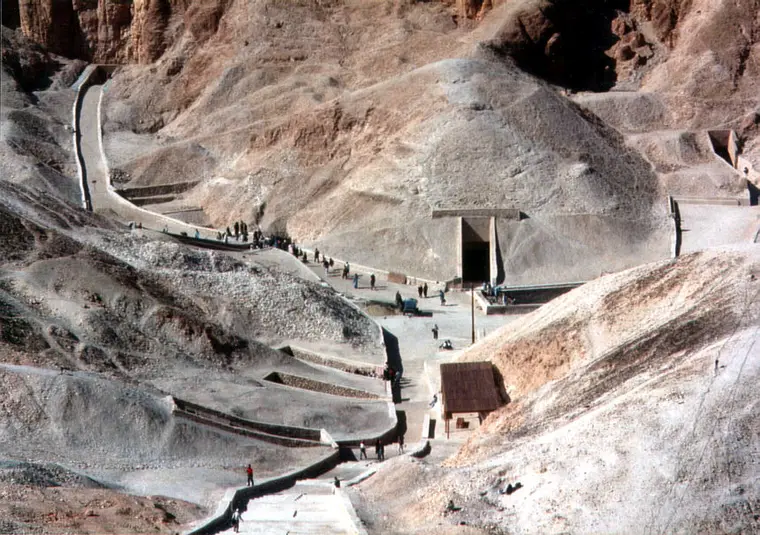
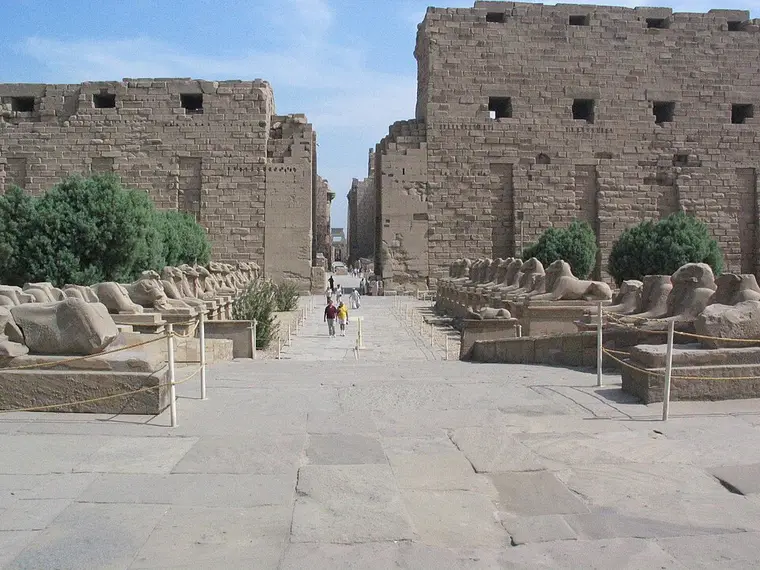
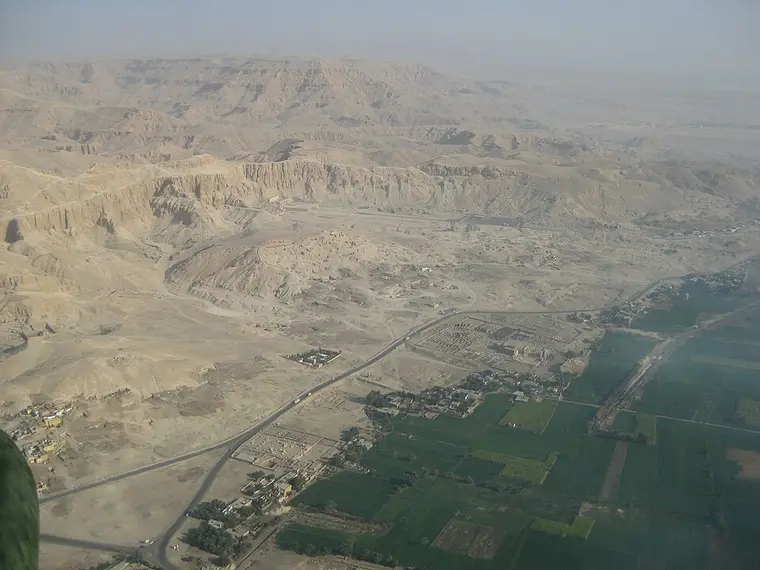
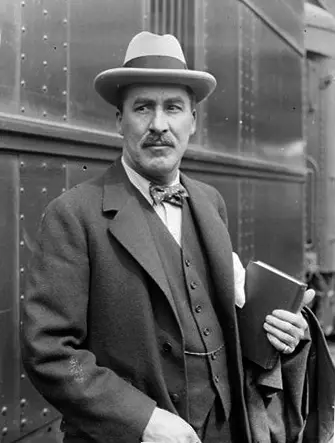
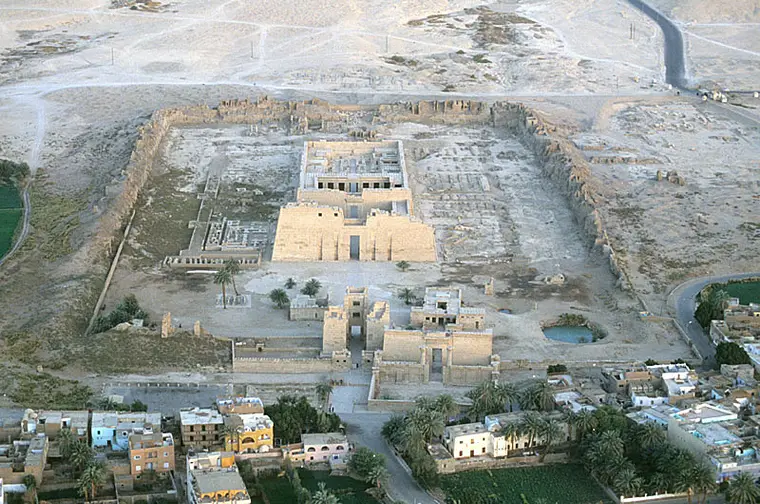
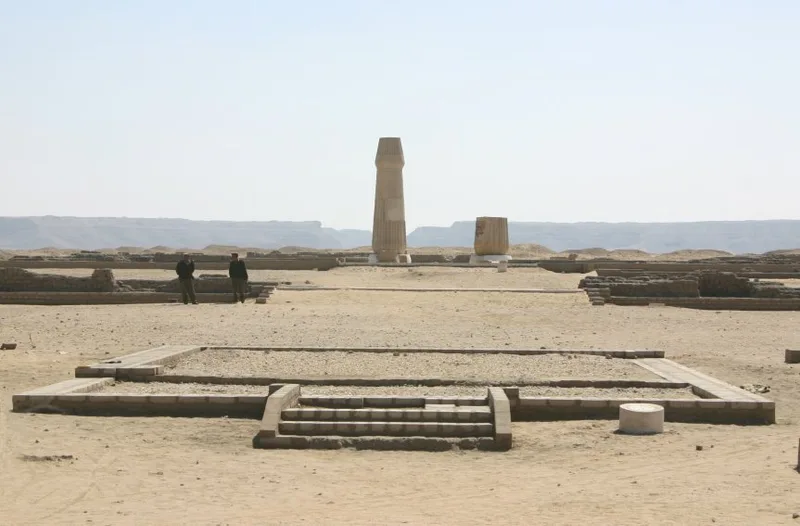
Sources for this chapter (657)Academic114Institution58Specialist book317Reputable web168
Academic(114)
- Radiocarbon-Based Chronology for Dynastic Egypt · Science · 2010
- Davies · Sobeknakht of Elkab and the coming of Kush · Egyptian Archaeology · 2003
- Gardiner · The Coronation of King Haremhab · Journal of Egyptian Archaeology · 1953
- Studies of ancient crania from northern Africa · American Journal of Physical Anthropology · 1990
- 'Were the ancient Egyptians black or white?' · Biblical Archaeology Review
- The physical proportions and living stature of New Kingdom pharaohs · Journal of Human Evolution · 1983
- The identification of the Eighteenth Dynasty royal mummies; a biological perspective · International Journal of Osteoarchaeology · 1991
- Insights from ancient DNA analysis of Egyptian human mummies: clues to disease and kinship · Human Molecular Genetics · 2020
- Ancestry and pathology in King Tutankhamun's family · JAMA · 2010
- Hawass, Zahi · Revisiting the harem conspiracy and death of Ramesses III: anthropological, forensic, radiological, and genetic study · BMJ · 2012
- Ancient Egyptian Creation Myths and Brother-sister Marriage in the 18th Dynasty and the 19th Dynasty · Studies in Mythology · 2025
- Grandet · Early–mid 20th dynasty · UCLA Encyclopedia of Egyptology · 2014
- Finkelstein · Is the Philistine Paradigm Still Viable? · 2007
- The Sea Peoples, from Cuneiform Tablets to Carbon Dating · PLOS ONE · 2011
- Kaniewski D. · Late Second-Early First Millennium BC abrupt climate changes in coastal Syria and their possible significance for the history of the Eastern Mediterranean. · Quaternary Research · 2010
- Matić · (De)queering Hatshepsut: Binary Bind in Archaeology of Egypt and Kingship Beyond the Corporeal · Journal of Archaeological Method and Theory · 2016
- Power and Gender in Ancient Egypt: The Case of Hatshepsut · Art Education · 2009
- Volumes 41–43 · American Research Center in Egypt · 2007
- The Discovery of Hatshepsut's 'Throne' · Kmt · 2002
- How old was Hatshepsut? · Universität der Göttingen, Seminar für Agyptologie und Koptologie, Göttingen · 1995
- Brown · The King Herself · National Geographic · 2009
- Maatkare Hatshepsut: The Female Pharaoh · Kmt · 2005
- La chronologie du règne de Thoutmosis II, ses conséquences sur la datation des momies royales et leurs répercussions sur l'histoire du développement de la Vallée des rois · Studien zur Altägyptischen Kultur · 1987
- Graefe · Der angebliche Zahn der angeblich krebskranken Diabetikerin Königin Hatschepsut, oder: Die Mumie der Hatschepsut bleibt unbekannt · Göttingen: Universität der Göttingen, Seminar für Agyptologie und Koptologie · 2011
- A Dental Observation · Kmt · 2008
- Faulkner · The Euphrates Campaign of Tuthmosis III · The Journal of Egyptian Archaeology · 1946
- Identifications of ancient Egyptian royal mummies from the 18th Dynasty reconsidered · Yearbook of Physical Anthropology · 2016
- DNA, Wine & Eclipses: the Dakhamunzu Affaire · Anthropological Notebooks · 2013
- From the Patriarchs to Moses II. Moses out of Egypt · The Biblical Archaeologist · 1973
- Two Altered Inscriptions of the Late Amarna Period · American Research Center in Egypt · 1988
- The King Is Dead. How Long Lived the King? · Kmt Communications · 2010
- King Tutankhamun's Family and Demise · American Medical Association · 2010
- Akhenaten and the Strange Physiques of Egypt's 18th Dynasty · American College of Physicians · 2009
- Did Akhenaten Suffer From Marfan's Syndrome? · Akhenaten Temple Project Newsletter · 1995
- Freudian Egypt · Burhan Al-Chalabi · 2006
- The remains of Pharaoh Akhenaten are not yet identified: Comments on 'Biological age of the skeletonised mummy from Tomb KV55 at Thebes (Egypt)' by Eugen Strouhal · Moravian Museum · 2010
- Neue Keilschriftliche Umschreibungen Ägyptischer Namen aus den Boǧazköytexten · The University of Chicago Press · 1948
- Amarna Probleme (1–2) · De Gruyter · 1960
- Gardiner · Taking Possession of the Constant Rate Hypothesis: Variation and Change in Ancient Egyptian Possessive Constructions · University of Pennsylvania Working Papers in Linguistics · 2015
- Goldwasser · Literary Late Egyptian as a Polysystem · Duke University Press · 1992
- Egypt and the External World in the Time of Akhenaten · The Journal of Egyptian Archaeology · 1921
- The Rediscovery of Akhenaten and His Place in Religion · American Research Center in Egypt · 1992
- Ancient DNA: Curse of the Pharaoh's DNA · Nature · 2011
- Proof of a 'Long Coregency' between Amenhotep III & Amenhotep IV Found in the Chapel of Vizier Amenhotep-Huy (Asasif Tomb 28) West Luxor · Kmt Communications · 2014
- The Transition from the Traditional to the New Style of Wall Relief under Amenhotep IV · University of Chicago Press · 1973
- The Year 16 graffito of Akhenaten in Dayr Abū Ḥinnis: A Contribution to the Study of the Later Years of Nefertiti · Brill · 2014
- The Sun-disc in Akhenaten's Program: Its Worship and Antecedents, I · American Research Center in Egypt · 1976
- The Monotheism of the Heretic Pharaoh: Precursor of Mosaic monotheism or Egyptian anomaly? · Biblical Archaeology Review · 1987
- Akhenaten: New Theories and Old Facts · American Schools of Oriental Research · 2013
- Ross · Akhenaten and Rib Hadda from Byblos · Saudi Aramco World · 1999
- Preliminary Notes Upon the Problem of Akhenaten · International Journal of Psycho-Analysis · 1939
- Biological age of skeletonized mummy from Tomb KV 55 at Thebes · Moravian Museum · 2010
- Nefertiti and Smenkh-ka-re · Verlag der Göttinger Miszellen · 1994
- Ashrafian · Familial epilepsy in the pharaohs of ancient Egypt's 18th Dynasty · Epilepsy & Behavior · 2012
- Homocystinuria, a possible solution of the Akhenaten's mystery · Croatian Anthropological Society · 2010
- Lessons for surveillance in the 21st century: a historical perspective from the past five millennia · Soz Praventivmed · 2001
- Amarna Age Chronology and the Identity of Nibh ̆ururiyain the Light of a Newly Reconstructed Hittite Text · De Gruyter · 2007
- Kozloff · Bubonic Plague in the Reign of Amenhotep III? · KMT · 2006
- Shortridge K · Pandemic influenza: a zoonosis? · Semin Respir Infect · 1992
- The Year 16 Graffito of Akhenaten in Dayr Abu Hinnis. A Contribution to the Study of the Later Years of Nefertiti · Journal of Egyptian History · 2014
- Seven Battered Osiride Figures in the Cairo Museum and the Sphinx Avenue of Tutankhamen at Karnak · Amarna Letters · 2000
- Kawai · The Time of Tutankhamun. What New Evidence Reveals · Scribe. The Magazine of the American Research Center in Egypt · 2022
- Rocchi · The First Prophet of Amenhotep IV / Akhenaten, in A DELTA-MAN IN YEBU · A Delta Man in Yebu · 2018
- Brier · God's Wife, God's Servant: The God's Wife of Amun (c. 740–525 BC) · American Oriental Society · 2010
- Tutankhamun's Dentition: The Pharaoh and his Teeth · Brazilian Dental Journal · 2015
- Paleopathology of the juvenile Pharaoh Tutankhamun—90th anniversary of discovery · Virchows Archiv · 2013
- Ikram · 2020. A. J. Veldmeijer and S. Ikram. 'Tutankhamun's Sticks and Staves. The Importance of Deceptively Simple Objects. Scribe 5: 8-13. · Scribe · 2020
- Tutankhamun and His Brothers · JAMA · 1980
- Markel · King Tutankhamun, modern medical science, and the expanding boundaries of historical inquiry · JAMA · 2010
- King Tutankhamun's Family and Demise—Reply · JAMA · 2010
- Purported medical diagnoses of Pharaoh Tutankhamun, c. 1325 BC- · Elsevier BV · 2014
- Familial epilepsy in the pharaohs of ancient Egypt's eighteenth dynasty · Epilepsy & Behavior · 2012
- Comment on: Familial epilepsy in the pharaohs of ancient Egypt's eighteenth dynasty · Epilepsy & Behavior · 2013
- Naqvi · Medicine's Role in Decoding Ancient Egypt · University of Western Ontario Medical Journal · 2008
- Stature estimation in Ancient Greece: population-specific equations and secular trends from 9000 BC to 900 AD · Archaeological and Anthropological Sciences · 2023
- Pharaoh Tutankhamun: a novel 3D digital facial approximation · Italian Journal of Anatomy and Embryology · 2023
- The remains of Tutankhamun · Antiquity · 1972
- The skull and cervical spine radiographs of Tutankhamen: a critical appraisal. · AJNR. American Journal of Neuroradiology · 2003
- New evidence for King Tutankhamen's death: his bizarre embalming · The Journal of Egyptian Archaeology · 2011
- The Case of Tut's Missing Collar · Archaeology · 2022
- Kawai · The Kingship of Tutankhamun from the Perspective of His Officialdom · The Society for Near Eastern Studies in Japan · 2024
- Rediscovering Egypt's Golden Dynasty · Archaeology · 2022
- Kawai · Ay versus horemheb: the political situation in the late eighteenth dynasty revisited · Journal of Egyptian History · 2010
- Bjorkman · Meteors and Meteorites in the Ancient Near East · Meteoritics and Planetary Science · 1973
- Daniela Comelli · The meteoritic origin of Tutankhamun's iron dagger blade – Comelli – 2016 – Meteoritics & Planetary Science – Wiley Online Library · Meteoritics and Planetary Science · 2016
- The real mummy's curse: Health risks associated with the sale and trade of mummified remains · International Journal of Cultural Property · 2026
- A diminutive new basilosaurid whale reveals the trajectory of the cetacean life histories during the Eocene. · Commun Biol · 2023
- Les temples mémoriaux de Thoutmosis II et Toutânkhamon (Un rituel destiné à des statues sur barque) · Bulletin de l'Institut Français d'Archéologie Orientale · 1989
- Hawass · Ancestry and Pathology in King Tutankhamun's Family · The Journal of the American Medical Association · 2010
- Mummified Daughters of King Tutankhamun: Archeologic and CT Studies · American Journal of Roentgenology · 2011
- The Most Famous Mummy of All is Nebkheperure Tutankhamen's · KMT: A Modern Journal of Ancient Egypt · 2022
- Skeletal dysplasia in ancient Egypt · American Journal of Medical Genetics Part A · 2008
- Reeves · Tutankhamun's Mask Reconsidered (2015) · Bulletin of the Egyptological Seminar · 2015
- New Evidence for Tutankhamun's Parents: Revelations from the Grand Egyptian Museum · Mitteilungen des Deutschen Archäologischen Instituts, Abteilung Kairo · 2018
- Malaria, mummies, mutations: Tutankhamun's archaeological autopsy · Tropical Medicine & International Health · 2010
- Tutankhamun: Klinefelter's Or Wilson's? · The Lancet · 1973
- Zivie · La nourrice royale Maïa et ses voisins: cinq tombeaux du Nouvel Empire récemment découverts à Saqqara · Comptes rendus des séances de l'Académie des Inscriptions et Belles-Lettres · 1998
- Ceccaldi · Recherches sur les momies: Ramsès II · Bulletin de l'Académie de Médecine · 1987
- Did Ramesses II really have ankylosing spondylitis? A reappraisal · Can Assoc Radiol Journal · 2004
- Brief Report: Ankylosing Spondylitis or Diffuse Idiopathic Skeletal Hyperostosis in Royal Egyptian Mummies of the 18th–20th Dynasties? Computed Tomography and Archaeology Studies · Arthritis & Rheumatology · 2014
- Schipper · Raamses, Pithom, and the Exodus: A Critical Evaluation of Ex 1:11 · Vetus Testamentum · 2015
- Stieglitz · The City of Amurru · Journal of Near Eastern Studies · 1991
- Israel in the Merneptah Stela · Bulletin of the American Schools of Oriental Research · 1994
- The Structure of the Final Hymnic-Poetic Unit on the Merenptah Stela · Zeitschrift für die alttestamentliche Wissenschaft · 2004
- Goedicke · Considerations on the Battle of Kadesh · The Journal of Egyptian Archaeology · 1966
- Schulman · The Narn at Kadesh Once Again · Journal of the Society for the Study of Egyptian Antiquities · 1981
- Pascal Vernus · Affairs and Scandals in Ancient Egypt · University of Pennsylvania
- Ruhli · New Ancient Egyptian Human Mummies from the Valley of the Kings, Luxor: Anthropological, Radiological, and Egyptological Investigations · BioMed Research International · 2015
- El-Aref, Nevine · Sleuthing in a royal tomb · Al-Ahram Weekly Online · 2004
- Cross · The Hydrology of the Valley of the Kings · JEA · 1993
- Rossi · Dimensions and Slope in the Nineteenth and Twentieth Dynasty Royal Tombs · The Egyptian Exploration Society · 2001
- Wilkinson · The paths of Re: Symbolism in the royal tombs of Wadi Biban El Moluk · KMT · 1993
- Irving L. Finkel · On the Rules for the Royal Game of Ur · Ancient Board Games in Perspective, British Museum Press, 16–32 · 2007
- Walter Crist, Anne-Elizabeth Dunn-Vaturi, Alex de Voogt · Ancient Egyptians at Play: Board Games across Borders · Bloomsbury · 2016
Institution(58)
- Amelia Ann Blandford Edwards · Chapter XV: Rameses the Great
- Block Statue of Ay
- Ancient Nubia: Egypt's Rival in Africa · University Museum of Archaeology and Anthropology · 1993
- Tomb-painting British Museum
- Lorenz · The Papyrus Harris
- Ancient Records of Egypt: Historical Documents from the Earliest Times to the Persian Conquest · The University of Chicago Press · 1906
- Hatshepsut: From Queen to Pharaoh · The Metropolitan Museum of Art · 2005
- Manetho · History of Egypt and Other Works · Harvard University Press – Loeb Classical Library no. 350 · 1940
- New Kingdom Rulers Thutmose III
- Museum · Interior of the Tomb of Thutmose III · 2022
- Museum · Mummy of Thutmose III · 2023
- Mummy 61074: A Strange Case of Mistaken Identity
- Causing His Name to Live: Studies in Egyptian Epigraphy and History in Memory of William J. Murnane · E. J. Brill Academic Publishers · 2009
- Arnold · The Royal Women of Amarna: Images of Beauty from Ancient Egypt · The Metropolitan Museum of Art · 1996
- The royal family at Amarna · University College London · 2001
- Akhenaten and Tutankhamun: Revolution and Restoration · University of Pennsylvania Museum of Archeology and Anthropology · 2006
- Studies in Honor of William Kelly Simpson · Museum of Fine Arts · 1996
- Digital Egypt for Universities: Tutankhamun · University College London · 2003
- Riches, Rivals & Radicals: 100 Years of Museums in America · American Association of Museums · 2006
- Classroom TUTorials: The Many Names of King Tutankhamun
- Tutankhamun Archive · 1923
- Marshall · Were there child-soldiers in ancient Egypt? · 2019
- Bryan · Property and the God's Wives of Amun · 2016
- Museum · Sandals of Tutankhamun · 2022
- Review of From Slave to Pharaoh: The Black Experience of Ancient Egypt by Donald Redford. · 2008
- Méndez · Museum's Nas-inspired King Tut statue sparks debate about Egyptians' race · 2023
- Independent · Dutch museum claims Tutankhamun was black · 2023
- Yee · Egypt Is Upset by a Dutch Exhibit About Afrocentrism · 2023
- Cascone · A Sculpture Depicting King Tut as a Black Man Is Sparking International Outrage · 2023
- Arnold · Tutankhamun's Funeral · 2010
- Votive stela of Userhat · 2022
- Tutanchamuns Mumienmaske Chronographie einer Ikone · Verlag des Römisch-Germanischen Zentralmuseums · 2022
- The First Family's Pets · The Herbert Hoover Presidential Library and Museum · 2017
- Record visitor figures
- Hindley · King Tut: A Classic Blockbuster Museum Exhibition That Began as a Diplomatic Gesture · 2015
- Grand Egyptian Museum to open between October and February: Minister · 2023
- The Royal Women of Amarna: Images of Beauty from Ancient Egypt · Metropolitan Museum of Art · 1996
- Treasures of Tutankhamun · The Metropolitan Museum of Art · 1976
- Ancient Egypt: Treasures from the Collection of the Oriental Institute · Oriental Institute of the University of Chicago · 2003
- Anneke Bart · Temples of Ramesses II
- Diodorus Siculus · Diodorus Siculus, Bibliotheca Historica, Books I-V, book 1, chapter 47, section 4
- Beit el-Wali · University of Chicago
- Treasure · Four Faces on One Neck: The Tetracephalic Ram as an Iconographic Form in New Kingdom Egypt · 2021
- Sed festival · The Global Egyptian Museum
- Edwards · Chapter XV: Rameses the Great
- Was the great Pharaoh Ramesses II a true redhead? · The University of Manchester · 2010
- Brand · The Monuments of Seti I: Epigraphic, Historical and Art Historical Analysis · Brill · 2000
- Bietak · Avaris: Capital of the Hyksos – Recent Excavations · British Museum Press · 1995
- The Epigraphic Survey · Reliefs and Inscriptions at Karnak III: The Bubastite Portal · The University of Chicago Press · 1954
- Collezione online
- Donald P. Ryan · Further Observations Concerning the Valley of the Kings · Pacific Lutheran University · 1995
- Recherches et travaux dans la tombe de Ramsès II: Aujourďhui · L'Institut d'Egyptologie Thébaine du Musée du Louvre
- Valley of the Kings, finds in the Petrie Museum · UCL
- Tomb Robbery Papyrus (Papyrus Mayer B) · Liverpool Museum
- Wilkinson, Richard H. · Valley of the Sun Kings: New Explorations in the Tombs of the Pharaohs · University of Arizona Egyptian Expedition · 1995
- Griffith Institute, University of Oxford · Tutankhamun: Anatomy of an Excavation — Carter archive, objects 345, 393, 585r, 593, 620(110) · Griffith Institute · 1922
- The Metropolitan Museum of Art · Game box for senet and twenty squares, 16.10.475a–l · The Metropolitan Museum of Art · 2026
- The British Museum · The Royal Game of Ur, BM 120834 · The British Museum · 2026
Specialist book(317)
- The Oxford History of Ancient Egypt · Oxford University Press · 2000
- Schneider · Historiographie in der Antike · Walter de Gruyter · 2008
- Ancient Egyptian Literature · University of California Press · 2019
- Tyldesley · Nefertiti: Egypt's Sun Queen · Penguin UK · 2005
- Brand · The Monuments of Seti I · Brill Academic Pub · 2000
- Grimal · A History of Ancient Egypt · Librairie Arthéme Fayard · 1988
- Proceedings of the 9th International Congress on the Archaeology of the Ancient Near East: June 9-13, 2014, University of Basel. Volume 2 · Harrassowitz · 2016
- Thomas · Rameses II: Pharaoh of the New Kingdom · The Rosen Publishing Group · 2003
- Kitchen · Ramesside Inscriptions, Setnakht, Ramesses III and Contemporaries: Translations (Ramesside Inscriptions Translations) · Wiley-Blackwell · 2008
- Wilkinson · The Rise and Fall of Ancient Egypt · Bloomsbury · 2010
- The Complete Royal Families of Ancient Egypt · Thames & Hudson · 2004
- Dodson, Aidan & Hilton, Dyan · The Complete Royal Families of Ancient Egypt · 2004
- Shaw · The Oxford History of Ancient Egypt · OUP Oxford · 2003
- Thutmose III: The Military Biography of Egypt's Greatest Warrior King · Potomac Books, Inc. · 2009
- Middle Egyptian: An Introduction to the Language and Culture of Hieroglyphs · Cambridge University Press · 2000
- Guardian of Ancient Egypt: Essays in Honor of Zahi Hawass · Czech Institute of Egyptology · 2020
- Ancient Near Eastern History and Culture · Taylor & Francis · 2023
- General history of Africa, IX: General history of Africa revisited
- "Afrasian linguistics" in The Oxford Handbook of Archaeology and Language · Oxford University Press · 2025
- Amenhotep III: Perspectives on His Reign · University of Michigan Press · 1998
- de la Bédoyère · Pharaohs of the Sun: The Rise and Fall of Tutankhamun's Dynasty · Pegasus Books · 2023
- Royal and Divine Statuary in Egypt's Dazzling Sun: Amenhotep III and his World · 1992
- Kuhrt · The Ancient Near East: c. 3000–330 BC · Routledge · 1995
- Ward WA, Sharp Joukowsky M. · The Crisis years: the 12th century BC: from beyond the Danube to the Tigris.
- Roberts RG. · Identity, choice, and the Year 8 reliefs of Ramesses III at Medinet Habou.
- Hatszepsut. Kobieta która została królem [The Woman Who Would be King] · WAB · 2016
- Hatszepsut · Prószyński i S-ka · 2016
- Nadig · Hatszepsut · Prószyński i S-ka · 2016
- Cooney · Hatszepsut. Kobieta, która została królem [The Woman Who Would be King] · WAB · 2016
- Margaux Baum, Susanna Thomas · Hatshepsut · The Rosen Publishing Group, Inc · 2017
- Hatshepsut, His Majesty, Herself · New York: Atheneum · 2001
- Chronologie des pharaonischen Ägypten: die Zeitbestimmung der ägyptischen Geschichte von der Vorzeit bis 332 v. Chr · Verlag Philipp von Zabern · 1997
- Encyclopedia of Ancient Egypt · Infobase Publishing · 2014
- Champollion le Jeune · Lettres écrites d'Égypte et de Nubie en 1828 et 1829 · 1868
- Clayton · Chronicle of the Pharaohs · Thames and Hudson · 1994
- Cooney · The Woman Who Would be King · Oneworld Publications · 2015
- Cooney · When Women Ruled the World: Six Queens of Egypt · National Geographic · 2018
- Hatshepsut: Egypt's First Female Pharaoh · Capstone Publishers · 2008
- Edwards · Pharaohs, Fellahs and Explorers · Harper & Brothers · 1891
- The Oxford Handbook of Ancient Nubia · Oxford University Press · 2020
- The Search For Nefertiti · Hachette UK · 2013
- Gardiner · Egypt of the Pharaohs · Oxford University Press · 1964
- Dancing for Hathor: Women in Ancient Egypt · Continuum · 2010
- The Pharaoh's Court · Marshall Cavendish · 2007
- Ancient Egyptian Chronology · Brill · 2006
- A Historical Atlas of Oman · The Rosen Publishing Group · 2004
- Lipinska · Oxford Encyclopedia of Ancient Egypt – Volume 2 · 2001
- Martin · African Political Thought · Springer · 2012
- Egyptian Religion · Cornell University Press · 1992
- Njoku · The History of Somalia · ABC-CLIO · 2013
- Encyclopedia of the Archaeology of Ancient Egypt · Routledge · 1999
- The Oxford History of the Ancient Near East: Volume III: from the Hyksos to the Late Second Millennium BC · Oxford University Press · 2022
- Women in Ancient Egypt · Harvard University Press · 1993
- Redford · History and Chronology of the 18th dynasty of Egypt: Seven studies · University of Toronto Press · 1967
- Leprohon · The Great Name: Ancient Egyptian Royal Titulary · Society of Biblical Literature · 2013
- Encyclopedia of Women in the Ancient World · ABC-CLIO · 2001
- Creativity and Innovation in the Reign of Hatshepsut · Oriental Institute of the University of Chicago · 2014
- When Egypt Ruled the East · University of Chicago · 1942
- Tyldesley · Hatchepsut: The Female Pharaoh · Viking · 1996
- Chronicle of the Queens of Egypt: From Early Dynastic Times To The Death Of Cleopatra · Thames & Hudson · 2006
- Manetho · Harvard University Press · 1940
- Wells · Hatshepsut · Doubleday · 1969
- Gabriel · Thutmose III: A Military Biography of Egypt's Greatest Warrior King · Potomac Books · 2009
- The Cambridge Ancient History Volume 2, Part 2: The Middle East and the Aegean Region, c. 1380–1000 BC · Cambridge University Press · 1975
- Putnam · An Introduction to Egyptology · Crescent Books · 1990
- Gabriel · Great Captains of Antiquity · Greenwood Press · 2001
- Strudwick · The Encyclopedia of Ancient Egypt · Sterling Publishing Co., Inc. · 2006
- Beckerath · Chronologie des pharaonischen Ägypten: die Zeitbestimmung der ägyptischen Geschichte von der Vorzeit bis 332 v. Chr · Verlag Philipp von Zabern · 1997
- The lost tombs of Thebes: life in paradise · Thames & Hudson · 2009
- Science in the Study of Ancient Egypt · Routledge · 2015
- History Of Egypt, Chaldaea, Syria, Babylonia, and Assyria, Volume 5 (of 12) · 2005
- Redford · The Wars in Syria and Palestine of Thutmose III · Brill · 2003
- Cline · Thutmose III: A New Biography · University of Michigan Press · 2006
- Gardiner · Egypt of the Pharaohs: An Introduction · Clarendon Press · 1961
- Tyldesley · Klątwa Tutanchamona. Niedokończona historia egipskiego władcy · Rebis · 2012
- Reeves · The Complete Tutankhamun: The King. The Tomb. The Royal Treasure · Thames & Hudson · 2007
- When Women Ruled the World: Six Queens of Egypt · National Geographic · 2018
- Entrepreneurship and Religion. · Edward Elgar Pub · 2010
- Rennison · 100 Must-read Historical Novels · A&C Black · 2009
- Akhenaten, Pharaoh of Egypt: A New Study · Thames and Hudson · 1968
- Aldred · Egyptian art in the Days of the Pharaohs 3100–32 BC · Thames & Hudson · 1985
- Aldred · Akhenaten, King of Egypt · Thames and Hudson · 1991
- Allen · Encyclopedia of Religion · Macmillan Reference · 2005
- Biblical Poetry and the Art of Close Reading · Cambridge University Press · 2018
- The encyclopaedia of ancient Egyptian architecture · I.B. Tauris · 2002
- Moses the Egyptian: The Memory of Egypt in Western Monotheism · Harvard University Press · 1997
- Religion And Politics: Cultural Perspectives · Brill Academic Publishers · 2005
- The Invention of Religion: Faith and Covenant in the Book of Exodus · Princeton University Press · 2020
- Baines · Visual and Written Culture in Ancient Egypt · Oxford University Press · 2007
- The Amarna Age · A. and C. Black · 1926
- Royal versus Divine Authority: Acquisition, Legitimization and Renewal of Power: 7th Symposium on Egyptian Royal Ideology, Prague, June 26–28, 2013 · Harrassowitz Verlag · 2015
- von Beckerath · Chronologie des Pharaonischen Ägypten: Die Zeitbestimmung der ägyptischen Geschichte von der Vorzeit bis 332 v. Chr · Philipp von Zabern · 1997
- The Oxford Handbook of Egyptian Epigraphy and Palaeography · Oxford University Press · 2020
- Ancient Records of Egypt · University of Illinois Press · 2001
- A History Of Egypt: From the Earliest Times to the Persian Conquest · Charles Scribner's Sons · 1909
- Breasted · Development of religion and thought in ancient Egypt · University of Pennsylvania Press · 1972
- The Oxford Handbook of the Psalms · Oxford University Press · 2014
- The Kingdom of the Hittites · Clarendon Press; Oxford University Press · 1998
- Sites of Exchange: European Crossroads and Faultlines · Rodopi · 2006
- Amarna Diplomacy: The Beginnings of International Relations · The Johns Hopkins University Press · 2002
- Tutankhamun's Armies: Battle and Conquest during Ancient Egypt's Late 18th Dynasty · John Wiley & Sons, Inc. · 2007
- Handbook to Life in Ancient Egypt · Facts on File Inc. · 1998
- The Rock Tombs of El Amarna · Egypt Exploration Fund · 1903
- Jewish and Christian Approaches to the Psalms: Conflict and Convergence · Oxford University Press · 2013
- From Creation to Babel: Studies in Genesis 1-11 · Bloomsbury Publishing · 2014
- Tutankhamen: Life and Death of a Pharaoh · New York Graphic Society · 1963
- The Encyclopedia of Ancient History · Blackwell Publishing Ltd. · 2012
- Amarna Sunrise: Egypt from the Golden Age to Age of Heresy · The American University in Cairo Press · 2014
- Amarna Sunset: Nefertiti, Tutankhamun, Ay, Horemheb, and the Egyptian Counter-Reformation · The American University in Cairo Press · 2009
- L'Égypte · Presses Universitaires de France · 1952
- Moses and Monotheism · A.A. Knopf · 1939
- D'Akhenaton à Toutânkhamon · Université Lumière-Lyon 2 · 1998
- The Inscriptions of Mes, A Contribution to the Study of Egyptian Judicial Procedure · J. C. Hinrichs publishers · 1905
- Akhenaten's Sed-festival at Karnak · Kegan Paul International · 1992
- Ancient Egyptian Queens: A Hieroglyphic Dictionary · Golden House Publications · 2005
- An X-ray Atlas of the Royal Mummies · University of Chicago Press · 1980
- A Dictionary of Egyptian Gods and Goddesses · Routledge · 2000
- Ancient Israel in Sinai: The Evidence for the Authenticity of the Wilderness Tradition · Oxford University Press, USA · 2005
- Hoffmeier · Akhenaten and the Origins of Monotheism · Oxford University Press · 2015
- Hornung · Akhenaten and the Religion of Light · Cornell University Press · 2001
- Kitchen · On the Reliability of the Old Testament · William. B. Eerdmans Publishing · 2003
- The Synchronisation of Civlisations in the Eastern Mediterranean in the Second Millennium B.C.: Proceedings of an international symposium at Schloss Haindorf, 15th–17th of November 1996 and at the Austrian Academy, Vienna, 11th–12th of May 1998 · Austrian Academy of Sciences Press · 2000
- Kitchen · The Third Intermediate Period in Egypt (1100–650 BC) · Aris & Phillips · 1986
- Laboury · Akhénaton · Pygmalion-Flammarion · 2010
- Heaven on Earth: The Varieties of the Millennial Experience · Oxford University Press · 2011
- Catalogue des Textes Hittites · Klincksieck · 1971
- Levenson · Creation and the persistence of evil · Princeton University Press · 1994
- Akhenaten Colossi of Karnak · American University in Cairo Press · 2010
- Akhenaten: History, Fantasy and Ancient Egypt · Routledge · 2003
- The Amarna Letters · The Johns Hopkins University Press · 1992
- Murnane · Texts from the Amarna Period in Egypt · Society of Biblical Literature · 1995
- The Boundary Stelae Of Akhentaten · Routledge · 2011
- Egypt, the Trunk of the Tree, A Modern Survey of and Ancient Land, Vol. II <!-- · Algora Publishing · 2004
- Im Licht von Amarna – 100 Jahre Fund der Nofretete · Imhof Verlag · 2012
- Ancient Egyptian Kingship · Brill · 1995
- Ockinga · The Oxford Encyclopedia of Ancient Egypt · Oxford University Press · 2001
- Rawlinson · History of Ancient Egypt · Longmans, Green, and Co. · 1881
- Akhenaten: The Heretic King · Princeton University Press · 1984
- Aspects of Monotheism: How God is One · Biblical Archaeology Society · 1997
- Akhenaten: Egypt's False Prophet · Thames & Hudson · 2019
- Ridley · Akhenaten: A Historian's View · The American University in Cairo Press · 2019
- Robins · Women in Ancient Egypt · Harvard University Press · 1993
- Cuneiform Parallels to the Old Testament · Oxford University Press · 1912
- Schulman · L'Égyptologie en 1979: Axes prioritaires de recherches · Editions du Centre national de la recherche scientifique · 1982
- Urkunden der 18. Dynastie · J.C. Hinrichs'sche Buchhandlung · 1906
- Ancient Egypt: A Very Short Introduction · Oxford University Press · 2004
- The Bible as a Meeting Point of Cultures through the Ages · Sevivoth · 1995
- Tutankhamen and the discovery of his tomb by the late Earl of Carnarvon and Mr Howard Carter · Routledge · 1923
- Stent · Paradoxes of Free Will · American Philosophical Society · 2002
- The Ancient World · Routledge · 2015
- Ancient Egypt, A Social History · Cambridge University Press · 2001
- Tyldesley · Egypt: How a Lost Civilisation Was Rediscovered · BBC Books · 2007
- Tyldesley · Chronicle of the Queens of Egypt: From Early Dynastic Times to the Death of Cleopatra · Thames & Hudson · 2006
- Wilkinson · The Complete Gods and Goddesses of Ancient Egypt · Thames & Hudson · 2003
- The Legacy of Tutankhamun: Art and History · Farid Atiya Press · 2008
- Aldred · Akhenaten and Nefertiti · Thames & Hudson · 1973
- Aldred · The Egyptians · Thames and Hudson · 1987
- Encyclopedia of African Religion · Sage Publications · 2009
- Bilolo · Le Créateur et la Création dans la pensée memphite et amarnienne. Approche synoptique du Document Philosophique de Memphis et du Grand Hymne Théologique d'Echnaton · Academy of African Thought · 2004
- El Mahdy · Tutankhamen: The Life and Death of a Boy King · Headline · 1999
- Rita E. Freed · Pharaohs of the Sun: Akhenaten – Nefertiti – Tutankhamen · Bulfinch Press · 1999
- Stevens · Akhenaten's workers : the Amarna Stone village survey, 2005–2009. Volume I, The survey, excavations and architecture · Egypt Exploration Society · 2012
- Van Dyke · Principles of Art: Pt. 1. Art in History; Pt. 2. Art in Theory · Fords, Howard, & Hulbert · 1887
- Wolf · Die Stellung der ägyptischen Kunst zur antiken und abendländischen und Das Problem des Künstlers in der ägyptischen Kunst · Gerstenberg · 1951
- Scanning the Pharaohs: CT Imaging of the New Kingdom Royal Mummies
- Cline · 1177 B.C. : the year civilization collapsed · Princeton University Press · 2014
- Norrie · A History of Disease in Ancient Times · Springer International Publishing · 2016
- Moran · The Amarna Letters · Johns Hopkins University Press · 1992
- Bommas · Tutankhamun: a biography · Routledge · 2025
- Toby A.H. Wilkinson · Early Dynastic Egypt · Routledge · 1999
- The Journal of Egyptian Archaeology · Egypt Exploration Fund · 1998
- Post-Amarna Period Statues of Amun and His Consorts Mut and Amunet · Brill · 2020
- Advances in Parasitology · Elsevier · 2024
- Life and death of a pharaoh - Tutankhamen · Graphic Society · 1978
- The Tomb of Tutankhamen · Cassel and Company, LTD · 1927
- Tutankhamun's Wardrobe: garments from the tomb of Tutankhamun · Barjesteh van Waalwijk van Doorn · 1999
- Disability in Ancient Egypt and Egyptology · Routledge · 2024
- Booth · Horemheb · Amberley Publishing Limited · 2009
- T. G. H. James · Howard Carter: The Path to Tutankhamun · Tauris Parke Paperbacks · 2006
- The tombs of Harmhabi and Touatânkhamanou · Duckworth Publishers · 2001
- Richard H. Wilkinson · The Oxford Handbook of the Valley of the Kings · Oxford University Press · 2016
- Howard Carter · The Tomb of Tutankhamun: Volume 1: Search, Discovery and Clearance of the Antechamber · Bloomsbury Publishing · 2014
- Howard Carter · The Discovery of the Tomb of Tutankhamen · Courier Corporation · 2012
- Iron from Tutankhamun's tomb · The American University in Cairo Press · 2022
- Hankey · A Passion for Egypt: Arthur Weigall, Tutankhamun and the 'Curse of the Pharaohs' · Tauris Parke Paperbacks · 2007
- Kathryn A. Bard · An Introduction to the Archaeology of Ancient Egypt · John Wiley & Sons · 2015
- Carl Nicholas Reeves · Howard Carter: Before Tutankhamun · H.N. Abrams · 1993
- Lorna Oakes · Ancient Egypt: an illustrated reference to the myths, religions, pyramids and temples of the land of the pharaohs · Hermes House · 2005
- Gordon · The Book of Spells, Hexes, and Curses · Carol Publishing Group · 1995
- Bill Price · Tutankhamun, Egypt's Most Famous Pharaoh · Harpenden : Pocket Essentials · 2009
- The Discovery of the Tomb of Tutankhamen · Dover Publications · 1977
- Egyptomania Goes to the Movies: From Archaeology to Popular Craze to Hollywood Fantasy · McFarland & Company · 2017
- Edward Chaney · Ancient Egypt in the Modern Imagination: Art, Literature and Culture · Bloomsbury Publishing · 2020
- Travel and Tourism Market Research Yearbook · Richard K. Miller Associates · 2008
- William Carruthers · Histories of Egyptology: Interdisciplinary Measures · Routledge · 2014
- Thomas R.H. Havens · Artist and Patron in Postwar Japan: Dance, Music, Theater, and the Visual Arts, 1955–1980 · Princeton University Press · 2014
- Sarah Anne Hughes · Museum and Gallery Publishing: From Theory to Case Study · Taylor & Francis · 2019
- Mona L. Russell · Egypt · ABC-CLIO · 2013
- Paul Cartledge · Responses to Oliver Stone's Alexander: Film, History, and Cultural Studies · Univ of Wisconsin Press · 2010
- Proceedings of the 1st International Conference in Safety and Crisis Management in the Construction, Tourism and SME Sectors · Universal-Publishers
- Ancient Egyptians: People of the Pyramids · Oxford University Press · 2001
- Barclay · Flavius Josephus: Translation and Commentary, Volume 10: Against Apion · BRILL · 2006
- Booysen · Thera and the Exodus: The Exodus Explained in Terms of Natural Phenomena and the Human Response to It · John Hunt Publishing · 2013
- Braun · National Geographic Tales of the Weird: Unbelievable True Stories · National Geographic Society · 2012
- Booth · The Boy Behind the Mask: Meeting the Real Tutankhamun · Oneworld · 2007
- Current Research in Egyptology 17 · Oxbow Books · 2017
- Clayton · Chronicle of the Pharaohs: The Reign-by-Reign Record of the Rulers and Dynasties of Ancient Egypt · Thames & Hudson · 2006
- How to Read Egyptian Hieroglyphs: A Step-by-step Guide to Teach Yourself · University of California Press · 2003
- Joyful in Thebes: Egyptological Studies in Honor of Betsy M. Bryan · Lockwood Press · 2015
- Tutankhamun's Armies: Battle and Conquest During Ancient Egypt's Late Eighteenth Dynasty · John Wiley & Sons · 2007
- Dodson · Amarna Sunset: Nefertiti, Tutankhamun, Ay, Horemheb, and the Egyptian Counter-Reformation · American University in Cairo Press · 2009
- Eaton-Krauss · The Unknown Tutankhamun · Bloomsbury Publishing · 2016
- 4. Symposium Zur Ägyptischen Königsideologie · Otto Harrassowitz Verlag · 2009
- Fritze · Egyptomania: A History of Fascination, Obsession and Fantasy · Reaktion Books · 2016
- Hawass · The Golden Age of Tutankhamun · American Univ in Cairo Press · 2004
- James · Howard Carter: The Path to Tutankhamun, Second Edition · I. B. Tauris · 2000
- Mackowiak · Diagnosing Giants: Solving the Medical Mysteries of Thirteen Patients Who Changed the World · Oxford University Press · 2013
- Morkot · The Egyptians: An Introduction · Routledge · 2005
- Nici · Famous Works of Art—And How They Got That Way · Rowman & Littlefield Publishers · 2015
- Form und Mass: Beiträge zur Literatur, Sprache und Kunst des alten Ägypten: Festschrift für Gerhard Fecht zum 65. Geburtstag am 6. Februar 1987 · Otto Harrassowitz Verlag · 1987
- Redford · The Oxford Essential Guide to Egyptian Mythology · Berkley Publishing Group · 2003
- Reeves · The Complete Tutankhamun: The King, the Tomb, the Royal Treasure · Thames and Hudson · 1990
- The Complete Valley of the Kings · Thames and Hudson · 1996
- Riggs · Photographing Tutankhamun: Archaeology, Ancient Egypt, and the Archive · Bloomsbury Publishing · 2018
- Roberts · HSC Ancient History · Pascal Press · 2006
- Riggs · Treasured: How Tutankhamun Shaped a Century · PublicAffairs · 2021
- Robinson · Writing and Script: A Very Short Introduction · Oxford University Press · 2009
- Thompson · Wonderful Things: A History of Egyptology, 3. From 1914 to the Twenty-First Century · American University in Cairo Press · 2018
- Tyldesley · Tutankhamen: The Search for an Egyptian King · Basic Books · 2012
- The Complete Temples of Egypt · Thames & Hudson · 2000
- Winstone · Howard Carter and the Discovery of the Tomb of Tutankhamun, Revised Edition · Barzan Publishing · 2006
- Bell · Aspects of the Cult of the Deified Tutankhamun · 1985
- Brier · Tutankhamun and the Tomb that Changed the World · Oxford University Press · 2023
- Brier · The Murder of Tutankhamen · Weidenfeld and Nicolsen · 1998
- Dodson · Tutankhamun, King of Egypt · Lives and Afterlives · 2022
- Hawass · Discovering Tutankhamun · The American University in Cairo Press · 2025
- Reeves · Complete Tutankhamun · National Geographic Books · 2023
- Shaw · The Story of Tutankhamun · Yale University Press · 2023
- Tyldesley · Tutankhamun: Lost for three thousand years, misunderstood for a century · Headline · 2023
- Gabriel · The Great Armies of Antiquity · Greenwood Publishing Group · 2002
- Gale · On Cooking Pots, Drinking Cups, Loomweights and Ethnicity in Bronze Age Cyprus and Neighbouring Regions · 2011
- Cairo and the Pyramids (Rough Guides Snapshot Egypt) · Rough Guides UK · 2013
- Bryce · Warriors of Anatolia: A Concise history of the Hittites · Bloomsbury · 2023
- Eyre · Proceedings of the Seventh International Congress of Egyptologists, Cambridge, 3-9 September 1995 · Peeters · 1998
- Kitchen · Pharaoh Triumphant · Aris & Phillips · 1985
- Van Seters · The Land that I Will Show You: Essays on the History and Archaeology of the Ancient Near East in Honour of J. Maxwell Miller · Sheffield Academic Press · 2001
- Siculus · The Historical Library of Diodorus the Sicilian · Printed by W. MʻDowall for J. Davis · 1814
- Török · The Image of the Ordered World in Ancient Nubian Art: The Construction of the Kushite Mind, 800 Bc-300 Ad · Brill · 2001
- James · Manetho, with an English translation by W.G. Waddell · Alpha Editions · 2020
- Proceedings First Vatican Coffin Conference 19–22 June 2013 Volume 2 · Edizioni Musei Vaticani · 2017
- Romer · Valley of the Kings · Castle Books
- Maspero · Egyptian Archaeology · Putnam · 1892
- Were the Ancient Egyptians Black Or White? · Biblical Archaeology Society · 1989
- Civilization or barbarism : an authentic anthropology · 1991
- 1968: A History in Verse · Black Sparrow Press · 1997
- Grabbe · The Book of Exodus: Composition, Reception, and Interpretation · BRILL · 2014
- Grabbe · The Dawn of Israel: A History of Canaan in the Second Millennium BCE · T&T Clark · 2022
- von Beckerath · Chronologie des Pharaonischen Ägypten · Philipp von Zabern · 1997
- Brand · Ramesses II: Egypt's Ultimate Pharaoh, Lockwood Press · 2023
- Brier · Egyptian Mummies: Unravelling the Secrets of an Ancient Art · William Morrow & Co. · 1994
- Brier · The Encyclopedia of Mummies · Checkmark Books · 1998
- Clayton · Chronology of the Pharaohs · Thames & Hudson · 1994
- Drews · The End of the Bronze Age: Changes in Warfare and the Catastrophe Ca. 1200 B.C. · Princeton University Press · 1993
- Kitchen · Pharaoh Triumphant: The Life and Times of Ramesses II, King of Egypt · Aris & Phillips · 1982
- Kitchen · Ramesside Inscriptions Translated and Annotated: Translations. Volume 2: Ramesses II; Royal Inscriptions · Blackwell Publishers · 1996
- Kitchen · Ramesside Inscriptions Translated and Annotated: Notes and Comments. Volume 2: Ramesses II; Royal Inscriptions · Blackwell Publishers · 1979
- The Beit el-Wali Temple of Ramesses II · 1967
- Rohl · Pharaohs and Kings: A Biblical Quest · Crown Publishers · 1995
- Siliotti · Egypt: temples, people, gods · 1994
- Skliar · Grosse kulturen der welt-Ägypten · 2005
- Tyldesley · Ramesses: Egypt's Greatest Pharaoh · Viking · 2000
- Westendorf · Das alte Ägypten · 1969
- La Momie de Ramsès II: Contribution Scientifique à l'Égyptologie · 1985
- Brand · Ramesses II, Egypt's Ultimate Pharaoh · Lockwood Press · 2023
- Dodson · The Complete Royal Families of Ancient Egypt · Thames & Hudson · 2004
- Grajetzki · Ancient Egyptian Queens – A Hieroglyphic Dictionary · Golden House Publications · 2005
- Kuhrt · The Ancient Near East c. 3000–330 BC · Routledge · 1995
- Rice · Who's Who in Ancient Egypt · Routledge · 1999
- Hasel · Domination and Resistance: Egyptian Military Activity in the Southern Levant, 1300–1185 BC · Brill · 1998
- Hasel · The Near East in the Southwest: Essays in Honor of William G. Dever · American Schools of Oriental Research · 2003
- James · Ramesses II · Friedman/Fairfax · 2002
- Eggenberger · An Encyclopedia of Battles · Dover · 1985
- Ralby · Atlas of Military History · Paragon · 2013
- Weir · History's Greatest Lies · Fair Winds · 2009
- Manley · The Penguin Historical Atlas of Ancient Egypt · Penguin · 1996
- Mark Healy · Qadesh 1300 BC: Clash of the Warrior Kings (Praeger Illustrated Military History) · Praeger · 2005
- Mark Healy · Armies of the Pharaohs · Bloomsbury USA · 1999
- Lichtheim · Ancient Egyptian Literature · University of California Press · 1975
- Bryce · Hattusili: The Hittite Prince who stole an Empire · Bloomsbury · 2024
- De Mieroop · A History of Ancient Egypt · Blackwell Publishing · 2007
- Roaf · Cultural Atlas of Mesopotamia and the Ancient Near East · Equinox · 1990
- Healy · Qadesh 1300 B.C, Clash of the Warrior Kings · Osprey Publishing; Osprey Campaign Series #22 · 1993
- Thomas R. Gensheimer · World Heritage and National Registers · Taylor & Francis · 2017
- Altenmüller · Valley of the Kings: The Tombs and Funerary Temples of Thebes West · VMB Publishers · 2001
- Divine of Body: The Remains of Egyptian Kings – Preservation, Reverence, and Memory in a World without Relics
- Ambros, Eva · Egypt: an up-to-date travel guide with 145 color photos and 21 maps · Hunter Publishing · 2001
- Baines, John · Cultural Atlas of Ancient Egypt · Facts on file · 2000
- Baillet, Jules · Inscriptions grecques et latines des tombeaux des rois ou Syringes à Thèbes · Institut Français d'Archéologie Orientale du Caire, Mémoires publiés par les membres · 1920
- M. L. Bierbrier · The Tomb-Builders of the Pharaohs · American Univ in Cairo Press · 1993
- Davis, Theodore M. · The Tomb of Siphtah with The Tomb of Queen Tiyi · Gerald Duckworth & Co Ltd · 2001
- Davis · The Tombs of Harmhabi and Touatânkhamanou · Duckworth Publishing · 2001
- Dodson, Aidan · Egyptian Rock-cut Tombs · Shire Publications Ltd · 1991
- El Mahdy, Christine · Tutankhamen: The Life and Death of the Boy-King · St. Martin's Press · 2001
- Maspero, Gaston · Manual of Egyptian Archaeology, Sixth English Edition · H. Grevel and Co · 1913
- Reeves, Nicholas · Valley of the Kings: The Decline of a Royal Necropolis · Keegan Paul · 1990
- Reeves, Nicholas · The Complete Valley of the Kings · Thames and Hudson · 1996
- Romer, John · Valley of the Kings · Henry Holt · 1981
- Sampsell, Bonnie M. · A Traveler's Guide to the Geology of Egypt · American University Press · 2003
- Siliotti, Alberto · Guide to the Valley of the Kings · Barnes and Noble · 1997
- Strudwick, Nigel · Thebes in Egypt · Cornell University · 1999
- Weeks, Kent R. · Valley of the Kings · Friedman/Fairfax · 2001
- Weeks, Kent R. · KV 5: A Preliminary Report on the Excavation of the Tomb of the Sons of Ramesses II in the Valley of the Kings · American University Press · 2000
- Weigall, Arthur · A Guide to the Antiquities of Upper Egypt · Mentheun & Co · 1910
- Winstone · Howard Carter and the discovery of the tomb of Tutankhamun · Barzan, Manchester. · 2006
- The Complete Temples of Ancient Egypt · Thames & Hudson · 2000
- Die Toponyme Vorarabischen Ursprungs im Modernen Ägypten: Ein Katalog (Göttinger Miszellen Beihefte Nr. 8) · Universität Göttingen · 2010
- Blyth · Karnak: Evolution of a Temple · Routledge · 2006
Reputable web(168)
- Bowman · Ancient Egypt · 2020
- Steven Snape · Estimating Population in Ancient Egypt · 2019
- Ramses II | Biography, Accomplishments, Tomb, Mummy, Death, & Facts | Britannica · 2023
- Ramses III | Ancient Egyptian Pharaoh & Military Leader | Britannica · 2024
- Mark · Clergy, Priests & Priestesses in Ancient Egypt · 2017
- Ideas about "Race" in Nile Valley Histories: A Consideration of "Racial" Paradigms in Recent Presentations on Nile Valley Africa, from "Black Pharaohs" to Mummy Genomest · 2022
- Sites in the Valley of the Kings · 2010
- Lundström · The Dynasties of Manetho
- Lundström · The Eighteenth Dynasty of ancient Egypt
- The Rise of the Ramessides: How a Military Family from the Nile Delta Founded One of Egypt's Most Celebrated Dynasties
- The Nineteenth Dynasty of Ancient Egypt | Pharaoh.se
- The Mystery of the Sea Peoples | Classical Wisdom Weekly · 2021
- Hatshepsut · PBS
- Bediz · The Story of Hatshepsut
- Allen · The Speos Artemidos Inscription of Hatshepsut · Bulletin of the Egyptological Seminar 16 · 2002
- University of Bonn · Deadly ancient Egyptian medication? German scientists shed light on dark secret of Queen Hatshepsut's flacon · 2011
- National Geographic · Photo Gallery: Mummy of Egypt's Lost Queen Found · 2007
- Hatshepsut: Female Pharaoh of Egypt · 2000
- Ancient Egypt's Greatest Warrior: TuthmosIs The 3rd – Egypt's Napoleon (Full History Documentary) · 2019
- Thutmose · 2024
- Thutmes III | Theban Mapping Project
- Druze
- Akhenaten
- Dorman · Akhenaton (King of Egypt)
- Amenhotep IV – Akhenaten · Marvel · 2021
- Davidson · Gleaming and Self-Aware, Philip Glass's Akhnaten Is Borne to the Met · Vox Media · 2019
- The End of the Amarna Period · BBC · 2011
- Hawass · King Tut's Family Secrets · National Geographic Society · 2010
- Hessler · Meet King Tut's Father, Egypt's First Revolutionary · National Geographic Society · 2017
- Hotton · Game Review: Assassin's Creed – The Curse of the Pharaohs · 2018
- Kemp · The Amarna Royal Tombs at Amarna · Amarna Research Foundation · 2015
- Lorenz, Maegara "The Mystery of Akhenaton: Genetics or Aesthetics" · Heptune.com
- Marfan syndrome · National Center for Advancing Translational Sciences · 2017
- Mark · Horemheb · 2014
- Spence · Akhenaten and the Amarna Period · BBC · 2011
- Locker · Did King Tutankhamen Die From Epilepsy? · 2013
- BBC - History - Ancient History in depth: Akhenaten and the Amarna Period
- Test 1 - Art And Art History 2302 with Elkins at Baylor University
- Tutankhamun or Tutankhamen
- وسط تأمين مشدد.. لقطات من نقل قناع توت عنخ آمون إلى المتحف المصري الكبير | صور · 2025
- Coppens · Continuity, Discontinuity and Change Perspectives from the New Kingdom to the Roman Era
- Johnson · Warrior Tut
- Lau · King Tut (1341-1323 BC) · 2007
- Tutankhamun "Wonderful Things" From The Pharaoh's Tomb
- In pictures: Who was Tutankhamun? The boy king discovered a century ago · 2022
- Wilkinson · A Brief Excavation of the Bows, Arrows, and Chariots in King Tut's Tomb · 2022
- Archery in Ancient Egypt · 2026
- Reimagining Tutankhamun as a Warrior
- Blakely · King Tut 'was more teen dynamo than frail pharaoh' · 2024
- Tutankhamun Allies & Enemies Episode 2
- Vol 40, fasc. 1: Annales du Service des Antiquités de l'Égypte (1940) : Service des Antiquités de l'Égypte : Free Download, Borrow, and Streaming: Internet Archive · 2016
- Lorenzi · Mummies may have had a real scare · 2008
- New twist in the tale of Tutankhamun's club foot · 2011
- Let that Be Your Last Battlefield: Tutankhamun and Disability
- Was-scepter · 1921
- Tutankhamun's Sticks · 2023
- Lesso · Were Ancient Egyptians Black? Let's Look at the Evidence · 2022
- How Did Tutankhamun Die? · 2014
- Forensic Artist Betty Pat Gatliff, Whose Facial Reconstructions Helped Solve Crimes, Dies at 89 · 2020
- CT scans reveal King Tut's face · NBC News · 2005
- Mannequin of Tutankhamun · 2023
- Tutankhamun was not black, says Hawass · 2007
- 'Tutankhamun was not black': antiquities chief · 2007
- Radford · The Shadow King, by Jo Marchant – book review · 2014
- Black Activists Upset Over King Tut Portraits · 2005
- Rose · King Tut Exhibit Prompts Debate on His Skin Color · 2007
- Bioarcheologist comes face to face with King Tut · 2022
- Rivers · 'Mummy guy': Western University scientist digs up new King Tut secrets · 2022
- Egypt · Tutankhamun's face · 2023
- Georgiou · Tutankhamun's face revealed in stunning detail in new 3D reconstruction · 2023
- Boztas · Dutch exhibition on Black culture and ancient Egypt faces social media backlash · 2023
- Dagres · Egyptians aren't racist. They're frustrated with Western appropriation of their ancient history. · 2023
- Tutankhamun: The Truth Uncovered · 2014
- Tutankhamun had 'buck teeth' and 'women's hips' according to virtual autopsy · 2014
- Jones · Tutankhamun: The Truth Uncovered, BBC1, review: Not much of a historical hunk · 2014
- Jones · Tutankhamun does not deserve this 21st-century desecration · 2014
- Tut, Tut: New View of King Tutankhamun Sparks Debate · 2014
- Hawass · Tutankhamon, segreti di famiglia
- Forensic Experts Claim That King Tut Died In A Chariot Accident
- Tutankhamen's Missing Ribs · 2007
- "Horemheb" Charlotte Booth (EEG Meeting Talk) · 2015
- Hewitt · King Tut: The Life & Afterlife of the Boy Pharaoh · 2025
- Lands · Stela of Userhat and His Wife Nefertari · 2022
- How Howard Carter Almost Missed Finding King Tut's Tomb · National Geographic · 2018
- King Tut: The Teen Whose Death Rocked Egypt · 2015
- Nada Deyaa' · Long awaited for Tutankhamun's tomb reopened after restoration · Daily News Egypt · 2019
- 1920s "Tutmania" and its Enduring Echoes | History News Network · History News Network · 2021
- Sensational Steve Martin · 1987
- ツタンカーメン展 · Tokyo National Research Institute for Cultural Properties · 2021
- Tutankhamun exhibition to be hosted in Sydney in 2021 – Egypt Today · Egypt Today · 2018
- Tutankhamun: Treasures of the Golden Pharaoh 2019 – 2023 · 2019
- Mira Maged · King Tutankhamun exhibition in Paris sells 130,000 tickets – Egypt Independent · 2019
- Blockbuster King Tut Exhibitions and their Fascinating History
- Williamson · Amarna Period · Department of Near Eastern Languages and Cultures, UC Los Angeles · 2015
- Mortuary temple of Ramesses II at Abydos
- Rameses · Wiley Publishing · 2004
- Ramses · Wiley Publishing · 2004
- The greatest pharaohs of Ancient Egypt · Sky HISTORY TV channel
- Ozymandias · PBS · 2000
- Leblanc · Gerard
- Samir · Egypt archaeologists refute Ramses II-Exodus connection - AL-Monitor: The Middle Eastʼs leading independent news source since 2012 · 2023
- The Naue Type II Sword
- Renewal of the kings' Reign : The Sed Heb of Ancient Egypt
- Guy Lecuyot · The Ramesseum (Egypt), Recent Archaeological Research
- À l'école des Scribes
- Hawass · The removal of Ramses II Statue
- Egypt: Prehistoric 'Pharaoh's Seat' Discovered in Egypt – Document – Gale General OneFile · AllAfrica Global Media · 2018
- Egyptian archeologists unearth pharaoh's celebration compartment in Cairo · 2018
- Red Granite Bust of Ramesses II Unearthed in Giza · Archaeology Magazine · 2019
- La momie de Ramsès II. Contribution scientifique à l'égyptologie
- Pain · Ramesses rides again
- Rameses II | Theban Mapping Project
- NMEC
- This image was digitally created for representative purposes | Fact Check · 2020
- Bulletin de l'Académie nationale de médecine · 1987
- Ancient pharaoh's hair returns to Egypt · Associated Press · 2007
- Tomb of Ramses II sons
- Shelley · Ozymandias
- Eames · Who Was the Pharaoh of the Exodus? · Armstrong Institute
- Ray · Ramesses the Great · BBC history
- Is Ramses II the Pharaoh of Moses? · 2020
- The story of Maurice Bucaille's inspiring conversion to Islam · 2013
- Battle of Kadesh: Clash of the Chariot Armies · 2019
- Battle of Kadesh · 2006
- Moulton · The Battle of Kadesh and the World's First Peace Treaty · 2021
- Egyptian Accounts of the Battle of Kadesh
- Battle of Kadesh | HistoryNet · 2006
- Theban Mapping Project · Theban Mapping Project
- Zahi Hawass · Spotlight Interview: 2008 · The Plateau: Official Website for Dr. Zahi Hawass
- Valley of the Kings · Theban Mapping Project
- Ancient Thebes and its necropolis · UNESCO Work Heritage Sites
- Geography and Geology of the Valley · Theban Mapping Project
- KV 7 (Rameses II) · Theban Mapping Project
- Ancient Egypt Resource · NicholasReeves.com
- Hirokatsu Watanabe, Masanori Ito and Nicholas Reeves · ARTP Radar Survey of the Valley of the Kings · Nicholas Reeves · 2000
- Historical development of the Valley of the Kings in the New Kingdom · Theban Mapping Project
- Historical Development of Royal Cemeteries outside Thebes and inside Thebes (Early Dynastic-Second Intermediate Period) · Theban Mapping Project
- History of the Valley of the Kings (Third Intermediate Period-Byzantine Period) · Theban Mapping Project
- Development of Tombs, Part I · Theban Mapping Project
- KV 5 History · Theban Mapping Project
- KV 3 (Son of Rameses III) · Theban Mapping Project
- Cachette of the Royal Mummies, TT320 · Russian Academy of Sciences – Network of the Centre for Egyptological Studies
- Introduction to the Deir el-Medina Database · Leiden University
- Description de l'Égypte – text of the 2nd edition · Gallica
- Bernardino Drovetti · Travellers In Egypt
- Project Amenmesse Homepage · Amenmesse Project
- KV 9 (Rameses V and Rameses VI) · Theban Mapping Project
- KV-10 tomb diagram · Amenmesse Project
- Tomb Numbering Systems in the Valley · Theban Mapping Project
- Interim Report on the Re-Clearance at the Royal Tomb of Amenophis III · Institute of Egyptology at Waseda University · 1991
- Egypt offers first look at newly discovered tomb: First such discovery in Valley of the Kings since Tutankhamun's in 1922 · NBC News · 2006
- KV 57 (Horemheb) · Theban Mapping Project
- Christian Leblanc · The Tomb of Ramesses II and Remains of His Funerary Treasure · Le Ramesseum: Temple de Millions d'Années de Ramsès II à Thèbes-Ouest
- KV 5 Excavation · Theban Mapping Project
- KV 14 (Tausert and Setnakht) · Theban Mapping project
- KV 19 (Mentuherkhepeshef) · Theban Mapping project
- The Finding of the Pharaohs · TravellersInEgypt.org
- Tomb Raiders of KV 46! · The Theban Royal Mummy Project
- Inside the Great Pyramid
- KV Condition Surveys · Theban Mapping Project
- Visitor Management in KV · Theban Mapping Project
- The Quest for Immortality, Treasures of Ancient Egypt, Virtual Tour: KV 34
- Valley of the Kings photographs on GlobalAmity.net
- VOKF Foundation (Origins, Aims, Objectives: The Amarna Royal Tombs Project · NicholasReeves.com
- Ancient Thebes with its Necropolis · United Nations Educational, Scientific, and Cultural Organization
- Egypt Tourism Statistics - How Many Tourists Visit? (2023)
- Everything You Need to Know About the Winter Solstice · 2015
- TIME · TIME report on Irving Finkel and the game in Cochin · TIME · 2008
Every ancient date is an estimate. Scholarly chronologies differ by decades, and by more the further back you go, which is why each figure carries a tilde. When a period is published we name the chronology its dates come from.
In this period
In this period
287 minutes in total- 01Introduction1 min read
- 02History11 min read
- 03Eighteenth Dynasty of Egypt18 min read
- 04Hatshepsut19 min read
- 05Thutmose III24 min read
- 06Amarna Period11 min read
- 07Akhenaten50 min read
- 08Tutankhamun50 min read
- 09Valley of the Kings28 min read
- 10Twenty squares: the game on the other side3 min read
- 11Ramesses II33 min read
- 12Nineteenth Dynasty of Egypt5 min read
- 13Battle of Kadesh13 min read
- 14Twentieth Dynasty of Egypt10 min read
- 15Karnak11 min read