From 1952 to today
~1952 – ~2026 CE
12 chapters · 345 min read · 610 sources
1952 CE
Introduction
1 min readThe History of Republican Egypt spans the period of modern Egyptian history from the Egyptian Revolution of 1952 to the present day, which saw the toppling of the monarchy of Egypt and Sudan, the establishment of a…The History of Republican Egypt spans the period of modern Egyptian history from the Egyptian Revolution of 1952 to the present day, which saw the toppling of the monarchy of Egypt and Sudan, the establishment of a presidential republic, and a period of profound economic, and political change in Egypt, and throughout the Arab world. The abolition of a monarchy and aristocracy viewed widely as sympathetic to Western interests, particularly since the ousting of Khedive Isma'il Pasha, over seven decades earlier, helped strengthen the authentically Egyptian character of the republic in the eyes of its supporters.
Following the formal abolition of the monarchy in 1953, Egypt was known officially as the Republic of Egypt until 1958, the United Arab Republic from 1958 to 1971 (including a period of union with Syria from 1958 to 1961), and has been known as the Arab Republic of Egypt since 1971.
Egypt's first four presidents were all drawn from professional military backgrounds, due in large part to the central role of the armed forces of Egypt in the Revolution of 1952, and oversaw authoritarian governments, with varying limits on political participation and freedom of speech. Under Gamal Abdel Nasser, the republic had an Arab socialist government, which changed to a more free market-oriented economy and less-pan-Arab orientation with his successors Anwar Sadat and Hosni Mubarak. In 2011 a revolution calling for more freedom overthrew Mubarak.
Nasser era
4 min readOn 22–26 July 1952, the Free Officers, a group of disaffected officers in the Egyptian army founded by Gamal Abdel Nasser, and headed by General Muhammad Naguib, initiated the Egyptian Revolution of 1952 with the…Revolution of 1952
On 22–26 July 1952, the Free Officers, a group of disaffected officers in the Egyptian army founded by Gamal Abdel Nasser, and headed by General Muhammad Naguib, initiated the Egyptian Revolution of 1952 with the overthrowing King Farouk, whom the military blamed for Egypt's poor performance in the 1948 War with Israel and lack of progress in fighting poverty, disease, and illiteracy in Egypt. In the following two years, the Free Officers consolidated power, and, following a brief experiment with civilian rule, abrogated the 1953 constitution, and declared Egypt a republic on 18 June 1953, Muhammad Naguib as Egypt's first President.
Within six months, all civilian political parties were banned, getting replaced by the "Liberation Rally" government party, the elites seeing a need for a "transitional authoritarianism" in light of Egypt's poverty, illiteracy and lack of a large middle class. In October and November 1954 the large Islamist Muslim Brotherhood organization was suppressed and President Naguib was ousted and arrested. He was replaced by Nasser. Nasser remained president until his death in 1970.
The revolutionaries wanted an end to British occupation but did not have a unified ideology or plan for Egypt. One issue that many agreed on was the need for land reform. Less than six percent of Egypt's population owned more than 65% of the land in Egypt, while at the top and less than 0.5% of Egyptians owned more than one-third of all fertile land. the process of land reform began on 11 September 1952, when (among many provisions) a law prohibited ownership of more than 200 feddans of land; limited the rental rate for land; established cooperatives for farmers; minimum wages, etc.
Nasser evolved into a charismatic leader, not only of Egypt but of the Arab world, promoting and implementing "Arab socialism".
Suez Crisis and War
When the United States held up military sales in reaction to Egyptian neutrality regarding the Soviet Union, Nasser concluded an arms deal with Czechoslovakia in September 1955. When the US and the World Bank withdrew their offer to help finance the Aswan High Dam in mid-1956, Nasser nationalized the privately owned Suez Canal Company. The crisis that followed, exacerbated by growing tensions with Israel over guerrilla attacks from Gaza and Israeli reprisals, support for the National Liberation Front's war of liberation against the French in Algeria and against Britain's presence in the Arab world, resulted in the invasion of Egypt in October by France, Britain, and Israel.
In 1958 Egypt joined with the Republic of Syria to form a state called the United Arab Republic. It existed until Syria's secession in 1961, although Egypt continued to be known as the UAR until 1971.
Nasser helped establish with India and Yugoslavia the Non-Aligned Movement of developing countries in September 1961, and continued to be a leading force in the movement until his death.
Nasser ruled as an autocrat but remained extremely popular within Egypt and throughout the Arab world due to his socialist policies at home and anti-imperialist internationalism in the region. His willingness to stand up to the Western powers and to Israel won him support throughout the region. It was partially to smash Nasser's independence that the United States armed Israel to the teeth in preparation for the Six Day War in 1967.
Six-Day War
In May 1967, Nasser closed the Straits of Tiran to passage of Israeli ships. On 26 May Nasser declared, "The battle will be a general one and our basic objective will be to destroy Israel". Israel considered the Straits of Tiran closure a casus belli. In the 1967 Six Day War, Israel attacked Egypt after claiming that Egyptian forces mobilized on Israel's border with Egypt. The Egyptian, Syrian and Jordanian armed forces were routed by the Israelis, after Nasser convinced the Syrians and Jordanians to attack Israel. Israel occupied the Sinai Peninsula and the Gaza Strip from Egypt, Golan Heights from Syria, and the West Bank from Jordan.
This defeat was a severe blow to Nasser's prestige at home and abroad. Following the defeat, Nasser made a dramatic offer to resign, which was only retracted in the face of mass demonstrations urging him to stay. The last three years of his control over Egypt were far more subdued.
Education
Educational opportunities were "dramatically expanded" after the revolution. The Free Officers pledged to provide free education for all citizens and abolished all fees for public schools. They doubled the Ministry of Education's budget in one decade; government spending on education grew from less than 3 percent of the gross domestic product (GDP) in 1952–53 to more than 5 percent by 1978. Expenditures on school construction increased 1,000 percent between 1952 and 1976, and the total number of primary schools doubled to 10,000. By the mid-1970s, the educational budget represented more than 25 percent of the government's total current budget expenses.
Sadat era
4 min readAfter Nasser's death, another of the "free officers", then Vice President Anwar el-Sadat, acceded to the office of the Presidency. He was not elected democratically.After Nasser's death, another of the "free officers", then Vice President Anwar el-Sadat, acceded to the office of the Presidency. He was not elected democratically.
In 1971, Sadat concluded a treaty of friendship with the Soviet Union, but a year later he ordered Soviet advisers to leave. Nevertheless, up to 4,000 military Soviet advisers were being shared with Syria, and Soviet engineers continued to maintain Egyptian military radar and equipment during the October War.
1973 War
In 1973, Sadat launched the 6 October 1973 war with Israel. Egypt's armed forces achieved initial successes in the Crossing of the Suez Canal and advanced 15 km, reaching the depth of the range of safe coverage of its own air force.
Having defeated the Israeli forces to this extent, Egyptian forces, rather than advancing under air cover, decided to immediately penetrate further into the Sinai desert. In spite of huge losses they kept advancing, creating the chance to open a gap between army forces. That gap was exploited by a tank division led by Ariel Sharon, and he and his tanks managed to penetrate onto Egyptian soil, reaching Suez City.
Israel was stunned by the attack but recuperated by infusion of weaponry from the U.S. Arab oil producers announced a boycott of Western backers of Israel: a 5% cut in output, to be followed by reductions every month until Israel had withdrawn from all the occupied territories and the rights of the Palestinians had been restored. A UN resolution supported by the United States and the Soviet Union called for an end to hostilities and for peace talks to begin. For President Anwar Sadat, however, the war was much more a victory than a draw, as the Egyptian successes restored Egyptian pride and led to peace talks with the Israelis and to Egypt regaining the entire Sinai peninsula.
International relations and the Camp David Accords
In foreign relations Sadat also launched momentous change from the Nasser era. President Sadat shifted Egypt from a policy of confrontation with Israel to one of peaceful accommodation through negotiations. Following the Sinai Disengagement Agreements of 1974 and 1975, Sadat created a fresh opening for progress by his dramatic visit to Jerusalem in November 1977. This led to the invitation from President Jimmy Carter of the United States to President Sadat and Israeli Prime Minister Menachem Begin to enter trilateral negotiations at Camp David.
The outcome was the historic Camp David accords, signed by Egypt and Israel and witnessed by the US on 17 September 1978. The accords led to 26 March 1979, signing of the Egypt–Israel peace treaty, by which Egypt regained control of the Sinai in May 1982. Throughout this period, US–Egyptian relations steadily improved, and Egypt became one of America's largest recipients of foreign aid. Sadat's willingness to break ranks by making peace with Israel earned him the enmity of most other Arab states, however. In 1977, Egypt fought a short border war with Libya.
Domestic policy and the Infitah
Sadat used his immense popularity with the Egyptian people to try to push through vast economic reforms that ended the socialist controls of Nasserism. Sadat introduced greater political freedom and a new economic policy, the most important aspect of which was the infitah or "open door" that relaxed government controls over the economy and encouraged private investment. While the reforms created a wealthy and successful upper class and a small middle class, these reforms had little effect upon the average Egyptian who began to grow dissatisfied with Sadat's rule. In 1977, Infitah policies led to massive spontaneous riots ('Bread Riots') involving hundreds of thousands of Egyptians when the state announced that it was retiring subsidies on basic foodstuffs.
Liberalization also included the reinstitution of due process and the legal banning of torture. Sadat dismantled much of the existing political machine and brought to trial a number of former government officials accused of criminal excesses during the Nasser era. Sadat tried to expand participation in the political process in the mid-1970s but later abandoned this effort. In the last years of his life, Egypt was wracked by violence arising from discontent with Sadat's rule and sectarian tensions, and it experienced a renewed measure of repression including extra judicial arrests.
Mubarak era
3 min readOn 6 October 1981, President Sadat was assassinated by Islamic extremists. Hosni Mubarak, Vice President since 1975 and air force commander during the October 1973 war, was elected president later that month. He was…On 6 October 1981, President Sadat was assassinated by Islamic extremists. Hosni Mubarak, Vice President since 1975 and air force commander during the October 1973 war, was elected president later that month. He was subsequently "re-elected" by referendum for three more 6-year terms, most recently in September 2005, all but the 2005 vote lacking any competing candidate.
Mubarak maintained Egypt's commitment to the Camp David peace process, but was able to coax Arab countries into resuming diplomatic relations with Egypt and re-establishing Egypt's position as an Arab leader. Egypt was readmitted to the Arab League in 1989. Egypt also has played a moderating role in such international forums as the UN and the Nonaligned Movement.
From 1991, Mubarak undertook an ambitious domestic economic reform program to reduce the size of the public sector and expand the role of the private sector.
During the 1990s, a series of International Monetary Fund arrangements, coupled with massive external debt relief resulting from Egypt's participation in the Gulf War coalition, helped Egypt improve its macroeconomic performance. During the 1990s and 2000s, inflation was lowered from double-digit to single digit rate. Gross domestic product (GDP) per capita based on purchasing-power-parity (PPP) increased fourfold between 1981 and 2006, from US$1355 in 1981, to $2525 in 1991, to $3686 in 2001 and to an estimated $4535 in 2006. Despite this, most Egyptians suffered a drop in their standard of living.
There was much less progress in political reform. The November 2000 People's Assembly elections saw 34 members of the opposition win seats in the 454-seat assembly, facing a clear majority of 388 affiliated with the ruling National Democratic Party (NDP). A constitutional amendment in May 2005 changed the presidential election to a multicandidate popular vote rather than a popular validation of a candidate nominated by the People's Assembly and on 7 September Mubarak was elected for another six-year term with 87 percent of the popular vote, followed by a distant but strong showing by Ayman Nour, leader of the opposition Ghad Party and a well-known rights activist. Shortly after mounting an unprecedented presidential campaign, Nour was jailed on forgery charges critics called phony; he was released on 18 February 2009. Brotherhood members were allowed to run for parliament in 2005 as independents, garnering 88 seats, or 20 percent of the People's Assembly.
The opposition parties have been weak and divided and are not yet credible alternatives to the NDP. The Muslim Brotherhood, founded in Egypt in 1928, remains an illegal organization and may not be recognized as a political party (current Egyptian law prohibits the formation of political parties based on religion). Members are known publicly and openly speak their views. Members of the Brotherhood have been elected to the People's Assembly and local councils as independents. The Egyptian political opposition also includes groups and popular movements such as Kefaya and the April 6 Youth Movement, although they are somewhat less organized than officially registered political parties. Bloggers, or cyberactivists as Courtney C. Radsch termed them, have also played an important political opposition role, writing, organizing, and mobilizing public opposition.
President Mubarak had tight, autocratic control over Egypt. A dramatic drop in support for Mubarak, or a dramatic increase in people dissatisfied with his practices and his domestic economic reform program increased with surfacing news about his son Alaa being extremely corrupt and favored in government tenders and privatization. As Alaa started getting out of the picture by 2000, Mubarak's second son Gamal started rising in the National Democratic Party and succeeded in getting a newer generation of neo-liberals into the party and eventually the government. Gamal Mubarak branched out with a few colleagues to set up Medinvest Associates Ltd., which manages a private equity fund, and to do some corporate finance consultancy work.
Civil unrest 2011-2014
5 min readBeginning on 25 January 2011, a series of street demonstrations, protests, and civil disobedience acts took place in Egypt, with organizers counting on the Tunisian uprising to inspire the crowds to mobilize. The…2011 revolution
Beginning on 25 January 2011, a series of street demonstrations, protests, and civil disobedience acts took place in Egypt, with organizers counting on the Tunisian uprising to inspire the crowds to mobilize. The demonstrations and riots were reported to have started over police brutality, state of emergency laws, unemployment, desire to raise the minimum wage, lack of housing, food inflation, corruption, lack of freedom of speech, and poor living conditions. The protests' main goal at the beginning was mainly to protest against the above-mentioned problems, but due to the reactions of the system which was considered late, inadequate and inconvenient the demonstrations started to develop and evolve so that the goal was to oust President Mubarak's regime. Most observers and analysts noticed a unique feature about the revolution that it did not have any leader and it is a clear example of "The wisdom of the crowd". On 11 February 2011, President Mubarak resigned, relinquishing power to an interim military authority. The democratically elected president, Mohammed Morsi, followed Mubarak's resignation.
First transition
The military provisional government, under Mohamed Hussein Tantawi, initiated reforms. Constitutional referendum was held; a provisional constitution came to force. Parliamentary free elections were held. A constituent assembly, founded on 26 March 2012, started to work for implementing a new constitution. The first free presidential elections were held in March–June 2012, with a runoff between former Prime Minister Ahmed Shafik and Muslim Brotherhood parliamentarian Mohamed Morsi. On 24 June 2012, Egypt's election commission announced that Morsi had won the run-off. On 30 June 2012, Mohamed Morsi was sworn in as Egypt’s new president.
Morsi's presidency
On 8 July 2012, Egypt's new president Mohamed Morsi announced he was overriding the military edict that dissolved the country's elected parliament and he called lawmakers back into session.
On 10 July 2012, the Supreme Constitutional Court of Egypt negated the decision by President Mohamed Morsi to call the nation's parliament back into session. On 2 August 2012, Egypt's Prime Minister Hisham Qandil announced his 35-member cabinet comprising 28 newcomers including four from the influential Muslim Brotherhood, six others and the former military ruler Mohamed Hussein Tantawi as the Defence Minister from the previous Government.
On 22 November 2012, President Morsi issued a declaration immunizing his decrees from challenge and seeking to protect the work of the constituent assembly drafting the new constitution. The declaration also requires a retrial of those accused in the Mubarak-era killings of protesters, who had been acquitted, and extends the mandate of the constituent assembly by two months. Additionally, the declaration authorizes Morsi to take any measures necessary to protect the revolution. Liberal and secular groups previously walked out of the constitutional constituent assembly because they believed that it would impose strict Islamic practices, while Muslim Brotherhood backers threw their support behind Morsi.
The move was criticized by Mohamed ElBaradei, the leader of Egypt's Constitution Party, who stated "Morsi today usurped all state powers & appointed himself Egypt's new pharaoh" on his Twitter feed. The move led to massive protests and violent action throughout Egypt. On 5 December 2012, Tens of thousands of supporters and opponents of Egypt's president clashed, hurling rocks and Molotov cocktails and brawling in Cairo's streets, in what was described as the largest violent battle between Islamists and their foes since the country's revolution. Six senior advisors and three other officials resigned from the government and the country's leading Islamic institution called on Morsi to stem his powers. Protesters also clamored from coastal cities to desert towns.
Morsi offered a "national dialogue" with opposition leaders but refused to cancel a 15 December vote on a draft constitution written by an Islamist-dominated assembly that has ignited two weeks of political unrest.
A constitutional referendum was held in two rounds on 15 and 22 December 2012, with 64% support, and 33% against. It was signed into law by a presidential decree issued by Morsi on 26 December 2012.
On 30 June 2013, on the first anniversary of the election of Morsi, millions of protesters across Egypt took to the streets and demanded the immediate resignation of the president. On 1 July, the Egyptian Armed Forces issued a 48-hour ultimatum that gave the country's political parties until 3 July to meet the demands of the Egyptian people. The presidency rejected the Egyptian Army's 48-hour ultimatum, vowing that the president would pursue his own plans for national reconciliation to resolve the political crisis. On 3 July, General Abdul Fatah al-Sisi, head of the Egyptian Armed Forces, announced that he had removed President Morsi from power, suspended the constitution and would be calling new presidential and Shura Council elections and appointed Supreme Constitutional Court's leader, Adly Mansour as acting president. Mansour was sworn in on 4 July 2013.
Second transition
During the months after the coup d'état, a new constitution was prepared, which took effect on 18 January 2014. After that, presidential and parliamentary elections have to be held within 6 months.
On 24 March 2014, 529 of Morsi's supporters were sentenced to death. On 28 April, the verdict against all except 37 of them was changed to life sentence, but another nearly 700 Islamists including the Muslim Brotherhood leader Mohammed Badie were sentenced to death. As of 28 April, the trial of Morsi is still ongoing.
El-Sisi confirmed on 26 March 2014 that he would run for president in the presidential election. The presidential election, which took place between 26 and 28 May 2014, saw el-Sisi win 96 percent of votes counted.
Sisi's presidency
1 min readIn the elections of June 2014 El-Sisi won with a percentage of 96.1%. On 8 June 2014, Abdel Fatah el-Sisi was officially sworn in as Egypt's new president. Under President el-Sisi, Egypt has implemented a rigorous…In the elections of June 2014 El-Sisi won with a percentage of 96.1%. On 8 June 2014, Abdel Fatah el-Sisi was officially sworn in as Egypt's new president. Under President el-Sisi, Egypt has implemented a rigorous policy of controlling the border to the Gaza Strip, including the dismantling of tunnels between the Gaza strip and Sinai.
In April 2018, El-Sisi was re-elected by landslide in election with no real opposition. In April 2019, Egypt’s parliament extended presidential terms from four to six years. President Abdel Fattah al-Sisi was also allowed to run for third term in next election in 2024.
Under El-Sisi Egypt is said to have returned to authoritarianism. New constitutional reforms have been implemented, meaning strengthening the role of military and limiting the political opposition. The constitutional changes were accepted in a referendum in April 2019.
In December 2020, final results of the parliamentary election confirmed a clear majority of the seats for Egypt’s Mostaqbal Watn (Nation’s Future) Party, which strongly supports president El-Sisi. The party even increased its majority, partly because of new electoral rules.
Suez Crisis
54 min readThe Suez Crisis, also known as the second Arab–Israeli war, the Tripartite Aggression in the Arab world and the Sinai War in Israel, was a British–French–Israeli invasion of Egypt in 1956. Israel invaded on 29 October,…The Suez Crisis, also known as the second Arab–Israeli war, the Tripartite Aggression in the Arab world and the Sinai War in Israel, was a British–French–Israeli invasion of Egypt in 1956. Israel invaded on 29 October, with the primary objective of re-opening the Straits of Tiran and the Gulf of Aqaba as the recent tightening of the eight-year-long Egyptian blockade further prevented Israeli passage. After issuing a joint ultimatum for a ceasefire, the United Kingdom and France joined the Israelis on 31 October, seeking to depose Egyptian president Gamal Abdel Nasser and regain control of the Suez Canal, which Nasser had nationalised earlier in the year.
Shortly after the invasion began, the three countries came under heavy political pressure from both the United States and the Soviet Union, as well as from the United Nations, eventually prompting their withdrawal from Egypt.
The crisis demonstrated that the United Kingdom and France could no longer pursue their independent foreign policy without consent from the United States. Israel's four-month-long occupation of the Egyptian-occupied Gaza Strip and Egypt's Sinai Peninsula enabled it to attain freedom of navigation through the Straits of Tiran, but the Suez Canal was closed from October 1956 to March 1957.
The crisis strengthened Nasser's standing and led to international humiliation for the British—with historians arguing that it signified the end of its role as a superpower—as well as the French amid the Cold War. As a result of the conflict, the UN established an emergency force to police and patrol the Egypt–Israel border. For his diplomatic efforts in resolving the conflict through UN initiatives, Canadian external affairs minister Lester B. Pearson received a Nobel Peace Prize.
Analysts have argued that the crisis may have emboldened the USSR, prompting the Soviet invasion of Hungary.
Background
The Suez Canal before 1945
The Suez Canal opened in 1869, financed by the French and Egyptian governments. The canal was operated by the Suez Company, an Egyptian-chartered company; the area surrounding the canal remained sovereign Egyptian territory.
The canal was strategically important, as it provided the shortest ocean link between the Mediterranean Sea and the Indian Ocean.
In 1875, as a result of debt and financial crisis, Egypt was forced to sell its shares in the operating company to the British government. They obtained a 44% share in the company for £4 million (equivalent to £ million in ). With the 1882 invasion and occupation of Egypt, the UK took de facto control of the country as well as the canal, its finances and operations.
The 1888 Convention of Constantinople declared the canal a neutral zone under British protection. In ratifying it, the Ottoman Empire agreed to permit international shipping to pass freely through the canal, in time of war and peace.
Despite this convention, Britain closed the canal on several occasions. During the Russo-Japanese War of 1904–05, the British denied the Russian Baltic Fleet use of the canal after the Dogger Bank incident and forced it to sail around Africa, giving the Imperial Japanese Armed Forces time to consolidate their position. During the First World War, Britain and France closed the canal to non-Allied shipping.
1945–1952
In the aftermath of the Second World War, Britain's military complex at Suez was one of the largest military installations in the world. The Suez base was an important part of Britain's strategic position in the Middle East; however, it became a source of growing tension in Anglo-Egyptian relations.
The canal continued to be strategically important after the Second World War for oil shipment. Western Europe then imported two million barrels per day from the Middle East, 1,200,000 by tanker through the canal, and another 800,000 via pipeline from the Persian Gulf (Trans-Arabian Pipeline) and Kirkuk (Kirkuk-Baniyas pipeline) to the Mediterranean. These pipeline routes were prone to instability, which led British leaders to prefer to use the sea route through the canal.
Egypt's domestic politics were experiencing a radical change. Unrest began to manifest in the growth of radical political groups, such as the Muslim Brotherhood in Egypt, and an increasingly hostile attitude towards Britain and its presence. Added to this anti-British fervour was the role Britain had played in the creation of Israel.
In October 1951, the Egyptian government unilaterally abrogated the Anglo-Egyptian Treaty of 1936, the terms of which granted Britain a lease on the Suez base for 20 more years. Britain refused to withdraw from Suez, relying upon its treaty rights, as well as the presence of the Suez garrison. This resulted in an escalation in violent hostility towards Britain and its troops in Egypt.
The Egyptian Revolution
In January 1952, British forces attempted to disarm a troublesome auxiliary police force barracks in Ismailia, resulting in the deaths of 41 Egyptians. This led to anti-Western riots in Cairo resulting in damage to property and the deaths of foreigners. This proved to be a catalyst for the removal of the Egyptian monarchy. On 23 July 1952 a military coup by the Egyptian nationalist 'Free Officers Movement'—led by Muhammad Neguib and Gamal Abdul Nasser—overthrew King Farouk. After a brief regency under the nominal reign of the infant Fuad II, the monarchy was abolished and the Republic of Egypt established in its stead.
After the 1952 Egyptian Revolution
Egypt and the United States
American policy was torn between a desire to maintain good relations with NATO allies such as Britain and France who were major colonial powers, and to align Third World nationalists such as Nasser, who resented British and French influence, with the Free World camp.
The Eisenhower administration saw the Near East as a gap into which Soviet influence could be projected, and which accordingly required an American-supported NATO-type organisation (the Middle East Defense Organization, or MEDO). The CIA offered Nasser a $3 million bribe if he would join the proposed Middle East Defense Organization; Nasser took the money, but refused to join. Nasser wanted an Egyptian-dominated Arab League to be the principal defence organisation in the Near East, which might be informally associated with the United States.
Dulles told Eisenhower in May 1953 that the Arab states believed that the United States would back Israel in aggressive expansion, and that the prestige of Western democracy in the Middle East was very low. The immediate consequence was a new policy of "even-handedness" where the United States very publicly sided with the Arab states in disputes with Israel and Britain in 1953–55.
Most of all, Nasser wanted the United States to supply arms on a generous scale to Egypt. Nasser's anti-Zionism rendered it difficult for the Eisenhower administration to get the approval of Congress necessary to sell weapons to Egypt.
Egypt and Britain
Britain's desire to mend Anglo-Egyptian relations in the wake of the coup saw the country strive for rapprochement throughout 1953-54. In October 1954, Britain and Egypt concluded the Anglo-Egyptian Agreement on the phased evacuation of British Armed Forces troops from the Suez base. Great Britain would withdraw all troops within 20 months, maintain the base, and retain a right to return for seven years. The Suez Company would revert to the Egyptian government in 1968.
The Baghdad Pact
Egyptian foreign policy under Nasser saw the entire Middle East as Egypt's rightful sphere of influence, and opposed all Western security initiatives in the Near East. Nasser believed that neither his regime nor Egypt's independence would be safe until Egypt had established itself as head of the Arab world. There was a feud between Nasser and the prime minister of Iraq, Nuri al-Said, for Arab leadership. The creation of the Baghdad Pact, (later the Central Treaty Organization) a Middle Eastern anti-Communist alliance of Pakistan, Iran, Turkey, Iraq and the UK, in 1955 seemed to confirm Nasser's fears Britain was attempting to draw the Eastern Arab World into a bloc centred upon Iraq and sympathetic to Britain.
The conclusion of the Baghdad Pact occurred almost simultaneously with a dramatic Israeli reprisal operation on the Gaza Strip on 28 February 1955 in retaliation for Palestinian fedayeen raids into Israel.
The close occurrence of the two events was mistakenly interpreted by Nasser as part of coordinated Western effort to push him into joining the Baghdad Pact. The signing of the Baghdad Pact and the Gaza raid marked the beginning of the end of Nasser's good relations with the Americans. Throughout 1955 and 1956, Nasser pursued a number of policies that would frustrate British aims throughout the Middle East, and result in increasing hostility between Britain and Egypt. Nasser also began to align Egypt with the kingdom of Saudi Arabia—whose rulers were hereditary enemies of the Hashemites—in an effort to frustrate British efforts to draw Syria, Jordan and Lebanon into the orbit of the Baghdad Pact.
Egypt and the Communist World
Nasser had first broached the subject of buying weapons from the Soviet Union in 1954, as a way of pressuring the Americans into selling him the arms he desired. Instead of siding with either superpower, Nasser tried to have them compete in attempts to buy his friendship. During secret talks with the Soviets in 1955, Nasser's demands for weapons were more than amply satisfied. The news in September 1955 of the Egyptian purchase of a huge quantity of Soviet arms via Czechoslovakia was seen by the West as a major increase in Soviet influence in the Near East. In Britain, the increase of Soviet influence in the Near East was seen as an ominous development that threatened to put an end to British influence in the region.
Egypt and Israel
Prior to 1955, Nasser had pursued efforts to reach peace with Israel and had worked to prevent cross-border Palestinian attacks. After the February 1955 Israeli raid on the Egyptian Army headquarters in Gaza in retaliation for a Palestinian fedayeen attack that killed an Israeli civilian, Nasser began allowing raids into Israel by the Palestinian militants. Egypt established fedayeen bases not just in Gaza but also in Jordan and Lebanon. The raids triggered a series of Israeli reprisal operations.
Israel wanted to occupy and annex both the Gaza Strip and the Sinai and exercise control over the Gulf of Aqaba.
The Israelis were concerned by Egypt's procurement of large amounts of Soviet weaponry. The influx of this advanced weaponry altered an already shaky balance of power. Israel believed it had only a narrow window of opportunity to hit Egypt's army. Additionally, Israel believed Egypt had formed a secret alliance with Jordan and Syria.
Egypt and France
France and Israel were allied against Egypt, in part due to Egyptian support of the Algerian National Liberation Front (FLN) rebels against the French. The French saw Nasser as a major threat. By early 1955, France was shipping large amounts of weapons to Israel, and by 1956 France agreed to disregard the Tripartite Declaration, and supply even more weapons to Israel. In 1956, Israeli director general of defense Shimon Peres informed the French that Israel had decided upon war with Egypt in 1956. Peres claimed that Nasser was a genocidal maniac intent upon not only destroying Israel, but also exterminating its people, and as such, Israel wanted a war before Egypt received even more Soviet weapons, and there was still a possibility of victory for the Jewish state.
Egyptian policies in 1956
In January 1956, to end the incipient arms race between Egypt, armed by the Soviet Union, and Israel, armed by France, which he saw as opening the Near East to Soviet influence, Eisenhower launched a major effort to make peace between Egypt and Israel. Eisenhower sent his close friend Robert B. Anderson to serve as a secret envoy, who offered large quantities of American aid in exchange for a peace treaty with Israel. Nasser and Israeli prime minister David Ben-Gurion had conflicting demands and the meetings were unsuccessful.
A second round of secret diplomacy by Anderson in February 1956 was equally unsuccessful. It is not clear if Nasser was sincerely interested in peace, or just merely saying what the Americans wanted to hear in the hope of obtaining American funding for the Aswan High Dam and American weapons. However, the British historian P. J. Vatikitos noted that Nasser's determination to promote Egypt as the world's foremost anti-Zionist state as a way of reinforcing his claim to Arab leadership meant that peace was unlikely.
Nasser sponsored demonstrations in Amman which led King Hussein of Jordan to dismiss the British Commander of the Arab Legion, John Bagot Glubb (known to the Arabs as Glubb Pasha) in March 1956. After the sacking of Glubb Pasha, British prime minister Anthony Eden became consumed with an obsessional hatred for Nasser, and from March 1956 onwards, was in private committed to the overthrow of Nasser. As one British politician recalled:
The American historian Donald Neff wrote that Eden's often hysterical and overwrought views towards Nasser reflected the influence of the amphetamines to which Eden had become addicted following a botched operation in 1953 together with the related effects of sustained sleep deprivation (Eden slept on average about 5 hours per night in early 1956).
On 16 May 1956, Nasser officially recognised the People's Republic of China, which angered the US and Secretary Dulles. This move, coupled with the impression that the project was beyond Egypt's economic capabilities, caused Eisenhower to withdraw all American financial aid for the Aswan Dam project on 19 July.
Nationalisation of the Suez Canal
On 26 July 1956, in a speech in Alexandria, Nasser announced the nationalisation of the canal. During his speech he used the name of Ferdinand de Lesseps, the builder of the canal, as a code-word for Egyptian forces to seize control of the canal. Egypt closed the canal (and the Straits of Tiran) to Israeli shipping. They also blockaded the Gulf of Aqaba, which was in contravention of the Constantinople Convention of 1888. Many argued that this was also a violation of the 1949 Armistice Agreements.
The Egyptian historian Abd al-Azim Ramadan notes Nasser's decision to nationalise the Suez Canal without political consultation as an example of his predilection for solitary decision-making.
British response
The nationalisation surprised Britain and its Commonwealth. There had been no discussion of the canal at the Commonwealth Prime Ministers' Conference in London in late June and early July. Egypt's action threatened British economic and military interests in the region.
Prime Minister Eden was under immense domestic pressure from Conservative MPs who drew direct comparisons between the events of 1956 and those of the Munich Agreement in 1938. Since the US government did not support the British protests, the British government decided in favour of military intervention against Egypt to keep the oil supply flowing and avoid the complete collapse of British influence in the region.
Eden was hosting a dinner for King Feisal II of Iraq and his prime minister. Leader of the Opposition Hugh Gaitskell was also at the dinner. He immediately agreed that military action might be inevitable, but warned Eden would have to keep the Americans closely informed. Eden believed that Parliament would support him; Gaitskell spoke for the Labour Party when he called the nationalisation a "high-handed and totally unjustifiable step". When Eden made a ministerial broadcast on the nationalisation, Labour declined its right to reply.
However, Gaitskell's support became more cautious as time went on. In two letters to Eden sent on 3 and 10 August 1956, Gaitskell condemned Nasser but warned that he would not support any action that violated the United Nations Charter, including an armed attack.
Two dozen Labour MPs issued a statement on 8 August stating that forcing Nasser to denationalise the canal against Egypt's wishes would violate the UN charter. Former Labour Foreign Minister Herbert Morrison hinted that he would support unilateral action by the government. Jo Grimond, who became Leader of the Liberal Party that November, thought if Nasser went unchallenged the whole Middle East would go his way.
The nationalisation was perceived as a direct threat to British interests. In a letter to the British Ambassador on 10 September 1956, Ivone Kirkpatrick, the Permanent Under-Secretary at the Foreign Office wrote:Direct military intervention, however, ran the risk of angering Washington and damaging Anglo-Arab relations. As a result, the British government concluded a secret military pact with France and Israel that was aimed at regaining control over the Suez Canal.
French response
The French prime minister Guy Mollet, outraged by Nasser's move, determined that Nasser would not get his way. French public opinion very much supported Mollet, and apart from the French Communist Party, all of the criticism of his government came from the right, who very publicly doubted that a socialist like Mollet had the guts to go to war with Nasser.
On 29 July 1956, the French Cabinet decided upon military action against Egypt in alliance with Israel. Britain was informed, and invited to co-operate if interested. At the same time, Mollet felt very much offended by what he considered to be the lackadaisical attitude of the Eisenhower administration to the nationalisation. This was especially the case because France had remained loyal to NATO even after the USSR had offered the French a deal earlier that year in which Paris would remain in NATO but become "semi-neutralist" in the Cold War if Moscow ended its support of the FLN in Algeria. In Mollet's view, his fidelity to NATO had earned him the right to expect firm American support against Egypt, and when that support proved not forthcoming, he became even more determined that if the Americans were not willing to do anything about Nasser, then France would act.
Commonwealth response
By 1956 the Panama Canal was much more important than the Suez to Australia and New Zealand. However, many still called the Suez Canal their "lifeline" to Britain or "jugular vein". Australian prime minister Robert Menzies and New Zealand Prime Minister Sidney Holland both supported Britain in the early weeks following the seizure. Menzies travelled to London from the United States after hearing of the nationalisation and became an informal member of the British Cabinet discussing the issue.
The "non-white Dominions" saw Egypt's seizing of the canal as an admirable act of anti-imperialism, and Nasser's Arab nationalism as similar to Asian nationalism. As India was a major user of the canal, Indian prime minister Jawaharlal Nehru remained publicly neutral other than warning that any use of force, or threats, could be "disastrous". Pakistan was also cautious about supporting Egypt given their rivalry as leading Islamic nations, but its government did state that Nasser had the right to nationalise.
Diplomatic solutions
Almost immediately after the nationalisation, Eisenhower suggested to Eden a conference of maritime nations that used the canal. The British preferred to invite the most important countries, but the Americans believed that inviting as many as possible amid maximum publicity would affect world opinion. The eight surviving signatories of the Constantinople Convention and the 16 other largest users of the canal were invited: Australia, Ceylon, Denmark, Egypt, Ethiopia, France, West Germany, Greece, India, Indonesia, Iran, Italy, Japan, the Netherlands, New Zealand, Norway, Pakistan, Portugal, Soviet Union, Spain, Sweden, Turkey, the United Kingdom, and the United States. All except Egypt—which sent an observer, and used India and the Soviet Union to represent its interests—and Greece accepted the invitation, and the 22 nations' representatives met in London from 16 to 23 August.
Fifteen of the nations supported the American-British-French position of international operation of the canal. Ceylon, Indonesia, and the Soviet Union supported India's competing proposal—which Nasser had preapproved—of international supervision only. India criticised Egypt's seizure of the canal, but insisted that its ownership and operation remain in Egyptian hands. The majority of 18 chose five nations to negotiate with Nasser in Cairo led by Menzies, while their proposal for international operation of the canal would go to the Security Council.
Menzies argued for compensation for the Suez Canal Company and the "establishment of principles" for the future use of the canal in a 7 September official communique to Nasser. He called for a convention to recognise Egyptian sovereignty of the canal but for the establishment of an international body to run the canal. Nasser rejected Menzies' proposals. Menzies hinted to Nasser that Britain and France might use force to resolve the crisis, but the US openly opposed the use of force and Menzies left Egypt without success.
The United States proposed an association of canal users that would set rules for its operation. Fourteen of the other nations, not including Pakistan, agreed. Britain believed that violation of the association rules would result in military force, but the United States opposed military action. Eisenhower felt the crisis had to be handled peacefully; he told Eden that American public opinion, and the international community, "would be outraged" unless all peaceful routes had been exhausted. The Americans refused to support any move that could be seen as imperialism or colonialism, seeing the US as the champion of decolonisation.
"The British and French reluctantly agreed to pursue the diplomatic avenue but viewed it as merely an attempt to buy time, during which they continued their military preparations." The British disregarded Eisenhower's argument that the American people would not accept a military solution, and doubted that Eisenhower had a determination to avoid war. Eden and other leading British officials believed that Nasser's engagement with communist states, support for Palestinian fedayeen, and attempts to destabilise pro-Western Arab regimes, would persuade the Americans to accept British and French actions if they were presented as a fait accompli.
Military preparations
Anglo-French planning
Anthony Eden began planning for an invasion in July 1956. Eden's plan called for the Cyprus-based 16th Independent Parachute Brigade Group to seize the canal zone. The prime minister's plan was rejected by Templer and the other service chiefs, who suggested the sea-power based Contingency Plan, which called for the Royal Marines to take Port Said, which would then be used as a base for three British divisions to overrun the canal zone.
In early August, the plan was modified by including a strategic bombing campaign that was intended to destroy Egypt's economy and thereby hopefully bring about Nasser's overthrow, as well as achieve air superiority. In addition, a role was allocated to the 16th Independent Parachute Brigade, which would lead the assault on Port Said in conjunction with the Royal Marine landing.
This operation (eventually named Musketeer) would require thousands of troops, leading the British to seek out France as an ally. In place of Port Said, Musketeer called for the capture of Alexandria. Once that city had been taken in assault from the sea, British armoured divisions would engage in a decisive battle of annihilation somewhere south of Alexandria and north of Cairo. To destroy the 300,000-strong Egyptian Army in his planned battle of annihilation, Stockwell estimated that he needed 80,000 troops, while at most the British Army could spare was 50,000 troops; the French could supply the necessary 30,000 troops to make up the shortfall.
On 11 August 1956, General Charles Keightley was appointed commander of Musketeer with French Admiral Pierre Barjot as his deputy commander. André Beaufre would command the French forces. Most of the officers of the Anglo-French Task Force expressed regret that it was Beaufre who was Stockwell's deputy rather the other way around.
A major problem both politically and militarily was the one-week interval between sending troops to the eastern Mediterranean and the beginning of the invasion. In late August 1956, Admiral Barjot suggested that Port Said once again be made the main target, which lessened the number of troops needed and thus reduced the interval between sending forces to the eastern Mediterranean and the invasion. Beaufre warned that merely capturing the canal zone made for a dangerously ambiguous goal.
Additionally, the coming of winter weather to the Mediterranean in late November would render the invasion impossible. An additional problem was Eden, who constantly interfered with the planning and was so obsessed with secrecy that he refused to tell Keightley whether he wanted to retake the Suez Canal or topple Nasser, or both.
In early September, Keightley embraced Barjot's idea of seizing Port Said, and presented Revise. On 8 September 1956 Revise was approved by the British and French cabinets.
Both Stockwell and Beaufre were opposed to Revise as an open-ended plan with no clear goal beyond seizing the canal zone, but was embraced by Eden and Mollet as offering greater political flexibility and the prospect of lesser Egyptian civilian casualties.
Franco-Israeli planning
In late September 1956, Guy Mollet had decided to attack Egypt with Britain, and if the British backed out (as Mollet believed that they might), with Israel. On 7 August, the French asked Ben Gurion if Israel would attack Egypt together with France; Israel agreed and joint planning began. On 30 September 1956 secret Franco-Israeli talks started in Paris, based on Britain's non-involvement. The French wanted to use British airfields in Cyprus to bomb Egypt, but wanted to use Israeli airfields if the ones in Cyprus were not available. Only on 5 October were the British informed of the secret Franco-Israeli alliance.
Israeli planning
In July 1956, IDF chief of staff General Moshe Dayan advised Prime Minister David Ben-Gurion that Israel should attack Egypt at the first chance, but Ben-Gurion stated he preferred to attack Egypt with the aid of France.
The planning for Operation Kadesh called for the Israeli Air Force to win air superiority, which was to be followed up with "one continuous battle" in the Sinai. Israeli forces would in a series of swift operations encircle and then take the four main Egyptian strong points in the Sinai: Sharm el-Sheikh, Arish, Abu Uwayulah (Abu Ageila), and the Gaza Strip.
After the capture of these four objectives, Israel hope that entire Egyptian Army would fall back into Egypt proper, and British and French forces would then be able to push the Egyptian Army against an Israeli advance, and crush in a decisive encounter.
Protocol of Sèvres
France, Israel and the United Kingdom reached a secret agreement regarding political and military cooperation to overthrow Nasser and de-nationalise the Canal during discussions held between 22 and 24 October 1956 in Sèvres, France. Under the terms of the Protocol, Israel would attack Egypt on 29 October. The British and French governments would issue a joint appeal for both Egypt and Israel to cease firing and withdraw 10 miles from the canal. If one of the forces rejected this demand (a guarantee, since Israel was already aware of it), the French and British militaries would attack on 31 October.
Forces
British
The 16th Independent Parachute Brigade Group, which was intended to be the main British strike force against Egypt, had neglected paratroop training in favour of counter-insurgency operations. The Royal Navy could project formidable power through the guns of its warships and aircraft flown from its carriers, but lacked amphibious capability.
The Royal Air Force (RAF) had just introduced two long-range bombers, the Vickers Valiant and the English Electric Canberra, but had not yet established proper bombing techniques for these aircraft. General Charles Keightley, the commander of the invasion force, believed that air power alone was sufficient to defeat Egypt. By contrast, General Hugh Stockwell, the Task Force's ground commander, believed that methodical and systematic armoured operations centred on the Centurion battle tank would be the key to victory.
French
French paratroopers of the elite Regiment de Parachutistes Coloniaux (RPC) were extremely experienced soldiers, who had distinguished themselves in the fighting in Indochina and in Algeria.
The main French (and Israeli) tank, the AMX-13, was lightly armoured but agile: designed for mobile, flanking operations. The French Navy had a powerful carrier force but, like its British counterpart, suffered from a lack of landing craft.
Israeli
American military historian Derek Varble called the Israel Defense Forces (IDF) the "best" military force in the Middle East while at the same time suffering from "deficiencies" such as "immature doctrine, faulty logistics, and technical inadequacies". The IDF's Chief of Staff, Major General Moshe Dayan, encouraged aggression, initiative, and ingenuity among the Israeli officer corps while ignoring logistics and armoured operations. Dayan preferred infantry at the expense of armour.
The IDF had a disorganised logistics arm, which was put under severe strain when the IDF invaded the Sinai. The main IDF tank was the AMX-13 and the main aircraft were the Dassault Mystère IVA and the Ouragan. Superior pilot training gave the Israeli Air Force an edge over their Egyptian opponents. The Israeli Navy consisted of two destroyers, seven frigates, eight minesweepers, several landing craft, and fourteen torpedo boats.
Egyptian
In the Egyptian Armed Forces, politics rather than military competence was the main criterion for promotion. The Egyptian commander, Field Marshal Abdel Hakim Amer, was a heavy drinker who was close friends with Nasser and who would prove incompetent as a general during the Crisis. In 1956, the Egyptian military was well equipped with weapons from the Soviet Union such as T-34 and IS-3 tanks, MiG-15 fighters, Ilyushin Il-28 bombers, SU-100 self-propelled guns and assault rifles.
Rigid lines between officers and men in the Egyptian Army led to a mutual "mistrust and contempt" between officers and the men who served under them. Egyptian troops were excellent in defensive operations, but had little capacity for offensive operations, owing to the lack of "rapport and effective small-unit leadership".
Operation Kadesh
The fighting began on 29 October 1956. At about 3:00 pm, Israeli Air Force Mustangs launched a series of attacks on Egyptian positions all over the Sinai. Egyptian commander Field Marshal Abdel Hakim Amer at first treated the reports of an Israeli incursion into the Sinai as a large raid instead of an invasion, and did not order a general alert. By the time that Amer realised his mistake, the Israelis had made significant advances into the Sinai.
Because Israeli intelligence expected Jordan to enter the war on Egypt's side, the Israel Border Police militarised the Israel-Jordan border, including the Green Line with the West Bank. Israeli-Arab villages along the Jordanian border were placed under curfew. This resulted in the killings of 48 civilians in the Arab village of Kafr Qasim in an event known as the Kafr Qasim massacre.
The Israeli 9th Infantry Brigade captured Ras al-Naqb, an important staging ground for the later attack against Sharm el-Sheikh, during the night of 29–30 October. Also that night, the 4th Infantry Brigade stormed al-Qusaymah, a jumping off point for the assault against Abu Uwayulah.
A portion of the paratroopers under Ariel Sharon's advanced to meet with the 1st Brigade. En route, Sharon assaulted Themed in a dawn attack, and was able to storm the town with his armour. Sharon decided to attack the Egyptian positions at Jebel Heitan. The Egyptians were defeated and forced to retreat. A total of 260 Egyptian and 38 Israeli soldiers were killed in the battle. Although the battle was an Israeli victory, the casualties sustained would surround Sharon with controversy.
The village of Abu Uwayulah served as the road centre for the entire Sinai, and thus was a key Israeli target. To the east of Abu Uwayulah were several ridges that formed a natural defensive zone known to the Israelis as the "Hedgehog". Holding the "Hedgehog" were 3,000 Egyptians of the 17th and 18th battalions of the 3rd Infantry Division commanded by Colonel Sami Yassa. Over the course of 30 October–1 November, the Israeli military repeatedly assaulted the position. Eventually, the lack of ammunition and water caused the Egyptians to retreat.
Air operations
In air combat, Israeli aircraft shot down between seven and nine Egyptian jets with the loss of one plane. On 1 November, President Nasser ordered his pilots to disengage and fly their planes to bases in southern Egypt.
On 3 November, Israeli Dassault Mystère fighter jets attacked a British warship, the Black Swan class sloop HMS Crane as it was patrolling the approaches to the Gulf of Aqaba after it had been mistaken for an Egyptian Navy warship. Three crewmen were wounded in the attack. The ship put up heavy anti-aircraft fire, and there are conflicting accounts as to whether or not it shot down one of the attacking jets.
Naval operations
The Egyptian Navy's Ibrahim el Awal, an ex-British, was damaged by the Israeli Navy and captured on 31 October after shelling Haifa. Also on 31 October, the Egyptian frigate Domiat was destroyed by a British light cruiser. On 4 November, a squadron of Egyptian motor torpedo boats attacked a British destroyer off the northeast coast of the Nile Delta. Three torpedo boats were sunk and the rest retreated.
Gaza Strip operations
The city of Rafah was strategically important to Israel. Dayan ordered the IDF forces to focus on breaking through rather than reducing every Egyptian strongpoint. French warships led by the cruiser Georges Leygues provided fire support. In the morning of 1 November, Israeli tanks had encircled the city. At that point, the commander of the Egyptian forces, General al-Abd, ordered his forces to abandon their posts outside of Rafah and retreat into the city.
With Rafah more or less cut off and Israeli forces controlling the northern and eastern roads leading into the city, the 27th Armored Brigade to went west to take al-Arish. By this point, Nasser had ordered his forces to fall back towards the Suez Canal, so at first Bar-Lev and his men met little resistance as they advanced across the northern Sinai.
Hearing of the order to withdraw, General al-Abd and his men left Rafah on the morning of 1 November through a gap in the Israeli lines. Three hours later, the Israelis took Rafah. After taking Rafah, Israeli troops killed 111 people, including 103 refugees, in Rafah's Palestinian refugee camp. The circumstances of the killings are disputed. On 2 November, Bar-Lev's forces took al-Arish. The city itself fell without a fight after its defenders retreated.
Meanwhile, the IDF attacked the Egyptian defences outside of Gaza City late on 1 November. Joined by infantry, the armour attacked the al-Muntar fortress outside of Gaza City, killing or capturing 3,500 Egyptian National Guard troops. By noon of 2 November, there was no more Egyptian opposition in the Gaza City area. By noon of 3 November, the Israelis had control of almost the entire Gaza Strip save for a few isolated strong points, which were soon attacked and taken.
The UN estimated that in total 447 to 550 Palestinian civilians were killed by Israeli troops during the first weeks of Israeli occupation of the strip. The manner in which these people were killed is disputed. A number of Palestinians were killed after the town of Khan Yunis was taken on 3 November. Israel maintains that the Palestinians were killed in street-fighting, while the Palestinians claimed that they were unarmed civilians executed by Israeli troops. The Director of the United Nations Relief and Works Agency later reported that 275 people were killed.
In both Gaza City and Khan Yunis, street-fighting led to the deaths of "dozens, perhaps hundreds, of non-combatants". Food and medicine distribution for refugees in need of assistance was complicated when some Palestinians ransacked the warehouses belonging to the United Nations Relief and Works Agency. This was compounded by a widespread view in Israel that the responsibility for the care of the Palestinian refugees rested with the UNRWA, not Israel, which led the Israelis to be slow with providing aid.
Sharm el-Sheikh operations
By 3 November, Sharm el-Sheikh was the last Israeli objective. The Egyptian forces at Sharm el-Sheikh had the advantage of holding one of the most strongly fortified positions in the entire Sinai, but had been subjected to heavy Israeli air attacks from the beginning of the war. The main difficulty faced by Colonel Abraham Yoffe's 9th Infantry Brigade was logistical. There were no good roads linking Ras an-Naqb to Sharm el-Sheikh.
After numerous skirmishes on the outskirts of Sharm el-Sheikh, Yoffe ordered an attack on the port around midnight on 4 November. After four hours of heavy fighting, Yoffe ordered his men to retreat. On the morning of 5 November, Israeli forces launched a massive artillery barrage and napalm strikes against Egyptian forces defending Sharm el-Sheikh. At 9:30 am on 5 November, the Egyptian commander, Colonel Raouf Mahfouz Zaki, surrendered Sharm el-Sheikh. The Israelis had lost 10 killed and 32 wounded, while the Egyptians had lost about 100 killed and 31 wounded. Another 864 Egyptian soldiers were taken prisoner.
Casualties
The Israeli losses were 172 dead and 817 wounded. The number of Egyptians killed was "never reliably established". Egyptian casualties to the Israeli invasion were estimated at 1,000–3,000 dead and 4,000 wounded, while losses to the Anglo-French operation were estimated at 650 dead and 900 wounded. 1,000 Egyptian civilians are estimated to have died.
Anglo-French Canal invasion
The Anglo-French military action had two phases: Operation Musketeer and Operation Telescope.
Operation Musketeer Revise (often referred to as Operation Revise) was in two phases:
To support the invasion, large air forces had been deployed to Cyprus and Malta by Britain and France and many aircraft carriers were deployed. The two airbases on Cyprus were so congested that a third field which was in dubious condition had to be brought into use for French aircraft.
Operation Telescope consisted of air- and sea-borne landings to capture the Canal Zone.
Operation Revise
In the morning of 30 October Britain and France sent ultimatums to Egypt and Israel. Eden and Mollet ordered Phase I of Operation Revise to begin 13 hours after the Anglo-French ultimatum with a bombing campaign.
Field Marshal Abdel Hakim Amer ordered Egyptian troops in the Sinai to stay put, as Amer confidently assured Nasser that the Egyptians could defeat the Israelis in the Sinai and then defeat the Anglo-French forces once they came ashore in the canal zone. Amer also advised Nasser to send more troops into the Sinai to inflict his promised defeat on Israel. Not until late on 31 October did Nasser disregard Amer's rosy assessment and ordered his forces to disengage in the Sinai and to retreat back to the canal zone to face the expected Anglo-French invasion.
British night bombing proved ineffective.Starting on the morning of 1 November, carrier-based planes began a series of daytime strikes on Egypt. By the night of 1 November the Egyptian Air Force had lost 200 planes.
With the destruction of Egypt's air force, Keightley ordered the beginning of Revise Phase II, a wide-ranging interdiction campaign. By 3 November, Beaufre convinced Keightley and Stockwell to seize the canal zone with airborne landings instead of waiting the planned ten days for Revise II, and gained the approval for Operation Telescope, as Beaufre had code-named the airborne assault on the canal zone.
Paratroop attack on Port Said
In the early morning of 5 November, an advance element of the 3rd Battalion of the British Parachute Regiment dropped on El Gamil Airfield, led by Brigadier M.A.H. Butler. At the same time, Lieutenant Colonel Pierre Chateau-Jobert landed with a force of the 2nd RPC at Raswa.
The British forces moved up towards Port Said with air support before digging in at 13:00 to hold until the beach assault. Overall, the British paratroopers had managed to inflict a decisive defeat on the Egyptians for the loss of four dead and 32 wounded.
The French paratroopers swiftly secured the western bridge. With close-air-support, the French paratroopers stormed and took Port Said's waterworks that morning. Chateau-Jobert followed up this success by beginning an attack on Port Fuad, which became a rout. During the fighting in the canal zone, the French paratroopers often executed Egyptian POWs.
The Egyptian commander at Port Said, General Salahedin Moguy then proposed a truce. Moguy had no interest in surrendering and had only made the truce offer to buy time for his men to dig in. As the paratroopers alone were not enough to take the city, Beaufre and British Admiral Manley Laurence Power urged that the sea-borne landings be accelerated and that Allied forces land the very next day.
Royal Marines come ashore at Port Said
At first light on 6 November, Royal Marines of No. 42 and 40 Commando stormed the beaches The battle group standing offshore opened fire, giving covering fire for the landings. The town of Port Said sustained great damage and was seen to be alight.
The men of 42 Commando as much as possible chose to by-pass Egyptian positions and focused on trying to break through inland.Upon entering downtown Port Said, the Marines became engaged in fierce urban combat.
In the afternoon, 522 additional French paratroopers were dropped near Port Fuad. These were also constantly supported by the Corsairs of the French Aéronavale. The French were aided by AMX-13 light tanks.
British Royal Marines of No. 45 Commando assaulted by helicopter, meeting stiff resistance, with shore batteries striking several helicopters, while friendly fire from British carrier-borne aircraft also mistakenly hit 45 Commando and HQ. One Marine was killed and 15 wounded when a carrier-based Wyvern mistakenly fired into a concentration of Marines. This was the first time helicopters were used by British forces to lift men directly into a combat zone.
Nasser proclaimed the Suez War to be a "people's war". As such, Egyptian troops were ordered to don civilian clothes while guns were freely handed out to Egyptian civilians. From Nasser's point of view, this presented the British and French with an unsolvable dilemma: cause deaths of innocent civilians and bring world sympathy to his cause while weakening morale in Britain and France, or fall prey to snipers attacking "with near impunity by hiding among crowds of apparent non-combatants".
These tactics worked especially well against the British. British leaders, especially Eden and the First Sea Lord Admiral Sir Louis Mountbatten, sincerely attempted to limit Egyptian civilian deaths. Despite Eden's best efforts, British bombing still killed hundreds of Egyptian civilians during Revise II, though these deaths were due more to imprecise aiming rather than a deliberate policy of "area bombing" such as that employed against Germany in World War II. At Port Said, the heavy fighting in the streets and the resulting fires destroyed much of the city, killing many civilians.
Most Egyptian soldiers wore civilian clothing and operated in small groups, but remained organised. Civilians who took up arms as guerrillas were organised into eight groups with five additional groups joining them from outside the city. The Egyptians were gradually pushed back as the British took key objectives. Egyptian sniper attacks and the need to clear every building led 3 Para to be slowed in their attempts to link up with the Royal Marines. The link-up of British and French forces occurred close to the offices of the Suez Canal Company.
Both Stockwell and Beaufre spent the day in Port Said, and were thus cut off from the news. Only late in the day did Beaufre and Stockwell learn of the acceptance of the United Nations ceasefire. The British forces were at al-Cap, a small village four miles north of al-Qantarah at 2:00 am, when the ceasefire came into effect.
Total Royal Marine casualties in the Port Said landings were nine killed and 60 wounded.
Responses to military action
Domestic British response
Eden's obsession with secrecy meant that the government did nothing in the months running up to the attack to explain to the British people or the reservists called up for their National Service in the summer and fall of 1956 why the war was necessary. Only one British soldier, however, refused to fight.
According to some historians, the majority of British people were on Eden's side. According to public opinion polls at the time, 37% of the British people supported the war while 44% were opposed. On 10 and 11 November an opinion poll found 53% supported the war, with 32% opposed.
Although the public believed the British government's justification of the invasion as a separation of Israeli and Egyptian forces, protests against the war occurred in Britain after it began. Stormy and violent debates in the House of Commons on 1 November 1956 almost degenerated into fist-fights after several Labour MPs compared Eden to Hitler. The British government pressured the BBC to support the war, and seriously considered taking over the network.
The majority of Conservative constituency associations passed resolutions of support to "Sir Anthony". The majority of letters written to MPs from their constituents were against the Suez attack. Significantly, many of the letters came from voters who identified as Conservatives.
The Labour Party and the Trade Union Congress organised nation-wide anti-war protests, starting on 1 November. On 4 November, at an anti-war rally in Trafalgar Square attended by 30,000 people (making it easily the biggest rally in London since 1945), the Labour MP Aneurin Bevan accused the government of "a policy of bankruptcy and despair". Inspired by Bevan's speech, the crowd at Trafalgar Square then marched on 10 Downing Street chanting "Eden Must Go!", and attempted to storm the prime minister's residence. The ensuing clashes between the police and the demonstrators which were captured by television cameras had a huge demoralising effect on the Eden cabinet, which was meeting there.
The conflict exposed the division within the Labour Party between its middle-class internationalist intelligentsia who opposed the conflict, and working-class voters who supported it. The Labour MP Richard Crossman said that "when the Labour Party leadership tried to organise demonstrations in the Provinces of the kind they'd held in Trafalgar Square, there was great reluctance among the working classes, because we were at war. It was Munich in reverse." Another Labour MP, Barbara Castle, recalled that Labour's protest against the conflict was "drowned in a wave of public jingoism". The Suez Crisis played a key role in the reconciliation of the Gaitskellite and Bevanite factions of the Labour Party, which both condemned the invasion, after the 1955 leadership election.
International responses
Responses by Western governments
Along with the Suez crisis, the United States was also dealing with the near-simultaneous Hungarian revolution. Vice-President Richard Nixon later explained: "We couldn't on one hand, complain about the Soviets intervening in Hungary and, on the other hand, approve of the British and the French picking that particular time to intervene against Nasser". Eisenhower also believed that if the United States supported the attack on Egypt, that the resulting backlash in the Arab world might win the Arabs over to the Soviet Union.
The United States put financial pressure on the UK to end the invasion. Because the Bank of England had lost $45 million between 30 October and 2 November, and Britain's oil supply had been restricted by the closing of the Suez Canal, the British sought immediate assistance from the IMF, but it was denied by the United States.
In addition, Eisenhower ordered his secretary of the treasury, George M. Humphrey, to prepare to sell part of the US government's sterling bond holdings. Britain's chancellor of the exchequer, Harold Macmillan, told Eden that Britain's foreign exchange reserves could not sustain the devaluation of the pound that would come after the United States' actions; and that within weeks of such a move, the country would be unable to import sufficient food and energy supplies. However, there were suspicions in the Cabinet that Macmillan had deliberately overstated the financial situation in order to force Eden out. What Treasury officials had told Macmillan was far less serious than what he told the Cabinet.
Despite having no commercial or military interest in the area, many countries were concerned with the growing rift between Western allied nations.
When Israel refused to withdraw its troops from the Gaza Strip and Sharm el-Sheikh, Eisenhower sought UN-backed efforts to impose economic sanctions on Israel until it fully withdrew from Egyptian territory. The Democratic Party-controlled Senate would not co-operate with Eisenhower's position on Israel.
A rare example of support for the Anglo-French actions against Egypt came from West Germany. Though his Cabinet was divided, West Germany's chancellor Konrad Adenauer told his Cabinet on 7 November that Nasser was a pro-Soviet force that needed to be cut down to size, and in his view the attack on Egypt was completely justified. Adenauer feared that the United States and Soviet Union would "carve up the world" according to their own interests. Because of this, Adenauer strengthened his relationship with Mollet and France.
Responses in the Muslim world
The attack on Egypt greatly offended many in the Muslim world. In Pakistan, 300,000 people took part in a rally in Lahore to show solidarity with Egypt, and a violent mob in Karachi chanting anti-British slogans burned down the British High Commission. In Syria, the government blew up the Kirkuk–Baniyas pipeline, which had allowed Iraqi oil to reach tankers in the Mediterranean, to punish Iraq for supporting the invasion and to cut Britain off from one of its main routes for taking delivery of Iraqi oil. In concert with US actions, Saudi Arabia started an oil embargo against Britain and France. The US refused to fill the gap until Britain and France agreed to a rapid withdrawal. Other NATO members refused to sell oil they received from Arab nations to Britain or France.
UN General Assembly Resolution 997
On 30 October, the Security Council submitted a draft resolution calling upon Israel immediately to withdraw its armed forces behind the established armistice lines. It was not adopted because of British and French vetoes. A similar draft resolution sponsored by the Soviet Union was also rejected. On 31 October, as planned, France and the UK launched their attacks against targets in Egypt. Later that day, the Security Council passed Resolution 119, calling an emergency special session of the General Assembly for the first time, in order to make appropriate recommendations to end the fighting.
The emergency special session was convened on 1 November. The same day Nasser requested diplomatic assistance from the US, without requesting the same from the Soviet Union.
In the early hours of 2 November, the General Assembly adopted the United States' proposal for Resolution 997. It called for an immediate ceasefire, the withdrawal of all forces behind the armistice lines, an arms embargo, and the reopening of the Suez Canal, which was now blocked. The vote was 64 in favour and five opposed (Australia, New Zealand, Britain, France, and Israel) with six abstentions.
Over the next several days, the emergency special session established the first United Nations Emergency Force (UNEF). This proposal of the emergency force and the resulting cease-fire was made possible primarily through the efforts of Lester B. Pearson, the Secretary of External Affairs of Canada, and Dag Hammarskjöld, the Secretary-General of the United Nations. Britain and France agreed to withdraw from Egypt within a week; Israel did not.
Post-invasion Israeli initiatives
On 7 November, David Ben-Gurion addressed the Knesset and declared a great victory, saying that the 1949 armistice agreement with Egypt was dead and buried, and that the armistice lines were no longer valid and could not be restored. Under no circumstances would Israel agree to the stationing of UN forces on its territory or in any area it occupied. He also made an oblique reference to his intention to annex the Sinai Peninsula. Isaac Alteras writes that Ben-Gurion "was carried away by the resounding victory against Egypt" and while "a statesman well known for his sober realism, [he] took flight in dreams of grandeur".
The speech marked the beginning of a four-month-long diplomatic struggle, culminating in withdrawal from all territory, under conditions far less palatable than those envisioned in the speech, but with conditions for sea access to Eilat and a UNEF presence on Egyptian soil. The speech immediately drew increased international pressure on Israel to withdraw. That day in New York, the emergency session passed Resolution 1002, again calling for the immediate withdrawal of Israeli troops to behind the armistice lines, and for the immediate withdrawal of British and French troops from Egyptian territory. After a long Israeli cabinet meeting late on 8 November, Ben-Gurion informed Eisenhower that Israel declared its willingness to accept withdrawal of Israeli forces from Sinai, "when satisfactory arrangements are made with the international force that is about to enter the canal zone".
Soviet response
Premier Nikolai Bulganin threatened to intervene on the Egyptian side, and to launch rocket attacks on Britain, France and Israel. It was later learned that the Soviets did not have the ICBMs necessary to launch this attack, but the West did not know this at the time.
The Soviet threat to send troops to Egypt to fight the Allies led Eisenhower to fear that this might be the beginning of World War III. Eisenhower immediately ordered Lockheed U-2 flights over Syria and Israel to search for any Soviet air forces on Syrian bases. The Americans excluded Israel from the guarantee against Soviet attack, however, alarming the Israeli government. The U-2 showed that Soviet aircraft were not in Syria despite the threats.
Ceasefire
Anthony Eden announced a cease fire on 6 November, warning neither France nor Israel beforehand. Troops were still in Port Said and on operational manoeuvres. Port Said had been overrun, and the military assessment was that the Suez Canal could have been completely taken within 24 hours.
Eisenhower was not in favour of an immediate withdrawal of British, French and Israeli troops until the US ambassador to the United Nations, Henry Cabot Lodge Jr. pushed for it. Without further guarantee, the Anglo-French Task Force had to finish withdrawing by 22 December 1956, to be replaced by Danish and Colombian units of the UNEF.
The Israelis refused to host any UN force on Israeli-controlled territory and withdrew from the Sinai and Gaza in March 1957. Before the withdrawal the Israeli forces systematically destroyed infrastructure in the Sinai peninsula such as roads, railways and telephone lines, and all houses in the villages of Abu Ageila and El Quseima. Israeli troops confiscated Egyptian National Railways equipment for use by Israel Railways.
The UNEF was formed by forces from countries that were not part of either NATO or the Warsaw Pact. Canadian Armed Forces troops participated in later years, since Canada had spearheaded the idea of a neutral force. By 24 April 1957, the canal was fully reopened to shipping.
Aftermath
The conflict resulted in a military victory for the Coalition, but a political victory for Egypt. Egypt maintained control of the canal.
Israel
In the context of the massive armament of Egypt via Czechoslovakia, Israel had been expecting an Egyptian invasion in either March or April 1957, as well as a Soviet invasion of Syria, neither of which occurred after this war. The fight over the canal also laid the groundwork for the Six-Day War in 1967 due to the lack of a peace settlement following the 1956 war and rising of tensions between Egypt and Israel.
The Israel Defense Forces gained confidence from the campaign.
The Straits of Tiran, closed by Egypt since 1950, were re-opened to Israeli shipping. The Israelis also secured the presence of UN Peacekeepers in Sinai. Operation Kadesh bought Israel an eleven-year lull on its southern border with Egypt.
In addition, its refusal to withdraw without guarantees, even in defiance of the United States and United Nations, ended all Western efforts, mainly American and British ones, to impose a political settlement in the Middle East without taking Israel's security needs into consideration.
In October 1965 Eisenhower told Jewish fundraiser and Republican party supporter Max M. Fisher that he greatly regretted forcing Israel to withdraw from the Sinai peninsula.
Soviet Union
The Soviet Union made major gains with regards to influence in the Middle East. Nikita Khrushchev's much publicised threat expressed through letters written by Nikolai Bulganin to begin rocket attacks on 5 November on Britain, France, and Israel if they did not withdraw from Egypt was widely believed at the time to have forced a ceasefire. Accordingly, it enhanced the prestige of the Soviet Union in Egypt, the Arab world, and the Third World, who believed the USSR was prepared to launch a nuclear attack on Britain, France, and Israel for the sake of Egypt. Though Nasser in private admitted that it was American economic pressure that had saved him, it was Khrushchev, not Eisenhower, whom Nasser publicly thanked as Egypt's saviour and special friend.
Shortly after it reopened, the canal was traversed by the first Soviet Navy warships since World War I. The Soviets' burgeoning influence in the Middle East, although it was not to last, included acquiring Mediterranean bases, and supporting the budding Palestinian liberation movement.
Khrushchev took the view that the Suez crisis had been a great triumph for Soviet nuclear brinkmanship, arguing publicly and privately that his threat to use nuclear weapons was what had saved Egypt. Therefore, a long period of crises began, starting with the Berlin crisis, beginning later in November 1958, and culminating in the Cuban Missile Crisis of 1962.
The Soviet Union was able to avoid most repercussions from its concurrent violent suppression of the rebellion in Hungary, and were able to present an image at the United Nations as a defender of small powers against imperialism.
United States
The crisis may also have hastened decolonisation, as many of the remaining British and French colonies gained independence over the next few years. Some argued that the imposed ending to the Crisis led to over-hasty decolonisation in Africa, increasing the chance of civil wars and military dictatorships in newly independent countries.
US secretary of state John Foster Dulles perceived a power vacuum in the Middle East, and he thought the United States should fill it. In order to prevent further Soviet expansion in the region, Eisenhower asked Congress on 5 January 1957 for authorisation to use military force if requested by any Middle Eastern nation to check aggression and, secondly, to set aside $200 million to help Middle Eastern countries that desired aid from the United States. Congress granted both requests and this policy became known as the Eisenhower Doctrine.
Nasser saw the Eisenhower Doctrine as a heavy-handed American attempt to dominate the Middle East and led him to ally Egypt with the Soviet Union as an effective counter-weight. It was only with the abandonment of the Eisenhower Doctrine in mid-1958 that Nasser started pulling away from the Soviet Union to resume his preferred role as an opportunist who tried to use both superpowers to his advantage.
The American historian Arthur L. Herman said that the episode ruined the usefulness of the United Nations to support American geopolitical aims.
Europe
The Bulganin letters showcased Europe's dependence upon the United States for security against Soviet nuclear threats while at the same time seeming to show that the American nuclear umbrella was not as reliable as had been advertised.
As a result, the French became determined to acquire their own nuclear weapons rather than rely upon the Americans, while Germany became even more interested in the idea of a European "Third Force" in the Cold War. This helped to lead to the formation of the European Economic Community, which was intended to be the foundation of the European "Third Force".
Egypt
Egypt kept control of the Suez Canal. The British historian D. R. Thorpe wrote that the outcome gave Nasser "an inflated view of his own power", thinking he had overcome the combined forces of the United Kingdom, France and Israel, failing to attribute their withdrawal to pressure from the superpowers.
American historian Derek Varble commented, "Although Egyptian forces fought with mediocre skill during the conflict, many Arabs saw Nasser as the conqueror of European colonialism and Zionism, simply because Britain, France and Israel left the Sinai and the northern Canal Zone." The fighting at Port Said became a symbol of Egyptian victory, linked to a global anti-colonial struggle.
Crackdown on Egyptian Jews
In October 1956, Nasser brought in a set of sweeping regulations abolishing civil liberties and allowing the state to stage mass arrests without charge and strip away Egyptian citizenship from any group it desired; these measures were mostly directed against the Jews of Egypt. As part of its new policy, 1,000 Jews were arrested and 500 Jewish businesses were seized by the government.
A statement branding the Jews as "Zionists and enemies of the state" was read out in the mosques of Cairo and Alexandria. Jewish bank accounts were confiscated and many Jews lost their jobs. Lawyers, engineers, doctors and teachers were not allowed to work in their professions. Thousands of Jews were ordered to leave the country.
They were allowed to take only one suitcase and a small sum of cash, and forced to sign declarations "donating" their property to the Egyptian government. Some 25,000 Jews, almost half of the Jewish community, left Egypt, mainly for Israel, Europe, the United States and South America. By 1957, the Jewish population of Egypt had fallen to 15,000.
Britain
The political and psychological impact of the crisis had a fundamental impact on British politics. Anthony Eden was accused of misleading parliament and resigned from office on 9 January 1957.
Though British influence continued in the Middle East, Suez was a blow to British prestige in the Near East from which the country never recovered. Britain evacuated all positions East of Suez by 1971, though this was due mainly to economic factors.
Eden's successor, Harold Macmillan, accelerated the process of decolonisation and sought to restore Britain's special relationship with the United States. Benefiting from his personal popularity and a healthy economy, Macmillan's government increased its Parliamentary majority in the 1959 general election.
During the 1960s there was much speculation that Prime Minister Harold Wilson's refusals to send British troops to the Vietnam War, were partially due to the Americans not supporting Britain during the Suez Crisis. In 1973, Prime Minister Edward Heath refused the US permission to use any of the UK's air bases to resupply during the Yom Kippur War, or to allow the Americans to gather intelligence from British bases in Cyprus.
However, the British relationship with the United States did not suffer lasting consequences from the crisis. The Sputnik Crisis, combined with Britain's first hydrogen bomb test Operation Grapple both of which took place the following year, led to the 1958 US–UK Mutual Defence Agreement. Six years after the crisis, the Americans sold Britain state-of-the-art missile technology at a moderate cost, which became the UK Polaris programme.
The war led to the eviction of GCHQ from several of its best foreign signals intelligence collection sites.
France
Risse-Kappen argued that Franco-American ties never recovered from the Suez crisis. Previously there had already been strains in the Franco-American relationship triggered by what Paris considered US betrayal of the French war effort in Indochina in 1954. From the point of view of General Charles de Gaulle, the Suez events demonstrated to France that it could not rely on its allies. The British had initiated a ceasefire in the midst of the battle without consulting the French, while the Americans had opposed Paris politically. The damage to the ties between Paris and Washington, D.C., "culminated in President de Gaulle's 1966 decision to withdraw from the military integration of NATO".
The crisis also galvanised France to accelerate its own nuclear weapons program in the hope of returning to a global power. The following year French president René Coty decided on the creation of the C.S.E.M., a new nuclear testing facility in the then French Sahara. Gerboise Bleue was successfully tested in 1960.
Much of the French Army officer corps felt that they had been "betrayed" by politicians in Paris when they were on the verge of victory, just as they believed they had been "betrayed" in Vietnam in 1954, and accordingly became more determined to win the war in Algeria, even if it meant overthrowing the Fourth Republic to do so. The Suez crisis thus helped to set the stage for the military disillusionment with the Fourth Republic, which was to lead to the collapse of the republic in 1958.
Canada
Lester B. Pearson, who would later become the prime minister of Canada, was awarded the Nobel Peace Prize in 1957 for his efforts in creating a mandate for a United Nations Peacekeeping Force, and he is considered the father of the modern concept of peacekeeping. The Suez Crisis contributed to the adoption of a new national flag of Canada in 1965, as the Egyptian government had objected to Canadian peacekeeping troops on the grounds that their flag at that time included a British ensign.
Military thought
The military lesson that was reinforced by the Suez War was the extent that the desert favoured highly fluid, mobile operations and the power of aerial interdiction. To operate in the open desert without air supremacy proved to be suicidal for the Egyptian forces in the Sinai. The Royal Marine helicopter assault at Port Said "showed promise as a technique for transporting troops into small landing zones". Egyptian urban warfare tactics at Port Said proved to be effective at slowing down the Allied advance.
Yom Kippur War
110 min readThe Yom Kippur War, also known as the 1973 Arab–Israeli War, the fourth Arab–Israeli War, the October War, or the Ramadan War (6–25 October 1973), was fought between Israel and a coalition of Arab states led by Egypt…The Yom Kippur War, also known as the 1973 Arab–Israeli War, the fourth Arab–Israeli War, the October War, or the Ramadan War (6–25 October 1973), was fought between Israel and a coalition of Arab states led by Egypt and Syria. Most of the fighting occurred in the Sinai Peninsula and the Golan Heights, territories occupied by Israel in 1967. Some combat also took place in mainland Egypt and northern Israel.
The war started on 6 October 1973, when the Arab coalition launched a surprise attack across their respective frontiers during the Jewish holy day of Yom Kippur, which coincided with the 10th day of Ramadan. The United States and Soviet Union engaged in massive resupply efforts for their allies (Israel and the Arab states, respectively), which heightened tensions between the two superpowers.
Egyptian and Syrian forces crossed their respective ceasefire lines with Israel, advancing into the Sinai and the Golan Heights. Egyptian forces crossed the Suez Canal in Operation Badr, establishing positions, while Syrian forces gained territory in the Golan Heights. After three days, Israel halted the Egyptian advance and pushed most of the Syrians back to the Purple Line. Israel then launched a counteroffensive into Syria, shelling the outskirts of Damascus. The Egyptian forces continued the advance into Sinai on 14 October to relieve the Syrian front which was coming under increasing pressure.
Israeli forces exploited the failed Egyptian advance to breach the Suez Canal, advancing north toward Ismailia and south toward Suez to sever the Egyptian Second and Third Armies, with some units pushing west. However, their advance met fierce resistance on all fronts. Both sides accepted a UN-brokered ceasefire on 22 October, though it collapsed the day after amid mutual accusations of violations. With the renewed fighting, Israel succeeded in advancing south, materializing the threat to the Third Army's supply lines, but failed to capture Suez. A second ceasefire on 25 October officially ended the conflict.
The Yom Kippur War had significant consequences. The Arab world, humiliated by the 1967 defeat, felt psychologically vindicated by its early and late successes in 1973. Meanwhile, Israel, despite battlefield achievements, recognized that future military dominance was uncertain. These shifts contributed to the Israeli–Palestinian peace process, leading to the 1978 Camp David Accords, when Israel returned the Sinai Peninsula to Egypt, and the Egypt–Israel peace treaty, the first time an Arab country recognized Israel. Egypt drifted away from the Soviet Union, eventually leaving the Eastern Bloc.
Background
Arab–Israeli conflict
The war was part of the Arab–Israeli conflict, an ongoing dispute that has included many battles and wars since the founding of the State of Israel in 1948. During the Six-Day War of 1967, Israel had captured Egypt's Sinai Peninsula, Egyptian-administered Gaza Strip, roughly half of Syria's Golan Heights, and the territories of the West Bank which had been held by Jordan since 1948.
On 19 June 1967, shortly after the Six-Day War, the Israeli government voted to return the Sinai to Egypt and the Golan Heights to Syria in exchange for a permanent peace settlement and a demilitarization of the returned territories. This decision was not made public at the time, nor was it conveyed to any Arab state. Israeli Foreign Minister Abba Eban has said that it had been conveyed, but there seems to be no solid evidence to corroborate his claim; no formal peace proposal was made either directly or indirectly by Israel. The Americans, who were briefed of the Cabinet's decision by Eban, were not asked to convey it to Cairo and Damascus as official peace proposals, nor were they given indications that Israel expected a reply. Eban rejected the prospect of a mediated peace, insisting of the need for direct negotiations with the Arab governments.
The Arab position, as it emerged in September 1967 at the Khartoum Arab Summit, was to reject any peaceful settlement with the State of Israel. The eight participating states—Egypt, Syria, Jordan, Lebanon, Iraq, Algeria, Kuwait, and Sudan—passed a resolution that would later become known as the "three nos": there would be no peace, no recognition and no negotiation with Israel. Prior to that, King Hussein of Jordan had stated that he could not rule out a possibility of a "real, permanent peace" between Israel and the Arab states.
Armed hostilities continued on a limited scale after the Six-Day War and escalated into the War of Attrition, an attempt to wear down the Israeli position through long-term pressure. In December 1970, Egyptian President Anwar Sadat had signaled in an interview with The New York Times that, in return for a total withdrawal from the Sinai Peninsula, he was ready "to recognize the rights of Israel as an independent state as defined by the Security Council of the United Nations." On 4 February 1971, Sadat gave a speech to the Egyptian National Assembly outlining a proposal under which Israel would withdraw from the Suez Canal and the Sinai Peninsula along with other occupied Arab territories.
Swedish diplomat Gunnar Jarring coincidentally proposed a similar initiative four days later, on 8 February 1971. Egypt responded by accepting much of Jarring's proposals, though differing on several issues, regarding the Gaza Strip, for example, and expressed its willingness to reach an accord if it also implemented the provisions of United Nations Security Council Resolution 242. This was the first time an Arab government had gone public declaring its readiness to sign a peace agreement with Israel.
Israeli Prime Minister Golda Meir reacted to the overture by forming a committee to examine the proposal and vet possible concessions. When the committee unanimously concluded that Israel's interests would be served by full withdrawal to the internationally recognized lines dividing Israel from Egypt and Syria, returning the Gaza Strip and, in a majority view, returning most of the West Bank and East Jerusalem, Meir was angered and shelved the document.
The United States was infuriated by the cool Israeli response to Egypt's proposal, and Assistant Secretary of State for Near Eastern Affairs Joseph Sisco informed Israeli ambassador Yitzhak Rabin that "Israel would be regarded responsible for rejecting the best opportunity to reach peace since the establishment of the state." Israel responded to Jarring's plan on 26 February by outlining its readiness to make some form of withdrawal, while declaring it had no intention of returning to the pre-5 June 1967 lines. Explicating the response, Eban told the Knesset that the pre-5 June 1967 lines "cannot assure Israel against aggression". Jarring was disappointed and blamed Israel for refusing to accept a complete pullout from the Sinai Peninsula.
The U.S. considered Israel an ally in the Cold War and had been supplying the Israeli military since the 1960s. U.S. National Security Advisor Henry Kissinger believed that the regional balance of power hinged on maintaining Israel's military dominance over Arab countries and that an Arab victory in the region would strengthen Soviet influence. Britain's position, on the other hand, was that war between the Arabs and Israelis could only be prevented by the implementation of United Nations Security Council Resolution 242 and a return to the pre-1967 boundaries.
Sadat also had important domestic concerns in wanting war. "The three years since Sadat had taken office... were the most demoralized in Egyptian history.... A desiccated economy added to the nation's despondency. War was a desperate option." Almost a full year before the war, in a meeting on 24 October 1972, with his Supreme Council of the Armed Forces, Sadat declared his intention to go to war with Israel even without proper Soviet support.
In February 1973, Sadat made a final peace overture that would have included Israeli withdrawal from the Sinai Peninsula that he relayed to Kissinger via his adviser Mohammad Hafez Ismail, which Kissinger made known to Meir. Meir rejected the peace proposal, and did not reconsider after Israeli leadership concluded, two months later, that this would result in imminent war with Egypt.
Lead up to the war
Four months before the war broke out, Kissinger made an offer to Ismail, Sadat's emissary. Kissinger proposed returning the Sinai Peninsula to Egyptian control and an Israeli withdrawal from all of Sinai, except for some strategic points. Ismail said he would return with Sadat's reply, but he never did. Sadat was already determined to go to war. Only an American guarantee that the United States would fulfill the entire Arab program in a brief time could have dissuaded Sadat.
Sadat had previously declared that Egypt was prepared to "sacrifice a million Egyptian soldiers" in a war with Israel. From the end of 1972, Egypt began a concentrated effort to build up its forces, receiving MiG-21 jet fighters, SA-2, SA-3, SA-6 and SA-7 antiaircraft missiles, T-55 and T-62 tanks, RPG-7 antitank weapons, and the AT-3 Sagger anti-tank guided missile from the Soviet Union and improving its military tactics, based on Soviet battlefield doctrines. Political generals, who had in large part been responsible for the rout in 1967, were replaced with competent ones.
Egypt aimed to secure a foothold on the eastern bank of the Suez Canal and use it to negotiate the return of the Sinai Peninsula.
The Soviets thought little of Sadat's chances in any war. They warned that any attempt to cross the heavily fortified Suez Canal would incur massive losses. Both the Soviets and Americans were at that time pursuing détente and had no interest in seeing the Middle East destabilized. In a June 1973 meeting with American President Richard Nixon, Soviet leader Leonid Brezhnev had proposed Israel pull back to its 1967 border. Brezhnev said that if Israel did not, "we will have difficulty keeping the military situation from flaring up"—an indication that the Soviet Union had been unable to restrain Sadat's plans.
Between May and August 1973, the Egyptian Army conducted military exercises near the border, and Ashraf Marwan inaccurately warned that Egypt and Syria would launch a surprise attack in the middle of May. The Israeli Army mobilized with their Blue-White Alert, in response to both the warnings and exercises, at considerable cost. These exercises led some Israelis to dismiss the actual war preparations—and Marwan's warning right before the attack was launched—as another exercise.
In the week leading up to Yom Kippur, the Egyptian Army staged a week-long training exercise adjacent to the Suez Canal. Israeli intelligence, detecting large troop movements towards the canal, dismissed them as mere training exercises. Movements of Syrian troops towards the border were also detected, as were the cancellation of leaves and a call-up of reserves in the Syrian army. These activities were considered puzzling but not a threat because Israeli intelligence suggested they would not attack without Egypt, and Egypt would not attack until the weaponry they wanted arrived. Despite this belief, Israel sent reinforcements to the Golan Heights. These forces were to prove critical during the early days of the war.
On 27 to 30 September, two batches of reservists were called up by the Egyptian Army to participate in these exercises. Two days before the outbreak of the war, on 4 October, the Egyptian command publicly announced the demobilization of part of the reservists called up during 27 September to lull Israeli suspicions. Around 20,000 troops were demobilized, and subsequently some of these men were given leave to perform the Umrah (pilgrimage) to Mecca.
According to Egyptian General El-Gamasy, "On the initiative of the operations staff, we reviewed the situation on the ground and developed a framework for the planned offensive operation. We studied the technical characteristics of the Suez Canal, the ebb and the flow of the tides, the speed of the currents and their direction, hours of darkness and of moonlight, weather conditions, and related conditions in the Mediterranean and Red sea." He explained further by saying: "Saturday 6 October 1973 (10 Ramadan 1393) was the day chosen for the September–October option. Conditions for a crossing were good, it was a fast day in Israel, and the moon on that day, 10 Ramadan, shone from sunset until midnight." The war coincided that year with the Muslim month of Ramadan, when many Muslim soldiers fast. On the other hand, the fact that the attack was launched on Yom Kippur may have helped Israel to more easily marshal reserves from their homes and synagogues because roads and communication lines were largely open, easing the mobilization and transportation of the military.
Despite refusing to participate, King Hussein of Jordan "had met with Sadat and Assad in Alexandria two weeks before. Given the mutual suspicions prevailing among the Arab leaders, it was unlikely that he had been told any specific war plans. But it was probable that Sadat and Assad had raised the prospect of war against Israel in more general terms to feel out the likelihood of Jordan joining in."
On the night of 25 September, Hussein secretly flew to Tel Aviv to warn Meir of an impending Syrian attack. "Are they going to war without the Egyptians, asked Mrs. Meir. The king said he didn't think so. 'I think they [Egypt] would cooperate. This warning was ignored, and Israeli intelligence indicated that Hussein had not said anything that was not already known. Throughout September, Israel received eleven warnings of war from well-placed sources. However, Mossad Director-General Zvi Zamir continued to insist that war was not an Arab option, even after Hussein's warning. Zamir would later remark that "We simply didn't feel them capable [of war]."
Several days before the war began, Lieutenant Colonel Aviezer Ya'ari, head of the Syria, Lebanon, and Iraq desk of Israeli military intelligence, suggested that the Egyptian and Syrian military exercises which were underway might be preparations for a combined attack. He was reprimanded and later told the Agranat Commission that he subsequently became more cautious in his estimates.
On the day before the war, General Ariel Sharon was shown aerial photographs and other intelligence by Yehoshua Saguy, his divisional intelligence officer. Sharon noticed that the concentration of Egyptian forces along the canal was far beyond anything observed during the training exercises, and that the Egyptians had amassed all of their crossing equipment along the canal. He then called General Shmuel Gonen, who had replaced him as head of Southern Command, and expressed his certainty that war was imminent.
Zamir's concern grew on 4–5 October, as additional signs of an impending attack were detected. Soviet advisers and their families left Egypt and Syria, transport aircraft thought to be laden with military equipment landed in Cairo and Damascus, and aerial photographs revealed that Egyptian and Syrian concentrations of tanks, infantry, and surface-to-air missiles (SAMs) were at an unprecedented high. According to declassified documents from the Agranat Commission, Brigadier General Yisrael Lior (Meir's military secretary/attaché) said that Mossad knew from Marwan that an attack was going to occur under the guise of a military drill a week before it occurred, but the process of passing along the information to the prime minister's office failed.
On the night of 5–6 October, Marwan incorrectly informed Zamir that a joint Syrian-Egyptian attack would take place at sunset the following day. It was this warning in particular, combined with the large number of other warnings, that finally goaded the Israeli High Command into action. Just hours before the attack began, orders went out for a partial call-up of the Israeli reserves.
Israeli preparation
Prime Minister Golda Meir, Minister of Defense Moshe Dayan and Chief of General Staff David Elazar met at 8:05 am on the morning of Yom Kippur, six hours before the war began. Elazar proposed a mobilization of the entire air force and four armored divisions, or 100,000 to 120,000 troops, while Dayan favored a mobilization of the air force and two armored divisions, or around 70,000 troops. Meir chose Elazar's proposal. Elazar argued in favor of a pre-emptive attack against Syrian airfields at noon, Syrian missiles at 3:00 pm, and Syrian ground forces at 5:00 pm:
Prior to the war, Kissinger and Nixon consistently warned Meir that she must not be responsible for initiating a Middle East war, and on 6 October 1973, Kissinger sent a further dispatch discouraging a preemptive strike. Israel was totally dependent on the United States for military resupply and sensitive to anything that might endanger that relationship. At 10:15 am, Meir met with American ambassador Kenneth Keating to inform him that Israel did not intend to preemptively start a war and asked that American efforts be directed at preventing war.
Kissinger urged the Soviets to use their influence to prevent war, contacted Egypt with Israel's message of non-preemption, and sent messages to other Arab governments to enlist their help on the side of moderation. These late efforts were futile. According to Kissinger, had Israel struck first it would not have received "so much as a nail" in support from the United States.
Sinai front
The Egyptians had prepared for an assault across the canal and deployed five divisions totaling 100,000 soldiers, 1,350 tanks and 2,000 guns and heavy mortars for the onslaught. Facing them were 450 soldiers of the Jerusalem Brigade, spread out in 16 forts along the length of the canal. There were 290 Israeli tanks in all of Sinai, divided into three armored brigades, only one of which was deployed near the canal when hostilities commenced.
Large bridgeheads were established on the east bank on 6 October. Israeli armoured forces launched counterattacks from 6 to 8 October, but they were often piecemeal and inadequately supported and were beaten back principally by Egyptians using portable anti-tank missiles. Between 9 and 12 October, the American response was a call for a cease-fire in place. The Egyptian units generally would not advance beyond a shallow strip for fear of losing the protection of their SAM batteries, which were situated on the west bank of the canal. In the Six-Day War, the Israeli Air Force had pummeled the defenseless Arab armies; this time, Egypt had heavily fortified their side of the ceasefire lines with SAM batteries provided by the Soviet Union.
On 9 October, the IDF chose to concentrate its reserves and build up its supplies while the Egyptians remained on the strategic defensive. Nixon and Kissinger held back on a full-scale resupply of arms to Israel. Short of supplies, the Israeli government reluctantly accepted a cease-fire in place on 12 October, but Sadat refused to do so. The Soviets started an airlift of arms to Syria and Egypt. The American global interest was to prove that Soviet arms could not dictate the outcome of the fighting, by supplying Israel. With an airlift in full swing, Washington was prepared to wait until Israeli success on the battlefield might persuade the Arabs and the Soviets to bring the fighting to an end.
The Israelis decided to counterattack once Egyptian armor attempted to expand the bridgehead beyond the protective SAM umbrella. The riposte, codenamed Operation Gazelle, was launched on 15 October. IDF forces spearheaded by Ariel Sharon's division broke through the Tasa corridor and crossed the Suez Canal to the north of the Great Bitter Lake. After intense fighting, the IDF progressed towards Cairo and advanced southwards on the east bank of the Great Bitter Lake and in the southern extent of the canal right up to Port Suez. Israeli progress towards Cairo was brought to a halt by a fresh ceasefire on 24 October.
Egyptian attack
Anticipating a swift Israeli armored counterattack by three armored divisions, the Egyptians had armed their assault force with large numbers of man-portable anti-tank weapons—rocket-propelled grenades and the less numerous but more advanced Sagger guided missiles, which proved devastating to the first Israeli armored counterattacks. Each of the five infantry divisions that were to cross the canal had been equipped with RPG-7 rockets and RPG-43 grenades and reinforced with an anti-tank guided missile battalion, as they would not have any armor support for nearly 12 hours. In addition, the Egyptians had built separate ramps at the crossing points, reaching as high as to counter the Israeli sand wall, provide covering fire for the assaulting infantry and to counter the first Israeli armored counterattacks.
The Egyptian Army put great effort into finding a quick and effective way of breaching the Israeli defenses. The Israelis had built large 18-metre (59 foot) high sand walls with a 60-degree slope and reinforced with concrete at the water line. Egyptian engineers initially experimented with explosive charges and bulldozers to clear the obstacles, before a junior officer proposed using high pressure water cannons. The idea was tested and found to be a sound one, and several high pressure water cannons were imported from Britain and East Germany. The water cannons effectively breached the sand walls using water from the canal.
At 2:00 pm on 6 October, Operation Badr began with a large airstrike. More than 200 Egyptian aircraft conducted simultaneous strikes against three airbases, Hawk missile batteries, three command centers, artillery positions, and several radar installations. Airfields at Refidim and Bir Tamada were temporarily put out of service, and damage was inflicted on a Hawk battery at Ophir. The aerial assault was coupled with a barrage from more than 2,000 artillery pieces for a period of 53 minutes against the Bar Lev Line and rear area command posts and concentration bases.
Author Andrew McGregor wrote that the success of the first strike negated the need for a second planned strike. Egypt acknowledged the loss of five aircraft during the attack. Kenneth Pollack wrote that 18 Egyptian aircraft were shot down, and that these losses prompted the cancellation of the second planned wave. In one notable engagement during this period, a pair of Israeli F-4E Phantoms challenged 28 Egyptian MiGs over Sharm el-Sheikh and within half an hour, shot down seven or eight MiGs with no losses. One of the Egyptian pilots killed was Captain Atef Sadat, President Sadat's half-brother.
Simultaneously, 14 Egyptian Tupolev Tu-16 bombers attacked Israeli targets in the Sinai with Kelt missiles, while another two Egyptian Tupolevs fired two Kelt missiles at a radar station in central Israel. One missile was shot down by a patrolling Israeli Mirage fighter, and the second fell into the sea. The attack was an attempt to warn Israel that Egypt could retaliate if it bombed targets deep within Egyptian territory.
Under cover of the initial artillery barrage, the Egyptian assault force of 32,000 infantry began crossing the canal in twelve waves at five separate crossing areas, from 14:05 to 17:30, in what became known as The Crossing. The Egyptians prevented Israeli forces from reinforcing the Bar Lev Line and proceeded to attack the Israeli fortifications. Meanwhile, engineers crossed over to breach the sand wall. The Israeli Air Force conducted air interdiction operations to try to prevent the bridges from being erected, but took losses from Egyptian SAM batteries. The air attacks were ineffective overall, as the sectional design of the bridges enabled quick repairs when hit.
Despite fierce resistance, the Israeli reserve brigade garrisoning the Bar-Lev forts was overwhelmed. According to Shazly, within six hours, fifteen strongpoints had been captured as Egyptian forces advanced several kilometres into the Sinai. Shazly's account was disputed by Kenneth Pollack, who noted that for the most part, the forts only fell to repeated assaults by superior forces or prolonged sieges over many days. The northernmost fortification of the Bar Lev Line, code-named 'Fort Budapest', withstood repeated assaults and remained in Israeli hands throughout the war. Once the bridges were laid, additional infantry with the remaining portable and recoilless anti-tank weapons began to cross the canal, while the first Egyptian tanks started to cross at 20:30.
The Egyptians also attempted to land several heli-borne commando units in various areas in the Sinai to hamper the arrival of Israeli reserves. This attempt met with disaster as the Israelis shot down up to 20 helicopters, inflicting heavy casualties. Israeli Major General (res.) Chaim Herzog placed Egyptian helicopter losses at 14. Other sources say that "several" helicopters were downed with "total loss of life" and that the few commandos that did filter through were ineffectual and presented nothing more than a "nuisance". Kenneth Pollack asserted that despite their heavy losses, the Egyptian commandos fought exceptionally hard and created considerable panic, prompting the Israelis to take precautions that hindered their ability to concentrate on stopping the assault across the canal.
Egyptian forces advanced approximately into the Sinai Desert with two armies (both corps-sized by western standards, included the 2nd Infantry Division in the northern Second Army). By the following morning, some 850 tanks had crossed the canal. In his account of the war, Saad El Shazly noted that by the morning of 7 October, the Egyptians had lost 280 soldiers and 20 tanks, though this account is disputed.
Most Israeli soldiers defending the Bar Lev Line became casualties, and some 200 were taken prisoner. In the subsequent days, some defenders of the Bar Lev Line managed to break through the Egyptian encirclement and return to their lines or were extracted during later Israeli counterattacks. For the next several days, the IAF played a minimal role in the fighting, largely because it was needed to deal with the simultaneous, and ultimately more threatening, Syrian attack in the Golan Heights.
Egyptian forces then consolidated their initial positions. On 7 October, the bridgeheads were enlarged an additional, at the same time repulsing Israeli counterattacks. In the north, the Egyptian 18th Division attacked the town of El-Qantarah el-Sharqiyya, engaging Israeli forces in and around the town. The fighting there was conducted at close quarters, and was sometimes hand-to-hand. The Egyptians were forced to clear the town building by building. By evening, most of the town was in Egyptian hands. El-Qantarah was completely cleared by the next morning.
Meanwhile, the Egyptian commandos airdropped on 6 October began encountering Israeli reserves the following morning. Both sides suffered heavy losses, but the commandos were at times successful in delaying the movement of Israeli reserves to the front. These special operations often led to confusion and anxiety among Israeli commanders, who commended the Egyptian commandos. This view was contradicted by another source that stated that few commandos made it to their objectives, and were usually nothing more than a nuisance. The most significant attempt to delay the arrival of the Israeli reserves by Egyptian commandos was the Romani ambush, in which an Egyptian commando company ambushed reserve forces of the IDF's 162nd Division. Around 10 IDF soldiers and 70 Egyptian commandos were killed. According to Abraham Rabinovich, only the commandos near Baluza and those blocking the road to Fort Budapest had measurable success. Of the 1,700 Egyptian commandos inserted behind Israeli lines during the war, 740 were killed—many in downed helicopters—and 330 taken prisoner.
Failed Israeli counter-attack
On 7 October, David Elazar visited Shmuel Gonen, commander of the Israeli Southern Command—who had only taken the position three months before at the retirement of Ariel Sharon—and met with Israeli commanders. The Israelis planned a cautious counterattack for the following day by Avraham Adan's 162nd Armored Division. The same day, the IAF carried out Operation Tagar, aiming to neutralize Egyptian Air Force bases and its missile defense shield.
Seven Egyptian airbases were damaged, with the loss of two A-4 Skyhawks and their pilots. Two more planned attacks were called off because of the increasing need for air power on the Syrian front. The IAF carried out additional air attacks against Egyptian forces on the east bank of the canal, reportedly inflicting heavy losses. Israeli jets had carried out hundreds of sorties against Egyptian targets by the following day, but the Egyptian SAM shield inflicted heavy losses. IAF aircraft losses amounted to three aircraft for every 200 sorties, an unsustainable rate. The Israelis responded by rapidly devising new tactics to thwart the Egyptian air defenses.
On 8 October, after Elazar had left, Gonen changed the plans on the basis of unduly optimistic field reports. Adan's division was composed of three brigades totaling 183 tanks. One of the brigades was still en route to the area, and would participate in the attack by noon, along with a supporting mechanized infantry brigade with an additional 44 tanks. The Israeli counterattack was in the direction of the Bar Lev strongpoints opposite the city of Ismailia, against entrenched Egyptian infantry. In a series of ill-coordinated attacks which were met by stiff resistance from Egyptian tanks, artillery, and infantry armed with anti-tank rockets, the Israelis were repulsed with heavy losses.
An initial Israeli attack by some 25 tanks broke through the first Egyptian troops and managed to come within of the canal before coming under withering fire. The Israelis lost 18 tanks within minutes and most of the commanders were killed or wounded. This was followed by a second attack by elements of two Israeli brigades, which had communication and coordination problems. The Egyptians allowed the Israelis to advance and then encircled them in a prepared kill zone before opening fire, wiping out most of the Israeli force within 13 minutes. The Egyptians destroyed over 50 Israeli tanks and captured eight intact.
That afternoon, Egyptian forces advanced once more to deepen their bridgeheads, and as a result the Israelis lost several strategic positions. Further Israeli attacks to regain the lost ground proved futile. Towards nightfall, an Egyptian counterattack was repulsed with the loss of 50 Egyptian tanks by the Israeli 143rd Armored Division, which was led by Ariel Sharon, who had been reinstated as a division commander at the outset of the war. Gawrych, citing Egyptian sources, documented Egyptian tank losses up to 13 October at 240.
Temporary stabilization
According to Herzog, by 9 October the front lines had stabilized. The Egyptians were unable to advance further, and Egyptian armored attacks on 9 and 10 October were repulsed with heavy losses. However, this was disputed by Shazly, who said that the Egyptians continued to advance and improve their positions well into 10 October. He pointed to one engagement, which involved elements of the 1st Infantry Brigade, attached to the 19th Division, which captured Ayoun Mousa, south of Suez.
The Egyptian 1st Mechanized Brigade launched a failed attack southward along the Gulf of Suez in the direction of Ras Sudar. Leaving the safety of the SAM umbrella, the force was attacked by Israeli aircraft and suffered heavy losses.
Between 10 and 13 October, both sides refrained from any large-scale actions, and the situation was relatively stable. Both sides launched small-scale attacks, and the Egyptians used helicopters to land commandos behind Israeli lines. Some Egyptian helicopters were shot down, and those commando forces that managed to land were quickly destroyed by Israeli troops. In one key engagement on 13 October, a particularly large Egyptian incursion was stopped and close to a hundred Egyptian commandos were killed.
Battle of the Sinai
On 14 October, an engagement now known as the Battle of the Sinai took place. In preparation for the attack, Egyptian helicopters set down 100 commandos near the Lateral Road to disrupt the Israeli rear. An Israeli reconnaissance unit quickly subdued them, killing 60 and taking numerous prisoners. Still bruised by the extensive losses their commandos had suffered on the opening day of the war, the Egyptians were unable or unwilling to implement further commando operations that had been planned in conjunction with the armored attack.
General Shazly strongly opposed any eastward advance that would leave his armor without adequate air cover. He was overruled by General Ismail and Sadat, whose aims were to seize the strategic Mitla and Gidi Passes and the Israeli nerve centre at Refidim, which they hoped would relieve pressure on the Syrians (who were by now on the defensive) by forcing Israel to shift divisions from Syria to the Sinai.
The 2nd and 3rd Armies were ordered to attack eastward in six simultaneous thrusts over a broad front, leaving behind five infantry divisions to hold the bridgeheads. The attacking forces, consisting of 800–1,000 tanks would not have SAM cover, so the Egyptian Air Force (EAF) was tasked with their defense against Israeli aerial attacks. Armored and mechanized units initiated the attack on 14 October with artillery support. They were up against 700–750 Israeli tanks.
In the event, the Egyptian armored thrust suffered heavy losses. Instead of concentrating forces of maneuvering, except for the wadi thrust, Egyptian units launched head-on-attacks against the waiting Israeli defenses. At least 250 Egyptian tanks and some 200 armored vehicles were destroyed. Egyptian casualties exceeded 1,000. Fewer than 40 Israeli tanks were hit, and all but six of them were repaired by Israeli maintenance crews and returned to service, while Israeli casualties numbered 665.
Kenneth Pollack credited a successful Israeli commando raid early on 14 October against an Egyptian signals-intercept site at Jebel Ataqah with seriously disrupting Egyptian command and control and contributing to its breakdown during the engagement. Israeli intelligence had also detected signs that the Egyptians were gearing up for a major armored thrust as early as 12 October.
Israeli breakthrough and crossing of the Suez Canal
At this point, General Sharon advocated an immediate crossing at Deversoir at the northern edge of Great Bitter Lake. Earlier, on 9 October, a reconnaissance force attached to Colonel Amnon Reshef's Brigade had detected a gap between the Egyptian Second and Third Armies in this sector. According to General Gamasy, the gap had been spotted by an American SR-71 spy plane.
The Israelis followed the Egyptian failed attack of 14 October with a multidivisional counterattack through the gap between the Egyptian Second and Third Armies. Sharon's 143rd Division, now reinforced with a paratroop brigade commanded by Colonel Danny Matt, was tasked with establishing bridgeheads on the east and west banks of the canal. The 162nd and 252nd Armored Divisions, commanded by Generals Avraham Adan and Kalman Magen, respectively, would then cross through the breach to the west bank of the canal and swing southward, encircling the 3rd Army.
On the night of 15 October, 750 of Colonel Matt's paratroopers crossed the canal in rubber dinghies. They were soon joined by tanks, ferried on motorized rafts, and additional infantry. The force encountered no resistance initially and fanned out in raiding parties, attacking supply convoys, SAM sites, logistic centers and anything else of military value, with priority given to the SAMs. Attacks on SAM sites punched a hole in the Egyptian anti-aircraft screen and enabled the IAF to strike Egyptian ground targets more aggressively.
On the night of 15 October, 20 Israeli tanks and seven APCs under the command of Colonel Haim Erez crossed the canal and penetrated into Egypt, taking the Egyptians by surprise. For the first 24 hours, Erez's force attacked SAM sites and military columns with impunity, including a major raid on Egyptian missile bases on 16 October, in which three Egyptian missile bases were destroyed, along with several tanks, for no Israeli losses. On the morning of 17 October, the force was attacked by the 23rd Egyptian Armored Brigade, but managed to repulse the attack. By this time, the Syrians no longer posed a credible threat and the Israelis were able to shift their air power to the south in support of the offensive. The combination of a weakened Egyptian SAM umbrella and a greater concentration of Israeli fighter-bombers meant that the IAF was capable of greatly increasing sorties against Egyptian military targets, including convoys, armor and airfields. The Egyptian bridges across the canal were damaged in Israeli air and artillery attacks.
Israeli jets began attacking Egyptian SAM sites and radars, prompting General Ismail to withdraw much of the Egyptians' air defense equipment. This in turn gave the IAF still greater freedom to operate in Egyptian airspace. Israeli jets also attacked and destroyed underground communication cables at Banha in the Nile Delta, forcing the Egyptians to transmit selective messages by radio, which could be intercepted. Aside from the cables at Banha, Israel refrained from attacking economic and strategic infrastructure following an Egyptian threat to retaliate against Israeli cities with Scud missiles. Israeli aircraft bombed Egyptian Scud batteries at Port Said several times.
The Egyptian Air Force attempted to interdict IAF sorties and attack Israeli ground forces, but suffered heavy losses in dogfights and from Israeli air defenses, while inflicting light aircraft losses. The heaviest air battles took place over the northern Nile Delta, where the Israelis repeatedly attempted to destroy Egyptian airbases. Although the Israelis tended to come out on top in aerial battles, one notable exception was the Air battle of Mansoura, when an Israeli raid against the Egyptian airbases of Tanta and Mansoura was repulsed by Egyptian fighter aircraft.
Securing the bridgehead
After the Israelis had secured the bridge on the west bank, Generals Bar-Lev and Elazar ordered Sharon to concentrate on securing the bridgehead on the east bank. He was ordered to clear the roads leading to the canal as well as a position known as the Chinese Farm, just north of Deversoir, the Israeli crossing point. Sharon objected and requested permission to expand and break out of the bridgehead on the west bank, arguing that such a maneuver would cause the collapse of Egyptian forces on the east bank. But the Israeli high command was insistent, believing that until the east bank was secure, forces on the west bank could be cut off. Sharon was overruled by his superiors and relented.
On 16 October, he dispatched Amnon Reshef's Brigade to attack the Chinese Farm. Other IDF forces attacked entrenched Egyptian forces overlooking the roads to the canal. After three days of bitter and close-quarters fighting, the Israelis succeeded in dislodging the numerically superior Egyptian forces. The Israelis lost about 300 dead, 1,000 wounded, and 56 tanks. The Egyptians suffered heavier casualties, including 118 tanks destroyed and 15 captured.
Egyptian response to the Israeli crossing
The Egyptians, meanwhile, failed to grasp the extent and magnitude of the Israeli crossing, nor did they appreciate its intent and purpose. This was partly due to attempts by Egyptian field commanders to obfuscate reports concerning the Israeli crossing and partly due to a false assumption that the canal crossing was merely a diversion for a major IDF offensive targeting the right flank of the Second Army. Consequently, on 16 October General Shazly ordered the 21st Armored Division to attack southward and the T-62-equipped 25th Independent Armored Brigade to attack northward in a pincer action to eliminate the perceived threat to the Second Army.
The Egyptians failed to scout the area and were unaware that by now, Adan's 162nd Armored Division was in the vicinity. Moreover, the 21st and 25th failed to coordinate their attacks, allowing General Adan's Division to meet each force separately. Adan first concentrated his attack on the 21st Armored Division, destroying 50–60 Egyptian tanks and forcing the remainder to retreat. He then turned southward and ambushed the 25th Independent Armored Brigade, destroying 86 of its 96 tanks and all of its APCs, while losing three tanks.
Egyptian artillery shelled the Israeli bridge over the canal on the morning of 17 October, scoring several hits. The Egyptian Air Force launched repeated raids, some with up to 20 aircraft, to take out the bridge and rafts, damaging the bridge. The Egyptians had to shut down their SAM sites during these raids, allowing Israeli fighters to intercept the Egyptians. The Egyptians lost 16 planes and seven helicopters, while the Israelis lost six planes.
The bridge was damaged, and the Israeli Paratroop Headquarters, which was near the bridge, was also hit; its commander and his deputy were wounded. During the night, the bridge was repaired, but only a trickle of Israeli forces was able to cross. According to Chaim Herzog, the Egyptians continued attacking the bridgehead until the ceasefire, using artillery and mortars to fire tens of thousands of shells into the area of the crossing. Egyptian aircraft attempted to bomb the bridge every day, and helicopters launched suicide missions, making attempts to drop barrels of napalm on the bridge and bridgehead.
The bridges were damaged multiple times, and had to be repaired at night. The attacks caused heavy casualties, and many tanks were sunk when their rafts were hit. Egyptian commandos and frogmen with armored support launched a ground attack against the bridgehead, which was repulsed with the loss of 10 tanks. Two subsequent Egyptian counterattacks were also beaten back.
After the failure of the 17 October counterattacks, the Egyptian General Staff slowly began to realize the magnitude of the Israeli offensive. Early on 18 October, the Soviets showed Sadat satellite imagery of Israeli forces operating on the west bank. Alarmed, Sadat dispatched Shazly to the front to assess the situation first-hand. He no longer trusted his field commanders to provide accurate reports. Shazly confirmed that the Israelis had at least one division on the west bank and were widening their bridgehead. He advocated withdrawing most of Egypt's armor from the east bank to confront the growing Israeli threat on the west bank. Sadat rejected this recommendation outright and even threatened Shazly with a court martial. Ahmad Ismail Ali recommended that Sadat push for a ceasefire so as to prevent the Israelis from exploiting their successes.
Israeli forces across the Suez
Israeli forces were by now pouring across the canal on two bridges, including one of Israeli design, and motorized rafts. Israeli engineers under Brigadier-General had worked under heavy Egyptian fire to set up the bridges, and over 100 Israelis were killed and hundreds more wounded. The crossing was difficult because of Egyptian artillery fire, though by 4:00 am, two of Adan's brigades were on the west bank of the canal. On the morning of 18 October, Sharon's forces on the west bank launched an offensive toward Ismailia, slowly pushing back the Egyptian paratroop brigade occupying the sand rampart northward to enlarge the bridgehead. Some of his units attempted to move west, but were stopped at the crossroads in Nefalia. Adan's division rolled south toward Suez City while Magen's division pushed west toward Cairo and south toward Adabiya.
On 19 October, one of Sharon's brigades continued to push the Egyptian paratroopers north towards Ismailia until the Israelis were within of the city. Sharon hoped to seize the city and thereby sever the logistical and supply lines for most of the Egyptian Second Army. Sharon's second brigade began to cross the canal. The brigade's forward elements moved to the Abu Sultan Camp, from where they moved north to take Orcha, an Egyptian logistics base defended by a commando battalion. Israeli infantrymen cleared the trenches and bunkers, often engaging in hand-to-hand combat, as tanks moved alongside them and fired into the trench sections to their front. The position was secured before nightfall. More than 300 Egyptians were killed and 50 taken prisoner, while the Israelis lost 16 dead.
The fall of Orcha caused the collapse of the Egyptian defensive line, allowing more Israeli troops to get onto the sand rampart. There, they were able to fire in support of Israeli troops facing Missouri Ridge, an Egyptian-occupied position on the Bar-Lev Line that could pose a threat to the Israeli crossing. On the same day, Israeli paratroopers participating in Sharon's drive pushed the Egyptians back far enough for the Israeli bridges to be out of sight of Egyptian artillery observers, though the Egyptians continued shelling the area.
As the Israelis pushed towards Ismailia, the Egyptians fought a delaying battle, retreating into defensive positions further north as they came under increasing pressure from the Israeli ground offensive, coupled with airstrikes. On 21 October, one of Sharon's brigades was occupying the city's outskirts, but facing fierce resistance from Egyptian paratroopers and commandos. The same day, Sharon's last remaining unit on the east bank attacked Missouri Ridge. Shmuel Gonen had demanded Sharon capture the position, and Sharon had reluctantly ordered the attack. The assault was preceded by an air attack that caused hundreds of Egyptian soldiers to flee and thousands of others to dig in.
One Israeli battalion then attacked from the south, destroying 20 tanks and overrunning infantry positions before being halted by Sagger missiles and minefields. Another battalion attacked from the southwest and inflicted heavy losses on the Egyptians, but its advance was halted after eight Israeli tanks were knocked out by the Egyptians. The surviving Israeli soldiers managed to hold off an Egyptian infantry assault while losing two soldiers before surrendering. Two of the Israeli soldiers managed to hide and escape back to Israeli lines. The Israelis managed to occupy one-third of Missouri Ridge. Defense Minister Moshe Dayan countermanded orders from Sharon's superiors to continue the attack. However, the Israelis continued to expand their holdings on the east bank. According to the Israelis, the IDF bridgehead was wide and deep by the end of 21 October.
On 22 October, Ismailia's Egyptian defenders were occupying their last line of defense. At around 10:00 am, the Israelis renewed the attack, moving toward Jebel Mariam, Abu 'Atwa and Nefisha. The Egyptian paratroopers at Jebel Mariam became engaged in intense fighting but, with their advantageous position, were able to repel the attack by late afternoon. Meanwhile, the Israelis concentrated artillery and mortar fire against the Egyptian Sa'iqa forces positions at Abu 'Atwa and Nefisha. At noon, advance Israeli elements engaged with a Sa'iqa reconnaissance unit, and the Israelis lost two tanks and a half-track. At 1:00 pm, an Israeli paratrooper company attacked Abu 'Atwa without first scouting ahead, and was ambushed and annihilated by the Egyptians. The attack ended after Israeli paratroopers suffered over fifty casualties and lost four tanks.
At the same time, two tank companies and mechanized infantry attacked Nefisha, supported with close air support. The Egyptian Sa'iqa commando battalion in charge of Nefisha managed to repel the attack after prolonged, heavy fighting that closed to very short distances. The Israelis lost three tanks, two half-tracks, and a large number of men. For their part the Sa'iqa commandos at Nefisha lost 24 killed, including four officers, and 42 wounded, including three officers. Edgar O'Ballance mentions a counterattack by the Egyptian Sa'iqa which took place during the afternoon and pushed some of Sharon's Israeli troops back along the Sweetwater Canal. The Israeli attack had been thoroughly routed.
Israeli forces failed to get behind Ismailia and encircle the city. The Israeli advance on Ismailia was stopped south of the city. The IDF failed to cut supplies for the Egyptian Second Army or to occupy Ismailia. The Egyptians registered a tactical and strategic victory in the defense of Ismailia, stopping an encirclement of their large forces on the east bank of the Suez Canal and ensuring their supply lines remained open.
On the northern front, the Israelis also attacked Port Said, facing Egyptian troops and a 900-strong Tunisian unit, who fought a defensive battle. According to the Egyptian government, the city was repeatedly bombed by Israeli jets, and hundreds of civilians were killed or wounded.
Adan and Magen moved south, decisively defeating the Egyptians in a series of engagements, though they often encountered determined Egyptian resistance, and both sides suffered heavy casualties. Adan advanced towards the Sweetwater Canal area, planning to break out into the surrounding desert and hit the Geneifa Hills, where many SAM sites were located. Adan's three armored brigades fanned out, with one advancing through the Geneifa Hills, another along a parallel road south of them, and the third advancing towards Mina. Adan's brigades met resistance from dug-in Egyptian forces in the Sweetwater Canal area's greenbelt. Adan's other brigades were also held by a line of Egyptian military camps and installations. Adan was also harassed by the Egyptian Air Force.
The Israelis slowly advanced, bypassing Egyptian positions whenever possible. After being denied air support due to the presence of two SAM batteries that had been brought forward, Adan sent two brigades to attack them. The brigades slipped past the dug-in Egyptian infantry, moving out from the greenbelt for more than, and fought off multiple Egyptian counterattacks. From a distance of, they shelled and destroyed the SAMs, allowing the IAF to provide Adan with close air support. Adan's troops advanced through the greenbelt and fought their way to the Geneifa Hills, clashing with scattered Egyptian, Kuwaiti and Palestinian troops. The Israelis clashed with an Egyptian armored unit at Mitzeneft and destroyed multiple SAM sites. Adan also captured Fayid Airport, which was subsequently prepared by Israeli crews to serve as a supply base and to fly out wounded soldiers.
west of the Bitter Lake, Colonel Natke Nir's brigade overran an Egyptian artillery brigade that had been participating in the shelling of the Israeli bridgehead. Scores of Egyptian artillerymen were killed and many more taken prisoner. Two Israeli soldiers were also killed, including the son of General Moshe Gidron. Meanwhile, Magen's division moved west and then south, covering Adan's flank and eventually moving south of Suez City to the Gulf of Suez.
The ceasefire and further battles
The United Nations Security Council passed (14–0) Resolution 338 calling for a ceasefire, largely negotiated between the U.S. and Soviet Union, on 22 October. It called upon the belligerents to immediately cease all military activity. The cease-fire was to come into effect 12 hours later at Israeli time. Because this was after dark, it was impossible for satellite surveillance to determine where the front lines were when the fighting was supposed to stop. U.S. Secretary of State Henry Kissinger intimated to Prime Minister Meir that he would not object to offensive action during the night before the ceasefire was to come into effect.
Several minutes before the ceasefire came into effect, three Scud missiles were fired at Israeli targets by either Egyptian forces or Soviet personnel in Egypt. This was the first combat use of Scud missiles. One Scud targeted the port of Arish and two targeted the Israeli bridgehead on the Suez Canal. One hit an Israeli supply convoy and killed seven soldiers. When the time for the ceasefire arrived, Sharon's division had failed to capture Ismailia and cut off the Second Army's supply lines, but Israeli forces were just a few hundred metres short of their southern goal—the last road linking Cairo and Suez.
Adan's drive south had left Israeli and Egyptian units scattered throughout the battlefield, with no clear lines between them. As Egyptian and Israeli units tried to regroup, regular firefights broke out. During the night, Elazar reported that the Egyptians were attacking in an attempt to regain land at various locations, and that nine Israeli tanks had been destroyed. He asked permission from Dayan to respond to the attacks and Dayan agreed. Israel then resumed its drive south.
It is unclear which side fired first but Israeli field commanders used the skirmishes as justification to resume the attacks. When Sadat protested alleged Israeli truce violations, Israel said that Egyptian troops had fired first. William B. Quandt noted that regardless of who fired the first post-ceasefire shot, it was the Israeli Army that was advancing beyond the 22 October ceasefire lines.
Adan resumed his attack on 23 October. Israeli troops finished the drive south, captured the last ancillary road south of the port of Suez, and encircled the Egyptian Third Army east of the Suez Canal. The Israelis then transported enormous amounts of military equipment across the canal, which Egypt claimed was in violation of the ceasefire. Egyptian aircraft launched repeated attacks in support of the Third Army, sometimes in groups of up to 30 planes, but took severe losses.
Battle of Suez
Israeli armor and paratroopers also entered Suez in an attempt to capture the city, but failed after being confronted by Egyptian soldiers and hastily raised local militia forces. They were surrounded and the armored column was ambushed and severely hit, while the paratroopers came under heavy fire and many of them became trapped inside a local building. The armored column and part of the infantry force were evacuated during the day, while the main contingent of the paratrooper force eventually managed to dash out of the city and make their way back to Israeli lines. The Israelis had lost 80 dead and 120 wounded, with minimal Egyptian casualties, for no tactical gain. Israel made two more probes into Suez, one on the 25th and one on the 28th, but both were repulsed.
Egypt's trapped Third Army
Kissinger found out about the Third Army's encirclement shortly thereafter. Kissinger considered that the situation presented the United States with a tremendous opportunity and that Egypt was dependent on the United States to prevent Israel from destroying its trapped army. The position could be parlayed later into allowing the United States to mediate in the dispute and wean Egypt from Soviet influence. As a result, the United States exerted tremendous pressure on the Israelis to refrain from destroying the trapped army, even threatening to support a UN resolution demanding that the Israelis withdraw to their 22 October positions if they did not allow non-military supplies to reach the army. In a phone call with Israeli ambassador Simcha Dinitz, Kissinger told the ambassador that the destruction of the Egyptian Third Army "is an option that does not exist."
The Israeli government also had its own motivations for not destroying the Third Army. These included the possibility of using the encircled Third Army as a bargaining chip for ending the Egyptian blockade of the Bab-el-Mandel Straits in the Red Sea and negotiating a repatriation of Israeli prisoners-of-war captured by Egypt. The exhausted state of the IDF, the possibility that humiliating Egypt by destroying the Third Army would make Sadat more bellicose and unwilling to cease hostilities, and Israel's intense fears that the Soviet Union would militarily intervene in the event the Third Army was destroyed were additional reasons for Israel ultimately deciding against destroying it.
Despite being surrounded, the Third Army managed to maintain its combat integrity east of the canal and keep up its defensive positions, to the surprise of many. According to Trevor N. Dupuy, the Israelis, Soviets and Americans overestimated the vulnerability of the Third Army at the time. It was not on the verge of collapse, and he wrote that while a renewed Israeli offensive would probably overcome it, this was not a certainty.
David T. Buckwalter agrees that despite the isolation of the Third Army, it was unclear if the Israelis could have protected their forces on the west bank of the canal from a determined Egyptian assault and still maintain sufficient strength along the rest of the front. This assessment was challenged by Patrick Seale, who stated that the Third Army was "on the brink of collapse". Seale's position was supported by P.R. Kumaraswamy, who wrote that intense American pressure prevented the Israelis from annihilating the stranded Third Army.
Herzog noted that given the Third Army's desperate situation, in terms of being cut off from re-supply and reassertion of Israeli air superiority, the destruction of the Third Army was inevitable and could have been achieved within a very brief period. Shazly himself described the Third Army's plight as "desperate" and classified its encirclement as a "catastrophe that was too big to hide". He further noted that, "the fate of the Egyptian Third Army was in the hands of Israel. Once the Third Army was encircled by Israeli troops every bit of bread to be sent to our men was paid for by meeting Israeli demands."
Shortly before the ceasefire came into effect, an Israeli tank battalion advanced into Adabiya, and took it with support from the Israeli Navy. Some 1,500 Egyptian prisoners were taken, and about a hundred Egyptian soldiers assembled just south of Adabiya, where they held out against the Israelis. The Israelis also conducted their third and final incursion into Suez. They made some gains, but failed to break into the city center. As a result, the city was partitioned down the main street, with the Egyptians holding the city center and the Israelis controlling the outskirts, port installations and oil refinery, effectively surrounding the Egyptian defenders.
Post-war battles
On the morning of 26 October, the Egyptian Third Army violated the ceasefire by attempting to break through the surrounding Israeli forces. The attack was repulsed by Israeli air and ground forces. The Egyptians also made minor gains in attacks against Sharon's forces in the Ismailia area. The Israelis reacted by bombing and shelling priority targets in Egypt, including command posts and water reserves. The front was quieter in the Second Army's sector in the northern canal area, where both sides generally respected the ceasefire.
Though most heavy fighting ended on 28 October, the fighting never stopped until 18 January 1974. Israeli Defense Minister Moshe Dayan stated that:
The IDF acknowledged the loss of 14 soldiers during this postwar period. Egyptian losses were higher, especially in the sector controlled by Ariel Sharon, who ordered his troops to respond with massive firepower to any Egyptian provocation. Some aerial battles took place, and the Israelis also shot down several helicopters attempting to resupply the Third Army.
Final situation on the Egyptian front
By the end of the war, the Israelis had advanced to positions some 101 kilometres from Egypt's capital, Cairo, and occupied 1,600 square kilometres west of the Suez Canal. They had also cut the Cairo–Suez road and encircled the bulk of Egypt's Third Army. The Israelis had also taken many prisoners after Egyptian soldiers, including many officers, began surrendering in masses towards the end of the war. The Egyptians held a narrow strip on the east bank of the canal, occupying some 1,200 square kilometres of the Sinai. One source estimated that the Egyptians had 70,000 men, 720 tanks and 994 artillery pieces on the east bank of the canal. However, 30,000 to 45,000 of them were now encircled by the Israelis.
Despite Israel's counterattack west of the canal, the Egyptian military was reformed and organized. Consequently, according to Gamasy, the Israeli military position became "weak" for different reasons:
Egypt wished to end the war when it realized that the IDF canal crossing offensive could result in a catastrophe. The Egyptians' besieged Third Army could not hold on without supply. The Israeli Army advanced to 100 km from Cairo, which worried Egypt. However, claims that Israel would be able to reach Cairo are largely exaggerated. By the end of the 1973 Yom Kippur War, despite Israeli forces crossing the Suez Canal, Egypt maintained significant armored reserves west of the Canal. Several mechanized and armored divisions, positioned around Cairo and Fayid, were prepared to counter any Israeli advance. The presence of these forces, along with Egyptian air defenses, prevented further Israeli penetration toward Cairo.
Golan front
Initial Syrian attacks
In the Golan Heights, the Syrians attacked two Israeli armored brigades, an infantry brigade, two paratrooper battalions and eleven artillery batteries with five divisions (the 7th, 9th and 5th, with the 1st and 3rd in reserve) and 188 batteries. At the onset of the battle, the Israeli brigades of some 3,000 troops, 180 tanks and 60 artillery pieces faced off against three infantry divisions with large armor components comprising 28,000 Syrian troops, 800 tanks and 600 artillery pieces. In addition, the Syrians deployed two armored divisions from the second day onwards.
To fight the opening phase of a possible battle, before reserves arrived, Israeli high command had, conforming to the original plan, allocated a single armored brigade, the 188th, accepting a disparity in tank numbers of eighteen to one. When the warning by King Hussein of an imminent Syrian attack was conveyed, Elazar at first only assigned two additional tank companies from 7th Armored Brigade: "We'll have one hundred tanks against their eight hundred. That ought to be enough". Eventually, his deputy, Israel Tal, ordered the entire 7th Armored Brigade to be brought up.
Efforts had been made to improve the Israeli defensive position. The "Purple Line" ran along a series of low dormant volcanic cones, "tels", in the north and deep ravines in the south. It was covered by a continuous tank ditch, bunker complexes and dense minefields. Directly west of this line a series of tank ramps were constructed: earthen platforms on which a Centurion tank could position itself with only its upper turret and gun visible, offering a substantial advantage when duelling the fully exposed enemy tanks.
The Syrians began their attack at 14:00 with an airstrike by about a hundred aircraft and a fifty-minute artillery barrage. The two forward infantry brigades, with an organic tank battalion, of each of the three infantry divisions then crossed the cease-fire lines, bypassing United Nations observer posts. They were covered by mobile anti-aircraft batteries, and equipped with bulldozers to fill-in anti-tank ditches, bridge-layer tanks to overcome obstacles and mine-clearance vehicles. These engineering vehicles were priority targets for Israeli tank gunners and took heavy losses, but Syrian infantry at points demolished the tank ditch, allowing their armor to cross.
At 14:45, two hundred men from the Syrian 82nd Paratrooper Battalion descended on foot from Mount Hermon and around 17:00 took the Israeli observation base on the southern slope, with its advanced surveillance equipment. A small force dropped by four helicopters simultaneously placed itself on the access road south of the base. Specialised intelligence personnel were captured. Made to believe that Israel had fallen, they disclosed much sensitive information. A first Israeli attempt on 8 October to retake the base from the south was ambushed and beaten off with heavy losses.
During the afternoon 7th Armored Brigade was still kept in reserve and the 188th Armored Brigade held the frontline with only two tank battalions, the 74th in the north and the 53rd in the south. The northern battalion waged an exemplary defensive battle against the forward brigades of the Syrian 7th Infantry Division, destroying fifty-nine Syrian tanks for minimal losses. The southern battalion destroyed a similar number, but facing four Syrian tank battalions from two divisions had a dozen of its own tanks knocked out. At bunker complex 111, opposite Kudne in Syria, the defending company beat off "determined" and "bravely" pressed attacks by the Syrian 9th Infantry Division; by nightfall it was reduced to three tanks, with only sixty-nine anti-tank rounds between them. Further successful resistance by the southern battalion was contingent on reinforcements.
Direct operational command of the Golan had at first been given to the 188 AB commander, Yitzhak Ben-Shoham, who ordered the 7th AB to concentrate at Wasset. The 7th AB commander, Avigdor Ben-Gal, resented obeying an officer of equal rank and went to the Northern Command headquarters at Nafah, announcing he would place his force in the northern sector at the "Quneitra Gap", a pass south of the Hermonit peak and the main access to the Golan Heights from the east. Northern Command was in the process of moving their headquarters to Safed in Galilee and the senior staff officers were absent at this moment, having expected the Syrian attack to start at 18:00. Operations officer Lieutenant-Colonel Uri Simhoni therefore improvised an allocation of the tactical reserves, thereby largely deciding the course of the battle.
The Armored School Centurion Tank Battalion (71st TB) was kept in general reserve. The 77th Tank Battalion of 7th AB was sent to Quneitra. Two companies of the 75th Mechanised Infantry Battalion, arrived in the morning, of the same brigade were sent to the southern sector. Also 82nd TB had to reinforce the south. However, Ben-Gal had split off a company of this battalion to serve as a reserve for his own brigade. Another company, soon after arriving in the south, was ambushed by an infiltrated Syrian commando force armed with Sagger missiles and almost entirely wiped out. As a result, effective reinforcement of the southern Golan sector was limited to just a single tank company.
At 16:00, Yitzhak Hofi, head Northern Command, shortly visited Nafah and split command of the Golan front: the north would be the responsibility of 7th AB, to which 53rd TB would be transferred. Command of 188th AB would be limited to the south, taking over 82nd TB. The first wave of the Syrian offensive had failed to penetrate, but at nightfall a second, larger, wave was launched. For this purpose each of the three infantry divisions, also committing their organic mechanised brigade with forty tanks, had been reinforced by an armored brigade of about ninety tanks. Two of these brigades were to attack the northern sector, four the southern sector.
Defense of the Quneitra Gap
Over four days of fighting, the 7th Armored Brigade in the north under Avigdor Ben-Gal managed to hold the rocky hill line defending the northern flank of their headquarters in Nafah, inflicting heavy losses on the Syrians. During the night of 6/7 October it beat off an attack of the Syrian 78th Armoured Brigade, attached to the 7th Infantry Division. On 7 October, 7th AB had to send part of its reserves to the collapsing southern sector. Replenishment from the Nafah matériel stock became impossible. Syrian High Command, understanding that forcing the Quneitra Gap would ensure a total victory on the Golan, decided to commit its strategic armored reserves.
During the night of 7/8 October, the independent 81st Armored Brigade, equipped with modern T-62s and part of the presidential guard, attacked but was beaten off. After this fight, the Israeli brigade would refer to the gap as the "Valley of Tears". Syrian Brigadier-General Omar Abrash, commander of the 7th Infantry Division, was killed on 8 October when his command tank was hit as he was preparing an attempt by 121st Mechanised Brigade to bypass the gap through a more southern route.
Having practiced on the Golan Heights numerous times, Israeli gunners made effective use of mobile artillery. During night attacks, however, the Syrian tanks had the advantage of active-illumination infrared night-vision equipment, which was not a standard Israeli equipment. Instead, some Israeli tanks were fitted with large xenon searchlights which were useful in illuminating and locating enemy positions, troops and vehicles. The close distances during night engagements negated the usual Israeli superiority in long-range duels. 77th Tank Battalion commander Avigdor Kahalani in the Quneitra Gap generally managed to hold a second tank ramp line.
In the afternoon of 9 October, Syrian command committed the Republican Guard independent 70th Armored Brigade, equipped with T-62s and BMP-1s. To hold the gap, 7th AB could by now muster only some two dozen tanks, elements from the 77th, 74th, 82nd and 71st Tank Battalion. Israeli command had directed all reserves to the threatened southern sector, trusting that the northern sector was secure. Fighting in daylight proved to be advantageous to the Syrians: the better armored T-62s were hard to destroy at long range and their high-velocity 115 mm U-5TS smoothbore guns were quite accurate at medium ranges, despite the lack of a rangefinder.
Taking losses and hit by an intense artillery barrage, the Israeli Centurions withdrew from their tank ramps. The situation was restored by an ad hoc force of thirteen tanks formed by Lt. Col. Yossi Ben-Hanan from repaired vehicles and stray crews. The Syrians abandoned their last breakthrough attempt, having lost since 6 October some 260 tanks in the Quneitra Gap.
Syrian breakthrough in the Southern Golan
In the southern sector, the Israeli Barak Armored Brigade had to defend a much flatter terrain. It also faced two-thirds of the Syrian second wave, while fielding at this time less than a third of the operational Israeli tanks. Beside these objective draw-backs, it suffered from ineffective command. Ben-Shoham initially still had his headquarters in Nafah, far from his sector. He did not realise a full war was in progress and tended to spread the 53rd TB platoons along the entire line, to stop any Syrian incursion. Also, he failed to coordinate the deployment of 82nd TB and 53rd TB.
The commander of 53rd TB, Lieutenant-Colonel Oded Eres, sent the two arriving companies of 82nd TB to his right flank and centre. No further reinforcement materialising, he urgently ordered the southern company to the north again; it was ambushed on the way. His left flank at Kudne remained unreinforced, although the defending company had increased the number of operational tanks to eight. This was the main axis of the Syrian 9th Infantry Division and its commander, Colonel Hassan Tourkmani, ordered the remnants of an organic tank battalion to be sacrificed forcing the minefield belt. Subsequently, the Syrian 51st Armored Brigade bypassed bunker complex 111 after dark. It then overran the Israeli supply compound at the Hushniya cross-roads.
Parts of the 75th Mechanised Infantry Battalion had been concentrated at Hushniya, but they did not consist of its two organic tank companies; they were M-113 units. Lacking modern antitank weapons, Israeli infantry was ineffective at stopping Syrian armor. The 51st AB passing through the Kudne/Rafid Gap turned northwest to move along the Petroleum Road or "Tapline Road", which provided a diagonal route across the heights, running straight from Hushniya to Nafah, the Israeli Golan headquarters, in the rear of the Quneitra Gap.
Israeli command was initially slow to realise that a breakthrough had taken place. Their main concern was that the Syrians would occupy some forward bunker complex or settlement. The fact that the defending tank platoons were still intact was seen as proof that the line had not been broken. Ben-Shoham around 18:30 moved his headquarters to the south. Reports of Syrian radio traffic at Hushniya, of Israeli reserve tanks passing columns of Syrian tanks in the dark and of enemy tanks moving at the rear of the observation post on Tel Saki, were dismissed by him as misidentifications. Only when two tanks parked in the dark near his staff vehicles and were recognised for T-55s when hastily driving away upon being hailed, he understood that a large Syrian tank unit had infiltrated his lines.
As a result, no regular units were directed to block a Syrian advance to Nafah. Ben-Shoham had ordered Lieutenant Zvika Greengold, who, about to be trained as a tank company commander, had arrived at Nafah unattached to any combat unit, to gather some crews and follow him to the south with a few tanks to take command of the bunker complex 111 and 112 tank forces which had lost all officers. south of Nafah base, Greengold was warned by a truck convoy that there were Syrian tanks ahead. These belonged to the 452nd Tank Battalion, hurrying north to surprise Nafah.
Confronted at short range with a first group of three T-55's, Greengold's Centurion destroyed them in quick succession. He then moved parallel to the road to the south, hitting advancing Syrian tanks in the flank and destroying another ten until he approached Hushniya. From this the commander of 452nd TB, Major Farouk Ismail, concluded that he had been ambushed by a strong Israeli tank unit and concentrated his remaining vehicles in a defensive position at Hushniya. Greengold decided not to reveal how precarious the Israeli situation was, in radio contact with Ben-Shoham hiding the fact that his "Force Zvika" consisted of only a single tank.
The next 9th Infantry Division unit to participate in the second wave, the 43rd Mechanised Infantry Brigade, entered the Golan at Kudne, but then sharply turned to the right advancing over the lateral "Reshet" road behind the Purple Line in the direction of Quneitra. Israeli 1st Infantry Brigade elements warned 7th Armored Brigade of the danger. Ben Gal then released the 82nd TB company he had held back, commanded by Captain Meir "Tiger" Zamir, and sent it to the south to cover his flank. Zamir ambushed the Syrian brigade; directing their fire with the xenon light projector on one of his tanks his company destroyed a dozen vehicles. At dawn he surprised the enemy column from the rear and dispersed the remnants of 43 MIB, having knocked-out all of its forty tanks.
Israeli strategic response
Around midnight, Hofi, at Safed, began to understand the magnitude of the Syrian breakthrough. He warned chief-of-staff Elazar that the entire Golan might be lost. Overhearing this message, an alarmed Dayan decided to personally visit the Northern Command headquarters. In the late night, Hofi informed Dayan that an estimated three hundred Syrian tanks had entered the southern Golan. No reserves were available to stop a Syrian incursion into Galilee. Visibly shaken by this news, the Israeli minister of defence ordered the Jordan bridges to be prepared for detonation.
Next, he contacted Benjamin Peled, commander of the Israeli Air Force. He shocked Peled by announcing that the Third Temple was about to fall. The IAF had just made a successful start with Operation Tagar, a very complex plan to neutralise the Egyptian AA-missile belt. Overruling objections by Peled, Dayan ordered to immediately carry out Operation Doogman 5 instead, the destruction of the Syrian SAM-belt, to allow the IAF to halt the Syrian advance.
As there was no time to obtain recent information on the location of the batteries, the attempt was a costly failure. The Israelis destroyed only one Syrian missile battery but lost six Phantom II aircraft. As a result, the IAF was unable to make a significant contribution to the defensive battle on the Golan. Over both fronts together, on 7 October only 129 bombardment sorties were flown. It also proved impossible to restart Tagar, curtailing IAF operations on the Sinai front for the duration of the war.
Less pessimistic than Dayan, Elazar was not ready yet to abandon the Golan Heights. Israeli High Command had a strategic reserve, consisting of the 146th Ugda that was earmarked for Central Command, controlling the eastern border with Jordan. In the evening of 6 October, Elazar had considered sending this division to the collapsing Sinai front in view of the initial defensive success at the Golan. The unexpected crisis led to an about-face. Priority was given to the north because of its proximity to Israeli population centers at Tiberias, Safed, Haifa and Netanya. Elazar ordered that, after mobilisation, the 146th Ugda was to reconquer the southern Golan.
This division would take some time to deploy. Some smaller units could be quickly mobilised to bolster the defenses. The Syrians had expected it to take at least twenty-four hours for Israeli reserves to reach the front lines; in fact, they began to join the fight only nine hours after the war began, twelve hours after the start of the mobilisation. The Golan position had been at only 80% of its planned strength for the defensive phase of a full war with Syria. Northern Command had a headquarters reserve consisting of an unnumbered rapid deployment Centurion tank battalion. Also, the 71st Mechanised Infantry Battalion, with two organic tank companies, of the 188th AB had not yet been activated. During the night of 6/7 October these two battalions were gradually brought up.
Around 01:00 on 7 October, the 36th Division was activated as a divisional headquarters under Brigadier Rafael Eitan, to take direct command of the northern front. The 7th Armored Brigade did not have this division as its original destination. It was an elite active General Headquarters reserve, moved from the Sinai to the Golan in reaction to the Syrian build-up. Under the original mobilisation Plan Gir ("Chalk"), the 36th Division was to be expanded by the 179th Armored Brigade. In the evening of 6 October, it was considered to send this brigade to the Sinai instead but this option was abandoned after the Syrian breakthrough. To speed up the relocation of 7th Armored Brigade to the north, this brigade had left its tanks at Tasa, the main mobilisation complex of the Sinai, and used the stocked vehicles of the 179th Armored Brigade to rebuild itself at Nafah.
In turn, the 179th Armored Brigade began to mobilise in eastern Galilee, from the mobilisation complex at the foot of the Golan Heights, using the stocked vehicles of the 164th Armoured Brigade. This latter brigade was earmarked for the 240th Division, a division to be held in reserve. Assuming that a sustained Syrian offensive would have led to crippling Arab tank losses, 36th and 240th divisions were in the prewar planning intended to execute an advance in the direction of Damascus, Operation Ze'ev Aravot ("Desert Wolf"). All remaining stocked Centurions in the north were eventually used to rebuild 7th and 188th brigades on the night of 9/10 October. The 164th Armored Brigade was ultimately sent to the Sinai, to activate itself using the old 7th Armored Brigade matériel.
The 679th Armored Brigade was intended to join the 240th Division and ordered to mobilise at noon 6 October. Reservists of both brigades arriving at the Galilee army depots were quickly assigned to tanks and sent to the front, without waiting for the crews they trained with to arrive, machine guns to be installed, or the tank guns to be calibrated, a time-consuming process known as bore-sighting. Elements of such larger units were during 7 October fed into the battle piece-meal.
Collapse of the Israeli 188th Armored Brigade
The Syrian first and second wave had in total numbered about six hundred tanks, half of which had been lost by the morning of 7 October. By this time, the Israelis had committed about 250 tanks to battle. Of the initially arriving reserves, the 71 MIB was used to block an advance by the westernmost elements of the Syrian 9th Infantry Division towards the Bnot Yaacov Bridge, the crucial connection between Galilee and Nafah. During the late evening of 6 October, the NCTB advanced from Nafah towards Hushniya, attempting to seal the breakthrough point. The attack, running into prepared positions occupied by a superior force of T-55s, was a dismal failure, leaving all of its officers dead or wounded. Greengold incorporated the remnants of the unit into his "Force Zvika".
By the early morning of 7 October, all attempts to patch the breach in the main defensive line of the southern sector became futile because also the center and right flank of the 188th AB had started to collapse. During the night, it had largely managed to hold its ground against continuous attacks, inflicting severe losses on the Syrians with accurate cannon fire, hoping to buy time for reserve forces to reach the front lines. Some tank crews sacrificed themselves rather than voluntarily give ground. Gradually, the fighting subsided.
Dawn revealed that the Syrian 5th Infantry Division under the cover of darkness had at numerous points bridged the tank ditch and cleared corridors through the minefield belt. The situation of 188th AB was rendered even more hazardous by the presence in its rear of the Syrian 9th Infantry Division. It was decided to abandon the southern Golan. In the night, many artillery and logistic units had already withdrawn, some slipping through the columns of 9th ID, others being destroyed by them. Civilian Jewish settlements had been evacuated. The same now happened with most fortifications, except bunker complex 116.
Ben-Shoham with his staff outflanked the Syrian penetration via a western route and reached the north. The 82nd TB company that had reinforced the center, commanded by Eli Geva, had the previous evening destroyed about thirty Syrian tanks. It now successfully crossed the axis of 9th ID to the north. Of the originally thirty-six tanks of 53rd TB, twelve remained. Eres hid them in the crater of Tel Faris, where a surveillance base was located. During the late evening of 7 October, he would successfully break out to the west.
The Syrian 5th ID subsequently occupied the plateau of the southern Golan. Ben-Shoham tried to maintain a foothold on the access roads by small groups of APCs manned by the 50th Paratrooper Battalion, but these were easily brushed aside. The Syrian 47th Armored Brigade advanced along the escarpment to the north, in the direction of the Bnot Yaacov Bridge. The 132nd Mechanised Infantry Brigade positioned itself east of El Al, on the road along the Jordan border, running to the south of Lake Tiberias. Israeli General Dan Lener in the late night activated the divisional headquarters of the 210th Ugda to take control over the sector between the lake and the Bnot Yaacov Bridge but he had no regular units to hold this line.
For the moment, he could do little more than personally halt retreating troops and vehicles on the more southern Arik Bridge and send them over the River Jordan again. Israeli command feared that the Syrians would quickly exploit this situation by advancing into Galilee. Dayan in the morning of 7 October called Shalhevet Freier, the director-general of the Israel Atomic Energy Commission, to a meeting with Golda Meir to discuss the possible arming of nuclear weapons. Meir rejected this option. The Syrian mechanised brigades in this area did not continue the offensive but began to entrench themselves in strong defensive positions. They had been forbidden by Al-Assad to approach the River Jordan, for fear of triggering an Israeli nuclear response.
The original Syrian offensive plan Al-Aouda ("The Return"), devised by Major-General Adul Habeisi, had emphasized the element of tactical surprise. It was known to the Syrians that the 188th AB normally rotated its two tank battalions on the Purple Line, so that on any given moment just thirty-three tanks were guarding the tank ditch. Infiltrations by commando teams armed with Saggers were planned to quickly isolate these ten tank platoons from reinforcement by tactical reserves. Simultaneously, helicopter-borne commando attacks at the Jordan bridges, landing during conditions of dusk to avoid the IAF, would isolate the Golan Heights from strategic reinforcements.
Night attacks by the three Syrian infantry divisions would then fragment the weakly-held forward Israeli defensive positions. To conclude the operation and deter any Israeli attempt to reconquer the Golan, the Syrian 1st and 3rd Armored Division would advance onto the plateau. This way, it was hoped to take the Golan within thirty hours. Coordination with Egypt forced a change of plans. The Egyptians wanted hostilities to start at noon; in the end they agreed to a compromise time of 14:00. The Syrian helicopter attacks were cancelled. Now uncertain of a successful outcome, the Syrians became less committed to the attack. They decided to keep one armored division as a strategic reserve, together with the two presidential guard independent armored brigades, which fielded the most modern tank matériel.
Israel retakes the southern Golan
The tide in the Golan began to turn as arriving Israeli reserve forces were able to contain the Syrian advance. Beginning on 8 October, the Israelis began pushing the Syrians back towards the pre-war ceasefire lines, inflicting heavy tank losses.
On 9 October, the Syrians launched a counterattack north of Quneitra. As part of the operation, they attempted to land heli-borne troops in the vicinity of El Rom. The counterattack was repulsed, and four Syrian helicopters were shot down with total loss of life. Syrian FROG-7 artillery rockets struck the Israeli Air Force base of Ramat David, killing a pilot and injuring several soldiers. Additional missiles struck civilian settlements. In retaliation, seven Israeli F-4 Phantoms flew into Syria and struck the Syrian General Staff Headquarters in Damascus. One Israeli Phantom was shot down. The attack prompted the Syrians to transfer air defense units from the Golan Heights to the home front, allowing the IAF greater freedom of action.
By 10 October, the last Syrian unit in the central sector was pushed back across the Purple Line, the pre-war ceasefire line. After four days of intense and incessant combat, the Israelis had succeeded in ejecting the Syrians from the entire Golan.
Israeli advance towards Damascus
A decision now had to be made—whether to stop at the post-1967 border or to continue advancing into Syrian territory. The Israeli High Command spent all of 10 October debating well into the night. Some favored disengagement, which would allow soldiers to be redeployed to the Sinai (Shmuel Gonen's defeat at Hizayon in the Sinai had taken place two days earlier). Others favored continuing the attack into Syria, towards Damascus, which would knock Syria out of the war; it would also restore Israel's image as the supreme military power in the Middle East and would give Israel a valuable bargaining chip once the war ended.
Others countered that Syria had strong defenses—antitank ditches, minefields, and strongpoints—and that it would be better to fight from defensive positions in the Golan Heights (rather than the flat terrain deeper in Syria) in the event of another war with Syria. However, Prime Minister Golda Meir realized the most crucial point of the whole debate:
On 11 October, Israeli forces pushed into Syria and advanced towards Damascus along the Quneitra-Damascus road until 14 October, encountering stiff resistance by Syrian reservists in prepared defenses. Three Israeli divisions broke the first and second defensive lines near Sasa, and conquered a further 50 square kilometres of territory in the Bashan salient. The Israeli Army advanced to within 30 km of Damascus and shelled the city's outskirts.
On 12 October, Israeli paratroopers from the elite Sayeret Tzanhanim reconnaissance unit launched Operation Gown, infiltrating deep into Syria and destroying a bridge in the tri-border area of Syria, Iraq, and Jordan. The operation disrupted the flow of weapons and troops to Syria. During the operation, the paratroopers destroyed a number of tank transports and killed several Syrian soldiers. There were no Israeli casualties.
Arab military intervention
As the Syrian position deteriorated, Jordan sent an expeditionary force into Syria. King Hussein, who had come under intense pressure to enter the war, told Israel of his intentions through U.S. intermediaries, in the hope that Israel would accept that this was not a casus belli justifying an attack on Jordan. Israeli Defense Minister Moshe Dayan declined to offer any such assurance, but said that Israel had no intention of opening another front. Iraq also sent an expeditionary force to Syria, consisting of the 3rd and 6th Armoured Divisions, some 30,000 men, 250–500 tanks, and 700 APCs. Israeli jets attacked Iraqi forces as they arrived in Syria.
The Iraqi divisions were a strategic surprise for the IDF, which had expected 24-hour-plus advance intelligence of such moves. This turned into an operational surprise, as the Iraqis attacked the exposed southern flank of the advancing Israeli armor, forcing its advance units to retreat a few kilometres in order to prevent encirclement. Combined Syrian, Iraqi and Jordanian counterattacks prevented any further Israeli gains. However, they were unable to push the Israelis back from the Bashan salient, and suffered heavy losses in their engagements with the Israelis. The most effective attack took place on 20 October, though Arab forces lost 120 tanks in that engagement.
The Syrian Air Force attacked Israeli columns, but its operations were highly limited because of Israeli air superiority, and it suffered heavy losses in dogfights with Israeli jets. On 23 October, a large air battle took place near Damascus during which the Israelis shot down 10 Syrian aircraft. The Syrians claimed a similar toll against Israel. The IDF also destroyed the Syrian missile defense system. The Israeli Air Force utilized its air superiority to attack strategic targets throughout Syria, including important power plants, petrol supplies, bridges and main roads. The strikes weakened the Syrian war effort, disrupted Soviet efforts to airlift military equipment into Syria, and disrupted normal life inside the country.
On 22 October, the Golani Brigade and Sayeret Matkal commandos recaptured the outpost on Mount Hermon, after a hard-fought battle that involved hand-to-hand combat and Syrian sniper attacks. An Israeli paratroop force landing by helicopter took the corresponding Syrian Hermon outposts on the mountain. An unsuccessful attack two weeks prior had cost the Israelis 23 dead and 55 wounded and the Syrians 29 dead and 11 wounded, while this second attack cost the Israelis 56 dead and 83 wounded. The Syrians lost about 120 killed and 100 wounded and several Syrian soldiers were taken prisoner. An IDF D9 bulldozer supported by infantry forced its way to the peak. Seven Syrian MiGs and two Syrian helicopters carrying reinforcements were shot down as they attempted to intercede.
Northern front de-escalation
On 22 October, the United Nations Security Council adopted Resolution 338 calling for a ceasefire. Following the UN-backed ceasefire, there were ongoing artillery exchanges and skirmishes, and Israeli forces continued to occupy positions deep within Syria. Some aerial engagements took place, and both sides lost several aircraft. Amid mounting international pressure and further UN resolutions calling for a ceasefire, the war finally came to a close on 26 October. Israel and Egypt signed a formal cease-fire agreement on 11 November, and this was followed by a disengagement agreement on 18 January the next year.
Hostilities between Israel and Syria continued, and on 4 February 1974, 500 Cubans joined a Syrian tank division at Mount Hermon in an attack against Israeli forces, sparking a War of Attrition in the Bashan Salient. It ended only on 31 May with a ceasefire between Israel and Syria.
Jordanian participation
The U.S. pressed King Hussein to keep Jordan out of the war. Though King Hussein initially refrained from entering the conflict, on the night of 12–13 October Jordanian troops deployed to the Jordanian-Syrian frontier to buttress Syrian troops, and Jordanian forces joined Syrian and Iraqi assaults on Israeli positions on 16 and 19 October. Hussein sent a second brigade to the Golan front on 21 October. According to historian Assaf David, declassified U.S. documents show that the Jordanian participation was only a token to preserve King Hussein's status in the Arab world. The documents reveal that Israel and Jordan had a tacit understanding that the Jordanian units would try to stay out of the fighting and Israel would try to not attack them.
Naval operations
On the first day of the war, Egyptian missile boats bombarded Israeli positions on the Sinai coast; targeting Rumana, Ras Beyron, Ras Masala and Ras Sudar on the Mediterranean and Sharm el-Sheikh on the Red Sea coast of the Sinai Peninsula. Egyptian frogmen raided the oil installations at Bala'eem, disabling the massive driller. Several small naval engagements took place on 7 October, including the Battle of Latakia and Battle of Marsa Talamat, both of which were Israeli victories. The Battle of Latakia, which saw Israeli and Syrian missile boats face off, was the first naval battle in history to be fought solely with missiles and electronic deception. It ended with all of the Syrian missile boats sunk.
The Battle of Baltim, which took place on 8–9 October off the coast of Baltim and Damietta, ended in a decisive Israeli victory. Six Israeli missile boats heading towards Port Said encountered four Egyptian missile boats coming from Alexandria. In an engagement lasting about forty minutes, the Israelis evaded Egyptian Styx missiles using electronic countermeasures and sank three of the Egyptian missile boats with Gabriel missiles and gunfire. The Battles of Latakia and Baltim "drastically changed the operational situation at sea to Israeli advantage".
Five nights after the Battle of Baltim, five Israeli patrol boats entered the Egyptian anchorage at Ras Ghareb, where over fifty Egyptian small patrol craft and armed fishing boats mobilized for the war effort and loaded with troops, ammunition, and supplies bound for the Israeli side of the Gulf were based. In the battle that followed, 19 Egyptian boats were sunk, while others remained bottled up in port.
The Israeli Navy had control of the Gulf of Suez during the war, which made possible the continued deployment of an Israeli SAM battery near an Israeli naval base close to the southern end of the Suez Canal, depriving the Egyptian Third Army of air support and preventing it from moving southward and attempting to capture the southern Sinai.
On 18 October, Israeli frogmen set off an explosion that severed two underwater communications cables off Beirut, one of which led to Alexandria and the other to Marseille. As a result, telex and telecommunications between the West and Syria were severed, and were not restored until the cables were repaired on 27 October. The cables had also been used by the Syrians and Egyptians to communicate with each other in preference to using radio, which was monitored by Israeli, U.S. and Soviet intelligence. Egypt and Syria resorted to communicating via a Jordanian radio station in Ajloun, bouncing the signals off a U.S. satellite.
Having decisively beaten the Egyptian and Syrian navies, the Israeli Navy had the run of the coastlines. Israeli missile boats utilized their 76 mm cannons and other armaments to strike targets along the Egyptian and Syrian coastlines, including wharves, oil tank farms, coastal batteries, radar stations, airstrips, and other targets of military value. The Israeli Navy even attacked some of Egypt's northernmost SAM batteries. The Israeli Navy's attacks were carried out with minimal support from the IAF (only one Arab naval target was destroyed from the air during the entire war).
The Egyptian Navy managed to enforce a blockade at Bab-el-Mandeb. Eighteen million tons of oil had been transported yearly from Iran to Israel through the straits of Bab-el-Mandeb. The blockade was enforced by two Egyptian destroyers and two submarines, supported by ancillary craft. Shipping destined for Israel through the Gulf of Eilat was halted by the Egyptians. The Israeli Navy had no means of lifting the blockade due to the long range involved, and the Israeli Air Force, apparently also incapable of lifting the blockade, did not challenge it. The blockade was lifted on 1 November, after Israel used the surrounded Egyptian Third Army as a bargaining chip. The Egyptians unsuccessfully attempted to blockade the Israeli Mediterranean coastline, and mined the Gulf of Suez to prevent the transportation of oil from the Bala'eem and Abu Rudeis oil fields in southwestern Sinai to Eilat in southern Israel. Two oil tankers, of 48,000 ton and 2,000 ton capacity, sank after hitting mines in the Gulf.
According to Admiral Ze'ev Almog, the Israeli Navy escorted tankers from the Gulf to Eilat throughout the war, and Israeli tankers sailing from Iran were directed to bypass the Red Sea. As a result of these actions and the failure of Egypt's Mediterranean blockade, the transport of oil, grain and weapons to Israeli ports was made possible throughout nearly the entire war. A post-war survey found that during the entire war period, Israel suffered no oil shortages, and even sold oil to third parties affected by the Arab oil embargo. This survey was disputed by Edgar O'Ballance, who said that no oil went to Israel during the blockade, and the Eilat-Ashdod pipeline was empty by the end of the war.
Israel responded with a counter-blockade of Egypt in the Gulf of Suez. The Israeli blockade was enforced by naval vessels based at Sharm el-Sheikh and on the Sinai coast facing the Gulf of Suez. The Israeli blockade substantially damaged the Egyptian economy. According to historian Gammal Hammad, Egypt's principal ports, Alexandria and Port Safaga, remained open to shipping throughout the war. Throughout the war, the Israeli Navy enjoyed complete command of the seas both in the Mediterranean approaches and in the Gulf of Suez.
During the last week of the war, Egyptian frogmen carried out three or four raids on Eilat. The attacks caused minor damage, but created some alarm.
According to Israeli and Western sources, the Israelis lost no vessels in the war. Israeli vessels were "targeted by as many as 52 Soviet-made anti-ship missiles", but none hit their targets. According to historian Benny Morris, the Egyptians lost seven missile boats and four torpedo boats and coastal defense craft, while the Syrians lost five missile boats, one minesweeper, and one coastal defense vessel.
U.S.–Soviet naval standoff
The war saw the largest naval confrontation between the United States Navy and Soviet Navy of the entire Cold War. As the United States and Soviet Union supported their respective allies, their fleets in the Mediterranean became increasingly hostile toward each other. The Soviet 5th Operational Squadron had 52 ships in the Mediterranean when the war began, including 11 submarines, some of which carried cruise missiles with nuclear warheads. The United States Sixth Fleet had 48, including two aircraft carriers, a helicopter carrier, and amphibious vessels carrying 2,000 marines.
As the war continued, both sides reinforced their fleets. The Soviet squadron grew to 97 vessels including 23 submarines, while the US Sixth Fleet grew to 60 vessels including 9 submarines, 2 helicopter carriers, and 3 aircraft carriers. Both fleets made preparations for war, and US aircraft conducted reconnaissance over the Soviet fleet. The two fleets began to disengage following the ceasefire.
Participation by other states
U.S. intelligence efforts
The U.S. intelligence community, including the CIA, failed to predict in advance the Egyptian–Syrian attack on Israel. A U.S. intelligence report as late as 4 October still stated that "We continue to believe that an outbreak of major Arab–Israeli hostilities remains unlikely for the immediate future". However, one U.S. government source that was able to predict the approaching war was Roger Merrick, an analyst working for the INR (Bureau of Intelligence and Research in the State Department), but his conclusions were ignored at the time, and the report he had written to that effect was only rediscovered by U.S. government archive officials in 2013.
U.S. aid to Israel
Based on intelligence estimates at the commencement of hostilities, American leaders expected the tide of the war to quickly shift in Israel's favor, and that Arab armies would be completely defeated within 72 to 96 hours. On 6 October, Secretary of State Kissinger convened the National Security Council's official crisis management group, the Washington Special Actions Group, which debated whether the U.S. should supply additional arms to Israel. High-ranking representatives of the Defense and State Departments opposed such a move. Kissinger was the sole dissenter; he said that if the U.S. refused aid, Israel would have little incentive to conform to American views in postwar diplomacy. Kissinger argued the sending of U.S. aid might cause Israel to moderate its territorial claims, but this thesis raised a protracted debate whether U.S. aid was likely to make it more accommodating or more intransigent toward the Arab world.
By 8 October, Israel had encountered military difficulties on both fronts. In the Sinai, Israeli efforts to break through Egyptian lines with armor had been thwarted, and while Israel had contained and begun to turn back the Syrian advance, Syrian forces were still overlooking the Jordan River and their air defense systems were inflicting a high toll on Israeli planes. It became clear by 9 October that no quick reversal in Israel's favor would occur and that IDF losses were unexpectedly high.
During the night of 8–9 October, an alarmed Dayan told Meir that "this is the end of the third temple." He was warning of Israel's impending total defeat, but "Temple" was also the code word for Israel's nuclear weapons. Dayan raised the nuclear topic in a cabinet meeting, warning that the country was approaching a point of "last resort". That night, Meir authorized the assembly of thirteen tactical nuclear weapons for Jericho missiles at Sdot Micha Airbase and F-4 Phantom II aircraft at Tel Nof Airbase. They would be used if absolutely necessary to prevent total defeat, but the preparation was done in an easily detectable way, likely as a signal to the United States. Kissinger learned of the nuclear alert on the morning of 9 October. That day, President Nixon ordered the commencement of Operation Nickel Grass, an American airlift to replace all of Israel's material losses.
Anecdotal evidence suggests that Kissinger told Sadat that the reason for the U.S. airlift was that the Israelis were close to "going nuclear". However, subsequent interviews with Kissinger, Schlesinger, and William Quandt suggested that the nuclear aspect was not a major factor in the decision to re-supply. These officials cited the ongoing Soviet re-supply effort and Sadat's early rejection of a ceasefire as the primary motivators. European countries refused to allow U.S. airplanes carrying supplies for Israel to refuel at their bases, fearing an Arab oil embargo, with the exception of Portugal and the Netherlands. Portugal permitted the United States to use the leased base of Lajes Field in the Azores, and the defence minister of the Netherlands, apparently acting without consulting his cabinet colleagues, secretly authorised the use of Dutch airfields. Greece, then under the dictatorial rule of the Regime of the Colonels, declared itself neutral in the conflict. However, the Greek junta permitted the United States to use communications facilities within Greece and the airports at Athens and at Souda Naval Base to facilitate its assistance to Israel, though it refused to allow the Americans to use its strategically important bases in Cyprus.
Israel began receiving supplies via U.S. Air Force cargo airplanes on 14 October, although some equipment had arrived on planes from Israel's national airline El Al before this date. By that time, the IDF had advanced deep into Syria and was mounting a largely successful invasion of the Egyptian mainland from the Sinai, but had taken severe material losses. According to Abraham Rabinovich, "while the American airlift of supplies did not immediately replace Israel's losses in equipment, it did allow Israel to expend what it did have more freely".
By the end of Nickel Grass, the United States had shipped 22,395 tons of matériel to Israel. 8,755 tons of it arrived before the end of the war. American C-141 Starlifter and C-5 Galaxy aircraft flew 567 missions throughout the airlift. El Al planes flew in an additional 5,500 tons of matériel in 170 flights. The airlift continued after the war until 14 November. The United States delivered approximately 90,000 tons of materiel to Israel by sealift by the beginning of December, using 16 ships. 33,210 tons of it arrived by November.
By the beginning of December, Israel had received between 34 and 40 F-4 fighter-bombers, 46 A-4 attack airplanes, 12 C-130 cargo airplanes, 8 CH-53 helicopters, 40 unmanned aerial vehicles, 200 M-60/M-48A3 tanks, 250 APCs, 226 utility vehicles, 12 MIM-72 Chaparral surface-to-air missile systems, three MIM-23 Hawk SAM systems, 36 155 mm artillery pieces, seven 175 mm artillery pieces, and large quantities of 105 mm, 155 mm and 175 mm ammunition. State of the art equipment, such as the AGM-65 Maverick missile and the BGM-71 TOW, weapons that had only entered production one or more years prior, as well as highly advanced electronic jamming equipment, was also sent. Most of the combat airplanes arrived during the war, and many were taken directly from USAF units. Most of the large equipment arrived after the ceasefire. The total cost of the equipment was approximately US$800 million (US$ today).
On 13 and 15 October, Egyptian air defense radar detected an aircraft at an altitude of and a speed of, making it impossible to intercept either by fighter or SAM missiles. The aircraft proceeded to cross the whole of the canal zone, the naval ports of the Red Sea (Hurghada and Safaga), flew over the airbases and air defenses in the Nile delta, and finally disappeared from radar screens over the Mediterranean Sea. The speed and altitude were those of the U.S. SR-71 Blackbird. According to Egyptian commanders, the intelligence provided by the reconnaissance flights helped the Israelis prepare for the Egyptian attack on 14 October and assisted it in conducting Operation Stouthearted Men.
Aid to Egypt and Syria
Soviet supplies
Starting on 9 October, the Soviet Union began supplying Egypt and Syria by air and by sea. The Soviets airlifted 12,500–15,000 tons of supplies, of which 6,000 tons went to Egypt, 3,750 tons went to Syria and 575 tons went to Iraq. General Shazly, the former Egyptian chief of staff, said that more than half of the airlifted Soviet hardware actually went to Syria. According to Ze'ev Schiff, Arab losses were so high and the attrition rate so great that equipment was taken directly from Soviet and Warsaw Pact stores to supply the airlift. Antonov An-12 and An-22 aircraft flew over 900 missions during the airlift.
The Soviets supplied another 63,000 tons, mainly to Syria, by means of a sealift by 30 October. Historian Gamal Hammad asserts that 400 T-55 and T-62 tanks supplied by the sealift were directed towards replacing Syrian losses, transported from Odessa on the Black Sea to the Syrian port of Latakia. Hammad claimed that Egypt did not receive any tanks from the Soviets. The sealift may have included Soviet nuclear weapons, which were not unloaded but kept in Alexandria harbor until November to counter the Israeli nuclear preparations, which Soviet satellites had detected. Soviet intelligence informed Egypt that Israel had armed three nuclear weapons.
American concern over possible evidence of nuclear warheads for the Soviet Scud missiles in Egypt contributed to Washington's decision to go to DEFCON 3. According to documents declassified in 2016, the move to DEFCON 3 was motivated by CIA reports indicating that the Soviet Union had sent a ship to Egypt carrying nuclear weapons along with two other amphibious vessels.
Soviet active aid
On the Golan front, Syrian forces received direct support from Soviet technicians and military personnel. At the start of the war, there were an estimated 2,000 Soviet personnel in Syria, of whom 1,000 were serving in Syrian air defense units. Soviet technicians repaired damaged tanks, SAMs and radar equipment, assembled fighter jets that arrived via the sealift, and drove tanks supplied by the sealift from ports to Damascus. On both the Golan and Sinai fronts, Soviet military personnel retrieved abandoned Israeli military equipment for shipment to Moscow.
Soviet advisors were reportedly present in Syrian command posts "at every echelon, from battalion up, including supreme headquarters". Some Soviet military personnel went into battle with the Syrians, and it was estimated that 20 were killed in action and more were wounded. In July 1974, Israeli Defense Minister Shimon Peres informed the Knesset that high-ranking Soviet officers had been killed on the Syrian front during the war. There were strong rumors that a handful were taken prisoner, but this was denied. However, it was noted that certain Soviet Jews were allowed to emigrate just after the war, leading to suspicions of a covert exchange. The Observer wrote that seven Soviets in uniform were taken prisoner after surrendering when the Israelis overran their bunker. The Israelis reportedly took the prisoners to Ramat David Airbase for interrogation, and treated the incident with great secrecy.
Soviet fighter pilots stationed in Egypt as advisors and instructors may have participated in combat operations. There are several references to Soviet personnel being captured which were never officially confirmed, including a US State Department mention of a report from an Israeli Air Force pilot which said that two Soviet MiG pilots had been captured, and the account of an Israeli paratrooper reservist who said that while mopping up bunkers near Suez City, his force captured four or five Soviet officers. Israeli officers who reported great difficulty in command and control due to jamming of their radio frequencies attributed the improved jamming capabilities they were facing to the Soviets. According to Gideon Remez and Isabella Ginor, Soviet Spetsnaz commandos twice conducted raids behind Israeli lines on the Egyptian front in the early days of the war and captured two Israeli Centurion tanks after killing their crews so that their upgraded guns could be studied.
Israeli military intelligence reported that Soviet-piloted MiG-25 Foxbat interceptor/reconnaissance aircraft overflew the Canal Zone.
Soviet intervention threat
On 9 October, the Soviet cultural center in Damascus was damaged during an IAF airstrike, and two days later, the Soviet merchant ship Ilya Mechnikov was sunk by the Israeli Navy during a battle off Syria. The Soviets condemned Israeli actions, and there were calls within the government for military retaliation. The Soviets ultimately reacted by deploying two destroyers off the Syrian coast. Soviet warships in the Mediterranean were authorized to open fire on Israeli combatants approaching Soviet convoys and transports. There were several recorded instances of Soviet ships exchanging fire with Israeli forces. In particular, the Soviet minesweeper Rulevoi and the medium landing ship SDK-137, guarding Soviet transport ships at the Syrian port of Latakia, fired on approaching Israeli jets.
During the cease-fire, Henry Kissinger mediated a series of exchanges with the Egyptians, Israelis and the Soviets. On 24 October, Sadat publicly appealed for American and Soviet contingents to oversee the ceasefire; it was quickly rejected in a White House statement. Kissinger also met with Soviet Ambassador Dobrynin to discuss convening a peace conference with Geneva as the venue. Later in the evening (9:35 pm) of 24–25 October, Brezhnev sent Nixon a "very urgent" letter.
In that letter, Brezhnev began by noting that Israel was continuing to violate the ceasefire and it posed a challenge to both the U.S. and USSR. He stressed the need to "implement" the ceasefire resolution and "invited" the U.S. to join the Soviets "to compel observance of the cease-fire without delay". He then threatened "I will say it straight that if you find it impossible to act jointly with us in this matter, we should be faced with the necessity urgently to consider taking appropriate steps unilaterally. We cannot allow arbitrariness on the part of Israel."
Kissinger immediately passed the message to White House Chief of Staff Alexander Haig, who met with Nixon for 20 minutes around 10:30 pm, and reportedly empowered Kissinger to take any necessary action. Kissinger immediately called a meeting of senior officials, including Haig, Defense Secretary James Schlesinger and CIA Director William Colby. The Watergate scandal had reached its apex, and Nixon was so agitated and discomposed that they decided to handle the matter without him:
When Kissinger asked Haig whether [Nixon] should be wakened, the White House chief of staff replied firmly 'No.' Haig clearly shared Kissinger's feelings that Nixon was in no shape to make weighty decisions.
The meeting produced a conciliatory response, which was sent (in Nixon's name) to Brezhnev. At the same time, it was decided to increase the DEFCON from four to three. Lastly, they approved a message to Sadat (again, in Nixon's name) asking him to drop his request for Soviet assistance, and threatening that if the Soviets were to intervene, so would the United States.
The Soviets placed seven airborne divisions on alert and airlift was marshaled to transport them to the Middle East. An airborne command post was set up in the southern Soviet Union, and several air force units were also alerted. "Reports also indicated that at least one of the divisions and a squadron of transport planes had been moved from the Soviet Union to an airbase in Yugoslavia".
The Soviets quickly detected the increased American defense condition, and were astonished and bewildered at the response. "Who could have imagined the Americans would be so easily frightened," said Nikolai Podgorny. "It is not reasonable to become engaged in a war with the United States because of Egypt and Syria," said Premier Alexei Kosygin, while KGB chief Yuri Andropov added that "We shall not unleash the Third World War." The letter from the U.S. cabinet arrived during the meeting. Brezhnev decided that the Americans were too nervous, and that the best course of action would be to wait to reply. The next morning, the Egyptians agreed to the American suggestion, and dropped their request for assistance from the Soviets, bringing the crisis to an end.
Other countries
In total, Arab countries added up to 100,000 troops to Egypt and Syria's frontline ranks, and about 20,000 troops stationed in Jordanian territory. Besides Egypt, Syria, Jordan, and Iraq, several other Arab states were also involved in this war, providing additional weapons and financing. In addition to its forces in Syria, Iraq sent a single Hawker Hunter squadron to Egypt. The squadron quickly gained a reputation amongst Egyptian field commanders for its skill in air support, particularly in anti-armor strikes.
However, nearly all Arab reinforcements came without logistical plans or support, expecting their hosts to supply them, and in several cases causing logistical problems. On the Syrian front, a lack of coordination between Arab forces led to several instances of friendly fire. Non-state participants:
Palestinian attacks from Lebanese territory
During the course of the war, Palestinian militias from southern Lebanon launched several attacks on Israeli border communities. All of the attempts to infiltrate Israel failed, and 23 militants were killed and four were captured during the clashes. Most of the activity was focused on Katyusha rocket and anti-tank missile fire on Israeli border communities. In the attacks some civilians were injured, mostly lightly and damage was made to property. On 10 October, after Palestinian militants fired some 40 rockets on Israeli communities, Chief of Staff David Elazar and chief of the Northern Command Yitzhak Hofi requested permission to send a force into Lebanon to root out Palestinian militants, but the request was declined by Defense Minister Moshe Dayan, who did not want to divert forces from the Syrian front.
UN-backed ceasefire
On 24 October, the UNSC passed Resolution 339, serving as a renewed call for all parties to adhere to the ceasefire terms established in Resolution 338. Most heavy fighting on the Egyptian front ended by 26 October, but clashes along the ceasefire lines and a few airstrikes on the Third Army took place. With some Israeli advances taking place, Kissinger threatened to support a UN withdrawal resolution, but before Israel could respond, Egyptian national security advisor Hafez Ismail sent Kissinger a stunning message Egypt was willing to enter into direct talks with Israel, provided that it agree to both allowing non-military supplies to reach the Third Army and to a complete ceasefire.
About noon on 25 October, Kissinger appeared before the press at the State Department. He described the various stages of the crisis and the evolution of U.S. policy. He reviewed the first two weeks of the crisis and the nuclear alert, reiterated opposition to U.S. and Soviet troops in the area and more strongly opposed unilateral Soviet moves. He then reviewed the prospects for a peace agreement, which he termed "quite promising", and had conciliatory words for Israel, Egypt and even the USSR. Kissinger concluded his remarks by spelling out the principles of a new U.S. policy toward the Arab–Israeli conflict saying: Our position is that... the conditions that produced this war were clearly intolerable to the Arab nations and that in the process of negotiations it will be necessary to make substantial concessions. The problem will be to relate the Arab concern for the sovereignty over the territories to the Israeli concern for secure boundaries. We believe that the process of negotiations between the parties is an essential component of this.
Quandt considers, "It was a brilliant performance, one of his most impressive." One hour later the United Nations Security Council adopted Resolution 340. This time the ceasefire held, and the fourth Arab–Israeli war was over.
Disengagement
Disengagement talks took place on 28 October 1973, at "Kilometre 101" between Israeli Major General Aharon Yariv and Egyptian Major General Abdel Ghani el-Gamasy. Ultimately, Kissinger took the proposal to Sadat, who agreed. United Nations checkpoints were brought in to replace Israeli ones, nonmilitary supplies were allowed to pass, and prisoners-of-war were to be exchanged.
A summit conference in Geneva followed in December 1973. All parties to the war—Israel, Syria, Jordan and Egypt—were invited to a joint effort by the Soviet Union and the United States to finally usher peace between the Arabs and Israelis. This conference was recognized by UN Security Council Resolution 344 and was based on the Resolution 338, calling for a "just and durable peace". Nevertheless, the conference was forced to adjourn on 9 January 1974, as Syria refused attendance.
After the failed conference, Henry Kissinger started conducting shuttle diplomacy, meeting with Israel and the Arab states directly. The first concrete result of this was the initial military disengagement agreement, signed by Israel and Egypt on 18 January 1974. The agreement commonly known as Sinai I had the official name of Sinai Separation of Forces Agreement. Under its terms, Israel agreed to pull back its forces from the areas West of Suez Canal, which it had occupied since the end of hostilities. Moreover, Israeli forces were also pulled back on the length of the whole front to create security zones for Egypt, UN and Israel, each roughly ten kilometres wide. Thus Israel gave up its advances reaching beyond the Suez canal, but it still held nearly all of Sinai. It became the first of many such Land for Peace agreements where Israel gave up territory in exchange for treaties.
On the Syrian front, skirmishes and artillery exchanges continued taking place. Shuttle diplomacy by Henry Kissinger eventually produced a disengagement agreement on 31 May 1974, based on exchange of prisoners-of-war, Israeli withdrawal to the Purple Line and the establishment of a UN buffer zone. The agreement ended the skirmishes and exchanges of artillery fire that had occurred frequently along the Israeli-Syrian ceasefire line. The UN Disengagement and Observer Force (UNDOF) was established as a peacekeeping force in the Golan. On June 26, president Hafez al-Assad raised the national flag over the city of Quneitra.
The peace discussion at the end of the war was the first time that Arab and Israeli officials met for direct public discussions since the aftermath of the 1948 war.
Reactions
Response in Israel
After the war, it had a stunning effect on the population in Israel. Following their victory in the Six-Day War, the Israeli military had become complacent. The shock and sudden reversals that occurred at the beginning of the war inflicted a terrible psychological blow to the Israelis, who had hitherto experienced no serious military challenges.
A protest against the Israeli government started four months after the war ended. It was led by Motti Ashkenazi, commander of Budapest, the northernmost of the Bar-Lev forts and the only one during the war not to be captured by the Egyptians. Anger against the Israeli government (and Dayan in particular) was high. Shimon Agranat, President of the Israeli Supreme Court, was asked to lead an inquiry, the Agranat Commission, into the events leading up to the war and the setbacks of the first few days.
Shmuel Gonen, commander of the Southern front, was recommended by the initial report to be relieved of active duty. He was forced to leave the army after the publication of the Commission's final report, on 30 January 1975, which found that "he failed to fulfill his duties adequately, and bears much of the responsibility for the dangerous situation in which our troops were caught."
Rather than quieting public discontent, the report—which "had stressed that it was judging the ministers' responsibility for security failings, not their parliamentary responsibility, which fell outside its mandate"—inflamed it. Although it had absolved Meir and Dayan of all responsibility, public calls for their resignations (especially Dayan's) intensified.
On 11 April 1974, Golda Meir resigned. Her cabinet followed suit, including Dayan, who had previously offered to resign twice and was turned down both times by Meir. A new government was seated in June and Yitzhak Rabin, who had spent most of the war as an advisor to Elazar in an unofficial capacity, became prime minister.
Response in Egypt
General Shazly had angered Sadat for advocating the withdrawal of Egyptian forces from Sinai to meet the Israeli incursion on the West Bank of the Canal. Six weeks after the war, he was relieved of command and forced out of the army, ultimately going into political exile for years. Upon his return to Egypt, he was placed under house arrest.
Following his release, he advocated the formation of a "Supreme High Committee" modeled after Israel's Agranat Commission in order to "probe, examine and analyze" the performance of Egyptian forces and the command decisions made during the war, but his requests were completely ignored. He published a book, banned in Egypt, that described Egypt's military failings and the sharp disagreements he had with Ismail and Sadat in connection with the prosecution of the war.
The commanders of the Second and Third Armies, Generals Khalil and Wasel, were also dismissed from the army. The commander of the Egyptian Second Army at the start of the war, General Mamoun, suffered a heart attack, or, alternatively, a breakdown, after the Egyptian defeat during the 14 October Sinai tank battle, and was replaced by General Khalil.
Response in Syria
In Syria, Colonel Rafik Halawi, the Druze commander of an infantry brigade that had collapsed during the Israeli breakthrough, was executed before the war even ended. He was given a quick hearing and sentenced to death; his execution was immediate. Military historian Zeev Schiff referred to him as Syria's "sacrificial lamb". The Syrians however offered vehement denials that Halawi was executed and expended great efforts trying to debunk the allegation. They said he was killed in battle with Israel and threatened severe punishment to anyone repeating the allegation of execution.
Their concern stemmed from a desire to maintain Syrian Druze loyalty to Assad's regime and prevent Syrian Druze from siding with their co-religionists in Israel. On 7 July 1974, Halawi's remains were removed from a Syrian military hospital and he was interred in Damascus at the "Cemetery of the Martyrs of the October War" in the presence of many Syrian dignitaries. One analyst noted that the presence of so many high-level officials was unusual and attributed it to Syrian efforts to quell any suggestion of execution.
Response in the Soviet Union
According to Anatoly Chernyaev, on 4 November 1973, Soviet leader Leonid Brezhnev said:
Arab oil embargo
In response to U.S. support of Israel, the Arab members of the Organization of the Petroleum Exporting Countries (OPEC), led by King Faisal of Saudi Arabia, decided to reduce oil production by 5% per month on 17 October. On 19 October, President Nixon authorized a major allocation of arms supplies and $2.2 billion in appropriations for Israel. In response, Saudi Arabia declared an embargo against the United States, later joined by other oil exporters and extended against the Netherlands and other countries, causing the 1973 energy crisis.
Aftermath
Historians differ in their assessments of the war's military outcome: some describe it as an Israeli victory, others as an Egyptian victory, and others as a military stalemate.
1973 oil crisis
Following the war, the Organization of Arab Petroleum Exporting Countries (OAPEC) announced that it was implementing a total oil embargo against countries that had supported Israel at any point during the 1973 Yom Kippur War, leading to the 1973 oil crisis.
Egyptian–Israeli disengagement agreement
Another Egyptian–Israeli disengagement agreement, the Sinai Interim Agreement, was signed in Geneva on 4 September 1975, and was commonly known as Sinai II. This agreement led Israel to withdraw from another 20–40 km with UN forces buffering the vacated area. After the agreement, Israel still held more than two-thirds of Sinai, which would prove to be a valuable bargaining chip in the coming negotiations.
Egyptian–Israeli Camp David Accords
The Yom Kippur War upset the status quo in the Middle East, and the war served as a direct antecedent of the 1978 Camp David Accords. The impetus for the talks came when United States President Jimmy Carter invited both Sadat and Begin to a summit at Camp David to negotiate a final peace. The talks took place from 5–17 September 1978. Ultimately, the talks succeeded, and Israel and Egypt signed the Egypt–Israel Peace Treaty in 1979. Israel subsequently withdrew its troops and settlers from the Sinai, in exchange for normal relations with Egypt and a lasting peace, with the last Israeli troops exiting on 26 April 1982.
The Accords resulted in the Egypt–Israel peace treaty, the first ever between Israel and an Arab state. According to George Friedman, the war gave the Israelis increased respect for the Egyptian military and decreased their confidence in their own, and caused the Israelis to be uncertain whether they could defeat Egypt in the event of another war. At the same time, the Egyptians recognized that despite their improvements, the Israelis survived in the end, and became doubtful that they could ever defeat Israel militarily. Therefore, a negotiated settlement made sense to both sides. Many in the Arab world were outraged at Egypt's peace with Israel. Sadat, in particular, became deeply unpopular both in the Arab world and in his own country. Egypt was suspended from the Arab League until 1989. Until then, Egypt had been "at the helm of the Arab world".
U.S. military doctrine
U.S. military studies of the Yom Kippur War played a major role in shaping U.S. military doctrine in subsequent decades, particularly because the U.S. Army's Training and Doctrine Command (TRADOC) was established only three months before the onset of the war. U.S. Army Chief of Staff Gen. Creighton Abrams, TRADOC Commander Gen. William E. DePuy, and other Army leaders saw Israel's strategic and doctrinal conditions between 1967 and 1973 as similar to NATO's position in Europe, and thus they undertook a deep study of Israel's warfighting in 1973 to derive insights for war against the Soviet Union.
Soon after the war, U.S. Army civilian analysts and senior officers such as Gen. Donn A. Starry visited the IDF and compiled "lessons" for the Army to learn after the war. These lessons covered the improved lethality and accuracy of anti-tank and anti-air missiles, the importance of superior training for tank crews, the necessity of cover and concealment during movement, and the importance of combined arms warfare. In 1976, TRADOC revised the Army's FM 100–5 Operations field manual and promoted an operational concept of "Active Defense", with a strong emphasis on tactical proficiency tied to the performance of advanced weapons systems like those observed in the Yom Kippur War fighting. Gen. DePuy visited Israel in 1976, where he toured Yom Kippur War battlefields and observed Israeli field training. He used these insights to encourage reforms of U.S. Army training to ease the Army's transition to a more professional force after the end of the military draft in 1973.
In May 1977, Gen. Starry (soon to succeed DePuy as TRADOC commander) returned to Israel and toured Yom Kippur War sites on the Golan Heights, guided by Raful Eitan and Moshe Peled. Starry used his observations to address problems left unaddressed by the Active Defense doctrine, such as how best to fight follow-on echelons after the first battle. TRADOC's 1982 revision of FM 100–5 replaced Active Defense with an offense-oriented operational doctrine known as AirLand Battle, which formed the basis of the American plan for Operation Desert Storm in 1991.
Casualties
Israel suffered between 2,521 and 2,800 killed in action. An additional 7,250 to 8,800 soldiers were wounded. Some 293 Israelis were captured. Approximately 400–800 Israeli tanks were destroyed. Another 600 were disabled but returned to service after repairs. A major Israeli advantage, noted by many observers, was their ability to quickly return damaged tanks to combat.
The Israeli Air Force lost 102–387 airplanes. Around 40% of these airplanes were shot down during the first three days of the war. IAF losses per combat sortie were less than in the Six-Day War of 1967.
Arab casualties were known to be much higher than Israel's. Precise figures are difficult to ascertain as Egypt and Syria never disclosed official figures. The lowest casualty estimate is 8,000 (5,000 Egyptian and 3,000 Syrian) killed and 18,000 wounded. The highest estimate is 18,500 (15,000 Egyptian and 3,500 Syrian) killed. Most estimates lie somewhere in between the two, with the Insight Team of London's The Sunday Times putting combined Egyptian and Syrian losses at 16,000 killed. Another source cites a figure of some 15,000 dead and 35,000 wounded. U.S. estimates placed Egyptian casualties at 13,000. Iraq lost 278 killed and 898 wounded, while Jordan suffered 23 killed and 77 wounded. Morocco had 170 killed and 18 Kuwaitis were killed. Some 8,372 Egyptians, 392 Syrians, 13 Iraqis and 6 Moroccans were taken prisoner.
Arab tank losses amounted to 2,250 though Gawrych cites a figure of 2,300. About 400 of these fell into Israeli hands in good working order and were incorporated into Israeli service. Between 341 and 514 Arab aircraft were shot down. According to Herzog, 334 of these aircraft were shot down by the IAF in air-to-air combat for the loss of only five Israeli planes. The Sunday Times Insight Team notes Arab aircraft losses of 450. Nineteen Arab naval vessels, including 10 missile boats, were sunk for no Israeli losses.
Atrocities
Syrian atrocities
Syria ignored the Geneva Conventions and many Israeli prisoners of war were tortured or killed. Advancing Israeli forces, re-capturing land taken by the Syrians early in the war, came across the bodies of 28 Israeli soldiers who had been blindfolded with their hands bound and summarily executed. In a December 1973 address to the National Assembly, Syrian Defense Minister Mustafa Tlass stated that he had awarded one soldier the Medal of the Republic for killing 28 Israeli prisoners with an axe, decapitating three of them and eating the flesh of one of his victims.
The Syrians employed brutal interrogation techniques utilizing electric shocks to the genitals. A number of Israeli soldiers taken prisoner on Mount Hermon were executed. Near the village of Hushniye, the Syrians captured 11 administrative personnel from the Golan Heights Force, all of whom were later found dead, blindfolded, and with their hands tied behind their backs. Within Hushniye, seven Israeli prisoners were found dead, and another three were executed at Tel Zohar. Syrian prisoners who fell into Israeli captivity confirmed that their comrades killed IDF prisoners.
A soldier from the Moroccan contingent fighting with Syrian forces was found to be carrying a sack filled with the body parts of Israeli soldiers which he intended to take home as souvenirs. The bodies of Israeli prisoners who were killed were stripped of their uniforms and found clad only in their underpants, and Syrian soldiers removed their dog tags to make identification of the bodies more difficult.
Some Israeli POWs reported having their fingernails ripped out while others were described as being turned into human ashtrays as their Syrian guards burned them with lit cigarettes. A report submitted by the chief medical officer of the Israeli army notes that, "the vast majority of (Israeli) prisoners were exposed during their imprisonment to severe physical and mental torture. The usual methods of torture were beatings aimed at various parts of the body, electric shocks, wounds deliberately inflicted on the ears, burns on the legs, suspension in painful positions and other methods."
Following the conclusion of hostilities, Syria would not release the names of prisoners it was holding to the International Committee of the Red Cross and in fact, did not even acknowledge holding any prisoners despite the fact they were publicly exhibited by the Syrians for television crews. The Syrians, having been thoroughly defeated by Israel, were attempting to use their captives as their sole bargaining chip in the post-war negotiations. One of the most famous Israeli POWs was Avraham Lanir, an Israeli pilot who bailed out over Syria and was taken prisoner. Lanir died under Syrian interrogation. When his body was returned in 1974, it exhibited signs of torture.
Egyptian atrocities
Israeli historian Aryeh Yitzhaki estimated that the Egyptians killed about 200 Israeli soldiers who had surrendered. Yitzhaki based this estimate on army documents. In addition, dozens of Israeli prisoners were beaten and otherwise mistreated in Egyptian captivity.
Individual Israeli soldiers gave testimony of witnessing comrades killed after surrendering to the Egyptians, or seeing the bodies of Israeli soldiers found blindfolded with their hands tied behind their backs. Avi Yaffe, a radioman serving on the Bar-Lev Line, reported hearing calls from other soldiers that the Egyptians were killing anyone who tried to surrender, and also obtained recordings of soldiers who were saved from Egyptian firing squads.
Issachar Ben-Gavriel, an Israeli soldier who was captured at the Suez Canal, said that out of his group of 19 soldiers who surrendered, 11 were shot dead. Another soldier said that a soldier in his unit was captured alive but beaten to death during interrogation. Photographic evidence of such executions exists, though some of it has never been made public. Photos were also found of Israeli prisoners who were photographed alive in Egyptian captivity, but were returned to Israel dead.
In 2013, the Israeli government declassified documents detailing Egyptian atrocities against prisoners of war, recording the deaths of at least 86 Israeli POWs at the hands of Egyptian forces. In an interview Israeli major general Herzl Shafir recalled instances of these accounts, including that of an injured prisoner who was murdered when an Egyptian doctor "disconnected him from the oxygen and kept him from getting an intravenous drip." He noted that statistics on the number of people killed was still unclear.
1954 CE
Gamal Abdel Nasser
71 min readGamal Abdel Nasser Hussein (15 January 1918 – 28 September 1970) was an Egyptian military officer and revolutionary who served as the second president of Egypt from 1954 until his death in 1970. Nasser led the Egyptian…Gamal Abdel Nasser Hussein (15 January 1918 – 28 September 1970) was an Egyptian military officer and revolutionary who served as the second president of Egypt from 1954 until his death in 1970. Nasser led the Egyptian revolution of 1952 and introduced far-reaching land reforms the following year. Following a 1954 assassination attempt by a Muslim Brotherhood member, he cracked down on the organization, put President Mohamed Naguib under house arrest and assumed executive office. He was formally elected president in June 1956.
Nasser's popularity in Egypt and the Arab world skyrocketed after his nationalization of the Suez Canal and his political victory in the subsequent Suez Crisis, known in Egypt as the Tripartite Aggression. Calls for pan-Arab unity under his leadership increased, culminating with the formation of the United Arab Republic with Syria from 1958 to 1961. In 1962, Nasser began a series of major socialist measures and modernization reforms in Egypt. Despite setbacks to his pan-Arabist cause, by 1963 Nasser's supporters gained power in several Arab countries, but he became embroiled in the North Yemen Civil War, and eventually the much larger Arab Cold War. He began his third presidential term in March 1965 after his political opponents were banned from running. Following Egypt's defeat by Israel in the Six-Day War of 1967, Nasser resigned, but he returned to office after popular demonstrations called for his reinstatement. By 1968, Nasser had appointed himself prime minister, launched the War of Attrition to regain the Israeli-occupied Sinai Peninsula, begun a process of depoliticizing the military, and issued a set of political liberalization reforms. After the conclusion of the 1970 Arab League summit, Nasser suffered a heart attack and died. His funeral in Cairo drew five to six million mourners, and prompted an outpouring of grief across the Arab world.
Nasser remains an iconic figure in the Arab world, particularly for his strides towards social justice and Arab unity, his modernization policies, and his anti-imperialist efforts. His presidency also encouraged and coincided with an Egyptian cultural boom, and the launching of large industrial projects, including the Aswan Dam, and Helwan city. Nasser's detractors criticize his authoritarianism, his human rights violations, his anti-Zionism, and the dominance of the military over civil institutions that characterised his tenure, establishing a pattern of military and dictatorial rule in Egypt which has persisted, nearly uninterrupted, to the present day.
Early life
Gamal Abdel Nasser Hussein was born in Bakos, Alexandria, Egypt on 15 January 1918, a year before the tumultuous events of the Egyptian Revolution of 1919. Nasser's father, Abdel Nasser Hussein, was a postal worker born in Beni Mur in Upper Egypt, and raised in Alexandria. His mother Fahima Hammad was born in the village of Bani Murr, the daughter of the Alexandrian coal trader. Her family came from Mallawi, el-Minya. His parents had married in 1917. Nasser had two brothers, Izz al-Arab and al-Leithi. Nasser's biographers Robert Stephens and Said Aburish wrote that Nasser's family believed strongly in the "Arab notion of glory", since the name of Nasser's brother, Izz al-Arab, translates to "Glory of the Arabs".
Nasser's family traveled frequently due to his father's work. In 1921, they moved to Asyut and, in 1923, to Khatatba, where Nasser's father ran a post office. Nasser attended a primary school for the children of railway employees until 1924, when he was sent to live with his paternal uncle in Cairo, and to attend the Nahhasin elementary school.
Nasser exchanged letters with his mother and visited her on holidays. He stopped receiving messages at the end of April 1926. Upon returning to Khatatba, he learned that his mother had died after giving birth to his third brother, Shawki, and that his family had kept the news from him. Nasser later stated that "losing her this way was a shock so deep that time failed to remedy". He adored his mother and the injury of her death deepened when his father remarried before the year's end.
In 1928, Nasser went to Alexandria to live with his maternal grandfather and attend the city's Attarin elementary school. He left in 1929 for a private boarding school in Helwan, and later returned to Alexandria to enter the Ras el-Tin secondary school and to join his father, who was working for the city's postal service. It was in Alexandria that Nasser became involved in political activism. After witnessing clashes between protesters and police in Manshia Square, he joined the demonstration without being aware of its purpose. The protest, organized by the ultranationalist Young Egypt Society, called for the end of colonialism in Egypt in the wake of the 1923 Egyptian constitution's annulment by Prime Minister Isma'il Sidqi. Nasser was arrested and detained for a night before his father bailed him out. Nasser joined the paramilitary wing of the group, known as the Green Shirts, for a brief period in 1934. His association with the group and active role in student demonstrations during this period "imbued him with a fierce Egyptian nationalism", according to the historian James Jankowski.
When his father was transferred to Cairo in 1933, Nasser joined him and attended al-Nahda al-Masria school. He took up acting in school plays for a brief period and wrote articles for the school's paper, including a piece on French philosopher Voltaire titled "Voltaire, the Man of Freedom". On 13 November 1935, Nasser led a student demonstration against British rule, protesting against a statement made four days prior by UK foreign minister Samuel Hoare that rejected prospects for the 1923 Constitution's restoration. Two protesters were killed and Nasser received a graze to the head from a policeman's bullet. The incident garnered his first mention in the press: the nationalist newspaper Al Gihad reported that Nasser led the protest and was among the wounded. On 12 December, the new king, Farouk, issued a decree restoring the constitution.
Nasser's involvement in political activity increased throughout his school years, such that he only attended 45 days of classes during his last year of secondary school. Despite it having the almost unanimous backing of Egypt's political forces, Nasser strongly objected to the 1936 Anglo-Egyptian Treaty because it stipulated the continued presence of British military bases in the country. Nonetheless, political unrest in Egypt declined significantly and Nasser resumed his studies at al-Nahda, where he received his leaving certificate later that year.
Early influences
Aburish asserts that Nasser was not distressed by his frequent relocations, which broadened his horizons and showed him Egyptian society's class divisions. His own social status was well below the wealthy Egyptian elite, and his discontent with those born into wealth and power grew throughout his lifetime. Nasser spent most of his spare time reading, particularly in 1933, when he lived near the National Library of Egypt. He read the Qur'an, the sayings of Muhammad, the lives of the Sahaba (Muhammad's companions), the biographies of nationalist leaders Napoleon, Atatürk, Otto von Bismarck and Garibaldi, and the autobiography of Winston Churchill.
Nasser was greatly influenced by Egyptian nationalism, as espoused by politician Mustafa Kamel, poet Ahmed Shawqi, and his anti-colonialist instructor at the Royal Military Academy, Aziz al-Masri, to whom Nasser expressed his gratitude in a 1961 newspaper interview. He was especially influenced by Egyptian writer Tawfiq al-Hakim's novel Return of the Spirit, in which al-Hakim wrote that the Egyptian people were only in need of a "man in whom all their feelings and desires will be represented, and who will be for them a symbol of their objective". Nasser later credited the novel as his inspiration to launch the coup d'état that began the Egyptian Revolution of 1952.
Military career
In 1937, Nasser applied to the Royal Military Academy for army officer training, but his police record of anti-government protest initially blocked his entry. Disappointed, he enrolled in the law school at King Fuad University, but quit after one semester to reapply to the Military Academy. From his readings, Nasser, who frequently spoke of "dignity, glory, and freedom" in his youth, became enchanted with the stories of national liberators and heroic conquerors; a military career became his chief priority.
Convinced that he needed a wasta, or an influential intermediary to promote his application above the others, Nasser managed to secure a meeting with Under-Secretary of War Ibrahim Khairy Pasha, the person responsible for the academy's selection board, and requested his help. Khairy Pasha agreed and sponsored Nasser's second application, which was accepted in late 1937. Nasser focused on his military career from then on, and had little contact with his family. At the academy, he met Abdel Hakim Amer and Anwar Sadat, both of whom became important aides during his presidency. After graduating from the academy in July 1938, he was commissioned a second lieutenant in the infantry, and posted to Mankabad. It was here that Nasser and his closest comrades, including Sadat and Amer, first discussed their dissatisfaction at widespread corruption in the country and their desire to topple the monarchy. Sadat would later write that because of his "energy, clear-thinking, and balanced judgement", Nasser emerged as the group's natural leader.
In 1941, Nasser was posted to Khartoum, Sudan, which was part of Egypt at the time. Nasser returned to Egypt in September 1942 after a brief stay in Sudan, then secured a position as an instructor in the Cairo Royal Military Academy in May 1943. In February 1942, in what became known as the Abdeen Palace Incident, British troops surrounded Farouk's palace to compel him to dismiss Prime Minister Hussein Sirri Pasha in favour of Mostafa El-Nahas, whom Britain felt would be more sympathetic to its war effort. The British ambassador, Miles Lampson, marched into the palace and confronted the King, stating that he would be forced to abdicate and sent into exile unless he dismissed Pasha. Ultimately, Farouk submitted, and appointed El-Nahas as Prime Minister. Nasser saw the incident as a blatant violation of Egyptian sovereignty and wrote, "I am ashamed that our army has not reacted against this attack", and wished for "calamity" to overtake the British. Nasser was accepted into the General Staff College later that year. He began to form a group of young military officers with strong nationalist sentiments who supported some form of revolution. Nasser stayed in touch with the group's members primarily through Amer, who continued to seek out interested officers within the Egyptian Armed Force's various branches and presented Nasser with a complete file on each of them.
1948 Arab–Israeli War
Nasser's first battlefield experience was in Palestine during the 1948 Arab–Israeli War. He initially volunteered to serve with the Arab Higher Committee (AHC) led by Mohammad Amin al-Husayni. Nasser met with and impressed al-Husayni, but was ultimately refused entry to the AHC's forces by the Egyptian government for reasons that were unclear.
In May 1948, following the British withdrawal, King Farouk sent the Egyptian army into Israel, with Nasser serving as a staff officer of the 6th Infantry Battalion. During the war, he wrote of the Egyptian army's unpreparedness, saying "our soldiers were dashed against fortifications". Nasser was deputy commander of the Egyptian forces that secured the Faluja pocket (commanded by Said Taha Bey nicknamed the "Sudanese tiger" by the Israelis). On 12 July, he was lightly wounded in the fighting. By August, his brigade was surrounded by the Israeli Army. Appeals for help from Transjordan's Arab Legion went unheeded, but the brigade refused to surrender. Negotiations between Israel and Egypt finally resulted in the ceding of Faluja to Israel. According to veteran journalist Eric Margolis, the defenders of Faluja, "including young army officer Gamal Abdel Nasser, became national heroes" for enduring Israeli bombardment while isolated from their command.
Still stationed after the war in the Faluja enclave, Nasser agreed to an Israeli request to identify 67 killed soldiers of the "religious platoon". The expedition was led by Rabbi Shlomo Goren and Nasser personally accompanied him, ordering the Egyptian soldiers to stand at attention. They spoke briefly, and according to Goren, after learning what the square phylacteries found with the soldiers were, Nasser told him that he "now understands their courageous stand". During an interview on Israeli TV in 1971, Rabbi Goren claimed the two agreed to meet again when the time of peace comes.
The Egyptian singer Umm Kulthum hosted a public celebration for the officers' return despite reservations from the royal government, which had been under British pressure to prevent the reception. The apparent difference in attitude between the government and the general public increased Nasser's determination to topple the monarchy. Nasser had also felt bitter that his brigade had not been relieved despite the resilience it displayed. He started writing his book Philosophy of the Revolution during the siege.
After the war, Nasser returned to his role as an instructor at the Royal Military Academy. He sent emissaries to forge an alliance with the Muslim Brotherhood in October 1948, but soon concluded that the religious agenda of the Brotherhood was not compatible with his nationalism. From then on, Nasser prevented the Brotherhood's influence over his cadres' activities without severing ties with the organization. Nasser was sent as a member of the Egyptian delegation to Rhodes in February 1949 to negotiate a formal armistice with Israel, and reportedly considered the terms to be humiliating, particularly because the Israelis were able to easily occupy the Eilat region while negotiating with the Arabs in March.
Revolution
Free Officers
Nasser's return to Egypt coincided with Husni al-Za'im's Syrian coup d'état. Its success and evident popular support among the Syrian people encouraged Nasser's revolutionary pursuits. Soon after his return, he was summoned and interrogated by Prime Minister Ibrahim Abdel Hadi regarding suspicions that he was forming a secret group of dissenting officers. According to secondhand reports, Nasser convincingly denied the allegations. Abdel Hadi was also hesitant to take drastic measures against the army, especially in front of its chief of staff, who was present during the interrogation, and subsequently released Nasser. The interrogation pushed Nasser to speed up his group's activities.
After 1949, the group adopted the name "Association of Free Officers" and advocated "little else but freedom and the restoration of their country's dignity". Nasser organized the Free Officers' founding committee, which eventually comprised fourteen men from different social and political backgrounds, including representation from Young Egypt, the Muslim Brotherhood, the Egyptian Communist Party, and the aristocracy. Nasser was unanimously elected chairman of the organization.
In the 1950 parliamentary elections, the Wafd Party of el-Nahhas gained a victory—mostly due to the absence of the Muslim Brotherhood, which boycotted the elections—and was perceived as a threat by the Free Officers as the Wafd had campaigned on demands similar to their own. Accusations of corruption against Wafd politicians began to surface, however, breeding an atmosphere of rumor and suspicion that consequently brought the Free Officers to the forefront of Egyptian politics. By then, the organization had expanded to around ninety members. According to Khaled Mohieddin, "nobody knew all of them and where they belonged in the hierarchy except Nasser". Nasser felt that the Free Officers were not ready to move against the government and, for nearly two years, he did little beyond officer recruitment and underground news bulletins.
On 11 October 1951, the Wafd government abrogated the unpopular Anglo-Egyptian Treaty of 1936 by which the United Kingdom had the right to maintain its military forces in the Suez Canal Zone. The popularity of this move, as well as that of government-sponsored guerrilla attacks against the British, put pressure on Nasser to act. According to Sadat, Nasser decided to wage "a large scale assassination campaign". In January 1952, he and Hassan Ibrahim attempted to kill the royalist general Hussein Sirri Amer by firing their submachine guns at his car as he drove through the streets of Cairo. Instead of killing the general, the attackers wounded an innocent female passerby. Nasser recalled that her wails "haunted" him and firmly dissuaded him from undertaking similar actions in the future.
Sirri Amer was close to King Farouk, and was nominated for the presidency of the Officer's Club—normally a ceremonial office—with the king's backing. Nasser was determined to establish the independence of the army from the monarchy, and with Amer as the intercessor, resolved to field a nominee for the Free Officers. They selected Mohamed Naguib, a popular general who had offered his resignation to Farouk in 1942 over British high-handedness and was wounded three times in the Palestine War. Naguib won overwhelmingly and the Free Officers, through their connection with a leading Egyptian daily, al-Misri, publicized his victory while praising the nationalistic spirit of the army.
Revolution of 1952
On 25 January 1952, at a time of growing fedayeen attacks on British forces occupying the Suez Canal Zone, some 7,000 British soldiers attacked the main police station in the Canal city Ismailia. In the ensuing battle, which lasted two hours, 50 Egyptian policeman were killed, sparking outrage across Egypt, and the Cairo Fire riots which left 76 people dead. Afterwards, Nasser published a simple six-point program in Rose al-Yūsuf to dismantle feudalism and British influence in Egypt. In May, Nasser received word that Farouk knew the names of the Free Officers and intended to arrest them; he immediately entrusted Free Officer Zakaria Mohieddin with the task of planning the government takeover by army units loyal to the association.
The Free Officers' intention was not to install themselves in government, but to re-establish a parliamentary democracy. Nasser did not believe that a low-ranking officer like himself (a lieutenant colonel) would be accepted by the Egyptian people, and so selected General Naguib to be his "boss" and lead the coup in name. The revolution they had long sought was launched on 22 July and was declared a success the next day. The Free Officers seized control of all government buildings, radio stations, and police stations, as well as army headquarters in Cairo. While many of the rebel officers were leading their units, Nasser donned civilian clothing to avoid detection by royalists and moved around Cairo monitoring the situation. In a move to stave off foreign intervention two days before the revolution, Nasser had notified the American and British governments of his intentions, and both had agreed not to aid Farouk. Under pressure from the Americans, Nasser had agreed to exile the deposed king with an honorary ceremony.
On 18 June 1953, the monarchy was abolished and the Republic of Egypt declared, with Naguib as its first president. According to Aburish, after assuming power, Nasser and the Free Officers expected to become the "guardians of the people's interests" against the monarchy and the pasha class while leaving the day-to-day tasks of government to civilians. They asked former prime minister Ali Maher to accept reappointment to his previous position, and to form an all-civilian cabinet. The Free Officers then governed as the Revolutionary Command Council (RCC) with Naguib as chairman and Nasser as vice-chairman. Relations between the RCC and Maher grew tense, however, as the latter viewed many of Nasser's schemes—agrarian reform, abolition of the monarchy, reorganization of political parties—as too radical, culminating in Maher's resignation on 7 September. Naguib assumed the additional role of prime minister, and Nasser that of deputy prime minister. In September, the Agrarian Reform Law was put into effect. In Nasser's eyes, this law gave the RCC its own identity and transformed the coup into a revolution.
Preceding the reform law, in August 1952, communist-led riots broke out at textile factories in Kafr el-Dawwar, leading to a clash with the army that left nine people dead. While most of the RCC insisted on executing the riot's two ringleaders, Nasser opposed this. Nonetheless, the sentences were carried out. The Muslim Brotherhood supported the RCC, and after Naguib's assumption of power, demanded four ministerial portfolios in the new cabinet. Nasser turned down their demands and instead hoped to co-opt the Brotherhood by giving two of its members, who were willing to serve officially as independents, minor ministerial posts.
Road to presidency
Disputes with Naguib
In January 1953, Nasser overcame opposition from Naguib and banned all political parties, creating a one-party system under the Liberation Rally, a loosely structured movement whose chief task was to organize pro-RCC rallies and lectures, with Nasser its secretary-general. Despite the dissolution order, Nasser was the only RCC member who still favored holding parliamentary elections, according to his fellow officer Abdel Latif Boghdadi. Although outvoted, he still advocated holding elections by 1956. In March 1953, Nasser led the Egyptian delegation negotiating a British withdrawal from the Suez Canal.
When Naguib began showing signs of independence from Nasser by distancing himself from the RCC's land reform decrees and drawing closer to Egypt's established political forces, namely the Wafd and the Brotherhood, Nasser resolved to depose him. In June, Nasser took control of the interior ministry post from Naguib loyalist Sulayman Hafez, and pressured Naguib to conclude the abolition of the monarchy.
On 25 February 1954, Naguib announced his resignation after the RCC held an official meeting without his presence two days prior. On 26 February, Nasser accepted the resignation, put Naguib under house arrest, and the RCC proclaimed Nasser as both RCC chairman and prime minister. As Naguib intended, a mutiny immediately followed, demanding Naguib's reinstatement and the RCC's dissolution. While visiting the striking officers at Military Headquarters (GHQ) to call for the mutiny's end, Nasser was initially intimidated into accepting their demands. However, on 27 February, Nasser's supporters in the army launched a raid on the GHQ, ending the mutiny. Later that day, hundreds of thousands of protesters, mainly belonging to the Brotherhood, called for Naguib's return and Nasser's imprisonment. In response, a sizable group within the RCC, led by Khaled Mohieddin, demanded Naguib's release and return to the presidency. Nasser acquiesced, but delayed Naguib's reinstatement until 4 March, allowing him to promote Amer to Commander of the Armed Forces—a position formerly occupied by Naguib.
On 5 March, Nasser's security coterie arrested thousands of participants in the uprising. As a ruse to rally opposition against a return to the pre-1952 order, the RCC decreed an end to restrictions on monarchy-era parties and the Free Officers' withdrawal from politics. The RCC succeeded in provoking the beneficiaries of the revolution, namely the workers, peasants, and petty bourgeois, to oppose the decrees, with one million transport workers launching a strike and thousands of peasants entering Cairo in protest in late March. Naguib sought to crack down on the protesters, but his requests were rebuffed by the heads of the security forces. On 29 March, Nasser announced the decrees' revocation in response to the "impulse of the street". Between April and June, hundreds of Naguib's supporters in the military were either arrested or dismissed, and Mohieddin was informally exiled to Switzerland to represent the RCC abroad. King Saud of Saudi Arabia attempted to mend relations between Nasser and Naguib, but to no avail.
Assuming chairmanship of RCC
On 26 October 1954, Muslim Brotherhood member Mahmoud Abdel-Latif attempted to assassinate Nasser while he was delivering a speech in Alexandria, broadcast to the Arab world by radio, to celebrate the British military withdrawal. The gunman was away from him and fired eight shots, but all missed Nasser. Panic broke out in the mass audience, but Nasser maintained his posture and raised his voice to appeal for calm. With great emotion he exclaimed the following:
My countrymen, my blood spills for you and for Egypt. I will live for your sake and die for the sake of your freedom and honor. Let them kill me; it does not concern me so long as I have instilled pride, honor, and freedom in you. If Gamal Abdel Nasser should die, each of you shall be Gamal Abdel Nasser... Gamal Abdel Nasser is of you and from you and he is willing to sacrifice his life for the nation.
The crowd roared in approval and Arab audiences were electrified. The assassination attempt backfired, quickly playing into Nasser's hands. Upon returning to Cairo, he ordered one of the largest political crackdowns in the modern history of Egypt, with the arrests of thousands of dissenters, mostly members of the Brotherhood, but also communists, and the dismissal of 140 officers loyal to Naguib. Eight Brotherhood leaders were sentenced to death, although the sentence of its chief ideologue, Sayyid Qutb, was commuted to a 15-year imprisonment. Naguib was removed from the presidency and put under house arrest, but was never tried or sentenced, and no one in the army rose to defend him. With his rivals neutralized, Nasser became the undisputed leader of Egypt.
Nasser's street following was still too small to sustain his plans for reform and to secure him in office. To promote himself and the Liberation Rally, he gave speeches in a cross-country tour, and imposed controls over the country's press by decreeing that all publications had to be approved by the party to prevent "sedition". Both Umm Kulthum and Abdel Halim Hafez, the leading Arab singers of the era, performed songs praising Nasser's nationalism. Others produced plays denigrating his political opponents. According to his associates, Nasser orchestrated the campaign himself. Arab nationalist terms such "Arab homeland" and "Arab nation" frequently began appearing in his speeches in 1954–55, whereas prior he would refer to the Arab "peoples" or the "Arab region". In January 1955, the RCC appointed him as their president, pending national elections.
Nasser made secret contacts with Israel in 1954–55, but determined that peace with Israel would be impossible, considering it an "expansionist state that viewed the Arabs with disdain". On 28 February 1955, Israeli troops attacked the Egyptian-held Gaza Strip with the stated aim of suppressing Palestinian fedayeen raids. Nasser did not feel that the Egyptian Army was ready for a confrontation and did not retaliate militarily. His failure to respond to Israeli military action demonstrated the ineffectiveness of his armed forces and constituted a blow to his growing popularity. Nasser subsequently ordered the tightening of the blockade on Israeli shipping through the Straits of Tiran and restricted the use of airspace over the Gulf of Aqaba by Israeli aircraft in early September. The Israelis re-militarized the al-Auja Demilitarized Zone on the Egyptian border on 21 September.
Simultaneous with Israel's February raid, the Baghdad Pact was formed between some regional allies of the UK. Nasser considered the Baghdad Pact a threat to his efforts to eliminate British military influence in the Middle East, and a mechanism to undermine the Arab League and "perpetuate [Arab] subservience to Zionism and [Western] imperialism". Nasser felt that if he was to maintain Egypt's regional leadership position he needed to acquire modern weaponry to arm his military. When it became apparent to him that Western countries would not supply Egypt under acceptable financial and military terms, Nasser turned to the Eastern Bloc and concluded a armaments agreement with Czechoslovakia on 27 September. Through the Czechoslovak arms deal, the balance of power between Egypt and Israel was more or less equalized and Nasser's role as the Arab leader defying the West was enhanced. The arms deal led to increased unease in the United States, where Nasser was compared to Benito Mussolini and Adolf Hitler, causing it to strengthen its relations with Israel and become more wary of Egypt as a result.
Adoption of neutralism
At the Bandung Conference in Indonesia in late April 1955, Nasser was treated as the leading representative of the Arab countries and was one of the most popular figures at the summit. He had paid earlier visits to Pakistan (9 April), India (14 April), Burma, and Afghanistan on the way to Bandung, and previously cemented a treaty of friendship with India in Cairo on 6 April, strengthening Egyptian–Indian relations on the international policy and economic development fronts.
Nasser mediated discussions between the pro-Western, pro-Soviet, and neutralist conference factions over the composition of the "Final Communique" addressing colonialism in Africa and Asia and the fostering of global peace amid the Cold War between the West and the Soviet Union. At Bandung, Nasser sought a proclamation for the avoidance of international defense alliances, support for the independence of Tunisia, Algeria, and Morocco from French rule, support for the Palestinian right of return, and the implementation of UN resolutions regarding the Arab–Israeli conflict. He succeeded in lobbying the attendees to pass resolutions on each of these issues, notably securing the strong support of China and India.
Following Bandung, Nasser officially adopted the "positive neutralism" of Yugoslavian president Josip Broz Tito and Indian Prime Minister Jawaharlal Nehru as a principal theme of Egyptian foreign policy regarding the Cold War. Nasser was welcomed by large crowds of people lining the streets of Cairo on his return to Egypt on 2 May and was widely heralded in the press for his achievements and leadership in the conference. Consequently, Nasser's prestige was greatly boosted, as was his self-confidence and image.
1956 constitution and presidency
With his domestic position considerably strengthened, Nasser was able to secure primacy over his RCC colleagues and gained relatively unchallenged decision-making authority, particularly over foreign policy.
In January 1956, the new Constitution of Egypt was drafted, entailing the establishment of a single-party system under the National Union (NU), a movement Nasser described as the "cadre through which we will realize our revolution". The NU was a reconfiguration of the Liberation Rally, which Nasser determined had failed in generating mass public participation. In the new movement, Nasser attempted to incorporate more citizens, approved by local-level party committees, in order to solidify popular backing for his government. The NU would select a nominee for the presidential election whose name would be provided for public approval.
Nasser's nomination for the post and the new constitution were put to public referendum on 23 June, and each was approved with near-unanimous support. Historian Kirk J. Beatie wrote that while the results were likely falsified, it was also "impossible to know how accurate they were." A 350-member National Assembly was established, elections for which were held in July 1957. Nasser had ultimate approval over all the candidates. The constitution granted women's suffrage, prohibited discrimination by sex, and entailed special protection for women in the workplace. Coinciding with the new constitution and Nasser's presidency, the RCC dissolved itself and its members resigned their military commissions as part of the transition to civilian rule. During the deliberations surrounding the establishment of a new government, Nasser began a process of sidelining his rivals among the original Free Officers, while elevating his closest allies to high-ranking positions in the cabinet.
Nationalization of the Suez Canal Company
After the three-year transition period ended with Nasser's official assumption of power, his domestic and independent foreign policies increasingly collided with the regional interests of the UK and France. The latter condemned his strong support for Algerian independence, and the UK's Eden government was agitated by Nasser's campaign against the Baghdad Pact. In addition, Nasser's adherence to neutralism regarding the Cold War, recognition of communist China, and arms deal with the Eastern bloc alienated the United States. On 19 July 1956, the US and UK abruptly withdrew their offer to finance construction of the Aswan Dam, citing concerns that Egypt's economy would be overwhelmed by the project.
Nasser was informed of the British–American withdrawal in a news statement while aboard a plane returning to Cairo from Belgrade, and took great offense. Although ideas for nationalizing the Suez Canal Company were in the offing after the UK agreed to withdraw its military from Egypt in 1954 (the last British troops left on 13 June 1956), journalist Mohamed Hassanein Heikal asserts that Nasser made the final decision to nationalize the company that operated the waterway between 19 and 20 July. Nasser himself would later state that he decided on 23 July, after studying the issue and deliberating with some of his advisers from the dissolved RCC, namely Boghdadi and technical specialist Mahmoud Younis, beginning on 21 July. The rest of the RCC's former members were informed of the decision on 24 July, while the bulk of the cabinet was unaware of the nationalization scheme until hours before Nasser publicly announced it. According to Ramadan, Nasser's decision to nationalize the canal was a solitary decision, taken without consultation.
On 26 July 1956, Nasser gave a speech in Alexandria announcing the nationalization of the Suez Canal Company as a means to fund the Aswan Dam project in light of the British–American withdrawal. In the speech, he denounced British imperialism in Egypt and British control over the canal company's profits, and upheld that the Egyptian people had a right to sovereignty over the waterway, especially since "120,000 Egyptians had died building it". The motion was technically in breach of the international agreement he had signed with the UK on 19 October 1954, although he ensured that all existing stockholders would be paid off.
The nationalization announcement was greeted very emotionally by the audience and, throughout the Arab world, thousands entered the streets shouting slogans of support. US ambassador Henry A. Byroade stated, "I cannot overemphasize [the] popularity of the Canal Company nationalization within Egypt, even among Nasser's enemies." Egyptian political scientist Mahmoud Hamad wrote that, prior to 1956, Nasser had consolidated control over Egypt's military and civilian bureaucracies, but it was only after the canal's nationalization that he gained near-total popular legitimacy and firmly established himself as the "charismatic leader" and "spokesman for the masses not only in Egypt, but all over the Third World". According to Aburish, this was Nasser's largest pan-Arab triumph at the time and "soon his pictures were to be found in the tents of Yemen, the souks of Marrakesh, and the posh villas of Syria". The official reason given for the nationalization was that funds from the canal would be used for the construction of the dam in Aswan. That same day, Egypt closed the canal to Israeli shipping.
Suez Crisis
France and the UK, the largest shareholders in the Suez Canal Company, saw its nationalization as yet another hostile measure aimed at them by the Egyptian government. Nasser was aware that the canal's nationalization would instigate an international crisis and believed the prospect of military intervention by the two countries was 80 percent likely. Nasser dismissed their claims, and believed that the UK would not be able to intervene militarily for at least two months after the announcement, and dismissed Israeli action as "impossible". In early October, the UN Security Council met on the matter of the canal's nationalization and adopted a resolution recognizing Egypt's right to control the canal as long as it continued to allow passage through it for foreign ships. According to Heikal, after this agreement, "Nasser estimated that the danger of invasion had dropped to 10 percent". Shortly thereafter, however, the UK, France, and Israel made a secret agreement to take over the Suez Canal, occupy the Suez Canal zone, and topple Nasser.
On 29 October 1956, Israeli forces crossed the Sinai Peninsula, overwhelmed Egyptian army posts, and quickly advanced to their objectives. Two days later, British and French planes bombarded Egyptian airfields in the canal zone. Nasser ordered the military's high command to withdraw the Egyptian Army from Sinai to bolster the canal's defenses. Moreover, he feared that if the armored corps was dispatched to confront the Israeli invading force and the British and French subsequently landed in the canal city of Port Said, Egyptian armor in the Sinai would be cut off from the canal and destroyed by the combined tripartite forces. Amer strongly disagreed, insisting that Egyptian tanks meet the Israelis in battle. The two had a heated exchange on 3 November, and Amer conceded. Nasser also ordered blockage of the canal by sinking or otherwise disabling forty-nine ships at its entrance.
Despite the commanded withdrawal of Egyptian troops, about 2,000 Egyptian soldiers were killed during engagement with Israeli forces, and some 5,000 Egyptian soldiers were captured by the Israeli Army. Amer and Salah Salem proposed requesting a ceasefire, with Salem further recommending that Nasser surrender himself to British forces. Nasser berated Amer and Salem, and vowed, "Nobody is going to surrender." Nasser assumed military command. Despite the relative ease in which Sinai was occupied, Nasser's prestige at home and among Arabs was undamaged. To counterbalance the Egyptian Army's dismal performance, Nasser authorized the distribution of about 400,000 rifles to civilian volunteers and hundreds of militias were formed throughout Egypt, many led by Nasser's political opponents.
It was at Port Said that Nasser saw a confrontation with the invading forces as being the strategic and psychological focal point of Egypt's defense. A third infantry battalion and hundreds of national guardsmen were sent to the city as reinforcements, while two regular companies were dispatched to organize popular resistance. Nasser and Boghdadi traveled to the canal zone to boost the morale of the armed volunteers. According to Boghdadi's memoirs, Nasser described the Egyptian Army as "shattered" as he saw the wreckage of Egyptian military equipment en route. When British and French forces landed in Port Said on 5–6 November, its local militia put up a stiff resistance, resulting in street-to-street fighting. The Egyptian Army commander in the city was preparing to request terms for a ceasefire, but Nasser ordered him to desist. The British-French forces managed to largely secure the city by 7 November. Between 750 and 1,000 Egyptians were killed in the battle for Port Said.
The US Eisenhower administration condemned the tripartite invasion, and supported UN resolutions demanding withdrawal and a United Nations Emergency Force (UNEF) to be stationed in Sinai. Nasser commended Eisenhower, stating he played the "greatest and most decisive role" in stopping the "tripartite conspiracy". By the end of December, British and French forces had totally withdrawn from Egyptian territory, while Israel completed its withdrawal in March 1957 and released all Egyptian prisoners of war. As a result of the Suez Crisis, Nasser brought in a set of regulations imposing rigorous requirements for residency and citizenship as well as forced expulsions, mostly affecting British and French nationals and Jews with foreign nationality, as well as many Egyptian Jews. Some 25,000 Jews, almost half of the Jewish community, left in 1956, mainly for Israel, Europe, the United States and South America.
After the fighting ended, Amer accused Nasser of provoking an unnecessary war and then blaming the military for the result. On 8 April, the canal was reopened, and Nasser's political position was enormously enhanced by the widely perceived failure of the invasion and attempt to topple him. British diplomat Anthony Nutting claimed the crisis "established Nasser finally and completely" as the rayyes (president) of Egypt.
Pan-Arabism and socialism
By 1957, pan-Arabism had become the dominant ideology in the Arab world, and the average Arab citizen considered Nasser their undisputed leader. Historian Adeed Dawisha credited Nasser's status to his "charisma, bolstered by his perceived victory in the Suez Crisis". The Cairo-based Voice of the Arabs radio station spread Nasser's ideas of united Arab action throughout the Arabic-speaking world, so much so that historian Eugene Rogan wrote, "Nasser conquered the Arab world by radio." Lebanese sympathizers of Nasser and the Egyptian embassy in Beirut—the press center of the Arab world—bought out Lebanese media outlets to further disseminate Nasser's ideals. Egypt also expanded its policy of secondment, dispatching thousands of high-skilled Egyptian professionals (usually politically active teachers) across the region. Nasser also enjoyed the support of Arab nationalist civilian and paramilitary organizations throughout the region. His followers were numerous and well-funded, but lacked any permanent structure and organization. They called themselves "Nasserites", despite Nasser's objection to the label (he preferred the term "Arab nationalists").
In January 1957, the US adopted the Eisenhower Doctrine and pledged to prevent the spread of communism and its perceived agents in the Middle East. Although Nasser was an opponent of communism in the region, his promotion of pan-Arabism was viewed as a threat by pro-Western states in the region. Eisenhower tried to isolate Nasser and reduce his regional influence by attempting to transform King Saud into a counterweight. Also in January, the elected Jordanian prime minister and Nasser supporter Sulayman al-Nabulsi brought Jordan into a military pact with Egypt, Syria, and Saudi Arabia.
Relations between Nasser and King Hussein of Jordan deteriorated in April when Hussein implicated Nasser in two coup attempts against him—although Nasser's involvement was never established—and dissolved al-Nabulsi's cabinet. Nasser subsequently slammed Hussein on Cairo radio as being "a tool of the imperialists". Relations with King Saud also became antagonistic as the latter began to fear that Nasser's increasing popularity in Saudi Arabia was a genuine threat to the royal family's survival. Despite opposition from the governments of Jordan, Saudi Arabia, Iraq, and Lebanon, Nasser maintained his prestige among their citizens and those of other Arab countries.
By the end of 1957, Nasser nationalized all remaining British and French assets in Egypt, including the tobacco, cement, pharmaceutical, and phosphate industries. When efforts to offer tax incentives and attract outside investments yielded no tangible results, he nationalized more companies and made them a part of his economic development organization. He stopped short of total government control: two-thirds of the economy was still in private hands. This effort achieved a measure of success, with increased agricultural production and investment in industrialization. Nasser initiated the Helwan steelworks, which subsequently became Egypt's largest enterprise, providing the country with product and tens of thousands of jobs. Nasser also decided to cooperate with the Soviet Union in the construction of the Aswan Dam to replace the withdrawal of US funds.
United Arab Republic
Despite his popularity with the people of the Arab world, by mid-1957 his only regional ally was Syria. In September, Turkish troops massed along the Syrian border, giving credence to rumors that the Baghdad Pact countries were attempting to topple Syria's leftist government. Nasser sent a contingent force to Syria as a symbolic display of solidarity, further elevating his prestige in the Arab world, and particularly among Syrians.
As political instability grew in Syria, delegations from the country were sent to Nasser demanding immediate unification with Egypt. Nasser initially turned down the request, citing the two countries' incompatible political and economic systems, lack of contiguity, the Syrian military's record of intervention in politics, and the deep factionalism among Syria's political forces. However, in January 1958, a second Syrian delegation managed to convince Nasser of an impending communist takeover and a consequent slide to civil strife. Nasser subsequently opted for union, albeit on the condition that it would be a total political merger with him as its president, to which the delegates and Syrian president Shukri al-Quwatli agreed. On 1 February, the United Arab Republic (UAR) was proclaimed and, according to Dawisha, the Arab world reacted in "stunned amazement, which quickly turned into uncontrolled euphoria." Nasser ordered a crackdown against Syrian communists, dismissing many of them from their governmental posts.
On a surprise visit to Damascus to celebrate the union on 24 February, Nasser was welcomed by crowds in the hundreds of thousands. Crown Prince Imam Badr of North Yemen was dispatched to Damascus with proposals to include his country in the new republic. Nasser agreed to establish a loose federal union with Yemen—the United Arab States—in place of total integration. While Nasser was in Syria, King Saud planned to have him assassinated on his return flight to Cairo. On 4 March, Nasser addressed the masses in Damascus and waved before them the Saudi check given to Syrian security chief and, unbeknownst to the Saudis, ardent Nasser supporter Abdel Hamid Sarraj to shoot down Nasser's plane. As a consequence of Saud's plot, he was forced by senior members of the Saudi royal family to informally cede most of his powers to his brother, King Faisal, a major Nasser opponent who advocated pan-Islamic unity over pan-Arabism.
A day after announcing the attempt on his life, Nasser established a new provisional constitution proclaiming a 600-member National Assembly (400 from Egypt and 200 from Syria) and the dissolution of all political parties. Nasser gave each of the provinces two vice-presidents: Boghdadi and Amer in Egypt, and Sabri al-Asali and Akram al-Hawrani in Syria. Nasser then left for Moscow to meet with Nikita Khrushchev. At the meeting, Khrushchev pressed Nasser to lift the ban on the Communist Party, but Nasser refused, stating it was an internal matter which was not a subject of discussion with outside powers. Khrushchev was reportedly taken aback and denied he had meant to interfere in the UAR's affairs. The matter was settled as both leaders sought to prevent a rift between their two countries.
With the establishment of the United Arab Republic, the United States under President Eisenhower attempted to build better relations and initiate a rapprochement between the two countries, contrasting with the previously cautious stance of the American government towards Nasser. In particular, Nasser sought American assistance in his ideological cold war with Abdel Karim Qasim in Iraq and his ideology of Qasimism, which conflicted with Nasser's pan-Arab nationalism. However, due to major ideological differences, no significant long-term working relationship developed between Nasser and Eisenhower.
Influence on the Arab world
In Lebanon, clashes between pro-Nasser factions and supporters of staunch Nasser opponent, then-President Camille Chamoun, culminated in civil strife by May. The former sought to unite with the UAR, while the latter sought Lebanon's continued independence. Nasser delegated oversight of the issue to Sarraj, who provided limited aid to Nasser's Lebanese supporters through money, light arms, and officer training—short of the large-scale support that Chamoun alleged. Nasser did not covet Lebanon, seeing it as a "special case", but sought to prevent Chamoun from a second presidential term. In Oman, the Jebel Akhdar War between the rebels in the interior of Oman against the British-backed Sultanate of Oman prompted Nasser to support the rebels in what was considered a war against colonialism between 1954 and 1959.
On 14 July 1958, Iraqi army officers Abdel Karim Qasim and Abdel Salam Aref overthrew the Iraqi monarchy and, the next day, Iraqi prime minister and Nasser's chief Arab antagonist, Nuri al-Said, was killed. The entire Iraqi royal family was killed, and Al-Said's and Iraqi crown prince 'Abd al-Ilah's bodies were mutilated and dragged across Baghdad. Nasser recognized the new government and stated that "any attack on Iraq was tantamount to an attack on the UAR". On 15 July, US marines landed in Lebanon, and British special forces in Jordan, upon the request of those countries' governments to prevent them from falling to pro-Nasser forces. Nasser felt that the revolution in Iraq left the road for pan-Arab unity unblocked. On 19 July, for the first time, he declared that he was opting for full Arab union, although he had no plan to merge Iraq with the UAR. While most members of the Iraqi Revolutionary Command Council (RCC) favored Iraqi-UAR unity, Qasim sought to keep Iraq independent and resented Nasser's large popular base in the country.
In the fall of 1958, Nasser formed a tripartite committee consisting of Zakaria Mohieddin, al-Hawrani, and Salah Bitar to oversee developments in Syria. By moving the latter two, who were Ba'athists, to Cairo, he neutralized important political figures who had their own ideas about how Syria should be run. He put Syria under Sarraj, who effectively reduced the province to a police state by imprisoning and exiling landholders who objected to the introduction of Egyptian agricultural reform in Syria, as well as communists. Following the Lebanese election of Fuad Chehab in September 1958, relations between Lebanon and the UAR improved considerably. On 25 March 1959, Chehab and Nasser met at the Lebanese–Syrian border and compromised on an end to the Lebanese crisis.
Relations between Nasser and Qasim grew increasingly bitter on 9 March, after Qasim's forces suppressed a rebellion in Mosul, launched a day earlier by a pro-Nasser Iraqi RCC officer backed by UAR authorities. Nasser had considered dispatching troops to aid his Iraqi sympathizers, but decided against it. He clamped down on Egyptian communist activity due to the key backing Iraqi communists provided Qasim. Several influential communists were arrested, including Nasser's old comrade Khaled Mohieddin, who had been allowed to re-enter Egypt in 1956.
By December, the political situation in Syria was faltering and Nasser responded by appointing Amer as governor-general alongside Sarraj. Syria's leaders opposed the appointment and many resigned from their government posts. Nasser later met with the opposition leaders and in a heated moment, exclaimed that he was the elected president of the UAR and those who did not accept his authority could "walk away".
Collapse of the union and aftermath
Opposition to the union mounted among some of Syria's key elements, namely the socioeconomic, political, and military elites. In response to Syria's worsening economy, which Nasser attributed to its control by the bourgeoisie, in July 1961, Nasser decreed socialist measures that nationalized wide-ranging sectors of the Syrian economy. He also dismissed Sarraj in September to curb the growing political crisis. Aburish states that Nasser was not fully capable of addressing Syrian problems because they were "foreign to him". In Egypt, the economic situation was more positive, with a GNP growth of 4.5 percent and a rapid growth of industry. In 1960, Nasser nationalized the Egyptian press, which had already been cooperating with his government, in order to steer coverage towards the country's socioeconomic issues and galvanize public support for his socialist measures.
On 28 September 1961, secessionist army units launched a coup in Damascus, declaring Syria's secession from the UAR. In response, pro-union army units in northern Syria revolted and pro-Nasser protests occurred in major Syrian cities. Nasser sent Egyptian Special Forces to Latakia to bolster his allies, but withdrew them two days later, citing a refusal to allow inter-Arab fighting. Addressing the UAR's breakup on 5 October, Nasser accepted personal responsibility and declared that Egypt would recognize an elected Syrian government. He privately blamed interference by hostile Arab governments. According to Heikal, Nasser suffered something resembling a nervous breakdown after the dissolution of the union; he began to smoke more heavily and his health began to deteriorate.
Revival on regional stage
Nasser's regional position changed unexpectedly when Yemeni officers led by Nasser supporter Abdullah al-Sallal overthrew Imam Badr of North Yemen on 27 September 1962. Al-Badr and his tribal partisans began receiving increasing support from Saudi Arabia to help reinstate the kingdom, while Nasser subsequently accepted a request by Sallal to militarily aid the new government on 30 September. Consequently, Egypt became increasingly embroiled in the drawn-out civil war, with 60,000 Egyptian soldiers deployed in North Yemen in March 1966. In August 1967, in order to make up for Egyptian losses during the Six-Day War, Nasser recalled 15,000 troops from North Yemen. As part of the Khartoum Resolution at the 1967 Arab League summit in the same month, Egypt announced that it was ready to withdraw all its soldiers from North Yemen and it did so by the end of 1967. 26,000 Egyptian soldiers were killed during the intervention. Most of Nasser's old colleagues had questioned the wisdom of continuing the war, but Amer reassured Nasser of their coming victory. Nasser later remarked in 1968 that intervention in Yemen was a "miscalculation".
In July 1962, Algeria became independent of France. As a staunch political and financial supporter of the Algerian independence movement, Nasser considered the country's independence to be a personal victory. Amid these developments, a pro-Nasser clique in the Saudi royal family led by Prince Talal defected to Egypt, along with the Jordanian chief of staff, in early 1963.
On 8 February 1963, a military coup in Iraq led by a Ba'athist–Nasserist alliance toppled Qasim, who was subsequently shot dead. Abdel Salam Aref, a Nasserist, was chosen to be the new president. A similar alliance toppled the Syrian government on 8 March. On 14 March, the new Iraqi and Syrian governments sent Nasser delegations to push for a new Arab union. At the meeting, Nasser lambasted the Ba'athists for "facilitating" Syria's split from the UAR, and asserted that he was the "leader of the Arabs". A transitional unity agreement stipulating a federal system was signed by the parties on 17 April and the new union was set to be established in May 1965. However, the agreement fell apart weeks later when Syria's Ba'athists purged Nasser's supporters from the officers corps. A failed counter-coup by a Nasserist colonel followed, after which Nasser condemned the Ba'athists as "fascists".
In January 1964, Nasser called for an Arab League summit in Cairo to establish a unified Arab response against Israel's plans to divert the Jordan River's waters for economic purposes, which Syria and Jordan deemed an act of war. Nasser blamed Arab divisions for what he deemed "the disastrous situation". He discouraged Syria and Palestinian guerrillas from provoking the Israelis, conceding that he had no plans for war with Israel. During the summit, Nasser developed cordial relations with King Hussein, and ties were mended with the rulers of Saudi Arabia, Syria, and Morocco. In May, Nasser moved to formally share his leadership position over the Palestine issue by initiating the creation of the Palestine Liberation Organization (PLO). In practice, Nasser used the PLO to wield control over the Palestinian fedayeen. Its head was to be Ahmad Shukeiri, Nasser's personal nominee.
After years of foreign policy coordination and developing ties, Nasser, President Sukarno of Indonesia, President Tito of Yugoslavia, and Prime Minister Nehru of India founded the Non-Aligned Movement (NAM) in 1961. Its declared purpose was to solidify international non-alignment and promote world peace amid the Cold War, end colonization, and increase economic cooperation among developing countries. In 1964, Nasser was made president of the NAM and held the second conference of the organization in Cairo.
Nasser played a significant part in the strengthening of African solidarity in the late 1950s and early 1960s, although his continental leadership role had increasingly passed to Algeria since 1962. During this period, Nasser made Egypt a refuge for anti-colonial leaders from several African countries and allowed the broadcast of anti-colonial propaganda from Cairo. Beginning in 1958, Nasser had a key role in the discussions among African leaders that led to the establishment of the Organisation of African Unity (OAU) in 1963.
Modernization efforts and internal dissent
Al-Azhar
In 1961, Nasser sought to firmly establish Egypt as the leader of the Arab world and to promote a second revolution in Egypt with the purpose of merging Islamic and socialist thinking. To achieve this, he initiated several reforms to modernize al-Azhar, which serves as the de facto leading authority in Sunni Islam, and to ensure its prominence over the Muslim Brotherhood and the more conservative Wahhabism promoted by Saudi Arabia. Nasser had used al-Azhar's most willing ulema (scholars) as a counterweight to the Brotherhood's Islamic influence, starting in 1953.
Nasser instructed al-Azhar to create changes in its syllabus that trickled to the lower levels of Egyptian education, consequently allowing the establishment of coeducational schools and the introduction of evolution into school curriculum. The reforms also included the merger of religious and civil courts. Moreover, Nasser forced al-Azhar to issue a fatwā admitting Shia Muslims, Alawites, and Druze into mainstream Islam; for centuries prior, al-Azhar deemed them to be "heretics".
Rivalry with Amer
Following Syria's secession, Nasser grew concerned with Amer's inability to train and modernize the army, and with the state within a state Amer had created in the military command and intelligence apparatus. In late 1961, Nasser established the Presidential Council and decreed it the authority to approve all senior military appointments, instead of leaving this responsibility solely to Amer. Moreover, he instructed that the primary criterion for promotion should be merit and not personal loyalties. Nasser retracted the initiative after Amer's allies in the officers corps threatened to mobilize against him.
In early 1962 Nasser again attempted to wrest control of the military command from Amer. Amer responded by directly confronting Nasser for the first time and secretly rallying his loyalist officers. Nasser ultimately backed down, wary of a possible violent confrontation between the military and his civilian government. According to Boghdadi, the stress caused by the UAR's collapse and Amer's increasing autonomy forced Nasser, who already had diabetes, to practically live on painkillers from then on.
National Charter and second term
In October 1961, Nasser embarked on a major nationalization program for Egypt, believing the total adoption of socialism was the answer to his country's problems and would have prevented Syria's secession. In order to organize and solidify his popular base with Egypt's citizens and counter the army's influence, Nasser introduced the National Charter in 1962 and a new constitution. The charter called for universal health care, affordable housing, vocational schools, greater women's rights and a family planning program, as well as widening the Suez Canal.
Nasser also attempted to maintain oversight of the country's civil service to prevent it from inflating and consequently becoming a burden to the state. New laws provided workers with a minimum wage, profit shares, free education, free health care, reduced working hours, and encouragement to participate in management. Land reforms guaranteed the security of tenant farmers, promoted agricultural growth, and reduced rural poverty. As a result of the 1962 measures, government ownership of Egyptian business reached 51 percent, and the National Union was renamed the Arab Socialist Union (ASU). With these measures came more domestic repression, as thousands of Islamists were imprisoned, including dozens of military officers. Nasser's tilt toward a Soviet-style system led his aides Boghdadi and Hussein el-Shafei to submit their resignations in protest.
During the presidential referendum in Egypt, Nasser was re-elected to a second term as UAR president and took his oath on 25 March 1965. He was the only candidate for the position, with virtually all of his political opponents forbidden by law from running for office, and his fellow party members reduced to mere followers. That same year, Nasser had the Muslim Brotherhood chief ideologue Sayyed Qutb imprisoned. Qutb was charged and found guilty by the court of plotting to assassinate Nasser, and was executed in 1966. Beginning in 1966, as Egypt's economy slowed and government debt became increasingly burdensome, Nasser began to ease state control over the private sector, encouraging state-owned bank loans to private business and introducing incentives to increase exports. During the '60s, the Egyptian economy went from sluggishness to the verge of collapse, the society became less free, and Nasser's appeal waned considerably.
Six-Day War
In mid May 1967, the Soviet Union issued warnings to Nasser of an impending Israeli attack on Syria, although Chief of Staff Mohamed Fawzi considered the warnings to be "baseless". According to Kandil, without Nasser's authorization, Amer used the Soviet warnings as a pretext to dispatch troops to Sinai on 14 May, and Nasser subsequently demanded UNEF's withdrawal. Earlier that day, Nasser received a warning from King Hussein of Israeli-American collusion to drag Egypt into war. The message had been originally received by Amer on 2 May, but was withheld from Nasser until the Sinai deployment on 14 May. Although in the preceding months, Hussein and Nasser had been accusing each other of avoiding a fight with Israel, Hussein was nonetheless wary that an Egyptian–Israeli war would risk the West Bank's occupation by Israel. Nasser still felt that the US would restrain Israel from attacking due to assurances that he received from the US and Soviet Union. In turn, he also reassured both powers that Egypt would only act defensively.
On 21 May, Amer asked Nasser to order the Straits of Tiran blockaded, a move Nasser believed Israel would use as a casus belli. Amer reassured him that the army was prepared for confrontation, but Nasser doubted Amer's assessment of the military's readiness. According to Nasser's vice president Zakaria Mohieddin, although "Amer had absolute authority over the armed forces, Nasser had his ways of knowing what was really going on". Moreover, Amer anticipated an impending Israeli attack and advocated a preemptive strike. Nasser refused the call upon determination that the air force lacked pilots and Amer's handpicked officers were incompetent. Still, Nasser concluded that if Israel attacked, Egypt's quantitative advantage in manpower and arms could stave off Israeli forces for at least two weeks, allowing for diplomacy towards a ceasefire. Israel repeated declarations it had made in 1957 that any closure of the Straits would be considered an act of war, or justification for war, but Nasser closed the Straits to Israeli shipping on 22–23 May. Towards the end of May, Nasser increasingly exchanged his positions of deterrence for deference to the inevitability of war, under increased pressure to act by both the general Arab populace and various Arab governments. On 26 May Nasser declared, "our basic objective will be to destroy Israel". On 30 May, King Hussein committed Jordan in an alliance with Egypt and Syria.
On the morning of 5 June, the Israeli Air Force struck Egyptian air fields, destroying much of the Egyptian Air Force. Before the day ended, Israeli armored units had cut through Egyptian defense lines and captured the town of el-Arish. The next day, Amer ordered the immediate withdrawal of Egyptian troops from Sinai—causing the majority of Egyptian casualties during the war. Israel quickly captured Sinai and the Gaza Strip from Egypt, the West Bank from Jordan, and the Golan Heights from Syria.
According to Sadat, it was only when the Israelis cut off the Egyptian garrison at Sharm el-Sheikh that Nasser became aware of the situation's gravity. After hearing of the attack, he rushed to army headquarters to inquire about the military situation. The simmering conflict between Nasser and Amer subsequently came to the fore, and officers present reported the pair burst into "a nonstop shouting match". The Supreme Executive Committee, set up by Nasser to oversee the conduct of the war, attributed the repeated Egyptian defeats to the Nasser–Amer rivalry and Amer's overall incompetence. According to Egyptian diplomat Ismail Fahmi, who became foreign minister during Sadat's presidency, the Israeli invasion and Egypt's consequent defeat was a result of Nasser's dismissal of all rational analysis of the situation and his undertaking of a series of irrational decisions.
Resignation and aftermath
During the first four days of the war, the general population of the Arab world believed Arab radio station fabrications of imminent Arab victory. On 9 June, Nasser appeared on television to inform Egypt's citizens of their country's defeat. He announced his resignation on television later that day, and ceded all presidential powers to his then-Vice President Zakaria Mohieddin, who had no prior information of this decision and refused to accept the post. It was in this resignation speech that the Six Day War was first called the "setback". The second sentence of his speech ran: "We cannot hide from ourselves the fact that we have met with a grave setback [naksa] in the last few days"—the "naksa" or "setback" for Egypt being the destruction of its armed forces, the loss of the entire Sinai Peninsula and the Gaza region, and the national humiliation and disgrace of losing a war to the vastly smaller Israeli Army.
Hundreds of thousands of sympathizers poured into the streets in mass demonstrations throughout Egypt and across the Arab world rejecting his resignation, chanting, "We are your soldiers, Gamal!" Nasser retracted his decision the next day.
On 11 July, Nasser replaced Amer with Mohamed Fawzi as general commander, over the protestations of Amer's loyalists in the military, 600 of whom marched on army headquarters and demanded Amer's reinstatement. After Nasser sacked thirty of the loyalists in response, Amer and his allies devised a plan to topple him on 27 August. Nasser was tipped off about their activities and, after several invitations, he convinced Amer to meet him at his home on 24 August. Nasser confronted Amer about the coup plot, which he denied before being arrested by Mohieddin. Amer allegedly committed suicide (others claims state he was poisoned) on 14 September. Despite his souring relationship with Amer, Nasser spoke of losing "the person closest to [him]". Thereafter, Nasser began a process of depoliticizing the armed forces, arresting dozens of leading military and intelligence figures loyal to Amer.
At the 29 August Arab League summit in Khartoum, Nasser's usual commanding position had receded as the attending heads of state expected Saudi King Faisal to lead. A ceasefire in the Yemen War was declared and the summit concluded with the Khartoum Resolution, which, according to Abd al Azim Ramadan, left only one option—a war with Israel.
The Soviet Union soon resupplied the Egyptian military with about half of its former arsenals and broke diplomatic relations with Israel. Nasser cut relations with the US following the war, and, according to Aburish, his policy of "playing the superpowers against each other" ended. In November, Nasser accepted UN Resolution 242, which called for Israel's withdrawal from territories acquired in the war. His supporters claimed Nasser's move was meant to buy time to prepare for another confrontation with Israel, while his detractors believed his acceptance of the resolution signaled a waning interest in Palestinian independence.
Final years of presidency
Domestic reforms and governmental changes
Nasser appointed himself the additional roles of prime minister and supreme commander of the armed forces on 19 June 1967. From 3–4 August 1967, the Arab Socialist Union (ASU)'s executive committee held a debate wherein Nasser bitterly attacked the current single-party system and proposed the creation of a second party. This 'real opposition' would be led by Free Officers Abdel Latif Boghdadi and Kamal el-Din Hussein, who were both former government members who had resigned following differences with Nasser's policies. It would also have been granted access to the same resources enjoyed by the ASU, including its own newspaper. Parliament would be dissolved to make way for elections in December. However, this proposal was met with resistance from his inner circle, including Zakaria Mohieddin and Sadat, who raised concerns about potential economic instability caused by a two-party system and argued that the timing of the move was unsuitable given the current crisis. Nasser's proposal was not implemented.
Angry at the military court's perceived leniency with air force officers charged with negligence during the 1967 war, workers and students launched protests calling for major political reforms in late February 1968. Nasser responded to the demonstrations, the most significant public challenge to his rule since workers' protests in March 1954, by removing most military figures from his cabinet and appointing eight civilians in place of several high-ranking members of the ASU. By 3 March, Nasser directed Egypt's intelligence apparatus to focus on external rather than domestic espionage, and declared the "fall of the mukhabarat state".
On 30 March, Nasser proclaimed a manifesto stipulating the restoration of civil liberties, greater parliamentary independence from the executive, major structural changes to the ASU, and a campaign to rid the government of corrupt elements. A public referendum approved the proposed measures in May, and held subsequent elections for the Supreme Executive Committee, the ASU's highest decision-making body. Observers noted that the declaration signaled an important shift from political repression to liberalization, although its promises would largely go unfulfilled.
Nasser appointed Sadat and Hussein el-Shafei as his vice presidents in December 1969. By then, relations with his other original military comrades, namely Khaled and Zakaria Mohieddin and former vice president Sabri, had become strained. By mid-1970, Nasser pondered replacing Sadat with Boghdadi after reconciling with the latter.
War of Attrition and regional diplomatic initiatives
Meanwhile, in January 1968, Nasser commenced the War of Attrition to reclaim territory captured by Israel, ordering attacks against Israeli positions east of the then-blockaded Suez Canal. In March, Nasser offered Yasser Arafat's Fatah movement arms and funds after their performance against Israeli forces in the Battle of Karameh that month. He also advised Arafat to think of peace with Israel and the establishment of a Palestinian state comprising the West Bank and the Gaza Strip. Nasser effectively ceded his leadership of the "Palestine issue" to Arafat.
Israel retaliated against Egyptian shelling with commando raids, artillery shelling and air strikes. This resulted in an exodus of civilians from Egyptian cities along the Suez Canal's western bank. Nasser ceased all military activities and began a program to build a network of internal defenses, while receiving the financial backing of various Arab states. The war resumed in March 1969. In November, Nasser brokered an agreement between the PLO and the Lebanese military that granted Palestinian guerrillas the right to use Lebanese territory to attack Israel.
In June 1970, Nasser accepted the US-sponsored Rogers Plan, which called for an end to hostilities and an Israeli withdrawal from Egyptian territory, but it was rejected by Israel, the PLO, and most Arab states except Jordan. Nasser had initially rejected the plan, but conceded under pressure from the Soviet Union, which feared that escalating regional conflict could drag it into a war with the US. He also determined that a ceasefire could serve as a tactical step toward the strategic goal of recapturing the Suez Canal. Nasser forestalled any movement toward direct negotiations with Israel. In dozens of speeches and statements, Nasser posited the equation that any direct peace talks with Israel were tantamount to surrender. Following Nasser's acceptance, Israel agreed to a ceasefire and Nasser used the lull in fighting to move surface-to-air missiles towards the canal zone.
Meanwhile, tensions in Jordan between an increasingly autonomous PLO and King Hussein's government had been simmering; following the Dawson's Field hijackings, a military campaign was launched to rout out PLO forces. The offensive elevated risks of a regional war and prompted Nasser to hold an emergency Arab League summit on 27 September in Cairo, where he forged a ceasefire.
Death and funeral
As the Arab League summit closed on 28 September 1970, hours after escorting the last Arab leader to leave, Nasser suffered a heart attack. He was immediately transported to his house, where his physicians tended to him. Nasser died several hours later, around 6 p.m. at age 52. Heikal, Sadat, and Nasser's wife Tahia were at his deathbed. According to his doctor, al-Sawi Habibi, Nasser's likely cause of death was arteriosclerosis, varicose veins, and complications from long-standing diabetes. Nasser was also a heavy smoker with a family history of heart disease—two of his brothers died in their fifties from the same condition. The state of Nasser's health was not known to the public prior to his death. He had suffered heart attacks before, in 1966 and September 1969.
Following the announcement of Nasser's death, most Arabs were in a state of shock. Nasser's funeral procession through Cairo on 1 October was attended by at least five million mourners. The procession to his burial site began at the old RCC headquarters with a flyover by MiG-21 jets. His flag-draped coffin was attached to a gun carriage pulled by six horses and led by a column of cavalrymen. All Arab heads of state attended, with the exception of Saudi King Faisal. King Hussein and Arafat cried openly, and Muammar Gaddafi of Libya fainted from emotional distress twice. A few major non-Arab dignitaries were present, including Soviet Premier Alexei Kosygin and French Prime Minister Jacques Chaban-Delmas.
Almost immediately after the procession began, mourners engulfed Nasser's coffin chanting, "There is no God but Allah, and Nasser is God's beloved... Each of us is Nasser." Police unsuccessfully attempted to quell the crowds and, as a result, most of the foreign dignitaries were evacuated. The final destination was the Nasr Mosque, which was afterwards renamed Abdel Nasser Mosque, where Nasser was buried.
Because of his ability to motivate nationalistic passions, "men, women, and children wept and wailed in the streets" after hearing of his death, according to Nutting. The general Arab reaction was of mourning, with thousands of people pouring onto the streets of major cities throughout the Arab world. Over a dozen people were killed in Beirut as a result of the chaos, and in Jerusalem, roughly 75,000 Arabs marched through the Old City chanting, "Nasser will never die." As a testament to his unchallenged leadership of the Arab people, following his death, the headline of the Lebanese Le Jour read, "One hundred million human beings—the Arabs—are orphans." Sherif Hetata, a former political prisoner and later member of Nasser's ASU, said that "Nasser's greatest achievement was his funeral. The world will never again see five million people crying together."
Legacy
Nasser made Egypt fully independent of British influence, and the country became a major power in the developing world under his leadership. One of Nasser's main domestic efforts was to establish social justice, which he deemed a prerequisite to liberal democracy. During his presidency, ordinary citizens enjoyed unprecedented access to housing, education, jobs, health services and nourishment, as well as other forms of social welfare, while feudalistic influence waned.
However, these advances came at the expense of civil liberties. In Nasser's Egypt, the media were tightly controlled, mail was opened, and telephones were wiretapped. He was elected in 1956, 1958 and 1965 in plebiscites in which he was the sole candidate, each time claiming unanimous or near-unanimous support. With few exceptions, the legislature did little more than approve Nasser's policies. As the legislature was made up almost entirely of government supporters, Nasser effectively held all governing power in the nation.
By the end of his presidency, employment and working conditions improved considerably, although poverty was still high in the country and substantial resources allocated for social welfare had been diverted to the war effort.
The national economy grew significantly through agrarian reform, major modernization projects such as the Helwan steel works and the Aswan Dam, and nationalization schemes such as that of the Suez Canal. However, the marked economic growth of the early 1960s took a downturn for the remainder of the decade, only recovering in 1970. Egypt experienced a "golden age" of culture during Nasser's presidency, according to historian Joel Gordon, particularly in film, television, theater, radio, literature, fine arts, comedy, poetry, and music. Egypt under Nasser dominated the Arab world in these fields, producing cultural icons.
During Mubarak's presidency, Nasserist political parties began to emerge in Egypt, the first being the Arab Democratic Nasserist Party (ADNP). The party carried minor political influence, and splits between its members beginning in 1995 resulted in the gradual establishment of splinter parties, including Hamdeen Sabahi's 1997 founding of Al-Karama. Sabahi came in third place during the 2012 presidential election. Nasserist activists were among the founders of Kefaya, a major opposition force during Mubarak's rule. On 19 September 2012, four Nasserist parties (the ADNP, Karama, the National Conciliation Party, and the Popular Nasserist Congress Party) merged to form the United Nasserist Party.
Public image
Nasser was known for his accessibility and direct relationship with ordinary Egyptians. His availability to the public, despite assassination attempts against him, was unparalleled among his successors. A skilled orator, Nasser gave 1,359 speeches between 1953 and 1970, a record for any Egyptian head of state. Historian Elie Podeh wrote that a constant theme of Nasser's image was "his ability to represent Egyptian authenticity, in triumph or defeat". The national press also helped to foster his popularity and profile—more so after the nationalization of state media. Historian Tarek Osman wrote: The interplay in the Nasser 'phenomenon' between genuine expression of popular feeling and state-sponsored propaganda may sometimes be hard to disentangle. But behind it lies a vital historical fact: that Gamal Abdel Nasser signifies the only truly Egyptian developmental project in the country's history since the fall of the Pharaonic state. There had been other projects... But this was different—in origin, meaning and impact. For Nasser was a man of the Egyptian soil who had overthrown the Middle East's most established and sophisticated monarchy in a swift and bloodless move—to the acclaim of millions of poor, oppressed Egyptians—and ushered in a programme of 'social justice', 'progress and development', and 'dignity'.
While Nasser was increasingly criticized by Egyptian intellectuals following the Six-Day War and his death in 1970, the general public was persistently sympathetic both during and after Nasser's life. According to political scientist Mahmoud Hamad, writing in 2008, "nostalgia for Nasser is easily sensed in Egypt and all Arab countries today". General malaise in Egyptian society, particularly during the Mubarak era, augmented nostalgia for Nasser's presidency, which increasingly became associated with the ideals of national purpose, hope, social cohesion, and vibrant culture.
Until the present day, Nasser serves as an iconic figure throughout the Arab world, a symbol of Arab unity and dignity, and a towering figure in modern Middle Eastern history. He is also considered a champion of social justice in Egypt. Time writes that despite his mistakes and shortcomings, Nasser "imparted a sense of personal worth and national pride that [Egypt and the Arabs] had not known for 400 years. This alone may have been enough to balance his flaws and failures."
Historian Steven A. Cook wrote in July 2013, "Nasser's heyday still represents, for many, the last time that Egypt felt united under leaders whose espoused principles met the needs of ordinary Egyptians." During the Arab Spring, which resulted in a revolution in Egypt, photographs of Nasser were raised in Cairo and Arab capitals during anti-government demonstrations. According to journalist Lamis Andoni, Nasser had become a "symbol of Arab dignity" during the mass demonstrations.
Criticism
Sadat declared his intention to "continue the path of Nasser" in his 7 October 1970 presidential inauguration speech, but began to depart from Nasserist policies as his domestic position improved following the 1973 October War. President Sadat's Infitah policy sought to open Egypt's economy for private investment. According to Heikal, ensuing anti-Nasser developments until the present day led to an Egypt "[half] at war with Abdel-Nasser, half [at war] with Anwar El-Sadat".
Nasser's Egyptian detractors considered him a dictator who thwarted democratic progress, imprisoned thousands of dissidents, and led a repressive administration responsible for numerous human rights violations. Islamists in Egypt, particularly members of the politically persecuted Brotherhood, viewed Nasser as oppressive, tyrannical, and demonic. Samer S. Shehata, who wrote an article on "The Politics of Laughter: Nasser, Sadat, and Mubarek in Egyptian Political Jokes" noted that "with the new regime came the end of parliamentary politics and political freedoms, including the right to organize political parties, and freedoms of speech and the press". Liberal writer Tawfiq al-Hakim described Nasser as a "confused Sultan" who employed stirring rhetoric, but had no actual plan to achieve his stated goals.
Some of Nasser's liberal and Islamist critics in Egypt, including the founding members of the New Wafd Party and writer Jamal Badawi, dismissed Nasser's popular appeal with the Egyptian masses during his presidency as being the product of successful manipulation and demagoguery. Egyptian political scientist Alaa al-Din Desouki blamed the 1952 revolution's shortcomings on Nasser's concentration of power, and Egypt's lack of democracy on Nasser's political style and his government's limitations on freedom of expression and political participation. American political scientist Mark Cooper asserted that Nasser's charisma and his direct relationship with the Egyptian people "rendered intermediaries (organizations and individuals) unnecessary". He opined that Nasser's legacy was a "guarantee of instability" due to Nasser's reliance on personal power and the absence of strong political institutions under his rule. Historian Abd al-Azim Ramadan wrote that Nasser was an irrational and irresponsible leader, blaming his inclination to solitary decision-making for Egypt's losses during the Suez War, among other events. Miles Copeland, Jr., a Central Intelligence Agency officer known for his close personal relationship with Nasser, said that the barriers between Nasser and the outside world have grown so thick that all but the information that attest to his infallibility, indispensability, and immortality has been filtered out.
Zakaria Mohieddin, who was Nasser's vice president, said that Nasser gradually changed during his reign. He ceased consulting his colleagues and made more and more of the decisions himself. Although Nasser repeatedly said that a war with Israel will start at a time of his, or Arab, choosing, in 1967 he started a bluffing game "but a successful bluff means your opponent must not know which cards you are holding. In this case Nasser's opponent could see his hand in the mirror and knew he was only holding a pair of deuces" and Nasser knew that his army is not prepared yet. "All of this was out of character...His tendencies in this regard may have been accentuated by diabetes... That was the only rational explanation for his actions in 1967".
Antisemitism allegations
During an interview with Gerhard Frey in the German neo-Nazi newspaper National-Zeitung on May 1, 1964, Nasser said that "no person, not even the most simple one, takes seriously the lie of the six million Jews that were murdered [in the Holocaust]." However, he is not known to have ever again publicly called the figure of six million into question, perhaps because his advisors and East German contacts had advised him on the subject. Nasser, convinced of its authenticity, also encouraged the distribution of the antisemitic fabrication The Protocols of the Elders of Zion. He believed that the Jews greatly influenced the global financial market and that they ultimately strove for world domination. Nasser also hired former Nazi officials like Johann von Leers to distribute antisemitic propaganda. He is, however, thought to have been more moderate in that regard than contemporary political powers like Young Egypt or the Muslim Brotherhood.
Regional leadership
Through his actions and speeches, and because he was able to symbolize the popular Arab will, Nasser inspired several nationalist revolutions in the Arab world. He defined the politics of his generation and communicated directly with the public masses of the Arab world, bypassing the various heads of states of those countries—an accomplishment not repeated by other Arab leaders. The extent of Nasser's centrality in the region made it a priority for incoming Arab nationalist heads of state to seek good relations with Egypt, in order to gain popular legitimacy from their own citizens.
To varying degrees, Nasser's statist system of government was continued in Egypt and emulated by virtually all Arab republics, namely Algeria, Syria, Iraq, Tunisia, Yemen, Sudan, and Libya. Ahmed Ben Bella, Algeria's first president, was a staunch Nasserist. Abdullah al-Sallal drove out the king of North Yemen in the name of Nasser's pan-Arabism. Other coups influenced by Nasser included those that occurred in Iraq in July 1958 and Syria in 1963. Muammar Gaddafi, who overthrew the Libyan monarchy in 1969, considered Nasser his hero and sought to succeed him as "leader of the Arabs". Also in 1969, Colonel Gaafar Nimeiry, a supporter of Nasser, took power in Sudan. The Arab Nationalist Movement (ANM) helped spread Nasser's pan-Arabist ideas throughout the Arab world, particularly among the Palestinians, Syrians, and Lebanese, and in South Yemen, the Persian Gulf, and Iraq. While many regional heads of state tried to emulate Nasser, Podeh opined that the "parochialism" of successive Arab leaders "transformed imitation [of Nasser] into parody".
Portrayal in film
In 1963, Egyptian director Youssef Chahine produced the film El Nasser Salah El Dine ("Saladin The Victorious"), which intentionally drew parallels between Saladin, considered a hero in the Arab world, and Nasser and his pan-Arabist policies. Nasser is played by Ahmed Zaki in Mohamed Fadel's 1996 Nasser 56. The film set the Egyptian box office record at the time, and focused on Nasser during the Suez Crisis. It is also considered a milestone in Egyptian and Arab cinema as the first film to dramatize the role of a modern-day Arab leader. Together with the 1999 Syrian biopic Gamal Abdel Nasser, the films marked the first biographical movies about contemporary public figures produced in the Arab world. He is portrayed by Amir Boutrous in the Netflix television series The Crown. Nasser is also portrayed by Amr Saad in the 2025 Egyptian film El Sett, a biopic about the iconic Egyptian singer and actress Umm Kulthum.
Personal life
In 1944, Nasser married Tahia Kazem (1920–1992), the daughter of a wealthy Iranian father and an Egyptian mother, both of whom had died when she was young. She had been introduced to Nasser through her brother, Abdel Hamid Kazim, a merchant friend of Nasser's, in 1943. After their wedding, the couple moved into a house in Manshiyat al-Bakri, a suburb of Cairo, where they lived for the rest of their lives. Nasser's entry into the officer corps in 1937 secured him relatively well-paid employment in a society where most people lived in poverty. Nasser and Tahia would sometimes discuss politics at home, but for the most part Nasser kept his career separate from his family life. He preferred to spend most of his free time with his children.
Nasser and Tahia had two daughters and three sons:
Although he was a proponent of secular politics, Nasser was an observant Muslim who made the Hajj pilgrimage to Mecca in 1954 and 1965. He was known to be personally incorruptible, a characteristic which further enhanced his reputation among the citizens of Egypt and the Arab world. Nasser's personal hobbies included playing chess, photography, watching American films, reading Arabic, English, and French magazines, and listening to classical music.
Nasser was a chain smoker. He maintained 18-hour workdays and rarely took time off for vacations. The combination of smoking and working long hours contributed to his poor health. He was diagnosed with diabetes in the early 1960s and by the time of his death in 1970, he also had arteriosclerosis, heart disease, and high blood pressure. He suffered two major heart attacks (in 1966 and 1969), and was on bed rest for six weeks after the second episode. State media reported that Nasser's absence from the public view at that time was a result of influenza.
1960 CE
Aswan Dam
24 min readThe Aswan High Dam, often called simply Aswan Dam was built between 1960 and 1970 across the Nile in Aswan, Egypt. One of the world's largest embankment dams, it was developed by the Egyptian government with the help of…The Aswan High Dam, often called simply Aswan Dam was built between 1960 and 1970 across the Nile in Aswan, Egypt. One of the world's largest embankment dams, it was developed by the Egyptian government with the help of the Soviet Union to control flooding, increase water storage for irrigation, and generate hydroelectricity. The dam was seen as pivotal to the country's industrialization plans. Like the Aswan Low Dam, which had been completed in 1902, the High Dam has changed the economy and culture of Egypt.
When the Aswan High Dam was completed, it was the tallest earthen dam in the world, surpassing the Chatuge Dam in the United States. It created the Lake Nasser reservoir.
It was built upstream of the Low Dam, which was built in 1902 to regulate the annual flooding of the Nile during late summer. These floods brought high water with natural nutrients and minerals that annually enriched the fertile soil along its floodplain and delta; this predictability had made the Nile valley ideal for farming since ancient times. However, this natural flooding varied, since high-water years could destroy the whole crop, while low-water years could create widespread drought and consequently famine. The Low Dam's relatively small capacity meant water continued to pass largely unimpeded down the valley from its East African drainage basin, so floods and droughts continues.
As Egypt's population grew and technology increased, the desire and the ability developed to completely control the flooding, and thus both protect and support farmland and its economically important cotton crop. With the greatly increased reservoir storage provided by the High Aswan Dam, the floods could be controlled and the water could be stored for later release over multiple years.
The Aswan Dam was designed by Nikolai Aleksandrovich Malyshev of the Moscow-based Hydroproject Institute. Designed for both irrigation and power generation, the dam incorporates a number of features that were relatively new in the 1960s, including a very deep grout curtain below its base. Although the reservoir will eventually silt in, even the most conservative estimates indicate the dam will give at least 200 years of service.
Construction history
The earliest recorded attempt to build a dam near Aswan was in the 11th century, when the Arab polymath and engineer Ibn al-Haytham (known as Alhazen in the West) was summoned to Egypt by the Fatimid Caliph Al-Hakim bi-Amr Allah to regulate the flooding of the Nile, a task requiring an early attempt at an Aswan Dam. After his field work convinced him of the impracticality of this scheme, and fearing the Caliph's anger, he feigned madness. He was kept under house arrest from 1011 until al-Hakim's death in 1021, during which time he wrote his influential Book of Optics.
Aswan Low Dam, 1898–1902
The British began construction of the first dam across the Nile in 1898. Construction lasted until 1902 and the dam was opened on 10 December 1902. The project was designed by Sir William Willcocks and involved several eminent engineers, including Sir Benjamin Baker and Sir John Aird, whose firm, John Aird & Co., was the main contractor.
Aswan High Dam prelude, 1954–1960
In 1952, the Greek-Egyptian engineer Adrian Daninos began to develop the plan of the new Aswan Dam. Although the Low Dam was almost overtopped in 1946, the government of King Farouk showed no interest in Daninos's plans. Instead the Nile Valley Plan by the British hydrologist Harold Edwin Hurst was favored, which proposed to store water in Sudan and Ethiopia, where evaporation is much lower. The Egyptian position changed completely after the overthrow of the monarchy, led by the Free Officers Movement including Gamal Abdel Nasser. The Free Officers were convinced that the Nile Waters had to be stored in Egypt for political reasons, and within two months, the plan of Daninos was accepted. Initially, both the United States and the USSR were interested in helping development of the dam. Complications ensued due to their rivalry during the Cold War, as well as growing intra-Arab tensions.
In 1955, Nasser was claiming to be the leader of Arab nationalism, in opposition to the traditional monarchies, especially the Hashemite Kingdom of Iraq following its signing of the 1955 Baghdad Pact. At that time the U.S. feared that communism would spread to the Middle East, and it saw Nasser as a natural leader of an anticommunist procapitalist Arab League. The United States and the United Kingdom offered to help finance construction of the High Dam, with a loan of $270 million, in return for Nasser's leadership in resolving the Arab-Israeli conflict. While opposed to communism, capitalism, and imperialism, Nasser identified as a tactical neutralist, and sought to work with both the U.S. and the USSR for Egyptian and Arab benefit. After the UN criticized a raid by Israel against Egyptian forces in Gaza in 1955, Nasser realized that he could not portray himself as the leader of pan-Arab nationalism if he could not defend his country militarily against Israel. In addition to his development plans, he looked to quickly modernize his military, and he turned first to the U.S. for aid.
American Secretary of State John Foster Dulles and President Dwight Eisenhower told Nasser that the U.S. would supply him with weapons only if they were used for defensive purposes and if he accepted American military personnel for supervision and training. Nasser did not accept these conditions, and consulted the USSR for support.
Although Dulles believed that Nasser was only bluffing and that the USSR would not aid Nasser, he was wrong: the USSR promised Nasser a quantity of arms in exchange for a deferred payment of Egyptian grain and cotton. On 27 September 1955, Nasser announced an arms deal, with Czechoslovakia acting as a middleman for the Soviet support. Instead of attacking Nasser for turning to the Soviets, Dulles sought to improve relations with him. In December 1955, the US and the UK pledged $56 and $14 million, respectively, toward construction of the High Aswan Dam.
Though the Czech arms deal created an incentive for the US to invest at Aswan, the UK cited the deal as a reason for repealing its promise of dam funds. Dulles was angered more by Nasser's diplomatic recognition of China, which was in direct conflict with Dulles's policy of containment of communism.
Several other factors contributed to the US deciding to withdraw its offer of funding for the dam. Dulles believed that the USSR would not fulfill its commitment of military aid. He was also irritated by Nasser's neutrality and attempts to play both sides of the Cold War. At the time, other Western allies in the Middle East, including Turkey and Iraq, were resentful that Egypt, a persistently neutral country, was being offered so much aid.
In June 1956, the Soviets offered Nasser $1.12 billion at 2% interest for the construction of the dam. On 19 July the U.S. State Department announced that American financial assistance for the High Dam was "not feasible in present circumstances."
On 26 July 1956, with wide Egyptian acclaim, Nasser announced the nationalization of the Suez Canal that included fair compensation for the former owners. Nasser planned on the revenues generated by the canal to help fund construction of the High Dam. When the Suez War broke out, the United Kingdom, France, and Israel seized the canal and the Sinai. But pressure from the U.S. and the USSR at the United Nations and elsewhere forced them to withdraw.
In 1958, the USSR proceeded to provide support for the High Dam project.
In the 1950s, archaeologists began raising concerns that several major historical sites, including the famous temple of Abu Simbel were about to be submerged by waters collected behind the dam. A rescue operation began in 1960 under UNESCO (for details see below under Effects).
Despite its size, the Aswan project has not materially hurt the Egyptian balance of payments. The three Soviet credits covered virtually all of the project's foreign exchange requirements, including the cost of technical services, imported power generating and transmission equipment and some imported equipment for land reclamation. Egypt was not seriously burdened by payments on the credits, most of which were extended for 12 years with interest at the very low rate of 2-1/2%. Repayments to the USSR constituted only a small net drain during the first half of the 1960s, and increased export earnings derived from crops grown on newly reclaimed land have largely offset the modest debt service payments in recent years. During 1965–1970, these export earnings amounted to an estimated $126 million, compared with debt service payments of $113 million.
Construction and filling, 1960–1976
The Soviets also provided technicians and heavy machinery. The enormous rock and clay dam was designed by Nikolai Aleksandrovich Malyshev of the Moscow-based Hydroproject Institute, along with some Egyptian engineers. 25,000 Egyptian engineers and workers contributed to the construction of the dams.
Originally designed by West German and French engineers in the early 1950s and slated for financing with Western credits, the Aswan High Dam became the USSR's largest and most famous foreign aid project after the United States, the United Kingdom, and the International Bank for Reconstruction and Development (IBRD) withdrew their support in 1956. The first Soviet loan of $100 million to cover construction of coffer dams for diversion of the Nile was extended in 1958. An additional $225 million was extended in 1960 to complete the dam and construct power-generating facilities, and subsequently about $100 million was made available for land reclamation. These credits of some $425 million covered only the foreign exchange costs of the project, including salaries of Soviet engineers who supervised the project and were responsible for the installation and testing of Soviet equipment. Actual construction, which began in 1960, was done by Egyptian companies on contract to the High Dam Authority, and all domestic costs were borne by the Egyptians. Egyptian participation in the venture has raised the construction industry's capacity and reputation significantly.
On the Egyptian side, the project was led by Osman Ahmed Osman's Arab Contractors. The relatively young Osman underbid his only competitor by one-half.
Irrigation scheme
Due to the absence of appreciable rainfall, Egypt's agriculture depends entirely on irrigation. With irrigation, two harvests per year are possible, except for sugar cane which has a growing period of almost one year.
The high dam at Aswan releases, on average, water per year, of which some are diverted into the irrigation canals.
In the Nile valley and delta, almost benefit from these waters producing on average 1.8 crops per year. The annual crop consumptive use of water is about. Hence, the overall irrigation efficiency is 38/46 = 0.826 or 83%. This is a relatively high irrigation efficiency. The field irrigation efficiencies are much less, but the losses are reused downstream. This continuous reuse accounts for the high overall efficiency.
The following table shows the distribution of irrigation water over the branch canals taking off from the one main irrigation canal, the Mansuriya Canal near Giza.
The salt concentration of the water in the Aswan reservoir is about, a very low salinity level. At an annual inflow of, the annual salt influx reaches 14 million tons. The average salt concentration of the drainage water evacuated into the sea and the coastal lakes is. At an annual discharge of (not counting the of salt intrusion from the sea and the lakes, see figure "Water balances"), the annual salt export reaches 27 million ton. In 1995, the output of salt was higher than the influx, and Egypt's agricultural lands were desalinizing. Part of this could be due to the large number of subsurface drainage projects executed in the last decades to control the water table and soil salinity.
Drainage through subsurface drains and drainage channels is essential to prevent a deterioration of crop yields from waterlogging and soil salinization caused by irrigation. By 2003, more than have been equipped with a subsurface drainage system and approximately of water is drained annually from areas with these systems. The total investment cost in agricultural drainage over 27 years from 1973 to 2002 was about $3.1 billion covering the cost of design, construction, maintenance, research and training. During this period 11 large-scale projects were implemented with financial support from World Bank and other donors.
Effects
The High Dam has resulted in protection from floods and droughts, an increase in agricultural production and employment, electricity production, and improved navigation that also benefits tourism. Conversely, the dam flooded a large area, causing the relocation of over 100,000 people. Many archaeological sites were submerged while others were relocated. The dam is blamed for coastline erosion, soil salinity, and health problems.
The assessment of the costs and benefits of the dam remains controversial decades after its completion. According to one estimate, the annual economic benefit of the High Dam immediately after its completion was, $587 million using the exchange rate in 1970 of $2.30 per: from agricultural production, from hydroelectric generation, from flood protection, and from improved navigation. At the time of its construction, total cost, including unspecified "subsidiary projects" and the extension of electric power lines, amounted to. Not taking into account the negative environmental and social effects of the dam, its costs are thus estimated to have been recovered within only two years. One observer notes: "The impacts of the Aswan High Dam (...) have been overwhelmingly positive. Although the Dam has contributed to some environmental problems, these have proved to be significantly less severe than was generally expected, or currently believed by many people." Another observer disagreed and he recommended that the dam should be torn down. Tearing it down would cost only a fraction of the funds required for "continually combating the dam's consequential damage" and of fertile land could be reclaimed from the layers of mud on the bed of the drained reservoir. Samuel C. Florman wrote about the dam: "As a structure it is a success. But in its effect on the ecology of the Nile Basin – most of which could have been predicted – it is a failure".
Periodic floods and droughts have affected Egypt since ancient times. The dam mitigated the effects of floods, such as those in 1964, 1973, and 1988. Navigation along the river has been improved, both upstream and downstream of the dam. Sailing along the Nile is a favorite tourism activity, which is mainly done during the winter when the natural flow of the Nile would have been too low to allow navigation of cruise ships. A new fishing industry has been created around Lake Nasser, though it is struggling due to its distance from any significant markets. The annual production was about 35,000 tons in the mid-1990s. Factories for the fishing industry and packaging have been set up near the Lake.
According to a 1971 CIA declassified report, although the High Dam has not created ecological problems as serious as some observers have charged, its construction has brought economic losses as well as gains. These losses derive largely from the settling in dam's lake of the rich silt traditionally borne by the Nile. To date (1971), the main impact has been on the fishing industry. Egypt's Mediterranean catch, which once averaged 35,000–40,000 tons annually, has shrunk to 20,000 tons or less, largely because the loss of plankton nourished by the silt has eliminated the sardine population in Egyptian waters. Fishing in high dam's lake may in time at least partly offset the loss of saltwater fish, but only the most optimistic estimates place the eventual catch as high as 15,000–20,000 tons. Lack of continuing silt deposits at the mouth of the river also has contributed to a serious erosion problem. Commercial fertilizer requirements and salination and drainage difficulties, already large in perennially irrigated areas of Lower and Middle Egypt, will be somewhat increased in Upper Egypt by the change to perennial irrigation.
Drought protection, agricultural production and employment
The dams also protected Egypt from the droughts in 1972–1973 and 1983–1987 that devastated East and West Africa. The High Dam allowed Egypt to reclaim about 2.0 million feddan (840,000 hectares) in the Nile Delta and along the Nile Valley, increasing the country's irrigated area by a third. The increase was brought about both by irrigating what used to be desert and by bringing under cultivation of that were previously used as flood retention basins. About half a million families were settled on these new lands. In particular the area under rice and sugar cane cultivation increased. In addition, about 1 million feddan (420,000 hectares), mostly in Upper Egypt, were converted from flood irrigation with only one crop per year to perennial irrigation allowing two or more crops per year. On other previously irrigated land, yields increased because water could be made available at critical low-flow periods. For example, wheat yields in Egypt tripled between 1952 and 1991 and better availability of water contributed to this increase. Most of the 32 km3 of freshwater, or almost 40 percent of the average flow of the Nile that were previously lost to the sea every year could be put to beneficial use. While about 10 km3 of the water saved is lost due to evaporation in Lake Nasser, the amount of water available for irrigation still increased by 22 km3. Other estimates put evaporation from Lake Nasser at between 10 and 16 cubic km per year.
Electricity production
The dam powers twelve generators each rated at, with a total of. Power generation began in 1967. When the High Dam first reached peak output in 1970, it produced around half of Egypt's production of electric power (about 15 percent by 1998), and it gave most Egyptian villages the use of electricity for the first time. The High Dam has also improved the efficiency and the extension of the Old Aswan Hydropower stations by regulating upstream flows. At the time of completion, it was the largest power station in Africa and the 6th largest hydroelectric power station in the world.
All High Dam power facilities were completed ahead of schedule. Twelve turbines were installed and tested, giving the plant an installed capacity of 2,100 megawatts (MW), or more than twice the national total in 1960. With this capacity, the Aswan plant can produce 10 billion kWh of energy yearly. Two 500-kilovolt trunk lines to Cairo have been completed, and initial transmission problems, stemming mainly from poor insulators, were solved. Also, the damage inflicted on a main transformer station in 1968 by Israeli commandos has been repaired, and the Aswan plant is fully integrated with the power network in Lower Egypt. By a 1971 estimation, power output at Aswan would not reach much more than half of the plant's theoretical capacity, because of limited water supplies and the differing seasonal water-use patterns for irrigation and power production. Agricultural demand for water in the summer exceeds the amount needed to meet the comparatively low summer demand for electric power. Heavy summer irrigation use, however, would leave insufficient water under Egyptian control to permit hydroelectric power production at full capacity in the winter. Technical studies indicate that a maximum annual output of 5 billion kWh appears to be all that can be sustained due to fluctuations in Nile flows. Aswan High Dam electricity production is expected to be impacted by upstream mega-dams during extended drought periods.
Dangers
A 2024 study by Nicol-André Berdellé found that an overflow and subsequent collapse of the Aswan High Dam would be catastrophic to Egypt, as it would likely destroy most of the developed areas in the country and cause tens of millions of casualties. Because of the large volume of Nasser Lake and the rapid time-scale of such an event, it would be among the most violent flooding events in history. The affected land would be impossible to farm afterward due to rigid sediment that would cover much of the farmland, which would then cause widespread famine in Egypt.
Plausible causes of such an event cited by Berdellé include a failure of the Grand Ethiopian Renaissance Dam, a military attack on the dam, or an exceptionally high annual Nile flood. Due to the continuing deposition of sediment on the bottom of Nasser lake, Berdellé said that such an event will become more likely every year and will happen in several decades unless action is taken. Berdellé said that the reservoir is operated at unsafe water levels and called on Egyptian authorities to limit water levels and deepen the Toshka spillway.
Resettlement and compensations
Lake Nasser flooded much of lower Nubia and 100,000 to 120,000 people were resettled in Sudan and Egypt.
In Sudan, 50,000 to 70,000 Sudanese Nubians were moved from the old town of Wadi Halfa and its surrounding villages. Some were moved to a newly created settlement on the shore of Lake Nasser called New Wadi Halfa, and some were resettled approximately south to the semi-arid Butana plain near the town of Khashm el-Girba up the Atbara River. The climate there had a regular rainy season as opposed to their previous desert habitat in which virtually no rain fell. The government developed an irrigation project, called the New Halfa Agricultural Development Scheme to grow cotton, grains, sugar cane and other crops. The Nubians were resettled in twenty five planned villages that included schools, medical facilities, and other services, including piped water and some electrification.
In Egypt, the majority of the 50,000 Nubians were moved three to ten kilometers from the Nile near Edna and Kom Ombo, downstream from Aswan in what was called "New Nubia". Housing and facilities were built for 47 village units whose relationship to each other approximated that in Old Nubia. Irrigated land was provided to grow mainly sugar cane.
In 2019–20, Egypt started to compensate the Nubians who lost their homes following the dam impoundment.
Archaeological sites
Twenty-two monuments and architectural complexes that were threatened by flooding from Lake Nasser, including the Abu Simbel temples, were preserved by moving them to the shores of the lake under the UNESCO Nubia Campaign. Also moved were Philae, Kalabsha and Amada.
These monuments were granted to countries that helped with the works:
These items were removed to the garden area of the Sudan National Museum of Khartoum:
The Temple of Ptah at Gerf Hussein had its free-standing section reconstructed at New Kalabsha, alongside the Temple of Kalabsha, Beit el-Wali, and the Kiosk of Qertassi.
The remaining archaeological sites, including the Buhen fort and the cemetery of Fadrus have been flooded by Lake Nasser.
Loss of sediments
Before the construction of the High Dam, the Nile deposited sediments of various particle size – consisting of fine sand, silt and clay – on fields in Upper Egypt through its annual flood, contributing to soil fertility. However, the nutrient value of the sediment has often been overestimated. 88 percent of the sediment was carried to the sea before the construction of the High Dam. The nutrient value added to the land by the sediment was only 6,000 tons of potash, 7,000 tons of phosphorus pentoxide and 17,000 tons of nitrogen. These amounts are insignificant compared to what is needed to reach the yields achieved today in Egypt's irrigation. Also, the annual spread of sediment due to the Nile floods occurred along the banks of the Nile. Areas far from the river which never received the Nile floods before are now being irrigated.
A more serious issue of trapping of sediment by the dam is that it has increased coastline erosion surrounding the Nile Delta. There is a lack of reliable statistics.
Waterlogging and increase in soil salinity
Before the construction of the High Dam, groundwater levels in the Nile Valley fluctuated per year with the water level of the Nile. During summer when evaporation was highest, the groundwater level was too deep to allow salts dissolved in the water to be pulled to the surface through capillary action. With the disappearance of the annual flood and heavy year-round irrigation, groundwater levels remained high with little fluctuation leading to waterlogging. Soil salinity also increased because the distance between the surface and the groundwater table was small enough (1–2 m depending on soil conditions and temperature) to allow water to be pulled up by evaporation so that the relatively small concentrations of salt in the groundwater accumulated on the soil surface over the years. Since most of the farmland did not have proper subsurface drainage to lower the groundwater table, salinization gradually affected crop yields. Drainage through sub-surface drains and drainage channels is essential to prevent a deterioration of crop yields from soil salinization and waterlogging. By 2003, more than 2 million hectares have been equipped with a subsurface drainage system at a cost from 1973 to 2002 of about $3.1 billion.
Health
Contrary to many predictions made prior to the Aswan High Dam construction and publications that followed, that the prevalence of schistosomiasis (bilharzia) — a tropical disease spread by contact with fresh water contaminated with parasitic flatworms — would increase, it did not. This assumption did not take into account the extent of perennial irrigation that was already present throughout Egypt decades before the high dam closure. By the 1950s only a small proportion of Upper Egypt had not been converted from basin (low transmission) to perennial (high transmission) irrigation. Expansion of perennial irrigation systems in Egypt did not depend on the high dam. In fact, within 15 years of the high dam closure there was solid evidence that bilharzia was declining in Upper Egypt. S. haematobium has since disappeared altogether. Suggested reasons for this include improvements in irrigation practice. In the Nile Delta, schistosomiasis had been highly endemic, with prevalence in the villages 50% or higher for almost a century before. This was a consequence of the conversion of the Delta to perennial irrigation to grow long staple cotton by the British. This has changed. Large-scale treatment programmes in the 1990s using single-dose oral medication contributed greatly to reducing the prevalence and severity of S. mansoni in the Delta.
Other effects
Sediment deposited in the reservoir is lowering the water storage capacity of Lake Nasser. The reservoir storage capacity is 162 km3, including 31 km3 dead storage at the bottom of the lake below above sea level, 90 km3 live storage, and 41 km3 of storage for high flood waters above above sea level. The annual sediment load of the Nile is about 134 million tons. This means that the dead storage volume would be filled up after 300–500 years if the sediment accumulated at the same rate throughout the area of the lake. Obviously sediment accumulates much faster at the upper reaches of the lake, where sedimentation has already affected the live storage zone.
Before the construction of the High Dam, the of irrigation and drainage canals in Egypt had to be dredged regularly to remove sediments. After construction of the dam, aquatic weeds grew much faster in the clearer water, helped by fertilizer residues. The total length of the infested waterways was about in the mid-1990s. Weeds have been gradually brought under control by manual, mechanical and biological methods.
Mediterranean fishing and brackish water lake fishery declined after the dam was finished because nutrients that flowed down the Nile to the Mediterranean were trapped behind the dam. For example, the sardine catch off the Egyptian coast declined from 18,000 tons in 1962 to a mere 460 tons in 1968, but then gradually recovered to 8,590 tons in 1992. A scientific article in the mid-1990s noted that "the mismatch between low primary productivity and relatively high levels of fish production in the region still presents a puzzle to scientists."
A concern before the construction of the High Dam had been the potential drop in river-bed level downstream of the Dam as the result of erosion caused by the flow of sediment-free water. Estimates by various national and international experts put this drop at between and. However, the actual drop has been measured at, much less than expected.
The red-brick construction industry, which consisted of hundreds of factories that used Nile sediment deposits along the river, has also been negatively affected. Deprived of sediment, they started using the older alluvium of otherwise arable land taking out of production up to annually, with an estimated destroyed by 1984 when the government prohibited, "with only modest success," further excavation. According to one source, bricks are now being made from new techniques which use a sand-clay mixture and it has been argued that the mud-based brick industry would have suffered even if the dam had not been built.
Because of the lower turbidity of the water sunlight penetrates deeper in the Nile water. Because of this and the increased presence of nutrients from fertilizers in the water, more algae grow in the Nile. This in turn increases the costs of drinking water treatment. Apparently few experts had expected that water quality in the Nile would actually decrease because of the High Dam.
1967 CE
Anwar Sadat
20 min readMuhammad Anwar es-Sadat (25 December 1918 – 6 October 1981) was an Egyptian politician and military officer who was the third president of Egypt from 1970 until his assassination in 1981. A former member of the Free…Muhammad Anwar es-Sadat (25 December 1918 – 6 October 1981) was an Egyptian politician and military officer who was the third president of Egypt from 1970 until his assassination in 1981. A former member of the Free Officers movement, Sadat was vice president under Gamal Abdel Nasser on two occasions and assumed the office on Nasser's death in 1970.
In his 11 years as president, he changed Egypt's trajectory, departing from many political and economic tenets of Nasserism, reinstituting a multi-party system, and launching the Infitah economic policy. As President, he led Egypt in the October war of 1973 to regain Egypt's Sinai Peninsula, which Israel had occupied since the Six-Day War of 1967, making him a hero in Egypt and, for a time, the wider Arab world. Afterwards, he engaged in negotiations with Israel, culminating in the Camp David Accords and the Egypt–Israel peace treaty.
Although reaction to the treatywhich resulted in the return of Sinai to Egyptwas generally favorable among Egyptians, it was rejected by the country's Muslim Brotherhood and the left, which felt Sadat had abandoned efforts to ensure a State of Palestine. With the exception of Sudan, the Arab world and the Palestine Liberation Organization (PLO) strongly opposed Sadat's efforts to make a separate peace with Israel without prior consultations with the Arab states. His refusal to reconcile with them over the Palestinian issue resulted in Egypt being suspended from the Arab League from 1979 to 1989. The peace treaty was also one of the primary factors that led to his assassination; on 6 October 1981, militants led by Khalid Al-Islambuli opened fire on Sadat with automatic rifles during the 6 October parade in Cairo, killing him.
Early life and revolutionary activities
Anwar Sadat was born on 25 December 1918 in Mit Abu El Kom, part of Monufia Governorate in what was then the Sultanate of Egypt, to a poor family. He had 14 siblings. One of his brothers, Atef Sadat, later became a pilot and was killed in action in 1973 during the Yom Kippur War. His mother, Sit Al-Berain, was born to an Egyptian mother and a Sudanese father. His father, Anwar Mohammed El Sadat, met Al-Berain while he was posted in Sudan as a medical officer, and returned with her to his hometown of El Kom. His father named him after Enver Pasha, who was lauded as the "Hero of Freedom" by the peoples of the Ottoman Empire for his role in the Young Turk Revolution.
He graduated from the Royal Military Academy in Cairo, the capital of what was then the Kingdom of Egypt, in 1938 and was appointed to the Signal Corps. He entered the army as a second lieutenant and was posted to the Anglo-Egyptian Sudan (the Sudan being a condominium under joint British and Egyptian rule at the time). There, he met Gamal Abdel Nasser, and along with several other junior officers they formed the Free Officers, an organization committed to overthrowing British rule in Egypt and eliminating state corruption.
During World War II, Sadat, a member of the fascist and ultranationalist Young Egypt Party, collaborated with Nazi Germany in Egypt as part of Operation Salam. There were meetings and talk amongst some pro-Axis junior officers of a potential revolt, and Sadat later said that he'd wanted to make Egypt "a second Iraq". After the Abdeen Palace incident, Sadat furthered his plans for a coup, but Muslim Brotherhood leader Hassan al-Banna declined to support the plot. He then met with two German agents in Cairo to discuss his plan, but was arrested and imprisoned for much of the war. By the end of the conflict, Sadat had already met with the secret society that decided to assassinate Amin Osman, Minister of Finance in the Wafd Party government, and the head of the Egyptian-British Friendship Society, due to his strong sympathies towards the British. Osman was assassinated in January 1946. Following the assassination of Amin Osman, Sadat returned and was sent to prison.
While in Qarmidan prison, Sadat faced solitary confinement. However, despite being the first accused in the Hussein Tawfiq case, Sadat escaped without leaving behind any evidence of criminality. Salah Zulfikar, then a young police officer, at that time was the officer in charge in the prison. He believed in his heart of Sadat's heroism and that he played a patriotic role towards his country and that he was convicted and imprisoned because of his love for his country. Zulfikar brought with him food, newspapers and cigarettes and helped his family a lot in obtaining visitor permits to check on him. Anwar Sadat was active in many political movements, including the Muslim Brotherhood, the fascist Young Egypt Party, the pro-Axis and pro-Royalist Iron Guard of Egypt, and the secret military group called the Free Officers. Along with his fellow Free Officers, Sadat participated in the military coup that launched the Egyptian Revolution of 1952, which overthrew King Farouk I on 23 July of that year. Sadat gave the first statement of the revolution over the radio to the Egyptian people.
During Nasser's presidency
During the presidency of Gamal Abdel Nasser, Sadat was appointed minister of State in 1954. He was also appointed editor of the newly founded daily Al Gomhuria. In 1959, he assumed the position of secretary to the National Union. Sadat was the 2nd president of the National Assembly (1960–1968) and then Vice President of Egypt and member of the presidential council in 1964. He was reappointed as vice president again in December 1969.
Presidency
Some of the major events of Sadat's presidency were his "Corrective Revolution" to consolidate power in 1971, the break with Egypt's long-time ally and aid-giver the USSR, the Yom Kippur War with Israel, the Camp David Accords and the Egypt–Israel peace treaty, the "opening up" (or Infitah) of Egypt's economy, and lastly his assassination in 1981.
Sadat succeeded Nasser as president after the latter's death in October 1970. Sadat's presidency was widely expected to be short-lived. Viewing him as having been little more than a puppet of the former president, Nasser's supporters in government settled on Sadat as someone they could manipulate easily. Sadat surprised everyone with a series of astute political moves by which he was able to retain the presidency and emerge as a leader in his own right.
On 15 May 1971, Sadat announced his corrective revolution, purging the government, political and security establishments of the most ardent Nasserists. Sadat encouraged the emergence of an Islamist movement, which had been suppressed by Nasser. Believing Islamists to be socially conservative he gave them "considerable cultural and ideological autonomy" in exchange for political support.
In 1971, as part of the Jarring Mission, three years into the War of Attrition in the Suez Canal zone, Sadat endorsed in a letter the peace proposals of UN negotiator Gunnar Jarring, which seemed to lead to a full peace with Israel on the basis of Israel's withdrawal to its pre-war borders. This peace initiative failed as neither Israel nor the United States of America accepted the terms as discussed then.
Corrective Revolution
Shortly after taking office, Sadat shocked many Egyptians by dismissing and imprisoning two of the most powerful figures in the regime, Vice President Ali Sabri, who had close ties with Soviet officials, and Sharawi Gomaa, the Interior Minister, who controlled the secret police.
Sadat's rising popularity would accelerate after he cut back the powers of the hated secret police, expelled Soviet military from the country and reformed the Egyptian army for a renewed confrontation with Israel.
Yom Kippur War
On 6 October 1973, in conjunction with Hafez al-Assad of Syria, Sadat launched the October War, also known as the Yom Kippur War (and less commonly as the Ramadan War), a surprise attack against the Israeli forces occupying the Egyptian Sinai Peninsula, and the Syrian Golan Heights in an attempt to retake these respective Egyptian and Syrian territories that had been occupied by Israel since the Six Day War six years earlier. The Egyptian and Syrian performance in the initial stages of the war astonished both Israel, and the Arab World. The most striking achievement (Operation Badr, also known as The Crossing) was the Egyptian military's advance approximately 15 km into the occupied Sinai Peninsula after penetrating and largely destroying the Bar Lev Line. This line was popularly thought to have been an impregnable defensive chain.
As the war progressed, three divisions of the Israeli army led by General Ariel Sharon had crossed the Suez Canal, trying to encircle first the Egyptian Second Army. Although this failed, prompted by an agreement between the United States of America and the Soviet Union, the United Nations Security Council passed Resolution 338 on 22 October 1973, calling for an immediate ceasefire. Although agreed upon, the ceasefire was immediately broken. Alexei Kosygin, the chairman of the USSR Council of Ministers, cancelled an official meeting with Danish Prime Minister Anker Jørgensen to travel to Egypt where he tried to persuade Sadat to sign a peace treaty. During Kosygin's two-day long stay it is unknown if he and Sadat ever met in person.
The Israeli military then continued their drive to encircle the Egyptian army. The encirclement was completed on 24 October, three days after the ceasefire was broken. This development prompted superpower tension, but a second ceasefire was imposed cooperatively on 25 October to end the war. At the conclusion of hostilities, Israeli forces were 40 kilometres (25 mi) from Damascus and 101 kilometres (63 mi) from Cairo.
Peace with Israel
The initial Egyptian and Syrian victories in the war restored popular morale throughout Egypt and the Arab World and, for many years after, Sadat was known as the "Hero of the Crossing". Israel recognized Egypt as a formidable foe, and Egypt's renewed political significance eventually led to regaining and reopening the Suez Canal through the peace process. His new peace policy led to the conclusion of two agreements on disengagement of forces with the Israeli government. The first of these agreements was signed on 18 January 1974, and the second on 4 September 1975.
One major aspect of Sadat's peace policy was to gain some religious support for his efforts. Already during his visit to the US in October–November 1975, he invited Evangelical pastor Billy Graham for an official visit, which was held a few days after Sadat's visit. In addition to cultivating relations with Evangelical Christians in the US, he also built some cooperation with the Vatican. On 8 April 1976, he visited the Vatican for the first time, and got a message of support from Pope Paul VI regarding achieving peace with Israel, to include a just solution to the Palestinian issue. Sadat, on his part, extended to the Pope a public invitation to visit Cairo.
Sadat also used the media to promote his purposes. In an interview he gave to the Lebanese magazine Al Hawadeth in early February 1976, he claimed he had secret commitment from the US government to put pressure on the Israeli government for a major withdrawal in Sinai and the Golan Heights. This statement caused some concern to the Israeli government, but Secretary of State Henry Kissinger denied such a promise was ever made.
Law 43 of 1974 or Infitah, was Anwar Sadat's policy of "opening the door" to foreign private investment within Egypt, in the years after ending the war with Israel. Infitah was accompanied by a break with longtime ally and aid-giver the USSR—which was replaced by the United States. The policy ended the domination of Egypt's economy by the public sector and encouraged both domestic and foreign investment in the private sector. Millions of previously poor Egyptians who had joined the middle class under the Nasser regime through education and jobs for the government or parastatals, were left stuck in an "increasingly marginalized, stagnant and low-paying public sector," under Infitah.
In January 1977, a series of 'Bread Riots' protested Sadat's economic liberalization and specifically a government decree lifting price controls on basic necessities like bread. The riots lasted for two days and included hundreds of thousands in Cairo. 120 buses and hundreds of buildings were destroyed in Cairo alone. The riots ended with the deployment of the army and the re-institution of the subsidies/price controls. During this time, Sadat was also taking a new approach towards improving relations with the West.
The United States and the Soviet Union agreed on 1 October 1977, on principles to govern a Geneva conference on the Middle East. Syria continued to resist such a conference. Not wanting either Syria or the Soviet Union to influence the peace process, Sadat decided to take more progressive stance towards building a comprehensive peace agreement with Israel.
The 1977 visit by Anwar Sadat to Jerusalem was the first time an Arab leader officially visited Israeli-controlled territory. Sadat met with Israeli prime minister Menachem Begin, and spoke before the Knesset in Jerusalem about his views on how to achieve a comprehensive peace to the Arab–Israeli conflict, which included the full implementation of UN Resolutions 242 and 338.
The peace treaty was finally signed by Anwar Sadat and Israeli prime minister Menachem Begin in Washington, D.C., United States, on 26 March 1979, following the Camp David Accords, a series of meetings between Egypt and Israel facilitated by US president Jimmy Carter. Both Sadat and Begin were awarded the Nobel Peace Prize for creating the treaty. In his acceptance speech, Sadat referred to the long-awaited peace desired by both Arabs and Israelis.
The main features of the agreement were the mutual recognition of each country by the other, the cessation of the state of war that had existed since the 1948 Arab–Israeli War, and the complete withdrawal by Israel of its armed forces and civilians from the rest of the Sinai Peninsula, which Israel had captured during the 1967 Six-Day War.
The agreement also provided for the free passage of Israeli ships through the Suez Canal and recognition of the Strait of Tiran and the Gulf of Aqaba as international waterways. The agreement notably made Egypt the first Arab country to officially recognize Israel. The peace agreement between Egypt and Israel has remained in effect since the treaty was signed.
The treaty was extremely unpopular in most of the Arab World and the wider Muslim World. His predecessor Nasser had made Egypt an icon of Arab nationalism, an ideology that appeared to be sidelined by an Egyptian orientation following the 1973 war (see National identity of Egyptians). The neighboring Arab countries believed that in signing the accords, Sadat had put Egypt's interests ahead of Arab unity, betraying Nasser's pan-Arabism, and destroyed the vision of a united "Arab front" for the support of the Palestinians against the "Zionist Entity". However, Sadat decided early on that peace was the solution. Sadat's shift towards a strategic relationship with the US was also seen as a betrayal by many Arabs. In the United States his peace moves gained him popularity among some Evangelical circles. He was awarded the Prince of Peace Award by Pat Robertson.
In 1979, the Arab League suspended Egypt in the wake of the Egyptian–Israel peace agreement, and the League moved its headquarters from Cairo to Tunis. Arab League member states believed in the elimination of the "Zionist Entity" and Israel at that time. It was not until 1989 that the League re-admitted Egypt as a member, and returned its headquarters to Cairo. As part of the peace deal, Israel withdrew from the Sinai Peninsula in phases, completing its withdrawal from the entire territory except the town of Taba by 25 April 1982 (withdrawal from which did not occur until 1989). The improved relations Egypt gained with the West through the Camp David Accords soon gave the country resilient economic growth. By 1980, however, Egypt's strained relations with the Arab World would result in a period of rapid inflation.
Relationship with Mohammad Reza Shah Pahlavi of Iran
The relationship between Iran and Egypt had fallen into open hostility during Gamal Abdel Nasser's presidency. Following his death in 1970, President Sadat turned this around quickly into an open and close friendship.
In 1971, Sadat addressed the Iranian parliament in Tehran in fluent Persian, describing the 2,500-year-old historic connection between the two lands.
Overnight, the Egyptian and Iranian governments were turned from bitter enemies into fast friends. The relationship between Cairo and Tehran became so friendly that the Shah of Iran, Mohammad Reza Pahlavi, called Sadat his "dear brother".
After the 1973 war with Israel, Iran assumed a leading role in cleaning up and reactivating the blocked Suez Canal with heavy investment. The country also facilitated the withdrawal of Israel from the occupied Sinai Peninsula by promising to substitute the loss of the oil to the Israelis with free Iranian oil if they withdrew from the Egyptian oil wells in western Sinai.
All these added more to the personal friendship between Sadat and the Shah of Iran. (The Shah's first wife was Princess Fawzia of Egypt. She was the eldest daughter of Sultan Fuad I of Egypt and Sudan (later King Fuad I) and his second wife Nazli Sabri.)
After his overthrow, the deposed Shah spent the last months of his life in exile in Egypt. When the Shah died, Sadat ordered that he be given a state funeral and be interred at the Al-Rifa'i Mosque in Cairo, the resting place of Egyptian Khedive Isma'il Pasha, his mother Khushyar Hanim, and numerous other members of the royal family of Egypt and Sudan.
Assassination
The last months of Sadat's presidency were marked by internal uprising. Sadat dismissed allegations that the rioting was incited by domestic issues, believing that the Soviet Union was recruiting its regional allies in Libya and Syria to incite an uprising that would eventually force him out of power. Following a failed military coup in June 1981, Sadat ordered a major crackdown that resulted in the arrest of numerous opposition figures. Although Sadat still maintained high levels of popularity in Egypt, it has been said that he was assassinated "at the peak" of his unpopularity.
Earlier in his presidency, Islamists had benefited from the 'rectification revolution' and the release from prison of activists jailed under Nasser. But Sadat's Sinai treaty with Israel enraged Islamists, particularly the radical Egyptian Islamic Jihad. According to interviews and information gathered by journalist Lawrence Wright, the group was recruiting military officers and accumulating weapons, waiting for the right moment to launch "a complete overthrow of the existing order" in Egypt. Chief strategist of El-Jihad was Abbud al-Zumar, a colonel in the military intelligence whose "plan was to kill the main leaders of the country, capture the headquarters of the army and State Security, the telephone exchange building, and of course the radio and television building, where news of the Islamic revolution would then be broadcast, unleashinghe expecteda popular uprising against secular authority all over the country".
In February 1981, Egyptian authorities were alerted to El-Jihad's plan by the arrest of an operative carrying crucial information. In September, Sadat ordered a highly unpopular roundup of more than 1,500 people, including many Jihad members, but also the Coptic Pope and other Coptic clergy, intellectuals and activists of all ideological stripes. All non-government press was banned as well. The roundup missed a Jihad cell in the military led by Lieutenant Khalid Al-Islambuli, who would succeed in assassinating Anwar Sadat that October. The assassination plot altogether was led by Muhammad Abd al-Salam Faraj, an Egyptian Islamic Jihad member who was a civilian engineer.
According to Tala'at Qasim, ex-head of the Gama'a Islamiyya interviewed in Middle East Report, it was not Islamic Jihad but his organization, known in English as the "Islamic Group", that organized the assassination and recruited the assassin (Al-Islambuli). Members of the Group's 'Majlis el-Shura' ('Consultative Council') – headed by the famed 'blind shaykh' – were arrested two weeks before the killing, but they did not disclose the existing plans and Al-Islambuli succeeded in assassinating Sadat.
On 6 October 1981, Sadat was assassinated during the annual victory parade held in Cairo to celebrate Egypt's crossing of the Suez Canal. Al-Islambuli emptied his assault rifle into Sadat's body while in the front of the grandstand, mortally wounding the President. In addition to Sadat, eleven others were killed, including the Cuban ambassador, an Omani general, a Coptic Orthodox bishop and Samir Helmy, the head of Egypt's Central Auditing Agency (CAA). Twenty-eight were wounded, including Vice President Hosni Mubarak, Irish Defence Minister James Tully, and four US military liaison officers.
The assassination squad was led by Lieutenant Al-Islambuli after a fatwā approving the assassination had been obtained from Omar Abdel-Rahman. Al-Salam Faraj and four defendants who directly attacked Sadat, including Al-Islambuli, were found guilty, sentenced to death, and executed on April 15, 1982. Sadat's two military assailants, al-Islambuli and Sergeant Hussein Abbas Mohammed, were executed by a firing squad, while the three civilian perpetrators, al-Salam Faraj, engineer and former army officer Abdel-Salam Abdel Aal and engineer Atta Tayel Hemida Raheel, were hanged. By April 1982, 19 people would be tried for Sadat's assassination, with 17 being jailed and two being acquitted.
Aftermath
Sadat was succeeded by his vice president Hosni Mubarak, whose hand was injured during the attack. Sadat's funeral was attended by a record number of dignitaries from around the world, including a rare simultaneous attendance by three former US presidents: Gerald Ford, Jimmy Carter and Richard Nixon. Sudan's President Gaafar Nimeiry was the only Arab head of state to attend the funeral. Only 3 of 24 states in the Arab LeagueOman, Somalia and Sudansent representatives at all. Israel's prime minister, Menachem Begin, considered Sadat a personal friend and insisted on attending the funeral, walking throughout the funeral procession so as not to desecrate the Sabbath. Sadat was buried in the unknown soldier memorial in Cairo, across the street from the stand where he was assassinated.
Over three hundred Islamic radicals were indicted in the trial of assassin Khalid Al-Islambuli, including future al-Qaeda leader Ayman al-Zawahiri, Omar Abdel-Rahman, and Abd al-Hamid Kishk. The trial was covered by the international press and Zawahiri's knowledge of English made him the de facto spokesman for the defendants. Zawahiri was released from prison in 1984. Abboud al-Zomor and Tareq al-Zomor, two Islamic Jihad leaders imprisoned in connection with the assassination, were released on 11 March 2011.
Despite these facts, the nephew of the late president, Talaat Sadat, claimed that the assassination was an international conspiracy. On 31 October 2006, he was sentenced to a year in prison for defaming Egypt's armed forces, less than a month after he gave the interview accusing Egyptian generals of masterminding his uncle's assassination. In an interview with a Saudi television channel, he also claimed both the United States and Israel were involved noting that no one from the special personal protection group of Sadat fired a single shot during the killing, and not one of them has been put on trial.
Media portrayals of Anwar Sadat
In 1983, Sadat, a miniseries based on the life of Anwar Sadat, aired on US television with Oscar-winning actor Louis Gossett Jr. in the title role. The film was promptly banned by the Egyptian government, as were all other movies produced and distributed by Columbia Pictures, over allegations of historical inaccuracies. A civil lawsuit was brought by Egypt's artists' and film unions against Columbia Pictures and the film's directors, producers and scriptwriters before a court in Cairo, but was dismissed, since the alleged slanders, having taken place outside the country, fell outside the Egyptian courts' jurisdiction.
The film was critically acclaimed in North America, but was unpopular among Egyptians and in the Egyptian press. Western authors attributed the film's poor reception in Egypt to racism – Gossett being African-American – in the Egyptian government or Egypt in general. Either way, one Western source wrote that Sadat's portrayal by Gossett "bothered race-conscious Egyptians and wouldn't have pleased [the deceased] Sadat," who identified as Egyptian and Northeast African, not black. The two-part series earned Gossett an Emmy nomination in the United States.
He was portrayed by Robert Loggia in the 1982 television movie A Woman Called Golda, opposite Ingrid Bergman as Golda Meir.
The first Egyptian depiction of Sadat's life came in 2001, when Ayyam El Sadat (English: The Days of Sadat) was released in Egyptian cinemas. The movie was a major success in Egypt, and was hailed as Ahmed Zaki's greatest performance to date.
Sadat was a recurring character on Saturday Night Live, played by Garrett Morris, who bore a resemblance to Sadat.
2011 CE
Egyptian revolution of 2011
48 min readThe 2011 Egyptian revolution, also known as the 25 January Revolution, began on 25 January 2011 and spread across Egypt. The date was set by various youth groups to coincide with National Police Day as a statement…The 2011 Egyptian revolution, also known as the 25 January Revolution, began on 25 January 2011 and spread across Egypt. The date was set by various youth groups to coincide with National Police Day as a statement against increasing police brutality during the later years of Hosni Mubarak's presidency. It consisted of demonstrations, marches, occupations of plazas, non-violent civil resistance, acts of civil disobedience and strikes. Millions of protesters from a range of socio-economic and religious backgrounds demanded Mubarak's removal from the office of president of Egypt. Violent clashes between security forces and protesters resulted in at least 846 people killed and over 6,000 injured. Protesters retaliated by burning over 90 police stations across the country.
The Egyptian protesters' grievances focused on legal and political issues, including police brutality, state-of-emergency laws, lack of political freedom, civil liberty, freedom of speech, corruption, high unemployment, food-price inflation and low wages. The protesters' primary demands were the end of the Mubarak regime. Strikes by labour unions added to the pressure on government officials. During the uprising, the capital, Cairo, was described as "a war zone" and the port city of Suez saw frequent violent clashes. Protesters defied a government-imposed curfew, which the police and military could not enforce in any case. Egypt's Central Security Forces, loyal to Mubarak, were gradually replaced by military troops. In the chaos, there was looting by rioters which was instigated (according to opposition sources) by plainclothes police officers. In response, watch groups were organised by civilian vigilantes to protect their neighborhoods.
On 11 February 2011, Vice President Omar Suleiman announced that Mubarak resigned as president, turning power over to the Supreme Council of the Armed Forces (SCAF). The military junta, chaired by defense minister Muhammad Hussein Tantawy, announced on 13 February that the constitution was suspended, both houses of parliament dissolved and the military would govern for six months (until elections could be held). The previous cabinet, including Prime Minister Ahmed Shafik, would serve as a caretaker government until a new one was formed.
After the revolution against Mubarak and a period of rule by the Supreme Council of the Armed Forces, the Muslim Brotherhood took power in Egypt through a series of popular elections, with Egyptians electing Islamist Mohamed Morsi to the presidency in June 2012, after winning the election over Ahmed Shafik. However, the Morsi government encountered fierce opposition after his attempt to pass an Islamic-leaning constitution. Morsi also issued a temporary presidential decree that raised his decisions over judicial review to enable the passing of the constitution. It sparked general outrage from secularists and members of the military, and a revolution broke out against his rule on 28 June 2013. On 3 July 2013, Morsi was deposed by the minister of defence, General Abdel Fattah el-Sisi, as millions of Egyptians took to the streets in support of early elections. Sisi went on to become Egypt's president after an election in 2014 which was boycotted by opposition parties.
Background
Hosni Mubarak became President of Egypt after the assassination of Anwar Sadat in 1981. He inherited an authoritarian system from Sadat which was imposed in 1952 following the coup against King Farouk. The coup in 1952 led to the abolishment of the monarchy and Egypt became a military dominated one-party state. Gamal Abdel Nasser, who was a member of the Free Officers, became the second President of Egypt following the resignation of Muhammad Naguib, and under his rule, the Arab Socialist Union operated as the sole political party in Egypt. Under Sadat, the multi-party system during the monarchy was reintroduced but the National Democratic Party (which evolved from Nasser’s Arab Socialist Union) remained dominant in Egypt’s politics and there were restrictions on opposition parties. Mubarak's National Democratic Party (NDP) maintained one-party rule. His government received support from the West and aid from the United States by its suppression of Islamic militants and maintaining the peace treaty with Israel. Mubarak was often compared to an Egyptian pharaoh by the media and some critics due to his authoritarian rule. He was in the 30th year of his regime when the 2011 uprising began.
According to political economist Adam Hanieh (2011), Mubarak's rule further deepened neoliberal reforms under Sadat creating close alliances between state institutions and business elites. These continued reforms intensified wealth disparities and fostered widespread corruption. Similarly, Angela Joya (2011) links two decades of privatization and corruption to rising youth unemployment and inequality, which spurred waves of labour protests in industrial centres like Mahalla al-Kubra in the early 2000s. The clear economic and social grievances became key sources of political mobilization leading up to the 2011 uprising.
Most causes of the revolution against Mubarak—inherited power, corruption, under-development, unemployment, unfair distribution of wealth and the presence of Israel—also existed in 1952, when the Free Officers ousted King Farouk. A new cause of the 2011 revolution was the increase in population, which aggravated unemployment.
During his presidency, Anwar Sadat neglected the modernisation of Egypt in contrast to his predecessor, Gamal Abdel Nasser, and his cronyism cost the country infrastructure industries which could generate new jobs. Communications media such as the internet, cell phones and satellite TV channels augmented mosques and Friday prayers, traditional means of mass communication. The mosques brought the Muslim Brotherhood to power, and the Brotherhood pressured all governments from 1928 through 2011 (as it had also done in neighbouring countries).
Inheritance of power
Mubarak's younger son, Gamal Mubarak, was rumoured in 2000 to succeed his father as the next president of Egypt. Gamal began receiving attention from the Egyptian media, since there were apparently no other heirs to the presidency. Bashar al-Assad's rise to power in Syria in June 2000, after the death of his father Hafez, sparked debate in the Egyptian press about the prospects for a similar scenario in Cairo.
During the years after Mubarak's 2005 re-election, several left- and right-wing (primarily unofficial) political groups expressed opposition to the inheritance of power, demanded reforms and asked for a multi-candidate election. In 2006, with opposition increasing, Daily News Egypt reported an online campaign initiative (the National Initiative against Power Inheritance) demanding that Gamal reduce his power. The campaign said that "President Mubarak and his son constantly denied even the possibility of [succession]. However, in reality they did the opposite, including amending the constitution to make sure that Gamal will be the only unchallenged candidate."
During the decade, public perception that Gamal would succeed his father grew. He wielded increasing power as NDP deputy secretary general and chair of the party's policy committee. Analysts described Mubarak's last decade in power as "the age of Gamal Mubarak". With his father's health declining and no appointed vice-president, Gamal was considered Egypt's de facto president by some. Although Gamal and his father denied an inheritance of power, he was speculated as likely to be chosen as the NDP candidate in the presidential election scheduled for 2011, when Hosni Mubarak's presidential term was set to expire. Gamal ultimately declined to run following the 2011 protests.
State-of-emergency law
Egypt was under a state of emergency since the assassination of Sadat in 1981, pursuant to Law No. 162 of 1958. A previous state of emergency was enacted in the 1967 Six-Day War before being lifted in 1980. Police powers were extended, constitutional rights and habeas corpus were effectively suspended and censorship was legalised as a result. The emergency law limited non-governmental political activity, including demonstrations, unapproved political organisations and unregistered financial donations. The Mubarak government cited the threat of terrorism in extending the state of emergency, claiming that opposition groups such as the Muslim Brotherhood could gain power in Egypt if the government did not forge parliamentary elections and suppress the group through emergency law. This led to the imprisonment of activists without trial, illegal, undocumented and hidden detention facilities and the rejection of university, mosque and newspaper staff based on their political affiliation. A December 2010 parliamentary election was preceded by a media crackdown, arrests, candidate bans (particularly Muslim Brotherhood candidates) and allegations of fraud due to the near-unanimous victory by the NDP in parliament. Human rights organizations estimated that in 2010, between 5,000 and 10,000 people were in long-term detention without charge or trial.
Police brutality
According to a US Embassy report, police brutality had been widespread in Egypt. In the five years before the revolution, the Mubarak regime denied the existence of torture or abuse by police. However, claims by domestic and international groups provided cellphone videos or first-hand accounts of hundreds of cases of police brutality. According to the 2009 Human Rights Report from the US State Department, "Domestic and international human rights groups reported that the Ministry of Interior (MOI) State Security Investigative Service (SSIS), police, and other government entities continued to employ torture to extract information or force confessions. The Egyptian Organization for Human Rights documented 30 cases of torture during the year 2009. In numerous trials defendants alleged that police tortured them during questioning. During the year activists and observers circulated some amateur cellphone videos documenting the alleged abuse of citizens by security officials. For example, on 8 February, a blogger posted a video of two police officers, identified by their first names and last initials, sodomizing a bound naked man named Ahmed Abdel Fattah Ali with a bottle. On 12 August, the same blogger posted two videos of alleged police torture of a man in a Port Said police station by the head of investigations, Mohammed Abu Ghazala. There was no indication that the government investigated either case."
The deployment of Baltageya —plainclothes agitators—by the NDP was a hallmark of the Mubarak government. The Egyptian Organisation for Human Rights documented 567 cases of torture, including 167 deaths, by police from 1993 to 2007. Excessive force was often used by law enforcement agencies against popular uprisings.
On 6 June 2010, a twenty-eight-year-old Egyptian, Khaled Mohamed Saeed, died under disputed circumstances in the Sidi Gaber area of Alexandria, with witnesses testifying that he was beaten to death by police – an event which galvanised Egyptians around the issue of police brutality. Authorities stated that Khaled died choking on hashish while being chased by police officers. Pictures which were released of Khaled's disfigured corpse from the morgue showed signs of torture. A Facebook page, "We are all Khaled Said", helped attract nationwide attention to the case. Mohamed ElBaradei, former head of the International Atomic Energy Agency, led a 2010 rally in Alexandria against police abuse, and visited Saeed's family to offer condolences.
During the January–February 2011 protests, police brutality was common. Jack Shenker, a reporter for The Guardian, was arrested during the Cairo protests on 26 January. He witnessed fellow Egyptian protesters being tortured, assaulted, and taken to undisclosed locations by police officers. Shenker and other detainees were released after covert intervention by Ayman Nour, the father of a fellow detainee.
Election corruption
Corruption, coercion not to vote and manipulation of election results occurred during many elections over Mubarak's 30-year rule. Until 2005, Mubarak was the only presidential candidate (with a yes-or-no vote). Mubarak won five consecutive presidential elections with a sweeping majority. Although opposition groups and international election-monitoring agencies charged that the elections were rigged, those agencies were not allowed to monitor elections. The only opposition presidential candidate in recent Egyptian history, Ayman Nour, was imprisoned before the 2005 elections. According to a 2007 UN survey, voter turnout was extremely low (about 25 per cent) because of a lack of trust in the political system.
Demographic and economic challenges
Unemployment and reliance on subsidised goods
The population of Egypt grew from 30,083,419 in 1966 to roughly 79,000,000 by 2008. The vast majority of Egyptians live near the banks of the Nile, in an area of about where the only arable land is found. In late 2010, about 40 per cent of Egypt's population lived on the equivalent of roughly US$2 per day, with a large portion relying on subsidised goods.
According to the Peterson Institute for International Economics and other proponents of demographic structural approach (cliodynamics), a basic problem in Egypt is unemployment driven by a demographic youth bulge; with the number of new people entering the workforce at about four per cent a year, unemployment in Egypt is almost 10 times as high for college graduates as for those who finished elementary school (particularly educated urban youth—the people who were in the streets during the revolution).
Economy and poor living conditions
Egypt's economy was highly centralised during the presidency of Gamal Abdel Nasser, becoming more market-driven under Anwar Sadat and Mubarak. From 2004 to 2008 the Mubarak government pursued economic reform to attract foreign investment and increase GDP, later postponing further reforms because of the Great Recession. The international economic downturn slowed Egypt's GDP growth to 4.5 per cent in 2009. In 2010, analysts said that the government of Prime Minister Ahmed Nazif would need to resume economic reform to attract foreign investment, increase growth and improve economic conditions. Despite recent high national economic growth, living conditions for the average Egyptian remained relatively poor (albeit better than other African nations with no significant social upheavals).
Corruption
Political corruption in the Mubarak administration's Interior Ministry rose dramatically, due to increased control of the system necessary to sustain his presidency. The rise to power of powerful businessmen in the NDP, the government and the House of Representatives led to public anger during the Ahmed Nazif government. Ahmed Ezz monopolised the steel industry, with more than 60 per cent of market share. Aladdin Elaasar, an Egyptian biographer and American professor, estimated that the Mubarak family was worth from $50 to $70 billion.
The wealth of former NDP secretary Ezz was estimated at ; the wealth of former housing minister Ahmed al-Maghraby was estimated at more than ; that of former tourism minister Zuhair Garrana is estimated at ; former minister of trade and industry Rashid Mohamed Rashid is estimated to be worth, and former interior minister Habib al-Adly was estimated to be worth. The perception among Egyptians was that the only people benefiting from the nation's wealth were businessmen with ties to the National Democratic Party: "Wealth fuels political power and political power buys wealth."
During the 2010 elections, opposition groups complained about government harassment and fraud. Opposition and citizen activists called for changes to a number of legal and constitutional provisions affecting elections. In 2010, Transparency International's Corruption Perceptions Index (CPI) gave Egypt a score of 3.1 based on perceptions by business people and analysts of the degree of corruption (with 10 being clean, and 0 totally corrupt).
Prelude
To prepare for the possible overthrow of Mubarak, opposition groups studied Gene Sharp's work on nonviolent action and worked with leaders of Otpor, the student-led Serbian organisation. Copies of Sharp's list of 198 non-violent "weapons", translated into Arabic and not always attributed to him, were circulated in Tahrir Square during its occupation.
Tunisian revolution
Following the ousting of Tunisian president Zine El Abidine Ben Ali after mass protests, many analysts (including former European Commission President Romano Prodi) saw Egypt as the next country where such a revolution might occur. According to The Washington Post, "The Jasmine Revolution [...] should serve as a stark warning to Arab leaders – beginning with Egypt's 83-year-old Hosni Mubarak – that their refusal to allow more economic and political opportunity is dangerous and untenable." Others believed that Egypt was not ready for revolution, citing little aspiration by the Egyptian people, low educational levels and a strong government with military support. The BBC said, "The simple fact is that most Egyptians do not see any way that they can change their country or their lives through political action, be it voting, activism, or going out on the streets to demonstrate."
Self-immolation
After the self-immolation of Mohamed Bouazizi in Tunisia on 17 December, a man set himself on fire on 18 January in front of the Egyptian parliament and five more attempts followed. On 17 January, Abdou Abdel Monaam, a baker, also set himself on fire to protest a law that prevented restaurant owners from buying subsidised bread, leading him to buy bread at the regular price – which is five times higher than the subsidised. Mohammed Farouq Mohammed, who is a lawyer, also set himself alight in front of the parliament to protest his ex-wife, who did not allow him to see his daughters. In Alexandria, an unemployed man by the name of Ahmed Hashem Sayed also set himself on fire.
National Police Day protests
Opposition groups planned a day of revolt for 25 January, coinciding with National Police Day, to protest police brutality in front of the Ministry of Interior. Protesters also demanded the resignation of the Minister of Interior, an end to State corruption, the end of emergency law and presidential term limits for the president.
Many political movements, opposition parties and public figures supported the day of revolt, including Youth for Justice and Freedom, the Coalition of the Youth of the Revolution, the Popular Democratic Movement for Change, the Revolutionary Socialists and the National Association for Change. The April 6 Youth Movement was a major supporter of the protest, distributing 20,000 leaflets saying "I will protest on 25 January for my rights". The Ghad El-Thawra Party, Karama, Wafd and Democratic Front supported the protests. The Muslim Brotherhood, Egypt's largest opposition group, confirmed on 23 January that it would participate. Public figures, including novelist Alaa Al Aswany, writer Belal Fadl and actors Amr Waked and Khaled Aboul Naga, announced that they would participate. The leftist National Progressive Unionist Party (the Tagammu) said that it would not participate, and the Coptic Church urged Christians not to participate in the protests.
Twenty-six-year-old Asmaa Mahfouz was instrumental in sparking the protests. In a video blog posted a week before National Police Day, she urged the Egyptian people to join her on 25 January in Tahrir Square to bring down the Mubarak regime. Mahfouz's use of video blogging and social media went viral and urged people not to be afraid. The Facebook group for the event attracted 80,000 people.
Timeline
Post-revolution timeline
Under the Supreme Council of the Armed Forces
Tens of thousands of demonstrators filled Tahrir Square, in addition to demonstrations in Alexandria, Suez, Ismailia and Gharbeya, in the largest demonstrations since the ouster of the Mubarak regime. Protestors demanded no military trials for civilians, restoration of the Egyptian Constitution before parliament elections and for all members of the old regime (and those who killed protesters in January and February) to stand trial.
the Justice Ministry issued a decree giving military officers authority to arrest civilians and try them in military courts. The provision remains in effect until a new constitution is introduced, and could mean those detained could remain in jail for that long according to state-run Egy News.
Under President Mohamed Morsi
November 2012 declaration
On 22 November 2012, Morsi issued a declaration immunizing his decrees from challenge and attempting to protect the work of the constituent assembly drafting the new constitution. The declaration required a retrial of those acquitted of killing protesters, and extended the constituent assembly's mandate by two months. The declaration also authorised Morsi to take any measures necessary to protect the revolution. Liberal and secular groups walked out of the constituent assembly because they believed that it would impose strict Islamism, while the Muslim Brotherhood supported Morsi.
Morsi's declaration was criticised by Constitution Party leader Mohamed ElBaradei (who said that he had "usurped all state powers and appointed himself Egypt's new pharaoh"), and led to violent protests throughout the country. Protesters again erected tents in Tahrir Square, demanding a reversal of the declaration and the dissolving of the constituent assembly. A "huge protest" was planned for Tuesday, 27 November, with clashes reported between protesters and police. The declaration was also condemned by Amnesty International UK.
In April 2013 a youth group was created opposing Morsi and attempting to collect 22 million signatures by 30 June 2013 (the first anniversary of his presidency) on a petition demanding early presidential elections. This triggered the June 2013 protests. Although protests were scheduled for 30 June, opponents began gathering on the 28th. Morsi supporters (primarily from Islamic parties) also protested that day. On 30 June the group organised large protests in Tahrir Square and the presidential palace demanding early presidential elections, which later spread to other governorates.
June—July 2013 protests and overthrow
On 30 June 2013, the first anniversary of Morsi's inauguration as president, millions of Egyptians protested against him, demanding he step down from office. Morsi refused to resign. A 48-hour ultimatum was issued to him, demanding that he respond to the demands of the Egyptians, and on 3 July 2013, the President of Egypt was overthrown. Unlike the imposition of martial law which followed the 2011 resignation of Hosni Mubarak, on 4 July 2013, a civilian senior jurist Adly Mansour was appointed interim president and was sworn in over the new government following Morsi's removal. Mansour had the right to issue constitutional declarations and vested executive power in the Supreme Constitutional Court, giving him executive, judicial and constitutional power. Morsi refused to accept his removal from office, and many supporters vowed to reinstate him. They originally intended their sit-ins to celebrate Morsi's first anniversary, but they quickly became opposed to the new authorities. Their sit-ins were dispersed on 14 August by security forces, leading to at least 904 civilian deaths and 8 police officers killed.
On 18 January 2014, the interim government institutionalised a new constitution following a referendum in which 98.2% of voters were supportive. Participation was low with only 38.6% of registered voters participating although this was higher than the 33% who voted in a referendum during Morsi's tenure. On 26 March 2014, Abdel Fattah el-Sisi, the head of the Egyptian Armed Forces, who at this time was in control of the country, resigned from the military, announcing he would stand as a candidate in the 2014 presidential election. The poll, which had a 47% turnout, and was held between 26 and 28 May 2014, resulted in a resounding victory for Sisi, who was then sworn into office as President of Egypt on 8 June 2014.
Protests by city
Cairo
Cairo has been at the centre of the revolution; the largest protests were held in downtown Tahrir Square, considered the "protest movement's beating heart and most effective symbol". During the first three days of the protests there were clashes between the central security police and demonstrators, but on 28 January the police withdrew from all of Cairo. Citizens formed neighbourhood-watch groups to maintain order, and widespread looting was reported. Traffic police were reintroduced to Cairo the morning of 31 January. Media reports initially claimed that up to one million protesters gathered in the square, leading to widespread coverage of the massive turnout. However, other analyses suggested that such estimates might have been overstated. A crowd-size analysis based on Tahrir Square's physical dimensions and density pointed to smaller numbers, suggesting a maximum capacity of 200,000 to 250,000 people within the square and surrounding areas. During the protests, reporters Natasha Smith, Lara Logan and Mona Eltahawy were sexually assaulted while covering the events.
Alexandria
Alexandria, home of Khaled Saeed, experienced major protests and clashes with police. There were few confrontations between demonstrators, since there were few Mubarak supporters (except for a few police-escorted convoys). The breakdown of law and order, including the general absence of police from the streets, continued until the evening of 3 February. Alexandria's protests were notable for the joint presence of Christians and Muslims in the events following the church bombing on 1 January, which sparked protests against the Mubarak regime.
Mansoura
In the northern city of Mansoura, there were daily protests against the Mubarak regime beginning on 25 January; two days later, the city was called a "war zone". On 28 January, 13 were reported dead in violent clashes; on 9 February, 18 more protesters died. One protest, on 1 February, had an estimated attendance of one million. The remote city of Siwa had been relatively calm, but local sheikhs reportedly in control put the community under lockdown after a nearby town was burned.
Suez
Suez also saw violent protests. Eyewitness reports suggested that the death toll was high, although confirmation was difficult due to a ban on media coverage in the area. Some online activists called Suez Egypt's Sidi Bouzid (the Tunisian city where protests began). On 3 February, 4,000 protesters took to the streets to demand Mubarak's resignation. A labour strike took place on 8 February, and large protests were held on 11 February. The MENA news agency reported the death of two protestors and one police officers on 26 January.
Other cities
There were protests in Luxor. On 11 February, police opened fire on protesters in Dairut, tens of thousands of protesters took to the streets of Shebin el-Kom, thousands protested in El-Arish on the Sinai Peninsula, large protests took place in the southern cities of Sohag and Minya, Egypt and nearly 100,000 people protested in and around local-government headquarters in Ismaïlia. Over 100,000 protesters gathered on 27 January in front of the city council in Zagazig. Bedouins in the Sinai Peninsula fought security forces for several weeks. As a result of the decreased military border presence, Bedouin groups protected the borders and pledged their support of the revolution. However, despite mounting tension among tourists no protests or civil unrest occurred in Sharm-El-Sheikh.
Deaths
Before the protests six cases of self-immolation were reported, including a man arrested while trying to set himself afire in downtown Cairo. The cases were inspired by (and began one month after) the acts of self-immolation in Tunisia which triggered the Tunisian revolution. The self-immolators included Abdou Abdel-Moneim Jaafar, Mohammed Farouk Hassan, Mohammed Ashour Sorour and Ahmed Hashim al-Sayyed, who later died from his injuries.
As of 30 January, Al Jazeera reported as many as 150 deaths in the protests.
By 29 January, 2,000 people were confirmed injured. That day, an employee of the Azerbaijani embassy in Cairo was killed on their way home from work; the following day, Azerbaijan sent a plane to evacuate citizens and opened a criminal investigation into the killing.
Funerals for those killed during the "Friday of Anger" were held on 30 January. Hundreds of mourners gathered, calling for Mubarak's removal. By 1 February the protests left at least 125 people dead, although Human Rights Watch said that UN High Commissioner for Human Rights Navi Pillay claimed that as many as 300 might have died in the unrest. The unconfirmed tally included 80 Human-Rights-Watch-verified deaths at two Cairo hospitals, 36 in Alexandria and 13 in Suez; over 3,000 people were reported injured.
An Egyptian governmental fact-finding commission about the revolution announced on 19 April that at least 846 Egyptians died in the nearly three-week-long uprising. One prominent Egyptian who was killed was Emad Effat, a senior cleric at the Dar al-Ifta al-Misriyyah school of Al-Azhar University. He died 16 December 2011, after he was shot in front of the cabinet building. At Effat's funeral the following day, hundreds of mourners chanted "Down with military rule".
International reaction
International response to the protests was initially mixed, although most governments called for peaceful action on both sides and a move towards reform. Most Western nations expressed concern about the situation, and many governments issued travel advisories and attempted to evacuate their citizens from Egypt.
The European Union Foreign Affairs Chief said, "I also reiterate my call upon the Egyptian authorities to urgently establish a constructive and peaceful way to respond to the legitimate aspirations of Egyptian citizens for democratic and socioeconomic reforms." The United States, the United Kingdom, France and Germany issued similar statements calling for reform and an end to violence against peaceful protesters. Joe Hoover (2011), a political analyst, argued that U.S. policy toward the protests reflected the rift between pro-democracy rhetoric and its long-standing realist goal of stability in the region. Washington initially hesitated to support the removal of Mubarak, fearing that rapid change could jeopardize its security partnerships and peace treaties in the region. Hoover claims that the Obama Administration's cautious statements, combined with the eventual call for a "peaceful transition," revealed the limits of the U.S. democracy promotion agenda when compared to maintaining influence and counter-terrorism cooperation in the Middle East. Many states in the region expressed concern and supported Mubarak; Saudi Arabia issued a statement "strongly condemn[ing]" the protests, while Tunisia and Iran supported them. Israel was cautious, with Prime Minister Benjamin Netanyahu asking his government ministers to maintain silence and urging Israel's allies to curb their criticism of President Mubarak; however, an Arab-Israeli parliamentarian supported the protests. Solidarity demonstrations for the protesters were held worldwide.
Chinese state media framed the Egyptian protests through the lens of securitization, according to Joobani and Helmy (2016). The government portrayed the mass mobilization displayed during the protests as a source of disorder and foreign interference. This aligned with China's policy of discouraging similar descent at home while maintaining its own stability for its citizens. The media emphasized chaos and uncertainty over the real goal of democratization. Chinese outlets attempted to sway public opinion away from large-scale protests and to present the authoritarian government as a safeguard for national security.
Non-governmental organizations expressed concern about the protests and the heavy-handed state response, with Amnesty International describing attempts to discourage the protests as "unacceptable". Many countries (including the US, Israel, the UK and Japan) issued travel warnings or began evacuating their citizens, and multinational corporations began evacuating expatriate employees. Many university students were also evacuated.
Post-ouster
Many nations, leaders and organizations hailed the end of the Mubarak regime, and celebrations were held in Tunisia and Lebanon. World leaders, including German Chancellor Angela Merkel and UK Prime Minister David Cameron, joined in praising the revolution. US President Barack Obama praised the achievement of the Egyptian people and encouraged other activists, saying "Let's look at Egypt's example". Amid growing concern for the country, Cameron was the first world leader to visit Egypt, ten days after Mubarak's resignation. A news blackout was lifted as the prime minister landed in Cairo for a brief five-hour stopover, hastily added to the beginning of a planned tour of the Middle East. On 15 March, United States Secretary of State Hillary Clinton visited Egypt; she was the highest-ranking US official to visit the country since the handover of power from Mubarak to the military. Clinton urged military leaders to begin the process of a democratic transition, offering support to protesters and reaffirming ties between the two nations.
Results
On 29 January, Mubarak indicated that he would change the government because, despite the crossing of a "point of no return", national stability and law and order must prevail. He asked the government, formed only months ago, to step down and promised that a new government would be formed. Mubarak appointed Omar Suleiman, head of Egyptian Intelligence, vice president and Ahmed Shafik prime minister. On 1 February, he said he would stay in office until the next election in September, and then leave. Mubarak promised political reform, but made no offer to resign.
The Muslim Brotherhood joined the revolution on 30 January, calling on the military to intervene and all opposition groups to unite against Mubarak. It joined other opposition groups in electing Mohamed el Baradei to lead an interim government.
Many of the Al-Azhar imams joined protesters throughout the country on 30 January. Christian leaders asked their congregations not to participate in the demonstrations, although a number of young Christian activists joined protests led by New Wafd Party member Raymond Lakah.
On 31 January, Mubarak swore in his new cabinet in the hope that the unrest would fade. Protesters in Tahrir Square continued demanding his ousting since a vice-president and prime minister were already appointed. He told the new government to preserve subsidies, control inflation and provide more jobs.
On 1 February, Mubarak said that although his candidacy had been announced by high-ranking members of his National Democratic Party, he never intended to run for reelection in September. He asked parliament for reforms:
Opposition groups, including the Muslim Brotherhood (MB), repeated their demand that Mubarak resign; after the protests turned violent, the MB said that it was time for military intervention. Mohamed ElBaradei, who said he was ready to lead a transitional government, was a consensus candidate from a unified opposition, which included the 6 April Youth Movement, the We Are All Khaled Said Movement, the National Association for Change, the 25 January Movement, Kefaya and the Muslim Brotherhood. ElBaradei formed a "steering committee". On 5 February, talks began between the government and opposition groups for a transitional period before elections.
Scholars have noted that the broad coalition which formed during the uprising began to fragment shortly after Mubarak stepped down. Political Scientist Benjamin Abrams (2024) describes the fragment as "movement split," where revolutionary alliances split into different factions after the initial goal had been completed. In the Egyptian Revolution, the conservative faction was satisfied with the removal of Mubarak and was focused on restoring stability, while the more radical groups pushed for more extensive reform to the existing political, economic, and social systems. The split factions made it difficult to produce a unified negotiating position during the transition period. The loss of unity made it difficult for the coalition to challenge the Supreme Council of the Armed Forces (SCAF), ultimately leading to the rise of military authority in the months following the uprising.
Building on this perspective, political scientist Mostafa Shehata (2018) dives into the post-revolution fragmentation between political factions and their inability to form a unified front. According to Shehata, opposition parties and new movements faced distrust, competition, and weak internal structures, which hindered the democratic front's success. The incomplete organization of party politics, combined with an absence of coordination between revolutionary actors, explains why early democratic gains were quickly undermined during the transition. This disorganization made it easier for the previously mentioned Supreme Council of the Armed Forces to reemerge in power, embracing authoritarian ideals.
The government cracked down on the media, halting internet access (a primary means of opposition communication) with the help of London-based Vodafone. Journalists were harassed by supporters of the regime, eliciting condemnation from the Committee to Protect Journalists, European countries and the United States. Narus, a subsidiary of Boeing, sold the Mubarak government surveillance equipment to help identify dissidents.
Reforms
The revolution's primary demands, chanted at every protest, were bread (also jobs and other material needs), freedom, social justice and human dignity. The fulfillment of these demands has been uneven and debatable. Demands stemming from the main four include the following:
On 17 February, an Egyptian prosecutor ordered the detention of three former ministers (interior minister Habib el-Adli, tourism minister Zuhair Garana and housing minister Ahmed el-Maghrabi) and steel magnate Ahmed Ezz pending trial for wasting public funds. The public prosecutor froze the bank accounts of Adli and his family following accusations that over ($680,000) were transferred to his personal account by a businessman. The foreign minister was requested to contact European countries to freeze the other defendants' accounts.
That day, the United States announced that it would give Egypt $150 million in aid to help it transition towards democracy. US Secretary of State Hillary Clinton said that William J. Burns (undersecretary of state for political affairs) and David Lipton (a senior White House adviser on international economics) would travel to Egypt the following week.
On 19 February a moderate Islamic party which had been banned for 15 years, Al-Wasat Al-Jadid (, New Center Party), was finally recognised by an Egyptian court. The party was founded in 1996 by activists who split from the Muslim Brotherhood and sought to create a tolerant, liberal Islamic movement, but its four attempts to register as an official party were rejected. That day, Prime Minister Ahmed Shafiq also said that 222 political prisoners would be released. Shafiq said that only a few were detained during the uprising; he put the number of remaining political prisoners at 487, but did not say when they would be released. On 20 February, an activist and law professor, accepted on television the position of deputy prime minister. The next day, the Muslim Brotherhood announced that it would form a political party, the Freedom and Justice Party led by Saad Ketatni, for the upcoming parliamentary election. A spokesperson said, "When we talk about the slogans of the revolution – freedom, social justice, equality – all of these are in the Sharia (Islamic law)."
On 3 March, Prime Minister Shafiq submitted his resignation to the Supreme Council of the Armed Forces. The SCAF appointed Essam Sharaf, a former transportation minister and a vocal critic of the regime following his resignation after the 2006 Qalyoub rail accident, to replace Shafik and form a new government. Sharaf's appointment was seen as a concession to protesters, since he was actively involved in the events in Tahrir Square. Sharaf appointed former International Court of Justice judge Nabil Elaraby foreign minister and Mansour El Essawi as interior minister.
On 16 April the Higher Administrative Court dissolved the former ruling National Democratic Party (NDP), ordering its funds and property to be transferred to the government. On 24 May it was announced that Hosni Mubarak and his sons, Gamal and Alaa, would be tried for the deaths of anti-government protesters during the revolution.
Trials
Mubarak's resignation was followed by a series of arrests of, and travel bans on, high-profile figures on charges of causing the deaths of 300–500 demonstrators, injuring 5,000 more, embezzlement, profiteering, money laundering and human rights abuses. Among those charged were Mubarak, his wife Suzanne, his sons Gamal and Alaa, former interior minister Habib el-Adly, former housing minister Ahmed El-Maghrabi, former tourism minister Zoheir Garana and former secretary for organizational affairs of the National Democratic Party Ahmed Ezz. Mubarak's ouster was followed by allegations of corruption against other government officials and senior politicians. On 28 February 2011, Egypt's top prosecutor, Yehia Galal, ordered an assets freeze on Mubarak and his family. This was followed by arrest warrants, travel bans and asset freezes for other public figures, including former parliament speaker Fathi Sorour and former Shura Council speaker Safwat El Sherif. Arrest warrants were issued for financial misappropriations by public figures who left the country at the outbreak of the revolution, including former trade and industry minister Rachid Mohamed Rachid and businessman Hussein Salem; Salem was believed to have fled to Dubai. Trials of the accused officials began on 5 March 2011, when former interior minister Habib el-Adli appeared at the Giza Criminal Court in Cairo.
In March 2011 Abbud al-Zumar, one of Egypt's best-known political prisoners, was freed after 30 years. Founder and first emir of the Egyptian Islamic Jihad, he was implicated on 6 October 1981 assassination of Anwar Sadat.
On 24 May, Mubarak was ordered to stand trial on charges of premeditated murder of peaceful protestors during the revolution; if convicted, he could face the death penalty. The list of charges, released by the public prosecutor, was "intentional murder, attempted killing of some demonstrators... misuse of influence and deliberately wasting public funds and unlawfully making private financial gains and profits".
Analysis
Regional instability
The Egyptian and Tunisian revolutions sparked a wave of uprisings, with demonstrations spreading across the Middle East and North Africa. Algeria, Bahrain, Iran, Jordan, Libya, Morocco, Yemen and Syria witnessed major protests, and minor demonstrations occurred in Iraq, Kuwait, Mauritania, Oman, Saudi Arabia, Somalia and Sudan.
The Egyptian protests were not centred around religion-based politics, but nationalism and social consciousness. Before the uprising, the best-organised and most-prominent opposition movements in the Arab world usually came from Islamist organisations with members who were motivated and ready to sacrifice. However, secular forces emerged from the revolution espousing principles shared with religious groups: freedom, social justice and dignity. Islamist organisations emerged with a greater freedom to operate. Although the cooperative, inter-faith revolution was no guarantee that partisan politics would not re-emerge in its wake, its success represented a change from the intellectual stagnation (created by decades of repression) which pitted modernity and Islamism against one another. Islamists and secularists were faced with new opportunities for dialogue on subjects such as the role of Islam and Sharia in society, freedom of speech and the impact of secularism on a predominantly Muslim population.
Despite the optimism surrounding the revolution, commentators expressed concern about the risk of increased power and influence for Islamist forces in the country and region and the difficulty of integrating different groups, ideologies and visions for the country. Journalist Caroline Glick wrote that the Egyptian revolution foreshadowed a rise in religious radicalism and support for terrorism, citing a 2010 Pew Opinion poll which found that Egyptians supported Islamists over modernizers by an over two-to-one margin. Another journalist, Shlomo Ben-Ami, said that Egypt's most formidable task was to refute the old paradigm of the Arab world which sees the only choices for regimes repressive, secular dictatorships or repressive theocracies. Ben-Ami noted that with Islam a central part of the society, any emergent regime was bound to be attuned to religion. In his view, a democracy which excluded all religion from public life (as in France) could succeed in Egypt but no genuine Arab democracy could disallow the participation of political Islam.
Since the revolution Islamist parties (such as the Muslim Brotherhood) have strengthened in the democratic landscape, leading constitutional change, voter mobilization and protests. This was a concern of the secular and youth movements, who wanted elections to be held later so they could catch up to the already-well-organised groups. Elections were held in September 2011, with Liberty and Justice (the Muslim Brotherhood party) winning 48.5 per cent of the vote. In 2014 in Upper Egypt, several newspapers reported that Upper Egypt wanted to secede from the rest of the country to improve its standard of living.
Alexandria church bombing
Early on New Year's Day 2011 a bomb exploded in front of an Alexandria church, killing 23 Coptic Christians. Egyptian officials said that "foreign elements" were behind the attack. Other sources claim that the bomb killed 21 people only and injured more than 70. Some Copts accused the Egyptian government of negligence; after the attack, many Christians protested in the streets (with Muslims joining later). After clashing with police, protesters in Alexandria and Cairo shouted slogans denouncing Mubarak's rule in support of unity between Christians and Muslims. Their sense of being let down by national security forces was cited as one of the first grievances sparking 25 January uprising. On 7 February a complaint was filed against Habib al-Adly (interior minister until Mubarak dissolved the government during the protests' early days), accusing him of directing the attack.
Role of women
Egyptian women have been participating actively in the revolution, in the same way that they played an active role in the strike movement in the few last years, in several cases pressurizing the men to join the strikes. In earlier protests in Egypt, women only accounted for about 10 per cent of the protesters, but on Tahrir Square they accounted for about 40 to 50 per cent in the days leading up to the fall of Mubarak. Women, with and without veils, participated in the defence of the square, set up barricades, led debates, shouted slogans and, together with the men, risked their lives. Some participated in the protests, were present in news clips and on Facebook forums and were part of the revolution's leadership during the Egyptian revolution. In Tahrir Square, female protesters (some with children) supported the protests. The diversity of the protesters in Tahrir Square was visible in the women who participated; many wore head scarves and other signs of religious conservatism, while others felt free to kiss a friend or smoke a cigarette in public. Women organised protests and reported events; female bloggers, such as Leil Zahra Mortada, risked abuse or imprisonment by keeping the world informed of events in Tahrir Square and elsewhere. Among those who died was Sally Zahran, who was beaten to death during one of the demonstrations. NASA reportedly planned to name one of its Mars exploration spacecraft in Zahran's honour.
The participation and contributions by Egyptian women to the protests were attributed to the fact that many (especially younger women) were better educated than previous generations and represent more than half of Egyptian university students. This is an empowering factor for women, who have become more present and active publicly. The advent of social media also provided a tool for women to become protest leaders.
Role of the military
The Egyptian Armed Forces initially enjoyed a better public reputation than the police did; the former was seen as a professional body protecting the country, and the latter was accused of systemic corruption and lawless violence. However, when the SCAF cracked down on protesters after becoming the de facto ruler of Egypt the military's popularity decreased. All four Egyptian presidents since the 1950s have a military background. Key Egyptian military personnel include defence minister Tantawi and armed forces chief of staff Sami Hafez Enan. The Egyptian military numbers about 468,500 active personnel, plus a reserve of 479,000.
As head of Egypt's armed forces, Tantawi has been described as "aged and change-resistant" and is attached to the old regime. He has used his position as defence minister to oppose economic and political reform he saw as weakening central authority. Other key figures (Sami Hafez Anan chief among them) are younger, with closer connections to the US and the Muslim Brotherhood. An important aspect of the relationship between the Egyptian and American military establishments is the $1.3 billion in annual military aid provided to Egypt, which pays for American-made military equipment and allows Egyptian officers to train in the US. Guaranteed this aid package, the ruling SCAF is resistant to reform. One analyst, conceding the military's conservatism, says it has no option but to facilitate democratisation. It will have to limit its political role to continue good relations with the West, and cannot restrict Islamist participation in a genuine democracy. American political scientist Nathan Toronto coined the term "coupvolution" to describe the military's consolidation of power after the revolution.
The military has led a violent crackdown on the Egyptian revolution since the fall of Mubarak. On 9 March 2011 military police violently dispersed a sit-in in Tahrir Square, arresting and torturing protesters. Seven female protesters were forcibly subjected to virginity tests. During the night of 8 April 2011 military police attacked a sit-in in Tahrir Square by protesters and sympathetic military officers, killing at least one. On 9 October the Egyptian military crushed protesters under armed personnel carriers and shot live ammunition at a demonstration in front of the Maspero television building, killing at least 24. On 19 November the military and police engaged in a continuous six-day battle with protestors in the streets of downtown Cairo and Alexandria, killing nearly 40 and injuring over 2,000. On 16 December 2011 military forces dispersed a sit-in at the Cabinet of Ministers building, killing 17. Soldiers fired live ammunition and attacked from the rooftop with Molotov cocktails, rocks and other missiles.
Impact on foreign relations
Foreign governments in the West (including the US) regarded Mubarak as an important ally and supporter in the Israeli–Palestinian peace negotiations. After wars with Israel in 1948, 1956, 1967 and 1973, Egypt signed a peace treaty in 1979 (provoking controversy in the Arab world). According to the 1978 Camp David Accords (which led to the peace treaty), Israel and Egypt receive billions of dollars in aid annually from the United States; Egypt received over US$1.3 billion in military aid each year, in addition to economic and development assistance. According to Juan Cole many Egyptian youth felt ignored by Mubarak, feeling that he put the interests of the West ahead of theirs. The cooperation of the Egyptian regime in enforcing the blockade of the Gaza Strip was deeply unpopular with the Egyptian public.
Online activism and social media
The 6 April Youth Movement (Arabic: حركة شباب 6 أبريل) is an Egyptian Facebook group begun in spring 2008 to support workers in El-Mahalla El-Kubra, an industrial town, who were planning to strike on 6 April. Activists called on participants to wear black and stay home the day of the strike. Bloggers and citizen journalists used Facebook, Twitter, Flickr, blogs and other media tools to report on the strike, alert their networks about police activity, organize legal protection and draw attention to their efforts. The New York Times has called it the political Facebook group in Egypt with the most dynamic debates. In March 2012 it had 325,000 predominantly young and members, most previously inactive politically, whose concerns included free speech, nepotism in government and the country's stagnant economy. Their Facebook forum features intense and heated discussions, and is frequently updated.
According to political scientist Shingo Hamanaka (2020), social media networks such as Facebook and Twitter did not act as isolated triggers of the 2011 Revolution but as mobilizing tools that connected pre-existing activist groups like 6 April Youth Movement to a broader audience. Hamanaka's analysis of two data sets show that individuals who were already highly engaged online, were significantly more likely to join street demonstrations. The study distinguishes between two groups, "early movers," who organized protests through digital platforms, and "late followers," who were influenced on digital platforms when widespread mass demonstrations began.
We are all Khaled Said is a Facebook group which formed in the aftermath of Said's beating and death. The group attracted hundreds of thousands of members worldwide, playing a prominent role in spreading (and drawing attention to) the growing discontent. As the protests began, Google executive Wael Ghonim revealed that he was behind the account. He was later detained for a few days until the government was able to get a hold of certain information that they needed. Many questions were left around that subject, no one really understood what had actually happened or what has had been said. In a TV interview with SCAF members after the revolution, Abdul Rahman Mansour (an underground activist and media expert) was disclosed as sharing the account with Ghonim. Another online contribution was made by Asmaa Mahfouz, an activist who posted a video challenging people to publicly protest. Facebook had previously suspended the group because some administrators were using pseudonyms, a violation of the company's terms of service.
Social media has been used extensively. As one Egyptian activist tweeted during the protests, "We use Facebook to schedule the protests, Twitter to coordinate, and YouTube to tell the world." Internet censorship has also been extensive, in some cases to the extent of taking entire nations virtually offline.
Facebook, Twitter and blogging helped spread the uprising. Egyptian businessman Khaled Said was beaten to death by police in June 2010, reportedly in retaliation for a video he posted showing Egyptian police sharing the spoils of a drug bust. Wael Ghonim's memorial Facebook page to Said grew to over 400,000 followers, creating an online arena where protestors and those discontented with the government could gather and organise. The page called for protests on 25 January, later known as the "Day of Wrath". Hundreds of thousands of protestors flooded the streets to show their discontent with murder and corruption in their country. Ghonim was jailed on 28 January, and released 12 days later.
Egyptian activist and 6 April Youth Movement member Asmaa Mahfouz posted a video urging the Egyptian people to meet her at Tahrir Square, rise up against the government and demand democracy. In the video, she spoke about four protesters who had immolated themselves in protest of 30 years of poverty and degradation. On 24 January Mahfouz posted another video relating efforts made in support of the protest, from printing posters to creating flyers. The videos were posted on Facebook and then YouTube. The day after her last video post, hundreds of thousands of Egyptians poured into the streets in protest.
Since 25 January 2011, videos (including those of a badly beaten Khaled Said, disproving police claims that he had choked to death), tweets and Facebook comments have kept the world abreast of the situation in Egypt. Amir Ali documents the ways in which social media was used by Egyptian activists, Egyptian celebrities and political figures abroad to fan the protests.
Democracy Now! journalist Sharif Abdel Kouddous provided live coverage and tweets from Tahrir Square during the protests, and was credited with using social media to increase awareness of the protests. The role of social media in the Egyptian uprising was debated in the first edition of the Dubai Debates: "Mark Zuckerberg – the new hero of the Arab people?" Amir Ali has argued that, based in part on the Egyptian revolution, social media may be an effective tool in developing nations.
Critics who downplay the influence of social networking on the Arab Spring cite several points:
Some protesters discouraged the use of social media. A widely circulated pamphlet by an anonymous activist group titled "How to Protest Intelligently" (Arabic: كيف للاحتجاج بذكاء؟), asked readers "not to use Twitter or Facebook or other websites because they are all being monitored by the Ministry of the Interior".
Television, particularly live coverage by Al Jazeera English and BBC News, was important to the revolution; the cameras provided exposure, preventing mass violence by the government in Tahrir Square (in contrast to the lack of live coverage and more-widespread violence in Libya). Its use was important in order to portray the violence of the Egyptian government, as well as, building support for the revolution through several different mediums. On one front was social media giving minute by minute updates via YouTube, Facebook and Twitter, and in the other hand was the use of the mainstream media to report to a wider audience about the overall developments occurring in Egypt. The ability of protesters to focus their demonstrations on a single area (with live coverage) was fundamental in Egypt but impossible in Libya, Bahrain and Syria, irrespective of social-media use. A social-media expert launched a network of messages with the hashtag #jan25 on 11 February 2011, when Mubarak's resignation was announced.
Social media helped secure solidarity for the revolutionaries from people outside of Egypt. This is evident through movements like the "March of Millions", "Voice of Egypt Abroad", "Egyptians Abroad in Support of Egypt" and "New United Arab States", who had their inception during the revolution inside the realms of Twitter and Facebook.
Journalism scholar Heather Ford studied the use of infoboxes and cleanup templates in the Wikipedia article regarding the revolution. Ford claims that infoboxes and cleanup tags were used as objects of "bespoken-code" by Wikipedia editors. By using these elements, editors shaped the news narrative in the first 18 days of the revolution. Ford used the discussion page and the history of edits to the page. She shows how political cartoons were removed, and how the number of casualties became a source of heated debate. Her research exemplifies how editors coordinated and prioritised work on the article, but also how political events are represented through collaborative journalism.
Role of media disruption on 28 January 2011
During the early morning hours of 28 January the Mubarak regime shut down internet and cell phone networks in the whole country. This media shutdown was likely one of the reasons why the numbers of protestors exploded on 28 January.
While the regime disrupted the media, people needed to engage in face-to-face communication on a local level, which the regime could not monitor or control. In such a situation it is more likely that radicals will influence their neighbours, who are not able to see the public opinion displayed in social media, therefore these people are then more likely to also engage in civil unrest.
This vicious circle can be explained through a threshold model of collective behaviour, which states that people are more likely to engage in risky actions if other people inside their networks (neighbours, friends, etc.) have taken action. Radicals have a small threshold and are more likely to form new networks during an information blackout, influencing the people.
Disrupting the media and communication had 2 main results: it increased the local mobilisation of people and empowered radicals who influenced their surroundings, which resulted in an increase in protests.
During 28 January the increased local mobilisation pushed a large amount of apolitical Egyptians into action, either to look after their friends and family in the absence of mobile communication or to complain about the shutdown, resulting in large protests not only in Cairo. Meanwhile, the Mubarak regime was unable to communicate a possible threat to the protestors via social media and was therefore unable to dissuade the crowds through this mean, which spread the protests further.
Post-revolutionary art
The 25 January Revolution and the fall of Hosni Mubarak the following month ushered in a new artistic era reflecting a changed social and political environment; "the revolution triggered a new public culture". Since its beginning, artists played a significant role in the protests; street art and music (electro or techno sha'bi) were used to craft a public culture. Artists documented and captured the essence of the revolution, distributing their art through online and face-to-face social networks.
See also
From this period
Places, objects and deities these chapters name — each one on the site, with its picture.
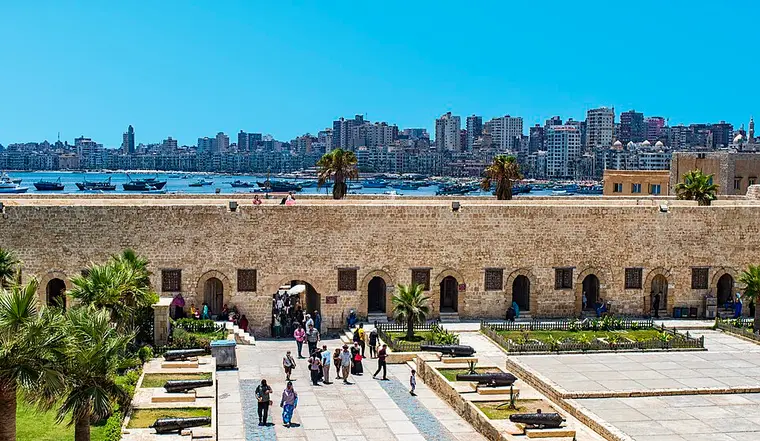
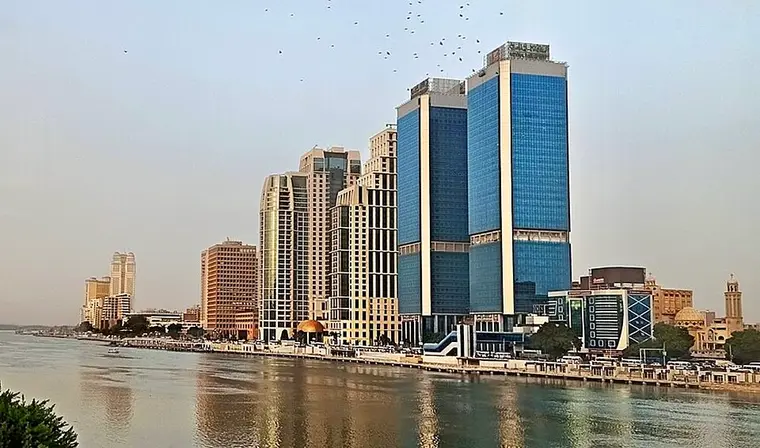
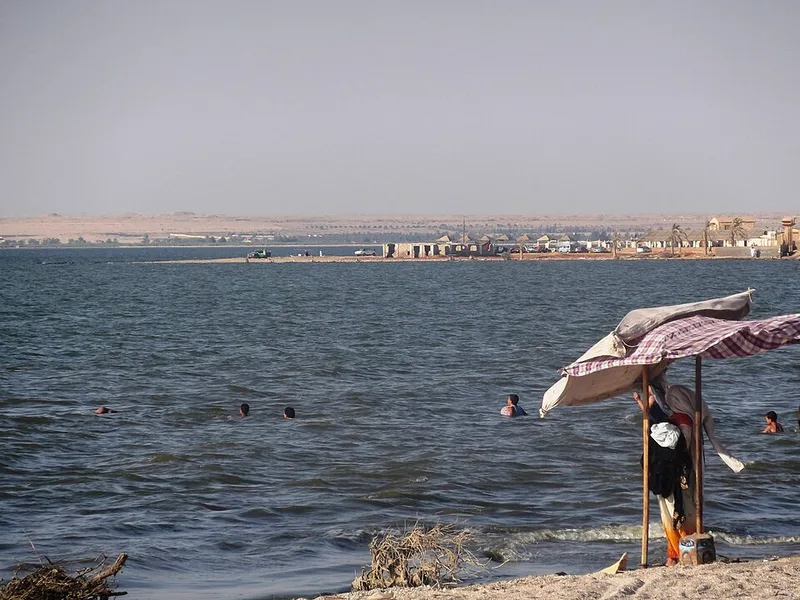

Sources for this chapter (610)Academic69Institution23Specialist book227Reputable web291
Academic(69)
- Couscous Mussolini: US perceptions of Gamal Abdel Nasser, the 1958 intervention in Lebanon and the origins of the US–Israeli special relationship · Cold War History · 2010
- Yolcu · Building a Model While Debunking Another: The Rivalry of Arab Nationalism between 'Abd al-Karim Qasim and Gamal Abdel Nasser · Nationalism and Ethnic Politics · 2020
- Accommodating to a working relationship: Arab Nationalism and US Cold War policies in the Middle East, 1958–60 · Cold War History · 2010
- The Khartoum Conference and Egyptian Policy after the 1967 War: A Reexamination · Middle East Journal · 2000
- The Politics of Laughter: Nasser, Sadat, and Mubarek in Egyptian Political Jokes · Folklore · 1992
- Golani · The Historical Place of the Czech-Egyptian Arms Deal, Fall 1955 · Middle Eastern Studies · 1995
- Oren · Escalation to Suez: The Egypt-Israel Border War, 1949–56 · Journal of Contemporary History · 1989
- Masalha · The 1956–57 Occupation of the Gaza Strip: Israeli Proposals to Resettle the Palestinian Refugees · British Journal of Middle Eastern Studies · 1996
- Yahel · Covert Diplomacy Between Israel and Egypt During Nasser Rule: 1952–1970 · SAGE Open · 2016
- Goodwin · Low Conspiracy?—Government interference in the BBC · Westminster Papers in Communication and Culture · 2005
- Black · 'The Bitterest Enemies of Communism': Labour Revisionists, Atlanticism and the Cold War · Contemporary British History · 2001
- Borhi · Containment, Rollback, Liberation or Inaction? The United States and Hungary in the 1950s · Journal of Cold War Studies · 1999
- Atlantic Dreams and European Realities: British Foreign Policy After Iraq · Journal of European Integration · 2008
- Theory and Reality in the Anglo-American Alliance · World Politics · 1966
- Adamthwaite · Suez revisited · International Affairs · 1988
- Dietl · Suez 1956: A European Intervention? · Journal of Contemporary History · 2008
- Laskier · Egyptian Jewry under the Nasser Regime, 1956–70 · Middle Eastern Studies · 1995
- Thornhill · Britain, the United States and the Rise of an Egyptian Leader: The Politics and Diplomacy of Nasser's Consolidation of Power, 1952-4 · The English Historical Review · 2004
- Lahav · The Suez Crisis of 1956 and its Aftermath: A Comparative Study of Constitutions, Use of Force, Diplomacy and International Relations · Boston University Law Review · 2015
- Painter · Oil and the American Century · The Journal of American History · 2012
- Sheffy · Unconcern at dawn, surprise at sunset: Egyptian intelligence appreciation before the Sinai campaign, 1956 · Intelligence and National Security · 1990
- Gazit · Egypt and Israel – Was There a Peace Opportunity Missed in 1971? · Journal of Contemporary History · 1997
- Hughes · Courting Sadat: The Heath Government and Britain's Arms Sales to Egypt, 1970–1973 · The International History Review · 2020
- Monson · Infitah and the Modernization of Egypt · Sigma: Journal of Political and International Studies · 1984
- Berenji · Sadat and the Road to Jerusalem: Bold Gestures and Risk Acceptance in the Search for Peace · International Security · 2020
- Orbach · Tyrannicide in Radical Islam: The Case of Sayyid Qutb and Abd al Salam Faraj · Middle Eastern Studies Vol. 48, No. 6 · 2012
- Одликувања · Službeni list SFRJ · 1764
- The Impact of American Arms Transfers to Israel during the 1973 Yom Kippur War · Israel Journal of Foreign Affairs · 2015
- Anatomy of an airlift: United States military assistance to Israel during the 1973 war · Cold War History · 2008
- Raz · The Generous Peace Offer that was Never Offered: The Israeli Cabinet Resolution of June 19, 1967 · Diplomatic History · 2013
- Hughes · Britain, the Transatlantic Alliance, and the Arab-Israeli War of 1973 · Journal of Cold War Studies · 2008
- Bar-Joseph · Last Chance to Avoid War: Sadat's Peace Initiative of February 1973 and its Failure · Journal of Contemporary History · 2006
- 'The Soviets were just an excuse': why Israel did not destroy the Egyptian Third Army · Cold War History · 2009
- Barkat · Yaakobi's Box · Israeli Air Force Magazine · 1998
- Rodman · Friendly Enemies: Israel and Jordan in the 1973 Yom Kuppur War · The Israel Journal of Foreign Affairs · 2012
- 'A Situation That Had to Be Manipulated': The American Airlift to Israel During the Yom Kippur War · Middle Eastern Studies · 2016
- 'Which Chile, Allende?' Henry Kissinger and the Portuguese revolution · Cold War History · 2011
- The Greek dictatorship, the USA and the Arabs, 1967–1974 · Journal of Southern Europe and the Balkans · 2007
- Liebman · The Myth of Defeat: The Memory of the Yom Kippur war in Israeli Society · Frank Cass · 1993
- Fighting Outnumbered: The Impact of the Yom Kippur War on the U.S. Army · The Journal of Military History · 2007
- Menshawy · Turning 'defeat' into 'victory': the power of discourse on the 1973 war in Egypt · Middle Eastern Studies · 2016
- Pape · Why Economic Sanctions Do Not Work · International Security · 1997
- Egyptian Revolution: A Demographic Structural Analysis · Entelequia. Revista Interdisciplinar · 2011
- Hanieh · Beyond Mubarak: Reframing The "Politics" and "Economics" of Egypt's Uprising · Studies in Political Economy · 2011
- Joya · The Egyptian revolution: crisis of neoliberalism and the potential for democratic politics · Review of African Political Economy · 2011
- Comparative Analysis to Evaluate the Effect of the Green Infrastructure Elements on Thermal Performance in Existing Cities: An Applied Study of El-Mahalla El-Kubra · Journal of Engineering Research · 2025
- Mehrez, Samia, ed. (2012): Translating Egypt's Revolution: the Language of Tahrir. Cairo/New York: The American University in Cairo Press, 340 p. – Meta
- O'Mahoney · Critical Realism and the Self · Journal of Critical Realism · 2011
- China's Media Policy on the Egyptian Revolution: A Case for Securitization · Asian Politics & Policy · 2016
- Abrams · Movement split: how the structure of revolutionary coalitions shapes revolutionary outcomes · Public Choice · 2024
- Jumet · Protest Dynamics under the Supreme Council of the Armed Forces Transitional Government · Oxford Scholarship Online · 2017
- Crisis: a timeline · Health in a Post-COVID World · 2023
- Shehata · Egypt's Political Actors Post-2011 Revolution: Incomplete Struggle for Democracy · Digest of Middle East Studies · 2018
- An upside of Arab revolts: Islamists talk democracy · The Christian Science Monitor · 2011
- Toronto · Egypt's 'Coup-volution' · Middle East Insights · 2011
- Hamanaka · The role of digital media in the 2011 Egyptian revolution · Democratization · 2020
- Ali · The Power of Social Media in Developing Nations: New Tools for Closing the Global Digital Divide and Beyond · Harvard Human Rights Journal
- The Arab Spring| Social Media in the Egyptian Revolution: Reconsidering Resource Mobilization Theory · International Journal of Communication · 2011
- Hassanpour · Media Disruption and Revolutionary Unrest:Evidence From Mubarak's Quasi-Experiment · Political Communication · 2014
- Hassanpour · Media Disruption and Revolutionary Unrest: Evidence From Mubarak's Quasi-Experiment · Political Communication · 2014
- Abaza · Walls, Segregating Downtown Cairo and the Mohammed Mahmud Street Graffiti · Theory, Culture & Society · 2012
- The Impact of Social Networks and Mobile Technologies on the Revolutions in the Arab World—A Study of Egypt and Tunisia · Laws · 2014
- Radsch · Core to Commonplace: The Evolution of Egypt's Blogosphere · American University of Cairo · 2008
- Albrecht · The Myth of Coup-proofing: Risk and Instances of Military Coups d'état in the Middle East and North Africa, 1950–2013 · Armed Forces & Society · 2015
- Biswas · Aswan Dam Revisited: The Benefits of a Much-Maligned Dam · Development and Cooperation · 2002
- Heggy, E. et al. Grand Ethiopian Renaissance Dam can generate sustainable hydropower while minimizing downstream water deficit during prolonged droughts. Commun Earth Environ 5, 757 (2024) · Communications Earth & Environment · 2024
- Rebuilding Cultural Identity: Nubian Rehabilitation along the Shore of Lake Nasser · Environmental Science and Sustainable Development · 2019
- Abu Zeid · Environmental impacts of the High Dam · Water Resources Development · 1989
- Schamp · Sadd el-Ali, der Hochdamm von Assuan (Sadd el-Ali, the High Dam of Aswan) · Geowissenschaften in unserer Zeit · 1983
Institution(23)
- The Central Intelligence Agency and Overhead Reconnaissance: The U-2 and OXCART Programs, 1954–1974 · History Staff, Central Intelligence Agency · 1992
- Gallery · Israel Railways
- Message to the Congress Transmitting the 11th Annual Report on United States Participation in the United Nations · University of California Santa Barbara · 1958
- Evans · Suez Canal Crisis · 2010
- Situation report in the Middle East · United States Department of State
- Sadat interview to El Hawadeth
- Crossing under Fire
- White House Military Briefing
- Geroux · Urban Warfare Project Case Study #4: Battle of Suez City. · 2022
- The national security archive, declassified archival records, The October War and U.S. Policy.
- Van Creveld · Military Lessons of the Yom Kippur War: Historical Perspectives · Sage · 1975
- 22 October Memorandum of Conversation between Meir and Kissinger
- The October War and U.S. Policy · 2003
- Department of State Operations Center, Situation Report in the Middle East as of 10/26/73
- State Department Intelligence and Research Predicted 1973 Arab–Israeli War · The National Security Archive (U.S.) · 2013
- White House Military Briefing, 22 October
- Saudi Arabian Military Activity Against Israel · CMU · 1978
- Jennings · Reconstitution Under Fire: Insights from the 1973 Yom Kippur War - Modern War Institute · 2025
- Anatoly Chernyaev · Diary of Anatoly Chernyaev, 1973 · National Security Archive Electronic Briefing Book No. 430
- University on the Square: Documenting Egypt's 21st Century Revolution · American University in Cairo
- Egypt's 21st Century Revolution Oral Histories · American University in Cairo
- Isqat Al-Nizam · American University in Cairo
- Egyptian and Arab Revolution Scholarly Works · American University in Cairo
Specialist book(227)
- Afaf Lutfi al-Sayyid Marsot · A Short History of Modern Egypt · Cambridge University Press · 1985
- Samir A. Mutawi · Jordan in the 1967 War · Cambridge University Press · 2002
- Warrior: An Autobiography · Simon and Schuster · 2002
- Fremont-Barnes · A History of Counterinsurgency [2 volumes] · ABC-CLIO · 2015
- Avi Shlaim · Lion of Jordan · Knopf Doubleday Publishing Group · 2008
- Itamar Rabinovich · From June to October: The Middle East Between 1967 And 1973 · Transaction Publishers
- Satloff · Among the Righteous: Lost Stories from the Holocaust's Long Reach Into Arab lands · PublicAffairs · 2007
- Laqueur · The Changing Face of Antisemitism: From Ancient Times to the Present Day · Oxford University Press · 2006
- Achar · The Arabs and the Holocaust · Saqi Books · 2011
- Stela · Polish orders and decorations · Warsaw · 2008
- Wistrich · Hitler's apocalypse: Jews and the Nazi legacy · Weidenfeld & Nicolson · 1985
- Richard Bordeaux Parker · The Politics of Miscalculation in the Middle East · Indiana University Press · 1993
- Herf · Nazi Propaganda for the Arab World · Yale University · 2009
- Stillman · Antisemitism. A Historical Encyclopedia of Prejudice and Persecution · ABC–CLIO · 2005
- Wilford · America's Great Game: The CIA's Secret Arabists and the Making of the Modern Middle East · Basic Books · 2013
- A Military History of Modern Egypt: From the Ottoman Conquest to the Ramadan War · 2006
- Ross · Causes and Consequences of the Arab–Israeli Conflict · Evans Brothers · 2004
- Isacoff · Writing the Arab–Israeli Conflict: Pragmatism and Historical Inquiry · Lexington Books · 2006
- Caplan · Futile Diplomacy: Operation Alpha and the Failure of Anglo-American Coercive Diplomacy in the Arab–Israeli Conflict, 1954–1956 · Psychology Press · 1983
- Mayer · The Eisenhower Years · Infobase Publishing · 2010
- Copeland · The Game Player: Confessions of the CIA's Original Political Operative · Aurum Press · 1989
- Pierre · 1956 Suez Crisis And The United Nations · Tannenberg Publishing · 2014
- Abernathy · The Dynamics of Global Dominance: European Overseas Empires, 1415–1980 · Yale University Press · 2000
- Owen · Suez Crisis · Oxford University Press · 2001
- Ellis · Historical Dictionary of Anglo-American Relations · Scarecrow Press · 2009
- Reassessing Suez 1956: New perspectives on the crisis and its aftermath · Routledge · 2016
- Christopher · The 1956 Hungarian Revolution: Hungarian and Canadian Perspectives · University of Ottawa Press · 2010
- Nasr · Arab and Israeli Terrorism: The Causes and Effects of Political Violence, 1936–1993 · McFarland · 1996
- Kandil · Soldiers, Spies and Statesmen: Egypt's Road to Revolt · Verso Books · 2012
- The World Bank Since Bretton Woods · Brookings Institution · 1973
- Rethinking Nasserism: Revolution and Historical Memory in Modern Egypt · University Press of Florida · 2004
- Eayrs · The Commonwealth and Suez: A Documentary Survey · Oxford University Press · 1964
- Menzies · Speech is of Time · Cassell · 1958
- Skardon · A Lesson for Our Times: How America Kept the Peace in the Hungary-Suez Crisis of 1956 · 2010
- Shaw · Eden, Suez and the Mass Media: Propaganda and Persuasion During the Suez Crisis · I.B. Tauris · 1996
- Williams · Harold Macmillan · 2009
- Creveld · The Sword And The Olive: A Critical History Of The Israeli Defense Force · PublicAffairs · 2008
- Dayan · Diary of the Sinai Campaign · Harper & Row · 1966
- Sacco · Footnotes in Gaza: A Graphic Novel · Metropolitan Books · 2009
- Eayrs, James · The Commonwealth and Suez: A Documentary Survey · Oxford University Press · 1964
- Polmar · Aircraft Carriers: A History of Carrier Aviation and Its Influence on World Events, Volume II: 1946–2006 · Potomac Books, Inc. · 2008
- Braddon · Suez: Splitting of a Nation · Collins · 1973
- Post-War Britain: A Political History · Penguin · 1984
- Sandbrook · Never Had It So Good: A History of Britain from Suez to the Beatles · Abacus · 2006
- Harrison · Seeking a Role: The United Kingdom, 1951–1970 · Oxford University Press · 2009
- Barnett · The Collapse of British Power · Eyre Methuen · 1972
- Castle · Fighting All The Way · Pan · 1994
- Campbell · Pistols at Dawn: Two Hundred Years of Political Rivalry from Pitt and Fox to Blair and Brown · Vintage · 2010
- Divine · Eisenhower and the Cold War · Oxford University Press · 1981
- Schwarz · Konrad Adenauer: A German Politician and Statesman in a Period of War, Revolution and Reconstruction, 1952–1967 · Berghahn Books · 1995
- Pike · Empires at War · I.B. Tauris · 2009
- Lacey · The Kingdom · Avon · 1981
- Encyclopedia of the United Nations · 2008
- Brecher · A Restless Mind: Essays in Honor of Amos Perlmutter · Psychology Press · 1996
- Shlaim · The Iron Wall: Israel and the Arab World · W. W. Norton · 2001
- Chomsky · The Fateful Triangle: The United States, Israel and the Palestinians · South End Press · 1983
- Cotterell · The Railways of Palestine and Israel · Tourret · 1984
- Mart · Eye on Israel: How America Came to View the Jewish State as an Ally · SUNY Press · 2006
- Lucas · Divided we Stand: Britain, the US and the Suez Crisis · Hodder · 1991
- Gavin · War And Peace In The Space Age · Harper
- Aldrich · GCHQ · Harper Press · 2011
- Thorner · A Country Nourished on Self-Doubt: Documents in Post-Confederation Canadian History · Broadview Press · 2003
- Alteras · Eisenhower and Israel: U.S.-Israeli Relations, 1953–1960 · University Press of Florida · 1993
- Barnett · Confronting the Costs of War: Military Power, State, and Society in Egypt and Israel · Princeton University Press · 1992
- Burns · Economic Aid and American Policy toward Egypt, 1955–1981 · State University of New York Press · 1985
- Butler · Britain and Empire: Adjusting to a Post-Imperial World · I.B. Tauris · 2002
- Darwin · Britain and Decolonisation: The Retreat From Empire in the Post-War World · Palgrave Macmillan · 1988
- Gaddis · We Now Know: Rethinking Cold War History · Oxford University Press · 1998
- Herzog · The Arab-Israeli Wars: War and Peace in the Middle East · Random House · 1982
- Horne · Macmillan: The Official Biography · Macmillan · 2008
- James · Anthony Eden: A Biography · McGraw Hill Book Company Inc · 1986
- Kingseed · Eisenhower and the Suez Crisis of 1956 · Louisiana State Press · 1995
- Kissinger · Diplomacy · Simon & Schuster · 1994
- Kyle · Suez: Britain's End of Empire in the Middle East · I.B. Tauris · 2003
- Love · Suez The Twice Fought War · McGraw-Hill · 1969
- Neff · Warriors at Suez : Eisenhower takes America into the Middle-East · Simon and Schuster · 1981
- Risse-Kappen · Cooperation among Democracies: The European Influence on U.S. Foreign Policy · Princeton University Press · 1997
- Sayed-Ahmed · Contemporary Egypt: Through Egyptian Eyes : Essays in Honour of Professor P.J. Vatikiotis · Routledge · 1993
- Sachar · A History of Israel: From the Rise of Zionism to Our Time · A.A. Knopf · 1996
- Schiff · A History of the Israeli Army: 1870–1974 · Straight Arrow Books · 1974
- Stewart · The Middle East Today: Political, Geographical and Cultural Perspectives · Routledge · 2013
- The 1956 War · Frank Cass Publishers · 2001
- Turner · Suez 1956 The World's First War for Oil · Hodder & Stoughton · 2006
- Varble · The Suez Crisis 1956 · Osprey · 2003
- Vatikiotis · Nasser and His Generation · Croom Helm · 1978
- Wilson · Our Times The age of Elizabeth II · Hutchinson · 2008
- Yergin · The Prize: The Epic Quest for Oil, Money, and Power · Simon & Schuster · 1991
- Arnstein · Britain Yesterday and Today: 1830 to the Present · Houghton Mifflin · 2001
- Beaufre · The Suez Expedition 1956 · Praeger · 1969
- Bregman · Israel's Wars: A History Since 1947 · Routledge · 2002
- Childers · The Road To Suez · MacGibbon & Kee · 1962
- Heikal · Cutting The Lion's Tail: Suez Through Egyptian eyes · Deutsch · 1986
- Hyam · Britain's Declining Empire: The Road to Decolonisation 1918–1969 · Cambridge University Press · 2006
- Karabell · Parting the desert: the creation of the Suez Canal · Alfred A. Knopf · 2003
- Kunz · The Economic Diplomacy of the Suez Crisis · U. of North Carolina Press · 1991
- Leuliette · St. Michael and the Dragon: Memoirs of a Paratrooper · Houghton Mifflin · 1964
- Lucas · Britain and Suez: The Lion's Last Roar · Manchester University Press · 1996
- Marshall · Sinai Victory: Command Decisions in History's Shortest War, Israel's Hundred-Hour Conquest of Egypt East of Suez, Autumn, 1956 · Battery Press · 1958
- McGregor · A Military History of Modern Egypt: From the Ottoman Conquest to the Ramadan War · Greenwood Publishing Group · 2006
- Reynolds · Brittania Overruled: British Policy and World Power in the Twentieth Century · Longman · 1991
- Sharon · Warrior: The Autobiography of Ariel Sharon · Simon and Schuster · 1989
- Verbeek · Decision-Making in Great Britain During the Suez Crisis: Small Groups and a Persistent Leader · Ashgate Publishing · 2003
- Vatikiotis · The History of Modern Egypt · Johns Hopkins University Press · 1991
- C. J. De Wet · Development-induced Displacement: Problems, Policies, and People · Berghahn Books · 2006
- Mango · Seventy-five Years of the Turkish Republic
- Alagna · Anwar Sadat · The Rosen Publishing Group · 2004
- Wagner · Anwar Sadat and Menachem Begin: Negotiating Peace in the Middle East · Infobase Publishing · 2007
- Sadat · Revolt on the Nile · A. Wingate · 1957
- Sadat · In Search of Identity: An Autobiography · Harper & Row · 1978
- Kepel · Jihad: Expansion et Déclin de l"Islamisme · Belknap Press of Harvard University Press · 2002
- Podeh · Chances for Peace · University of Texas Press · 2015
- Golan · Soviet Policies in the Middle East: From World War Two to Gorbachev · Cambridge University Press · 1990
- Righteous Victims: A History of the Zionist-Arab Conflict, 1881–1998 · 1999 · 2001
- Olivier · Failure of Political Islam · Harvard University Press · 1994
- Weaver · Portrait of Egypt · Farrar, Straus and Giroux · 1999
- Psalm 83: A New Discovery · iUniverse · 2014
- J. Tyler Dickovick · Africa 2012 · Stryker Post · 2012
- Sadat · Son, This Is Your Uncle Gamal – Memoirs of Anwar el-Sadat · Maktabat al-ʻIrfān · 1958
- Tripp · Contemporary Egypt: Through Egyptian eyes · Routledge · 1993
- Avner · The Prime Ministers: An Intimate Narrative of Israeli Leadership · The Toby Press · 2010
- Eidelberg · Sadat's Strategy · Dawn Books · 1979
- Haykal · Autumn of Fury: The Assassination of Sadat · Wm Collins & Sons & Co · 1982
- Peace in the Making · Gefen Publishing House · 2010
- Meital · Egypt's Struggle for Peace: Continuity and Change, 1967–1971 · University Press of Florida · 1997
- Waterbury · The Egypt of Nasser and Sadat: The Political Economy of Two Regimes · Princeton University Press · 1983
- Wright · The Looming Tower: Al-Qaeda and the Road to 9/11 · Knopf · 2006
- Mahjoub Tobji · Les officiers de Sa Majesté: Les dérives des généraux marocains 1956–2006 · Fayard · 2006
- Israel: A History · Harper Perennial · 2008
- Neil Partrick · Saudi Arabian Foreign Policy: Conflict and Cooperation · Bloomsbury · 2016
- The Cuban Intervention in Angola, 1965–1991 · Routledge · 2004
- Shlaim · The Iron Wall – Israel and the Arab World · Penguin Books · 2014
- Gavriely-Nuri · The Normalization of War in Israeli Discourse, 1967–2008 · Rowman & Littlefield · 2013
- Chances for Peace: Missed Opportunities in the Arab-Israeli Conflict · University of Texas Press · 2015
- The Angel: The Egyptian Spy Who Saved Israel · HarperCollins · 2016
- William B. Quandt · Decade of Decisions: American Policy Toward the Arab–Israeli Conflict, 1967–1976 · University of California Press · 1977
- Abouseada · The Crossing of the Suez Canal, 6 October 1973 (The Ramadan War) · U.S. Army War College · 1980
- The Struggle for the Middle East · University of California Press · 1988
- Revisiting the Yom Kippur War · Psychology Press · 2000
- Dayan · Story of My Life · Da Capo · 1992
- Major George E. Knapp · Combined Arms in battle since 1939 · U.S. Army Command and General Staff College · 1992
- Bidanda M. Chengappa · Pakistan: Islamisation Army And Foreign Policy · APH Publishing · 2004
- Simon Dunstan · The Yom Kippur War 1973 (2): The Sinai · Osprey Publishing · 2003
- P. R. Kumaraswamy · Revisiting the Yom Kippur War · Routledge · 2013
- Lindsey Hilsum · Sandstorm · Faber & Faber · 2015
- Asher · Inside Israel's Northern Command: The Yom Kippur War on the Syrian Border · University Press of Kentucky · 2014
- Boyne · The Yom Kippur War · St. Martin's Press · 2007
- Carta's Atlas of Israel: The Third Decade 1971–1981 · Jerusalem: Carta · 1983
- Macdonald · Propaganda and Information Warfare in the Twenty-First Century · Routledge · 2006
- The Israeli Army · Abt Books · 1983
- Kumaraswamy · Revisiting The Yom Kippur War · Psychology Press · 2000
- The Yom Kippur War: The Arab-Israeli War of 1973 · Bloomsbury USA · 2007
- Asaf Siniver · The Yom Kippur War: Politics, Legacy, Diplomacy · Oxford University Press · 2013
- Ian Bickerton · The Arab-Israeli Conflict: A Guide for the Perplexed · A&C Black · 2012
- P.R. Kumaraswamy · Revisiting the Yom Kippur War · Routledge · 2013
- Siniver · The Yom Kippur War: Politics, Legacy, Diplomacy · Oxford University Press · 2013
- A World Ignited: How Apostles of Ethnic, Religious, and Racial Hatred Torch the Globe · Rowman & Littlefield Publishers · 2007
- Kacowicz · Peaceful Territorial Change · Univ of South Carolina Press · 1994
- Porter · The USSR in Third World Conflicts: Soviet Arms and Diplomacy in Local Wars 1945-1980 · Cambridge University Press · 1986
- Lansford · 9/11 and the Wars in Afghanistan and Iraq: A Chronology and Reference Guide · Bloomsbury Publishing USA · 2011
- Bailey · Jordan's Palestinian Challenge, 1948-1983: A Political History · Routledge · 2019
- A Portrait of the Israeli Soldier · Greenwood Press · 1986
- Kenneth W. Stein · Heroic Diplomacy: Sadat, Kissinger, Carter, Begin, and the Quest for Arab–Israeli Peace · Psychology Press · 1999
- Henry Kissinger · Years of Upheaval: The Second Volume of His Classic Memoirs · Simon and Schuster · 2011
- Arab-Israeli Air Wars 1947–82 · Bloomsbury USA · 2001
- Duel for the Golan: the 100-hour battle that saved Israel · William Morrow and Company, Inc · 1987
- el Badri · The Ramadan War, 1973 · T. N. Dupuy Associates Books · 1979
- Bar-Joseph · The Watchman Fell Asleep: The Surprise of Yom Kippur and Its Sources · SUNY Press · 2012
- A Never-ending Conflict: A Guide to Israeli Military History · Bloomsbury Academic · 2004
- Ben-Ami · Scars of War, Wounds of Peace: The Israeli–Arab Tragedy · Phoenix · 2005
- Boyne · The two o'clock war: the 1973 Yom Kippur conflict and the airlift that saved Israel · Thomas Dunne Books · 2002
- Bronson · Thicker than oil: America's uneasy partnership with Saudi Arabia · Oxford University Press · 2006
- Brook · In the Sands of Sinai: a Physician's Account of the Yom Kippur War · CreateSpace · 2011
- Israel's Best Defence: The First Full Story of the Israeli Air Force · Airlife · 1994
- Dupuy · Elusive victory: The Arab–Israeli Wars, 1947–1974 · Harper & Row · 1978
- The October War: Memoirs of Field Marshal El-Gamasy of Egypt · American University in Cairo Press · 1993
- Gawrych · The Albatross of Decisive Victory: War and Policy Between Egypt and Israel in the 1967 and 1973 Arab-Israeli Wars · Greenwood Publishing Group · 2000
- Gawrych · The 1973 Arab-Israeli War: The Albatross of Decisive Victory · Combat Studies Institute, U.S. Army Command and General Staff College · 1996
- Yom Kippur War Lexicon · Zmora-Bitan-Dvir · 2003
- Hammad · al-Maʻārik al-ḥarbīyah ʻalá al-jabhah al-Miṣrīyah: (Ḥarb Uktūbar 1973, al-ʻĀshir min Ramaḍān) · Dār al-Shurūq · 2002
- Heikal · The Road to Ramadan · Collins · 1975
- Herzog · The War of Atonement: The Inside Story of the Yom Kippur War · Little, Brown and Company · 1975
- Herzog · the Arab-Israeli Wars · Random House · 1982
- Herzog · Heroes of Israel · Little, Brown · 1989
- Insight Team of the London Sunday Times · The Yom Kippur War · Doubleday · 1974
- Rabinovich · Boats of Cherbourg · Random House Value Publishing · 1990
- Israeli · Man of Defiance: A Political Biography of Anwar Sadat · Weidenfeld & Nicolson · 1985
- Israelyan · Inside the Kremlin During the Yom Kippur War · Pennsylvania State University Press · 2003
- Karsh · The Iran-Iraq War, 1980–1988 · Osprey Publishing · 2002
- Failing to Win · Harvard University Press · 2009
- Eighteen Days in October. The Yom Kippur War and How It Created the Modern Middle East · St. Martin's Press · 2023
- Lanir · ha-Hafta'ah ha-basisit: modi'in ba-mashber · Hakibbutz Hameuchad · 2002
- Righteous Victims: A History of the Zionist-Arab Conflict, 1881-2001 · Vintage Books · 2001
- Ma'Oz · Syria and Israel: From War to Peacemaking · Clarendon Press · 1995
- Neff · Warriors against Israel · Amana Books · 1988
- Arab MiG-19 and MiG-21 units in combat · Osprey Publishing · 2004
- O'Ballance · No Victor, No Vanquished: The Yom Kippur War · Presidio Press · 1978
- Arabs at War: Military Effectiveness, 1948-1991 · University of Nebraska Press · 2002
- Quandt · Peace Process: American diplomacy and the Arab–Israeli conflict since 1967 · Brookings Institution / University of California Press · 2005
- The Boats of Cherbourg: The Navy That Stole Its Own Boats and Revolutionized Naval Warfare · Primary Publishing · 1988
- Rabinovich · The Yom Kippur War: The Epic Encounter That Transformed the Middle East · Schocken Books · 2004
- Rabinovich · The Yom Kippur War: The Epic Encounter That Transformed the Middle East. Revised and Updated Edition · Schocken Books · 2017
- al Sadat · In Search of Identity: An Autobiography · Collins · 1978
- A history of the Israeli Army (1870-1974) · San Francisco : Straight Arrow Books; New York : distributed by Simon and Schuster · 1974
- October Earthquake: Yom Kippur 1973 · Transaction Publishers · 2013
- Sharon: The Life of a Leader · HarperCollins · 2011
- Shazly · The Crossing of the Suez, Revised Edition · American Mideast Research · 2003
- Shlaim, Avi · The Iron Wall: Israel and the Arab World · W.W. Norton & Company · 2001
- Rodman · Israel in the 1973 Yom Kippur War: diplomacy, battle, and lessons · Sussex Academic Press · 2017
- El-Hewie · Chain Reaction: Egypt's Revolt 2011 Illustrated · Shaymaa · 2011
- El-Hewie · A Matter of Faith: The Islamic Spring · Shaymaa · 2013
- Caraley · American Hegemony: Preventive War, Iraq, and Imposing Democracy · Academy of Political Science · 2004
- Rutherford · Egypt after Mubarak: Liberalism, Islam, and Democracy in the Arab World · Princeton University Press · 2008
- The Report: Egypt 2007 · Oxford Business Group · 2007
- Witzel · This is what they tell US: The US Printing Press on the 2011 Revolution in Egypt
- El Bernoussi · Dignity in the Egyptian Revolution: Protest and Demand during the Arab Uprisings · Cambridge University Press · 2021
- Atkins · The 9/11 Encyclopædia · ABC-CLIO · 2011
- Terrorism and Political Contention: New Perspectives on North Africa and the Sahel Region · Springer · 2024
- Bradley · Inside Egypt: the land of the Pharaohs on the brink of a revolution · Palgrave Macmillan · 2008
- Egypt: the moment of change · Zed Books · 2009
- Ketchley · Egypt in a time of revolution: contentious politics and the Arab Spring · Cambridge University Press · 2017
- Clay County, NC Then and Now: A Written and Pictorial History · Genealogy Publishing Service · 2007
- Collins · The Nile: Histories, Cultures, Myths. Edited by Haggai Erlich and Israel Gershoni · Lynne Rienner · 2000
- Smith · Palestine and the Arab–Israeli Conflict · Bedford/St. Martin's. · 2007
- Eisenhower in War and Peace · Random House Publishing Group · 2012
- Collins · The Nile · Yale University Press · 2002
- Florman · The existential pleasures of engineering · St. Martin's Press · 1994
- Stock · Aswan and Abu Simbel: history and guide · American University in Cairo Press · 1993
Reputable web(291)
- Universalis · ÉGYPTE - L'Égypte républicaine : De la RAUà la guerre de Six Jours | Histoire
- Egypt - October 1973 War · Countrystudies.us
- Jailan Zayan · AFP – Egypt braces for nationwide protests · Agence France-Presse · 2011
- The Egyptian constitutional referendum of March 2011 a new beginning
- Rallies for, against Egypt president's new powers · 2012
- Twitter / ELBaradei · 2012
- Czech News Agency · Soud s islamisty v Egyptě: Na popraviště půjde více než 500 Mursího stoupenců · IHNED.cz · 2014
- Czech News Agency · Soud v Egyptě vynesl za protesty trest smrti nad skoro 700 lidmi · ceskenoviny.cz · 2014
- Egypt's El-Sisi bids military farewell, says he will run for presidency - Politics - Egypt - Ahram Online
- El-Sisi wins Egypt's presidential race with 96.91% · Ahram Online
- Egypt's War against the Gaza Tunnels · 2018
- Nasser · HarperCollins
- Abdel Nasser · A Historical Sketch of Gamal Abdel Nasser · Bibliotheca Alexandrina
- The Books Gamal Abdel Nasser Used to Read, 1. During his Secondary School Years · Bibliotheca Alexandrina
- Establishment of UNEF (United Nations Emergency Force) · United Nations
- Michael M. Laskier · Egyptian Jewry under the Nasser Regime, 1956–70 · Historical Society of Jews from Egypt · 1995
- Claims that Sadat killed Nasser are unfounded · Al Arabiya · 2010
- Egypt Elections Watch: Al-Karama · Ahram Online and Jadaliyya · 2011
- El-Set, biopic about Umm Kalthoum, premieres at 22nd Marrakech Film Festival - Screens - Arts & Culture
- Kijamii · After The Trailer: Meet The Real People Behind "El Sett" | NileFM | EGYPT'S#1 FOR HIT MUSIC
- Syrian History - Gamal Abdul Nasser during the union years, practicing his favorite hobby: photography - 1960
- Gamal Abdel Nasser Writings · Bibliotheca Alexandrina
- Seznamy nositelů státních vyznamenání
- Hubrich · Verleihungsliste zum Orden "Großer Stern der Völkerfreundschaft" von 1964 bis 1989 · 2015
- Suomen Valkoisen Ruusun Ritarikunnan Suurristin Ketjuineen Ulkomaalaiset Saajat · 2020
- Senarai Penuh Penerima Darjah Kebesaran, Bintang dan Pingat Persekutuan Tahun 1965
- National Orders awards 29 October 2004
- Tito in Africa: Picturing Solidarity · 2020
- Zuljan · Armed Conflict Year Index
- Egypt Today staff · In 63rd ann. of Tripartite Aggression, members of popular resistance tell heroic stories · 2019
- Suez Crisis · A&E Television Networks · 2009
- Mastny · NATO in the Beholder's Eye: Soviet Perceptions and Policies, 1949–56 · Woodrow Wilson International Center for Scholars · 2002
- Suez Canal
- Ben-Gurion Exchange with Soviet Premier Bulganin Regarding Threat to Israel (November 1956)
- Compromise-Minded Conferees · 1956
- Orders, Decorations, Medals and Militaria (9 & 10 May 2018): Lot 81 | Noonans Mayfair
- SUEZ (OPERATION MUSKETEER)
- Walsh · The Suez Fiasco 1956 · Socialism Today · 2006
- Aneurin Bevan 1956 · 2010
- First United Nations Emergency Force (UNEF I) · United Nations
- Emergency Special Sessions · United Nations General Assembly
- Trueman · The Suez Crisis of 1956 · 2015
- Service Cinématographique des Armées SCA reportage de Paul Corcuff, 22 December 1956 · Ministry of Defense
- Why Was The Suez Crisis So Important?
- Herman · A Man, A Plan, A Canal What Nasser wrought when he seized Suez a half century ago · 2006
- Jewish Refugees from Arab Countries
- Archived copy
- Peace with Israel
- آباء رؤساء مصر من عامة الشعب.. عسكري وساعي بريد وكاتب وحاجب محكمة وفلاح · مؤسسة الأهرام
- باره في زيارة لموطن أم السادات · شبكة الجزيرة الإعلامية · 2018
- Sadat's Wife autobiography
- New play 'Camp David' retraces 1978 peace accord · Associated Press · 2014
- Alterman · Sadat and His Legacy: Egypt and the World, 1977–1997 · The Washington Institute for Near East Policy · 1998
- Alterman · New Media New Politics? · The Washington Institute for Near East Policy · 1998
- Egypt Corrective Revolution 1971 · Onwar · 2000
- Mary Ann Fay · A Country Study · The Library of Congress · 1990
- National Press Club Luncheon Speakers, Anwar Sadat, February 6, 1978 · National Press Club via Library of Congress · 1978
- Text of diplomatic cable regarding Graham's visit to Egypt (US government website)
- Text of Pope's message to Sadat · Vatican · 1976
- Telephone conversation between Kissinger and Rabin, February 5, 1976
- Abdou · Infitah: How Sadat’s Open-Door Economic Policy Lives On · 2022
- Egyptian President Sadat's Speech in Jerusalem (1977) · Economic Cooperation Foundation
- Anwar Al-Sadat
- The Nobel Peace Prize 1978 – Presentation Speech · Nobel prize · 1978
- Teaching · Pat Robertson
- Senarai Penuh Penerima Darjah Kebesaran, Bintang dan Pingat Persekutuan Tahun 1965.
- Trump signs law honoring Anwar Sadat · EgyptToday · 2018
- Cenciotti · Israeli F-4s Actually Fought North Korean MiGs During the Yom Kippur War
- بطولات السعوديين حاضرة.. في الحروب العربية · Okaz · 2019
- Guerre du Kippour: quand le Maroc et l'Algérie se battaient côte à côte · Jeune Afrique · 2013
- Williams · Cuba: Havana's Military Machine · 1988
- قائمة الشرف.. شهداء الكويت في حرب أكتوبر 1973 · al watan · 2025
- James Bean and Craig Girard · Anwar al-Sadat's grand strategy in the Yom Kippur War · National War College · 2001
- Ginsburg · Egypt's Sadat is 'not worth tomatoes,' reservist professor assured Israel's military intelligence before 1973 war · The Times of Israel · 2012
- Ginsburg · Mossad's tip-off ahead of Yom Kippur War did not reach prime minister, newly released papers show · 2012
- Doron Geller · Israeli Intelligence and the Yom Kippur War of 1973 · The Jewish Agency for Israel · 2005
- Government of Israel Concern about possible Syrian and Egyptian attack today · United States Department of State · 1973
- Abudi · The missile did not bend the wing · Journal of the Israeli Air Force · 2003
- Abudi · [What between 'challenge' and 'model'] · The Fisher Institute · 2005
- Milestones in the History of U.S. Foreign Relations - Office of the Historian
- Israel Air Force · Iaf.org.il
- Yom Kippur War: Embattled Israeli Bridgehead at Chinese Farm · 2006
- Zabecki · Arab–Israeli Wars: 60 Years of Conflict · Historyandtheheadlines.abc-clio.com · 2008
- Dr. David Nicolle & Sherif Sharmy · Battle of el-Mansourah · Air Combat Information Group (ACIG) · 2003
- Almog · Israeli Naval Power: An Essential Factor in the Operational Battlefield · Institute for National Security Studies (Israel) · 2011
- Rashba · Yom Kippur War: Sacrificial Stand in the Golan Heights · Military History magazine via History.net · 1998
- Hussain · Opinion: The Fourth round – A Critical Review of 1973 Arab–Israeli War · Defence Journal · 2002
- Yom Kippur War · 2023
- The little-known US-Soviet confrontation during Yom Kippur War · 2016
- Matthew T. Penney, "Intelligence and the 1973 Arab–Israeli War" in President Nixon and the Role of Intelligence in the 1973 Arab–Israeli War, symposium held by CIA, 30 January 2013.
- Violent Week: The Politics of Death · 1976
- The Israeli 'Nuclear Alert' of 1973: Deterrence and Signaling in Crisis · CNA · 2013
- A tale of two fleets: a Russian perspective on the 1973 Naval standoff in the Mediterranean · Thefreelibrary.com
- Easly · Leadership lessons from history · 2010
- John Lacomia · Remember When ... Operation Nickel Grass · Air Force
- McDonnell F-4 Phantom: Essential Aircraft in the Air Warfare in the Middle East · Historynet.com · 2006
- Strategic Doctrine – Israel
- CIA reveals its secret briefings to Presidents Nixon and Ford · CNN · 2016
- How did the U.S.S. Little Rock and her Crew Participate in the Arab–Israeli Yom Kippur War? · USS Little Rock Association
- Effects-Based Operations: the Yom Kippur War Case Study
- Kuwaiti Ministry of Defense
- Cairo Reshuffles Military Leadership
- Milestones: 1969–1976 - Office of the Historian
- The October Arab-Israeli War of 1973: What happened? · 2024
- Summary of "Tactical Stalemates" · 2024
- Who Lost the Yom Kippur War? A Military Inventory of the Middle East · 2024
- Sinai Interim Agreement: 1975
- George Friedman · Israeli–Palestinian Peace Talks, Again · 2010
- The Yom Kippur War and the Shaping of the United States Air Force · Air University Press, Curtis E. LeMay Center for Doctrine Development and Education · 2019
- From Active Defense to AirLand Battle: The Development of Army Doctrine 1973–1982 · United States Army Training and Doctrine Command · 1984
- Ministry of Foreign Affairs · Mfa.gov.il
- 6th of October 1973: When Morocco Participated in the Yom Kippur War
- Middle East: Sandstorm at Kilometer 101 · 1973
- On Arab Treatment of Israeli Prisoners · The New York Times · 1984
- Treatment of Israeli POW's in Syria and Their Status Under the Geneva Conventions: Hearing, Ninety-third Congress, Second Session. 26 February 1974 · 1974
- Statement in the Knesset on the treatment of Israeli prisoners of war in Syria by Defence Minister Peres and Knesset Resolution – 12 June 1974 · Mfa.gov.il
- Pow Expose · IsraCast · 2007
- Boyne · Nickel Grass · 1998
- Intro
- Part I
- Part II
- Part III
- Part IV
- Part V
- Part VI
- Part VII
- Notes
- Quandt · Soviet Policy in the October 1973 War · Rand Corp. R-1864-ISA · 1976
- Rodman · The Impact of American Arms Transfers to Israel during the 1973 Yom Kippur War · Israel Journal of Foreign Affairs, VII:3. · 2013
- Egypt's prime minister quits, new govt soon-army · Forexyard.com
- How the mighty have fallen · 2011
- 846 killed in Egypt uprising · Haaretz · 2011
- 924 killed in Egyptian Revolution · 2011
- Activists on Facebook: the military killed 99 and wounded 2702 in 10 months · Tahrirnews.com · 2011
- Egypt's revolution death toll rises to 384 · Al Masry Al Youm · 2011
- Faisal Al Yafai · Egypt's army fails to grasp the post-Mubarak realities – The National · Thenational.ae · 2012
- شيحة: مكاتب الصحة وثقت سقوط 840 شهيداً خلال ثورة 25 يناير · Almasry-alyoum.com · 2011
- Was the Egyptian revolution really non-violent? · 2012
- Q&A: What's Behind the Unrest? · SBS · 2011
- Trade unions: the revolutionary social network at play in Egypt and Tunisia · Defenddemocracy.org
- Hosni Mubarak resigns as president · Al Jazeera · 2011
- President Morsi in Egypt Seizes New Powers · 2012
- Egypt: The Bread and Freedom Revolution |A Global Revolution · Aglobalrevolution.wordpress.com · 2011
- Business News » Investors See White Revolution in Egypt · 3 News NZ · 2011
- History's crossroads · The Indian Express
- Egypt: A Nation in Waiting · 2011
- Al-A'sar, Marwa · Egyptians abroad speak out against inheritance of power · 2006
- Gamal Essam El-Din · How Gamal brought down the whole Mubarak house · Middle East Online · 2011
- Law 1958/162 (Emergency Law) · Edinburgh Middle East Report
- Egypt and The Impact of 27 years of Emergency on Human Rights · Egyptian Organisation for Human Rights · 2008
- Shehata · Egypt After 9/11: Perceptions of the United States · Contemporary Conflicts · 2004
- Choney, Suzanne · Egyptian bloggers brave police intimidation · NBC News · 2011
- Mayer, Jane · The C.I.A.'s Travel Agent · 2006
- Holder, R. Clemente · Egyptian Lawyer's Death Triggers Cairo Protests · Washington Report on Middle East Affairs · 1994
- 2009 Human Rights Report: Egypt · U.S. Department of State
- EGYPT: Police brutality focuses minds · 2011
- Feature: Torture ties the Egyptian government to a brutal past · 2013
- Central Agency for Population Mobilisation and Statistics — Population Clock (July 2008) · Msrintranet.capmas.gov.eg
- The long-term economic challenges Egypt must overcome · Marketplace · 2011
- Egypt Economy 2011 · CIA World Factbook
- Egypt's Mubarak Likely to Retain Vast Wealth · ABC News
- Obama optimistic about Egypt as negotiators make concessions · AHN
- How did Egypt become so corrupt? – Inside Story · Al Jazeera
- National Association for Change · 2010
- CPI 2010 table · Transparency International
- بوابة الوفد الالكترونية
- Singel · Egypt Shut Down Its Net With a Series of Phone Calls · 2011
- Van Beijnum · How Egypt did (and your government could) shut down the Internet · Ars Technica · 2011
- Egypt security building stormed · Al Jazeera · 2011
- Tens of thousands in Tahrir as some threaten to extend protests | Al-Masry Al-Youm: Today's News from Egypt · Al-Masry Al-Youm
- Thousands of Egyptians protest against police brutality · WireUpdate
- Hundreds of thousands revitalise Egypt'sEgypt's revolution on Determination Friday · Ahram Online
- Egypt: Detained protesters risk military trials · 2011
- Military police's latest Tahrir clampdown reignites popular anger · english.ahram.org.eg
- Chick · Egypt's military lifts emergency law – with one big loophole · The Christian Science Monitor · 2012
- Egypt's military leader lifts emergency law · globalpost · 2012
- El-Shenawi · Egypt's army chief lifts emergency law on eve of revolution anniversary · Al Arabiya · 2012
- Othman · State of emergency ends, military council says will not renew · 2012
- Tentative deal on Egypt constituent assembly · Al Jazeera · 2012
- Egypt's liberals stage walkout · Al Jazeera · 2012
- Egypt decree grants arrest powers to military · Al Jazeera · 2012
- Egypt court orders dissolving of parliament · Al Jazeera · 2012
- Hill · Court throws Egypt transition into disarray · Al Jazeera · 2012
- The Constitutional Declaration (with 17 June 2012 Annex) · Carnegie Endowment for International Peace
- English text of SCAF amended Egypt Constitutional Declaration · Ahram Online · 2012
- Hill · Background: SCAF's last-minute power grab · Al Jazeera · 2012
- Political uncertainty deepens in Egypt · Al Jazeera · 2012
- Egyptians hold their breath until Sunday · Middle East Online · 2012
- Randa Ali · Egypt Supreme Court blocks arrest powers for military, hailed by experts · Ahram Online · 2012
- In Egypt, the Court revoked the right of military arrest civil · European news in English · 2012
- Administrative Court Rules in Favor of Appeal Presented by Human Rights NGOs, Revokes Decree Enabling Military Intelligence and Military Police to Arrest Civilians · Nazra for Feminist Studies · 2012
- Nada Hussein Rashwan · Egypt's constituent assembly convenes Tuesday with future still in doubt · Ahram Online · 2012
- Ahmed Aboul Enein · Constituent Assembly carries on · Daily News Egypt · 2012
- Aswat Masriya · Egypt: Morsi Takes Symbolic Oath in Tahrir Square · allAfrica · 2012
- Clashes Break Out After Morsi Seizes New Power in Egypt · The New York Times · 2012
- Press Releases · Amnesty International
- Anti-Morsi protesters occupy Tahrir in preparation for 30 June – Daily News Egypt · 2013
- Egyptian army issues 48-hour ultimatum · Al-Jazeera English · 2013
- Egypt constitution 'approved by 98.1 percent' · Al Jazeera English · 2014
- Patrick Kingsley · Egypt's new constitution gets 98% 'yes' vote · The Guardian · 2014
- Egypt's El-Sisi bids military farewell, says he will run for presidency · Ahram Online · 2014
- Kingsley · Egypt's Sisi sworn in as president · 2014
- The different shades of Tahrir – Anger in Egypt · Al Jazeera
- Million man march kicks off · 2011
- Update on the Size of Protests in Cairo · 2011
- Shachtman · How Many People Are in Tahrir Square? Here's How to Tell [Updated] · 2011
- Mackey · Updates on Day 8 of Protests in Egypt · 2011
- Tencer · Reports of 'Massacre' in Suez as Protests in Egypt Move into Third day · 2011
- Egypt Travel Advice · FCO
- eljazeera77 · مظاهرات مدينه الزقازيق محافظه الشرقيه 28 يناير · YouTube · 2011
- Sinai Bedouins support the #Jan25 Revolution بدو سيناء يعلنون تأييدهم للثورة المصرية " 3arabawy · Arabawy.org · 2011
- Rosenberg, David · Self-Immolation Spreads Across the Mideast, Inspiring Protest, Controversy · The Media Line · 2011
- Mother of Ahmed Hashim al-Sayyed · Reuters (via Yahoo! News) · 2011
- Police Disappear from Streets: Prisoners Breakout · 2011
- Ambassador: Embassy will continue providing necessary help to Azerbaijanis in Egypt · En.trend.az · 2011
- Prosecutor General's Office Files Lawsuit on Murder of Accountant of Azerbaijani Embassy in Egypt · 2011
- Nolan, Dan · Hundreds Mourn the Dead in Egypt · Al Jazeera · 2011
- Egypt Unrest Claimed About 300 Lives – UN High Commissioner for Human Rights Navi Pillay · Allvoices.com
- UN Human Rights Chief: 300 Reported Dead in Egypt Protests · Haaretz · 2011
- Fact-Finding National Commission About 25 Jan Revolution Final Report · 2011
- At least 846 killed in Egypt's revolution · Al-Masry Al-Youm · 2011
- Regional Reaction Mixed For Egypt Protests · Eurasia Review
- Travel warning issued, evacuation to start as protests continue in Egypt · English People's Daily Online · 2011
- Trimel · Amnesty International Rebukes Egyptian Leaders for "Failed" Response to Protest Demands Organization Says Leaders' Efforts to Discourage Protests are "Unacceptable"
- Baird-Remba · Mubarak Steps Down: Reactions From Around the World.
- Obama · Follow Egypt's Example, Obama Tells Mideast. · 2011
- Protesters Return to Cairo's Main Square – Egyptian President Fires His Cabinet But Refuses To Step Down · NBC News · 2011
- Mubarak Swears in New Cabinet – Egypt's President Appoints New Cabinet in an Attempt To Quell Ongoing Mass Street Protests Against His Rule · Al Jazeera · 2011
- Mubarak Orders State Subsidies – Hosni Mubarak Ordered His New PM To Preserve Subsidies, Control Inflation and Provide More Jobs · Al Jazeera · 2011
- El-Ghatrify, Alaa · NDP Official: President To Run for 6th Term; Gamal Mubarak Candidacy 'Delusory' · Almasry Alyoum · 2010
- Defiant Mubarak Vows To Finish Term – Violence Erupts in Alexandria Shortly After Egyptian President's Announcement That He Will Not Seek Another Term · Al Jazeera · 2011
- Memmott · ElBaradei Back in Egypt; Says It's Time for a New Government: The Two-Way · NPR · 2011
- Cowie · Egypt Leaves the Internet · Renesys · 2011
- Webster · Vodafone confirms role in Egypt's cellular, Internet blackout · 2011
- Goodman · Digital Darkness: U.S., U.K. Companies Help Egyptian Regime Shut Down Telecommunications and Identify Dissident Voices · Democracy Now! · 2011
- Egypt: A List of Demands from Tahrir Square · Global Voices · 2011
- Abigail Hauslohner · The Most Powerful Weapon of Egypt's Ruling Generals: State TV · 2012
- Muslim Brotherhood to establish 'Freedom and Justice Party' · Al-Masry Al-Youm
- The Muslim Brotherhood Official English Website · Ikhwanweb · 2011
- Gordon · Muslim Brotherhood sits at Egypt's new democratic table · The Jerusalem Post · 2011
- Muslim Brothers see corruption-free Egypt flourishing · Al Arabiya · 2011
- Egypte: le Premier ministre remplacé, satisfaction des opposants · Euronews · 2011
- Meet Essam Sharaf: Egypt's first post-revolution Prime Minister · Ahram Online · 2011
- Egypt's Elaraby accepts foreign minister post · The Jerusalem Post · 2011
- Egypt PM appoints new key ministers · Al Jazeera
- مصطفى الفقى: شخصية كبيرة فى الرئاسة أكدت لى أن "مبارك" لن يترشح وابنه سيكون البديل · Almasry-alyoum.com
- Egypt Issues Travel Ban, Asset Freeze on Mubarak · Voice of America · 2011
- NDP fires Mubarak – then what? · Ahram Online · 2011
- الشريف ينفي امتلاكه حسابات خاصة خارج مصر · Masrawy.com · 2011
- 5 مارس.. بدء محاكمة العادلي أمام الجنايات · Masrawy.com · 2011
- Secularism is what the Arab world needs – Blog Post · Palestinenote.com · 2011
- Glick, Caroline · Our World: Clueless in Washington · The Jerusalem Post · 2011
- Saving the Egyptian Revolution · Project Syndicate · 2011
- Niklas Albin Svensson · The key role of women in the Egyptian revolution · In Defence of Marxism · 2011
- Why and How SCAF must fold in Egypt · 2011
- Egypt: Is There a Way Forward? · 2011
- Key members of Egypt Armed Forces Supreme Council · Apnews.myway.com
- Kotb · In Egypt, Inclusive Democracy is no Longer just a Suggestion · Masr or Egypt · 2013
- Egypt: Admission of forced 'virginity tests' must lead to justice – Amnesty International · Amnesty International · 2011
- Video: Tahrir Square Egypt Army Attack Protesters 8/9 April 2011 (Youtube) · Newsblogged.com · 2011
- Manshy007 · SCAF Crimes – جرائم العسكر · Scaf-crimes.blogspot.com · 2011
- Background Note: Egypt · United States Department of State · 2010
- 6 April Youth Movement – حركة شباب 6 إبريل · Facebook
- The Realist Prism: Politics vs. Social Media in the Arab Uprising · World Politics Review · 2011
- History of the Revolution on Facebook · Daily Kos · 2011
- The Arab Uprising's Cascading Effects · Miller-McCune · 2011
- Craig Labovitz's Blog · Monkey.org
- Sharif Abdel Kouddous Transitions from Democracy Now! Senior Producer to Middle East Correspondent · Democracy Now
- Sharif Abdel Kouddous · Pulitzer Center
- Previous Debate · DubaiDebates.com · 2011
- A Look at Twitter in Iran « Sysomos Blog · Blog.sysomos.com · 2009
- Businessweek – Business News, Stock market & Financial Advice · Businessweek.com
- Rebekah Heacock · Egypt: Gene Sharp Taught Us How To Revolt! · Global Voices · 2011
- Egyptian Activists' Action Plan: Translated · 2011
- IJBS - Volume 9-1 January 2012
- Panisson · The Egyptian Revolution on Twitter
- Smith · Revolution Graffiti: Street Art of the new Egypt · Middle East Monitor
- Parshley · For Egypt's Graffiti Artists Revolution Brings Inspiration and Uncertainty
- Kholeif · The Social Impulse: Politics, Media and Art After the Arab Uprisings · Art & Education
- Egyptian Revolution – One Year On · Thomson Reuters Foundation · 2012
- Egypt's Revolution · Al Jazeera
- Egyptian elections · Thomson Reuters Foundation
- Tahrir Documents · University of California, Los Angeles
- Aswan High Dam · Carbon Monitoring for Action
- INTELLIGENCE MEMORANDUM ECONOMIC IMPRACT OF THE ASWAN HIGH DAM · 1971
- MIL-OSI · Legends of Russian science: Nikolai Aleksandrovich Malyshev · foreignaffairs.co.nz · 2024
- Osman the Efficient
- 1970: Aswan Dam Completed · National Geographic Society
- Aswan High Dam | dam, Egypt
- Power plant profile: Aswan High dam, Egypt · 2021
- Egypt's PM witnesses compensation of Nubians displaced by dam construction · 2020
Every ancient date is an estimate. Scholarly chronologies differ by decades, and by more the further back you go, which is why each figure carries a tilde. When a period is published we name the chronology its dates come from.
In this period
In this period
345 minutes in total- 01Introduction1 min read
- 02Nasser era4 min read
- 03Sadat era4 min read
- 04Mubarak era3 min read
- 05Civil unrest 2011-20145 min read
- 06Sisi's presidency1 min read
- 07Suez Crisis54 min read
- 08Yom Kippur War110 min read
- 09Gamal Abdel Nasser71 min read
- 10Aswan Dam24 min read
- 11Anwar Sadat20 min read
- 12Egyptian revolution of 201148 min read