The Kingdom of Egypt
~1922 – ~1952 CE
12 chapters · 159 min read · 201 sources
1922 CE
Introduction
3 min readThe Kingdom of Egypt was the legal form of the Egyptian state during the latter period of the Muhammad Ali dynasty's reign, from the United Kingdom's recognition of Egyptian independence in 1922 until the abolition of…The Kingdom of Egypt was the legal form of the Egyptian state during the latter period of the Muhammad Ali dynasty's reign, from the United Kingdom's recognition of Egyptian independence in 1922 until the abolition of the monarchy of Egypt and the Sudan in 1953 following the Egyptian Revolution of 1952. Until the Anglo-Egyptian treaty of 1936, the Kingdom was only nominally independent, as the United Kingdom retained control of foreign relations, communications, the military, and the territory of Anglo-Egyptian Sudan. Officially, Sudan was governed as a condominium of the two states; however, in reality, true power in Sudan lay with the United Kingdom. Between 1936 and 1953, the British continued to maintain their military presence in the Suez Canal, as well as influence over Egypt's political advisers, at a reduced level.
The legal status of Egypt had been highly convoluted, due to its de facto breakaway from the Ottoman Empire in 1805, its occupation by Britain in 1882, and the re-establishment of the Sultanate of Egypt (destroyed by the Ottomans in 1517) as a British protectorate in 1914. In line with the change in status from sultanate to kingdom, the title of the reigning Sultan, Fuad I, was changed from Sultan of Egypt to King of Egypt. Throughout the Kingdom's existence, the Sudan was formally united with Egypt. However, actual Egyptian authority in the Sudan was largely nominal due to the United Kingdom's role as the dominant power in the Anglo-Egyptian Sudan. As had been the case during the Khedivate of Egypt, and the Sultanate of Egypt, the Egyptian monarch was styled as the sovereign of "Egypt and the Sudan".
During the reign of King Fuad, the monarchy struggled with the Wafd Party, a broadly based nationalist political organisation strongly opposed to British influence in Egypt, and with the British themselves, who were determined to maintain their control over the Suez Canal. Other political forces emerging in this period included the Communist Party (1921), and the Muslim Brotherhood (1928), which eventually became a potent political and religious force.
King Fuad died in 1936, and the throne passed to his 16-year-old son, Farouk. Rising nationalist sentiment in Egypt and the Sudan, and British concern following Fascist Italy's recent invasion of Abyssinia led to the Anglo-Egyptian treaty of 1936, which required the United Kingdom to withdraw all troops from Egypt proper (excluding the Sudan), except in the Suez Canal Zone (agreed to be evacuated by 1949), but permitted the return of British military personnel in the event of war. The Kingdom was plagued by corruption, and its subjects saw it as a puppet of the British, notwithstanding the bitter enmity between King Farouk and the United Kingdom during the Second World War, as evidenced by the Abdeen Palace incident of 1942. This, coupled with the defeat in the 1948 Arab–Israeli War of 1948–1949, led to the 1952 Egyptian revolution by the Free Officers Movement. Farouk abdicated in favour of his infant son Ahmed Fuad, who became King Fuad II. In 1953 the monarchy was abolished, and Egypt became a republic. The legal status of the Sudan was only resolved in 1953, when Egypt and the United Kingdom agreed that it should be granted independence in 1956.
History
8 min readDuring the Ottoman period, the country was administered as the Egypt Eyalet, followed by the autonomous tributary state of the Khedivate of Egypt ruled by the Muhammad Ali dynasty.Sultanate and Kingdom
During the Ottoman period, the country was administered as the Egypt Eyalet, followed by the autonomous tributary state of the Khedivate of Egypt ruled by the Muhammad Ali dynasty.
In 1914, Khedive Abbas II sided with the Ottoman Empire and the Central Powers in the First World War, and was promptly deposed by the British in favour of his uncle Hussein Kamel, creating the Sultanate of Egypt. Ottoman sovereignty over Egypt, which had been hardly more than a legal fiction since 1805, now was officially terminated. Hussein Kamel was declared Sultan of Egypt, and the country became a British protectorate.
Aftermath of the First World War
A group known as the Wafd (meaning "Delegation") attended the Paris Peace Conference of 1919 to demand Egypt's independence. Included in the group was political leader, Saad Zaghlul, who would later become Prime Minister. When the group was arrested and deported to the island of Malta, demonstrations started to occur in Egypt.
From March to April 1919, there were mass demonstrations that turned into uprisings. These are known in Egypt as the First Revolution. In November 1919, the Milner Commission was sent to Egypt by the British to attempt to resolve the situation. In 1920, Lord Milner submitted his report to Lord Curzon, the British Foreign Secretary, recommending that the protectorate should be replaced by a treaty of alliance.
As a result, Curzon agreed to receive an Egyptian mission headed by Zaghlul and Adli Pasha to discuss the proposals. The mission arrived in London in June 1920 and the agreement was concluded in August 1920. In February 1921, the British Parliament approved the agreement and Egypt was asked to send another mission to London with full powers to conclude a definitive treaty. Adli Pasha led this mission, which arrived in June 1921. However, the Dominion delegates at the 1921 Imperial Conference had stressed the importance of maintaining control over the Suez Canal Zone and Curzon could not persuade his Cabinet colleagues to agree to any terms that Adli Pasha was prepared to accept. The mission returned to Egypt in disgust.
In December 1921, the British authorities in Cairo imposed martial law and once again deported Zaghlul. Demonstrations again led to violence. In deference to the growing nationalism and at the suggestion of the High Commissioner, Field Marshal The 1st Viscount Allenby, the United Kingdom officially recognised Egyptian independence in February 1922, abolishing the protectorate, and converting the Sultanate of Egypt into the Kingdom of Egypt. Sarwat Pasha became prime minister. British influence, however, continued to dominate Egypt's political life and fostered fiscal, administrative, and governmental reforms. Britain retained control of the Canal Zone, the Anglo-Egyptian Sudan and Egypt's external protection, the police, army, the railways and communications, the protection of foreign interests and minorities, pending a final agreement.
Representing the Wafd Party, Zaghlul was elected Prime Minister in 1924. He demanded that Britain recognise Egyptian sovereignty in the Sudan and the unity of the Nile Valley. On 19 November 1924, Major-General Sir Lee Stack, the Governor-General of the Anglo-Egyptian Sudan, was assassinated in Cairo and pro-Egyptian riots broke out in parts of the Sudan. The British demanded that Egypt pay an apology fee and withdraw troops from the Sudan. Zaghlul agreed to the first but not the second and resigned.
Recognition
With nationalist sentiment rising, Britain formally recognised Egyptian independence in February 1922, and Hussein Kamel's successor, Sultan Ahmed Fuad I, substituted the title of King for Sultan, becoming King Fuad I of Egypt and Sudan. However, the British influence in Egyptian affairs persisted. Of particular concern to Egypt was Britain's continual efforts to divest Egypt of all control in the Sudan. To both the King and the nationalist movement, this was intolerable, and the Egyptian Government made a point of stressing that Fuad and his son, King Farouk I, were "King of Egypt and Sudan".
Second World War
The government of Egypt was legally neutral during the Second World War. The army was not in combat. In practice the British made Egypt a major base of operations against Italy and Germany, and finally defeated them both. London's highest priority was control of the Eastern Mediterranean, especially keeping the Suez Canal open for merchant ships and for military connections with India and Australia. Several battles of the North African campaign were fought on Egyptian soil, such as the Italian Invasion of Egypt, Battle of Sidi Barrani or the Battle of Mersa Matruh, First, Second Battles of El Alamein.
The government of Egypt, and the Egyptian population, played a minor role in the Second World War. When the war began in September 1939, Egypt declared martial law and broke off diplomatic relations with Germany. It did not declare war on Germany, but the Prime Minister associated Egypt with the British war effort. It broke off diplomatic relations with the Kingdom of Italy in 1940, but never declared war, even when the Italian Royal Army invaded Egypt. King Farouk practically took a neutral position, which accorded with elite opinion among the Egyptians. The Egyptian army did no fighting. It was apathetic about the war, with the leading officers looking on the British as occupiers and sometimes holding some private sympathies toward the Axis. In June 1940, the King dismissed Prime Minister Aly Maher, who got on poorly with the British. A new coalition government was formed with the Independent Hassan Pasha Sabri as Prime Minister briefly, followed by Hussein Sirri Pasha.
Following a ministerial crisis in February 1942, the British ambassador, Sir Miles Lampson, pressed Farouk to have a Wafd or Wafd-coalition government replace Hussein Sirri Pasha's government. On the night of 4 February 1942, British troops and tanks surrounded Abdeen Palace in Cairo and Lampson presented Farouk with an ultimatum. Farouk capitulated, and Nahhas formed a government shortly thereafter. However, the humiliation meted out to Farouk, and the actions of the Wafd in cooperating with the British and taking power, lost support for both the British and the Wafd among both civilians and, more importantly, the Egyptian military.
Post-war period
Most British troops were withdrawn to the Suez Canal area in 1947 (the British army maintained a military base there), but nationalist and anti-British sentiment continued to grow after the War. Anti-monarchy sentiments further increased following the disastrous performance of the Kingdom in the 1948 Arab–Israeli War. The 1950 election saw a landslide victory of the nationalist Wafd Party and the King was forced to appoint Mostafa El-Nahas as the new Prime Minister. In 1951 Egypt unilaterally withdrew from the Anglo-Egyptian treaty of 1936 and ordered all remaining British troops to leave the Suez Canal.
Suez Emergency
According to the BBC, 'In October 1951 a tense stand-off between the British and Egyptian governments broke down over the number of UK troops stationed in the country. In response, the British government mobilised 60,000 troops in 10 days, in what was described as the biggest airlift of troops since World War Two.'
As the British refused to leave their base around the Suez Canal, the Egyptian government cut off the water and refused to allow food into the Suez Canal base, announced a boycott of British goods, forbade Egyptian workers from entering the base and sponsored guerrilla attacks. The situation turned the area around the Suez Canal into a low level war zone. On 24 January 1952, Egyptian guerrillas staged an attack on the British forces around the Suez Canal, during which the Egyptian Auxiliary Police were observed helping the guerrillas. In response, on 25 January, General George Erskine sent British tanks and infantry to surround the auxiliary police station in Ismailia and gave the policemen an hour to surrender their arms in the grounds. The police were arming the guerrillas. The police commander called the Interior Minister, Fouad Serageddin, Nahas's right-hand man, who was smoking cigars in his bath at the time, to ask if he should surrender or fight. Serageddin ordered the police to fight "to the last man and the last bullet". The resulting battle saw the police station levelled and 43 Egyptian policemen killed together with 3 British soldiers. The Ismailia incident outraged Egypt. The next day, 26 January 1952, was "Black Saturday", as the anti-British riot was known. It saw much of downtown Cairo which the Khedive Ismail the Magnificent had rebuilt in the style of Paris, burned down. Farouk blamed the Wafd for the Black Saturday riot, and dismissed Nahas as prime minister the next day and replaced by Aly Maher Pasha.
Dissolution
On 23 July 1952, the Free Officers Movement, led by Mohamed Naguib and Gamal Abdel Nasser, toppled King Farouk in a coup d'état that began the Egyptian Revolution of 1952. On 26 July, Farouk abdicated in favour of his seven-month-old son, Ahmed Fuad, who became King Fuad II. At 6pm the same day, the now former king departed Egypt on the royal yacht, along with other members of the royal family, including the new infant king. Following precedent for a sovereign under the age of majority, a Regency Council was formed, led by Prince Muhammad Abdel Moneim. The Regency Council, however, held only nominal authority, as real power lay with the Revolutionary Command Council, led by Naguib and Nasser.
Popular expectations for immediate reforms led to the workers' riots in Kafr Dawar on 12 August 1952, which resulted in two death sentences. Following a brief experiment with civilian rule, the Free Officers abolished the monarchy, and declared Egypt a republic on 18 June 1953, abrogating the constitution of 1923. In addition to serving as head of the Revolutionary Command Council, and Prime Minister, Naguib was proclaimed as Egypt's first President, while Nasser was appointed as Deputy Prime Minister.
Demographics
1 min readEthnic Egyptians made up the majority of the population in Egypt. However, thousands of Greeks, Jews, Italians, Maltese, Armenians and Syro-Lebanese were present in Egypt. These communities were known as the…Ethnic Egyptians made up the majority of the population in Egypt. However, thousands of Greeks, Jews, Italians, Maltese, Armenians and Syro-Lebanese were present in Egypt. These communities were known as the Mutamassirun (Egyptianized). Despite the fact these communities were foreigners, they were integrated into Egyptian society and were considered to be homogenous groups by Egyptian nationalists. The Mutammassirun community had most of its members leaving Egypt in the 1950s. After the Suez Crisis of 1956, more than 12,000 of 18,000 people who carried British or French nationality were expelled and were only allowed to take one suitcase with them and a small sum of cash. Rise of antisemitism following the 1948 war coupled alongside those of Arab nationalism & the Muslim Brotherhood also hastened the large-scale exodus of the Mutammassirun, especially those of the Christian faith.
Fuad I of Egypt
4 min readFuad I ( Fu’ād al-Awwal; 26 March 1868 – 28 April 1936) was the ruler of Egypt from 1917 to 1936. He was the last Sultan and later first King of Egypt and the Sudan. The ninth ruler of Egypt and Sudan from the Muhammad…Fuad I ( Fu’ād al-Awwal; 26 March 1868 – 28 April 1936) was the ruler of Egypt from 1917 to 1936. He was the last Sultan and later first King of Egypt and the Sudan. The ninth ruler of Egypt and Sudan from the Muhammad Ali dynasty, he ascended to the throne in 1917, succeeding his elder brother Hussein Kamel. He replaced the title of Sultan with King when the United Kingdom unilaterally declared Egyptian independence in 1922.
Early life
Fuad was born in Giza Palace in Cairo, the fifth issue of Isma'il Pasha. He spent his childhood with his exiled father in Naples. He was educated at the military academy in Turin, Italy. His mother was Ferial Qadin.
Prior to becoming sultan, Fuad played a major role in the establishment of Egyptian University (now called Cairo University). He became the university's first rector in 1908, and remained in the post until his resignation in 1913. He was succeeded as rector by then-minister of Justice Hussein Rushdi Pasha.
in 1911, following the Italian invasion of Tripoli and Cyrenaica during the Italo-Turkish War, Prince Ahmed Fuad sought to establish himself as the Arab Muslim ruler of Libya under the Italian crown, as the likelihood of Fuad becoming the monarch in his own country seemed remote; however, the Italian government ultimately rejected his proposal, preferring direct colonial administration over a subsidiary monarchy.
In 1913, Azzam Pasha suggested nominating Prince Fuad for the throne of Albania, in response to the desire of Albanian Muslims to have a Muslim king. The European Allied powers chose a German prince instead to rule Albania in March 1914.
Fuad also served as president of the Egyptian Geographic Society from 1915 until 1918.
Reign
He ascended the throne of the Sultanate of Egypt upon the death of his brother Hussein Kamel in 1917. In the aftermath of the Egyptian Revolution of 1919, the United Kingdom ended its protectorate over Egypt, and recognised it as a sovereign state on 28 February 1922. On 15 March 1922, Fuad issued a decree changing his title from Sultan of Egypt to King of Egypt. In 1930, he attempted to strengthen the power of the Crown by abrogating the 1923 Constitution and replacing it with a new constitution that limited the role of parliament to advisory status only. Large scale public dissatisfaction compelled him to restore the earlier constitution in 1935.
The 1923 Constitution granted Fuad vast powers. He made frequent use of his right to dissolve Parliament. During his reign, cabinets were dismissed at royal will, and parliaments never lasted for their full four-year term but were dissolved by decree.
Creation of the Royal Archives
Fuad was an instrumental force in modern Egyptian historiography. He employed numerous archivists to copy, translate, and arrange eighty-seven volumes of correspondence related to his paternal ancestors from European archives, and later to collect old documents from Egyptian archives into what became the Royal Archives in the 1930s. Fuad's efforts to portray his ancestors – especially his great-grandfather Muhammad Ali, his grandfather Ibrahim, and his father – as nationalists and benevolent monarchs would prove to be an enduring influence on Egyptian historiography.
Personal life
Fuad married his first wife, Princess Shivakiar Khanum Effendi (1876–1947), in Cairo, on 30 May 1895 (nikah), and at the Abbasiya Palace in Cairo, on 14 February 1896 (zifaf). She was his first cousin once removed and the only daughter of Field Marshal Prince Ibrahim Fahmi Ahmad Pasha (his first cousin) by his first wife, Vijdan Navjuvan Khanum. They had two children, a son, Ismail Fuad, who died in infancy, and a daughter, Fawkia. Unhappily married, the couple divorced in 1898. During a dispute with the brother of his first wife, Prince Ahmad Saif-uddin Ibrahim Bey, Fuad was shot in the throat. He survived, but carried that scar the rest of his life.
Fuad married his second wife at the Bustan Palace in Cairo on 24 May 1919. She was Nazli Sabri (1894–1978), daughter of Abdu'r-Rahim Pasha Sabri, sometime Minister of Agriculture and Governor of Cairo, by his wife, Tawfika Khanum Sharif. Queen Nazli also was a maternal granddaughter of Major-General Muhammad Sharif Pasha, sometime Prime Minister and Minister for Foreign Affairs, and a great-granddaughter of Suleiman Pasha, a French officer in Napoleon's army who converted to Islam and reorganized the Egyptian army. The couple had five children, the future King Farouk, and four daughters, the Princesses Fawzia (who became queen consort of Iran), Faiza, Faika, and Fathia.
As with his first wife, Fuad's relation with his second wife was also stormy. The couple continually fought, Fuad even forbidding Nazli from leaving the palace. When Fuad died, it was said that the triumphant Nazli sold all of his clothes to a local used-clothes market in revenge. Fuad died at the Koubbeh Palace in Cairo and was buried at the Khedival Mausoleum in the ar-Rifai Mosque in Cairo.
King Fuad's wife lived as a widow after his death. She did not have good relations with her son. After Fuad's death, she left Egypt and went to the United States. She converted to Catholicism in 1950 and changed her name to Mary Elizabeth. She was deprived of her rights and titles in Egypt. Once named the world's richest and most elegant woman, she possessed one of the largest jewellery collections in the world.
Farouk of Egypt
76 min readFarouk I (; ; 11 February 1920 – 18 March 1965) was the tenth ruler of Egypt from the Muhammad Ali dynasty and the penultimate King of Egypt and the Sudan, succeeding his father, Fuad I, in 1936 and reigning until his…Farouk I (; ; 11 February 1920 – 18 March 1965) was the tenth ruler of Egypt from the Muhammad Ali dynasty and the penultimate King of Egypt and the Sudan, succeeding his father, Fuad I, in 1936 and reigning until his overthrow in a military coup in 1952.
As King, Farouk was known for his extravagant playboy lifestyle. While initially popular, his reputation eroded due to the corruption and incompetence of his government. He was overthrown in the 1952 coup d'état and forced to abdicate in favour of his six-month-old son, Ahmed Fuad, who succeeded him as Fuad II. He in turn formally reigned as the last King of Egypt and the Sudan from July 1952 until the abolition of the Egyptian monarchy in June 1953. Farouk died in exile in Italy in 1965.
His sister, Princess Fawzia bint Fuad, was the first wife and consort of the Shah of Iran, Mohammad Reza Pahlavi.
Early life and education
Farouk was born at Abdeen Palace in Cairo on 11 February 1920 as His Sultanic Highness Farouk bin Fuad, Hereditary Prince of Egypt and Sudan. He was the eldest child of Sultan Fuad I, later King Fuad I of Egypt and Sudan, and his second wife, Queen Nazli Sabri. He grew up with his sisters, Princess Fawzia, Princess Faiza, Princess Faika and Princess Fathia, as well as an older half-sister, Princess Fawkia, from his father's earlier marriage to Princess Shivakiar Khanum Effendi. Farouk came from a royal background with Albanian, Circassian, Turkish, French, Greek and Egyptian ancestry.
Farouk spent much of his childhood within the royal palaces, where his father tightly controlled his upbringing and restricted his contact with outsiders. Languages became the strongest part of his education from an early age. He spoke Egyptian Arabic, Turkish and French, later learned English and Italian, and became fluent in classical Arabic, which he later used in public speeches.
Tutors often criticized Farouk's academic performance outside language study. One wrote, "Improve your bad handwriting and pay attention to the cleanliness of your notebook", while another complained that he did not know "the history of your ancestors". Others praised him excessively, including one tutor who described an essay beginning "My father had a lot of ministers and I have a cat" as evidence of a "brilliant future" in literature.
Farouk also became known for practical jokes from a young age. At Koubbeh Palace, he once used an air gun to shoot out windows, and during a visit by Queen Marie of Romania he arranged for two horses to be brought into the royal harem after she expressed interest in seeing them. The incident reportedly ended after the animals defecated on the palace floors, greatly displeasing both Queen Marie and Queen Nazli. His closest companion during childhood was Antonio Pulli, an Italian electrician at Abdeen Palace who later became influential during his reign.After failing the entrance examinations for Eton College, Farouk attended the Royal Military Academy, Woolwich, in England, as an extramural student. In October 1935, at the age of 15, he moved to Kenry House in Surrey while attending Woolwich. One tutor, the Egyptian military officer General Aziz Ali al-Misri, complained that Farouk avoided studying and expected answers during examinations. Instead, he spent much of his time in London shopping, attending football matches and visiting restaurants and brothels. Another tutor, the Egyptian explorer and courtier Ahmed Hassanein, gave more favourable reports of his progress.
In January 1936, at the age of 15, Farouk represented Egypt at the funeral of King George V of the United Kingdom at Westminster Abbey in London. During the same period, Egypt remained socially and economically unequal, with much of the country's cultivated land controlled by a small landowning elite.
Ascension to the throne
Ascension
On 28 April 1936, King Fuad I died of a heart attack, and his sixteen-year-old son Farouk left England to return to Egypt as king. Before departing, he visited Buckingham Palace to accept the condolences of Edward VIII, then travelled through France and crossed the Mediterranean to Egypt. When he arrived in Alexandria on 6 May 1936, he was greeted by large crowds shouting "Long live the king of the Nile!" and "Long live the king of Egypt and the Sudan!"
At the beginning of his reign, Farouk was widely popular and was known as al malik al mahbub ("the beloved king"). Along with the throne, he inherited enormous wealth. Fuad left him a fortune estimated at US$100 million, including of land in the Nile valley, five palaces, 200 automobiles and two yachts. The land alone amounted to about one-seventh of Egypt's arable farmland.
Although Farouk inherited immense wealth and popularity, at age sixteen he came to the throne with little preparation for rule. Reflecting on the circumstances of his accession, his biographer William Stadiem wrote:
no pharaoh, no Mameluke, no khedive ever began a reign with such unquestionable, enthusiastic goodwill as King Farouk. And none was as unprepared to rule. Here was a completely sheltered, virtually uneducated sixteen-year old, expected to fill the spats of his wily, politically astute father in a loaded tug-of-war between nationalism, imperialism, constitutionalism, and monarchy.
Shortly after becoming king, Farouk addressed the nation by radio, becoming the first Egyptian sovereign to speak directly to the public in this way:
Relations with Britain
As Farouk was extremely popular with the Egyptian people, it was decided by the Prime Minister, Aly Maher, that Farouk should not return to Britain as that would be unpopular, though one of the regents, Prince Muhammad Ali, had wanted Farouk to keep trying to be admitted on a full-time basis to the Royal Military Academy as a means of getting him out of the country. Since under Egyptian law women could not inherit the throne, Farouk's cousin Prince Muhammad Ali was next in line to the throne. Prince Muhammad Ali was to spend the next 16 years scheming to depose Farouk so he could become king. Egypt was in the process of negotiating a treaty that would reduce some of the British privileges in Egypt and make the country more independent in exchange for keeping Egypt in the British sphere of influence. The ambitions of Benito Mussolini to dominate the Mediterranean led the Wafd—traditionally the anti-British party—to want to keep the British presence in Egypt, at least as long as Mussolini kept calling the Mediterranean Mare Nostrum. For both the Wafd and the British, it was convenient to keep Farouk in Egypt so that when he signed the new Anglo-Egyptian treaty, it would not be seen as under duress as it would be if Farouk was living in Britain. Sir Miles Lampson believed he together with assorted other British officials like the king's tutor, Edward Ford, could mould Farouk into an Anglophile. Lampson's plans were derailed when it emerged that Farouk was more interested in duck-hunting than Ford's lectures and that the king had "bragged" he would "have the hell" with the British, saying they had humiliated him for long enough.
The fact that Farouk had dismissed all of the British servants employed by his father, while keeping the Italian servants, suggested he had inherited Fuad's Italophilia. Farouk especially resented Lampson's attempts to set himself up as a surrogate father, finding him impossibly patronising and rude, complaining that at one moment Lampson would address him as a king and the next moment would call him to his face a "naughty boy". Lampson was 55 when Farouk acceded to the throne and he never learned how to treat the teenage Farouk as an equal. The official was charmed by Egypt, which he regarded as a wondrous exotic land, but as his Arabic was not particularly good, his contacts with ordinary Egyptians were only on a superficial level. Lampson was fluent in French and his social contracts were almost entirely with the Egyptian elite. Lampson wrote in his diary about the death of King Fuad: "Slippery customer though he was, he was an immense factor in the situation here and... we could always in the last resort get him to act in any particular line that we wished". About Farouk, Lampson wrote he did not expect to have "a young immature King on our hands. I frankly don't know quite how that problem is going to be handled".
Early popularity
Farouk was enamoured of the glamorous royal lifestyle. Although he already had thousands of acres of land, dozens of palaces and hundreds of cars, the youthful king often travelled to Europe for grand shopping sprees, earning the ire of many of his subjects. It is said that he ate 600 oysters a week. His personal vehicle was a red 1947 Bentley Mark VI, with coachwork by Figoni et Falaschi; he dictated that, other than the military jeeps which made up the rest of his entourage, no other cars were to be painted red. In 1951, he bought the pear-shaped 94-carat Star of the East diamond and a fancy-coloured oval-cut diamond from jeweller Harry Winston.
He was most popular in his early years, and the nobility largely celebrated him. For example, during the accession of the young King Farouk, "the Abaza family had solicited palace authorities to permit the royal train to stop briefly in their village so that the king could partake of refreshments offered in a large, magnificently ornamented tent the family had erected in the train station." The Chief Accountant to Farouk was Yadidya Israel, who was secretly working with the Free Officers movement that removed the King in 1952, as was the Abaza family's own Wagih Abaza, who later became governor of six governorates in post-Farouk Egypt.
Relations with the Wafd
Farouk's accession was initially encouraging for the populace and nobility, due to his youth and Egyptian roots through his mother Nazli Sabri. Standing 6'0 tall and extremely handsome in his teenage years, Farouk was viewed as a sex symbol in his early years, making the cover of Time magazine as a leader to watch while Life magazine in article on him called the Abdeen Palace "possibly the most magnificent royal place in the world" and Farouk "the very model of a young Muslim gentleman". However, the situation was not the same with some Egyptian politicians and elected government officials, with whom Farouk quarrelled frequently, despite their loyalty in principle to his throne. There was also the issue of the British influence in the Egyptian government, which Farouk viewed with disdain. Farouk's accession had changed the dynamic of Egyptian politics from being a struggle of an unpopular king vs. the popular Wafd party as it was under his father to that of a popular Wafd vs. an even more popular king. The Wafd Party, led by Nahas Pasha, had been the most popular party in Egypt since it had been founded in 1919, and the Wafd leaders felt threatened by Farouk's popularity with ordinary Egyptians. Right from the start of Farouk's reign, the Wafd—who claimed to speak alone for Egypt's masses—saw Farouk as a threat and Nahas Pasha worked constantly to clip the king's power, confirming the prejudices that Farouk had inherited from his father against the Wafd. When Nahas and the other Wafd leaders travelled to London to sign the Anglo-Egyptian treaty in August 1936, they stopped over in Switzerland to hold discussions with former Khedive Abbas II about how best to depose Farouk and put Abbas back on the throne.
The dominant figure in the Wafd was Makram Ebeid, the man widely considered to be the most intelligent Egyptian politician of the interwar era. Ebeid was a Coptic Christian, which made it unacceptable for him to be prime minister of Muslim majority Egypt, and so he exercised power via his protege Nahas, who was the official party leader. Leaders in the Wafd like Ali Maher, opposed to Ebeid and Nahas, looked to Farouk as a rival source of patronage and power. Both Ebeid and Nahas disliked Maher, regarding him as an intriguer and an opportunist, and found a further reason to dislike him even more when Maher became Farouk's favourite political adviser. The nationalistic Wafd Party was the most powerful political machine in Egypt, and when the Wafd was in power, it tended to be very corrupt and nepotistic. Those excluded from opportunities for corruption, like Maher Pasha, made much of the corruption, in particular the baleful influence of Nahas Pasha's dominating wife (who insisted on giving high government jobs to members of her family, no matter how unqualified they were). Though the Wafd Party had been founded in 1919 as the anti-British party, the fact that Nahas Pasha championed the 1936 treaty as the best way of keeping Mussolini from conquering Egypt as he had done Ethiopia, paradoxically led Lampson to favour Nahas and the Wafd as the most pro-British party, in turn leading opponents of the Wafd to attack them for "selling out" by signing a treaty which allowed the British to keep their garrisons in Egypt. As Farouk could not stand the overbearing Lampson, and saw the Wafd as his enemies, the king naturally aligned himself with the anti-Wafd factions and those who saw the treaty as a "sell out". Lampson personally favoured deposing Farouk and putting his cousin Prince Muhammad Ali on the throne in order to keep the Wafd in power, but feared that a coup would destroy the popular legitimacy of Nahas.
Public religion and populism
Despite the regency council, Farouk was determined to exercise his royal prerogatives. When Farouk asked for a new railroad station to be built outside of the Montazah palace, the council refused under the grounds that station was only used twice a year by the royal family, when they arrived at the Montazah palace to escape the summer heat in Cairo and when they returned to Cairo in the fall. Unwilling to take no for an answer, Farouk called out his servants and led them to demolish the station, forcing the regency council to approve building a new station. To counterbalance the Wafd, Farouk from the time he arrived back in Egypt started to use Islam as a political weapon, always attending the Friday prayers at the local mosques, donating to Islamic charities, and courting the Muslim Brotherhood, the only group capable of rivalling the Wafd in terms of the ability to mobilize the masses. Farouk was known in his early years as the "pious king" as unlike his predecessors he went out of his way to be seen as a devout Muslim. The Egyptian historian Laila Morsy wrote that Nahas never really tried to reach an understanding with the Palace, and treated Farouk as an enemy from the start, seeing him as a threat to the Wafd. The Wafd ran a powerful patronage machine in rural Egypt and the enthusiastic response of the fellaheen to the king as he threw gold coins at them during his tours of the countryside was viewed by Nahas as a major threat. Nahas sought to prevent the king from "parading" himself before the masses, claiming that the king's royal tours cost the government too much money, and as the Wafd was a secularist party, charged that Farouk's overt religiosity violated the constitution. However, the attacks by the secularist Wafd on Farouk for being too pious a Muslim estranged conservative Muslim opinion who rallied in defence of the "pious king". As the Coptic Christian minority tended to vote as a bloc for the Wafd and many prominent Wafd leaders like Ebeid were Copts, the Wafd was widely seen as the "Coptic party". The aggressive defence by Nahas of secularism as a core principle of Egyptian life and his attacks against the king as a danger for being a devout Muslim led to a backlash and the charge that secularism was merely a device for allowing the Coptic Christian minority to dominate Egypt at the expense of the Muslim majority.
Assumption of full powers and coronation
On 29 June 1937, Farouk turned 17 under the Islamic lunar calendar, and since in the Islamic world a baby is considered to be one year old at the time of birth, by Muslim standards he was celebrating his 18th birthday. As he was considered 18, he thus attained his majority, and the Regency Council, which had irked Farouk so much, was dissolved. Farouk's coronation, held in Cairo, on 29 July 1937, outdid the coronation of George VI, which had just taken place that May, as Farouk held larger parades and fireworks displays than had taken place in London. For his coronation, Farouk reduced the fares on the Nile steamers and at least two million fellaheen (Egyptian peasants) took advantage of the price cut to attend his coronation in Cairo. Farouk's coronation speech implicitly criticized the land-owning Turco-Circassian elite that he himself was a part of, as Farouk declared: "The poor are not responsible for their poverty but rather the wealthy. Give to the poor what they merit without their asking. A king is a good king when the poor of the land have the right to live, when the sick have the right to be healed, when the timid have the right to be tranquil and when the ignorant have the right to learn". Farouk's coronation speech, which was unexpectedly poetic, was written by his tutor, the poet Ahmed Hassanein, who felt that the king should present himself as the friend of the fellaheen to undercut the populist Wafd Party.
Dismissal of the Wafd government
In the fall of 1937, Farouk dismissed the Wafd government headed by Prime Minister Mostafa El-Nahas and replaced him as Prime Minister with Mohamed Mahmoud Pasha. The immediate issue were Nahas's attempts to dismiss Farouk's chef de cabinet Ali Maher together with Farouk's Italian servants, but the more general issue was who would rule Egypt: the Crown or Parliament? As a number of ministers in the new government were pro-Italian at the same time that Mussolini was increasing the number of Italian troops in Libya, Farouk's move was seen as pro-Italian and anti-British. Lampson delivered what he called a "little lecture" to Farouk, reporting to London: "It will be fatal if the boy [Farouk] comes to think he is invincible and can play any trick he likes. Personally I have always liked him and he certainly has a most remarkable intelligence and courage—one begins to fear almost too much of the latter". At a meeting at the Abdeen Palace in December 1937, where Lampson declared that London was opposed to the Mahmoud government, Lampson reported: "I found him rather baffling to deal with—in extraordinary good humour and apparently taking the whole thing rather flippantly whist at times relapsing into a very 'kingly' attitude". Farouk told Lampson that he didn't care if the Wafd had a majority in Parliament, as he was the king and he wanted a prime minister who would obey him, not Parliament. Lampson ended the meeting by saying Quos deus vult perdere prius dementat ("Those God wishes to destroy, he first makes mad").
Reign
World War II
Egypt remained neutral in World War II, but under heavy pressure from Lampson, Farouk broke diplomatic relations with Germany in September 1939.
Under the 1936 treaty, Britain had the right to defend Egypt from an invasion, which turned the Western Desert of Egypt into a battlefield when Italy declared war on Britain on 10 June 1940, and invaded Egypt. Under the 1936 treaty, the Egyptians were obligated to assist the British with logistical services, but Maher frustrated this by appointing corrupt bureaucrats to positions such as presidency of the Egyptian state railroad who demanded baksheesh (bribe) in exchange for co-operating. Owing to the strategic importance of Egypt, ultimately 2 million soldiers from Britain, Australia, India and New Zealand arrived in Egypt. Lampson was against Egypt declaring war on the Axis powers despite the Italian invasion of Egypt as having Egypt as a belligerent would mean Egypt would have the right to attend the peace conference once the Allies had won the war, and as Lampson put it, the Egyptians would make demands that would be "embarrassing" for the British at such a peace conference.
Farouk was greatly upset in 1940 when he learned that his mother, Queen Nazli, whom he viewed as a rather chaste figure, was having an affair with his former tutor, Prince Ahmed Hassanein, who as a desert explorer, poet, Olympic athlete and aviator, was one of the most famous Egyptians alive. When Farouk caught Hassanein reading passages from the Quran to his mother in her bedroom, he pulled out a handgun and threatened to shoot them, saying "you are disgracing the memory of my father, and if I end it by killing one of you, then God will forgive me, for it is according to our holy law as you both know". Distracting Farouk from thoughts of matricide was a meeting on 17 June 1940, with Lampson who demanded that Farouk dismiss Maher as prime minister and General al-Misri as chief of staff of the Egyptian Army, saying both were pro-Axis. Lampson wrote to London: "I repeated I hoped that he realized we were in deadly earnest. He said he knew that full well, and cryptically, that so was he".
On 28 June 1940, Farouk dismissed Maher Pasha as prime minister, but refused to appoint Nahas Pasha as prime minister as Lampson wanted, saying that Nahas was full of "Bolshevik schemes". The new prime minister was Hassan Sabry, whom Lampson felt was acceptable, and despite his previous threats to kill him, Prince Hassanein was made chef de cabinet. Prince Hassanein had been educated at Oxford University and unusually for an Egyptian, was an Anglophile, having fond memories of his time in England when he studied at Oxford. Lampson had come to detest Farouk by this time, and his favourite advice to London was "the only thing to do is kick the boy out". In November 1940, the Prime Minister Sabry died of a heart attack when delivering his opening speech to Parliament and was replaced with Hussein Serry Pasha. Farouk felt very lonely as a king, not having any real friends, made worse by the very public feud between Queen Farida and Queen Nazli as the former hated the latter for her attempts to dominate her. Farouk's best friend was Pulli, who was more of a "man Friday". Maher had made contacts on behalf of the king with General al-Misri, on "sick leave" since June 1940; with a group of anti-British officers in the Egyptian Army, and Hassan el Banna, the Supreme Guide of the Muslim Brotherhood, to discuss a possible anti-British uprising when the Axis broke through the British lines. Egypt together with the American South was one of the few places in the world suitable for growing cotton, a water-intensive and labour-intensive crop that was traditionally known as "white gold" owing to the high prices it fetched. World War II created a huge demand for cotton, and after the United States entered the war in late 1941, so many American men were called up for service with the armed forces that Egypt became the only source of cotton for the Allies. For those who owned farmland in Egypt on which cotton was grown, the Second World War was a time of prosperity as the high prices of cotton counteracted the effects of wartime inflation.
The Italians had only advanced within of Egypt before stopping at Sidi Barrani, and on 9 December 1940, the British launched an offensive that drove the Italians back into Libya. In response, in January 1941, German forces were dispatched to the Mediterranean to assist the Italians and on 12 February 1941, the Afrika Korps under the command of Erwin Rommel arrived in Libya. Starting on 31 March 1941, a Wehrmacht offensive drove the British out of Libya and into Egypt. As 95% of Egyptians live in the Nile river valley, the fighting in the Western Desert only affected the Bedouin nomads who lived in the desert. At the same time in 1941 that Rommel was inflicting a series of defeats on the British in the Western Desert, Farouk wrote to Adolf Hitler promising him that when the Wehrmacht entered the Nile river valley, he would bring Egypt into the war on the Axis side. The American historian Gerhard Weinberg wrote that the fact that Farouk wanted to see his country occupied by Fascist Italy and Nazi Germany was not a sign of great wisdom on his part, but rather because he never understood "that Axis rule of Egypt was likely to be far more oppressive than British".
During the hardships of the Second World War, criticism was levelled at Farouk for his lavish lifestyle. His decision not to put out the lights at his palace in Alexandria when the city was blacked out because of German and Italian bombing was deemed particularly offensive by the Egyptian people. This was a large contrast to the British royal family back in England, who were well known to have an opposite reaction to the bombings near their home. Owing to the continuing British occupation of Egypt, many Egyptians, Farouk included, were positively disposed towards Germany and Italy, and despite the presence of British troops, Egypt remained officially neutral until the final year of the war. Consequently, Farouk's Italian servants were not interned, and there is an unconfirmed story that Farouk told British Ambassador Sir Miles Lampson (who had an Italian wife), "I'll get rid of my Italians when you get rid of yours". Many Italians in Egypt, mostly men, were interned in British concentration camps, such as the notorious camp Fayed, outside of Cairo. Treatment of these prisoners in those camps was extreme and physically excessively harsh, many losing inordinate amounts of body weight and contracting typhus. In January 1942, when Farouk was away on vacation, Lampson pressured Serry Pasha into breaking diplomatic relations with Vichy France. As the king was not consulted about the severing of ties with Vichy France, Farouk used this violation of the constitution as an excuse to dismiss Serry and announced he planned to appoint Maher as prime minister again. Serry knew that his government was likely to be defeated on a motion of no confidence when Parliament opened on 3 February 1942, and in the meantime demonstrations by students at Cairo University and Al-Azhar University had broken out, calling for a German victory.
Following a ministerial crisis in February 1942, the British government, through its ambassador in Egypt, Sir Miles Lampson, pressed Farouk to have a Wafd or Wafd-coalition government replace Hussein Sirri Pasha's government. Lampson had Sir Walter Monckton flown in from London to draft an abdication decree for Farouk to sign as Monckton had drafted the abdication decree for Edward VIII and it was agreed that Prince Muhammad Ali would become the new king. Lampson wanted to depose Farouk, but General Robert Stone and Oliver Lyttleton both argued that if Farouk agreed to appoint Nahas Pasha prime minister that the public reaction to "throwing the boy out for giving us at 9 p.m. the answer which we should have welcomed at 6 p.m." would be highly negative. Reluctantly, Lampson agreed that Farouk could stay if he agreed to make Nahas prime minister. Farouk asked his military how long the Egyptian Army could hold Cairo against the British and was told at most they could for two hours. On the night of 4 February 1942, soldiers surrounded Abdeen Palace in Cairo and Lampson presented Farouk with an ultimatum. While a battalion of infantry took up their positions around the palace with the roar of tanks could be heard in the distance, Lampson arrived at the Abdeen Palace in his Rolls-Royce together with General Stone. As the doors to Abdeen Palace were locked, one of the officers present used his revolver to shoot open the door and Lampson stormed in, demanding to see the king at once. Farouk initially started to sign the abdication degree that Lampson had placed on his desk, but Prince Hassanein, who was present as a sort of mediator, intervened and spoke to Farouk in Turkish, a language which he knew that Lampson did not speak. Unknown to Lampson, three of Farouk's Albanian bodyguards were hiding behind the curtains in his study with orders to shoot the ambassador if he should touch Farouk. Prince Hassanein's intervention had its effect, and Farouk turned to Lampson to say he was giving in. Farouk capitulated, and Nahhas formed a government shortly thereafter. However, the humiliation meted out to Farouk, and the actions of the Wafd in co-operating with the British and taking power, lost support for both the British and the Wafd among both civilians and, more importantly, the Egyptian military. At the time, the incident caused the Egyptian people to rally around their king, on 11 February 1942 (his birthday by Western standards), he received was loudly cheered by the crowd on Abdeen Square. General Stone wrote Farouk a letter of apology for the incident. Air Marshal William Sholto Douglas wrote that Lampson had made a huge error in "treating King Farouk as if he were nothing but a naughty and rather silly boy... Farouk was naughty and he was still very young... but to my mind, and taking a hard-headed view, he was also the King of Egypt".
In April 1942, at a luncheon with Lampson and King George II of Greece, Farouk refused to speak to Lampson and told George that he would be wasting his time meeting the Wafd ministers as they were all ces canailles ("these scoundrels"). On 2 July 1942, Lampson visited the Abdeen Palace to tell Farouk that there was a real possibility of Axis forces taking Cairo and suggested that the king should flee to Khartoum if the Afrika Corps took Cairo. Farouk who had no intention of decamping to Khartoum simply walked out of the room. After the Battle of El Alamein, the Axis forces were driven out of Egypt and back into Libya, which caused Farouk to change his views over to a markedly pro-British direction. Air Marshal Douglas, one of the few British people whom Farouk was friends with, gave him the uniform of a RAF officer, which became the king's favourite uniform.
Farouk also met various Allied leaders. South African Prime Minister Jan Christian Smuts called Farouk "surprisingly intelligent". U.S. Senator Richard Russell Jr., who represented Georgia, a cotton-growing state, found he had much in common with Farouk and stated he was "an attractive, clear-eyed young man... very much on the job... well above the ordinary run of rulers". The American financier and diplomat Winthrop W. Aldrich discovered that Farouk was very informed about the workings of the international gold market, saying the king had a sharp eye for business. Air Marshal Douglas wrote "I began to genuinely like Farouk. There was no indication then there was anything that was vicious about him, although at times his flippancy became annoying. Another failing of his was that he appeared to be almost fanatically keen on acquiring great wealth... he revealed all too clearly his shortsightedness in stating openly that one of his main interests in life was to increase that fortune. This led him into currying favor with the rich people in Egypt, as they did with him, at the expense of the common people, in whom he had little or no interest". Douglas concluded that the king was "an intelligent young man... he was by no means the fool that he appeared to be through the stupid way in which he quite often behaved in public". However, a meeting with the British prime minister Winston Churchill in August 1942 when Farouk stole his watch did not make the best impression; though Farouk later returned the watch, presenting his theft of Churchill's watch as merely a practical joke, saying he knew "the English had a great sense of humor". Farouk had pardoned a thief in exchange for teaching him how to be a pickpocket, a skill that Farouk used on Churchill, much to the latter's chagrin.
In the time honored fashion, the Wafd government headed by Nahas proved to be an extremely corrupt and Nahas is widely considered to be one of the most corrupt Egyptian prime ministers of all time. Nahas fell out with his patron, Makram Ebeid, and expelled him from the Wafd at the instigation of his wife. Ebeid retaliated with The Black Book, a detailed expose published in the spring of 1943 listing 108 cases of major corruption involving Nahas and his wife. On 29 March 1943, Ebeid visited the Abdeen Palace to present Farouk with a copy of The Black Book and asked that he dismiss Nahas for corruption. Farouk attempted to use the furor caused by The Black Book as an excuse to dismiss the extremely unpopular Nahas, who had become Egypt's most hated man, but Lampson warned him via Prince Hassanein that he would be deposed if he dismissed his prime minister. Lampson in a dispatch to Sir Anthony Eden, who was once again Foreign Secretary, argued that Egypt needed political calm and to allow Farouk to dismiss Nahas would cause chaos as the latter would start "ranting" against the British. General Stone recommended that Lampson not be allowed to depose Farouk under the grounds that such a step was likely to cause anti-British rioting in Egypt which would require putting down, which Stone was opposed to on public relations grounds.
In November 1943, Farouk went driving with Pulli in his red Cadillac to Ismalia to see a yacht he just purchased when he was involved in an automobile incident when his attempt to bypass a British Army truck by speeding caused him to hit another car head-on. An attempt to place Farouk on a stretcher failed when the overweight king turned out to be too heavy, causing the stretcher to break under his weight. Farouk had suffered two broken ribs as a result of the car accident, but he liked being in a British Army hospital so much, flirting with the nurses, that he pretended to be injured far longer than what he really was. As a result, Farouk missed the Cairo Conference when the U.S. President Franklin D. Roosevelt, the British Prime Minister Winston Churchill and the Chinese Generalissimo Chiang Kai-shek all arrived in Cairo to discuss war plans against Japan for 1944, though he appeared to have no regrets, preferring to spend his time flirting with the nurses and buying them gifts that were worth more than their annual salaries.
Reflecting a continuing interest in the Balkans, the region where his family came from, Farouk by 1943 hosted King Zog I of Albania, King Peter II of Yugoslavia and King George II of Greece, telling all three kings that he wanted Egypt to play a role in the Balkans after the war, as he was proud of his Albanian ancestry.
In late 1943, Farouk started a policy giving support to student and working men's association and in early 1944 paid a visit to Upper Egypt, when he donated money to victims of the malaria epidemic. In April 1944, Farouk attempted to sack Nahas as prime minister over the latter's response to the malaria epidemic in Upper Egypt. Reflecting the importance of controlling patronage in Egypt, Nahas Pasha had gone on a separate relief tour of Upper Egypt apart from the king and founded a relief organization, the Nahas Institute, in his own name instead of the king as was normal to treat the thousands sickened with malaria. Farouk told Lampson that "there could not be two kings in Egypt" and the "semi-royal" nature of Nahas's tour of Upper Egypt was an insult to him. Farouk attempted to soften the blow by announcing the new prime minister would be the well known Anglophile Prince Hassanein, but Lampson refused to accept him. Lampson attempted to have Farouk deposed again, sending off a telegram to Churchill advising him to take "direct control" of Egypt. Lampson once again threatened Farouk, who remained flippant and dismissive. When Prince Hassanein tried to persuade Lampson to accept the dismissal of the deeply corrupt Wafd government as an improvement, the ambassador was unmoved, leading the normally Anglophile Hassanein to say the Egyptians were getting tired of British influence in their internal affairs. By 1944, the withdrawal of much the British garrison in Egypt together with the view that to depose Farouk would make a nationalist martyr led to much of the British Foreign Office feeling that Lampson's constant plans to replace the king would do more harm than good. Lord Moyne, the junior British foreign minister in charge of Middle Eastern affairs, told Lampson that his plans to depose Farouk in 1944 would damage Britain's moral position in the world and force the British to send more troops to Egypt to put down the expected riots when the main concern was the Italian theatre of operations. General Bernard Paget rejected Lampson's plans to depose Farouk as the Egyptian Army was loyal to him, and to depose the king would mean going to war against Egypt, which Paget called an unnecessary distraction.
The day before Farouk was tentatively due to be deposed, Prince Hassanein arrived at the British Embassy with a letter for Lampson saying: "I am commanded by His Majesty to inform Your Excellency that he has decided to leave the present Government in Office for the time being". As Nahas became unpopular, he sought to embrace Arab nationalism to rally support, having Egypt join the Arab League in October 1944 and speaking more and more about "the Palestine question". In October 1944, when Lampson went away for a vacation in South Africa, Farouk finally dismissed Nahas as prime minister on 8 October 1944, and replaced him with Ahmed Maher, the brother of Ali Maher. The dismissal of Nahas was seen by Lampson as a personal defeat, who complained in his diary that he would never have a politician "in our pocket" like him again, and was seen as a decisive turning point when Farouk had finally outwitted Lampson. But at the same time, Lampson admitted that Nahas by his corruption had become a liability, and that Britain could not continue to support a corrupt government in the long run, as the British people would not tolerate going to war with Egypt to keep someone like Nahas in office.
On 6 November 1944, Lord Moyne was assassinated in Cairo by two members of the extreme right-wing Zionist group, Lehi, better known as the Stern Gang. The two assassins, Eliyahu Bet-Zuri and Eliyahu Hakim, gunned down Lord Moyne and his chauffeur, but were then captured by the Cairo police. Afterwards, Bet-Zuri and Hakim were tried and sentenced to death by an Egyptian court. Farouk came under strong pressure from American Zionist groups to pardon the two assassins while Lampson pressured him not to pardon the assassins. For a time, Farouk escaped the matter by sailing on the royal yacht Mahroussa to Saudi Arabia to go on the haji to Mecca and meet King Ibn Saud. In March 1945, the assassins of Lord Moyne were hanged, and for the first time, Farouk was accused in the United States of being anti-Semitic.
Farouk declared war on the Axis Powers, long after the fighting in Egypt's Western Desert had ceased. On 13 February 1945, Farouk met President Franklin D. Roosevelt of the United States on abroad the cruiser USS Quincy, anchored in the Great Bitter Lake. Farouk seemed confused by the purpose of the meeting with Roosevelt, talking much about how after the war he hoped more American tourists would visit Egypt and Egyptian-American trade would increase. Though the meeting consisted mostly of pleasantries, Roosevelt did give Farouk the gift of a Douglas C-47 plane, to add to his airplane collection. After meeting Roosevelt, the king met Churchill who according to Lampson:told Farouk that he should take a definite line in regard to the improvement of the social conditions in Egypt. He ventured to affirm that nowhere in the world were the conditions of extreme wealth and extreme poverty so glaring. What an opportunity for a young Sovereign to come forward and champion the interests and living conditions of his people. Why not take from the rich Pashas some of their superabundant wealth and devote it to the improvement of the living conditions of the fellaheen?. Farouk was more interested in learning if Egypt would be allowed to join the new United Nations and learned from Churchill that only nations that were at war with the Axis powers would be allowed to join the United Nations, which would replace the League of Nations after the war.
In 1919, it had been a great humiliation for the Egyptians that Egypt had been excluded from the Paris Peace Conference that led to the Treaty of Versailles and the League of Nations, causing the revolution of 1919. Farouk was determined that this time that Egypt would be a founding member of the United Nations, which would show the world that the country was ending British influence in Egyptian affairs. On 24 February 1945, Prime Minister Maher had the Chamber of Deputies issue declarations of war against Germany and Japan, and as he was leaving the Chamber, he was assassinated by Mahmoud Isawi, a member of the pro-Axis Young Egypt Society. Isawi was shaking Maher's hand and then pulled out his handgun, shooting the prime minister three times while screaming that he had betrayed Egypt by declaring war on Germany and Japan. When Lampson arrived at the Koubbeh Palace to see Farouk, he wrote he was shocked instead to see instead "it was the wicked Aly Maher who was receiving condolences". As a result, Egypt attended the peace conference in San Francisco in April 1945 that founded the United Nations.
The new prime minister, Mahmoud El Nokrashy Pasha, demanded that the British finally keep the terms of the 1936 treaty by pulling out of the Nile river valley while university students rioted in Cairo demanding the British leave Egypt altogether. Lampson by 1945 was widely seen in Whitehall as a man with an unrealistic view of Anglo-Egyptian relations and only Lampson's friendship with Churchill kept him on as an ambassador in Cairo. The new Labour government that came into office in July 1945 wanted a new relationship with Egypt, and Farouk let it be known he wanted a new British ambassador. The new Labour Foreign Secretary, Ernest Bevin, a man of working-class origins, found the aristocratic Lampson to be a snob, and moreover Lampson's vehement disapproval of the Labour government's policy towards India further isolated him. For all these reasons, Bevin was well disposed to Farouk's entreaties to replace Lampson. Farouk had vaguely promised to carry out social reforms, a major concern in London as the wartime inflation had led to increases in support for the Egyptian Communist Party on the left and the Muslim Brotherhood on the right, and was willing to negotiate a new relationship with Britain. Moreover, once the war had ended, the Wafd had returned to its traditional anti-British political position, which led Whitehall to conclude that Farouk was London's best hope of keeping Egypt in the British sphere of influence. The Egyptian ambassador in London passed on messages from Farouk blaming Lampson all the problems in Anglo-Egyptian relations, and stated that Farouk would be willing to return to his father's policies of opposing the Wafd and of seeking British "moral support" after the war.
Decline
Economic and social conditions
Egypt ended the Second World War as the richest country in the Middle East, owing largely to the high prices of cotton. In 1945 in a reversal of the usual roles, Egypt was a creditor nation to the United Kingdom, with the British government owing Egypt £400 million. The stark income disparities of Egyptian society meant the wealth of Egypt was very unequally distributed with the kingdom having 500 millionaires while the fellaheen lived in extreme poverty. In 1945, a medical study showed that 80% of Egyptians suffered from bilharzia and ophthalmia, both diseases that were easily preventable and treatable. The authors of the study noted both bilharzia and ophthalmia were spread by waterborne parasitic worms, and the prevalence of both diseases could easily be eliminated in Egypt by providing people with safe sources of drinking water. The bumbling response of the Egyptian authorities to the cholera epidemic in 1947 that killed 80,000 people was an additional cause of criticism as cholera is caused by drinking water contaminated with feces, and the entire epidemic could have been avoided if only ordinary Egyptians had sources of clean drinking water. King Farouk had traditionally posed as the friend of the poor, but by 1945 such gestures that the king liked to engage in such as throwing gold coins at the fellaheen or dropping ping-pong balls from his plane that could be redeemed for candy were no longer felt to be sufficient. Increasingly, demands were being made that the king should engage in social reforms instead of theatrical gestures like handing out gold coins during royal visits, and as Farouk was unwilling to consider land reform or improving the water sanitation, his popularity began to decline. Farouk's social life also started to damage his image. The American journalist Norbert Schiller wrote "Farouk was seen frequently womanizing at the hottest night spots in Cairo and Alexandria. In Egypt, the king's gallivanting was put under wraps by the palace censorship office, but abroad pictures of a fat balding king surrounded by Europe's social elite were splashed across the world's tabloids." Farouk's only act of self-restraint was that he refused to drink alcohol as however much his lifestyle departed from the one recommended by the Quran, he could not bring himself to break the Muslim prohibition on alcohol.
Court politics and the kitchen cabinet
Farouk's chief advisers in ruling Egypt starting in 1945 were his "kitchen cabinet" consisting of his right-hand man, Antonio Pulli together with the king's Lebanese press secretary Karim Thabet; Elias Andraous, an ethnic Greek from Alexandria whom Farouk valued for his business skills; and Edmond Galhan, a Lebanese arms dealer whose official title was "general purveyor to the Royal Palaces", but whose real job was to engage in black market activities for the king. Prince Hassanein warned Farouk against his "kitchen cabinet", saying all of them were greedy, unscrupulous men who abused the king's trust to enrich themselves, but Farouk disregarded his advice. In February 1946, Prince Hassanein was killed in an automobile accident, and a secret marriage contract between him and Queen Nazli was found that was dated 1937, which infuriated Farouk. After much lobbying on the part of Farouk, the new Labour government in London decided to replace Lampson with Sir Ronald Campbell as the British ambassador in Cairo, and on 9 March 1946, Lampson left Cairo, much to the king's glee.
British withdrawal and Sudan
In May 1946, Farouk granted asylum to former king of Italy, Victor Emmanuel III, who had abdicated on 9 May 1946. Farouk was repaying a family debt as Victor Emmanuel's father, King Umberto I, had granted asylum to Farouk's grandfather, Ismail the Magnificent, in 1879, but as Victor Emmanuel had supported the Fascist regime of Mussolini, his arrival in Egypt did much damage to Farouk's image. In June 1946, Farouk granted asylum to Amin al-Husseini, the Grand Mufti of Jerusalem, who escaped from France where he was being held on charges of being a war criminal, arriving in Egypt on a forged passport. Farouk did not care that al-Husseini was urgently wanted in Yugoslavia on charges of being a Nazi war criminal for his role in organizing the massacres of Bosnian Serbs and Jews. Farouk wanted the British to keep the 1936 agreement by pulling their troops out of Cairo and Alexandria, and felt having notoriously Anglophobic rabble-rousing Grand Mufti in Egypt would be a useful way of threatening them. However, the way that Farouk addressed al-Hussenini as the "king of Jerusalem" appeared to suggest that he envisioned the Grand Mufti as the future leader of a Palestinian state. Starting in June 1946, the British did finally pull out of the Nile river valley and henceforward the only place the British Army were stationed at in Egypt was at the gigantic base around the Suez Canal. In August 1946, the British pulled out of the Citadel in Cairo. By September 1946, the British pull-out from the Nile valley was complete. Farouk continued to press the British to leave Egypt altogether, but the question of who would control the Sudan led to the collapse of the talks in December 1946. Farouk considered the Sudan to be part of Egypt, and wanted the Anglo-Egyptian condominium over the Sudan to end at the same time that the British would pull out of Egypt, which the British were unwilling to accept.
Palestine and al-Husseini
Having the charismatic al-Husseini in Egypt had the effect of focusing attention on the Palestine issue, a matter which most Egyptians had previously ignored, all the more so when al-Husseini made an alliance with Hassan al-Banna, the Supreme Guide of the fundamentalist Muslim Brotherhood, which was rapidly becoming the most powerful mass movement in Egypt with over a million members. Farouk himself welcomed the Grand Mufti to royal receptions, and his speeches calling for jihad against Zionism did much to put the "Palestine Question" on the public agenda. Farouk himself was not personally anti-Semitic, having a Jewish mistress, the singer Lilianne Cohen, better known by her stage name Camelia, but given increasing discontent with the very stark income inequalities in Egypt, Farouk felt taking a militantly anti-Zionist line was the best way of distracting public attention. At the Royal Automobile Club in Cairo, Farouk engaged in all night gambling sessions with rich Egyptian Jews despite his professed anti-Zionism and often joked: "Bring me my Zionist enemies so I can take their money!" In December 1947, a demonstration organized by the Muslim Brotherhood in Cairo calling for Egyptian intervention in Palestine drew 100,000 people. In November 1947, when Britain announced it was terminating the Palestine Mandate in May 1948, a civil war erupted between the Jewish and Arab populations of Palestine, and the fighting was very extensively covered by the Egyptian media. The stories about atrocities, both real and imagined, against the Palestinians, served to greatly agitate the Egyptian people. Furthermore, there was a widespread belief in Egypt that once the British left Palestine and the Zionists proclaimed a new state to be called Israel, that the resulting war would be an easy "march on Jerusalem" lasting only a few days. In December 1947, a summit of the leaders of the Arab League was held in Cairo to discuss what to do when the Mandate of Palestine came to an end in May 1948. King Abdullah I of Jordan wanted all of Palestine for himself and dismissed Farouk as a pseudo-Arab who should not even be attending the summit, saying with reference to Farouk's Albanian ancestry: "You do not make a gentleman out of a Balkan farmer's son simply by making him a king".Reflecting the influence of King Ibn' Saud of Saudi Arabia who spoke in the same way, Farouk often described Zionism as a ploy by the Soviet Union to take over the Middle East, calling the Zionists Jewish "communists" from Eastern Europe who were working on Moscow's instructions to "wreck" the traditional order in the Middle East. Both Farouk and Ibn' Saud detested Abdullah, and both preferred that a Palestinian state headed by the Grand Mufti of Jerusalem be created rather than see Palestine annexed to Jordan or becoming a Jewish state.
Road to the 1948 war
Farouk did not bother to tell the prime minister Mahmoud El Nokrashy Pasha about his decision for war with Israel, who only learned of his decision a few days before the war was due to start on 15 May 1948, from the Defense Minister and Chief of the General Staff. Farouk was so convinced that the war would be a victorious "march on Jerusalem" that he had already started planning the victory parade in Cairo before the war started. Farouk was described as "like some boy playing with so many lead soldiers" as he involved himself deeply in the military planning, personally deciding where his army would march when it invaded Palestine. As late as 13 May 1948, Norakshy Pasha was assuring foreign diplomats that Egypt would not attack Israel when it was expected to be proclaimed on 15 May, and Egypt's intervention in the war took most observers by surprise. In the diplomacy in the run-up to the war, Egypt was generally seen as a moderate state with Egyptian diplomats repeatedly saying that their country was opposed to a military solution to the "Palestine Question". Nokrashy in 1947 asked in private if it was possible for the United States to take over the Palestine Mandate when the British left, saying he did not want a war.
Defeat in the Arab-Israeli War
In May 1948, Prime Minister Mahmoud El Nokrashy Pasha advised Farouk against going to war with Israel, warning that the Egyptian Army was not ready. Farouk overruled him, fearing the growing popularity of the Muslim Brotherhood, which was demanding Egyptian intervention in Palestine. He believed that refusing to fight could strengthen the Brotherhood and threaten his rule.
The war ended in a major defeat for Egypt and dealt a serious blow to Farouk's prestige. Many officers were angered by allegations that Edmond Galhan, a Lebanese arms dealer and member of Farouk's informal "kitchen cabinet", had profited by selling defective surplus Italian rifles to the army. Although the rifles were not the sole cause of Egypt's defeat, many Egyptians became fixated on the scandal, believing that Egypt would have been victorious had the army not been supplied with defective rifles. Six years after the Abdeen Palace incident of 1942, Egypt's defeat led many Egyptians to reinterpret the episode as evidence of the king's weakness and poor leadership.
The Muslim Brotherhood, which had strongly supported intervention in Palestine, turned against the government after Egypt's defeat. In October 1948, members of the organization assassinated the Cairo police chief and later the governor of Cairo Province.
Violence escalated on 28 December 1948, when Nokrashy Pasha was assassinated by a Brotherhood member disguised as a police officer. Egypt signed an armistice with Israel the following month, retaining only the Gaza Strip.
In February 1949, Hassan al-Banna, the founder and Supreme Guide of the Muslim Brotherhood, called for Farouk's overthrow. Shortly afterward, he was shot by a Cairo policeman. After being taken to hospital, he was denied a blood transfusion and died later the same day. Shortly afterward, Amin al-Husseini, the Grand Mufti of Jerusalem and a prominent Palestinian Arab nationalist leader, left Egypt for Lebanon.
American perceptions of Farouk and Nahas
In September 1949, when Jefferson Caffery arrived in Cairo as the new U.S. ambassador and met Farouk for the first time, the king told Caffery (who came from Louisiana) that just as the South had its blacks good only for picking cotton, so too did Egypt have its fellaheen likewise only good for picking cotton.
Caffery reported in his cable to Washington that he was appalled that Nahas, whom Caffery called the stupidest and most corrupt politician in Egypt, was now prime minister. Caffery stated that Nahas was unqualified to be prime minister because of his "completely total ignorance of the facts of life as they apply to the situation today", giving the example: Most observers are willing to concede that Nahas knows of the existence of Korea, but I have found no one who would be willing to seriously contend that he is aware of the fact that Korea borders on Red China. His ignorance is as colossal as it is appalling... At the time of my interview with Nahas he was totally unconscious of the subject which I was discussing. The only ray of light which penetrated was the fact that I wanted something from him. This prompted the street politician's response of "aidez-nous et nous vous aiderons". Caffery called Nahas a venal "street politician" whose only platform was the "tried and true formula of 'Evacuation and Unity of the Nile Valley'" and stated the only positive aspect of him as prime minister was that "we can get anything which we want from him if we are willing to pay for it". Nahas as prime minister proved to be as corrupt and venal as he was during his previous times in office, going on a rampage of rapacious looting of the public coffers to enrich himself and his even more greedy wife.
The cotton boom and rising discontent
The Korean War caused a shortfall in the American cotton production as young men were called up for national service, causing a cotton boom in Egypt. As the international prices for cotton rose, Egyptian landlords forced their tenant farmers to grow more cotton at the expense of food, leading to major food shortages and inflation in Egypt. In face of the corrupt Nahas government, the Egyptian people looked to their king for leadership who in the meantime had departed for France for a two-month-long bachelor party. Farouk's biographer, William Stadiem, wrote about how the king in 1950 "went on the most excessively lavish, self-indulgent bachelor party in the annals of sybaritism".
Farouk's wealth and European tour
In 1950, Farouk's fortune was estimated to be about £50 million or about US$140 million, making him into one of the world's richest men, and a billionaire many times over in today's money. Farouk's wealth and his lifestyle made the centre of media attention all over the world. In August 1950, Farouk visited France to stay at the casino at Deauville for his bachelor party, leaving Alexandria on his yacht Fakr el Bihar with an Egyptian destroyer as an escort and landed at Marseille. Farouk, together with his entourage consisting of his "kitchen cabinet", 30 Albanian bodyguards, assorted Egyptian secretaries and doctors, Sudanese food tasters and various other followers travelled across the French countryside in a column of 7 Cadillacs surrounded by motorcycle-riding bodyguards and an airplane flying overhead with orders to land in case Farouk wanted to fly instead.
Upon the king arriving in Deauville, a media circus began as hundreds of journalists from Europe and North America descended on Deauville to report on Farouk's every doing as he stayed at the Hotel du Golf with his entourage occupying 25 rooms. Journalists watched on as the corpulent king gorged himself on food, eating in one single meal dishes of sole à crème, côte de veau à la crème, framboises à la crème, and champignons à la crème, each dish tasted in advance by Farouk's Sudanese food tasters. At his first night at the casino in Deauville, Farouk won 20 million francs (about $57,000 U.S. dollars) gambling at baccarat, and on his second night won 15 million francs. As Farouk spent extravagant sums of money during his visit to Deauville, staying at the casino every night until 5 am, he earned himself a reputation for flamboyant high living that never went away.
From Deauville, Farouk went to Biarritz, where he stayed at the Hotel du Palais and resumed his friendship with the Duke of Windsor as the former King Edward VIII was now known. Farouk then crossed over to San Sebastian in Spain to attend a film festival with four "of his ladies of the moment" as the British ambassador to Spain called them. Farouk's next stop was Cannes, where he engaged on the night of 22 September in a $80,000 game of chemin de fer at the Palm Beach Casino with the Nawab of Palanpur, the Italian industrialist Gianni Agnelli, the Hollywood mogul Jack L. Warner and the British industrialist Myers "Lucky Mickie" Hyman. Hyman won the game and then promptly died of a heart-attack, leading to newspaper headlines such as "Lucky Mickie Beats Farouk-and Dies!" Finally, Farouk ended his bachelor party in San Remo in Italy where he purchased a number of Roman antiques at an auction to add to his collection and afterwards arrived in Alexandria in October 1950.
Warnings of unrest
Upon his return, Farouk received an anonymous public letter from the "opposition" which warned "a revolt is near; that would not only destroy those who are unjust but would leave the country in a state of financial, moral and political bankruptcy". The letter warned: Circumstances have placed in the palace certain officials who do not deserve that honor. These ill-advised and mishandle matters. Some of them have even come under suspicion that they are implicated in the arms scandal effecting our valiant army. The belief prevails that justice will be incapable of touching these officials, just as the belief has prevailed... that Parliamentary government has become mere ink on paper. The world press describes us as a public that bears injustice slightly and says we do not know that we are being maltreated and driven like animals. God knows that our breasts are boiling with anger, and that only a little hope restrains us... The country remembers the happy days when Your Majesty was the honest good shepherd. All the hopes of the country were concentrated on Your Majesty. No occasion passed when the country did not demonstrate its loyalty and sincerity to Your Majesty.
Abrogation of the Anglo-Egyptian Treaty
On 17 October 1951, the Egyptian government got Parliamentary approval to cancel the 1936 Anglo-Egyptian Treaty. Nahas told Parliament: "It was for Egypt that I signed the 1936 treaty and it is for Egypt that I call on you to abrogate it". As a result, the British forces in the Suez Canal were considered enemy forces and King Farouk was declared "King of Egypt and Sudan". This title was not recognised by many countries, and Egypt entered diplomatic debates as well as internal political unrest. As the British refused to leave their base around the Suez Canal, the Egyptians cut off all food and water to the base, ordered a boycott of British goods, recalled all of the Egyptian workers on the base and began guerrilla attacks, turning the area around the Suez Canal into a war zone.
The Free Officers emerge
In December 1951, Farouk backed General Sirri Amer for the president of the Cairo Officers' Club, and in a surprise upset, Amer was defeated in the election by General Mohamed Naguib, which was the first public sign of military dissatisfaction with the king as the secret Free Officers group had issued pamphlets urging other officers to vote for Naguib under the slogan "The Army says NO to Farouk". Farouk invalidated the results of the election and ordered an investigation of the Free Officers.
The Battle of Ismailia
On 24 January 1952, Egyptian guerrillas attacked the British base at the Suez Canal, during which the Egyptian Auxiliary Police were observed helping the guerrillas. In response, General George Erskine on 25 January had British tanks and infantry surround the auxiliary police station in Ismailia and gave the police an hour to surrender their arms under the grounds the police were arming the guerrillas. The police commander called the Interior Minister, Fouad Serageddin, Nahas's right-hand man, who was smoking cigars in his bath at the time, to ask what to do. Serageddin ordered the police to fight "to the last man and the last bullet". The resulting battle saw the police station levelled and 43 policemen killed together with 3 soldiers.
Black Saturday
The Battle of Ismailia outraged Egypt and the next day, 26 January 1952, was "Black Saturday", as the riot was known, that saw much of downtown Cairo which Ismail the Magnificent had rebuilt in the style of Paris, burned down. Shepheard's Hotel, which had long been a symbol of British power in Egypt, was burned down together with Groppi's, the most famous restaurant in Cairo, and Cicurel's, the most famous shopping centre. Serageddin ordered the police not to intervene during the Black Saturday riot, which saw 26 people killed and over 400 cinemas, cabarets, nightclubs, bars, restaurants and shops burned down in downtown Cairo. During the Black Saturday riot, Farouk was at the Abdeen Palace holding a luncheon attended by 600 guests to celebrate the birth of Fuad, and first became aware of the riot, when he noticed the black cloud of smoke rising up from downtown Cairo. Though Farouk ordered the Egyptian Army to put down the riot, it was too late and the fashionable and glamorous downtown Cairo built by his grandfather was destroyed that day. Farouk blamed the Wafd for the Black Saturday riot, and dismissed Nahas as prime minister the next day. Nahas and the rest of the Wafd leaders were so shocked by the fury of the "Black Saturday" riot that they meekly accepted Farouk's dismissal without protest.
Crisis of legitimacy
The "Black Saturday" riot was the beginning of a crisis of legitimacy in Egypt's institutions, including the monarchy, as the riot had starkly shown that most Egyptians did not feel their political system represented them. The American historian Joel Gordon wrote that "Black Saturday" forced "Egypt's political leaders to confront the severity of the crisis which the country faced". For the next six months, Farouk frequently shuffled prime ministers in an attempt to quell widespread demands for reform. The sense of crisis was captured by the widespread call for "salvation ministries" and a "just tyrant" that would end corruption, secure the evacuation of the British from the canal zone, and institute social reforms. Each of the prime ministers in the period January–July 1952 were judged by this criterion. The popular slogan was al-tathir qabl al-tahrir ("purification before liberation"), namely a leader who would make Egypt strong enough to force the British to leave. The Battle of Ismailia had shown that Egypt was too weak to militarily expel the British from the Canal zone, and the principal criticism of Farouk and Nahas was that they recklessly launched the "popular struggle" that Egypt could not hope to win. After the Battle of Ismailia, the feeling amongst the policial classes was that Egypt had to end the "popular struggle" and negotiate a British withdrawal, which underlined Egypt's weakness. Gordon called Farouk an unscrupulous leader with a "shrewd ability for statecraft" who could have posed as the "just tyrant" if it was not for his addiction to gluttony and partying. Sir Ralph Stevenson, the British ambassador, reported that "where own amusement and distraction are concerned, the king is fighting a losing battle against the man". Farouk's more responsible advisers like Hussein Serry Pasha together with Andraous of the "kitchen cabinet" tried their best to persuade the king to pose as the "just tyrant", but were constantly sabotaged by Pulli, Galhan and Thabet.
The search for reform
Nahas was replaced with Ali Maher who wanted to negotiate an exit agreement with the British and sought in turn to have the Wafd support his government to provide him with the necessary votes in parliament. One of Maher's first acts was an anti-inflation bill lowering the prices of basic staples and another was an anti-corruption bill, both of which were popular, but his unwillingness to prosecute the Wafd leaders for "Black Saturday" as Farouk wanted ensured his dismissal. On 2 March 1952, Maher was sacked and replaced with Ahmed Naguib el-Hilaly as prime minister. Hilaly had a reputation for incorruptibility and began a crackdown on corruption while having Serageddin arrested for charges of complicity in the "Black Saturday" riot. Hilaly also announced he was would pursue "purification before liberation", namely prosecute the Wafd leaders for corruption and "Black Saturday" before tackling the question of the British evacuation. In early May 1952, Farouk confessed to Caffery that Hilaly was his last hope as for once he did not have an alternative prime minister if he should have to sack him.
Thabet told Caffery that the prime minister's Fortunes Bill, which would require all past, present and future cabinet ministers to reveal the origins of their wealth would destroy the monarchy saying that by purging the Wafd a veritable Pandora's box would be open and Egypt would go through a Roman holiday of charges and counter-charges which could only result in the man-in-the-street becoming aware of the fact that he has been ruled by crooks of various colorations for at least the past ten years... such an awareness could only result in a further deterioration of the King's reputation with the people for having held him responsible for the naming of such men to his Cabinets... His conclusion was that Hilay Pasha must be discharged from office immediately.
The fall of Hilaly
Owing to pressure from Thabet and rest of the "kitchen cabinet", Hilaly was sacked and replaced with Hussein Serry Pasha as prime minister on 1 July 1952. The popular rumour in Cairo had it that Ahmed 'Abbud, a Wafdist industrialist had paid a million Egyptian pound bribe to the king to sack Hilaly before he lost his monopoly on sugar production that he had bought from Nahas. Serry was well regarded, but his reputation as the "king's man" together with a genial, easy-going personality that made him unsuitable for the role of a "just tyrant" ensured that nobody took him seriously. Alone of the four prime ministers between January–July 1952, Serry sensed rising discontent in the ranks of the Army officer corps.
The Muhammad ancestry claim
Thabet then issued a press release claiming that genealogists had discovered that Farouk was a direct descendant of Muhammad, a claim that caused widespread mockery. General Mohammad Naguib wrote: "If there was any Arabic blood in Farouk's veins, it was so diluted that it couldn't possibly have been traced back to Mohammad and it was a sacrilege for anyone to have tried to do so".
American fears and the Free Officers
Farouk was always very anti-communist, but by 1952, a conviction arose among American decision-makers that based on the way that things were going in Egypt, a communist revolution was inevitable unless the government started social reforms at once. Caffery reported to Washington that the Egyptian Communist Party was growing in popularity and it was the Egyptian Communists who were behind the "Black Saturday" riot. In what became known as Project FF (Fat Fucker), officers of the Central Intelligence Agency led by Kermit Roosevelt Jr. were in contact with Free Officers. The extent and importance of American assistance to the Free Officers has been hotly debated by historians with the historian P. J. Vatikiotis maintaining that various CIA officers in their memoirs such as Miles Copeland Jr. in his 1969 autobiography The Game of Nations vastly exaggerated their role assisting the Free Officers.
Overthrow
Farouk was widely condemned by his people for his corrupt and ineffectual governance, failure to expel foreign influence in Egypt's affairs, and the Egyptian army's failure in the 1948 Arab–Israeli War to stop the expulsion of Palestinians by paramilitary Zionist forces and to prevent the creation of the state of Israel. Public discontent against Farouk rose to new levels, to the extent that the 1951 film Quo Vadis was banned in Egypt out of the fear the audiences would identify the fat Emperor Nero played by Peter Ustinov with Farouk. Farouk usually spent his summers in Alexandria to escape the summer heat in Cairo, and on the night of 20 July 1952 was gambling at the Royal Automobile Club when he received a phone call from Prime Minister Serry saying he had learned from a police spy that the Free Officers were planning to launch a coup sometime that summer. Serry also warned that Farouk's plans to appoint General Sirri Amer, a man deeply involved in the arms scandal, as War Minister would turn the officer corps against him; a plan that ultimately failed when even General Amer realised he was too unpopular with the officer corps to be an effective War Minister, causing him to refuse the appointment. When Farouk asked Serry to read out a list of who was involved in the conspiracy, he laughingly dismissed them as too junior to pose a threat, appointed his brother-in-law Ismail Chirine War Minister with orders to "clean up" the Army and returned to the Montaza Palace, unworried.
The appointment of Chirine as War Minister spurred the Free Officers into action, and on 22 July their leaders, General Muhammad Naguib and Colonel Gamal Abdel Nasser, decided on a coup the next day. Learning from one of his spies that the coup was due to begin tomorrow, at about 7 pm, Farouk ordered the arrest of all the Free Officers. Two Free Officers living in Alexandria were so convinced the coup would fail that evening of 23 July that they went to the Montaza palace to confess and seek a royal pardon. Finally, on the night of 23 July 1952, the Free Officers, led by Naguib and Nasser, staged a military coup that launched the Egyptian revolution of 1952. The Free Officers, knowing that warrants had been issued for their arrest, launched the coup that night, storming the staff headquarters in Cairo, killing two and wounding two on the night of 23 July and by about 1:30 am, Cairo was under their control.
In Alexandria, Farouk appealed to Caffery for help, accusing the Free Officers of all being Communists. Despite the strained relations with Britain, Farouk also appealed to Britain to intervene; the "Black Saturday" riot had convinced the Churchill government that to intervene in Egypt would entail guerrilla warfare in the Nile river valley, which ruled out intervention. Ali Maher, who sided with the Free Officers and was appointed prime minister by them, arrived in Alexandria on 24 July to tell Farouk that the Free Officers wanted Naguib to be War Minister and the dismissal of his "kitchen cabinet". On 25 July, Farouk went with a machine gun by his side to the Ras El Tin Palace, driving his red Mercedes-Benz down the streets of Alexandria at high speed. The Ras El Tin Palace was located right by Alexandria harbour under the guns of the Egyptian Navy's warships, as the Navy had stayed loyal. Farouk had his loyal Sudanese Guard, which was 800 strong, build barricades around the palace. Late on the morning of 25 July, the palace was surrounded by troops loyal to the Free Officers, who attempted to storm it, only to be repulsed by the Sudanese Guard. Farouk, who was an expert marksman, used his hunting gun to kill four of the attackers himself as they sought to race across the palace grounds. After several hours of fighting, Caffery was able to arrange a ceasefire.
On the morning of 26 July 1952, Maher arrived at the Ras El Tin Palace to present Farouk with an ultimatum drafted by Naguib telling the king he must abdicate and leave Egypt by 6 pm the next day or else the troops loyal to the Free Officers would storm the palace and execute the king. By this time, tanks and artillery had arrived outside the palace, and Farouk agreed to abdicate. At about 12:30 pm, Farouk, in the presence of a Supreme Court justice and Caffery, nearly cried as he signed the instrument of abdication. At about 5:30 pm Farouk left the palace, was saluted by the Sudanese Guard, said farewell to his best friend Pulli who was not allowed to leave Egypt, and at the dock, boarded the royal yacht El Mahrousa to leave Egypt for the last time. The Mahrousa was the same yacht that had taken Ismail the Magnificent to Italy when he was deposed in 1879, which Farouk kept brooding about during his voyage to Naples. The Abaza family's Fouad Pasha Abaza, a businessman who held several official positions, notably sent the only message that King Farouk of Egypt received on the royal yacht as he was exiled from Egypt.
Farouk went into exile in Monaco and Italy, where he lived for the rest of his life, arriving in Naples on 29 July 1952. Immediately following his abdication, Farouk's baby son, Ahmed Fuad, was proclaimed King Fuad II, but for all intents and purposes Egypt was now governed by Naguib, Nasser, and the Free Officers. On 18 June 1953, the revolutionary government formally abolished the monarchy, ending 150 years of the Muhammad Ali dynasty's rule, and Egypt was declared a republic.
Exile
Farouk fled Egypt in great haste, and his abandoned possessions—including a huge collection of pornography—became objects of curiosity and ridicule. On his exile from Egypt, Farouk settled first in Naples, and later in Rome. At his first press conference on 30 July 1952, on the island of Capri, Farouk took questions in English, French and Italian, maintaining he was now a poor man, though reporters noted he hired Carlo d'Emilio, a Rome lawyer known in Italy as the 'king of lawyers', to represent him. D'Emilo found Farouk the Villa Dusmet, a huge estate outside of Rome, which he rented and became his home. In October 1952, Farouk was indicted for treason in Egypt, though no extradition request was filed with the Italian government. In his exile, Farouk became known as the 'king of the night', as he spent his nights at Roman nightclubs in the company of various starlets who had come to Rome to work in either the Italian film industry and/or the Hollywood productions which were filmed in 1950s Italy because of the low lira. Despite his claims of poverty, Farouk had all of his children educated at the Institut Le Rosey in Switzerland, one of the most exclusive and expensive private schools in the world, Princess Feriyal, she said that Saudi Arabia paid for everything.
On 29 April 1958, the United Arab Republic, a federation of Egypt and Syria, issued rulings revoking his citizenship. He was granted Monegasque citizenship in 1959 by his close friend Prince Rainier III.
Marriage, affairs and children
Marriage 1: Safinaz Zulficar
On 24 August 1937, about a year after ascending the throne at the age of sixteen, King Farouk announced his engagement to Safinaz Zulficar, the teenage daughter of the Alexandrian judge Youssef Zulficar Pasha. Zulficar later became Queen Farida. The engagement greatly increased Farouk's popularity, as many Egyptians viewed the match as a marriage between the young king and an Egyptian woman outside the traditional Turco-Circassian royal aristocracy.
The engagement was publicly presented in the Egyptian press as a romance between the youthful king and an Egyptian woman from outside the royal elite. However, the marriage was also strongly influenced by Queen Nazli, who preferred a younger daughter-in-law she believed could be shaped by palace life. Crowds gathered outside Ras El Tin Palace in Alexandria to hear the news, and a crush reportedly left 22 people dead and more than 100 injured.
Before the marriage, Farouk renamed Safinaz Zulficar as "Farida", believing names beginning with the letter F brought good luck. According to historian William Stadiem, Farouk personally intervened after Farida's father initially objected to the marriage on the grounds that his daughter was too young. Judge Zulficar was reportedly detained by police while attempting to leave for Beirut and later agreed to the marriage after Farouk granted him the honorary title of pasha.
Farouk and Farida were married on 20 January 1938 in an elaborate public celebration in Cairo, less than five months after their engagement. Cairo was illuminated for the wedding, with lights on public buildings and boats along the Nile while crowds gathered throughout the capital. Farida wore a custom-made Parisian wedding dress reportedly costing about US$30,000. The marriage further strengthened Farouk's popularity during the early years of his reign, when he was widely portrayed in the Egyptian press as "the beloved king".
Farouk appeared publicly with Queen Farida unveiled, breaking with conservative royal custom and attracting considerable public attention. The couple became central to the monarchy's carefully cultivated public image during the late 1930s. Within the first six years of the marriage, Farouk and Farida had three daughters: Princess Ferial, born in 1938; Princess Fawzia, born in 1940; and Princess Fadia, born in 1943.
The absence of a male heir became a growing source of anxiety for Farouk, as Egyptian succession law barred women from inheriting the throne. According to Stadiem, by the early years of the Second World War, Farouk had become increasingly distressed by the lack of a son and consulted physicians in hopes of producing a male heir.
During the war years, the marriage deteriorated significantly. According to historian William Stadiem, rumours circulated within elite Egyptian society that Farida was involved with the aristocrat Wahid Yussri, while Farouk engaged in numerous extramarital affairs. Tensions within the royal household were worsened by Farouk's volatile relationship with Queen Nazli and continuing court rivalries. By the mid-1940s, the marriage had become increasingly strained.
On 17 November 1948, Farouk divorced Queen Farida after roughly a decade of marriage. The divorce damaged Farouk politically, as Queen Farida remained considerably more popular with the Egyptian public than the increasingly unpopular king.
Marriage 2: Narriman Sadek
By 1950, Farouk's popularity had declined sharply amid growing criticism of the monarchy's extravagance, corruption and political instability. Seeking both a fresh public image and a male heir, the 30-year-old king became interested in Narriman Sadek, an eighteen-year-old Egyptian commoner from the grande bourgeoisie. According to the American ambassador Jefferson Caffery, Karim Thabet of the king's influential "kitchen cabinet" encouraged the marriage in the belief that "the Egyptian people loved royal weddings" and that marrying a commoner would restore some of Farouk's populist appeal.
Narriman had previously been engaged to Zaki Hashem, a Harvard-educated Egyptian economist. After Farouk granted Narriman's father the title of bey, the engagement was broken off, leading Hashem to complain that the king had "stolen his fiancée". Following the engagement announcement, Narriman was sent to Rome to be prepared for royal life and court etiquette.
On 11 February 1951, Farouk announced his engagement to Narriman, and less than three months later the couple married in an elaborate royal ceremony in Cairo on 6 May 1951 at which the Sudanese singer Hawa Al-Tagtaga performed. Initially, the marriage generated considerable public goodwill, and many Egyptians viewed the match favourably because Narriman was a commoner rather than a member of the traditional Turco-Circassian elite.Much of that goodwill dissipated during the couple's extended honeymoon in Europe, where reports of lavish spending damaged Farouk's public image. During the trip, Farouk purchased a luxury private train from Fiat and reportedly lost approximately US$150,000 in a baccarat game at Cannes. The royal couple were closely followed by paparazzi throughout Europe, and Farouk became alarmed after photographs appeared showing him beside a champagne bucket containing a bottle of Vichy water, fearing they would be interpreted as evidence that he had consumed alcohol during Ramadan.
At the same time, Egypt entered a period of escalating political tension as Prime Minister Nahas Pasha intensified confrontation with Britain and unilaterally abrogated the 1936 Anglo-Egyptian treaty in October 1951.< While still abroad, Farouk privately admitted to Aga Khan III that his alliance with Nahas was "unnatural" and acknowledged his declining popularity.
Less than a year after the wedding, Narriman gave birth to the future King Fuad II on 16 January 1952. Only six months after the birth of the male heir Farouk had sought, he was overthrown during the 1952 Egyptian revolution and forced to abdicate in favour of his infant son. The couple divorced in 1954 after approximately three years of marriage.
Mistresses and womanizing
Farouk developed a public reputation during his reign as a glamorous and womanizing monarch, particularly during the final decade of his rule and later during his exile in Europe. His affairs became a regular subject of gossip in Cairo society circles and the international press, helping to create a lasting image of Farouk as a wealthy and increasingly decadent "playboy king".
In 1943, when Farouk was 23 years old and still married to Queen Farida, the British novelist and socialite Barbara Skelton replaced the Brazilian-born socialite Irene Ginette Guinle as the woman described in the press as Farouk's "official mistress". Skelton later described Farouk as "immature" and a "complete philistine", though she also remembered him as "incredibly sweet, with a good sense of humor". The two briefly resumed their relationship in 1950.
By the late 1940s, Farouk's court had acquired a reputation for actresses, singers, dancers and imported European glamour, while Cairo nightlife itself became increasingly linked with the monarchy. Farouk's romantic reputation merged with a broader image of extravagance centered on gambling, collecting and conspicuous luxury. According to contemporary accounts, he consumed hundreds of oysters each week, collected luxury watches, cars and antiques, and became known for lavish shopping trips in Europe. His personal vehicle was reportedly a red 1947 Bentley Mark VI with coachwork by Figoni et Falaschi, and he ordered that no other vehicles in his entourage be painted red.
After his overthrow in 1952, Farouk settled into an exile divided between Italy and Monaco, where his social life continued to attract press attention long after his political influence had vanished. During these years he was linked to several European and American socialites, including the American singer Pat Rainey and the Swedish writer Birgitta Stenberg, who later claimed that Farouk had effectively acquired her from the mobster Charles "Lucky" Luciano.
Farouk later became involved with the Italian opera singer Irma Capece Minutolo, more than twenty years his junior, who became his longtime companion. In 2005, Capece Minutolo claimed that she and Farouk had married in 1957, when he was 37 and she was still in her teens. Capece Minutolo, who had previously been Miss Naples of 1953, was widely described as Farouk's final "official mistress".
Farouk's private life became increasingly politically damaging after the Second World War, particularly following the 1948 Arab-Israeli War. Critics portrayed his affairs, gambling and nightlife as evidence that the king had become detached from the economic and political problems facing Egypt.
Collections
Farouk was an enthusiastic and often obsessive collector whose interests ranged from European art and ancient Egyptian antiquities to coins, stamps, diamonds, rubies, dogs, Fabergé eggs, ancient Tibetan coins, medieval suits of armour, Geiger counters, aspirin bottles, razor blades, and paper clips.
Among Farouk's best-known collections was his coin collection, which included one of the rare 1933 double eagle gold coins from the United States, as well as other exceptionally rare pieces. The collection became one of the most celebrated private coin collections of the twentieth century.
After the 1952 Egyptian revolution, the Egyptian government seized and auctioned many of Farouk's possessions. The sale included a seven-piece bedroom suite inspired by the furnishings of Napoleon and Joséphine at the Château de Malmaison.
His coin collection was catalogued by Sotheby & Co. of London and sold in Cairo as The Palace Collections of Egypt, a sale beginning on 24 February 1954. The 1933 double eagle was catalogued in that sale as part of lot 185, but was withdrawn before it came under the hammer.
Inventories compiled after his overthrow revealed the scale of his collecting. At Koubbeh Palace, officials found approximately 2,000 silk shirts, 10,000 silk ties, 50 diamond-studded gold walking sticks, and an autographed portrait of Adolf Hitler. One of his most famous possessions, the 1933 double eagle, disappeared before it could be returned to the United States after his overthrow, resurfaced in New York in 1996, and was later sold at auction for more than seven million dollars.
Death
Farouk spent his final years in Rome, where he lived with the Italian opera singer Irma Capece Minutolo. More than a decade after his overthrow during the Egyptian Revolution of 1952, he remained a familiar figure in the cafés and restaurants of the Italian capital. According to his daughter, Princess Ferial, he was a devoted father during his years in exile. He spent much of his time at the Café de Paris on Via Veneto, where he drank coffee, smoked cigars and socialized with visitors.
On 18 March 1965, at the age of 45, Farouk collapsed at the Île de France restaurant in Rome after a late-night meal and was taken to San Camillo Hospital, where he died shortly afterward.
Farouk's will requested burial in the Al-Rifa'i Mosque in Cairo, the traditional burial place of the Muhammad Ali dynasty. The government of President Gamal Abdel Nasser refused the request, and Farouk was initially buried in Italy following a funeral in Rome attended by his mother, Queen Nazli. On 31 March 1965, his remains were returned to Egypt and secretly reburied at Hosh al-Basha, the burial complex of Ibrahim Pasha in the Al-Shafi'i district of Cairo. During the presidency of Anwar Sadat, his remains were transferred to Al-Rifa'i Mosque, where they were reinterred alongside other members of the Muhammad Ali dynasty.
In popular culture
In 1952, Farouk's former mistress, Barbara Skelton, published a novel entitled A Young Girl's Touch about a proper and prim young English woman named Melinda who has an affair with a grotesquely obese Middle Eastern monarch named King Yoyo who enjoys spanking her. Skelton later admitted A Young Girl's Touch was a roman à clef with Melinda being herself and King Yoyo was King Farouk. Gore Vidal's 1953 pulp novel Thieves Fall Out is set against his overthrow. In 1954, the film Abdulla the Great was partially shot in Egypt in the Abdeen Palace and the Koubbeh Palace, and concerns the story of a fat and fabulously rich Middle Eastern king who lusts after a British model. The film was released in 1955. The film's producer, Gregory Ratoff, stated during the filming: "If you ask me officially if it is about Farouk, I must tell you no! No!" before going on to say the film was about a "playboy monarch, a gambler, a money-crazed king with an enthusiasm for life and women... if the world see Farouk in the character of the star, then we can do nothing about it". Farouk's Italian lawyer, Carlo d'Emilio, reportedly threatened on behalf of Farouk to sue for libel if the character of "Abdulla the Great" was too much like Farouk.
English science-fiction and fantasy author John Whitbourn published The Book of Farouk, a fictional "autobiography" by Farouk, depicting him as a towering global statesman bestriding 20th-century history, and an incomparable erotic artiste besides. Nothing is True...: The First Book of Farouk was published in 2018, followed in 2019 by its concluding companion, And Everything is Permissible - The Second Book of Farouk, covering the deposed king's sybaritic European exile, 1952–1965. The latter's title completes the former's citing of valedictory words attributed to Hassan-i Sabbah, 12th-century founder of the Order of Assassins.
In 2007, the MBC aired an Egyptian television series titled Al Malik Farouk about the life of King Farouk and he was portrayed by Syrian actor Taym Hassan.
Wafd Party
8 min readThe Wafd Party was a nationalist liberal political party in Egypt. It was said to be Egypt's most popular and influential political party for a period from the end of World War I through the 1930s. During this time, it…The Wafd Party was a nationalist liberal political party in Egypt. It was said to be Egypt's most popular and influential political party for a period from the end of World War I through the 1930s. During this time, it was instrumental in the development of the 1923 constitution, and supported moving Egypt from dynastic rule to a constitutional monarchy, where power would be wielded by a nationally-elected parliament. The party was dissolved in 1953, after the 1952 Egyptian revolution.
History
Rise
The Wafd party was an Egyptian nationalist movement that came into existence in the aftermath of World War I. Although it was not the first nationalist group in Egypt, it had the longest lasting impact. It was preceded and influenced by smaller and less significant movements which evolved over time into the more modern and stronger nationalist Wafd Party. One of these earlier movements was the Urabi Revolt led by Ahmed Urabi in the early 1880s. This uprising fought against the ruling powers of the Egyptian Khedive and European interference with Egyptian affairs. Saad Zaghloul, the future creator and leader of the Wafd Party, was a follower of Urabi, and participated in the revolt.
The actual party began taking shape during World War I and was founded in November 1918. The original members included seven prominent figures of the Egyptian landed gentry and legal profession, including their leader Saad Zaghloul. They presented themselves with Zaghloul as their representative to Reginald Wingate, the British High Commissioner in Egypt and requested to represent Egypt at the Paris Peace Conference. They told Wingate that the main goal of the Wafd was the immediate termination of the British occupation of Egypt, but not of their intention to use the Paris Peace Conference to plead their case to the world powers. Zaghloul had created a delegation (or Wafd in Arabic) that involved representatives of most of the political and social groups of Egypt. Since it was full of so many different groups, it could not yet truly be considered a political party but more of a coalition. The Wafd had formed a constitution, outlining the ways that they wished to govern Egypt.
The Wafd was denied its request to go to London and speak with the home government, nor were they allowed to attend the Paris peace conference. The Wafd counteracted this by publishing memos and giving speeches ensuring that the delegations in Paris would know what the real Egyptian delegation desired. Zaghloul became a popular figure amongst the Egyptian public and was able to arouse popular discontent at Egyptian's continued status as a British protectorate. British authorities arrested Zaghloul and three other leaders and had them exiled to the island of Malta in 1919. These deportations caused the opposite effect to that the British had hoped, and though attempts were made to keep it quiet, word spread and eventually led to a strike of law students. This strike became a demonstration with chants including "Long live Saad! … Long live Independence!" This started the Egyptian Revolution of 1919, and in the following days many more began to strike and the government and courts shut down entirely. Several riots and other disturbances broke out over Egypt, which were gradually suppressed by the British. The British then released Saad Zaghloul and his followers, hoping to create a rift in the Wafd leadership. However, the party became more unified, and the strikes continued. The symbol used by the protesters was a crescent placed next to a cross on a plain green flag, Indicating the sense of national unity between Muslim and Christian Egyptians in facing the British occupation. And as the Wafd were seen as the revolution's party, the crescent and cross ultimately became the symbol of the Wafd.
The Wafd was now becoming a true party and one with widespread support of the people. The delegation made its way to Paris only to hear that U.S. President Woodrow Wilson supported the British Protectorate of Egypt. Although at this point the British were still in control, the Wafd was effectively leading the people of Egypt. In 1922, the British protectorate ended and the Wafd was placed in control of Egypt. The party rapidly became the dominant political organization in the country through most of the liberal period which came to an end with the rise of Gamal Abdel Nasser.
Government party
The three-decade period between Britain's nominal exit in 1922 and the nationalist revolution of 1952 saw the erection of an uneasy balance of power between the King, the British Residency, and the Wafd leadership, of which the Wafd was the least powerful. In the fragile stability of this triangle, the Wafd became Egypt's preeminent political organization, described by contemporary historians as "the first in the field," "the best organized," and "the strongest numerically." In the 1924 parliamentary election the Wafd won 179 of 211 parliamentary seats. In 1936 it won 89% of the vote and 157 seats in Parliament.
However, ties between the Wafd and the two other axes of power – the King and the Residency – were strained by the party's raison d'être of opposing British intervention in Egypt and the King's collusion therein. King Fuad I's relations with the Wafd were described as "cool," and ties between the monarch and the largest political party further deteriorated after Fuad's son Farouk, who succeeded his father to the sultanate, signed an unduly quiescent treaty with the British in 1936. This alienated the party that had arisen primarily out of popular resentment of British control of Egypt and commanded popular support by associating itself most closely with the nationalist struggle for full Egyptian independence.
Decline
The power vacuum resulting from the end of the British mandate over Egypt also precipitated a severe welfare provision vacuum which the new government failed to fill. By the 1930s, Egypt became a top destination for Christian missionary organizations, which funded and performed badly needed social services for the Egyptian middle and lower classes. Western Proselytism consortia beseeched their sponsors "to make heavy sacrifices so that Egyptian children could have a better education than their own parents could afford"; likewise, the proliferation of missionary-operated hospitals exposed the inadequacy of government-provided healthcare.
Further social unrest resulted from the government's inability to resolve metastasizing labor disputes threatening the Egyptian economy. The twin occurrences of the worldwide recession prompted by the Great Depression and a regional cotton crisis slowed Egypt's GDP growth through the late 1920s and most of the following two decades. The consequent instability in the labor market motivated early attempts at widespread unionization. Sensing a threat to its unrivaled power, the Wafd implemented numerous local labor conciliation boards, which were essentially toothless owing to the dearth of labor laws on a national level. Though the Wafd secured guarantees of a permanent national labor council, no significant labor laws were enacted; those that did gain passage were not enforced; and the Wafd was unable to effect any substantial change in the fiercely anti-union policy of the government.
Failures of youth mobilization
During the 1920s, the party's leadership had placed very low emphasis on the recruitment and mobilization of youth. Complacent in its dominant parliamentary position, the Wafd did not pursue innovative methods of youth organization until at least the mid-1930s, leaving it hopelessly behind future competitors such as the Egyptian Muslim Brotherhood, which had employed a far more effective local-franchising system since its inception in 1928.
After student demonstrations against the Anglo-Egyptian Treaty of 1936 and the anti-labor policies of the government began to reveal cracks in the previously ironclad Wafd coalition, party leaders created a youth wing dubbed the "Blue Shirts." However, rather than capitalizing on the grassroots nature of the youth movements, the party instead tried to slot the Blue Shirts onto their own rung in the top-down Wafd hierarchy, presenting members with uniforms, badges, and a standardized salute – all under the motto "Obedience & Struggle." By June 1937, the Wafd feared that the Blue Shirts were becoming too militant, and thereafter further restricted their privileges. Having never fully embraced youth mobilization, by the close of the 1930s the uneasy Wafd leadership had essentially abandoned any efforts at intergenerational coalition-building.
Accommodation of the British presence
Easily the greatest factor contributing to popular disillusionment with the Wafd was the party's failure to boycott the Farouk government after it acceded to the Anglo-Egyptian Treaty of 1936. The policies followed by the party during the Anglo-Egyptian crisis of the mid-1930s alienated many Egyptian nationalists – heretofore the single most reliable support bloc for the Wafd – and severed the party between its small but powerful accommodationist minority and its large but voiceless resistant majority. The failure of the Wafd to more aggressively oppose the continuation of the British presence "left Egyptian politics devoid of a popularly legitimized leader or party."
Dissolution
The collapse of the widespread popular support once commanded by the Wafd has been historically attributed to the combined embattlements of three distinct trends in Egyptian politics of the pre-revolutionary era. The party, along with all other Egyptian political parties, was banned in January 1953 by Gamal Abdel Nasser following the Free Officers Revolution of 1952. The paper of the party, Al Misri, was also closed in 1954.
Mostafa El-Nahas
11 min readHe was born in Samanud (Gharbiyya) where his father was a lumber merchant. He graduated from el-Nasiraiyah Elementary School in Cairo in 1891. He then graduated from the Khedivial Secondary School in 1896. After earning…Early life, education and exile
He was born in Samanud (Gharbiyya) where his father was a lumber merchant. He graduated from el-Nasiraiyah Elementary School in Cairo in 1891. He then graduated from the Khedivial Secondary School in 1896. After earning his license from the Khedivial Law School in 1900, he worked in Mohammad Farid's law office before opening his own practice in Mansoura. In 1904 he became a judge in the Tanta National Court. He was initially a member of the Watani party before joining Sa'ad Zaghloul's delegation - Arabic: Wafd - of Egyptian nationalists to the 1919 Paris Peace Conference. He was dismissed from the bench in 1919 when he joined the Wafd and was exiled with Saad Zaghlul to the Seychelles from December 1921 to 1923 during the 1919 Egyptian revolution. Nahas sided with Zaghloul during a split in 1921 between him and Adly Yakan; supporters of Yakan would later found the Liberal Constitutional Party. Nahas was chosen upon his repatriation to represent Samanud in the first Chamber of Deputies elected under the 1923 Constitution.
Political history
He became minister for communications during Zaghloul's ministry in 1924. Reelected in 1926 as a deputy from Sir Abu Nanna (Gharbiyya) and barred by the British from taking another cabinet post, he was elected one of the Chamber's two vice presidents and, in 1927, its president. Upon Saad Zaghloul's death in August 1927, he defeated Saad's nephew in the contest to lead the Wafd Party.
In 1928, Nahas formed his first government, while also serving as the minister of interior. This was his first and shortest government; he was dismissed by King Fuad after he refused to withdraw a law in the assembly that limited the police's ability to contain demonstrations, much to the annoyance of the British. While out of power, he took the position that the Wafd would not recognize any treaty with Britain while it was not in government. During his second term, he was unable to come to an agreement with the British foreign secretary Arthur Henderson. Specifically, Henderson refused to agree to Nahas' proposal of joint rule of Sudan. On the home front, Nahas resigned after the king refused to sign a bill allowing for the prosecution of ministers who attacked the 1923 constitution.
From 1930 to 1935, the 1923 constitution was replaced by a new constitution under Ismail Sidky's government, which granted far more powers to the king while severely limiting the democratic system. The historian Marius Deeb called this time "The Palace-Sidqi Dictatorship". During this time, Nahas led the Wafd to revolt against the government. Nahas organized a boycott of British goods and large demonstrations, some of which, like in Mansura, were deadly. On the 31st of March 1931, the Wafd and the Liberal Constitutionalists agreed to form a coalition to work for the restoration of the constitution, while boycotting the 1931 elections. The need to curtail the autocracy of the conservative monarchy lead the Wafd closer to the British. It was during this time that on June 12th, 1934, Nahas married Zainab Hanim al-Wakil, the daughter of a prominent Wafdist in Beheira. One of the reasons for this marriage was a law passed by the Sidqi government that forbade retired officials from getting a pension if they not married by fifty-five; Nahas was married two days before his fifty-fifth birthday.
After Sidqi resigned over health reasons, Naseem Pasha became prime minister. Nahas tried to pressure Neseem to reinstate the 1923 constitution, but agreed to delay the issue for the time being, costing the Wafd Rose al Yusuf and its writer Abbas Al-Aqqad, as well losing the patience of many rank and file Wafd supporters. However, when the British Foreign Secretary Samuel Hoare announced his opposition to both the 1923 and 1930 constitution, the constitutional question morphed into a nationalist question, as student protests rocked the nation. During these protests that Wafd approved the creation of a student paramilitary organization, the Blue Shirts, on January of 1936. The Blue Shirts would later engage in street battles with Young Egypt's Green Shirts, much to the concern of the palace establishment. These protests led to restoration of the 1923 constitution, allowing the Wafd to return to power for the first time in six years.
After a victory in the 1936 elections, Nahas formed his third government. During this time, Nahas achieved two major diplomatic victories with Britain: the Anglo-Egyptian Treaty of 1936 and the 1937 Montreux Convention. However, his government faced issues with the new king, King Farouk. The Wafd opposed the religiosity of the coronation as a threat to secularism and democracy. Issues between the Palace and the Government over the Blue Shirts, the right to appoint vacate senate seats and the appointment of Ali Maher as Chief of the Royal Cabinet lead to resignation of Nahas. It was also during this that the party split.
The Wafd had traditionally been divided over socioeconomic lines - between rural land owners and the urban middle class. The latter was represented by the "gang of four": Nahas, Makram Ebied, Ahmad Mahir, and Mahmud Fahmi al-Nukrashi. This wing of the party came into power after the election of Nahas to leader of the party. Yet cracks in alliance were forming by 1935. Nukrashi and Mahir were opposed to Naseem's government, while Nahas accused Nukrashi as being responsible for Britain's hardline stance in 1930, since he was in favor of continuing negotiations despite the Sudan issue. Nukrashi and Mahir accused Nahas of running the party as a dictator and building a personality cult. Another issue was regarding the construction of the Aswan Dam. Nukrashi supported opening the project up to international bidding, while Nahas and Makram wanted to give it to a British firm. After a cabinet reshuffle, Mahmud al-Nuqrashi was out of the government and expelled from the party. Ahmad Mahir also left; him and Nuqrashi formed the Sa'adist Party, claiming to be the real successors to Sa'ad Zaghloul. On November 28th, 1937, Ezz al-Din Tewfiq, a member of Young Egypt, tried to assassinate Nahas.
The Wafd would remain out of power until the 1942 Abdeen Palace Incident, where British pressure forced King Farouk to appoint Nahas prime minister. Nahas then fell out with his patron, Makram Ebeid who was serving as the Finance minister and expelled him from the Wafd and the cabinet at the instigation of his wife. Ebeid retaliated with The Black Book, a detailed expose published in the spring of 1943 listing 108 cases of major corruption involving Nahas and his wife. Ebeid accused Nahas of having the Egyptian embassy in London buy expensive silver-fox fur coats for his wife with government funds; of confiscating a school in the Garden City area of Cairo to turn into his personal office; of using government money to irrigate land in the desert owned by his cousin; and of abusing his position as prime minister to pressure landowners in the Nile delta to sell farmland to him. Against Madame Nahas, Ebeid accused her of engaging in insider trading on the Alexandria cotton exchange and of pressuring her husband to appoint members of her family to high offices of state that they were not qualified for. Even Lampson wrote in his diary that "the so-called book does seem to contain pretty damaging evidence". His wife died two years after his death in 1967. His and her cemetery are located in the Elwakil yard in Basateen, Cairo. He also helped found the Arab League in 1944.
In 1950, in a volte-face that stunned observers of Egyptian politics, Karim Thabet of King Farouk's "kitchen cabinet" arranged an alliance between the king and Nahas Pasha. The U.S ambassador Jefferson Caffery reported to Washington:"The proposal was that the King would receive Nahas in private audience prior to summoning a Wafd government and that if the King were not satisfied by his conversation with Nahas, Nahas gave his word or honor that he would retire from the leadership of the Wafd Party as an "elder statesmen" and that the King would then be free to choose any of the younger Wafd leaders in whom he had confidence. The King agreed to this proposal and was completely captivated by Nahas, who tactfully started the interview by swearing that his one desire in life was to kiss the King's hand and to remain always worthy in His Majesty's opinion of being allowed to repeat the performance. At this point Nahas went on his knees before the King who according to Thabet was so charmed that he assisted him to his feet with the words, "Rise, Mr. Prime Minister"". Caffery reported in his cable to Washington that he was appalled that Nahas, whom Caffery called the most stupid and corrupt politician in Egypt, was now prime minister. Caffery stated that Nahas was unqualified to be prime minister because of his "completely total ignorance of the facts of life as they apply to the situation today", giving the example: "Most observers are willing to concede that Nahas knows of the existence of Korea, but I have found no one who would be willing to seriously contend that he is aware of the fact that Korea borders on Red China. His ignorance is as colossal as it is appalling...At the time of my interview with Nahas he was totally unconscious of the subject which I was discussing. The only ray of light which penetrated was that I wanted something from him. This prompted the street politician's response of "aidez-nous et nous vous aiderons". Caffery stated that Nahas's French (the language of the Egyptian elite) was "of dubious quality" and he spoke a colloquial Egyptian Arabic more appropriate to the streets than the high society of Cairo. Caffery called Nahas a venal "street politician" whose only platform was the "tried and true formula of 'Evacuation and Unity of the Nile Valley'" and stated the only positive aspect of him as prime minister was that "we can get anything which we want from him if we are willing to pay for it".
Nahas's government was extremely corrupt and in year 1951 alone Madame Nahas had acquired ownership of one thousand acres of farmland in the Nile Delta, which was ideal for growing cotton and made her into an extremely rich woman. The Korean War caused a shortfall in the American cotton production as young men were called up for national service, causing a cotton boom in Egypt. As the international prices for cotton rose, Egyptian landlords forced their tenant farmers to grow more cotton at the expense of food, leading to major food shortages and inflation in Egypt. Nahas passed a law forbidding Egyptian farmers to grow wheat, which would done something to reduce the food shortages and the consequent inflation, as he and his wife personally benefited from the high international prices for cotton.
Nahas promised in early 1951 a Five Year Plan to provide a $20 million US dollars for a universal pension system plus money for improved education, clean drinking water, and better roads, but nothing came of the plan while the corruption continued unabated. He was one of the signers of the Anglo-Egyptian Treaty of 1936, but in 1951 he denounced it. In a bid for popularity amid rumors that King Farouk was planning to dismiss him, on 17 October 1951 Nahas unilaterally abrogated the 1936 Anglo-Egyptian treaty, making himself the hero of the hour. Nahas told Parliament: "It was for Egypt that I signed the 1936 treaty and it is for Egypt that I call on you to abrogate it".
As the British refused to leave their base around the Suez Canal, the Egyptian government cut off the water and refused to allow food into the Suez Canal base, announced a boycott of British goods, forbade Egyptian workers to enter the base and sponsored guerrilla attacks, turning the area around the Suez Canal into a low level war zone. On 24 January 1952, Egyptian guerrillas staged a fierce attack on the British forces around the Suez Canal, during which the Egyptian Auxiliary Police were observed helping the guerrillas. In response, General George Erskine on 25 January sent out British tanks and infantry to surround the auxiliary police station in Ismailia and gave the policemen an hour to surrender their arms under the grounds the police were arming the guerrillas. The police commander called the Interior Minister, Fouad Serageddin, Nahas's right-hand man, who was smoking cigars in his bath at the time, to ask if he should surrender or fight. Serageddin ordered the police to fight "to the last man and the last bullet". The resulting battle saw the police station leveled and 43 Egyptian policemen killed, together with 3 British soldiers. The Ismailia incident outraged Egypt and the next day, 26 January 1952 was "Black Saturday", as the anti-British riot was known, that saw much of Downtown Cairo, which Khedive Ismail the Magnificent had rebuilt in the style of Paris, burned down. Farouk blamed the Wafd for the Black Saturday riot and dismissed Nahas as prime minister the next day.
After the Egyptian Revolution of 1952, the Wafd Party was dissolved. Both he and his wife were imprisoned from 1953 to 1954. He then retired to private life. His death on 23 August 1965 led to a mass demonstration at his funeral that was allowed by Gamal Abdel Nasser's government.
Talaat Harb
2 min readThe establishment of Banque Misr, the first real Egyptian bank owned by Egyptian shareholders and staffed by Egyptian nationals, where Arabic (the national language) was used in all communications, was a major step in…His works
The establishment of Banque Misr, the first real Egyptian bank owned by Egyptian shareholders and staffed by Egyptian nationals, where Arabic (the national language) was used in all communications, was a major step in establishing a national economic identity.
The idea of establishing Banque Misr first emerged in 1907. He was a renowned nationalist industrialist, he published a book calling for the founding of a national bank with financing the Egyptian economy. He called attention to the idle funds invested by foreigners for purposes other than the interests of Egypt. He continued advocating this call on all occasions, with untiring persistence. Harb co-founded a newspaper, Al Jarida, which was the official organ of the Umma Party. In 1911, he published another book titled "The Egyptian Economic Reform and the Nation's Bank Project ", where he explained his economic idea.
In recognition of the importance of spreading banking awareness within and outside Egypt, the bank sought to spread its branches all over the country and in several states: Lebanon, Syria, Sudan, Yemen and Saudi Arabia.
In 1907, Talaat Harb contributed 100 EGP to the establishment of Al Ahly SC
The bank, under the leadership of Talaat Harb, established a number of companies operating in various sectors, such as: textiles, shipping, publishing, movie making, insurance and the first national airline: Egypt Air.
He had many roles in many modern Egyptian economic crisis and incidents like Kom Ombo sugar crisis and the likes of cotton trading.
After the declaration of the Republic in Egypt, Talaat Harb was honored by naming several streets and squares in Cairo and other cities after him. His statue adorns Talaat Harb square in downtown Cairo. In 1980, on the occasion of the sixtieth anniversary of Banque Misr, the late President Anwar Sadat, awarded Talaat Harb posthumously Order of The Nile, which is the highest-ranking of all Egyptian decorations. It is granted exclusively to kings, heads of state and those who rendered great services on a national or human level in general.
He also initiated many economic projects in Saudi Arabia for which he was acknowledged by presenting two pieces of the Kiswa of Kabaa by HM King Abdul-‘Aziz Al-Sa‘ud of Saudi Arabia in 1936. In 2002 the two Kiswa pieces were donated by his grandchildren to a museum.
Personal life
Talaat Harb lost his wife at a relatively early age. He was survived by his four daughters: Fatma, Aisha, Khadiga and Hoda (Before her death she donated a piece of land and money to build an academic cardiac institute at Ain Shams Faculty of medicine).
He was commemorated in the writings and poems of the then poet laureate Ahmed Shawqi, Abbās al-Aqqād, Ihsan Abdel Quddous, Salah Gawdat and the Lebanese-American Kahlil Gibran.
1923 CE
1952 Egyptian revolution
30 min readOn 23 July 1952, a coup began in Egypt with the toppling of King Farouk in a coup d'état by the Free Officers Movement, a group of army officers led by Mohamed Naguib and Gamal Abdel Nasser. It ushered in a wave of…On 23 July 1952, a coup began in Egypt with the toppling of King Farouk in a coup d'état by the Free Officers Movement, a group of army officers led by Mohamed Naguib and Gamal Abdel Nasser. It ushered in a wave of revolutionary politics in the Arab world, contributing to the escalation of decolonization and the development of Third World solidarity during the Cold War.
Though initially focused on grievances against King Farouk, the movement had more wide-ranging political ambitions. In the first three years of the Revolution, the Free Officers moved to abolish the constitutional monarchy and aristocracy of Egypt and Sudan, establish a republic, end the British occupation of the country, and secure the independence of Sudan (previously governed as a condominium of Egypt and the United Kingdom). The revolutionary government adopted a staunchly nationalist, anti-imperialist agenda, which came to be expressed chiefly through Arab nationalism, and the international non-alignment.
The coup was faced with immediate threats from Western imperial powers, particularly the United Kingdom, which had occupied Egypt since 1882, and France, both of whom were wary of rising nationalist sentiment in territories under their control throughout Africa and the Arab world. The ongoing state of war with Israel also posed a serious challenge, as the Free Officers increased Egypt's already strong support of the Palestinians. These two issues converged in the fourth year of the coup when Egypt was invaded by the United Kingdom, France, and Israel in the Suez Crisis of 1956 (known in Egypt as the Tripartite Aggression). Despite enormous military losses, the war was seen as a political victory for Egypt, especially as it left the Suez Canal in uncontested Egyptian control for the first time since 1875, erasing what was seen as a mark of national humiliation. This strengthened the appeal of the coup in other Arab countries.
Wholesale agrarian reform, and large-scale industrialization programs were initiated in the first decade and half of the revolution, leading to an unprecedented period of infrastructure building, and urbanization. By the 1960s, Arab socialism had become a dominant theme, transforming Egypt into a centrally planned economy. Official fear of a Western-sponsored counter-revolution, domestic religious extremism, potential communist infiltration, and the conflict with the State of Israel were all cited as reasons compelling severe and longstanding restrictions on political opposition, and the prohibition of a multi-party system. These restrictions on political activity would remain in place until the presidency of Anwar Sadat from 1970 onwards, during which many of the policies of the coup were scaled back or reversed.
The early successes of the coup encouraged numerous other nationalist movements in other countries, such as Algeria, where there were anti-imperialist and anti-colonial rebellions against European empires. It also inspired the toppling of existing pro-Western monarchies and governments in the Middle East and North Africa. The coup is commemorated each year on 23 July.
Background and causes
Muhammad Ali dynasty
The history of Egypt during the 19th and early 20th centuries was defined by the vastly different reigns of successive members of the Muhammad Ali dynasty and the gradually increasing intrusion into Egyptian affairs of the great powers, particularly the United Kingdom and France. From 1805, Egypt underwent a period of rapid modernisation under Muhammad Ali Pasha, who declared himself Khedive in defiance of his nominal suzerain, the Ottoman Sultan. Within a matter of decades, Muhammad Ali transformed Egypt from a neglected Ottoman province to a virtually independent state that temporarily rivalled the Ottoman Empire for dominance in the Eastern Mediterranean and the Mashriq. Muhammad Ali conquered the Sudan, invaded East Africa, and led Egypt during both the First Egyptian–Ottoman War and the Second Egyptian–Ottoman War, triggering the Oriental Crisis. As a result of these wars, Egypt was expelled from the Levant, but allowed to keep its Sudanese territory. After Muhammad Ali's death, his successors Abbas I and Sa'id attempted to modernize Egypt, starting construction of the Suez Canal. Due to conscription, taxes were raised on nobles in exchange for more land and peasants (fellahin in Arabic). Peasants continued to lose access to their land as cotton became a major cash crop in Egypt.
Under Isma'il the Magnificent, Egypt went through massive modernization programmes and campaigns of military expansion in Sudan and East Africa. Isma'il greatly accelerated the enfranchisement of the Egyptian peasantry and middle class, who had been politically and economically marginalized by the wealthy elites of Egyptian society. It was during this time that an Egyptian intelligentsia was formed, a social class of educated Egyptians well-read in politics and culture known as the Effendi. Under the education minister Ali Pasha Mubarak, the public education system in Egypt grew the field of educated nationalist effendiyya. It was during this time that Italians, Greeks, French, Armenians, Jews, and other groups immigrated to Egypt, establishing a small but wealthy and politically powerful cosmopolitan community. Foreigners were not subject to Egyptian laws, but went through a separate court system known as the Mixed Courts. Isma'il also established Egypt's first parliament. This period of intellectualism in Egypt, and the Arab world as a whole, later became known as the Nahda. Coupled with Isma'il's powerful espousal of Egyptian statehood, this contributed to the growth of Egyptian nationalism, particularly within the army. However, the war with Ethiopia ended in disaster, further exasperating the Egyptian treasury. The Caisse de la Dette Publique (Public Debt Commission) was founded as a way for Egypt to pay its debts.
Isma'il's grand policies were ruinously expensive, and financial pressure eventually compelled him to sell Egypt's shares in the Universal Company of the Maritime Canal of Suez, the company that owned the 99-year lease to manage the Suez Canal. The sale of the Canal mere years after it had been constructed at the cost of some 80,000 Egyptian lives was seen as a national humiliation, particularly as it effectively granted the purchaser, the United Kingdom, a basis for interfering in Egyptian affairs. Shortly thereafter, the United Kingdom, along with the other Great Powers, deposed Isma'il in favour of his son, Tewfik Pasha.
Tewfik was seen as a puppet of the foreign powers who had deposed his father, a perception heightened by his repressive policies. Discontent with Tewfik's rule ignited the Urabi Revolt of 1881, led by nationalist soldiers under Ahmed Urabi. Urabi came from a peasant family, and his rise through the ranks of the military in spite of his humble background had been made possible by the reforms of Isma'il—reforms which he saw as being under attack by Tewfik. The prospect of revolutionary instability in Egypt, and the inferred danger to the Suez Canal, prompted the United Kingdom to intervene militarily in support of Tewfik.
British occupation under the 'Veiled Protectorate'
After the Anglo-Egyptian War, the United Kingdom was left in de facto control over the country, a state of affairs that became known as the veiled protectorate. In the years that followed, the United Kingdom would cement its political and military position in Egypt, and subsequently in Egypt's domains in Sudan, with the British high representative in Cairo exercising more power than the Khedive himself. In 1888, at the Convention of Constantinople, the United Kingdom won the right to protect the Suez Canal with military force, giving Britain a permanent base from which to dominate Egyptian politics.
In 1899, the United Kingdom forced Tewfik's successor as Khedive, the nationalist Abbas II, to transform Sudan from an integral part of Egypt into the Anglo-Egyptian Sudan, a condominium in which sovereignty would be shared between Egypt and the United Kingdom. Once established, the condominium witnessed ever-decreasing Egyptian control, and would for most of its existence be governed in practice by the United Kingdom through the Governor-General in Khartoum. For the remainder of his reign, this would be one of the flashpoints between the nationalist Khedive Abbas II and the United Kingdom, with Abbas seeking to arrest and reverse the process of increasing British control in Egypt and Sudan.
Egyptians nationalism was brewing under the harsh economic policies of the British. Nationalist activists such as Mostafa Kamil Pasha, Abdullah an-Nadeem and Yaqub Sanu fought for greater autonomy for Egypt. The phrase "Egypt for the Egyptians" was a popular rallying cry among nationalists in protest to the privileges of foreigners. It was during this time that the five major points of contentions among nationalists were crystallized:
Following the Ottoman Empire's entry in to the First World War as a member of the Central Powers in 1914, the United Kingdom deposed Abbas II in favour of his pro-British uncle, Hussein Kamel. The legal fiction of Ottoman sovereignty was terminated, and the Sultanate of Egypt, destroyed by the Ottoman Empire in 1517, was re-established with Hussein Kamel as Sultan. Despite the restoration of the nominal sultanate, British power in Egypt and Sudan was undiminished, as the United Kingdom declared Egypt to be a formal protectorate of the United Kingdom. Whilst Egypt was not annexed to the British Empire, with the British King never becoming sovereign of Egypt, Egypt's status as a protectorate precluded any actual independence for the sultanate. For all intents and purposes, the Sultanate of Egypt was as much controlled by the United Kingdom as the Khedivate of Egypt had been.
Kingdom of Egypt
After World War I, Egyptian nationalists tried to send a delegation (Arabic: Wafd) to the Paris Peace Conference to renegotiate for Egyptian independence. When Britain refused, nationalist anger at British control erupted into the Egyptian coup of 1919, prompting the United Kingdom to recognise Egyptian independence in 1922 as the Kingdom of Egypt. However, Britain still retained the rights over the Sudan, its empire in Egypt and foreigners:
The leading party after the coup was the Wafd Party, led by Sa'ad Zaghoul and his successor Mostafa al-Nahhas. The resulting 1923 Egyptian constitution created a proper – albeit flawed – constitutional monarchy. Universal male suffrage allowed Egyptians to vote in parliamentary elections, however the king had the power to dismiss cabinets, dissolve parliament and appoint prime ministers. Politics in Egypt were divided between the liberal Wafdists versus the conservative monarchical establishment. The Wafd had little to offer outside of defending the liberal framework and negotiating for greater autonomy; Wafdist elites were still wealthy land-owning capitalists who did not offer a radical program in the traditional economic structure of peasants and landlords. While the Wafd enjoyed genuine popularity among the masses, the degrading economic conditions of Egypt beginning the 1930s combined with the failure of the 1923 regime to adequately address these issues sparked the rise of socialist and labor movements.
The Wafd believed that through gradual negotiations, it would be able to secure complete Egyptian independence. Egypt was successful in abolishing the Mixed courts in 1937, repealing the Public Debt Commission in 1940, and negotiating the 1936 Anglo-Egyptian treaty. This treaty limited the extent of British troops in Egypt (except with regards to the Suez canal and the Sudan), and the creation of a proper Egyptian military.
The final decade: 1942–1952
During the Second World War, Egypt was a major Allied base for the North African campaign. Egypt remained officially neutral under the closing weeks of the war, however, its territory became a battlefield between the Allies and Axis Powers. In 1942, the refusal of Egypt's young King Farouk to appoint al-Nahhas prime minister led to the Abdeen Palace Incident, where the British military surrounded Farouk's palace, and ordered him at gunpoint to appoint al-Nahhas. Though nationalist army officers, including Mohamed Naguib, appealed to Farouk to resist, the deployment of British tanks and artillery outside the Royal palace forced the King to concede. This incident permanently damaged the prestige of both King Farouk's conservative clique and al-Nahhas' Wafd. The surrender to British convinced many Egyptian nationalists that only the removal of the entire 1923 system could bring an end to the United Kingdom's occupation of Egypt. The historian Selma Botman describes the state of the late Wafd:
After decades of pseudo-independence, elitist infighting and deteriorating economic conditions, more radical politics consumed Egypt. The Muslim Brotherhood was founded in 1928, pushing for an Islamic-revival against colonialism and modernity. Leftist movements like the Egyptian Communist Party, Iskra, and the Democratic Movement for National Liberation rallied growing numbers of striking workers, especially as King Farouk's extravagant lifestyle continued to insult the millions of Egyptians living in poverty. The 1945 riots in Egypt and the 1946 student protests demonstrated the need for politicians to negotiate full independence. These protests very quickly took an antisemitic turn, evolving into a prolonged pogrom of Alexandria's and Cairo's Jewish communities, often accompanied with chants of "death to the Jews" and antisemitic conspiracy theories that Jews were receiving beneficial treatment over "real Egyptians." Prime Minister Ismail Sidky and British secretary of foreign affairs Ernest Bevin entered negotiations. However, issues over the status of Sudan and British troops ended hopes for a successful discussion. The ire of the nationalists concentrated on two issues, Sudan and the Suez. By flaming the fires of nationalism, the Egyptian elites forced themselves to intervene in the civil war in Palestine.
During the 1948 Arab-Israeli war, Egyptian troops fought in the southern front against Israel. Though Egypt quickly gained controlled over the Naqab desert, a successful Israeli counter-offensive left Egypt with just the Gaza Strip. During the Faluja pocket, a young Egyptian officer called Gamal Abdel-Nasser made a name for himself as a hero for holding out until the 1949 armistice agreement. Anger over corruption in the war, such as rumors of gun-smuggling leading to Egyptian troops being underequipped for battle. Returning from the war, an Egyptian commander commented: "The real battle is in Egypt."
In 1950, the Wafd formed a government for the last time. After years of martial law and political chaos, the Wafd decisively won the 1950 elections on a mandate of continuing its historic political fight against Britain. al-Nahhas, who was now 70 years old, was no longer the national hero he was in 1919. Genuine economic reforms as well as a final agreement with Britain were the pressing issues of the day, with a faction known as the 'Wafdist Vanguards', attempted to push for reform. In 1950, a poll showed that 60% of Cairo students wanted either 'Islamic socialism', socialism or communism. Even Wafd politician Fuad Sirageddin Pasha announced that the Wafd was now 'socialist'. In practice, corruption continued as party elders maintained their grip on power. A new law limited landowning to 50 feddans, but was not applicable to retroactive land gains and retained ministerial immunity. Fuad Sirageddin Pasha later told the U.S. ambassador: "I own 8000 feddans. Do you think I want Egypt to go communist?" The CIA attempted to pressure King Farouk to adopt reforms suitable to American interests, but failed. Reformers in the party were not strong enough to pass the legislation needed to avoid a total revolution; stubbornness and corruption made the Wafd incapable of delivering to the Egyptian people.
The strategic value of the Suez Canal was too valuable for Britain in the Cold War to completely surrender. In a dramatic move, the Wafd abrogated the 1936 treaty in 1951. Anti-British demonstrations morphed into a small guerrilla war on the canal; 'liberation battalions' battled British forces. The government was rapidly losing control over the situation, as students on the Islamist right and socialist left ignited an inferno of non-violent strikes and violent battles. On January 25, 1952, seven thousand British troops ordered the Egyptian police at Ismalia to surrender their weapons. When the police refused, the resulting Battle of Ismalia left 56 Egyptians and 13 British dead. The next day, a series of riots engulfed Cairo. The Egyptian masses torched 750 foreign-owned stores, causing around 40-50 million Egyptian Pounds worth of damage. Black Saturday was the end for the Wafd; al-Nahhas was dismissed on the next day.
After al-Nahhas, three independent politicians were appointed to clean up the mess and chaos in Egypt. The three governments of Ali Maher (January 27 – March 1), Ahmad Nagib al-Hilali (March 2 – July 2) and Hussein Sirri Pasha (July 2–20) each failed to solve the situation. Maher moved quickly to restore order and calm the economic situation. He created a ministry of rural affairs to study proposals for land reform and lifted curfew restrictions by February. He tried to create a unity government with the Wafd, but they denied his offer of several cabinet positions. His dealings with the Wafd, such as advocating a unity government, alienated his allies to the right and motivated Farouk to deal with him as soon as possible. He was pressured to produce a report on the Cairo Fire that implicated the Wafd as responsible, but refused. The king adjourned parliament and two palace loyalists in the cabinet resigned. The British ambassador refused to meet with Maher, forcing his resignation.
Nagib al-Hilali succeeded Maher, taking a much more active approach. He decreed new anti-corruption laws and created 'purge-committees' to overhaul the bureaucracy. Hilai ordered Fuad Sirageddin under house arrest. A week later, he dissolved parliament, announcing new elections in May. By April, they were postponed indefinitely. The Egyptian journalist Ihsan Abdel Quddous criticized the government, writing "Corruption does not mean corruption of the Wafd government alone". Rumors that the King Farouk was going to sack al-Hilali led him to resign on July 2.
Huseinn Sirri moved as prime minister to lift Sirageddin's house arrest, though he did not promise new elections or to lift martial law. However, events in the military soon were spiraling out of control. In January, in a dramatic election in the officers club, opposition candidates were elected to the Officers Club governing board. In mid-July, Farouk responded by annulling the election and appointing his own men to the board. With a crisis brewing, Sirri offered the War Ministry to General Muhammad Naguib, who was elected club president. When he refused, Sirri resigned on July 20, after failing to persuade Farouk to adopt a more conciliatory pose toward the army. Al-Hilali returned as prime minister on July 22, with the promise of total freedom to select a cabinet. However, when Farouk nominated his own brother-in-law war minister, al-Hilali resigned the next day.
Free Officer Movement
The modern Egyptian army was established as a result of the 1936 Anglo-Egyptian treaty, which allowed the Egyptian army to expand from 398 officers to 982. Nasser applied at the Obassia Military College, Egypt's leading cadet school, in 1937. Anwar Sadat graduated from the Egyptian Military Academy in 1938. Sadat had been trying to form an anti-British uprising since the 1940s, but was arrested after meeting with two Nazi spies in 1942. The humiliating 1942 British coup and the disaster in Palestine motivated the creation of a secret cell of revolutionary Egyptian officers. After the witnessing the 1949 Syrian coup, when Syrian military overthrew the government, whispers of a revolt spread throughout the corps. While an exact date is not known, by 1949 meetings and discussions in the homes of the officers started the beginning of the 'Free Officers' movement. While officers met with communists in the Democratic Movement for National Liberation (DMNL) and Islamists in the Muslim Brotherhood, it was an organization independent of the pre-existing opposition. Members took a vow of secrecy with one hand on the Quran and the other on a revolver, and published anonymous leaflets and articles criticizing the higher command and the government as a whole for corruption. By 1952, it grew so large that few members knew the identities of the leaders of the conspiracy: Colonel Nasser and General Naguib.
The founder of the CIA, Miles Copeland Jr., claimed to have established contacts with the officers at this time, though the historian Said Aburish argues that America did not know about the coup until two days beforehand but did not move to stop it after verifying it was not communist.
Military coup
By the spring of 1952, the Free Officers began plotting their coup. They had planned to overthrow the monarchy in early August, but events soon made them accelerate their plans. On July 16, King Farouk ordered the governing board of the Officers Club dissolved, causing the officers to fear their arrest was imminent.
On the 23rd, infantry units seized general headquarters and blocked roads leading to Cairo. Nasser and Abdel Hakim Amr, as the higher level leaders, took a car ride to visit every unit in Cairo. After arresting his commanding officer, Muhammad Abu al-Fadl al-Gizawi answered several phone calls as the man he just arrested to assure high command that everything was calm. By 3:00a.m, Muhammad Naguib arrived at headquarters in Cairo. By 7:00p.m, who was at the movies during the announced on the radio that the Free Officers had taken over; Egypt was now governed by the Revolutionary Command Council.
Declaration of revolution
At 7:30 a.m., a broadcasting station issued the first communiqué of the coup d'état in the name of Gen. Naguib to the Egyptian people. It attempted to justify the coup, which was also known as the "Blessed Movement". The person reading the message was Free Officer and future president of Egypt Anwar Sadat. The coup was conducted by less than a hundred almost all of which were drawn from junior and prompted scenes of celebration in the streets by cheering mobs.
With his British support network now neutralized, King Farouk sought the intervention of the United States, which was unresponsive. By the 25th, the army had occupied Alexandria, where the King was in residence at the Montaza Palace. Terrified, Farouk abandoned Montaza and fled to Ras Al Teen Palace on the waterfront. Naguib ordered the captain of Farouk's yacht, al-Mahrusa, not to sail without orders from the army.
Debate broke out among the Free Officers concerning the fate of the deposed king. While some (including Gen. Naguib and Nasser) thought that the best course of action was to send him into exile, others argued that he should be put on trial or executed. Finally, the order came for Farouk to abdicate in favour of his son, Crown Prince Ahmed Fuad – who was acceded to the throne as King Fuad II – and a three-man Regency Council was appointed. The former king's departure into exile came on 26 July 1952 and at 6 o'clock that evening he set sail for Italy with protection from the Egyptian Army.
Consolidation
The Coup Command Council (CCC), made up of the previous nine-member command committee of the Free Officers in addition to five more members, chaired by Naguib, was formed. Ali Maher was asked to form a civilian government. The first issue was regarding the 1923 constitution. Ali Maher's argument that "immediate return of constitutional procedure" would "leave the country saddled with a defective constitution, an unsuitable electoral system, and an inefficient, party-ridden administration" was understood by the junta. A three-man regency was created to oversee palace affairs consisting of Prince Muhammad Abdel Moneim, Wafdist Bahey El Din Barakat Pasha and Colonel Rashad Mehanna.
The six principles of the RCC were:
The officers did not want to simply remove the king and then retreat into a civilian government. The RCC believed that the entire Egyptian system needed to be overhauled, to remove 'reactionary' elements and restore stability. The RCC were not Marxists, but were receptive to the socialist critique of the traditional system. The officers moved to purge their opponents in Egypt to create a new Egypt beyond petty party politics and street violence.
The earliest reforms were populist but symbolic of a new era: the elimination of the government's summer recess to Alexandria, ending the subsidization of private automobiles for cabinet ministers, and the abolition of the honorific titles bey and pasha. Others were more economic, such as tax reforms, pay raises for the military and decreases in rent. The pressing issue of the day was land reform. A ceiling on landholding of 200 feddans was agreed, to lower the price of land and therefore decrease rents. However, the junta butted heads with Ali Maher. Maher believed, like most in the political climate of Egypt, that a complete overhaul of the state was needed. By this time, many Egyptians believed that the 1923 system needed to be completely rebuilt. Maher assumed office with a mandate to further his reforms. The 'illegal-gains' legislation was to be expanded to root out corruption, and 'purge-committees' were created to 'purify' the parties. Maher refused to recall parliament or announce new elections; instead favoring martial law for at least half a year. However, Maher came into conflict with the officers. The junta was skeptical of traditional politicians, and gave Maher a list of nominees to appoint for cabinet positions, which Maher refused. Maher, a landowner himself, instead believed that land redistribution would damage the economy by lowering productivity and discouraging foreign investment. He proposed a revised progressive tax structure on land and a 500 feddan limit, whereby excess land would be taxed at 80%. The landowners suggested a 1,000 feddan limit, with additional exemptions of 100 feddans per wife and son and 50 feddans per daughter.
A 2024 study found that in the aftermath of the coup, officials that were senior and had connections with the deposed monarch were more likely to be purged, while experienced bureaucrats and those with university education were more likely to be retained as part of the government.
Party 'Purification'
On September 7, Ali Maher was dismissed, and 64 other politicians, including Foaud Sergeddin, were arrested. The following day the government decreed the 200 feddan limit. At first the Egyptian legal scholar Abd El-Razzak El-Sanhuri was considered to fill in Maher's shoes, but American concerns over Sanhuri's signature in the Stockholm appeal of 1951 led to Naguib's appointment as prime minister. Rashad al-Barawi was also considered, but the American ambassador Jefferson Caffery rejected this idea, calling al-Barawi a 'commie'.
The junta pressed for party reform, the removal of traditional corrupt elements within establishment parties. The Wafd hastily formed a "purge committee", expelling fourteen members, only one of which had any significant power. Old-guard Wafdists resisted the call for purification, while the younger elements supported the removal of the old-guard. On September 9, all parties were dissolved and had to apply for recertification with a list of founding members, financial statements and a party program. Anyone facing corruption charges was automatically ineligible for membership. The RCC refused to accept the Wafd's certification so long as Nahhas, who had refused to meet with Naguib so long as Sergeddin remained in prison, was listed as party president and founder. The Egyptian lawyer Sulayman Hafez summed up the RCC's feelings on Nahhas when he called him a "tumor in the body politic". The September prisoners were released on December 6, the last day they could be held without charge. The case over the recertification of the Wafd went to the State Council on January 10, 1953. On the 17th, the junta announced the abolition of all political parties, where Naguib would rule in a three-year transitional period. The junta justified its decree because of the resistance to 'purification' and the opposition to land reform. The officers had underestimated the resistance by the liberal establishment, and sought to end the 'reactionary mentality' of the old system.
On February 21, Naguib created the constitutional committee of fifty. Ali Maher served as president, who then divided the committee into five subcommittees and appointed a five-man executive committee. By March they had approved the creation of a Republic, ending the regency. However, the committee was not a substitute for parliament; it was not taken seriously by the officers, who announced Egypt was a republic and Naguib was selected as president on June 18, without approval from the committee.
By September, the Revolutionary Tribunal was formed, composed solely of three officers as judges, Abdel Baghdadi, Anwar Sadat and Hasan Ibrahim. In a speech in at Tahrir Square, Salah Salim described how colonialism in Egypt did not rule with soldiers or arms, but "traitors". Salim described the RCC as dedicated to "the struggle against imperialism and the Egyptian traitors who served it cause". Traitors were spreading rumors intending to destabilize the economy and cause hatred towards the army, especially through the universities. While he did not name anyone directly, a mocking imitation of a party leader kissing the King's hand was unmistakably evoking al-Nahhas. Salim's speech best exemplifies the RCC's mentality that student protesters and workers strikes were a part of a counter-revolutionary conspiracy.
Within a week of the speech, the government arrested eleven politicians, and placed Nahhas and his wife under house arrest. The trial of former prime minister and Sa'adist leader Ibrahim Abdel Hady over corruption and the murder of Hasan al-Banna lasted only a week before the court sentenced him to death, later commuted to life imprisonment three day later. Most defendants either received 10–15 year sentences, were stripped of property, or were fined. The most severe sentences were for British collaborators in the Suez insurgency – of the thirteen tried, eleven were convicted, four were hanged, one got a life sentence and the others were sentenced to 10–15 years.
The trial of Fouad Serageddin was more than just the charges – a £EP 5,000 bribe, arms racketeering during the 1948 war, allowing the king to transfer funds outside the country, illegally benefiting from road paving as transport minister in 1945, and conspiring to monopolize the cotton industry – the entire Wafd institution was effectively on trial. The prosecution focused mostly on Serageddin's rise to power within the Wafd and his personal failings in the 1950 government. Serageddin's rivals, the who's who of Egypt's liberal government, took the stand to air out personal grievances. Witnesses included former prime ministers (Naguib al-Hilali, Hussein Sirri, Ali Maher), Mohammed Hussein Heikal, and Makram Ebeid. In his defence, Serageddin positioned himself as a proud nationalist, citing his order to the Ismalia police not to surrender their weapons in 1951. In the end, he received a fifteen-year sentence, but was released in 1956.
When political parties were banned, RCC formed the Liberation Rally, a movement that would subsume all of the preexisting political movements. While it was effective at rallies and speeches, it did not have the same institutional power as the Brotherhood, Wafd or DMNL. The rally remained as a tool for the officers, because of lack of enrollment of the other power brokers in Egypt's political arena.
In opposition to the new constitution with its overt secularism was the Muslim Brotherhood. Additionally, contrary to orders issued by the council, members of the Liberation Rally accumulated much of the seized non-Muslim property and distributed it amongst their closed networks. Angered at being left out of the political and economic spoils and seeing a continuation of secularism and modernity within the Free Officers Movement such as had existed under the King, the Muslim Brotherhood organized its street elements. From June 1953 into the following year, Egypt was wracked by street riots, clashes, arson, and civil tumult as the regime and the Muslim Brotherhood battled for popular support.
Anti-leftist crackdown
Relations between the RCC and the DMNL were established before the coup. DMNL leader Ahmad Hamrush met with Nasser on July 22, and charged him with mobilizing loyal troops in Alexandria. The DMNL had connections within the military establishment, with around sixty-seventy officers in the military wing, including Khaled Mohieddin. Ahmad Hamrush, leader of the military wing of the DMNL, was not a member of the Free Officers but was given advance knowledge of the coup, later sharing it with the rest of the DMNL.
The first clash between the officers and the labor movement started only a month after the coup. In the city of Kafr al Dawar, local workers went on strike for higher wages, paid leave, an independent elected union, and the dismissal of two members of the managerial staff. Ten thousand workers in the city were on strike, shouting slogans in praise of Mohammed Naguib. The workers burned the homes of company police, destroyed employee files in company offices and medical facilities, and smashed equipment used to test productivity. The police were called, surrounding the factory; the clash between the workers and police left many injured and a few dead. Naguib met with Mustafa al-Khamis, one of the leaders of the strike, and offered him a lesser punishment if he were to give the name of fellow workers. He refused, and was hanged to death on factory grounds, as long with co-conspirator Ahmad al-Bakri on September 7, 1952. His last words were "I was wronged, I want a re-trial." The RCC was convinced that the strike was inspired from outside forces, though there is no evidence that the DMNL ordered the riot.
The Egyptian Communist Party (ECP) opposed the military only a week after the coup. The ECP soon dubbed the army 'the great deception' after it failed to put the king on trial, failed to immediately abolish the monarchy, and failed to immediately restore political rights. Co-founder of the party, Ismail Sabri Abdullah remarked
The DMNL, the largest of the leftist parties, was firmly against the RCC after the banning of political parties in early 1953. Public demonstrators at college campuses were detained at the military academy until "they learned how to behave". As early as late 1952, a communist-Wafd coalition in a college student election defeated the Muslim Brotherhood, which was then supported by the RCC. A wave of anti-communist arrests continued throughout 1953–1954. During a trial of ECP members on July 27, 1953, Mahmud Ghannam – the assistant secretary to the Wafd – was chief council for the defense, even demanding to subpoena Nasser, Naguib and other RCC members to question them on why the defendants should be charged for distributing leaflets, when the Free Officers also distributed leaflets before the coup. The officers did not accept this challenge. The court later heard testimony from the Grand Mufti of Egypt, who denounced communism as anti-religion and 'subservise'. While the DMNL tried to create a united front with the remains of the Wafd, this was not seriously materialized. Student protests continued well into the summer of 1954.
1954
In January, the Muslim Brotherhood was outlawed. It remained an illegal political organization until the revolution of 2011. The move came in the wake of clashes between members of the Brotherhood and Liberation Rally student demonstrators on 12 January 1954. March witnessed clashes within the RCC, symbolized in the ultimately successful attempt to oust Naguib. The move faced opposition from within the army, and some members of the RCC, especially Khaled Mohieddin, favored a return to constitutional government. On 26 October, an assassination attempt suspected by the Brotherhood was directed at Nasser during a rally in Alexandria. This led to the regime acting against the Brotherhood, executing Brotherhood leaders on 9 December. Nasser subsequently cemented power, first becoming chairman of the RCC, and finally prime minister, with Naguib's constitutional position remaining vague until 14 November, when he was dismissed from office and placed under house arrest.
Meanwhile, the RCC managed to remain united in its opposition to the British and French, specifically in regard to the Suez Canal. Despite continued calls from the RCC, in debates in the United Nations, and pressure from both the U.S. and USSR, the British refused to transfer control of the Canal to the new regime. The RCC began funding and coordinating ever greater attacks on the British and French in the Suez Canal Zone, and Damietta. Finally, on 19 October, Nasser signed a treaty for the evacuation of British troops from Egypt, to be completed over the following 20 months. Two years later, on 18 June 1956, Nasser raised the Egyptian flag over the Canal Zone, announcing the complete evacuation of British troops.
1956
President Nasser announced a new Constitution on 16 January at a popular rally, setting up a presidential system of government in which the president has the power to appoint and dismiss ministers. An elections law was passed on 3 March granting women the right to vote for the first time in Egyptian history. Nasser was elected as the second president of the Republic on 23 June. In 1957, Nasser announced the formation of the National Union (Al-Ittihad Al-Qawmi), paving the way to July elections for the National Assembly, the first parliament since 1952.
Egyptian Constitution of 1923
5 min readThe Constitution of 1923 was the main constitution of Egypt from 1923–1952. It was replaced by the Constitution of 1930 for a 5-year period from October 1930 before being restored in December 1935. It adopted the…The Constitution of 1923 was the main constitution of Egypt from 1923–1952. It was replaced by the Constitution of 1930 for a 5-year period from October 1930 before being restored in December 1935. It adopted the parliamentary representative system based on separation of and cooperation among authorities. The Parliament of Egypt was a bicameral system made up of the Senate and the Chamber of Deputies. It was suspended following the 1952 Egyptian Revolution.
History
After World War I, the former deputy speaker of the wartime suspended 1913 Legislative Assembly Sa'ad Zaghloul asked the High Commissioner in Cairo, Reginald Wingate, permission to visit London to negotiate the political status of post-war Egypt. When the British refused, Zaghloul formed a delegation - the Arabic word being Wafd - with other Egyptian nationalists with the hope of securing independence at the Paris Peace Conference. In response, the British arrested Zaghloul and four other Wafdists, and deported them to Malta. This sparked the 1919 Egyptian Revolution, as the Egyptian masses revolted against the British and in favor of the Wafd. This set the stage for negotiations between the Egyptian nationalists and British officials over the status of Egypt. The negotiations between Alfred Milner and Zaghloul began on 9 June 1920. Before negotiations collapsed, Milner proposed a memorandum on 18 August, whereby Britain would respect the independence of Egypt as a constitutional monarchy, with stipulations that safeguarded British interests. While Milner did not believe that Egypt was ready to govern itself, one explanation for why he suggested a constitutional government was to bring Egyptian liberals to the negotiating table. Rounds of negotiations between Egyptian nationalists and British officials, continued until the Unilateral Declaration of Egyptian Independence in 1922. In this period, local Egyptian politics were divided between Wafdists who supported Zaghloul and the Liberal Constitutionalists who supported Adly Yakan.
Based on its new status, Egypt needed a constitution. King Fuad appointed Abdel Khalek Tharwat prime minister on 1 March 1922 with the goal of writing a new constitution. On 2 April, the council of ministers approved his memorandum to set up a 30-member constitutional committee, presided over by Husayn Rushdi Pasha and included four ex-ministers, nine members of the former legislative assembly, the head of the sufi orders, an ex-mufti of Egypt. five Copts including the bishop of Alexandria, one Jew, as well as other politicians such as Muhammad Ali Alluba, Mohammed Hussein Heikal and Aly Maher. The Wafd, the most popular political movement in the country refused to participate in the commission. The draft constitution was a comprise between King Fuad's power for a strong monarchy and members of the commission who preferred a more limited constitutional monarchy with a strong assembly. The draft stated that the king, who was the head of the executive, had a limited veto over parliament, as well as the right to dissolve parliament and appointed and dismiss ministers. Despite Allenby's misgivings, the document also referred to King Fuad as "king of Egypt and the Sudan". However, following Tharwat's resignation, Allenby was able to secure a declaration by King Fuad to give up this title, causing Tharwat's successor, Mohamed Tawfik Naseem, to resign and succeeded by Yahya Ibrahim. After heavy discussions on the constitution, until the King promulgated it on 19 April 1923. However, this document differed from the draft, such as giving the king the power to confer civil and military rank, decorations and titles, to appoint and dismiss military officers and diplomats, as well as increasing the proportion of monarch appointed senators and give the king to power to appoint the president of senate. The structure and contents of the constitution were heavily inspired by the Belgian constitution of 1831. However, there are major differences. For example, the Egyptian constitution that the king can veto bills that parliament passes and can pass laws, royal decrees, when parliament in on recess.
Characteristics
The parliamentary representative system that was adopted ensured that the relationship between the executive and the legislature was based on the principle of control and balance of powers. It made the Cabinet accountable to the parliament, which had the right to move no confidence vote, while giving the King the right to dissolve parliament. However, it gave the parliament the right to convene in case it was not called to sit according to the scheduled date.
As for the Chamber of Deputies, the constitution stated that all its members were to be elected for a 5-year term. On the other hand, three fifths of the Senate members were elected, and the rest were appointed. The constitution also adopted the principle of equal competences for the two branches, with some exceptions.
The number of members was increased from time to time. The Chamber of Deputies, for example, had 214 members from 1924–1930, then it increased to 235. The number decreased under the 1930 Constitution which continued in effect from 1931–1934 to become 150. It increased once again under the 1923 Constitution to become 232 for the period from 1936–1938. Then the number of members became 264 from 1938–1949. Then it was increased to 319 in 1950 and continued as such up until the Egyptian Revolution of 1952.
The parliament established by the Constitution of 1923 was an advanced step along the course of democracy and representation in Egypt. However, in practice it was mixed with numerous negative aspects. Political life from 1923–1952 varied between tides of limited popular democracy and ebbs due to intervention by occupation forces and the palace, which led to the dissolution of parliament ten times. Moreover, a new constitution was issued in 1930 which lasted for five years. This was a setback to democratic life until the Constitution of 1923 was restored in 1935.
Thus, constitutional conditions deteriorated due to both internal and external reasons. This deterioration was reflected in a state of political and governmental instability to the extent that Egypt had 40 cabinets in the period 1923–1952.
1936 CE
Anglo-Egyptian treaty of 1936
4 min readThe Anglo-Egyptian Treaty of 1936 (officially, The Treaty of Alliance Between His Majesty, in Respect of the United Kingdom, and His Majesty, the King of Egypt) was a treaty signed between the United Kingdom and the…The Anglo-Egyptian Treaty of 1936 (officially, The Treaty of Alliance Between His Majesty, in Respect of the United Kingdom, and His Majesty, the King of Egypt) was a treaty signed between the United Kingdom and the Kingdom of Egypt. The treaty significantly reduced Britain's influence in Egypt's domestic policy but Britain still had significant influence in Egypt's foreign policy and defence, especially the Suez Canal.
Under the terms of the treaty, the United Kingdom was required to withdraw all its troops from Egypt, except those necessary to protect the Suez Canal and its surroundings, numbering 10,000 troops plus auxiliary personnel. Additionally, the United Kingdom would supply and train Egypt's army and assist in its defence in case of war. The treaty was to last for 20 years; it was negotiated in the Zaafarana palace, signed in London on 26 August 1936 and ratified on 22 December. It was registered in the League of Nations Treaty Series on 6 January 1937.
Background
In November 1918, seven prominent Egyptians from the landed gentry and the legal profession, including Sa'd Zaghlul, formed a delegation, or Wafd, whose chief goal was the complete independence of Egypt from British rule. But when the Wafd asked the British High Commissioner in Egypt if they could represent the country at the 1919 Paris Peace Conference, he refused. As a result, the delegation organisers took their message of independence to the people of Egypt and this led to the founding of one of the most popular political parties in modern Egyptian history.
Wafdist leaders thought that the ideas of independence and constitutional government were closely related and they had someone to model themselves after - the British. Following the proclamation of the Egyptian Constitution of 1923 the 1923–24 Egyptian parliamentary elections were held. Many European-educated Egyptians believed that the mere existence of a constitution and a parliament would legitimize Egyptian claims for complete independence.
But Egyptian democratic independence ran into many obstacles; the nature of the constitution gave many powers to the king, including the power to dissolve parliament. So the king used this constitutional power to get rid of parliament when it went against his wishes, culminating in many periods of royal rule. The British also continued to meddle in Egyptian politics, and they did not allow for a fully independent political apparatus to develop. Also the Wafd party and other minor political parties never created a coalition to stand together against the British, instead they held each other in contempt. The result of these obstacles was a constant struggle for power between the British-backed King Fuad I, and the Wafd party that sought complete independence from the British.
The intense desire for real independence was only partially fulfilled in 1936, when Britain agreed to renegotiate the 1922 declaration of independence, because of Italian expansionism into Ethiopia in 1935.
Among the justifications for the treaty was the Second Italo-Abyssinian War, which had started in 1935. King Farouk feared that the Italians might invade Egypt or drag it into the fighting. The 1936 treaty did not resolve the question of Sudan, which, under the terms of the existing Anglo-Egyptian Condominium Agreement of 1899, stated that Sudan should be jointly governed by Egypt and Britain, but with real power remaining in British hands. With rising tension in Europe, the treaty expressly favoured maintaining the status quo. The treaty, however, was not welcomed by Egyptian nationalists like Young Egypt, who wanted full independence. It ignited a wave of demonstrations against the British and the Wafd Party, which had supported the treaty.
Aftermath
On 23 September 1945, after the end of World War II, the Egyptian government demanded the modification of the treaty to terminate the British military presence, and also to allow the annexation of the Anglo-Egyptian Sudan. In 1946, Britain agreed to withdraw all remaining troops in Egypt into the Suez Canal Zone. In 1947, UK troops officially withdrew from all other Egyptian bases outside the Suez Canal Zone. Following the Wafd Party's victory in the boycotted 1950 election of Egypt, the new Wafd government unilaterally abrogated the treaty on October 15th 1951. Three years later, and with new government leadership under Gamal Abdel Nasser, the UK agreed to withdraw its troops in the Anglo–Egyptian Agreement of 1954; the British withdrawal was completed in June 1956. This date is seen as when Egypt gained full independence, although Nasser had already established an independent foreign policy that caused tension with several Western powers.
Following the abrupt withdrawal of an offer by Britain and the United States to fund the building of the Aswan Dam, Egypt nationalised the Suez Canal on 26 July 1956, ostensibly to pay for the dam, although in reality the Soviets provided most of the funding. The nationalization was technically in violation of the international agreement that Nasser had signed on 19 October 1954, although he agreed to pay compensation to the shareholders. Some months later, France, Israel and Britain colluded to overthrow Nasser, and the Suez Crisis ensued. After international pressure and threats from the 2 new superpowers (the United States and the USSR), Britain, France and Israel were all forced to withdraw from Egypt, and the canal remained under Egyptian control.
1952 CE
Cairo fire
7 min readThe Cairo Fire, also known as Black Saturday, was a series of riots that took place on 26 January 1952, marked by the burning and looting of some 750 buildings—retail shops, cafes, cinemas, hotels, restaurants,…The Cairo Fire, also known as Black Saturday, was a series of riots that took place on 26 January 1952, marked by the burning and looting of some 750 buildings—retail shops, cafes, cinemas, hotels, restaurants, theatres, nightclubs, and the city's Casino Opera —in downtown Cairo. The direct trigger of the riots was the Battle of Ismailia, an attack on an Egyptian police installation in Ismaïlia by British forces on 25 January, in which roughly 50 auxiliary policemen were killed.
The spontaneous anti-British protests that followed these deaths were quickly seized upon by organized elements in the crowd, who burned and ransacked large sectors of Cairo amidst the unexplained absence of security forces. The fire is thought by some to have signalled the end of the Kingdom of Egypt. The perpetrators of the Cairo Fire remain unknown to this day, and the truth about this important event in modern Egyptian history has yet to be established.
The disorder that befell Cairo during the 1952 fire has been compared to the chaos that followed the anti-government protests of 25 January 2011, which saw demonstrations take place amidst massive arson and looting, an inexplicable withdrawal of the police, and organized prison-breaking.
Background
In 1952, the British occupation of Egypt was entering its 70th year, but by then was limited to the Suez Canal zone. On the morning of 25 January 1952, Brigadier Kenneth Exham, the British commander in the region, issued an order to Egyptian policemen in Ismaïlia, demanding that they surrender their weapons and leave the canal zone. Exham's order came in response to attacks against British forces by fedayeen groups, which were being supported by Egyptian policemen. The Ismailia Governorate refused the British request, a refusal that was reiterated by interior minister Fouad Serageddin.
On January 25 1952, 7,000 British Army troops surrounded an Egyptian police station in Ismaïlia, which was harboring fedayeen that had attacked British forces. When a shot was fired at the British from inside the station, the British attacked and captured it after a fierce firefight. Of the 700 auxiliary policemen inside the station, 50 were killed and 80 wounded during the confrontation. All surviving Egyptian police officers were taken captive by British forces after the battle. The British also suffered minor casualties during the engagement as well.
Events
The following day, news of the confrontation in Ismaïlia reached Cairo, provoking the ire of the Egyptian public. The unrest began at Almaza Airport, when workers there refused to provide services to four British aeroplanes. It was followed by a police demonstration in the Abbaseya barracks, who wished to express their solidarity with their dead and captured colleagues in Ismaïlia. Protesters then headed towards the university building, where they were joined by students. Together they marched towards the prime minister's office to demand that Egypt break its diplomatic relations with the United Kingdom and declare war on Britain. Abdul Fattah Hassan, the Minister of Social Affairs, told them that the Wafdist government wished to do so, but faced opposition from King Farouk I. As a result, protesters went to Abdeen Palace where they were joined by students from Al-Azhar. The crowd expressed its discontent towards the king, his supporters and the British.
The first act of arson took place in Opera Square, with the burning of Casino Opera entertainment club. The fire spread to Shepheard's Hotel, the Automobile Club, Barclays Bank, as well as other shops, corporate offices, movie theaters, hotels and banks. Fueled by anti-British and anti-Western sentiment, the mob concentrated on British-owned properties along with establishments with foreign connections, as well as buildings popularly associated with Western influence. Nightclubs and other establishments frequented by King Farouk I were equally targeted. The fires also reached the neighbourhoods of Faggala, Daher, Citadel, as well as Tahrir Square and Cairo Train Station Square. Due to the prevailing chaos, theft and looting occurred, until the Royal Egyptian Army arrived shortly before sunset and managed to restore order. The Army was alerted belatedly, after most of the damage had already occurred.
Damage
Most of the destruction, the extent of which was unforeseen by everyone, occurred between 12:30 pm and 11 pm. A total of £3.4 million damage was done to British and foreign property. Nearly 300 shops were destroyed, including some of Egypt's most famous department stores, such as Cicurel, Omar Effendi and the Salon Vert. The damage tally also included 30 corporate offices, 13 hotels (among which Shepheard's, Metropolitan and Victoria), 40 movie theaters (including Rivoli, Radio, Metro, Diana, and Miami), eight auto shows, 10 firearms shops, 73 coffeehouses and restaurants (including Groppi's), 92 bars and 16 social clubs. As for the human casualties, 26 people died and 552 suffered injuries such as burns and bone fractures. The dead included the 82-year old mathematician James Ireland Craig, who had devised the Craig retroazimuthal projection to enable Muslims to find the qibla, the direction to Mecca. Thousands of workers were displaced due to the destruction of these establishments.
Aftermath
The events were seen at the time as evidence of the Egyptian government's inability to maintain order. Royal Egyptian Army troops quickly moved to restore order, which dissuaded the British from increasing the zone of their occupation. Prime Minister Mustafa el-Nahhas initially presented his resignation, which was refused by King Farouk I. The Wafdist government of el-Nahhas and the king blamed each other for the failure to call in troops earlier. The Council of Ministers imposed martial law throughout the country, and ordered the closure of schools and universities. El-Nahhas was appointed military commander-in-chief, and proclaimed a curfew in Cairo and Giza from 6 pm to 6 am. He also issued an order banning public gatherings of five or more persons, with offenders facing imprisonment.
The king was holding a banquet at Abdeen Palace for nearly 2,000 military officers when the disturbances took place. The banquet had been organized to celebrate the birth of his son Ahmad Fuad. The following day, the king dismissed the Wafdist government, a decision which slightly eased tensions with the British. However, the series of short-lived cabinets he appointed afterward failed to restore public confidence in the monarchy. The resultant political and domestic instability throughout the ensuing six months was among the factors that paved the way for the Egyptian Revolution of 1952. The Cairo Fire pushed the Free Officers to advance the date of their planned coup, which took place on 23 July 1952. The coup resulted in the forced abdication of Farouk I and the abolition of the monarchy a year later. It also reignited hostilities with the British, which led to the signing of the Anglo-Egyptian Evacuation Agreement of 1954. The last British troops stationed in Egypt left the country on 18 June 1956.
Conspiracy theories
No one was arrested during the disorder. It appears that there were organized elements in the crowd, both left-wing and right-wing. According to official sources as well as eyewitnesses, the disturbances had been masterminded beforehand, and the groups responsible for it were highly skilled and trained. This was evidenced by the speed and precision with which the fires were ignited. The perpetrators held tools to force open closed doors, and used acetylene stoves to melt steel barriers placed on windows and doors. They executed their plan in record time through the use of nearly 30 cars. The timing was also another clear indication of the careful planning behind the arson. Saturday afternoon was chosen due to the weekend closure of offices and department stores, as well as the post-matinée closure of movie theaters.
Although some of the country's politicians may have been implicated in the initial outbreak of violence, it has never been fully determined who started the Cairo Fire. Historians still disagree about the identity of the initiators of the disturbances, leading to several conspiracy theories. Some believe King Farouk I masterminded the disorder to get rid of the government of el-Nahhas. Others have promoted the conspiracy theory that the British authorities instigated the fire to punish the administration of el-Nahhas for its unilateral abrogation of the Anglo-Egyptian Treaty in 1951. Alternative theories put the blame on the Muslim Brotherhood or the Egyptian Socialist Party, formerly known as Misr al-Fatat. Nevertheless, no material evidence has ever appeared to incriminate a specific group. Following the 23 July 1952 coup, an inquiry was opened to investigate the circumstances surrounding the Cairo Fire, but failed to identify the real perpetrators. The Cairo Fire thus remains an unsolved mystery.
From this period
Places, objects and deities these chapters name — each one on the site, with its picture.
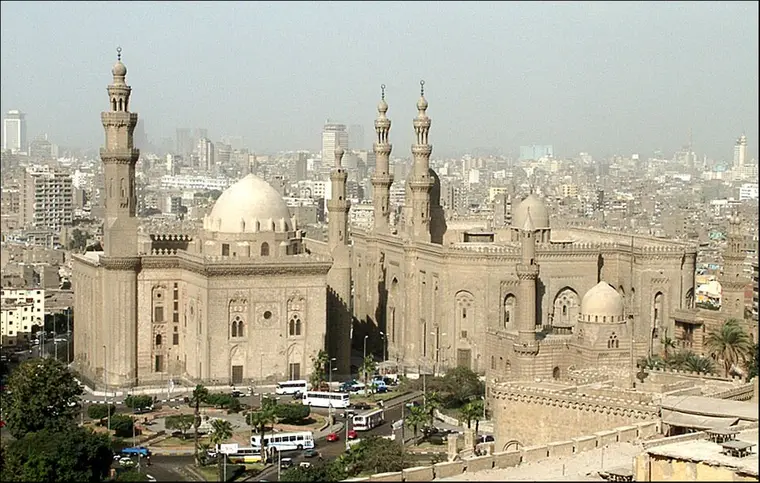
Sources for this chapter (201)Academic46Institution3Specialist book101Reputable web51
Academic(46)
- Shousha · Cholera Epidemic in Egypt (1947) · Bulletin of the World Health Organization · 1948
- Labour and Politics in Egypt, 1919–1939 · International Journal of Middle East Studies · 1979
- Hamed · The Egyptian Labour Movement Between the World Wars · Journal of Asian and African Studies (Tokyo) · 1990
- Karakoç · Industrial growth in interwar Egypt: first estimates, new insights · European Review of Economic History · 2018
- Thornhill · Informal Empire, Independent Egypt and the Accession of King Farouk · The Journal of Imperial and Commonwealth History · 2010
- Monaco Makes Farouk Citizen · Deseret News · 1959
- Halawi · A monarch rehabilitated · Al Ahram Weekly · 2007
- The Myth of the Savior: Egypt's "Just Tyrants" on the Eve of Revolution, January–July 1952 · The Journal of the American Research Center in Egypt · 1989
- Egypt's 1948 Invasion of Palestine · Middle Eastern Studies · 1986
- Farouk in British Policy · Middle Eastern Studies · 1984
- Indicative Cases of Britain's Wartime Policy in Egypt, 1942–44 · Middle Eastern Studies · 1994
- 4 February 1942: Its Causes and Its Influence on Egyptian Politics and on the Future of Anglo-Egyptian Relations, 1937–1945 · International Journal of Middle East Studies · 1979
- Britain, the United States and the Rise of an Egyptian Leader: The Politics and Diplomacy of Nasser's Consolidation of Power, 1952–4 · The English Historical Review · 2004
- Informal Empire, Independent Egypt and the Accession of King Farouk · Journal of Imperial and Commonwealth History · 2010
- Kitchen · Violence in Defence of Empire: The British Army and the 1919 Egyptian Revolution · Journal of Modern European History / Zeitschrift für moderne europäische Geschichte / Revue d'histoire européenne contemporaine · 2015
- Gordon · The False Hopes of 1950: The Wafd's Last Hurrah and the Demise of Egypt's Old Order · International Journal of Middle East Studies · 1989
- Jankowski · The Egyptian Blue Shirts and the Egyptian Wafd, 1935–1938 · Middle Eastern Studies · 1970
- Morsy · American Support for the 1952 Egyptian Coup: Why? · Middle Eastern Studies · 1995
- Following the Free Officers: Explaining the Politics of Coup Contagion and Containment · International Studies Review · 2025
- Lahav · The Suez Crisis of 1956 and its Aftermath: A Comparative Study of Constitutions, Use of Force, Diplomacy and International Relations · Boston University Law Review · 2015
- Shouman · Ali Pasha Mubarak's Philosophy of Education and its Relationship to the Emergence of a Modern Bureaucracy in Egypt · Archived Theses and Dissertations · 1999
- Tignor · The Economic Activities of Foreigners in Egypt, 1920–1950: From Millet to Haute Bourgeoisie · Comparative Studies in Society and History · 1980
- Hoyle · The Mixed Courts of Egypt 1875–1885 · Arab Law Quarterly · 1986
- Ghazi · Egypt's 1923 Constitution: A Constitution of National Unity · Tabayyun · 2013
- Convention Regarding Abolition of Capitulations in Egypt · The American Journal of International Law · 1940
- P. · The Abolition of the Capitulatory Régime in Egypt · Bulletin of International News · 1937
- Warburg · Lampson's Ultimatum to Faruq, 4 February, 1942 · Middle Eastern Studies · 1975
- Slonim · Origins of the 1950 Tripartite Declaration on the Middle East · Middle Eastern Studies · 1987
- Ginat · Egypt's Efforts to Unite the Nile Valley: Diplomacy and Propaganda, 1945–47 · Middle Eastern Studies · 2007
- Eppel · The Arab States and the 1948 War in Palestine: The Socio-Political Struggles, the Compelling Nationalist Discourse and the Regional Context of Involvement · Middle Eastern Studies · 2012
- Mason · 'The decisive volley': The battle of Ismailia and the decline of British influence in Egypt, January–July, 1952 · The Journal of Imperial and Commonwealth History · 1993
- Purging to Transform the Post-Colonial State: Evidence From the 1952 Egyptian Revolution · Comparative Political Studies · 2024
- Ide · From Kafr al-Dawwar to Kharga's 'Desert Hell Camp': the repression of Communist workers in Egypt, 1952–1965 · International Journal on Strikes and Social Conflicts · 2015
- Gordon · The Myth of the Savior: Egypt's "Just Tyrants" on the Eve of Revolution, January-July 1952 · Journal of the American Research Center in Egypt · 1989
- Botman · Egyptian Communists and the Free Officers: 1950-54 · Middle Eastern Studies · 1986
- Bentwich · The Constitution of Egypt · Journal of Comparative Legislation and International Law · 1924
- Independence and constitutionalism in Egypt 1919–1922 · International Journal of Asian Studies · 2022
- The 1923 Egyptian Constitution – vision and ambivalence in the future of education in Egypt · History of Education · 2019
- Donald M. Reid · Turn-of-the-Century Egyptian School Days · Comparative Education Review · 1983
- Reid · Political Assassination in Egypt, 1910-1954 · The International Journal of African Historical Studies · 1982
- Morewood · Appeasement from strength: The making of the 1936 Anglo-Egyptian treaty of friendship and alliance · Diplomacy & Statecraft · 1996
- Morsy · The Military Clauses of the Anglo–Egyptian Treaty of Friendship and Alliance, 1936 · International Journal of Middle East Studies · 1984
- Robert L. Tignor · The Egyptian Revolution of 1919: New Directions in the Egyptian Economy · Middle Eastern Studies · 1976
- Hassan · Burning down the house · Al-Ahram Weekly · 2002
- Special: Cairo Fire · Al-Ahram Weekly · 2002
- Photo Album · Al-Ahram · 2010
Institution(3)
Specialist book(101)
- Bonné · The Economic Development of the Middle East: An Outline of Planned Reconstruction after the War · Routledge · 2003
- Egypt & Nasser: 1952–56 · Facts on File · 1973
- Al-Sayyid-Marsot · Egypt's Liberal Experiment: 1922–1936 · University of California Press · 1977
- Abu Sarah · Revolutionary Emotions in Cold War Egypt: Islam, Communism, and Anti-Colonial Protest · Bloomsbury Academic · 2024
- Egypt from Independence to Revolution, 1919-1952 · Syracuse University Press · 1991
- Deeb · Party Politics in Egypt: the Wafd & Its Rivals 1919–1939 · Ithaca Press · 1979
- Goldberg · Tinker, Tailor, and Textile Worker: Class and Politics in Egypt, 1930-1952 · University of California Press · 1986
- Re-envisioning Egypt 1919-1952 · American University in Cairo Press · 2005
- State, Private Enterprise and Economic Change in Egypt, 1918-1952 · Princeton University Press · 2017
- Monarchy and Modernity in Egypt: Politics, Islam and Neo-colonialism Between the Wars · I.B. Tauris · 2013
- Rosten · The Last Cheetah of Egypt: A Narrative History of Egyptian Royalty from 1805 to 1953 · iUniverse · 2015
- Morgan · History of the Coptic Orthodox People and the Church of Egypt · FriesnPress · 2016
- Hassan · In the House of Muhammad Ali: A Family Album, 1805–1952 · American University in Cairo Press · 2000
- عباس · جامعة القاهرة ماضيها وحاضرها · Hindawi Foundation · 2025
- المفتطف · د.ن.، · 1951
- المحيط الثقافى · المجلس الاعلى للثقافة، · 2005
- محمد · كيف سقطت الملكية في مصر: فاروق بداية و نهاية · دار الخيال، · 1999
- ماهر · متون البوابات · دار كنوز للنشر والتوزيع · 2020
- عبدالجواد · العثماني الأخير · Ibiidi Publishing · 2021
- عصام · عبد الرحمن عزام: الإسلام-- العروبة-- الوطنية · مطبعة دار الكتب والوثائق القومية بالقاهرة، · 2011
- Abdalla · The Student Movement and National Politics in Egypt, 1923–1973 · American University in Cairo Press · 2008
- Intellectuals in the Modern Islamic World: Transmission, Transformation, Communication · Taylor & Francis · 2006
- Kees Versteegh · Encyclopedia of Arabic Language and Linguistics: A-Ed · Brill · 2005
- Whidden · Monarchy and Modernity in Egypt: Politics, Islam and Neo-Colonialism Between the Wars · Bloomsbury Publishing · 2013
- Shah · Fuad King of Egypt · Herbert Jenkins Limited · 1936
- Jessup · An Encyclopedic Dictionary of Conflict and Conflict Resolution, 1945–1996 · Greenwood Publishing Group · 1998
- Goldschmidt · Biographical Dictionary of Modern Egypt · Lynne Rienner · 2000
- Burke's Royal Families of the World · Burke's Peerage · 1980
- Collier's Encyclopedia with Bibliography and Index · Macmillan Educational Co · 1983
- Smith · Islam and the Search for Social Order in Modern Egypt: A Biography of Muhammad Husayn Haykal · State University of New York Press · 1983
- Goldschmidt · A Brief History of Egypt · Facts On File · 2008
- Vatikiotis · The History of Modern Egypt: From Muhammad Ali to Mubarak · Johns Hopkins University Press · 1992
- Skelton · Tears Before Bedtime · Weidenfeld & Nicolson · 1987
- Stenberg · Kärlek i Europa · Norstedts · 1981
- Sotheby & Co. · The Palace Collections of Egypt: Catalogue of the Important and Valuable Collection of Coins and Medals · Sotheby & Co. · 1954
- Whitbourn · Nothing Is True...: The First Book of Farouk · 2018
- Decisions at Yalta an appraisal ical of summit diplomacy · Scholarly Resources · 1986
- The Shah · St. Martin's Publishing Group · 2011
- Too Rich: The High Life and Tragic Death of King Farouk · Carroll & Graf Pub · 1991
- Nasser and his generation · Croom Helm · 1978
- A World at Arms: A Global History of World War II · Cambridge University Press · 2004
- Faces in a Mirror · Prentice-Hall, Inc. · 1980
- The Last Pharaoh: Farouk of Egypt · McCall Pub. Co. · 1970
- The British Defence of Egypt, 1935–40: Conflict and Crisis in the Eastern Mediterranean · Routledge · 2008
- FDR and the End of Empire: The Origins of American Power in the Middle East · Palgrave Macmillan · 2012
- A King Betrayed: The Ill-Fated Reign of Farouk of Egypt · Quartet Books · 1989
- A Woman of Egypt · Simon and Schuster · 1987
- Booth · Encyclopedia of the Modern Middle East and North Africa 2nd Edition (vol. 2) · Gale · 2004
- A History of the Modern Middle East · 2016
- Terry · The Wafd: Cornerstone of Egyptian Political Power · Publisher: Third World Centre for Research and Publishing · 1982
- Quraishi · Liberal Nationalism in Egypt; Rise and Fall of the Wafd Party · Jamal Printing Press · 1967
- Wilford · America's Great Game: The CIA's Secret Arabists and the Making of the Modern Middle East · Basic Books · 2013
- Historical Dictionary of Modern Coups D'état · Rowman & Littlefield · 2022
- Rezk · The Arab world and Western intelligence: analysing the Middle East, 1956–1981 · Edinburgh University Press · 2017
- Arab Socialism. [al-Ishtirakīyah Al-ʻArabīyah]: A Documentary Survey · University of Utah Press · 1969
- Stenner · Globalizing Morocco · Stanford University Press · 2019
- Hunter · Egypt under the Khedives, 1805 – 1879: from household government to modern bureaucracy · American University in Cairo Press · 1999
- Ryzova · The Age of the Efendiyya · Oxford University Press · 2014
- The long 1890s in Egypt: colonial quiescence, subterranean resistance · Edinburgh University Press · 2014
- Mitchell · Colonising Egypt · Univ. of California Press · 2003
- Schölch · Egypt for the Egyptians! the socio-political crisis in Egypt, 1878–1882 · Published for the Middle East Centre, St. Antony's College, Oxford [by] Ithaca Press · 1981
- Independence Documents of the World · Oceana Publications · 1977
- Goldberg · Tinker, tailor, and textile worker: class and politics in Egypt, 1930–1952 · University of California Press · 1986
- The Dispersion of Egyptian Jewry: Culture, Politics, and the Formation of a Modern Diaspora · American Univ in Cairo Press · 2005
- McNamara · Britain, Nasser And The Balance Of Power In The Middle East, 1952–1977 · Taylor & Francis Group · 2004
- Perlmann · The Near East and the Great Powers · Harvard University Press · 1951
- Cook · The struggle for Egypt: from Nasser to Tahrir Square · Oxford university press · 2012
- Watry · Diplomacy at the Brink: Eisenhower, Churchill, and Eden in the Cold War · Louisiana State University Press · 2014
- Gordon · Nasser: Hero of the Arab Nation · Oneworld Publications · 2006
- Aburish · Nasser: The Last Arab · St. Martin's Press · 2004
- Mitchell · The Society of the Muslim Brothers · Oxford University Press · 1993
- Gordon · Nasser's Blessed Movement: Egypt's Free Officers and the July Revolution · Oxford University Press · 1992
- Botman · Egypt from independence to revolution, 1919–1952 · Syracuse University Press · 1991
- Botman · The Rise of Egyptian Communism, 1939-1970 · Syracuse University Press · 1988
- Workers on the Nile: Nationalism, Communism, Islam, and the Egyptian Working Class, 1882-1954 · Princeton University Press · 1987
- Terry · The Wafd, 1919-1952: Cornerstone of Egyptian political power · Third World Centre for Research and Pub · 1982
- Abdalla · The Student Movement and national politics in Egypt: 1923-1973 · Al Saqi Books · 1985
- Copeland · The Game of Nations: The Amorality of Power Politics · Simon and Schuster · 1970
- Muḥyī al-Dīn · Memories of a Revolution: Egypt, 1952 · American University in Cairo Press · 1995
- Sadat · Revolt on the Nile · A. Wingate · 1957
- Sadat · In Search of Identity: An Autobiography · Harper & Row · 1978
- Nasser · The Philosophy of the Revolution · 1955
- Naguib · Egypt's Destiny: A Personal Statement · Doubleday · 1955
- Ganshof van der Meersch · Pouvoir de fait et règle de droit dans le fonctionnement des institutions politiques · Editions de la librairie encyclopédique · 1957
- Britain in Egypt: Egyptian Nationalism and Imperial Strategy, 1919-1931 · I.B. Tauris · 2019
- Development of Parliamentarism in the Modern Islamic World · Toyo Bunko · 2009
- Kedourie · Political and Social Change in Egypt in Modern Egypt · Oxford University Press · 1968
- British Pro-Consuls in Egypt, 1914-1929: The Challenge of Nationalism · Routledge · 2004
- Maghraoui · Liberalism without Democracy: Nationhood and Citizenship in Egypt, 1922–1936 · Duke University Press · 2006
- Khalil · The Arab States and the Arab League: A Documentary Record · Khayats · 1962
- Al-Hadidy · Contemporary Egypt: Through Egyptian Eyes · Routledge · 1993
- Historical Dictionary of Egypt · Rowman & Littlefield · 2023
- Long · British Pro-Consuls in Egypt, 1914-1929 : The Challenge of Nationalism · RoutledgeCurzon · 2005
- Lerman · Political Thought and Political History Studies in Memory of Elie Kedourie · Routledge · 2002
- Stadiem · Too Rich: The High Life and Tragic Death of King Farouk · Carroll & Graf Pub · 1991
- A Chronology of Conflict and Resolution, 1945–1985 · Greenwood Press · 1989
- Ibrahim · The 1936 Anglo-Egyptian Treaty: An Historical Study with Special Reference to the Contemporary Situation in Egypt and the Sudan · Khartoum University Press · 1976
- Morewood · The British Defence of Egypt 1935–1940: Conflict and crisis in the Eastern Mediterranean · Frank Cass · 2005
- Goldschmidt · Historical Dictionary of Egypt · Scarecrow Press · 2013
- Kerbœuf · Re-Envisioning Egypt 1919–1952 · American University in Cairo Press · 2005
- King · Historical Dictionary of Egypt · American University in Cairo Press · 1989
Reputable web(51)
- Sudan (Self-Government Statute) · Hansard
- The Presidents of the Society · Egyptian Geographic Society
- Egypt: New King, Old Trouble · 1936
- ENTIDADES ESTRANGEIRAS AGRACIADAS COM ORDENS PORTUGUESAS - Página Oficial das Ordens Honoríficas Portuguesas
- Hemeroteca Digital. Biblioteca Nacional de España
- Suomen Valkoisen Ruusun ritarikunnan suurristin ketjuineen saajat · 2020
- Farouk I
- Fawziyyah
- Baraka · Al-Ahram Weekly - Entertainment - Lawsuits, love and heartbreak
- Peeters · Egypt's Forgotten Lysanders
- The EAF 's Diamond Anniversary · 2007
- Schiller · Farouk and Narriman: Egypt's Last Royal Romance · Photo-Orientalist
- الملك يلتقي رئيس وزرائه
- Fuad II
- 1947 Bentley Mark VI by Figoni et Falaschi
- Lester · Numismatic "Gumshoe:" On the Trail of King Farouk · Gold Rush Gallery
- 1913 Liberty Head Five Cents · CoinFacts
- 1835 $5, DCAM (Proof) Classic Head $5 · PCGS CoinFacts
- Prime Provenance: The King Farouk Bedroom Suite
- The 1933 Double Eagle
- The Abdication of King Farouk
- Queen Nazli, King Farouk, Sultana Malk
- King Farouk wearing orders of France, Monaco and Spain
- Farouk and Princess Ferial of Egypt
- Biography for King Farouk · IMDb
- New King, Old Trouble · 1936
- The Press: Egyptian Uproar · 1954
- Egypt – Revolution, Republic, Nile | Britannica
- Egypt's 23 Revolution – and beyond: challenges and gains · 2020
- Egypt's Revolution and the Lessons for Today – AIIA
- Omar Ashour · Egypt's Revolution: Two Lessons from History · 2011
- Egyptian Revolution of 1952 · 2017
- Mansour · Egypt's 1952 revolution: Seven decades of military rule · 2022
- Babar · Egypt celebrates 70th anniversary of Revolution Day · 2022
- Egypt – Muhammad Ali, 1805–48
- Egypt – Social Change in the Nineteenth Century
- ʿAlī Pasha Mubārak | Egyptian statesman, reformer & educator | Britannica
- Viceroy | Monarchy, Colonialism & Representation | Britannica
- Archives · The National Archives – 100 years ago: 'Egypt is declared to be an independent sovereign State' · 2022
- The Egyptian Jewels of King Farouk; Farouking Fabulous
- Anti-jewish Riots in Egypt; Synagogues Burned in Cairo; Six Killed in Alexandria · 2015
- Morgan · Sunday Times Reporter Interview with President "Gamal Abdel Nasser"
- MilitaryHistoryOnline.com – Egypt's Canal Zone Guerrillas: The 'Liberation Battalions' and Auxiliary Police, 1951–1954
- Countries E
- Muṣṭafā al-Naḥḥās Pasha | Prime Minister of Egypt & Nationalist Leader | Britannica · 2025
- Full Text of the Treaty · Foreign and Commonwealth Office
- Banque Misr history · Banquemisr.com.eg
- Kom-Ombo Banknote · Collectornetwork.com
- Economy of Egypt & capitalists · Escholarship.org
- Manuscript center · Manuscript center · 2002
- Mustafa · Misr cinema history · Weekly.ahram.org.eg
Every ancient date is an estimate. Scholarly chronologies differ by decades, and by more the further back you go, which is why each figure carries a tilde. When a period is published we name the chronology its dates come from.
In this period
In this period
159 minutes in total- 01Introduction3 min read
- 02History8 min read
- 03Demographics1 min read
- 04Fuad I of Egypt4 min read
- 05Farouk of Egypt76 min read
- 06Wafd Party8 min read
- 07Mostafa El-Nahas11 min read
- 08Talaat Harb2 min read
- 091952 Egyptian revolution30 min read
- 10Egyptian Constitution of 19235 min read
- 11Anglo-Egyptian treaty of 19364 min read
- 12Cairo fire7 min read